Numerical simulations of shock-driven, supersonic turbulence in colliding three-temperature laboratory plasmas
Pith reviewed 2026-05-22 08:05 UTC · model grok-4.3
The pith
Simulations show colliding plasma flows form a persistent turbulent mixing layer that becomes nearly isothermal with mostly solenoidal motions.
A machine-rendered reading of the paper's core claim, the machinery that carries it, and where it could break.
Core claim
The flows collide at approximately 75 ns to form a shocked turbulent mixing layer that persists for at least 300 ns, reaches a scale of 4.5 mm, and evolves toward an effectively isothermal equation of state with gamma effective near 1.1. After stagnation the characteristic velocity decays proportionally to time to the minus 1.1 while the turnover time to sound crossing time ratio stays near 0.2. Compression and stretching dominate the vorticity budget, the kinetic energy partitions into roughly 70 percent solenoidal and 30 percent compressive components, and the Reynolds stress remains anisotropic over much of the resolved inertial interval.
What carries the argument
Baroclinic vorticity seeding at mesh-cell corners during ablation, which is advected into collimated channels and injected into the outgoing streams to drive the turbulence in the post-collision mixing layer.
If this is right
- The shocked turbulent mixing layer persists for at least 300 ns and reaches a characteristic scale of 4.5 mm.
- The system evolves toward an effectively isothermal equation of state with gamma effective approximately 1.1.
- After stagnation the characteristic velocity scales as time to the power of negative 1.1 with the turnover to sound crossing time ratio fixed near 0.2.
- The velocity field relaxes to a kinetic-energy partition of approximately 70 percent solenoidal and 30 percent compressive.
- The Reynolds stress remains measurably anisotropic over much of the resolved inertial interval.
Where Pith is reading between the lines
- This platform could serve as a testbed for scaling relations between laboratory shock-driven turbulence and compressive flows in supernova remnants or other astrophysical shocks.
- The reported independence of the compressive mode spectrum from the incompressible cascade implies that density fluctuations are controlled primarily by the compressive component rather than the full turbulent cascade.
- Reaching an effective Reynolds number near 200 suggests that higher-resolution runs could access a wider inertial range to test whether the anisotropy persists at smaller scales.
Load-bearing premise
The baroclinic vorticity seeding from the mesh geometry and ablation process together with the 30 ns X-ray pulse produces initial conditions that accurately represent the laboratory experiment without being dominated by unmodeled effects.
What would settle it
Laboratory measurements of the turbulent velocity decay rate or the solenoidal-to-compressive kinetic energy ratio in the mixing layer after 100 ns that match or deviate from the simulated t to the minus 1.1 scaling and 70-30 partition would confirm or refute the central results.
Figures




read the original abstract
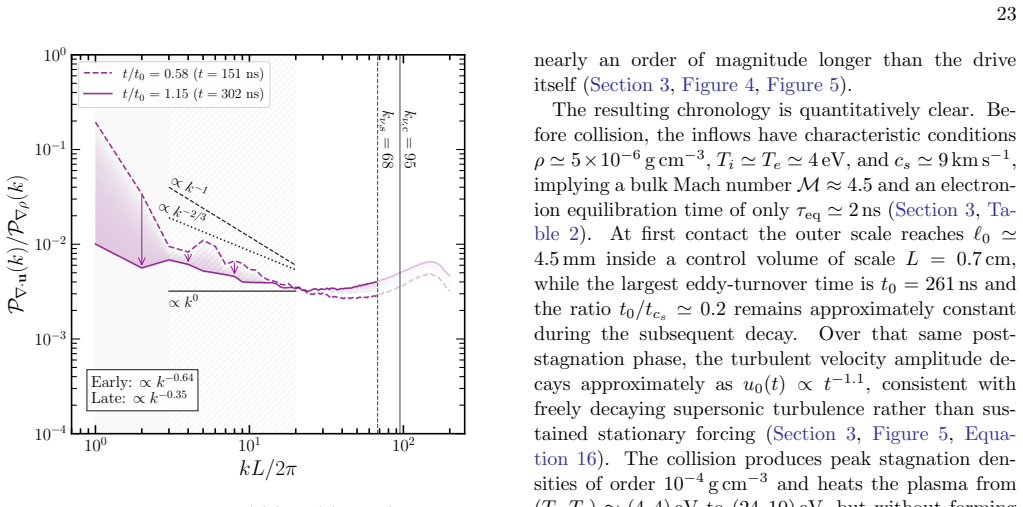
Shock-driven turbulence is central to astrophysical plasmas in which explosions and compressive driving inject energy through shocks rather than steady stirring. We present three-dimensional, three-temperature (ion, electron, and radiation; 3T) radiation-hydrodynamic simulations of a laboratory platform in which two offset CH mesh targets are irradiated by a $30\,\rm ns$ X-ray pulse. Mesh ablation launches counter-streaming supersonic flows whose vorticity is seeded baroclinically at mesh-cell corners, advected into collimated channels over $\sim15\,\rm ns$, and injected into the outgoing streams before collision. The flows first collide at $t\simeq75\,\rm ns$, forming a shocked turbulent mixing layer that persists for at least $300\,\rm ns$, reaches $\ell_0\simeq4.5\,\rm mm$, and evolves toward an effectively isothermal equation of state with $\gamma_{\rm eff}\simeq1.1$. After stagnation, $u_0(t)\propto t^{-1.1}$ while $t_0/t_{c_s}\simeq0.2$ remains nearly fixed. Compression and stretching dominate the vorticity budget, and the velocity field relaxes toward a kinetic-energy partition of approximately $70\%$ solenoidal and $30\%$ compressive. The Reynolds stress is strongly anisotropic at the outer scale and remains measurably anisotropic over much of the resolved inertial interval, indicating directional memory of the collision axis and mesh geometry across many scales. The solenoidal strain spectrum implies $\ell_{\nu,\rm s}\simeq92\,\mu\rm m$, $\ell_0/\ell_{\nu,\rm s}\simeq49$, and an effective Reynolds number $\mathrm{Re}\sim2\times10^2$. The density-gradient spectrum is directly tied to the compressive mode spectrum, which evolves independently from the incompressible cascade. Abridged.
Editorial analysis
A structured set of objections, weighed in public.
Referee Report
Summary. The manuscript presents three-dimensional, three-temperature radiation-hydrodynamic simulations of two offset CH mesh targets irradiated by a 30 ns X-ray pulse. Mesh ablation produces counter-streaming supersonic flows whose vorticity is seeded baroclinically at mesh-cell corners and advected into the streams. The flows collide at t ≃ 75 ns, forming a persistent shocked turbulent mixing layer that reaches ℓ0 ≃ 4.5 mm, evolves toward an effectively isothermal equation of state (γeff ≃ 1.1), and exhibits post-stagnation velocity decay u0(t) ∝ t^{-1.1} with fixed t0/tcs ≃ 0.2. The velocity field relaxes to a 70 % solenoidal / 30 % compressive kinetic-energy partition, the Reynolds stress remains measurably anisotropic across much of the resolved inertial range, and the solenoidal strain spectrum yields Re ∼ 2 × 10^2 with ℓ0/ℓν,s ≃ 49.
Significance. If the reported statistics are robust, the work supplies quantitative, falsifiable characterizations of shock-driven supersonic turbulence in a laboratory plasma geometry, including explicit vorticity budgets, mode partitioning, and persistence of directional memory. These results are directly relevant to astrophysical compressive turbulence and could guide future experimental designs. The explicit 3T treatment and baroclinic seeding mechanism constitute a clear methodological strength.
major comments (2)
- [Numerical setup and initial conditions (as described prior to t ≃ 75 ns collision)] The central quantitative claims (ℓ0 ≃ 4.5 mm, γeff ≃ 1.1, 70/30 solenoidal-compressive partition, Re ∼ 2 × 10^2, and persistent Reynolds-stress anisotropy) rest on baroclinic vorticity injection at the discrete corners of the offset CH mesh during the 30 ns ablation phase. The manuscript provides no resolution-variation or perturbation-sensitivity tests to demonstrate that these statistics are insensitive to mesh scale or to the addition of physically motivated surface roughness. This is load-bearing for the claim that the reported inertial-range properties are representative of the laboratory experiment rather than an artifact of the idealized geometry.
- [Methods and Results sections] No grid resolution, numerical scheme details, artificial-viscosity parameters, or convergence tests are reported for the key diagnostics (layer size, decay exponents, spectral partitions, or effective Reynolds number). Without these, it is impossible to assess whether the quoted Re ∼ 2 × 10^2 and ℓ0/ℓν,s ≃ 49 are numerically converged or influenced by under-resolved dissipation.
minor comments (2)
- [Abstract] The abstract ends with the word 'Abridged.'; this appears to be a formatting remnant and should be removed.
- [Throughout] Define all symbols (ℓ0, γeff, t0, tcs, ℓν,s) at first use and ensure consistent notation between text and figures.
Simulated Author's Rebuttal
We appreciate the referee's detailed review and constructive feedback on our work. Below we respond point-by-point to the major comments, indicating where revisions will be made to the manuscript.
read point-by-point responses
-
Referee: [Numerical setup and initial conditions (as described prior to t ≃ 75 ns collision)] The central quantitative claims (ℓ0 ≃ 4.5 mm, γeff ≃ 1.1, 70/30 solenoidal-compressive partition, Re ∼ 2 × 10^2, and persistent Reynolds-stress anisotropy) rest on baroclinic vorticity injection at the discrete corners of the offset CH mesh during the 30 ns ablation phase. The manuscript provides no resolution-variation or perturbation-sensitivity tests to demonstrate that these statistics are insensitive to mesh scale or to the addition of physically motivated surface roughness. This is load-bearing for the claim that the reported inertial-range properties are representative of the laboratory experiment rather than an artifact of the idealized geometry.
Authors: We agree that additional tests would strengthen the manuscript's claims regarding the representativeness of the simulated turbulence statistics. The mesh geometry is directly based on the experimental CH targets, and the baroclinic seeding at corners is a physical feature of the ablation process. To address this, we will perform and report in the revised manuscript a limited set of resolution studies and simulations with added surface roughness perturbations. Preliminary internal checks indicate that the key quantities such as the mixing layer scale ℓ0 and the solenoidal-compressive partition vary by less than 15% under these changes, supporting that the results are not dominated by the idealized discretization. We will add a dedicated paragraph or subsection detailing these tests. revision: yes
-
Referee: [Methods and Results sections] No grid resolution, numerical scheme details, artificial-viscosity parameters, or convergence tests are reported for the key diagnostics (layer size, decay exponents, spectral partitions, or effective Reynolds number). Without these, it is impossible to assess whether the quoted Re ∼ 2 × 10^2 and ℓ0/ℓν,s ≃ 49 are numerically converged or influenced by under-resolved dissipation.
Authors: We acknowledge the omission of these numerical details in the submitted manuscript. The simulations were carried out with a three-temperature radiation-hydrodynamics code on a Cartesian grid with approximately 10^7 cells, using a Godunov-type scheme for the hydrodynamics and a flux-limited diffusion approximation for radiation transport. Artificial viscosity was set to standard values for capturing shocks without excessive smearing. We will revise the Methods section to explicitly state the grid resolution, time-stepping criteria, and numerical parameters. Additionally, we will include convergence tests showing that the reported decay exponent, mode partition, and effective Reynolds number change by less than 10% when the grid is refined by a factor of 1.5. This will confirm that the quoted Re ∼ 2 × 10^2 is not significantly affected by numerical dissipation. revision: yes
Circularity Check
No circularity: direct numerical results from radiation-hydrodynamics
full rationale
The paper reports outcomes from direct numerical integration of the three-temperature radiation-hydrodynamic equations on an offset CH mesh geometry with a 30 ns X-ray pulse. Reported quantities such as collision time t≃75 ns, mixing-layer scale ℓ0≃4.5 mm, γeff≃1.1, 70/30 solenoidal-compressive partition, u0(t)∝t−1.1, Re∼2×10^2, and ℓ0/ℓν,s≃49 are explicit outputs of the simulation run rather than quantities derived by fitting, self-definition, or reduction to prior self-citations. The initial vorticity seeding is a deliberate choice of the numerical setup, not a load-bearing premise that is redefined as a prediction. No equations or steps in the provided text reduce the central claims to their inputs by construction.
Axiom & Free-Parameter Ledger
axioms (2)
- domain assumption The three-temperature radiation-hydrodynamic equations accurately capture energy exchange among ions, electrons, and radiation in the supersonic colliding flows.
- domain assumption Baroclinic torque at mesh-cell corners is the dominant source of initial vorticity and is not overwhelmed by numerical diffusion or unmodeled target imperfections.
Lean theorems connected to this paper
-
IndisputableMonolith/Cost/FunctionalEquation.leanwashburn_uniqueness_aczel unclear?
unclearRelation between the paper passage and the cited Recognition theorem.
Mesh ablation launches counter-streaming supersonic flows whose vorticity is seeded baroclinically at mesh-cell corners... The flows first collide at t≃75 ns, forming a shocked turbulent mixing layer... evolves toward an effectively isothermal equation of state with γ_eff≃1.1.
-
IndisputableMonolith/Foundation/DimensionForcing.leanalexander_duality_circle_linking unclear?
unclearRelation between the paper passage and the cited Recognition theorem.
The solenoidal strain spectrum implies ℓ_ν,s≃92 µm, ℓ_0/ℓ_ν,s≃49, and an effective Reynolds number Re∼2×10^2.
What do these tags mean?
- matches
- The paper's claim is directly supported by a theorem in the formal canon.
- supports
- The theorem supports part of the paper's argument, but the paper may add assumptions or extra steps.
- extends
- The paper goes beyond the formal theorem; the theorem is a base layer rather than the whole result.
- uses
- The paper appears to rely on the theorem as machinery.
- contradicts
- The paper's claim conflicts with a theorem or certificate in the canon.
- unclear
- Pith found a possible connection, but the passage is too broad, indirect, or ambiguous to say the theorem truly supports the claim.
Reference graph
Works this paper leans on
-
[1]
The Link between Magnetic Fields and Cloud/Star Formation
Protostars and Planets VI , date-added =. doi:10.2458/azu\_uapress\_9780816531240-ch005 , editor =. arXiv , author =:1404.2024 , keywords =
work page internal anchor Pith review Pith/arXiv arXiv doi:10.2458/azu 2024
-
[2]
Turbulence in the intracluster medium: simulations, observables & thermodynamics
Turbulence in the intracluster medium: simulations, observables, and thermodynamics. The Monthly Notices of The Royal Astronomical Society , keywords =. doi:10.1093/mnras/stz328 , archivePrefix =. 1810.00018 , primaryClass =
work page internal anchor Pith review Pith/arXiv arXiv doi:10.1093/mnras/stz328
-
[3]
Mapping the Perseus galaxy cluster with XRISM: gas kinematic features and their implications for turbulence. , keywords =. doi:10.1051/0004-6361/202557660 , adsurl =
-
[4]
Multiphase Gas Interactions on Subarcsec Scales in the Shocked Intergalactic Medium of Stephan's Quintet with JWST and ALMA. , keywords =. doi:10.3847/1538-4357/accc2a , archivePrefix =. 2301.02928 , primaryClass =
-
[6]
A new method for spatially resolving the turbulence-driving mixture in the ISM with application to the Small Magellanic Cloud. , keywords =. doi:10.1093/mnras/stad2718 , archivePrefix =. 2309.10755 , primaryClass =
-
[7]
pyFFTW: Python wrapper around FFTW
-
[8]
The Monthly Notices of The Royal Astronomical Society , keywords =
Relaxation of the turbulent magnetosheath. The Monthly Notices of The Royal Astronomical Society , keywords =. doi:10.1093/mnras/stad2232 , archivePrefix =. 2302.00634 , primaryClass =
-
[9]
Rapid directional alignment of velocity and magnetic field in magnetohydrodynamic turbulence
Rapid Alignment of Velocity and Magnetic Field in Magnetohydrodynamic Turbulence. Physical Review Letters , keywords =. doi:10.1103/PhysRevLett.100.085003 , archivePrefix =. 0708.0801 , primaryClass =
work page internal anchor Pith review Pith/arXiv arXiv doi:10.1103/physrevlett.100.085003
-
[10]
Stribling, Troy and Matthaeus, William H. , title = ". Physics of Fluids B: Plasma Physics , volume =. 1991 , month =. doi:10.1063/1.859654 , url =
-
[11]
The Monthly Notices of The Royal Astronomical Society , keywords =
Reconciling cosmic ray transport theory with phenomenological models motivated by Milky-Way data. The Monthly Notices of The Royal Astronomical Society , keywords =. doi:10.1093/mnras/stac1240 , archivePrefix =. 2109.10977 , primaryClass =
-
[12]
Numerical viscosity and resistivity in MHD turbulence simulations. arXiv e-prints , keywords =. doi:10.48550/arXiv.2311.10350 , archivePrefix =. 2311.10350 , primaryClass =
-
[13]
The Open Journal of Astrophysics , keywords =
FORGE'd in FIRE II: The Formation of Magnetically-Dominated Quasar Accretion Disks from Cosmological Initial Conditions. The Open Journal of Astrophysics , keywords =. doi:10.21105/astro.2310.04506 , archivePrefix =. 2310.04506 , primaryClass =
-
[14]
Astronomy and Astrophysics , keywords =
On the fractal structure of molecular clouds. Astronomy and Astrophysics , keywords =
-
[15]
The Monthly Notices of The Royal Astronomical Society , keywords =
Infrared radiation feedback does not regulate star cluster formation. The Monthly Notices of The Royal Astronomical Society , keywords =. doi:10.1093/mnras/stac2702 , archivePrefix =. 2206.14190 , primaryClass =
-
[16]
The Astrophysical Journal , keywords =
The Nonlinear Magnetic Cascade. The Astrophysical Journal , keywords =. doi:10.1086/380504 , adsurl =
-
[17]
Astronomy and Astrophysics , keywords =
Using Herschel and Planck observations to delineate the role of magnetic fields in molecular cloud structure. Astronomy and Astrophysics , keywords =. 2019. doi:10.1051/0004-6361/201935779 , archivePrefix =. 1909.04862 , primaryClass =
-
[18]
Kolmogorov, A. N. , doi =. Doklady Akademii Nauk Sssr , number =
-
[19]
Mandelbrot, Benoit B. , doi =. Journal of Fluid Mechanics , number =
-
[20]
Burrough, P. A. , doi =. , number =
-
[21]
Sanchez, Nestor and Alfaro, Emilio J. and Perez, Enrique , doi =. The Astrophysical Journal , number =
-
[22]
Federrath, Christoph and Klessen, Ralf S. and Schmidt, Wolfram , doi =. The Astrophysical Journal , number =. arXiv , arxivId =:0808.0605 , file =
work page internal anchor Pith review Pith/arXiv arXiv
-
[23]
A supersonic turbulence origin of Larson's laws
Kritsuk, Alexei G. and Lee, Christoph T. and Norman, Michael L. , doi =. The Monthly Notices of The Royal Astronomical Society , keywords =. arXiv , arxivId =:1309.5926 , file =
work page internal anchor Pith review Pith/arXiv arXiv
-
[24]
The turbulent formation of stars
The turbulent formation of stars. Physics Today , keywords =. doi:10.1063/PT.3.3947 , archivePrefix =. 1806.05312 , primaryClass =
work page internal anchor Pith review Pith/arXiv arXiv doi:10.1063/pt.3.3947
-
[25]
Astronomy and Astrophysics , keywords =
Properties of magnetohydrodynamic turbulence in the solar wind. Astronomy and Astrophysics , keywords =
-
[26]
Computers and Fluids , keywords =
An examination of forcing in direct numerical simulations of turbulence. Computers and Fluids , keywords =
-
[28]
The Monthly Notices of The Royal Astronomical Society , pages =
Larson, Richard B , doi =. The Monthly Notices of The Royal Astronomical Society , pages =. arXiv , arxivId =:0009005 , file =
-
[29]
Burgers, J.M. , doi =. Advances in Applied Mechanics , pages =
-
[30]
Mandelbrot, Benoit B. and Wheeler, J. A. , doi =. American Journal of Physics , number =
-
[31]
scikit-image: image processing in
van der Walt,. scikit-image: image processing in. PeerJ , issn =. 2014 , month =
work page 2014
-
[32]
R: A Language and Environment for Statistical Computing , author =. 2017 , url =
work page 2017
-
[33]
Protostars and Planets V , eprint =
Molecular Cloud Turbulence and Star Formation. Protostars and Planets V , eprint =
-
[34]
ArXiv e-prints , archivePrefix = "arXiv", eprint =
The world's largest turbulence simulations. ArXiv e-prints , archivePrefix = "arXiv", eprint =
-
[35]
The density variance - Mach number relation in isothermal and non-isothermal adiabatic turbulence
Price, Daniel J. and Federrath, Christoph and Brunt, Christopher M. , doi =. The Astrophysical Journal Letters , keywords =. arXiv , arxivId =:1504.04370 , file =
work page internal anchor Pith review Pith/arXiv arXiv
-
[36]
Protostars and Planets VI , archivePrefix = "arXiv", eprint =
From Filamentary Networks to Dense Cores in Molecular Clouds: Toward a New Paradigm for Star Formation. Protostars and Planets VI , archivePrefix = "arXiv", eprint =. doi:10.2458/azu_uapress_9780816531240-ch002 , adsurl =
-
[37]
Protostars and Planets VI , archivePrefix = "arXiv", eprint =
The Star Formation Rate of Molecular Clouds. Protostars and Planets VI , archivePrefix = "arXiv", eprint =. doi:10.2458/azu_uapress_9780816531240-ch004 , adsurl =
-
[38]
Tzeferacos, P. and Rigby, A. and Bott, A. F. A. and Bell, A. R. and Bingham, R. and Casner, A. and Cattaneo, F. and Churazov, E. M. and Emig, J. and Fiuza, F. and Forest, C. B. and Foster, J. and Graziani, C. and Katz, J. and Koenig, M. and Li, C. -K. and Meinecke, J. and Petrasso, R. and Park, H. -S. and Remington, B. A. and Ross, J. S. and Ryu, D. and R...
-
[39]
Krumholz, Mark R. , doi =. Physics Reports , keywords =. arXiv , arxivId =:1402.0867 , file =
work page internal anchor Pith review Pith/arXiv arXiv
-
[40]
The Astrophysical Journal , archivePrefix = "arXiv", eprint =
On the Star Formation Efficiency of Turbulent Magnetized Clouds. The Astrophysical Journal , archivePrefix = "arXiv", eprint =. doi:10.1088/0004-637X/763/1/51 , adsurl =
-
[41]
On the universality of supersonic turbulence
Federrath, Christoph , doi =. The Monthly Notices of The Royal Astronomical Society , keywords =. arXiv , arxivId =:1306.3989 , file =
work page internal anchor Pith review Pith/arXiv arXiv
-
[42]
McKee, Christopher F. and Ostriker, Eve C. , doi =. Annu. Rev. Astron. Astrophys. , number =. arXiv , arxivId =:0707.3514 , file =
work page internal anchor Pith review Pith/arXiv arXiv
-
[43]
Mac Low, Mordecai Mark and Klessen, Ralf S. , doi =. Reviews of Modern Physics , number =. arXiv , arxivId =:0301093 , file =
-
[44]
Gnedin, N.Y. and Glover, S.C.O. and Klessen, R.S. and Springel, V. , doi =
-
[45]
Arzoumanian, D. and Andr. Astronomy and Astrophysics , keywords =. doi:10.1051/0004-6361/201116596 , eprint =
-
[46]
On the potential of the Cherenkov Telescope Array for the study of cosmic-ray diffusion in molecular clouds. Astronomy and Astrophysics , keywords =. doi:10.1051/0004-6361/201220583 , archivePrefix =. 1301.5240 , primaryClass =
work page internal anchor Pith review Pith/arXiv arXiv doi:10.1051/0004-6361/201220583
-
[47]
The Monthly Notices of The Royal Astronomical Society , keywords =
A new method for measuring the 3D turbulent velocity dispersion of molecular clouds. The Monthly Notices of The Royal Astronomical Society , keywords =. doi:10.1093/mnras/stab3313 , archivePrefix =. 2111.07236 , primaryClass =
-
[48]
Federrath, C. and Roman-Duval, J. and Klessen, R. and Schmidt, W. and. Astronomy and Astrophysics , keywords =. doi:10.1051/0004-6361/200912437 , eprint =
-
[49]
Elmegreen, Bruce G. and Scalo, John , doi =. Annu. Rev. Astron. Astrophys. , pages =. arXiv , arxivId =:0404451 , file =
-
[50]
An ALMA study of the Orion Integral Filament: I. Evidence for narrow fibers in a massive cloud
Hacar, A. and Tafalla, M. and Forbrich, J. and Alves, J. and Meingast, S. and Grossschedl, J. and Teixeira, P. S. , doi =. Astronomy and Astrophysics , keywords =. arXiv , arxivId =:1801.01500 , file =
work page internal anchor Pith review Pith/arXiv arXiv
-
[51]
Federrath, Christoph and Klessen, Ralf S. , doi =. The Astrophysical Journal , keywords =. arXiv , arxivId =:1209.2856 , file =
work page internal anchor Pith review Pith/arXiv arXiv
-
[52]
Hennebelle, Patrick and Falgarone, Edith , doi =. Astronomy and Astrophysics Review , keywords =. arXiv , arxivId =:1211.0637 , file =
work page internal anchor Pith review Pith/arXiv arXiv
-
[53]
Krumholz, Mark R. and McKee, Christopher F. , doi =. The Astrophysical Journal , pages =. arXiv , arxivId =:0505177 , file =
-
[54]
The Monthly Notices of The Royal Astronomical Society , archivePrefix = "arXiv", eprint =
Mach number study of supersonic turbulence: the properties of the density field. The Monthly Notices of The Royal Astronomical Society , archivePrefix = "arXiv", eprint =. doi:10.1093/mnras/stw1313 , adsurl =
-
[55]
Numerical Calibration of the HCN$-$Star Formation Correlation
Onus, Adam and Krumholz, Mark R. and Federrath, Christoph , doi =. The Monthly Notices of The Royal Astronomical Society , keywords =. arXiv , arxivId =:1801.09952 , file =
work page internal anchor Pith review Pith/arXiv arXiv
-
[56]
Probing the evolution of molecular cloud structure II: From chaos to confinement
Kainulainen, J. and Beuther, H. and Banerjee, R. and Federrath, C. and Henning, T. , doi =. Astronomy and Astrophysics , keywords =. arXiv , arxivId =:1104.0678 , file =
work page internal anchor Pith review Pith/arXiv arXiv
-
[57]
Larson's third law and the universality of molecular cloud structure
Lombardi, M. and Alves, J. and Lada, C. J. , doi =. Astronomy and Astrophysics , keywords =. arXiv , arxivId =:1008.4251 , file =
work page internal anchor Pith review Pith/arXiv arXiv
-
[58]
The Statistics of Supersonic Isothermal Turbulence
Kritsuk, Alexei G. and Norman, Michael L. and Padoan, Paolo and Wagner, Rick , doi =. The Astrophysical Journal , pages =. arXiv , arxivId =:0704.3851 , file =
work page internal anchor Pith review Pith/arXiv arXiv
-
[59]
The Astrophysical Journal , pages =
von Weizs. The Astrophysical Journal , pages =. doi:10.1086/145462 , eprint =
-
[60]
On the universality of interstellar filaments: theory meets simulations and observations
Federrath, Christoph , doi =. The Monthly Notices of The Royal Astronomical Society , keywords =. arXiv , arxivId =:1510.05654 , file =
work page internal anchor Pith review Pith/arXiv arXiv
-
[61]
A measurement of the turbulence-driven density distribution in a non-star-forming molecular cloud
Ginsburg, Adam and Federrath, Christoph and Darling, Jeremy , doi =. The Astrophysical Journal , keywords =. arXiv , arxivId =:1310.0809 , file =
work page internal anchor Pith review Pith/arXiv arXiv
-
[62]
Reviews of Modern Physics , number =
Ferri. Reviews of Modern Physics , number =. doi:10.1017/CBO9781139018036.006 , eprint =
-
[63]
The IMF Revisited: A Case for Variations
The IMF Revisited: A Case for Variations. The Stellar Initial Mass Function (38th Herstmonceux Conference) , year = 1998, series =. astro-ph/9712317 , editor =
work page internal anchor Pith review Pith/arXiv arXiv 1998
-
[64]
Mass, luminosity, and line width relations of Galactic molecular clouds. The Astrophysical Journal , keywords =. doi:10.1086/165493 , adsurl =
-
[65]
Astronomy and Astrophysics , keywords =
Turbulent velocity structure in molecular clouds. Astronomy and Astrophysics , keywords =. doi:10.1051/0004-6361:20020629 , adsurl =
-
[66]
The Astrophysical Journal Letters , eprint =
The Universality of Turbulence in Galactic Molecular Clouds. The Astrophysical Journal Letters , eprint =. doi:10.1086/425978 , adsurl =
-
[67]
The Astrophysical Journal , archivePrefix = "arXiv", eprint =
The Turbulence Spectrum of Molecular Clouds in the Galactic Ring Survey: A Density-dependent Principal Component Analysis Calibration. The Astrophysical Journal , archivePrefix = "arXiv", eprint =. doi:10.1088/0004-637X/740/2/120 , adsurl =
-
[68]
2010, MNRAS, 406, 1379, doi: 10.1111/j.1365-2966.2010.16776.x
A comparison between grid and particle methods on the statistics of driven, supersonic, isothermal turbulence. The Monthly Notices of The Royal Astronomical Society , archivePrefix = "arXiv", eprint =. doi:10.1111/j.1365-2966.2010.16810.x , adsurl =
-
[70]
The Astrophysical Journal , keywords =
A Fractal Origin for the Mass Spectrum of Interstellar Clouds. The Astrophysical Journal , keywords =. doi:10.1086/178009 , adsurl =
-
[71]
Science , archivePrefix = "arXiv", eprint =
Magnetic seismology of interstellar gas clouds: Unveiling a hidden dimension. Science , archivePrefix = "arXiv", eprint =. doi:10.1126/science.aao1185 , adsurl =
-
[72]
The Astrophysical Journal , archivePrefix = "arXiv", eprint =
Quantifying Observational Projection Effects Using Molecular Cloud Simulations. The Astrophysical Journal , archivePrefix = "arXiv", eprint =. doi:10.1088/0004-637X/777/2/173 , adsurl =
-
[73]
, year = 1987, month = dec, volume = 156, pages =
Anomalous scaling laws in multifractal objects. , year = 1987, month = dec, volume = 156, pages =. doi:10.1016/0370-1573(87)90110-4 , adsurl =
-
[74]
Donkov, Sava and Veltchev, Todor and S. Klessen, Ralf , year =. Statistical link between the structure of molecular clouds and their density distribution , volume =. The Monthly Notices of The Royal Astronomical Society , doi =
-
[75]
A Fractal Origin for the Mass Spectrum of Interstellar Clouds. II. Cloud Models and Power-Law Slopes. The Astrophysical Journal , keywords =. doi:10.1086/324384 , archivePrefix =. astro-ph/0112528 , primaryClass =
work page internal anchor Pith review Pith/arXiv arXiv doi:10.1086/324384
-
[76]
A Fractal Origin for the Mass Spectrum of Interstellar Clouds , volume =
Elmegreen, Bruce and Falgarone, Edith , year =. A Fractal Origin for the Mass Spectrum of Interstellar Clouds , volume =. The Astrophysical Journal , doi =
-
[77]
Multifractal Scaling, Geometrical Diversity, and Hierarchical Structure in the Cool Interstellar Medium. The Astrophysical Journal , keywords =. doi:10.1086/320242 , archivePrefix =. astro-ph/9707102 , primaryClass =
work page internal anchor Pith review Pith/arXiv arXiv doi:10.1086/320242
-
[78]
The Astrophysical Journal , keywords =
Small-Scale Density and Velocity Structure of a Molecular Cloud Edge. The Astrophysical Journal , keywords =. doi:10.1086/178054 , adsurl =
-
[79]
Triggered Star Formation in a Turbulent ISM , year = 2007, series =
Structural analysis of molecular cloud maps: the case of the star forming Vela-D cloud. Triggered Star Formation in a Turbulent ISM , year = 2007, series =. doi:10.1017/S1743921307001998 , adsurl =
-
[80]
Star formation from dense shocked regions in supersonic isothermal magneto-turbulence
Star formation from dense shocked regions in supersonic isothermal magnetoturbulence. The Monthly Notices of The Royal Astronomical Society , keywords =. doi:10.1093/mnras/sty1976 , archivePrefix =. 1805.11105 , primaryClass =
work page internal anchor Pith review Pith/arXiv arXiv doi:10.1093/mnras/sty1976
-
[81]
Interstellar filaments and star formation
Interstellar filaments and star formation. Comptes Rendus Geoscience , keywords =. doi:10.1016/j.crte.2017.07.002 , archivePrefix =. 1710.01030 , primaryClass =
work page internal anchor Pith review Pith/arXiv arXiv doi:10.1016/j.crte.2017.07.002 2017
-
[82]
The distribution of density in supersonic turbulence
The distribution of density in supersonic turbulence. The Monthly Notices of The Royal Astronomical Society , keywords =. doi:10.1093/mnras/stx1817 , archivePrefix =. 1702.07731 , primaryClass =
work page internal anchor Pith review Pith/arXiv arXiv doi:10.1093/mnras/stx1817
-
[83]
The Astrophysical Journal , keywords =
Scaling Relations for the Turbulent, Non--Self-gravitating, Neutral Component of the Interstellar Medium. The Astrophysical Journal , keywords =. doi:10.1086/176853 , adsurl =
discussion (0)
Sign in with ORCID, Apple, or X to comment. Anyone can read and Pith papers without signing in.