REVIEW 3 major objections 5 minor 1 cited by
Towards an application of fourth-order shear statistics II: Efficient estimation of fourth-order shear correlation functions and an application to the DES Y3 data
T0 review · 3 major / 5 minor · reviewed 2026-08-04 · deepseek-v4-flash
Pith's one-line read A quadratic-time estimator measures the connected fourth-order aperture mass in DES Y3 data
desk verdict Solid methodological advance in 4PCF estimation; the DES Y3 'detection' p-value is not calibrated and should not be quoted as a headline number as published. read the letter →
The pith
A machine-rendered reading of the paper's core claim, the machinery that carries it, and where it could break.
The reading
What carries the argument
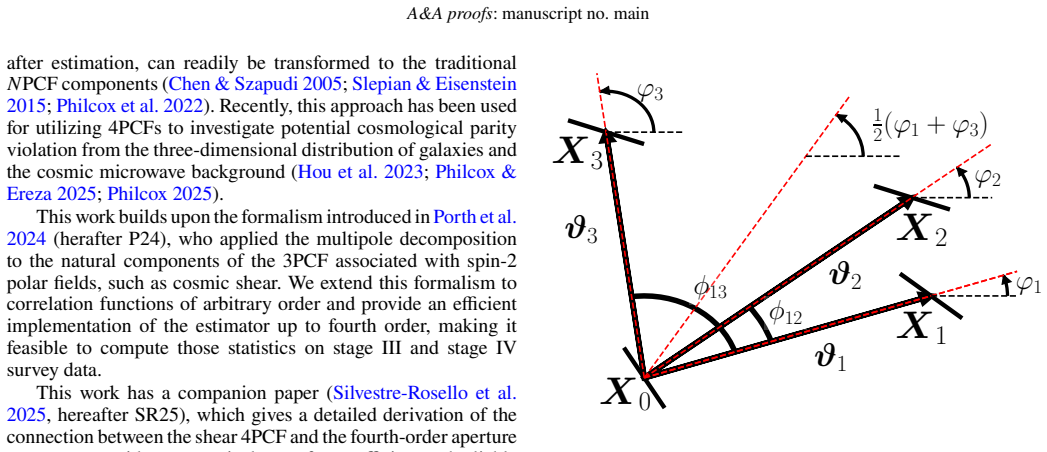
The estimator decomposes the angular dependence of the shear 4PCF into multipole components using a generalized projection. Each multipole is built from sums of per-galaxy discrete fields that collect weighted shears or counts in annular bins; the four-point sum factorizes into three neighbor sums plus one outer sum, giving quadratic scaling. Radial-bin permutation symmetries reduce the number of configurations that must be computed, and a low-memory implementation with hierarchical reduced catalogues controls both memory and runtime. The aperture-mass integrals from the companion paper then convert the binned 4PCF into fourth-order aperture statistics with an implicit E/B-mode decomposition
What would settle it
Compute the null-hypothesis p-value for the connected fourth-order aperture mass using the full 864-footprint sample covariance, or an independent set of DES-Y3-geometry mocks, instead of the internal covariance corrected by r_std,foot; if the p-value becomes non-significant, the claimed detection rests on that heuristic. A second check is to run the estimator on mocks with the DES Y3 best-fit cosmology and see whether the low measured amplitude persists.
Extended reading notes
Core claim
The central claim is that the multipole decomposition of the shear 4PCF, previously applied to three-point functions, extends to fourth order and turns the naive N^4 quadruplet sum into factorized per-galaxy sums that scale quadratically, with tree-based hierarchies reducing the prefactor. Using the natural components of the shear 4PCF, the estimator reconstructs the correlation function to percent accuracy with multipoles up to n_max ~ 15. Applied non-tomographically to DES Y3 and integrated into fourth-order aperture statistics, it yields a strong rejection of the null hypothesis of no connected E-mode signal (p = 4.09e-137 with the internally estimated covariance), while B-mode and parity
Load-bearing premise
The detection's quoted significance relies on a Gaussian likelihood and a covariance built from mocks plus an internal patch estimate corrected by a heuristic factor, even though the paper shows the sampling distribution is strongly skewed and the raw internal errors are overconfident.
Editorial extensions
If this is right
- Measuring the shear 4PCF becomes practical for billions-of-galaxies surveys: the multipole estimator runs in quadratic time and the low-memory implementation keeps the footprint manageable.
- The recommended binning (65 radial bins, n_max=15) gives about 2 percent accuracy for the fourth-order aperture mass on scales 4-30 arcmin, so the statistic can serve as a compression of the full 4PCF.
- DES Y3 shows a connected fourth-order aperture-mass signal: the E-mode null hypothesis is rejected with p about 4e-137 under the internally estimated covariance, while B-modes and parity-violating modes are consistent with noise.
- The DES Y3 amplitude is lower than the mock prediction, and the paper argues this mirrors the earlier DES Y3 third-order result; understanding this offset is a prerequisite for cosmological interpretation.
- The sampling distribution of the fourth-order aperture mass is skewed, so error bars from internal estimators are overconfident unless a correction such as r_std,foot is applied.
Reading between the lines
- The same factorization extends to arbitrary order, so fifth- and sixth-order shear cumulants may become computationally accessible; the bottleneck will shift to the number of multipoles and bins rather than tuple counting.
- The strong non-Gaussianity of the sampling distribution suggests that Gaussian likelihood analyses of fourth-order cumulants will be biased; simulation-based inference or variance-stabilizing transformations should be tested on the mocks before cosmological fits.
- If the low DES Y3 amplitude is cosmological, combining third- and fourth-order aperture masses could break degeneracies that two-point analyses leave unresolved, because the two orders weight the density field differently; a tomographic measurement would test whether the offset is redshift-dependent.
- Applying the estimator to tomographic bin pairs should be done with awareness of the quartic scaling with the number of bins; the paper's memory-light implementation makes this feasible, but runtime will still grow quickly.
Editorial analysis
A structured set of objections, weighed in public.
Referee Report
Summary. This paper presents an efficient estimator for the shear four-point correlation function (4PCF) based on multipole decomposition, extending Porth et al. (2024) to fourth order and implementing it in the public orpheus package. The estimator is validated on Gaussian random fields, where the measured 4PCF is compared with a prediction built from the measured 2PCF, and on the SLICS N-body suite, where the fourth-order aperture mass obtained from the 4PCF is compared with a direct estimator. The paper then applies the estimator to DES Y3 data, measuring fourth-order aperture statistics in a non-tomographic setup. The authors report a significant detection of the connected E-mode fourth-order aperture mass (p = 4.09e-137 in Sect. 6.4) and note that the sampling distribution is strongly skewed and that internal covariance estimates are overconfident. They also find the DES Y3 amplitude to be lower than expectations from T17 mocks and discuss possible astrophysical explanations.
Significance. The main methodological contribution—a quadratic-scaling multipole estimator for the shear 4PCF with a low-memory implementation, validated against a direct estimator on N-body simulations and made publicly available—is useful and likely to be adopted for Stage III/IV analyses. The application to DES Y3 is a first step toward using fourth-order shear statistics in real data. However, the headline detection significance is not calibrated: it is based on a Gaussian likelihood and an internally estimated covariance that the paper itself shows to be overconfident, and no corrected p-value is provided. With appropriate recalibration or a more cautious claim, the paper would be a solid contribution.
major comments (3)
- [Sect. 6.4 and Sect. 6.3.2 / Fig. 4 / Fig. D.1] The headline p-value p = 4.09e-137 is computed with the internally estimated covariance matrix and a Gaussian likelihood. Section 6.3.2 and Fig. 4 (right panel) explicitly show that this internal covariance underestimates the true spread and overpredicts S/N, motivating the heuristic correction r_std,foot. Figure D.1 further shows that the sampling distribution of <M4_ap>_c is strongly skewed and non-Gaussian. No p-value is reported for cov_foot, cov_robust,foot, or for the r_std,foot-corrected covariance, and no simulation-based calibration of the null distribution is provided. Because the detection claim is the central result, this is a load-bearing gap. Please provide a calibrated p-value under a non-Gaussian/non-normal likelihood, or explicitly restate the result as a methodology demonstration without a quantitative detection significance.
- [Sect. 6.4] The sentence 'using the internally estimated covariance matrix of <M4_x>' appears to use the wrong statistic for the E-mode null test: in the notation of Sect. 5.1 and Eq. (35), <M4_x> is not the pure E-mode statistic <M4_ap>_c. If this is literal, the reported p-value is computed with the covariance of a different quantity and does not support the stated claim. If it is a typo, it must be corrected. This clarification is needed for reproducibility of the main quantitative result.
- [Sect. 4.2 / Fig. 2] The Gaussian-field validation compares the multipole-based 4PCF to a 4PCF built from the 2PCF measured on the same mocks, so it mainly demonstrates internal consistency rather than unbiasedness with respect to the true theoretical 4PCF. The small differences shown in the bottom row are attributed to noise, and the quoted percent-level agreement is not a fully independent test. The SLICS/direct-estimator comparison in Sect. 5.3 is stronger and more decisive; please describe the GRF test accordingly and state explicitly that the Gaussian truth is reconstructed from the same realizations.
minor comments (5)
- [Eq. (4)] The fourth factor in the definition of Γ^P_0 uses X3 twice: the third factor should be γ(X2; ζ2), not γ(X3; ζ2). Please fix this typo, which propagates to the index conventions.
- [Eq. (36)] The denominator contains 'γ_t,k γ_t,k l'; this appears to be a typo for γ_t,k γ_t,l. Please correct.
- [References] The companion paper SR25 (Silvestre-Rosello et al. 2025) is cited as 'submitted to A&A, and published on arXiv' but no arXiv identifier or DOI is given. Since Eq. (34) and the binning recommendations rely on SR25, please provide a complete reference.
- [Abstract / Sect. 1] The statement 'We make our estimator code available on GitHub as part of the orpheus package/github-square' does not contain a working link or repository identifier. Please add the actual URL or a footnote.
- [Sect. 6.3.1] The mock footprints use octant cuts rather than the actual DES Y3 geometry. The text notes that this may cause 'a slight misestimation' for large scales. Given that the covariance is used for the signal-to-noise assessment, please add a quantitative test of the geometry sensitivity (e.g., using the DES Y3 mask with the direct estimator) or state more explicitly the expected impact.
Circularity Check
No significant circularity: the 4PCF estimator is derived from first principles and validated against external N-body simulations; the flagged covariance overconfidence is a statistical calibration concern, not a circular step.
full rationale
The central derivation chain is independent of its outputs. The multipole-based 4PCF estimator (Sect. 3) is derived algebraically from the bin-averaged 4PCF definitions and the ×-projection, with no parameter fitted to the data. The Gaussian random field validation (Sect. 4) compares the estimator to the Wick-theorem 4PCF reconstructed from the measured 2PCF on the same mocks; this is a self-consistency check of the multipole expansion, not a circular derivation, because the 4PCF estimator is not defined in terms of the 2PCF and no parameter is adjusted to force agreement. The aperture-mass conversion (Sect. 5) adopts filter functions from the companion paper SR25, but these are mathematical identities rather than empirical claims, and the full pipeline is cross-validated on the independent SLICS N-body suite against a direct estimator (Sect. 5.3). The DES Y3 detection (Sect. 6.4) uses a covariance estimated from T17 mocks and internal patches; the paper itself highlights that the internal covariance is overconfident and the sampling distribution non-Gaussian (Sect. 6.3.2, Fig. D.1). That is a statistical calibration and correctness risk, not circularity: the reported p-value does not reduce to a fitted input or to a self-citation. No load-bearing self-citation is invoked to forbid alternative estimators or interpretations. Therefore the paper's core estimator and validation are self-contained against external benchmarks, and no circular step is identifiable.
Assumptions & free parameters
free parameters (4)
- n_max =
15
- r_min,Delta =
40
- r_std,foot =
not quoted
- 4PCF binning scheme =
65 log radial bins in [0.25',166.29']; 129 linear angular bins; 24/31 aperture radii in [1',32']
assumptions (5)
- domain assumption Flat-sky approximation on 100 overlapping patches covers DES Y3 and the T17 mocks
- domain assumption Statistical homogeneity and isotropy of the shear field
- domain assumption Observed ellipticities can be modelled as reduced shear plus shape noise (Seitz & Schneider 1997)
- domain assumption T17 ray-tracing mocks with octant geometry provide a faithful covariance model for DES Y3
- domain assumption The 'base catalogue' resampling of DES Y3 weights, shapes and n(z) preserves the data's noise properties
Cite this review
Pith. "Pith review of Towards an application of fourth-order shear statistics II: Efficient estimation of fourth-order shear correlation functions and an application to the DES Y3 data." pith.science (2026). https://pith.science/paper/Q5UM3BKL
@misc{pith2026250907974,
  author       = {Pith},
  title        = {Pith review of: Towards an application of fourth-order shear statistics II: Efficient estimation of fourth-order shear correlation functions and an application to the DES Y3 data},
  year         = {2026},
  howpublished = {\url{https://pith.science/paper/Q5UM3BKL}},
  note         = {Machine review of arXiv:2509.07974}
}
abstract
Higher-order lensing statistics contain a wealth of cosmological information that is not captured by second-order statistics. Stage-III lensing surveys have sufficient statistical power to significantly detect cumulant-based statistics up to fourth order. We derive and validate an efficient estimation procedure for the four-point correlation function (4PCF) of polar fields such as weak lensing shear. We then use our approach to measure the shear 4PCF and the fourth-order aperture mass statistics in the DES Y3 survey. We construct an efficient estimator for fourth-order shear statistics which builds on the multipole decomposition of the shear 4PCF. We then validate our estimator on mock ellipticity catalogues obtained from Gaussian random fields and on realistic $N$-body simulations. Finally, we apply our estimator to the DES Y3 data and present a measurement of the fourth-order aperture statistics in a non-tomographic setup. Due to its quadratic scaling, our estimator provides a significant speed-up over hypothetical brute force or tree-based estimation methods of the shear 4PCF. We report a significant detection of the connected part of the fourth-order aperture mass in the DES Y3 data. We find the sampling distribution of the fourth-order aperture mass to be significantly skewed. We make our estimator code available on GitHub as part of the orpheus package.
Figures


Figures from the paper (2 more)


Forward citations
Cited by 1 Pith paper
-
Fourth-order galaxy-galaxy-lensing: Theoretical framework and direct estimation
The authors derive the fourth-order galaxy-galaxy lensing 4PCF and aperture statistics, implement a numerical pipeline and FFT estimator, and detect the connected ⟨N³ M_ap⟩ signal at SNR ~9 in stage IV mock data over ...
Reference graph
Works this paper leans on
-
[1]
, " * write output.state after.block = add.period write newline
ENTRY address archiveprefix author booktitle chapter edition editor howpublished institution eprint journal key month note number organization pages publisher school series title type volume year label extra.label sort.label short.list INTEGERS output.state before.all mid.sentence after.sentence after.block FUNCTION init.state.consts #0 'before.all := #1 ...
-
[2]
write newline
" write newline "" before.all 'output.state := FUNCTION n.dashify 't := "" t empty not t #1 #1 substring "-" = t #1 #2 substring "--" = not "--" * t #2 global.max substring 't := t #1 #1 substring "-" = "-" * t #2 global.max substring 't := while if t #1 #1 substring * t #2 global.max substring 't := if while FUNCTION word.in bbl.in " " * FUNCTION format....
-
[3]
A., et al
Amon , A., Gruen , D., Troxel , M. A., et al. 2022, , 105, 023514
2022
-
[4]
Anbajagane , D., Chang , C., Banerjee , A., et al. 2023, , 526, 5530
work page 2023
-
[5]
2021, , 645, A104
Asgari , M., Lin , C.-A., Joachimi , B., et al. 2021, , 645, A104
2021
- [6]
-
[7]
& Schneider , P
Bartelmann , M. & Schneider , P. 2001, , 340, 291
2001
-
[8]
Barthelemy , A., Codis , S., Uhlemann , C., Bernardeau , F., & Gavazzi , R. 2020, , 492, 3420
work page 2020
Show all 69 references
-
[9]
D., Saust , A
Blandford , R. D., Saust , A. B., Brainerd , T. G., & Villumsen , J. V. 1991, , 251, 600
1991
-
[10]
A., Porth , L., Heydenreich , S., et al
Burger , P. A., Porth , L., Heydenreich , S., et al. 2024, , 683, A103
2024
-
[11]
& Szapudi , I
Chen , G. & Szapudi , I. 2005, , 635, 743
2005
-
[12]
G., Natarajan , P., Pen , U.-L., & Theuns , T
Crittenden , R. G., Natarajan , P., Pen , U.-L., & Theuns , T. 2002, , 568, 20
2002
-
[13]
2023, , 108, 123519
Dalal , R., Li , X., Nicola , A., et al. 2023, , 108, 123519
2023
-
[14]
2017, Gravitational Lensing (Cambridge University Press)
Dodelson, S. 2017, Gravitational Lensing (Cambridge University Press)
2017
-
[15]
2023, , 675, A120
Euclid Collaboration: Ajani , V., Baldi , M., Barthelemy , A., et al. 2023, , 675, A120
2023
-
[16]
2025, A&A, 697, A1
Euclid Collaboration: Mellier , Y., Abdurro'uf , Acevedo Barroso , J., et al. 2025, A&A, 697, A1
2025
-
[17]
T., Honscheid , K., et al
Flaugher , B., Diehl , H. T., Honscheid , K., et al. 2015, , 150, 150
2015
-
[18]
2014, , 441, 2725
Fu , L., Kilbinger , M., Erben , T., et al. 2014, , 441, 2725
2014
-
[19]
2021, , 504, 4312
Gatti , M., Sheldon , E., Amon , A., et al. 2021, , 504, 4312
2021
-
[20]
Gomes , R. C. H., Sugiyama , S., Jain , B., et al. 2025, arXiv:2503.03964
2025
-
[21]
M., Hivon , E., Banday , A
G \'o rski , K. M., Hivon , E., Banday , A. J., et al. 2005, , 622, 759
2005
-
[22]
2018, , 481, 1337
Harnois-D \'e raps , J., Amon , A., Choi , A., et al. 2018, , 481, 1337
2018
-
[23]
2024, , 534, 3305
Harnois-D \'e raps , J., Heydenreich , S., Giblin , B., et al. 2024, , 534, 3305
2024
-
[24]
R., Millman, K
Harris, C. R., Millman, K. J., van der Walt, S. J., et al. 2020, Nature, 585, 357
2020
-
[25]
2022, , 667, A125
Heydenreich , S., Br \"u ck , B., Burger , P., et al. 2022, , 667, A125
2022
-
[26]
2023, , 672, A44
Heydenreich , S., Linke , L., Burger , P., & Schneider , P. 2023, , 672, A44
2023
-
[27]
Hou , J., Slepian , Z., & Cahn , R. N. 2023, , 522, 5701
2023
-
[28]
Hunter, J. D. 2007, Computing in Science & Engineering, 9, 90
2007
-
[29]
M., Tyson , J
Ivezi \'c , Z ., Kahn , S. M., Tyson , J. A., et al. 2019, , 873, 111
2019
-
[30]
& Van Waerbeke , L
Jain , B. & Van Waerbeke , L. 2000, , 530, L1
2000
-
[31]
2016, , 460, 2245
Jarvis , M., Sheldon , E., Zuntz , J., et al. 2016, , 460, 2245
2016
-
[32]
1992, , 388, 272
Kaiser , N. 1992, , 388, 272
1992
-
[33]
1995, , 439, L1
Kaiser , N. 1995, , 439, L1
1995
-
[34]
& Squires , G
Kaiser , N. & Squires , G. 1993, , 404, 441
1993
-
[35]
Kaiser , N., Wilson , G., & Luppino , G. A. 2000, arXiv:0003338
2000
-
[36]
2015, Reports on Progress in Physics, 78, 086901
Kilbinger , M. 2015, Reports on Progress in Physics, 78, 086901
2015
-
[37]
M., Lim , E
Kratochvil , J. M., Lim , E. A., Wang , S., et al. 2012, , 85, 103513
2012
-
[38]
2023, , 108, 123518
Li , X., Zhang , T., Sugiyama , S., et al. 2023, , 108, 123518
2023
-
[39]
2018, , 56, 393
Mandelbaum , R. 2018, , 56, 393
2018
-
[40]
2021, , 505, 4249
Myles , J., Alarcon , A., Amon , A., et al. 2021, , 505, 4249
2021
-
[41]
2011, Journal of Machine Learning Research, 12, 2825
Pedregosa, F., Varoquaux, G., Gramfort, A., et al. 2011, Journal of Machine Learning Research, 12, 2825
2011
-
[42]
Philcox , O. H. E. 2025, , 111, 123534
2025
-
[43]
Philcox , O. H. E. & Ereza , J. 2025, Philosophical Transactions of the Royal Society of London Series A, 383, 20240034
2025
-
[44]
Philcox , O. H. E., Slepian , Z., Hou , J., et al. 2022, , 509, 2457
2022
-
[45]
2024, , 689, A227
Porth , L., Heydenreich , S., Burger , P., Linke , L., & Schneider , P. 2024, , 689, A227
2024
-
[46]
& Smith , R
Porth , L. & Smith , R. E. 2021, , 508, 3474
2021
-
[47]
Rousseeuw , P. J. & van Driessen , K. 1999, Technometrics, 41, 212
1999
-
[48]
2010, , 404, 350
Rowe , B. 2010, , 404, 350
2010
-
[49]
1996, , 283, 837
Schneider , P. 1996, , 283, 837
1996
-
[50]
2005, , 431, 9
Schneider , P., Kilbinger , M., & Lombardi , M. 2005, , 431, 9
2005
-
[51]
& Lombardi , M
Schneider , P. & Lombardi , M. 2003, , 397, 809
2003
-
[52]
1998, , 296, 873
Schneider , P., van Waerbeke , L., Jain , B., & Kruse , G. 1998, , 296, 873
1998
-
[53]
2002, , 396, 1
Schneider , P., van Waerbeke , L., Kilbinger , M., & Mellier , Y. 2002, , 396, 1
2002
-
[54]
F., Jarvis , M., Jain , B., et al
Secco , L. F., Jarvis , M., Jain , B., et al. 2022 a , , 105, 103537
2022
-
[55]
F., Samuroff , S., Krause , E., et al
Secco , L. F., Samuroff , S., Krause , E., et al. 2022 b , , 105, 023515
2022
-
[56]
& Schneider , P
Seitz , C. & Schneider , P. 1997, , 318, 687
1997
-
[57]
2025, submitted to , and published on arXiv
Silvestre-Rosello , E., Porth , L., Linke , L., et al. 2025, submitted to , and published on arXiv
2025
-
[58]
& Eisenstein , D
Slepian , Z. & Eisenstein , D. J. 2015, , 454, 4142
2015
-
[59]
Sugiyama , S., Gomes , R. C. H., & Jarvis , M. 2024, arXiv:2407.01798
2024 arXiv
-
[60]
2023, RAS Techniques and Instruments, 2, 62
Sunseri , J., Slepian , Z., Portillo , S., et al. 2023, RAS Techniques and Instruments, 2, 62
2023
-
[61]
2017, , 850, 24
Takahashi , R., Hamana , T., Shirasaki , M., et al. 2017, , 850, 24
2017
-
[62]
2005, arXiv:0510346
The Dark Energy Survey Collaboration . 2005, arXiv:0510346
2005
-
[63]
2016, , 460, 1270
The Dark Energy Survey Collaboration . 2016, , 460, 1270
2016
-
[64]
A., Liu , J., & Shirasaki , M
Thiele , L., Marques , G. A., Liu , J., & Shirasaki , M. 2023, , 108, 123526
2023
-
[65]
2000, , 358, 30
Van Waerbeke , L., Mellier , Y., Erben , T., et al. 2000, , 358, 30
2000
-
[66]
E., et al
Virtanen, P., Gommers, R., Oliphant, T. E., et al. 2020, Nature Methods, 17, 261
2020
-
[67]
M., Tyson , J
Wittman , D. M., Tyson , J. A., Kirkman , D., Dell'Antonio , I., & Bernstein , G. 2000, , 405, 143
2000
-
[68]
H., St \"o lzner , B., Asgari , M., et al
Wright , A. H., St \"o lzner , B., Asgari , M., et al. 2025, arXiv:2503.19441
2025 arXiv
-
[69]
2019, Journal of Open Source Software, 4, 1298
Zonca, A., Singer, L., Lenz, D., et al. 2019, Journal of Open Source Software, 4, 1298
2019
Reviewed August 4, 2026 · model on record in the stance chip above.
Discussion (0). Sign in to comment.