REVIEW 4 major objections 5 minor 13 references
Configurations related to combinatorial Veronesians representing a skew perspective
T0 review · 4 major / 5 minor · reviewed 2026-08-14 · deepseek-v4-flash
Pith's one-line read Every Veblen-axis skew perspective is now classified
desk verdict A genuinely interesting extension of Veronese-like skews, but the paper's own numbers contradict the classification theorem and the computational evidence is not provided. read the letter →
The pith
A machine-rendered reading of the paper's core claim, the machinery that carries it, and where it could break.
The reading
What carries the argument
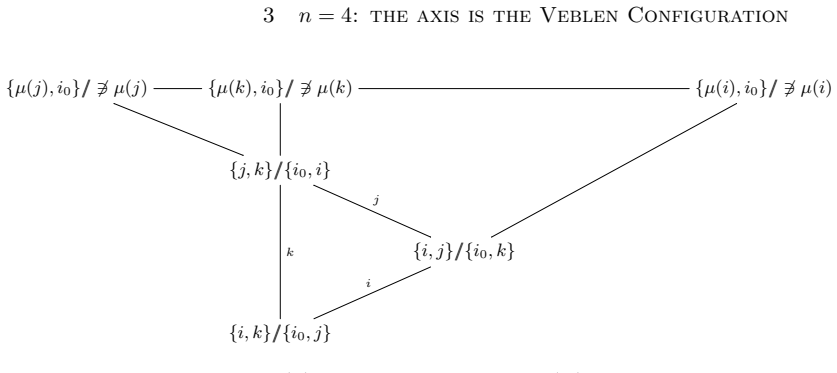
The load-bearing object is the skew-perspective construction $\Pi(n,\sigma,N)$: take two $n$-element sets $A,B$, a centre point $p$, and a binomial configuration $N$ on the 2-subsets of an $n$-set; then put lines $\{p,a_i,b_i\}$, $\{a_i,a_j,c_{ij}\}$, $\{b_i,b_j,c_{\sigma^{-1}(ij)}\}$, plus the lines of $N$ on the $c$'s. For $n=4$ the axis $N$ is a Veblen configuration on $\wp_2(I_4)$, and the admissible skews are the Veronese-type permutations $\sigma_\Phi$ generated by a nested sequence $\Phi=(\varphi_4,\varphi_3,\varphi_2)$ of permutations of initial segments. The proof machinery tracks free complete subgraphs $K_5$ -- subgraphs whose edges lie on distinct lines that intersect only in the subgraph's own vertices -- and uses the star-triangle sets $S(i)$ of the Veblen configuration to decide when a third, "new" $K_5$ appears. The classification then reduces to enumerating the finitely many possible pairs $(\Phi,V)$ and testing isomorphism.
What would settle it
Independently regenerate all structures $M(f,s,i)=\Pi(4,\sigma_{\mathrm{PHI}[f]},V_s(\mathrm{MU}[i]))$ for $f=2,\dots,8$, $s=5,6$, $i=1,\dots,15$, test pairwise isomorphism with a certified graph-isomorphism routine, and compare the count of isomorphism classes with exactly two free $K_5$'s to 104 and the classes with three or more $K_5$'s to the 11 listed system types; any discrepancy falsifies the classification.
Extended reading notes
Core claim
On the paper's own terms, the discovery is a complete enumeration. For $n=4$, every skew perspective $\Pi(4,\sigma_\Phi,V)$ with a Veronese-type skew $\sigma_\Phi$ and a Veblen axis $V$ on $\wp_2(I_4)$ is either one of 104 pairwise non-isomorphic $(15_4\,20_3)$-configurations freely containing exactly two $K_5$'s (under the stated exclusion $\sigma_\Phi\notin S_{I_4}$), or, when it freely contains three or more $K_5$'s, it is isomorphic to one of 11 systems of triangle perspectives from the earlier classification, with the specific excluded types listed. A companion theorem determines exactly when the automorphism group is nontrivial: for the two-$K_5$ cases it is always either trivial or $\{id,S\}\cong C_2$, with an explicit list of parameters.
Load-bearing premise
The load-bearing premise is that the computer-aided enumeration and isomorphism checks behind the 104-configuration count are complete and correct; the paper states the resulting parameter lists but does not ship the program, its inputs, or its raw output.
Editorial extensions
If this is right
- The full isomorphism type of any configuration in this family is determined by the pair (skew, Veblen labelling), so the 104-configuration list gives a finite recipe for constructing every example.
- Any such perspective that admits a third free $K_5$ is already among the 11 known systems of triangle perspectives, so no new highly symmetric examples hide in this family.
- The non-trivial automorphism group of a two-$K_5$ configuration is at most $\{id,S\}\cong C_2$, with the exceptional parameter values explicitly listed.
- Together with the trivial-skew case classified elsewhere, the census of all $(15_4\,20_3)$-configurations obtainable from a skew perspective over a Veblen axis is complete.
Reading between the lines
- Beyond the paper: the same construction with a fixed Veronese-type skew and a varying axial configuration could be used to organize larger binomial configurations, since the hard part is the finite isomorphism test on the axis.
- Beyond the paper: the rigidity theorem suggests that almost all of the 104 configurations are asymmetric; computing the automorphism group of each with an independent algorithm would test that expectation and could reveal accidental symmetries not captured by the listed criterion.
- Beyond the paper: the paper itself recalls that combinatorial Veronesians for $k>3$ are not embeddable in Desarguesian spaces; a short step beyond the paper is to test whether the 104 configurations share this non-embeddability.
Signed reviews
Editorial analysis
A structured set of objections, weighed in public.
Referee Report
Summary. The paper develops a theory of configurations Π(n,σ,N), called skew perspectives, and specializes to skews σΦ generated by a sequence Φ=(φ_n,...,φ_2) of permutations, which generalize the skew of a combinatorial Veronesian. Section 2 proves structural lemmas about when Π(n,σΦ,N) has additional free complete subgraphs, rigidity of automorphisms, and re-presentation of a perspective between different simplexes. Section 3 restricts to n=4 with a Veblen (Pasch) configuration as the axis and states Theorem 3.3: there are exactly 104 pairwise non-isomorphic (15_4 20_3)-configurations Π(4,σΦ,V) with exactly two free K5's, together with 11 configurations from the prior classification of configurations with at least three free K5's. Theorem 3.7 classifies the nontrivial automorphisms among the exactly-two-K5 cases.
Significance. The framework is of genuine interest: reducing the classification to line perspectives and axial configurations, and the construction σΦ, are natural tools in the program of classifying binomial partial Steiner triple systems. The lemmas in Sections 1–2, including Lemma 2.8, Proposition 2.12, and Proposition 2.14, appear to be proved coherently, and the connection with combinatorial Veronesians is a substantive contribution. If Theorem 3.3 is correct, the paper provides a complete classification of a natural subclass of (15_4 20_3)-configurations. However, the central computational claim is not reproducible from the manuscript, and the printed computational trace contains several internal inconsistencies, so the significance can only be fully assessed after the computation is made available and the discrepancies are repaired.
major comments (4)
- [§3, Theorem 3.3 and Note 3.5] The exhaustiveness claim of the classification is delegated to "pouring computer-aided computations" and "a Maple program," but the manuscript supplies no code, no parameter files, no output tables, and no certificate. The reader can verify the structural lemmas but cannot check the enumeration itself. Because the count 104 is the central result, this is a load-bearing gap: the authors should provide a reproducible computational artifact or an independent mathematical certificate.
- [Note 3.5, PHI list (26)] PHI[2] = [(1)(2)(3),(1,2)] is not outside the excluded class. By Lemma 2.8(b) with n=4, σΦ = (3)(4)(1,2) ∈ S_I4, while Theorem 3.3(i) explicitly assumes σΦ ≠ α for every α∈S_I4, and Note 3.4 says such cases reduce to α=id. Note 3.5 only excludes f=1, so the enumeration over (f,s,i) includes a family that does not belong to the theorem's domain. The missing exclusion f≠2 must be addressed.
- [Abstract and Introduction] The abstract and the introduction both state that there are "18 such configurations, and 14 of them have not been found before," whereas Theorem 3.3 asserts 104 configurations with exactly two free K5's plus 11 STP configurations. These numbers are irreconcilable as descriptions of the same classification, and the manuscript does not explain what the '18' counts. The summary of results must be corrected to a single consistent statement.
- [Note 3.5, two-free-K5 lists] The explicitly listed non-isomorphic parameters sum to 105, not 104: f=2,3,5 give 10 each, f=4 gives 14, f=6 gives 12, f=7 gives 25, and f=8 gives 24. This is exactly the count that Theorem 3.3(i) claims, so an error or overcount is present. The discrepancy directly affects the central classification and must be fixed.
minor comments (5)
- [Note 3.5, list (28)] The entry "(6, 4)(6, 11)" is missing a comma and should read "(6, 4), (6, 11)."
- [Note 3.5, list (27)] The eleventh element "(1)" is not a permutation of I4 as written; it should presumably be "(1)(2,4)(3)" or another full cycle notation.
- [Section 2 heading] The heading "Vergras-like skew" appears to be a typo for "Veronese-like skew."
- [Figure 2 caption] The caption writes "Π(4,ζ, G∗_2(I4))" twice; the first occurrence should presumably be "Π(4,ζ_4, G∗_2(I4))" and the second "Π(4,ζ_4, ζ_4(G∗_2(I4)))."
- [Theorem 3.3(ii)] The wording "with (i), (ii), (iv), (v), and (xiii) excluded and (ii), (iii) in [6, Remark 2.10]" is ambiguous; the authors should state explicitly which 11 types remain.
Circularity Check
No circular derivation; the classification is an independent enumeration, though its print support is internally inconsistent.
full rationale
Fact 1.2 is taken from the authors' earlier paper but is a general structural equivalence ('M is a binomial configuration ... freely contains two K_{N-1}-graphs iff M ≅ Π(n,σ,N)'), not an assertion of the classification being proved. Theorem 3.3(ii) explicitly delegates the at-least-three-K5 case to the earlier [6] classification; that is an application of a published result, not a derivation from the present paper's own conclusion. The new part, Theorem 3.3(i), is a finite Maple enumeration over the explicit lists PHI and MU, and the paper states that the isomorphism checks were done by 'a Maple program'; no fitted parameter is renamed as a prediction, and no equation defining Π(4,σΦ,V) contains the target count 104. The construction of σΦ is a definition, and Lemma 2.8 is proved, not cited. Therefore no step of the derivation reduces to its own input by construction. I note, however, that the enumeration is not fully checkable from the manuscript: the Maple code and outputs are not shipped, the abstract's '18 such configurations' is not reconciled with Theorem 3.3's 104+11, Note 3.5's two-free lists sum to 105, and PHI[2] is not excluded despite Lemma 2.8(b). These are reproducibility/correctness concerns, not circularity; the low score reflects only the paper's reliance on the authors' own prior structural and classification results.
Assumptions & free parameters
assumptions (3)
- domain assumption Fact 1.2: every ((N choose 2), N-2, (N choose 3), 3)-configuration that freely contains two K_{N-1} graphs is isomorphic to Π(n,σ,N).
- domain assumption The six listed labellings of the Veblen configuration on ℘2(I4) are exhaustive up to isomorphism.
- domain assumption The classification of (15_4 20_3)-configurations with at least three K5 graphs from [6, Classification 2.8 and Remark 2.10] is correct and complete.
Cite this review
Pith. "Pith review of Configurations related to combinatorial Veronesians representing a skew perspective." pith.science (2026). https://pith.science/paper/Q7FZVQHX
@misc{pith2026190807877,
  author       = {Pith},
  title        = {Pith review of: Configurations related to combinatorial Veronesians representing a skew perspective},
  year         = {2026},
  howpublished = {\url{https://pith.science/paper/Q7FZVQHX}},
  note         = {Machine review of arXiv:1908.07877}
}
abstract
A combinatorial object representing schemas of, possibly skew, perspectives, called {\em a configuration of skew perspective} has been defined in \cite{klik:binom}, \cite{maszko}. Here we develop the theory of configurations generalizing perspectives defined in combinatorial Veronesians. The complete classification of thus obtained $({15}_4 {20}_3)$-configurations is presented.
Figures


Figures from the paper (2 more)


Reference graph
Works this paper leans on
-
[2]
D. Hilbert, S. Cohn-Vossen , Geometry and the Imagination , AMS Chelsea Publishing, 1999
work page 1999
-
[1]
Hartshorne, Foundations of projective geometry , Lecture Notes, Harvard University, 1967
R. Hartshorne, Foundations of projective geometry , Lecture Notes, Harvard University, 1967
work page 1967
-
[3]
H. Karzel, H.-J. Kroll , Perspectivities in Circle Geometries, [in] Geometry – von Staudt’s point of view , P. Plaumann, K. Strambach (Eds), D. Reidel Publ. Co., 1981, pp. 51–100
work page 1981
-
[4]
Configurations representing a skew perspective
K. Maszkowski, M. Pra ˙zmowska, K. Pra ˙zmowski, Configurations repre- senting a skew perspective , arXiv:1806.04237 16 3 n = 4: the axis is the Veblen Configuration
-
[5]
K. Petelczyc, M. Pra ˙zmowska, 103-configurations and projective realizabil- ity of multiplied configurations , Des. Codes Cryptogr. 51, no. 1 (2009), 45–54
work page 2009
-
[6]
K. Petelczyc, M. Pra ˙zmowska, A complete classification of the (154203)- configurations with at least three K5-graphs, Discrete Math. 338 (2016), no 7, 1243–1251
work page 2016
-
[7]
M. Pra ˙zmowska, Multiple perspectives and generalizations of the Desargues configuration, Demonstratio Math. 39 (2006), no. 4, 887–906
work page 2006
-
[8]
M. Pra ˙zmowska, On some regular multi-Veblen configurations, the geometry of combinatorial quasi Grassmannians , Demonstratio Math. 42(2009), no.1 2, 387–402
work page 2009
Show all 13 references
-
[9]
M. M. Pra ˙zmowska, On the existence of projective embeddings of multiveblen configurations, Bull. Belg. Math. Soc. Simon-Stevin, 17, (2010), no 2, 1–15
2010
-
[10]
Pra ˙zmowska, K
M. Pra ˙zmowska, K. Pra ˙zmowski, Some generalization of Desargues and Veronese configurations, Serdica Math. J. 32 (2006), no 2–3, 185–208
2006
-
[11]
Pra ˙zmowska, K
M. Pra ˙zmowska, K. Pra ˙zmowski, Combinatorial Veronese structures, their geometry, and problems of embeddability , Results Math. 51 (2008), 275–308
2008
-
[12]
Pra ˙zmowska, K
M. Pra ˙zmowska, K. Pra ˙zmowski, Binomial partial Steiner triple systems containing complete graphs, Graphs Combin. 32(2016), no. 5, 2079–2092
2016
-
[13]
Pra ˙zmowska, K
M. Pra ˙zmowska, K. Pra ˙zmowski On a class of (154 203)-configurations reflecting abstract properties of a perspective between tetrahedrons arXiv:1806.04261 Author’s address: Agata Bazylewska-Zejer, Ma lgorzata Pra˙ zmowska, Krzysztof Pra˙ zmowski Institute of Mathematics, Univ...
Reviewed August 14, 2026 · model on record in the stance chip above.
Discussion (0). Continue with ORCID to comment.