REVIEW 4 major objections 6 minor 18 references
EcoKube: Simulating Carbon-Aware Scheduling Policies in Heterogeneous Edge-Cloud Environments
T0 review · 4 major / 6 minor · reviewed 2026-07-13 · grok-4.5
Pith's one-line read EcoKube is a configurable, Kubernetes-compatible simulator that makes carbon-aware scheduling policies reproducible and comparable on heterogeneous edge–cloud topologies before real deployment.
desk verdict Useful open simulator for carbon-aware K8s-style policy comparison; the 45% emissions number is mostly in-model optimization, not yet external proof. read the letter →
The pith
A machine-rendered reading of the paper's core claim, the machinery that carries it, and where it could break.
The reading
What carries the argument
The two-stage EcoKube scoring rule: first rank candidate sites by normalised carbon intensity, PUE, site factor and optional network penalty; then, inside the chosen site, rank feasible nodes by a weighted sum of estimated IT energy, emissions (energy × PUE × CI), latency penalty and accelerator-fit term (Eqs. 3–4), after Kubernetes-style hard-constraint filtering.
What would settle it
Deploy the identical EcoKube Policy and the three baselines on a real multi-site Kubernetes federation equipped with calibrated power meters and the same carbon-intensity traces; if measured carbon savings collapse or reverse while the simulator still reports a large drop, the claim that the framework correctly ranks real sustainability impact is falsified.
Extended reading notes
Core claim
A modular discrete-event simulator that models both site-level carbon and efficiency signals and node-level heterogeneity can turn sustainability-aware scheduling into a controlled, Kubernetes-compatible experiment. Under the reported three-site synthetic scenarios, the framework’s reference weighted-sum policy reduces the mean operational emissions estimate from 32.14 kg to 17.63 kg per roughly 900-job run (a 45.15 percent drop relative to default Kubernetes) while increasing makespan by only 1.35 percent.
Load-bearing premise
The simulator’s own location-aware emissions number (energy times site PUE times time-aligned carbon intensity) is treated as a valid external measure of real sustainability impact even though the workloads are synthetic, the topology is fixed, and no calibrated power measurements from live multi-site clusters are used.
Editorial extensions
If this is right
- Operators can rank carbon-aware heuristics under controlled edge–cloud heterogeneity before writing Kubernetes extensions.
- Explicit site-level CI/PUE and node-level accelerator modelling changes observed carbon–performance trade-offs relative to homogeneous-cluster assumptions.
- The same seed-controlled workflow supports weight, arrival-rate and workload-mix sweeps that stress-test policy rankings.
- Substantial reductions in the reported emissions estimate are achievable without large makespan penalties when both site and node signals are used.
Reading between the lines
- The same site/node split could be lifted into a live multi-cluster Kubernetes scheduler once power and CI adapters are calibrated against measured traces.
- Because every run is deterministic and seed-controlled, the simulator can serve as a regression harness for any new multi-objective ranking method that claims carbon awareness.
- Adding delay-tolerant temporal shifting inside the same topology would let researchers quantify the extra gain from combining spatial and temporal levers under identical conditions.
Editorial analysis
A structured set of objections, weighed in public.
Referee Report
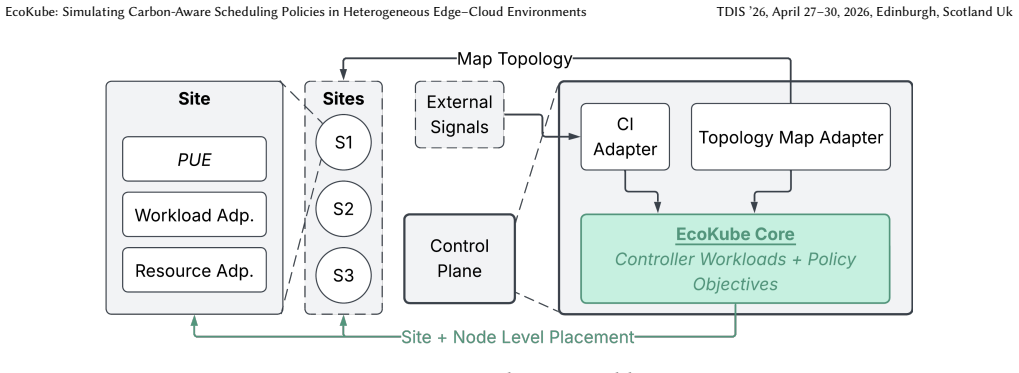
Summary. EcoKube is a Go-based discrete-event simulator for comparing sustainability-aware scheduling policies on heterogeneous federated edge–cloud topologies. It models site-level CI/PUE (and a normalisation factor k_s), node-level feasibility (resources, accelerators, latency), and exposes Kubernetes-style hard filtering plus a pluggable Score hook. A reference two-stage weighted policy (site then node; Eqs. 3–4) is compared under matched seeds to default Kubernetes, KEIDS, and TOPSIS/KCSS on synthetic batch workloads over a fixed three-site (NL/FR/DE), eight-node substrate. In the reported slice, EcoKube Policy cuts the model’s operational emissions estimate by ~45% relative to k8s (32.14 kg → 17.63 kg mean per ~900-job run; Table 4) with ~1.35% makespan increase. The stated contribution is architectural and experimental: a reproducible pre-deployment comparison workflow, not a new optimisation paradigm.
Significance. If the framework is sound and usable, it fills a real gap: carbon-aware placement work often lacks a shared, Kubernetes-compatible test harness that jointly models site CI/PUE and node heterogeneity. Strengths include deterministic matched evaluation, public artifacts (GitHub), explicit policy hooks, and honest framing of EcoKube Policy as a reference instantiation. The result is primarily an engineering/methodology contribution for the sustainable systems and edge–cloud scheduling community; transfer of the 45% emissions figure to real multi-site carbon impact is not yet established and should not be the main claim.
major comments (4)
- §4.1–4.2 and Table 4: The headline 45.15% emissions reduction treats total_ci_cost_g (energy × PUE × time-aligned CI, cf. Eq. 1) as an external outcome, yet EcoKube Policy’s site and node scores (Eqs. 3–4) directly embed the same Ê·PUE·CI product with non-trivial weight (w_C = 0.21 plus site-level terms). Under synthetic energy estimates and a single fixed topology, the large gap vs k8s/KEIDS/TOPSIS mainly shows more aggressive optimisation of the simulator’s own objective. For the central claim of a “reproducible way to compare … before deployment,” reframe results as in-model ranking behaviour, report sensitivity when the evaluation metric is partially decoupled from scoring inputs, or add an external/held-out carbon proxy.
- §3.1.3 Eq. (3) and §4.1: Estimated IT energy Ê_{w,n} is load-bearing for both ranking and the reported emissions metric, but the manuscript does not specify how energy is computed (power model, utilisation, GPU vs CPU, contention, idle power, or duration). Without this, absolute kg figures and cross-policy deltas in Table 4 cannot be audited or reproduced from the text alone. Document the energy model, its parameters, and any calibration assumptions; if purely synthetic, state that explicitly and bound sensitivity.
- §4.1 and Table 3: Evaluation uses one three-site/eight-node topology, three synthetic mix presets, and no real-cluster power or placement traces. §4.3 acknowledges this, but the abstract and conclusions still present the workflow as ready for pre-deployment comparison. Either expand to at least one additional topology/workload family (or a small empirical replay) or narrow the claim to “controlled synthetic comparison under hybrid heterogeneity,” with quantitative limits on generalisation.
- Table 2 / §4.1 baselines: KEIDS and TOPSIS/KCSS are reimplemented inside EcoKube. Faithfulness of those ports (objective terms, interference model for KEIDS, criteria set for TOPSIS) is not validated against original papers or reference code. Mis-implementation would inflate EcoKube Policy’s relative gain. Provide implementation notes, parameter mapping, and a short sanity check that baseline behaviour matches published intent under a simple scenario.
minor comments (6)
- §3.1.4 vs Table 3: Site-level weights are written as α, β, γ in the table but as a weight vector W and separate site parameters in the text; align notation throughout.
- Figure 2: Axis labels repeat the metric name; add error bars or IQR over the 50 repetitions so variance is visible.
- Eq. (1): k_s is introduced as compensating for “measurement and attribution differences” but never given numerical values or a selection method in the evaluation setup.
- Abstract and §1: “TOPSIS/KCSS” is slightly ambiguous; Table 2 lists topsis with citation [8] (KCSS)—clarify whether one or two baselines are used.
- §4.1: Warm-up of 30 minutes is stated but not justified relative to arrival rates and job counts; a one-sentence rationale would help.
- References: several arXiv and survey items are fine for a workshop, but ensure KEIDS venue/year consistency with the IEEE IoT Journal citation as printed.
Circularity Check
No derivation circularity; only mild, acknowledged objective–metric alignment in the synthetic evaluation slice.
-
other
[§3.1.3 Eq. 3; §4.1 evaluation metrics; Table 4]
"C(w, n, t)=w_E Ê_w,n + w_C Ê_w,n · PUE_s(n) · CI_s(n) + … This distinction is important since the policy also consumes CI- and PUE-related signals during ranking; accordingly, the reported emissions estimate should be interpreted as an externally recomputed outcome under the scenario model. … EcoKube Policy … achieves a 45.15% reduction in the reported emissions estimate relative to k8s … from 32.14 kg to 17.63 kg"
The primary reported outcome (estimated emissions / total_ci_cost_g) is the same energy×PUE×CI functional that appears with non-zero weight in EcoKube Policy’s scoring (Eq. 3) and site ranking. Relative to pure k8s (which ignores CI/PUE), a large reduction is therefore partly by construction of the objective. This is mild and acknowledged, not a fitted-parameter-as-prediction or self-definitional derivation of a physical law; KEIDS/TOPSIS see the same signals yet do not obtain the 45% gap, so the result is not tautological.
full rationale
EcoKube is an engineering/systems paper whose load-bearing claim is architectural: a deterministic, Kubernetes-style simulator with pluggable Score hooks for comparing sustainability-aware policies under heterogeneous federated topologies. That claim is self-contained and is evaluated against external baselines (default k8s, KEIDS, TOPSIS/KCSS) under matched seeds, topology, and CI/PUE traces; it does not rest on a first-principles derivation, uniqueness theorem, or self-citation chain. The reference EcoKube Policy’s node score (Eq. 3) and site ranking do embed the same Ê·PUE·CI product later aggregated as total_ci_cost_g / estimated emissions, so the large gap versus k8s is partly the expected effect of optimizing a weighted form of the reported functional. The authors explicitly flag this (§4.1) and treat the quantity as a scenario-model estimate, not real-world footprint. Critically, other CI-aware baselines (KEIDS, TOPSIS) observe the same signals yet show essentially no emissions reduction in the same slice (Table 4: ~32.12 kg vs k8s 32.14 kg), so the 45% figure is not forced by mere inclusion of the term—it reflects EcoKube’s particular site-then-node composition under the synthetic generator. Weights are exposed configuration knobs with a reported sweep, not parameters fitted to the headline outcome and then re-presented as prediction. No self-citation carries a uniqueness or ansatz premise; no known empirical law is renamed. Score 1 reflects only the mild, transparent objective–metric coupling, not a circular derivation.
Assumptions & free parameters
free parameters (5)
- Node-level weights w_E, w_C, w_L, w_fit(n) =
0.58, 0.21, 0.21, 0.20
- Site-level parameters α, β, γ, w_fit(s) =
0.58, 0.21, 0.21, 0.2
- Carbon weight sweep θ_c =
{0.2,0.4,0.6,0.8}
- Site normalisation factor k_s and fixed PUE per site =
fixed per campaign (values not fully tabulated in text)
- Synthetic workload presets (gpu_share, arrival rates, batch sizes, job counts) =
gpu_share 0.05/0.12/0.28; rates 0.8–1.4 jobs/min; N∈{300,600,900}
assumptions (5)
- domain assumption Job carbon footprint ≈ E_IT · PUE_s · k_s · CI_s over the job interval (Eq. 1).
- domain assumption Completion time decomposes as queue + runtime + network latency terms with node-dependent runtime (Eq. 2).
- domain assumption Kubernetes-style hard constraints (requests/limits, taints/tolerations, affinity) correctly define feasibility before soft scoring.
- ad hoc to paper Min-max normalisation of energy, emissions, latency, and fit over the feasible candidate set yields comparable scores for weighted ranking (Eq. 3–4).
- ad hoc to paper Synthetic batch arrivals and a fixed 3-site NL/FR/DE topology with 8 nodes are sufficient to demonstrate framework utility for hybrid edge-cloud policies.
invented entities (2)
-
EcoKube modular discrete-event simulator with CI/Topology/Resource/Workload adapters and pluggable Score hook
independent evidence
-
EcoKube Policy (two-stage site-then-node weighted ranking)
Cite this review
Pith. "Pith review of EcoKube: Simulating Carbon-Aware Scheduling Policies in Heterogeneous Edge-Cloud Environments." pith.science (2026). https://pith.science/paper/QA4SOBZF
@misc{pith2026260709318,
  author       = {Pith},
  title        = {Pith review of: EcoKube: Simulating Carbon-Aware Scheduling Policies in Heterogeneous Edge-Cloud Environments},
  year         = {2026},
  howpublished = {\url{https://pith.science/paper/QA4SOBZF}},
  note         = {Machine review of arXiv:2607.09318}
}
read the original abstract
Energy demand from cloud and edge computing is rising rapidly, with AI workloads further intensifying electricity use and associated carbon emissions. In hybrid edge-cloud settings, sustainability impact depends on time- and location-varying grid Carbon Intensity (CI), site Power Usage Effectiveness (PUE), and heterogeneous hardware characteristics. Existing carbon-aware work explores solutions such as temporal elasticity, spatio-temporal workload shifting, and carbon-aware placement across distributed sites. However, these solutions do not provide a consistent and reproducible workflow for evaluating sustainability-aware scheduling policies on heterogeneous, federated edge-cloud topologies. We present EcoKube: a configurable simulation framework for the reproducible evaluation of sustainability-aware scheduling policies in heterogeneous edge-cloud environments. The framework includes an event-driven deterministic simulator, policy hooks, and a heterogeneity-aware reference policy. We evaluate the framework with synthetic batch workloads, comparing the reference policy against the default Kubernetes scheduler, KEIDS, and TOPSIS/KCSS. The contribution is architectural and experimental: EcoKube provides a reproducible way to compare sustainability-aware policies before deployment.
Figures

Reference graph
Works this paper leans on
-
[1]
Coroamă, Matteo Franzil, Stefano Galantino, and Matthias Finkbeiner
Nasir Asadov, Vlad C. Coroamă, Matteo Franzil, Stefano Galantino, and Matthias Finkbeiner. 2025. Carbon-Aware Spatio-Temporal Workload Shifting in Edge– Cloud Environments: A Review and Novel Algorithm.Sustainability17, 14 (Jan. 2025), 6433. doi:10.3390/su17146433
-
[2]
Reza Ghafari, Farhad Heydari Kabutarkhani, and Nima Mansouri. 2022. Task Scheduling Algorithms for Energy Optimization in Cloud Environment: A Comprehensive Review.Cluster Computing25, 2 (April 2022), 1035–1093. doi:10.1007/s10586-021-03512-z
-
[3]
Hanafy, Qianlin Liang, Noman Bashir, David Irwin, and Prashant Shenoy
Walid A. Hanafy, Qianlin Liang, Noman Bashir, David Irwin, and Prashant Shenoy. 2023. CarbonScaler: Leveraging Cloud Workload Elasticity for Op- timizing Carbon-Efficiency.Proc. ACM Meas. Anal. Comput. Syst.7, 3 (Dec. 2023), 57:1–57:28. doi:10.1145/3626788
doi:10.1145/3626788 2023
-
[4]
Cheol-Ho Hong and Blesson Varghese. 2020. Resource Management in Fog/Edge Computing: A Survey on Architectures, Infrastructure, and Algorithms.Comput. Surveys52, 5 (2020), 1–37. doi:10.1145/3326066
doi:10.1145/3326066 2020
-
[5]
Avita Katal, Susheela Dahiya, and Tanupriya Choudhury. 2023. Energy Efficiency in Cloud Computing Data Centers: A Survey on Software Technologies.Cluster Computing26, 3 (2023), 1845–1875. doi:10.1007/s10586-022-03713-0
-
[6]
Kuljeet Kaur, Sahil Garg, Georges Kaddoum, Syed Hassan Ahmed, and Mo- hammed Atiquzzaman. 2025. KEIDS: Kubernetes-Based Energy and Interference Driven Scheduler for Industrial IoT in Edge-Cloud Ecosystem.IEEE Internet of Things Journal7, 5 (2025), 4228–4237. doi:10.1109/JIOT.2019.2939534
-
[7]
2023.Counting Carbon: A Survey of Factors Influencing the Emissions of Machine Learning
Alexandra Sasha Luccioni and Alex Hernandez-Garcia. 2023.Counting Carbon: A Survey of Factors Influencing the Emissions of Machine Learning. arXiv:2302.08476 [cs] doi:10.48550/arXiv.2302.08476
-
[8]
Toufik Menouer. 2021. KCSS: Kubernetes Container Scheduling Strategy.The Journal of Supercomputing77, 5 (May 2021), 4267–4293. doi:10.1007/s11227-020- 03427-3
Show all 18 references
-
[9]
Ana Radovanović, Ross Koningstein, Ian Schneider, Bokan Chen, Alexandre Duarte, Binz Roy, Diyue Xiao, Maya Haridasan, Patrick Hung, Nick Care, Saurav Talukdar, Eric Mullen, Kendal Smith, MariEllen Cottman, and Walfredo Cirne
-
[10]
doi:10.1109/TPWRS.2022.3173250
Carbon-Aware Computing for Datacenters.IEEE Transactions on Power Systems38, 2 (2023), 1270–1280. doi:10.1109/TPWRS.2022.3173250
2023 doi
-
[11]
Noura Saad, Mahmoud Ezzat, Reem Hasan, Mohammad Shayan, Ammar Gharaibeh, and Mohammed Hammad. 2025. Carbon-Aware Container Orchestra- tion: A Survey.Journal of Network and Computer Applications(Jan. 2025), 103731. doi:10.1016/j.jnca.2024.103731
2025 doi
-
[12]
Abdullah Senjab, Mahmud Noman, Toufique Ahmed, Sultan Alharbi, Muham- mad Waseem Iqbal, and Valdis Berzins. 2023. A Survey on Kubernetes Scheduling: A Taxonomy and Open Challenges.Cluster Computing27, 1 (Dec. 2023), 123–154. doi:10.1007/s10586-023-04094-5
2023 doi
-
[13]
Abel Souza, Shruti Jasoria, Basundhara Chakrabarty, Alexander Bridgwater, Axel Lundberg, Filip Skogh, Ahmed Ali-Eldin, David Irwin, and Prashant Shenoy
-
[14]
InProceedings of the 14th International Green and Sustainable Computing Conference(New York, NY, USA, 2024-05-29)(IGSC ’23)
CASPER: Carbon-Aware Scheduling and Provisioning for Distributed Web Services. InProceedings of the 14th International Green and Sustainable Computing Conference(New York, NY, USA, 2024-05-29)(IGSC ’23). Association for Computing Machinery, New York, NY, USA, 67–73. doi:10.114...
2024 doi
-
[15]
Philipp Wiesner, Ilja Behnke, Dominik Scheinert, Kordian Gontarska, and Lau- ritz Thamsen. 2021. Let’s Wait Awhile: How Temporal Workload Shifting Can Reduce Carbon Emissions in the Cloud. InProceedings of the 22nd In- ternational Middleware Conference(New York, NY, USA, 2021-...
2021 doi
-
[16]
Hanafy, Abel Souza, Khai Nguyen, Jan Harkes, David Ir- win, Mahadev Satyanarayanan, and Prashant Shenoy
Li Wu, Walid A. Hanafy, Abel Souza, Khai Nguyen, Jan Harkes, David Ir- win, Mahadev Satyanarayanan, and Prashant Shenoy. 2025. CarbonEdge: Leveraging Mesoscale Spatial Carbon-Intensity Variations for Low Carbon Edge Computing. InProceedings of the 34th International Symposium ...
2025 doi
-
[17]
Chien-Sheng Yang, Chien-Chun Huang-Fu, and I-Kang Fu. 2022. Carbon- Neutralized Task Scheduling for Green Computing Networks. InGLOBECOM 2022 - 2022 IEEE Global Communications Conference(2022-12). Institute of Electrical and Electronics Engineers (IEEE), Rio de Janeiro, Brazil...
2022 doi
- [18]
Reviewed July 13, 2026 · model on record in the stance chip above.
Discussion (0). Sign in to comment.