REVIEW 2 major objections 4 minor 95 references
Testing the Accuracy of Halo Occupation Distribution Modelling using Hydrodynamic Simulations
T0 review · 2 major / 4 minor · reviewed 2026-08-14 · deepseek-v4-flash
Pith's one-line read A simple five-parameter galaxy-halo recipe works for bright galaxies after correcting halo masses for baryons, but faint galaxies need extra bias parameters.
desk verdict A systematic and useful HOD stress test whose main claims hold up, though the key mass-correction robustness check is not shown and the faint-sample conclusion is indirect. read the letter →
The pith
A machine-rendered reading of the paper's core claim, the machinery that carries it, and where it could break.
The reading
What carries the argument
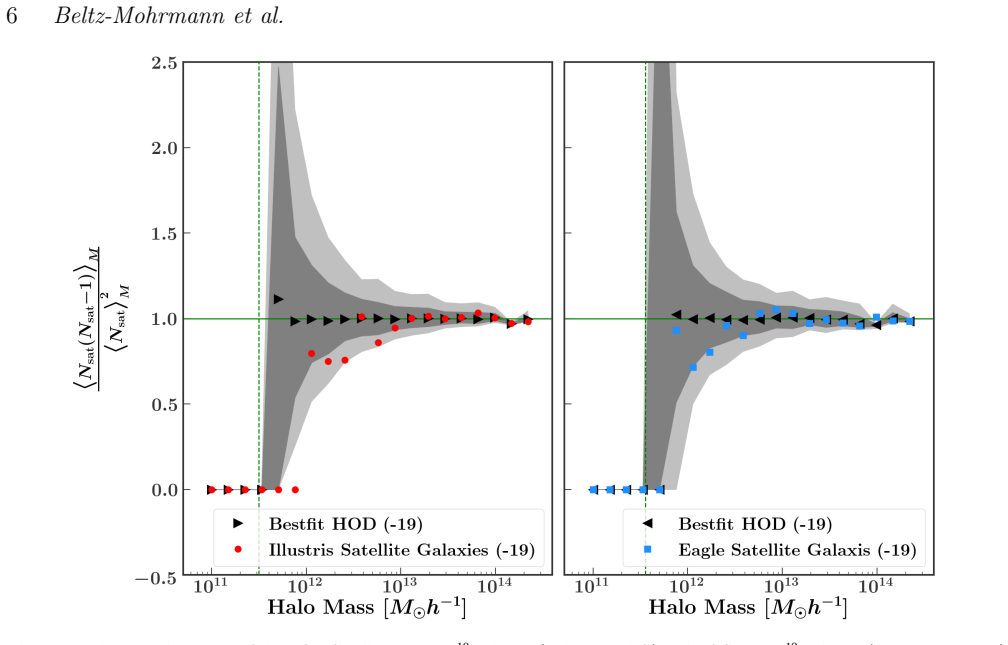
The engine is the "vanilla" HOD: central galaxies are placed with probability $\langle N_{\mathrm{cen}}\rangle = \frac{1}{2}[1+\mathrm{erf}((\log M-\log M_{\min})/\sigma_{\log M})]$, and satellites are Poisson draws with mean $\langle N_{\mathrm{sat}}\rangle = \langle N_{\mathrm{cen}}\rangle((M-M_0)/M_1)^\alpha$. The second piece is a rank-based mass correction: dark-matter-only haloes are sorted by mass and assigned the mass of the hydrodynamic halo at the same rank, giving each dark-matter-only halo a multiplier that recovers the hydrodynamic halo mass function. The third piece is a diagnostic protocol: replacing satellites' positions and velocities with random dark-matter particle values removes spatial and velocity bias, while swapping galaxies between haloes of similar mass removes assembly bias; the improvement in agreement after each operation identifies which missing ingredient the baseline model needs.
What would settle it
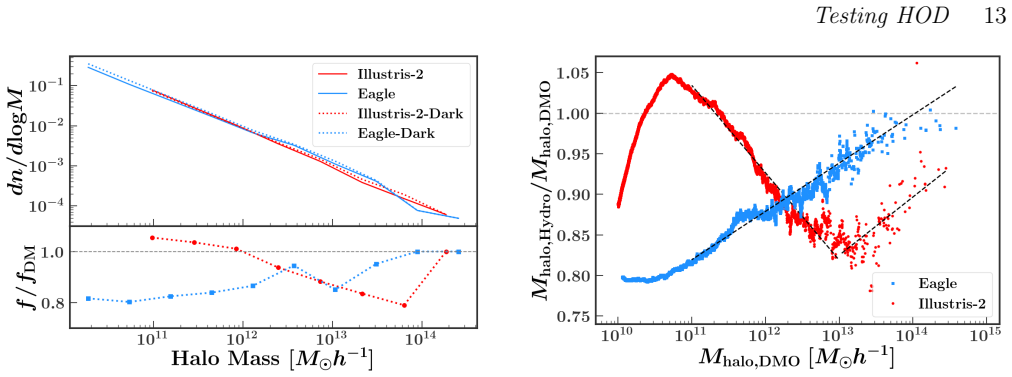
Compare the rank-based mass ratios shown in Figure 8 with ratios obtained by matching haloes between the hydrodynamic and dark-matter-only runs through their particle IDs; if the two mass-ratio curves disagree, the correction is not isolating a pure baryonic mass shift, and the reported clustering agreement could be a coincidence. A second check is to recompute the correction separately in high- and low-density regions and see whether a single multiplier fits both.
Extended reading notes
Core claim
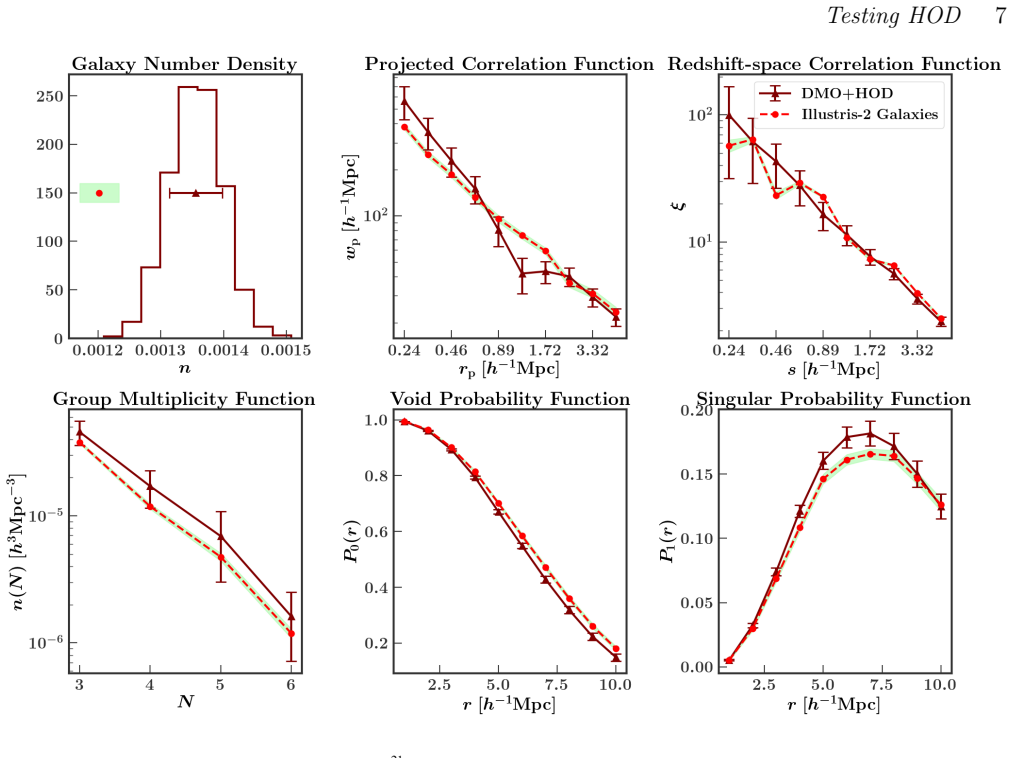
The paper's central claim is that the standard five-parameter HOD is not inherently inadequate, but it is usually applied to the wrong haloes. In the hydrodynamic runs, baryonic feedback lowers halo masses relative to the dark-matter-only runs, shifting the halo mass function to lower masses, so the same best-fitting HOD populates too many high-mass haloes and overproduces galaxies. The paper corrects this by rank-matching dark-matter-only haloes to hydrodynamic haloes and multiplying each mass by the ratio of the two, which makes the mass functions agree. After that correction, the five-parameter HOD reproduces the projected correlation function, the redshift-space correlation function, the group multiplicity function, the void probability function, the singular probability function, and the number density for the bright galaxy sample in both simulations. The faint sample does not agree on most of these statistics until satellite spatial bias, satellite and central velocity bias, and assembly bias are successively removed from the simulation galaxies; the paper reads this as evidence that faint samples need HOD parameters for those biases, while bright samples do not. The exact baryonic correction is simulation-dependent, which the authors take as a warning that any fixed correction carries systematic uncertainty.
Load-bearing premise
The whole post-correction result rests on assuming that matching dark-matter-only haloes to hydrodynamic haloes by mass rank pairs the same halo population, so the correction only shifts halo masses and does not accidentally erase environmental or clustering information; if that pairing is wrong, the bright-sample agreement could be an artifact.
Editorial extensions
If this is right
- Bright galaxy samples can be modelled with the standard five-parameter HOD, provided the dark-matter-only halo mass function is first corrected for the baryonic shift.
- Faint galaxy samples will require extended HODs that include spatial, velocity, and assembly-bias parameters; vanilla HOD fits to faint samples will inherit systematic bias.
- Galaxy number density is a sharp diagnostic: a dark-matter-only HOD run that matches correlation functions but overproduces number density is probably missing the baryonic halo-mass correction.
- Because the baryonic correction differs between the two simulations, HOD analyses of real surveys should repeat with several plausible corrections to quantify the systematic uncertainty.
- The void probability function is especially sensitive to assembly bias, so surveys should measure counts-in-cells statistics in addition to correlation functions when constraining extended HOD parameters.
Reading between the lines
- A direct test of the correction is to run the same rank-matching on a third hydrodynamic simulation with different feedback physics; the spread in the required mass-ratio curves would show how much of the bright-sample success is simulation-specific.
- The bias-removal protocol could be inverted into a calibration: inject known spatial, velocity, and assembly-bias amplitudes into dark-matter-only mocks and check whether the proposed HOD extensions recover the injected values.
- The rank-based correction assumes a single global mass shift, so it likely misses environment-dependent baryonic effects at low masses; a natural extension is a correction that also depends on halo concentration or local density.
- The paper's division between bright and faint samples suggests that cosmological constraints from bright galaxy clustering are less affected by uncertain baryonic feedback, so future surveys may want to prioritize bright samples for HOD-based cosmology.
Signed reviews
Editorial analysis
A structured set of objections, weighed in public.
Referee Report
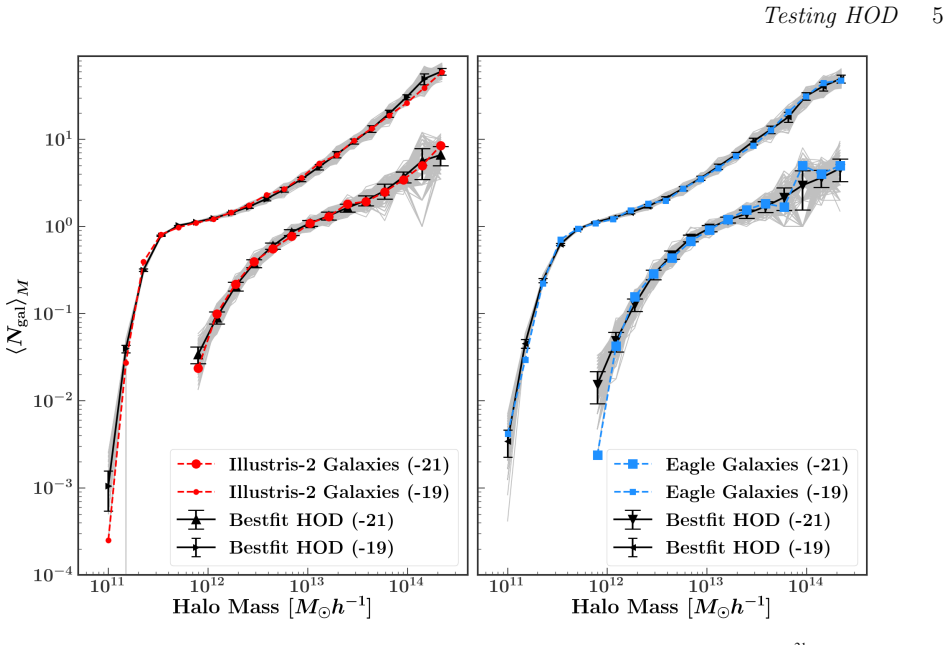
Summary. The paper tests whether the standard five-parameter HOD of Zheng et al. (2007) can reproduce galaxy clustering in two hydrodynamic simulations, Illustris-2 and EAGLE, for a high- and a low-luminosity threshold sample. For each simulation and sample, the HOD parameters are fitted to the mean central and satellite occupation functions of the hydrodynamic run, and the same parameters are then applied to the DMO counterpart simulation to generate 1000 mock catalogues. Six statistics are measured on both the hydrodynamic galaxies and the mocks: galaxy number density, the projected and redshift-space two-point correlation functions, the group multiplicity function, the void probability function, and a 'singular probability function.' The authors find that the HOD systematically overpredicts the number density in every case, which they trace to baryons shifting the halo mass function to lower masses in both simulations, albeit with different mass dependence (Section 6). After correcting the DMO halo masses by rank-based abundance matching to the hydrodynamic haloes, the vanilla HOD reproduces all clustering statistics for the high-luminosity samples at roughly the 2-3 sigma level.
Significance. If the central high-luminosity result holds, the paper is a useful quantitative demonstration of a systematic that is usually ignored in HOD applications: baryonic feedback shifts the halo mass function in a simulation-dependent way, and the correction must be calibrated rather than assumed. The study has notable strengths. The HOD is fitted only to the occupation function, so the projected and redshift-space correlation functions, group multiplicity function, VPF, and SPF are out-of-sample predictions; the number density, by contrast, is essentially fixed by the HMF correction and the HOD fit, a point the paper should state explicitly. The use of two independent hydrodynamic codes with different numerics and feedback models gives some handle on theoretical systematics, and the suite of six statistics, including the rarely used VPF and SPF, provides diagnostic power beyond the usual two-point clustering. The paper also provides fitting functions for the baryonic mass correction (Table 4) that are directly useful to the community.
major comments (2)
- [Section 6, Figures 7–9] The abstract's high-luminosity claim ('After applying a correction to the halo mass function in each simulation, the HOD is able to accurately reproduce all clustering statistics') rests entirely on the rank-based abundance-matching correction of DMO halo masses (Section 6, Figure 8). That correction is only valid if the baryonic mass shift is essentially independent of environment; the manuscript says 'We have examined the conditional HMF in Illustris ... the effect of baryons on the HMF only depends on environment at very high halo masses' and that an environment-dependent correction changes the clustering statistics 'negligibly,' but no such analysis is shown, and no analogous check is reported for EAGLE. Because the correction makes the global HMF (and, together with the HOD fit to the occupation function, the galaxy number density) agree by construction, the nontrivial content of the high-luminosity claim is the spatial and velocity clustering of the corrected halo population. If the rank mapping assigns systematically wrong masses to DMO haloes in particular environments, the agreement in wp(rp) and xi(s) could be an artifact of the correction method rather than evidence for the HOD. I request that the authors (i) show the conditional mass ratio M_hydro/M_DMO in environment bins for both simulations, (ii) repeat the clustering comparison using an alternative correction, e.g., position- or particle-ID-matched haloes or an environment-dependent correction, and (iii) present the halo correlation function comparison that is currently described only in words in Section 6.
- [Section 7, Table 3] The low-luminosity conclusion is established by removing effects from the hydrodynamic simulation galaxies rather than by fitting an extended HOD. The abstract's wording ('we find evidence that ... is necessary') is appropriately hedged, but the conclusions should state explicitly that the removal experiments test necessity, not sufficiency: they show that a vanilla HOD cannot match galaxies that exhibit spatial/velocity/assembly bias, but they do not demonstrate that an HOD with free bias parameters can fit the original simulation statistics. In addition, the assembly-bias removal procedure (Section 7.3) swaps galaxies between 'pairs of haloes with similar masses' without specifying the mass tolerance or the construction of the four pairings used to generate the 4000 realizations; the reported p-values could depend on these choices. Please specify the pairing criterion and test sensitivity to it. A direct check of whether a decorated HOD (e.g., Hearin et al. 2016) with bias parameters can reproduce the low-luminosity clustering would considerably strengthen the paper's central recommendation.
minor comments (4)
- [Section 6] The statement that for the M−21r samples 'all clustering statistics are at or better than the 2σ level' after the HMF correction is not consistent with Table 3 for EAGLE: wp(rp) has p=3.64×10^-2 and xi(s) has p=4.07×10^-2, below the conventional two-sided 2σ threshold (p≈0.0455). Please state the σ convention used or reword the claim.
- [Section 6] The post-correction number density agreement is close to guaranteed: both the HOD parameters (Section 3.2) and the HMF correction (Section 6) are derived from the same hydrodynamic simulation, so the number-density p-values after correction are a consistency check rather than an independent prediction. The paper should say this when presenting the corrected number-density p-values.
- [Section 8] The bullet list in the summary contains a grammatical error: 'It also able to accurately reproduce galaxy number density' should read 'It is also able to ...'.
- [Figure 9 caption] The caption says 'The values of these points are given in Tables 3'; this should be 'Table 3'.
Circularity Check
High-luminosity success is partly circular: the HMF correction is built from the same simulations, so the corrected number-density agreement is forced; the other clustering statistics are genuinely out-of-sample and unsullied.
-
fitted input called prediction
[Section 6 ('The Effect of Baryons on the Halo Mass Function'), Figure 8 procedure and Table 3 rows labeled 'Halo Mass Function']
"We do this by identifying the most massive halo in the dark matter only simulation and assigning it the mass of the most massive halo in the hydrodynamic version, and then we do the same for the next most massive halo, and so on. In other words, we multiply the DMO halo masses in each simulation by their y-axis value in Figure 8. This process serves to isolate the effect of baryons on the halo mass function, allowing us to correct the DMO HMFs so that they agree with the HMFs from the hydrodynamic simulations."
The correction factor is computed from the same hydrodynamic and DMO simulations that define the comparison target, and the procedure explicitly forces the corrected DMO halo mass function to equal the hydrodynamic HMF. The HOD parameters were themselves fit to the hydrodynamic galaxy occupation in Section 3.2. Therefore the post-correction galaxy number density is not an out-of-sample prediction: ng = ∫(dN_DMO,corrected/dM)<N_fit(M)>dM equals ∫(dN_hydro/dM)<N_hydro(M)>dM by construction, up to the quality of the occupation fit. The high p-values for number density in the 'Halo Mass Function' rows of Table 3 therefore largely reflect the in-sample HOD fit, not a successful prediction.
full rationale
The paper's central derivation is mostly self-contained and the clustering comparisons are legitimate: five-parameter HODs are fit to hydrodynamic galaxy occupations, applied to DMO haloes, and six clustering statistics are measured in matched ways. The main circular element is the halo-mass-function correction. The rank-based abundance-matching ratio in Figure 8 is derived from the same two simulations that serve as the target, and the paper explicitly uses it to force the DMO HMF to agree with the hydrodynamic HMF. Because the HOD was already fit to those same hydrodynamic galaxies, the corrected number density is a fitted input renamed as a successful prediction, not an independent test. This affects only the number-density component of the 'all clustering statistics' claim; the other five statistics are not used in the fits, and the persistent low-luminosity discrepancies are nontrivial. There is no load-bearing self-citation chain, no imported uniqueness theorem, and no ansatz smuggled in via citation. The rank-matching method's environmental robustness is a correctness risk rather than a circularity, since the paper reports but does not show those checks. Overall the central claim is partially constructed from its inputs but retains substantial independent content, giving a score of 4.
Assumptions & free parameters
free parameters (5)
- HOD log M_min =
Illustris -21/-19, EAGLE -21/-19: 12.681, 11.500, 12.767, 11.555
- HOD sigma_logM =
0.532, 0.180, 0.504, 0.237
- HOD log M_0 =
12.296, 11.659, 12.467, 11.717
- HOD log M_1 =
13.635, 12.590, 13.799, 12.566
- HOD alpha =
0.994, 0.979, 1.000, 0.938
assumptions (5)
- domain assumption Illustris-2 and EAGLE hydrodynamic simulations are adequate stand-ins for real galaxy formation when testing the HOD framework.
- domain assumption In the vanilla HOD, mean occupation depends only on halo mass, with central and satellite components given by Eqs. (1) and (2).
- domain assumption Satellite galaxy counts are Poisson and satellite positions and velocities trace dark matter particles, while centrals sit at halo centers.
- domain assumption Rank-based abundance matching of DMO halo masses to hydro halo masses yields the correct baryonic halo mass correction.
- domain assumption The galaxy-swapping procedure in Section 7.3 removes assembly bias without otherwise changing the clustering signal.
Cite this review
Pith. "Pith review of Testing the Accuracy of Halo Occupation Distribution Modelling using Hydrodynamic Simulations." pith.science (2026). https://pith.science/paper/QAKWLHGG
@misc{pith2026190811448,
  author       = {Pith},
  title        = {Pith review of: Testing the Accuracy of Halo Occupation Distribution Modelling using Hydrodynamic Simulations},
  year         = {2026},
  howpublished = {\url{https://pith.science/paper/QAKWLHGG}},
  note         = {Machine review of arXiv:1908.11448}
}
read the original abstract
Halo models provide a simple and computationally inexpensive way to investigate the connection between galaxies and their dark matter haloes. However, these models rely on the assumption that the role of baryons can be easily parametrized in the modelling procedure. We aim to examine the ability of halo occupation distribution (HOD) modelling to reproduce the galaxy clustering found in two different hydrodynamic simulations, Illustris and EAGLE. For each simulation, we measure several galaxy clustering statistics on two different luminosity threshold samples. We then apply a simple five parameter HOD, which was fit to each simulation separately, to the corresponding dark matter only simulations, and measure the same clustering statistics. We find that the halo mass function is shifted to lower masses in the hydrodynamic simulations, resulting in a galaxy number density that is too high when an HOD is applied to the dark matter only simulation. However, the exact way in which baryons alter the mass function is remarkably different in the two simulations. After applying a correction to the halo mass function in each simulation, the HOD is able to accurately reproduce all clustering statistics for the high luminosity sample of galaxies. For the low luminosity sample, we find evidence that in addition to correcting the halo mass function, including spatial, velocity, and assembly bias parameters in the HOD is necessary to accurately reproduce clustering statistics.
Figures
Figures from the paper (5 more)



Reference graph
Works this paper leans on
-
[1]
Abazajian K. N., et al., 2009, @doi [ ] 10.1088/0067-0049/182/2/543 , http://adsabs.harvard.edu/abs/2009ApJS..182..543A 182, 543
-
[2]
Artale M. C., Zehavi I., Contreras S., Norberg P., 2018, @doi [ ] 10.1093/mnras/sty2110 , http://adsabs.harvard.edu/abs/2018MNRAS.480.3978A 480, 3978
-
[5]
Berlind A. A., Weinberg D. H., 2002, @doi [ ] 10.1086/341469 , http://adsabs.harvard.edu/abs/2002ApJ...575..587B 575, 587
doi:10.1086/341469 2002
-
[6]
A., et al., 2003, @doi [ ] 10.1086/376517 , http://adsabs.harvard.edu/abs/2003ApJ...593....1B 593, 1
Berlind A. A., et al., 2003, @doi [ ] 10.1086/376517 , http://adsabs.harvard.edu/abs/2003ApJ...593....1B 593, 1
doi:10.1086/376517 2003
-
[7]
A., et al., 2006, @doi [ ] 10.1086/508170 , http://adsabs.harvard.edu/abs/2006ApJS..167....1B 167, 1
Berlind A. A., et al., 2006, @doi [ ] 10.1086/508170 , http://adsabs.harvard.edu/abs/2006ApJS..167....1B 167, 1
doi:10.1086/508170 2006
-
[8]
Beutler F., et al., 2013, @doi [ ] 10.1093/mnras/sts637 , http://adsabs.harvard.edu/abs/2013MNRAS.429.3604B 429, 3604
-
[9]
Bocquet S., Saro A., Dolag K., Mohr J. J., 2016, @doi [ ] 10.1093/mnras/stv2657 , http://adsabs.harvard.edu/abs/2016MNRAS.456.2361B 456, 2361
-
[10]
J., Hernquist L., Pillepich A., Nelson D., Marinacci F., Springel V., Vogelsberger M., 2019, arXiv e-prints, https://ui.adsabs.harvard.edu/abs/2019arXiv190508799B
Bose S., Eisenstein D. J., Hernquist L., Pillepich A., Nelson D., Marinacci F., Springel V., Vogelsberger M., 2019, arXiv e-prints, https://ui.adsabs.harvard.edu/abs/2019arXiv190508799B
2019
Show all 95 references
-
[11]
Boylan-Kolchin M., Springel V., White S. D. M., Jenkins A., 2010, @doi [ ] 10.1111/j.1365-2966.2010.16774.x , http://adsabs.harvard.edu/abs/2010MNRAS.406..896B 406, 896
2010
-
[12]
S., Wechsler R
Bullock J. S., Wechsler R. H., Somerville R. S., 2002, @doi [ ] 10.1046/j.1365-8711.2002.04959.x , http://adsabs.harvard.edu/abs/2002MNRAS.329..246B 329, 246
2002
-
[13]
E., Schaye J., Schaller M., Crain R
Chaves-Montero J., Angulo R. E., Schaye J., Schaller M., Crain R. A., Furlong M., Theuns T., 2016, @doi [ ] 10.1093/mnras/stw1225 , https://ui.adsabs.harvard.edu/abs/2016MNRAS.460.3100C 460, 3100
2016 doi
-
[16]
M., Jim \'e nez E., Lacerna I., 2019, @doi [ ] 10.1093/mnras/stz018 , http://adsabs.harvard.edu/abs/2019MNRAS.484.1133C 484, 1133
Contreras S., Zehavi I., Padilla N., Baugh C. M., Jim \'e nez E., Lacerna I., 2019, @doi [ ] 10.1093/mnras/stz018 , http://adsabs.harvard.edu/abs/2019MNRAS.484.1133C 484, 1133
2019 doi
-
[17]
Cooray A., Sheth R., 2002, @doi [ ] 10.1016/S0370-1573(02)00276-4 , http://adsabs.harvard.edu/abs/2002PhR...372....1C 372, 1
2002 doi
-
[18]
A., et al., 2015, @doi [ ] 10.1093/mnras/stv725 , http://adsabs.harvard.edu/abs/2015MNRAS.450.1937C 450, 1937
Crain R. A., et al., 2015, @doi [ ] 10.1093/mnras/stv725 , http://adsabs.harvard.edu/abs/2015MNRAS.450.1937C 450, 1937
2015 doi
-
[19]
J., Gao L., White S
Croton D. J., Gao L., White S. D. M., 2007, @doi [ ] 10.1111/j.1365-2966.2006.11230.x , http://adsabs.harvard.edu/abs/2007MNRAS.374.1303C 374, 1303
2007
-
[21]
DESI Collaboration et al., 2016, arXiv e-prints, http://adsabs.harvard.edu/abs/2016arXiv161100036D
2016
-
[22]
S., et al., 2013, @doi [ ] 10.1088/0004-6256/145/1/10 , http://adsabs.harvard.edu/abs/2013AJ....145...10D 145, 10
Dawson K. S., et al., 2013, @doi [ ] 10.1088/0004-6256/145/1/10 , http://adsabs.harvard.edu/abs/2013AJ....145...10D 145, 10
2013 doi
-
[23]
H., Crain R
Desmond H., Mao Y.-Y., Wechsler R. H., Crain R. A., Schaye J., 2017, @doi [ ] 10.1093/mnrasl/slx093 , http://adsabs.harvard.edu/abs/2017MNRAS.471L..11D 471, L11
2017 doi
-
[24]
Gao F., Han L., 2012, @doi [Computational Optimization and Applications] 10.1007/s10589-010-9329-3 , 51, 259
2012 doi
-
[25]
Gao L., Springel V., White S. D. M., 2005, @doi [ ] 10.1111/j.1745-3933.2005.00084.x , http://adsabs.harvard.edu/abs/2005MNRAS.363L..66G 363, L66
2005
-
[26]
Genel S., et al., 2014, @doi [ ] 10.1093/mnras/stu1654 , http://adsabs.harvard.edu/abs/2014MNRAS.445..175G 445, 175
2014 doi
-
[27]
Guo H., et al., 2015a, @doi [ ] 10.1093/mnras/stu2120 , http://adsabs.harvard.edu/abs/2015MNRAS.446..578G 446, 578
-
[28]
Guo H., et al., 2015b, @doi [ ] 10.1093/mnras/stv1966 , http://adsabs.harvard.edu/abs/2015MNRAS.453.4368G 453, 4368
-
[30]
P., Zentner A
Hearin A. P., Zentner A. R., van den Bosch F. C., Campbell D., Tollerud E., 2016, @doi [ ] 10.1093/mnras/stw840 , http://adsabs.harvard.edu/abs/2016MNRAS.460.2552H 460, 2552
2016 doi
-
[31]
D., 2007, Computing In Science & Engineering, 9, 90
Hunter J. D., 2007, Computing In Science & Engineering, 9, 90
2007
-
[32]
M., Gonzalez-Perez V., 2019, arXiv e-prints, https://ui.adsabs.harvard.edu/abs/2019arXiv190604298J
Jim \'e nez E., Contreras S., Padilla N., Zehavi I., Baugh C. M., Gonzalez-Perez V., 2019, arXiv e-prints, https://ui.adsabs.harvard.edu/abs/2019arXiv190604298J
2019
-
[33]
P., Mo H
Jing Y. P., Mo H. J., B \"o rner G., 1998, @doi [ ] 10.1086/305209 , http://adsabs.harvard.edu/abs/1998ApJ...494....1J 494, 1
1998 doi
-
[34]
Jones E., Oliphant T., Peterson P., Others 2001, SciPy : Open source scientific tools for Python, http://www.scipy.org/
2001
-
[35]
H., et al., 2004, @doi [ ] 10.1111/j.1365-2966.2004.08353.x , http://adsabs.harvard.edu/abs/2004MNRAS.355..747J 355, 747
Jones D. H., et al., 2004, @doi [ ] 10.1111/j.1365-2966.2004.08353.x , http://adsabs.harvard.edu/abs/2004MNRAS.355..747J 355, 747
2004
-
[36]
Jose C., Subramanian K., Srianand R., Samui S., 2013, @doi [ ] 10.1093/mnras/sts503 , http://adsabs.harvard.edu/abs/2013MNRAS.429.2333J 429, 2333
2013 doi
-
[37]
Kauffmann G., Nusser A., Steinmetz M., 1997, @doi [ ] 10.1093/mnras/286.4.795 , http://adsabs.harvard.edu/abs/1997MNRAS.286..795K 286, 795
1997 doi
-
[38]
M., Diaferio A., White S
Kauffmann G., Colberg J. M., Diaferio A., White S. D. M., 1999, @doi [ ] 10.1046/j.1365-8711.1999.02202.x , http://adsabs.harvard.edu/abs/1999MNRAS.303..188K 303, 188
1999
-
[39]
Kim J.-W., et al., 2014, @doi [ ] 10.1093/mnras/stt2245 , http://adsabs.harvard.edu/abs/2014MNRAS.438..825K 438, 825
2014 doi
-
[40]
V., Berlind A
Kravtsov A. V., Berlind A. A., Wechsler R. H., Klypin A. A., Gottl \"o ber S., Allgood B., Primack J. R., 2004, @doi [ ] 10.1086/420959 , http://adsabs.harvard.edu/abs/2004ApJ...609...35K 609, 35
2004 doi
-
[41]
Y., Somerville R
Lee K.-S., Giavalisco M., Gnedin O. Y., Somerville R. S., Ferguson H. C., Dickinson M., Ouchi M., 2006, @doi [ ] 10.1086/500387 , http://adsabs.harvard.edu/abs/2006ApJ...642...63L 642, 63
2006 doi
-
[42]
N., 2000, @doi [ ] 10.1086/317146 , https://ui.adsabs.harvard.edu/abs/2000ApJ...543..503M 543, 503
Ma C.-P., Fry J. N., 2000, @doi [ ] 10.1086/317146 , https://ui.adsabs.harvard.edu/abs/2000ApJ...543..503M 543, 503
2000 doi
-
[43]
Magliocchetti M., Porciani C., 2003, @doi [ ] 10.1046/j.1365-2966.2003.07094.x , http://adsabs.harvard.edu/abs/2003MNRAS.346..186M 346, 186
2003
-
[44]
H., 2015, @doi [ ] 10.1088/0004-637X/810/1/21 , http://adsabs.harvard.edu/abs/2015ApJ...810...21M 810, 21
Mao Y.-Y., Williamson M., Wechsler R. H., 2015, @doi [ ] 10.1088/0004-637X/810/1/21 , http://adsabs.harvard.edu/abs/2015ApJ...810...21M 810, 21
2015 doi
-
[45]
Marinacci F., et al., 2018, @doi [ ] 10.1093/mnras/sty2206 , https://ui.adsabs.harvard.edu/abs/2018MNRAS.480.5113M 480, 5113
2018 doi
-
[46]
McAlpine S., et al., 2016, @doi [Astronomy and Computing] 10.1016/j.ascom.2016.02.004 , http://adsabs.harvard.edu/abs/2016A
2016 doi
-
[47]
McBride C., Berlind A., Scoccimarro R., Wechsler R., Busha M., Gardner J., van den Bosch F., 2009, in American Astronomical Society Meeting Abstracts \#213. p. 253
2009
-
[48]
McClelland J., Silk J., 1977, @doi [ ] 10.1086/155583 , https://ui.adsabs.harvard.edu/abs/1977ApJ...217..331M 217, 331
1977 doi
-
[49]
McCullagh N., Norberg P., Cole S., Gonzalez-Perez V., Baugh C., Helly J., 2017, arXiv e-prints, http://adsabs.harvard.edu/abs/2017arXiv170501988M
2017
-
[50]
A., Somerville R
Moustakas L. A., Somerville R. S., 2002, @doi [ ] 10.1086/342133 , http://adsabs.harvard.edu/abs/2002ApJ...577....1M 577, 1
2002 doi
-
[51]
P., et al., 2018, @doi [ ] 10.1093/mnras/sty618 , https://ui.adsabs.harvard.edu/abs/2018MNRAS.477.1206N 477, 1206
Naiman J. P., et al., 2018, @doi [ ] 10.1093/mnras/sty618 , https://ui.adsabs.harvard.edu/abs/2018MNRAS.477.1206N 477, 1206
2018 doi
-
[52]
F., Frenk C
Navarro J. F., Frenk C. S., White S. D. M., 1997, @doi [ ] 10.1086/304888 , http://adsabs.harvard.edu/abs/1997ApJ...490..493N 490, 493
1997 doi
-
[53]
A., Mead R., 1965, Computer Journal, 7, 308
Nelder J. A., Mead R., 1965, Computer Journal, 7, 308
1965
-
[54]
Nelson D., et al., 2015, @doi [Astronomy and Computing] 10.1016/j.ascom.2015.09.003 , http://adsabs.harvard.edu/abs/2015A
2015 doi
-
[55]
Nelson D., et al., 2018, @doi [ ] 10.1093/mnras/stx3040 , https://ui.adsabs.harvard.edu/abs/2018MNRAS.475..624N 475, 624
2018 doi
-
[56]
L., 1952, @doi [ ] 10.1086/145599 , http://adsabs.harvard.edu/abs/1952ApJ...116..144N 116, 144
Neyman J., Scott E. L., 1952, @doi [ ] 10.1086/145599 , http://adsabs.harvard.edu/abs/1952ApJ...116..144N 116, 144
1952 doi
-
[57]
Padilla N., Contreras S., Zehavi I., Baugh C., Norberg P., 2018, arXiv e-prints, http://adsabs.harvard.edu/abs/2018arXiv180906424P
2018
-
[59]
Peebles P. J. E., 1974, , https://ui.adsabs.harvard.edu/abs/1974A
1974
-
[60]
E., 2007, @doi [Computing in Science and Engineering] 10.1109/MCSE.2007.53 , 9, 21
P\'erez F., Granger B. E., 2007, @doi [Computing in Science and Engineering] 10.1109/MCSE.2007.53 , 9, 21
2007 doi
-
[61]
Pillepich A., et al., 2018, @doi [ ] 10.1093/mnras/stx3112 , https://ui.adsabs.harvard.edu/abs/2018MNRAS.475..648P 475, 648
2018 doi
-
[62]
A., Berlind A
Piscionere J. A., Berlind A. A., McBride C. K., Scoccimarro R., 2015, @doi [ ] 10.1088/0004-637X/806/1/125 , http://adsabs.harvard.edu/abs/2015ApJ...806..125P 806, 125
2015 doi
-
[63]
Pujol A., Gazta \ n aga E., 2014, @doi [ ] 10.1093/mnras/stu1001 , https://ui.adsabs.harvard.edu/abs/2014MNRAS.442.1930P 442, 1930
2014 doi
-
[64]
Pujol A., Hoffmann K., Jim \'e nez N., Gazta \ n aga E., 2017, @doi [ ] 10.1051/0004-6361/201629121 , https://ui.adsabs.harvard.edu/abs/2017A
2017 doi
-
[65]
N., Maller A
Salcedo A. N., Maller A. H., Berlind A. A., Sinha M., McBride C. K., Behroozi P. S., Wechsler R. H., Weinberg D. H., 2018, @doi [ ] 10.1093/mnras/sty109 , http://adsabs.harvard.edu/abs/2018MNRAS.475.4411S 475, 4411
2018 doi
-
[66]
Scannapieco C., et al., 2012, @doi [ ] 10.1111/j.1365-2966.2012.20993.x , http://adsabs.harvard.edu/abs/2012MNRAS.423.1726S 423, 1726
2012
-
[67]
Schaller M., et al., 2015, @doi [ ] 10.1093/mnras/stv1067 , http://adsabs.harvard.edu/abs/2015MNRAS.451.1247S 451, 1247
2015 doi
-
[68]
Schaye J., et al., 2015, @doi [ ] 10.1093/mnras/stu2058 , http://adsabs.harvard.edu/abs/2015MNRAS.446..521S 446, 521
2015 doi
-
[69]
J., Bertschinger E., 1991, @doi [ ] 10.1086/170658 , http://adsabs.harvard.edu/abs/1991ApJ...381..349S 381, 349
Scherrer R. J., Bertschinger E., 1991, @doi [ ] 10.1086/170658 , http://adsabs.harvard.edu/abs/1991ApJ...381..349S 381, 349
1991 doi
-
[70]
K., Hui L., Jain B., 2001, @doi [ ] 10.1086/318261 , http://adsabs.harvard.edu/abs/2001ApJ...546...20S 546, 20
Scoccimarro R., Sheth R. K., Hui L., Jain B., 2001, @doi [ ] 10.1086/318261 , http://adsabs.harvard.edu/abs/2001ApJ...546...20S 546, 20
2001 doi
-
[71]
Seljak U., 2000, @doi [ ] 10.1046/j.1365-8711.2000.03715.x , http://adsabs.harvard.edu/abs/2000MNRAS.318..203S 318, 203
2000
-
[72]
K., Hui L., Diaferio A., Scoccimarro R., 2001, @doi [ ] 10.1046/j.1365-8711.2001.04222.x , https://ui.adsabs.harvard.edu/abs/2001MNRAS.325.1288S 325, 1288
Sheth R. K., Hui L., Diaferio A., Scoccimarro R., 2001, @doi [ ] 10.1046/j.1365-8711.2001.04222.x , https://ui.adsabs.harvard.edu/abs/2001MNRAS.325.1288S 325, 1288
2001
-
[73]
Sinha M., Garrison L., 2017, Corrfunc: Blazing fast correlation functions on the CPU , Astrophysics Source Code Library ( @eprint ascl 1703.003 )
2017
-
[74]
H., 2019, @doi [ ] 10.1093/mnras/stz3157 , https://ui.adsabs.harvard.edu/abs/2019MNRAS.tmp.2750S p
Sinha M., Garrison L. H., 2019, @doi [ ] 10.1093/mnras/stz3157 , https://ui.adsabs.harvard.edu/abs/2019MNRAS.tmp.2750S p. 2750
2019 doi
-
[75]
A., McBride C
Sinha M., Berlind A. A., McBride C. K., Scoccimarro R., Piscionere J. A., Wibking B. D., 2018, @doi [ ] 10.1093/mnras/sty967 , http://adsabs.harvard.edu/abs/2018MNRAS.478.1042S 478, 1042
2018 doi
-
[77]
Springel V., et al., 2018, @doi [ ] 10.1093/mnras/stx3304 , https://ui.adsabs.harvard.edu/abs/2018MNRAS.475..676S 475, 676
2018 doi
-
[78]
The EAGLE team 2017, arXiv e-prints, https://ui.adsabs.harvard.edu/abs/2017arXiv170609899T
2017
-
[79]
L., Weinberg D
Tinker J. L., Weinberg D. H., Zheng Z., Zehavi I., 2005, @doi [ ] 10.1086/432084 , http://adsabs.harvard.edu/abs/2005ApJ...631...41T 631, 41
2005 doi
-
[80]
L., Weinberg D
Tinker J. L., Weinberg D. H., Warren M. S., 2006, @doi [ ] 10.1086/504795 , http://adsabs.harvard.edu/abs/2006ApJ...647..737T 647, 737
2006 doi
-
[81]
L., Wechsler R
Tinker J. L., Wechsler R. H., Zheng Z., 2010, @doi [ ] 10.1088/0004-637X/709/1/67 , http://adsabs.harvard.edu/abs/2010ApJ...709...67T 709, 67
2010 doi
-
[82]
Vakili M., Hahn C., 2019, @doi [ ] 10.3847/1538-4357/aaf1a1 , https://ui.adsabs.harvard.edu/abs/2019ApJ...872..115V 872, 115
2019 doi
-
[83]
C., Varoquaux G., 2011, Computing in Science & Engineering, 13, 22
Van Der Walt S., Colbert S. C., Varoquaux G., 2011, Computing in Science & Engineering, 13, 22
2011
-
[84]
C., Weinmann S
Van den Bosch F. C., Weinmann S. M., Yang X., Mo H. J., Li C., Jing Y. P., 2005, @doi [ ] 10.1111/j.1365-2966.2005.09260.x , http://adsabs.harvard.edu/abs/2005MNRAS.361.1203V 361, 1203
2005
-
[85]
Vogelsberger M., et al., 2014a, @doi [ ] 10.1093/mnras/stu1536 , http://adsabs.harvard.edu/abs/2014MNRAS.444.1518V 444, 1518
-
[86]
Vogelsberger M., et al., 2014b, @doi [ ] 10.1038/nature13316 , http://adsabs.harvard.edu/abs/2014Natur.509..177V 509, 177
-
[87]
Walsh K., Tinker J., 2019, @doi [ ] 10.1093/mnras/stz1351 , https://ui.adsabs.harvard.edu/abs/2019MNRAS.tmp.1286W
2019 doi
-
[88]
Wang K., et al., 2019, @doi [ ] 10.1093/mnras/stz1733 , https://ui.adsabs.harvard.edu/abs/2019MNRAS.tmp.1686W
2019 doi
-
[89]
F., Berlind A
Watson D. F., Berlind A. A., McBride C. K., Hogg D. W., Jiang T., 2012, @doi [ ] 10.1088/0004-637X/749/1/83 , http://adsabs.harvard.edu/abs/2012ApJ...749...83W 749, 83
2012 doi
-
[90]
H., Zentner A
Wechsler R. H., Zentner A. R., Bullock J. S., Kravtsov A. V., Allgood B., 2006, @doi [ ] 10.1086/507120 , http://adsabs.harvard.edu/abs/2006ApJ...652...71W 652, 71
2006 doi
-
[91]
White M., Hernquist L., Springel V., 2001, @doi [ ] 10.1086/319644 , http://adsabs.harvard.edu/abs/2001ApJ...550L.129W 550, L129
2001 doi
-
[92]
Xu X., Zheng Z., 2018, arXiv e-prints, http://adsabs.harvard.edu/abs/2018arXiv181211210X
2018
-
[93]
G., et al., 2000, @doi [ ] 10.1086/301513 , http://adsabs.harvard.edu/abs/2000AJ....120.1579Y 120, 1579
York D. G., et al., 2000, @doi [ ] 10.1086/301513 , http://adsabs.harvard.edu/abs/2000AJ....120.1579Y 120, 1579
2000 doi
-
[94]
Zehavi I., et al., 2004, @doi [ ] 10.1086/386535 , http://adsabs.harvard.edu/abs/2004ApJ...608...16Z 608, 16
2004 doi
-
[95]
Zehavi I., et al., 2005, @doi [ ] 10.1086/431891 , http://adsabs.harvard.edu/abs/2005ApJ...630....1Z 630, 1
2005 doi
-
[96]
Zehavi I., et al., 2011, @doi [ ] 10.1088/0004-637X/736/1/59 , http://adsabs.harvard.edu/abs/2011ApJ...736...59Z 736, 59
2011 doi
-
[97]
J., Baugh C
Zehavi I., Contreras S., Padilla N., Smith N. J., Baugh C. M., Norberg P., 2018, @doi [ ] 10.3847/1538-4357/aaa54a , http://adsabs.harvard.edu/abs/2018ApJ...853...84Z 853, 84
2018 doi
-
[98]
R., Hearin A
Zentner A. R., Hearin A. P., van den Bosch F. C., 2014, @doi [ ] 10.1093/mnras/stu1383 , http://adsabs.harvard.edu/abs/2014MNRAS.443.3044Z 443, 3044
2014 doi
-
[99]
R., Hearin A., van den Bosch F
Zentner A. R., Hearin A., van den Bosch F. C., Lange J. U., Villarreal A., 2019, @doi [ ] 10.1093/mnras/stz470 , https://ui.adsabs.harvard.edu/abs/2019MNRAS.485.1196Z 485, 1196
2019 doi
-
[100]
Zheng Z., 2004, @doi [ ] 10.1086/421542 , http://adsabs.harvard.edu/abs/2004ApJ...610...61Z 610, 61
2004 doi
-
[101]
Zheng Z., et al., 2005, @doi [ ] 10.1086/466510 , http://adsabs.harvard.edu/abs/2005ApJ...633..791Z 633, 791
2005 doi
-
[102]
L., Zehavi I., 2007, @doi [ ] 10.1086/521074 , http://adsabs.harvard.edu/abs/2007ApJ...667..760Z 667, 760
Zheng Z., Coil A. L., Zehavi I., 2007, @doi [ ] 10.1086/521074 , http://adsabs.harvard.edu/abs/2007ApJ...667..760Z 667, 760
2007 doi
-
[103]
write newline
" write newline "" before.all 'output.state := FUNCTION fin.entry write newline FUNCTION new.block output.state before.all = 'skip after.block 'output.state := if FUNCTION new.sentence output.state after.block = 'skip output.state before.all = 'skip after.sentence 'output.stat...
Reviewed August 14, 2026 · model on record in the stance chip above.
Discussion (0). Continue with ORCID to comment.