REVIEW 4 major objections 6 minor 2 cited by
UniVA: Unified Value Alignment for Generative Recommendation in Online Advertising at Tencent
T0 review · 4 major / 6 minor · reviewed 2026-08-02 · deepseek-v4-flash
Pith's one-line read UniVA claims that value-aware tokenization, decoding, and beam search lift ad GMV by 1.5% and offline hit rate by 37%.
desk verdict The system integration is genuinely useful, but the headline gains are confounded with decoder capacity, so attribution needs a controlled ablation. read the letter →
The pith
A machine-rendered reading of the paper's core claim, the machinery that carries it, and where it could break.
The reading
What carries the argument
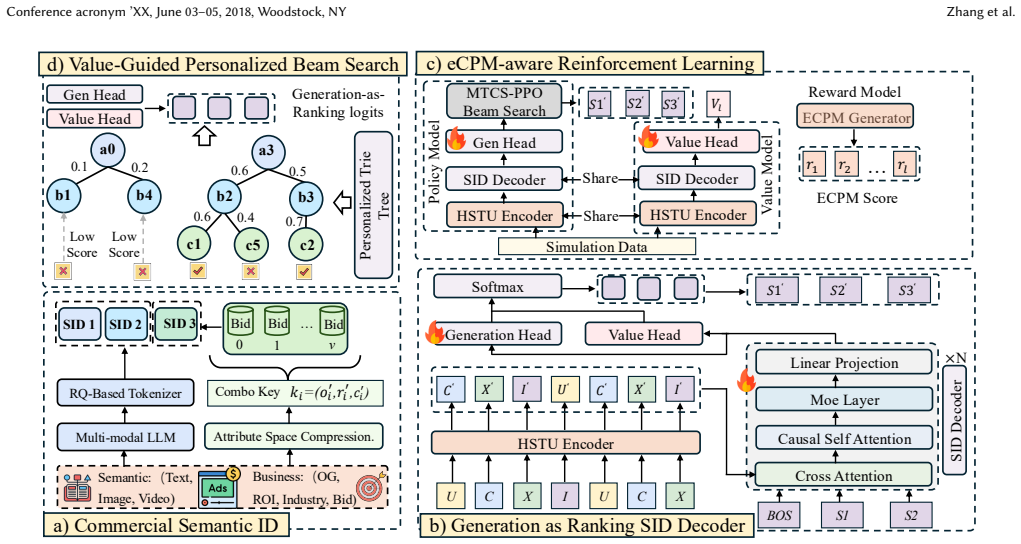
The load-bearing identity is the fused generation-as-ranking logit, the element-wise sum of the generation head's vocabulary scores and the value head's token-level value scores; this fused score stands in for both relevance and commercial preference at every decoding step. It is anchored by the Commercial SID—a final token built from compressed business attributes and equal-frequency bid bins grouped by composition key—which makes the token space itself value-discriminative. The third piece is the personalized valid-path trie, which prunes online beam expansion to feasible SID paths and lets the fused logits serve as the beam score without a separate reranker.
What would settle it
Train an equal-size (80M) SID decoder with the same MoR/MoE backbone and Commercial SID tokenization but with the value head removed and no RL stage, and compare HR@100; if it reaches the same 37% improvement, the value-alignment mechanism is not the cause. Similarly, an online A/B of an equal-capacity semantic-only model against the production baseline would settle whether the 1.5% GMV lift persists without value-aware decoding.
Extended reading notes
Core claim
The paper's core claim is that the mismatch between generation likelihood and advertising utility—what it calls 'value inconsistency'—can be resolved by injecting value into all three stages of a generative recommender. It introduces a Commercial SID: the upper levels of the item code keep semantic structure, while a final level encodes compressed commercial attributes (optimization goal, ROI, industry, bid) using a classify-then-bin discretization. On top of that, a dual-head decoder outputs both a generation score and a token-level value score, fusing them during autoregressive decoding so high-value paths are not pruned early. The same fused score is reused online in a value-guided person
Load-bearing premise
The load-bearing premise is that the reported gains come from value alignment rather than from the decoder's much larger capacity, since the paper's ablation never holds capacity fixed while removing the value signal.
Editorial extensions
If this is right
- If correct, value-aware SID tokenization makes commercially similar ads share token paths, so a model can generalize value across items it has never seen.
- The fused decoder removes the online reranking stage, so value-aware serving costs roughly the same as semantic serving while improving valid candidate coverage.
- Trie-constrained beam search produces 300 valid paths where unconstrained search yields only 48 under the same beam budget, cutting wasted computation.
- The same decoder performs generation and ranking, meaning no extra value model needs to be trained for serving-time ranking.
- The offline value metrics (ValueHR@100, wNDCG@100) improve by 37.01% and 26.20%, suggesting the GMV lift is not just a retrieval artifact.
Reading between the lines
- If value alignment is the real driver, the classify-then-bin tokenizer could be transplanted to other generative retrieval tasks that have a scalar utility signal, such as e-commerce or content feeds with engagement value, not just ads.
- A direct way to separate the mechanism would be to run UniVA's full decoder with Commercial SID but without the value head and RL; if that matches the 37% gain, then decoder capacity, not value alignment, is doing the work.
- Because the eCPM reward is estimated by a simulated ranking stack, the online gain may grow if the RL reward were replaced with a live auction feedback loop.
- The value head doubles as a critic; one could export it as a cheap per-token value estimator for tasks like budget pacing or creative selection.
Editorial analysis
A structured set of objections, weighed in public.
Referee Report
Summary. UniVA proposes to align commercial value throughout the generative advertising recommendation pipeline: a Commercial SID tokenizer that injects structured business attributes and bid information into the final SID level; a Generation-as-Ranking SID Decoder with a generation head and a value head whose logits are fused during decoding, trained by supervised learning followed by eCPM-aware reinforcement learning; and a value-guided personalized beam search that restricts decoding to a request-valid trie. Experiments on Tencent WeChat Channels advertising report a 37.04% relative offline HR@100 improvement over a GPR+SID Decoder baseline and a 1.5% online GMV lift over the production baseline. The paper claims that unified value alignment across tokenization, decoding, and serving is the key driver of these gains.
Significance. If the attribution were solid, UniVA would be a practically important contribution: it demonstrates a way to make the SID space value-discriminative, to fuse generation and value signals in a single decoding pass, and to constrain decoding to request-valid paths without a separate reranker. The paper also provides a useful empirical comparison of Commercial SID construction strategies and reports a monotone scaling trend. However, the load-bearing quantitative claims are weakened by a capacity confound in the offline ablation, by the absence of statistical significance/confidence information in the online A/B test, and by an unvalidated simulator at the core of the RL stage. These issues are fixable with additional control experiments and reporting, but as presented the evidence does not isolate the effect of value alignment.
major comments (4)
- [Table 1 / §4.2] The central +37.04% HR@100 claim is confounded with decoder capacity. The ablation adds Commercial SID (+5.78% at equal 3M parameters), then deeper layers (7M), MoR (5M), Sparse MoE (60M), and finally the full UniVA (80M/23.2G) that simultaneously adds the value head, RL, and additional compute. There is no equal-capacity baseline trained by SL only without value alignment at 80M/23.2G, nor an ablation that adds the value-head/RL components at 3M. Consequently, the 18.64-point difference between the Sparse MoE row and Full UniVA cannot be attributed to value alignment rather than the extra 20M parameters and 14.7G FLOPs. Please add a capacity-matched no-value-alignment control (e.g., the Sparse MoE decoder with the same parameter/FLOP budget trained only on L_SL and served with the same trie) and, if possible, a value-aligned variant at the 3M decoder scale.
- [§4.5 / Table 3] The online A/B test covers 5 days over 5% traffic and reports no confidence intervals, p-values, or variance information. The 1.50% GMV lift vs. production baseline includes the effect of the larger SID decoder and Commercial SID, not just generation-as-ranking; v1 already has +1.03% without generation-as-ranking. The incremental +0.47% between v1 and v2 could be within noise. Please report the number of requests, day-level lifts, standard errors or Bayesian intervals, and ideally an equal-capacity baseline without value fusion online. As written, the online result does not support the claim that unified value alignment causes the GMV lift.
- [§3.3] The RL stage relies on a 'high-fidelity offline simulator' that reproduces candidate inventory, feature pipelines, business constraints, and the downstream ranking stack, but no evidence of fidelity is provided. The eCPM reward is produced by the simulator, so any mismatch between simulated and production ranking directly biases the value head. Please provide a simulation-vs-production calibration study (e.g., correlation of simulated eCPM with online outcomes, or comparison of reward distributions on a held-out request set). Without this, the contribution of the RL component to the reported gains is not established.
- [§3.2 / §3.3] The fusion Fuse(o_gen, o_value) is elementwise summation for all vocabulary tokens, but the value head is trained only on the selected token's value (L_value uses v_l = o_value[a_l] for the sampled action a_l). Value scores for non-selected tokens are not directly regressed, so the fused distribution may be uncalibrated at inference. Please report how the value-head scores behave on non-selected tokens (e.g., calibration or ranking quality of value scores alone), and consider ablating alternative fusion forms (e.g., log-sum-exp, temperature-weighted addition) or adding a token-level value supervision signal for non-selected tokens.
minor comments (6)
- [§4.2] Typo: 'performance performance' in the first paragraph.
- [Abstract/Conclusion] The method is referred to both as 'Generation-as-Ranking' and 'Co-Generation-Ranking' in the Conclusion; please unify terminology. Also, 'UniV A' spacing appears in the Abstract.
- [Table 1] The row label '+(layer2-layer4)' is unclear; it seems to mean adding decoder layers, but please state explicitly which layers are added. Also 'MOR' should be 'MoR' for consistency.
- [§4.5] The phrase 'over 5% traffic' could be interpreted as 5% of all traffic or 5% of a specific channel; please clarify the randomization unit and whether the control and treatment are served from the same traffic pool.
- [§4.4] In the Commercial SID strategy comparison (Figure 4), some reported vocabulary sizes exceed the 2048 budget (e.g., V=2048, 2045). Explain how the budget is enforced or whether these values are soft constraints.
- [References] Several references to the authors' own companion works ([10], [11], [26]) are used as baselines or components; please ensure that the reliance on these unpublished preprints is clearly disclosed and, if possible, cite published versions when available.
Circularity Check
Minor by-construction observations and self-cited building blocks; the central value-alignment claim is externally tested and not circular.
-
self definitional
[Section 3.1 Eq. (6); Section 4.4 'Commercial SID Quality Analysis' / Figure 3]
"Eq. (6): s^L_i = Φ_com(x^c_i) = ψ(k_i, x^b_i). Section 4.4: 'Relative to 3-level SID, 2-level SID + CSID consistently reduces both bid standard deviation and bid range across Mean, P75, and P99... This indicates that items assigned to the same full SID path become much more consistent in commercial value, rather than mixing ads with widely different bid levels under the same semantic path.'"
The final SID token is defined as an equi-frequency bid bin under the composition key (Section 3.1: 'the bids within each key are partitioned into n_k equi-frequency bins' and Eq. (6) maps key and bid to global bin ID). Therefore, items sharing a full 2-level SID + CSID path necessarily share a bid bin, so low within-path bid variance/range is entailed by the construction. Reporting it as 'Commercial SID Quality Analysis' is a restatement of the tokenizer, not an empirical validation of value alignment.
-
fitted input called prediction
[Section 3.1 Eq. (5); Section 4.4 'Commercial SID Strategy Analysis' / Figure 4]
"Under the vocabulary budget constraint ∑_{k∈K} n_k≤V, we select {n_k} to maximize the weighted entropy H. ... 'Classify-then-Bin combined with Equal-frequency achieves the highest weighted entropy while keeping the vocabulary size closest to the target budget of 2048, with H=7.487 and V=1939.'"
The binning configuration was selected by grid search to maximize weighted entropy H, so reporting that the chosen configuration attains the highest H is a restatement of the selection objective rather than an independent experimental outcome. The downstream HR@K comparisons provide independent evidence for the design, so this tautology does not by itself settle the main claim.
full rationale
The paper's central claim is that unified value alignment across SID tokenization, decoding, and serving yields a 37.04% relative offline HR@100 gain and a 1.5% online GMV lift. These are measured against a baseline and in a production A/B test; they are not mathematical consequences of the definitions. The value head is trained with eCPM rewards and later reused for serving, but the evaluation uses ground-truth next interactions and production GMV, so this is a standard train/serve loop rather than a definitional equivalence. Table 1 mixes decoder-capacity growth with value-alignment components and lacks an equal-capacity no-value control; that is an attribution confound, not circularity. The paper relies on the authors' prior GPR [26] for the backbone, simulator, and baseline, and on companion preprints [10][11]; these self-citations are not independently verified here, but the online A/B result provides an external check that keeps them from being the sole load-bearing evidence. The two flagged steps are minor by-construction 'insights' (bid dispersion reduction and entropy-maximization self-confirmation) that support component design choices without determining the core HR@100/GMV result. Overall, the main derivation is not circular; score 2 reflects minor self-citation and tautological supporting analyses.
Assumptions & free parameters
free parameters (4)
- Commercial attribute compression thresholds =
99% / top-9 (75%) / fallback counts 25-8-10
- Bid binning bounds n_max, n_min and vocabulary budget V =
n_max=25, n_min=3, V=2048
- SID codebook size / number of levels =
3-level, codebook 2048; best variant 2*2048 + CSID
- SID decoder architecture hyperparameters =
4 layers, emb 256, 64 experts, top-16, lr 0.001, batch 16
assumptions (5)
- domain assumption The offline simulator is high-fidelity and reproduces production candidate inventory, features, constraints, and ranking stack.
- domain assumption Copied production pCTR/pCVR models yield reliable eCPM reward estimates for sampled SID paths.
- ad hoc to paper Element-wise summation of generation and value logits is an adequate fusion for generation-as-ranking.
- domain assumption RQ-based semantic tokenization preserves the coarse-to-fine semantic locality needed for the upper SID levels.
- domain assumption Beam search with cumulative fused logits plus prefix validity is sufficient to serve online within latency constraints.
Cite this review
Pith. "Pith review of UniVA: Unified Value Alignment for Generative Recommendation in Online Advertising at Tencent." pith.science (2026). https://pith.science/paper/QCZ42UOE
@misc{pith2026260505803,
  author       = {Pith},
  title        = {Pith review of: UniVA: Unified Value Alignment for Generative Recommendation in Online Advertising at Tencent},
  year         = {2026},
  howpublished = {\url{https://pith.science/paper/QCZ42UOE}},
  note         = {Machine review of arXiv:2605.05803}
}
read the original abstract
Generative Recommendation (GR) reformulates recommendation as next-token generation over item Semantic IDs (SIDs) and has shown promise in industrial applications. However, extending GR to advertising is non-trivial, as advertising recommendation must jointly account for user relevance and commercial value. This creates a mismatch: high generation likelihood does not necessarily imply high advertising utility. As a result, valuable ads may be poorly distinguished in the SID space, pruned during autoregressive decoding, or missed when request-invalid branches consume limited beam capacity during online serving. To address this problem, we propose UniVA, a Unified Value Alignment framework for generative advertising recommendation. UniVA aligns commercial value across the entire pipeline of SID construction, autoregressive decoding, and online serving. Commercial SID Tokenization injects business attributes and bid information into SID construction. A Generation-as-Ranking SID Decoder then fuses generation scores with token-level value estimates during autoregressive decoding. {Finally, Value-Aware Constrained Serving restricts the fused decoding process to request-valid SID paths through a personalized trie.} Experiments on the Tencent WeChat Channels advertising platform show that UniVA achieves a 37.04\% relative improvement in offline Hit Rate@100 over the baseline and lifts gross merchandise value (GMV) by 1.5\% in online A/B tests.
Figures


Figures from the paper (1 more)

Forward citations
Cited by 2 Pith papers
-
Beyond Semantic IDs: Encoding Business-Value Ranking into Document Identifiers for Generative Retrieval
Encoding business-value ranks inside semantic clusters yields collision-free DocIDs that improve generative-retrieval Hitrate and deliver +1.06% GMV online.
-
TSGR: Taobao Search Generative Retrieval
TSGR makes Taobao search retrieval value-aware by ordering item IDs by clicks and query intent and re-ranking generated candidates with a value module, improving HR@1000 and GMV.
Reference graph
Works this paper leans on
-
[1]
Josh Achiam, Steven Adler, Sandhini Agarwal, Lama Ahmad, Ilge Akkaya, Floren- cia Leoni Aleman, Diogo Almeida, Janko Altenschmidt, Sam Altman, Shyamal Anadkat, et al. 2023. Gpt-4 technical report.arXiv preprint arXiv:2303.08774 (2023)
arXiv 2023
-
[2]
Sangmin Bae, Yujin Kim, Reza Bayat, Sungnyun Kim, Jiyoun Ha, Tal Schuster, Adam Fisch, Hrayr Harutyunyan, Ziwei Ji, Aaron Courville, et al. 2025. Mixture- of-recursions: Learning dynamic recursive depths for adaptive token-level com- putation.arXiv preprint arXiv:2507.10524(2025)
arXiv 2025
-
[3]
Damai Dai, Chengqi Deng, Chenggang Zhao, RX Xu, Huazuo Gao, Deli Chen, Jiashi Li, Wangding Zeng, Xingkai Yu, Yu Wu, et al. 2024. Deepseekmoe: Towards ultimate expert specialization in mixture-of-experts language models. InProceed- ings of the 62nd Annual Meeting of the Association for Computational Linguistics (Volume 1: Long Papers). 1280–1297
2024
-
[4]
Ruidong Han, Bin Yin, Shangyu Chen, He Jiang, Fei Jiang, Xiang Li, Chi Ma, Mincong Huang, Xiaoguang Li, Chunzhen Jing, et al . 2025. Mtgr: Industrial- scale generative recommendation framework in meituan. InProceedings of the 34th ACM International Conference on Information and Knowledge Management. 5731–5738
2025
-
[5]
Xuegang Hao, Ming Zhang, Alex Li, Xiangyu Qian, Zhi Ma, Yanlong Zang, Shijie Yang, Zhongxuan Han, Xiaolong Ma, Jinguang Liu, et al. 2025. OxygenREC: An Instruction-Following Generative Framework for E-commerce Recommendation. arXiv preprint arXiv:2512.22386(2025)
arXiv 2025
-
[7]
Yupeng Hou, Zhankui He, Julian McAuley, and Wayne Xin Zhao. 2023. Learning vector-quantized item representation for transferable sequential recommenders. InProceedings of the ACM Web Conference 2023. 1162–1171
2023
-
[8]
Yupeng Hou, Jiacheng Li, Ashley Shin, Jinsung Jeon, Abhishek Santhanam, Wei Shao, Kaveh Hassani, Ning Yao, and Julian McAuley. 2025. Generating long semantic ids in parallel for recommendation. InProceedings of the 31st ACM SIGKDD Conference on Knowledge Discovery and Data Mining V. 2. 956–966
2025
-
[9]
Yanhua Huang, Yuqi Chen, Xiong Cao, Rui Yang, Mingliang Qi, Yinghao Zhu, Qingchang Han, Yaowei Liu, Zhaoyu Liu, Xuefeng Yao, et al . 2025. Towards Large-scale Generative Ranking.arXiv preprint arXiv:2505.04180(2025)
arXiv 2025
Show all 31 references
-
[10]
Jie Jiang, Yangru Huang, Zeyu Wang, Changping Wang, Yuling Xiong, Jun Zhang, and Huan Yu. 2026. Spend Search Where It Pays: Value-Guided Structured Sampling and Optimization for Generative Recommendation.arXiv preprint arXiv:2602.10699(2026)
2026
-
[11]
Jie Jiang, Xinxun Zhang, Enming Zhang, Yuling Xiong, Jun Zhang, Jingwen Wang, Huan Yu, Yuxiang Wang, Hao Wang, Xiao Yan, et al. 2026. End-to-End Semantic ID Generation for Generative Advertisement Recommendation.arXiv preprint arXiv:2602.10445(2026)
2026 arXiv
-
[12]
Yuchen Jiang, Qi Li, Han Zhu, Jinbei Yu, Jin Li, Ziru Xu, Huihui Dong, and Bo Zheng. 2022. Adaptive domain interest network for multi-domain recommenda- tion. InProceedings of the 31st ACM International Conference on Information & Knowledge Management. 3212–3221
2022
-
[13]
Xiaopeng Li, Bo Chen, Junda She, Shiteng Cao, You Wang, Qinlin Jia, Haiying He, Zheli Zhou, Zhao Liu, Ji Liu, et al. 2025. A survey of generative recommendation from a tri-decoupled perspective: Tokenization, architecture, and optimization. (2025)
2025
-
[14]
Yongqi Li, Xinyu Lin, Wenjie Wang, Fuli Feng, Liang Pang, Wenjie Li, Liqiang Nie, Xiangnan He, and Tat-Seng Chua. 2024. A survey of generative search and recom- mendation in the era of large language models.arXiv preprint arXiv:2404.16924 (2024)
2024 arXiv
-
[15]
Xinchen Luo, Jiangxia Cao, Tianyu Sun, Jinkai Yu, Rui Huang, Wei Yuan, Hezheng Lin, Yichen Zheng, Shiyao Wang, Qigen Hu, et al . 2025. Qarm: Quantitative alignment multi-modal recommendation at kuaishou. InProceedings of the 34th ACM International Conference on Information and...
2025
-
[16]
Changhua Pei, Xinru Yang, Qing Cui, Xiao Lin, Fei Sun, Peng Jiang, Wenwu Ou, and Yongfeng Zhang. 2019. Value-aware Recommendation based on Rein- forcement Profit Maximization. InThe World Wide Web Conference (WWW ’19). Association for Computing Machinery, New York, NY, USA, 3123–3129
2019
-
[17]
Aleksandr V Petrov and Craig Macdonald. 2024. RecJPQ: training large-catalogue sequential recommenders. InProceedings of the 17th ACM International Conference on Web Search and Data Mining. 538–547
2024
-
[18]
Shashank Rajput, Nikhil Mehta, Anima Singh, Raghunandan Hulikal Keshavan, Trung Vu, Lukasz Heldt, Lichan Hong, Yi Tay, Vinh Tran, Jonah Samost, et al
-
[19]
Hugo Touvron, Louis Martin, Kevin Stone, Peter Albert, Amjad Almahairi, Yas- mine Babaei, Nikolay Bashlykov, Soumya Batra, Prajjwal Bhargava, Shruti Bhos- ale, et al. 2023. Llama 2: Open foundation and fine-tuned chat models.arXiv preprint arXiv:2307.09288(2023). Conference ac...
2023 arXiv
-
[20]
Wenjie Wang, Honghui Bao, Xinyu Lin, Jizhi Zhang, Yongqi Li, Fuli Feng, See- Kiong Ng, and Tat-Seng Chua. 2024. Learnable item tokenization for generative recommendation. InProceedings of the 33rd ACM International Conference on Information and Knowledge Management. 2400–2409
2024
-
[21]
Yejing Wang, Shengyu Zhou, Jinyu Lu, Ziwei Liu, Langming Liu, Maolin Wang, Wenlin Zhang, Feng Li, Wenbo Su, Pengjie Wang, et al. 2025. NEZHA: A Zero- sacrifice and Hyperspeed Decoding Architecture for Generative Recommenda- tions.arXiv preprint arXiv:2511.18793(2025)
2025
-
[22]
Lee Xiong, Zhirong Chen, Rahul Mayuranath, Shangran Qiu, Arda Ozdemir, Lu Li, Yang Hu, Dave Li, Jingtao Ren, Howard Cheng, et al. 2026. LLaTTE: Scaling Laws for Multi-Stage Sequence Modeling in Large-Scale Ads Recommendation. arXiv preprint arXiv:2601.20083(2026)
2026
-
[23]
Ben Xue, Dan Liu, Lixiang Wang, Mingjie Sun, Peng Wang, Pengfei Zhang, Shaoyun Shi, Tianyu Xu, Yunhao Sha, Zhiqiang Liu, et al . 2026. Generative Recommendation for Large-Scale Advertising.arXiv preprint arXiv:2602.22732 (2026)
2026
-
[24]
Chao Yi, Dian Chen, Gaoyang Guo, Jiakai Tang, Jian Wu, Jing Yu, Mao Zhang, Sunhao Dai, Wen Chen, Wenjun Yang, et al. 2025. Recgpt technical report.arXiv preprint arXiv:2507.22879(2025)
2025 arXiv
-
[25]
Jiaqi Zhai, Lucy Liao, Xing Liu, Yueming Wang, Rui Li, Xuan Cao, Leon Gao, Zhao- jie Gong, Fangda Gu, Jiayuan He, et al. 2024. Actions Speak Louder than Words: Trillion-Parameter Sequential Transducers for Generative Recommendations. In International Conference on Machine Lear...
2024
-
[26]
Jun Zhang, Yi Li, Yue Liu, Changping Wang, Yuan Wang, Yuling Xiong, Xun Liu, Haiyang Wu, Qian Li, Enming Zhang, et al. 2025. GPR: Towards a Generative Pre-trained One-Model Paradigm for Large-Scale Advertising Recommendation. arXiv preprint arXiv:2511.10138(2025)
2025
-
[27]
Chujie Zhao, Qun Hu, Shiping Song, Dagui Chen, Han Zhu, Jian Xu, and Bo Zheng. 2025. LLM-Auction: Generative Auction towards LLM-Native Advertising. arXiv preprint arXiv:2512.10551(2025)
2025 arXiv
-
[28]
Zuowu Zheng, Ze Wang, Fan Yang, Jiangke Fan, Teng Zhang, Yongkang Wang, and Xingxing Wang. 2025. Ega-v2: An end-to-end generative framework for industrial advertising.arXiv preprint arXiv:2505.17549(2025)
2025 arXiv
-
[29]
Guorui Zhou, Jiaxin Deng, Jinghao Zhang, Kuo Cai, Lejian Ren, Qiang Luo, Qian- qian Wang, Qigen Hu, Rui Huang, Shiyao Wang, et al. 2025. OneRec Technical Report.arXiv preprint arXiv:2506.13695(2025)
2025
-
[30]
Guorui Zhou, Hengrui Hu, Hongtao Cheng, Huanjie Wang, Jiaxin Deng, Jinghao Zhang, Kuo Cai, Lejian Ren, Lu Ren, Liao Yu, et al. 2025. Onerec-v2 technical report.arXiv preprint arXiv:2508.20900(2025)
2025 arXiv
-
[31]
Hao Zhou, Chengming Hu, Ye Yuan, Yufei Cui, Yili Jin, Can Chen, Haolun Wu, Dun Yuan, Li Jiang, Di Wu, et al. 2024. Large language model (llm) for telecom- munications: A comprehensive survey on principles, key techniques, and oppor- tunities.IEEE Communications Surveys & Tutor...
2024
-
[2023]
Recommender systems with generative retrieval.Advances in Neural Information Processing Systems36 (2023), 10299–10315
2023
Reviewed August 2, 2026 · model on record in the stance chip above.
Discussion (0). Sign in to comment.