REVIEW 2 major objections 4 minor 4 cited by
The Stripped-Star Ultraviolet Magellanic Cloud Survey (SUMS): The UV Photometric Catalog and Stripped Star Candidate Selection
T0 review · 2 major / 4 minor · reviewed 2026-08-07 · deepseek-v4-flash
Pith's one-line read From 2,420 archival Swift UV images, this paper builds a 734,869-source catalog and identifies 820 candidate stripped-star systems by their ultraviolet excess blueward of the theoretical main sequence.
desk verdict A genuinely useful UV catalog and a plausible candidate list, but the 820 count is anchored by a single extinction choice the paper itself shows is fragile. read the letter →
The pith
A machine-rendered reading of the paper's core claim, the machinery that carries it, and where it could break.
The reading
What carries the argument
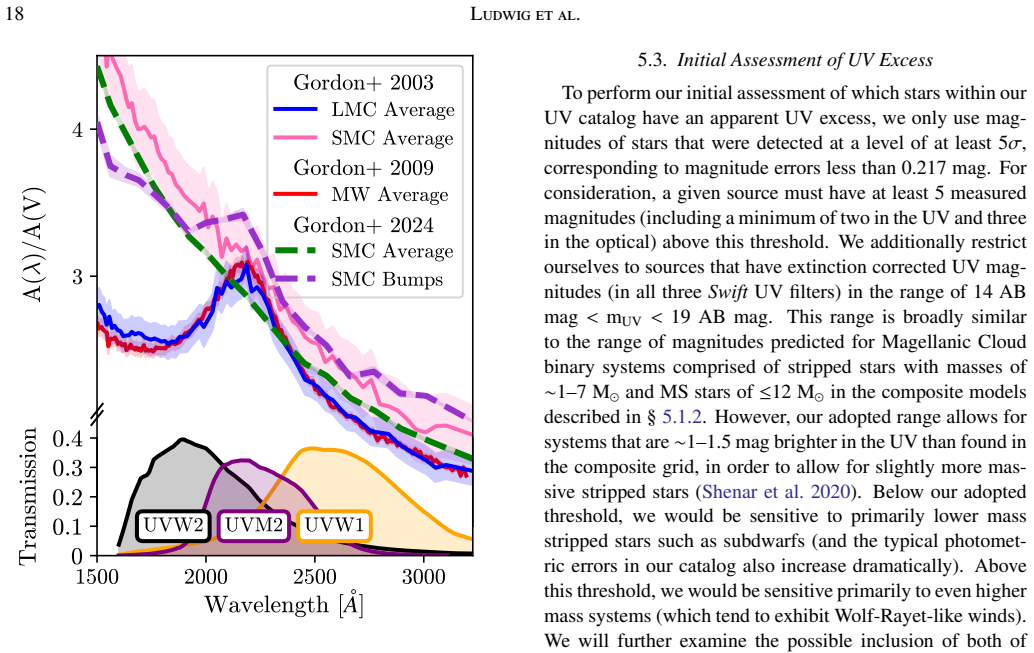
The load-bearing mechanism is the UV-excess selection itself: each source's extinction-corrected magnitudes are compared, in nine UV-optical color-magnitude diagrams, against a theoretical zero-age main sequence — the locus where stars begin core hydrogen burning — built from MESA evolutionary models and Kurucz ATLAS model atmospheres, and a source must lie blueward of that line by more than its photometric error in at least four of the nine diagrams. That comparison is possible only because the photometry is carried out with The Tractor forward-modeling code, which fits a radially symmetric point-spread function — reconstructed from Swift's calibration curves of growth — at positions inherited from the MCPS optical survey, deblending the crowded, roughly 2.5-arcsecond-resolution UVOT images; this is the first application of The Tractor to Swift-UVOT data, and the paper validates it with residual tests, aperture-photometry comparisons, and injected-star crowding simulations. The selection also rests on a single adopted extinction value per galaxy — $A_V = 0.38$ mag for the LMC and $0.22$ mag for the SMC, chosen so the theoretical main sequence aligns with the blue edge of the observed main-sequence overdensity — combined with the Gordon et al. (2003) extinction curves.
What would settle it
Take the 105 candidates that remain even at zero assumed extinction — the systems most robust to the dust assumption — and obtain their spectra: if they show ordinary hydrogen-rich B-type main-sequence spectra with no He II absorption and no radial-velocity variation, the UV-excess method is being driven by something other than stripped stars, while hydrogen depletion, high temperature, and binary motion would confirm the method at scale. A purely photometric check is also available in the paper's own Table 4: measuring individual line-of-sight extinctions toward the candidates and recomputing the selection with star-by-star $A_V$ would show whether the 522/298 counts survive.
Extended reading notes
Core claim
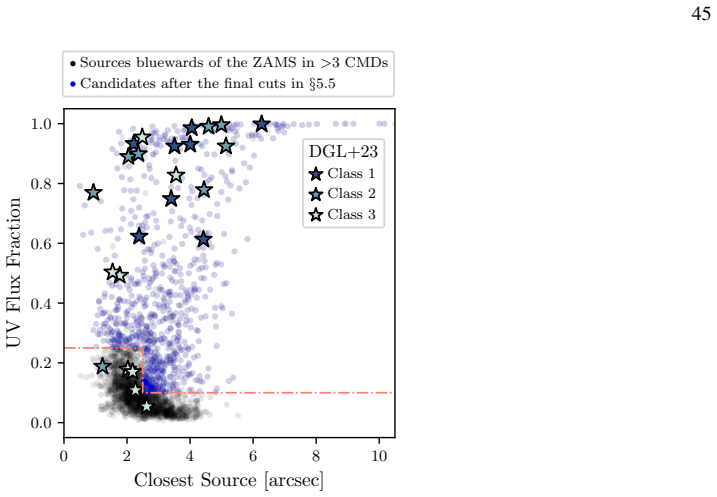
The paper's central claim is that intermediate-mass stripped-star binaries are identifiable by an ultraviolet excess: when a hot stripped star is paired with a main-sequence companion of $\lesssim 8\,M_\odot$ (or a compact object), the system lands blueward of the theoretical zero-age main sequence in UV-optical color-magnitude diagrams built from the Swift UVW2, UVM2, and UVW1 bands. The authors realize this claim observationally by performing forced point-spread-function photometry with forward modeling on 2,420 archival Swift-UVOT images, anchoring positions to the ground-based MCPS optical catalog, and validating the result against standard aperture photometry for isolated stars and against injected two-star simulations. After quality cuts on SED shape, crowding, and Gaia membership, the selection yields 522 candidate systems in the LMC and 298 in the SMC; 18 of the 25 stripped-star candidates previously confirmed spectroscopically survive the stricter cuts, including all eight with clear stripped-star spectral features. The paper is explicit that this count is not the census itself: the number varies from 105 to 820 as the adopted line-of-sight extinction varies, and roughly half the candidates lie close enough to the main sequence that low-reddening B-type stars could mimic them.
Load-bearing premise
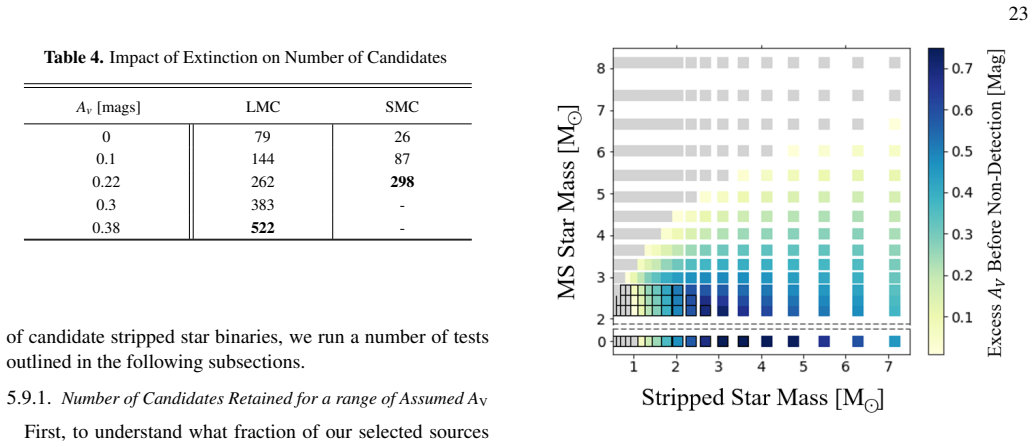
The candidate list stands on the assumption that one extinction value per galaxy describes the reddening toward every star: if the true extinction varies from star to star, the sample changes, and the paper itself shows the candidate count spanning 105 systems (at zero extinction) to 820 systems (at the adopted $A_V = 0.38$/$0.22$ mag).
Editorial extensions
If this is right
- If the selection is correct, the Magellanic Clouds host several hundred intermediate-mass stripped-star binaries, and a systematic census of these objects becomes possible from archival ultraviolet imaging rather than new observations.
- The public SUMS catalog — 734,869 sources with UVW2, UVM2, and UVW1 photometry to roughly 20 Vega mag, plus U, B, V, and I photometry from MCPS — becomes a community resource for ultraviolet population studies of the Clouds, where fewer than 5% of sources have prior classifications.
- The candidate counts sit in the same order of magnitude as binary population synthesis predictions after efficiency corrections (~414 and ~99 observable systems predicted for the LMC and SMC, versus 522 and 298 candidates), giving modelers a new population to reproduce.
- Because most candidates are optically faint and many sit close to the main sequence, the paper's 'Very Blue-Excellent' subset is the natural first target list for spectroscopy to confirm masses, temperatures, and hydrogen-depleted surfaces.
- The paper's control-field analysis implies only about one to two foreground or background objects per galaxy should survive all cuts, so contamination from unrelated stars is not the main source of error in the candidate list; dust is.
Reading between the lines
- Under the single-$A_V$ design, the 820 count is best read as a lower bound on the true stripped-star population, since dusty systems in high-extinction regions are missed, while the 'Blue' ranks nearest the main sequence are the most likely to hide low-reddening main-sequence impostors; if so, the spectroscopic confirmation rate should rise with the 'Very Blue' ranking.
- The V-shaped ultraviolet SED that the paper identifies as the signature of under-corrected LMC extinction suggests a path that needs no new data: refitting every source with star-by-star extinction, using the UVW2–UVM2–UVW1 morphology and the 2175 Å bump, could sharpen the candidate list and produce an extinction map of both Clouds.
- If the UV-excess method survives spectroscopic scrutiny here, the same forced-photometry pipeline transfers to other Swift-UVOT fields and to upcoming wide-field ultraviolet missions, making it a standard route to finding post-interaction binaries in any nearby galaxy with known distances and low extinction.
Editorial analysis
A structured set of objections, weighed in public.
Referee Report
Summary. The paper presents the SUMS UV photometric catalog of the Magellanic Clouds, constructed by applying the Tractor forward-modeling code to 2,420 archival Swift-UVOT images, with source positions and optical photometry taken from the MCPS catalog. The catalog contains 734,869 sources in three UV filters (UVW2, UVM2, UVW1). The paper validates the photometry against uvotsource and through injection simulations, then selects candidate stripped-star binaries as sources lying blueward of the theoretical ZAMS in multiple UV-optical CMDs after applying a single extinction correction per galaxy (AV=0.38 mag for the LMC, 0.22 mag for the SMC). After quality cuts and Gaia-based foreground rejection, the final sample contains 522 candidates in the LMC and 298 in the SMC, subclassified into 'Very Blue' and 'Blue' categories. The paper discusses contaminants, presents SED-fitting mass estimates, and compares the candidate counts with binary population synthesis predictions.
Significance. If the candidate identification is correct, this is the first systematic, wide-field census of intermediate-mass stripped-star candidates in the Magellanic Clouds, and the public UV photometric catalog is a valuable community resource. The photometric pipeline is validated carefully, and the paper is unusually transparent about the sensitivity of the candidate counts to the extinction assumption. The recovery of 18/25 spectroscopically confirmed DGL+23 systems, including all Class 1 and most Class 2 objects, is a strong endorsement of the selection methodology. However, the headline number of 820 candidates (522 LMC + 298 SMC) is not robust to the adopted extinction: the paper's own Table 4 shows the count varies from roughly 105 to 820 across a plausible range of AV. The 'Very Blue' subset (105 sources) is far more robust and is the part of the sample that should be emphasized in quantitative claims.
major comments (2)
- [§5.2, §5.9.1, Table 4] The single adopted reddening values are calibrated on the same data used for candidate selection: AV=0.38 (LMC) and 0.22 (SMC) are chosen specifically to align the theoretical ZAMS with the blue edge of the observed main-sequence overdensity. Table 4 then shows the candidate count changes from 79/26 at AV=0 to 522/298 at the adopted values, an order-of-magnitude sensitivity. The headline numbers in the Abstract and §5.7 are therefore not an independent measurement of the stripped-star population; they are a consequence of the calibration choice. The authors should either (i) anchor AV with an independent calibration, e.g., using the full distribution of star-by-star extinction from Zaritsky et al. maps or a spatially resolved extinction model, or (ii) present candidate counts as a function of AV and make the AV-robust 'Very Blue' subset (105 sources) the primary quantitative claim.
- [§6.6, Eq. (1)] The comparison of observed candidate numbers (522/298) with the Hovis-Afflerbach et al. (2024) population synthesis predictions (414/99) is used to claim broad agreement. However, the observed number is the AV-dependent count from Table 4 and can range from ~105 to ~820 depending on the assumed reddening. Without propagating the AV uncertainty into this comparison, the agreement carries no quantitative weight. The authors should either provide a range of predicted observable numbers across the full AV distribution, or explicitly label this as an illustrative, order-of-magnitude exercise with no statistical claim.
minor comments (4)
- [§5.2] Typo: 'rational' should be 'rationale' in the sentence describing the choice of AV.
- [Figure 1 caption] The caption lists 'UVM1' as one of the three UVOT filters; the correct filter designation used throughout the paper is 'UVW1'.
- [§1] The mass range for intermediate-mass stripped stars is given as '~2-8 M⊙' in the introduction but later extended to 'broadly include binary stripped stars between 1 and 8 M⊙'; please reconcile these definitions explicitly.
- [§3.4.3] Minor typo: 'systemic shift' should be 'systematic shift' in the discussion of the comparison with uvotsource.
Circularity Check
Candidate selection uses an extinction zero-point fit to the same MS data that defines the UV-excess boundary, and the SED-shape classification is partly guaranteed by the model-grid cuts; the catalog itself retains independent validation.
-
self definitional
[Section 5.2 'Choice of A_V' and Section 5.3 'Initial Assessment of UV Excess']
"we find that adopting AV=0.38 and 0.22 mag aligns the blue edge of the large overdensity of stars in the UV-optical CMDs with the theoretical ZAMS described in § 5.1.3."
The extinction value is not independently measured but is chosen so that the theoretical ZAMS coincides with the blue edge of the observed MS overdensity in the same CMDs used for candidate selection. Candidates are then selected as sources lying bluewards of that ZAMS (§5.3). Thus 'UV excess relative to main-sequence stars' is operationally equivalent to 'bluer than the blue edge of the observed MS tail' after the fitted AV is applied. The headline candidate counts (522 LMC, 298 SMC) therefore depend strongly on this data-calibrated boundary; the paper's own Table 4 shows the counts drop to 79/26 at AV=0. This is a transparent calibration rather than a hidden derivation, but the candidate population is partly defined by the data it is supposed to probe.
-
self definitional
[Section 6.3, footnote 24]
"We note that this is not unexpected, as we use the composite stripped star plus MS model grid from Drout et al. (2023) as a baseline when performing cuts on SED quality in § 5.4."
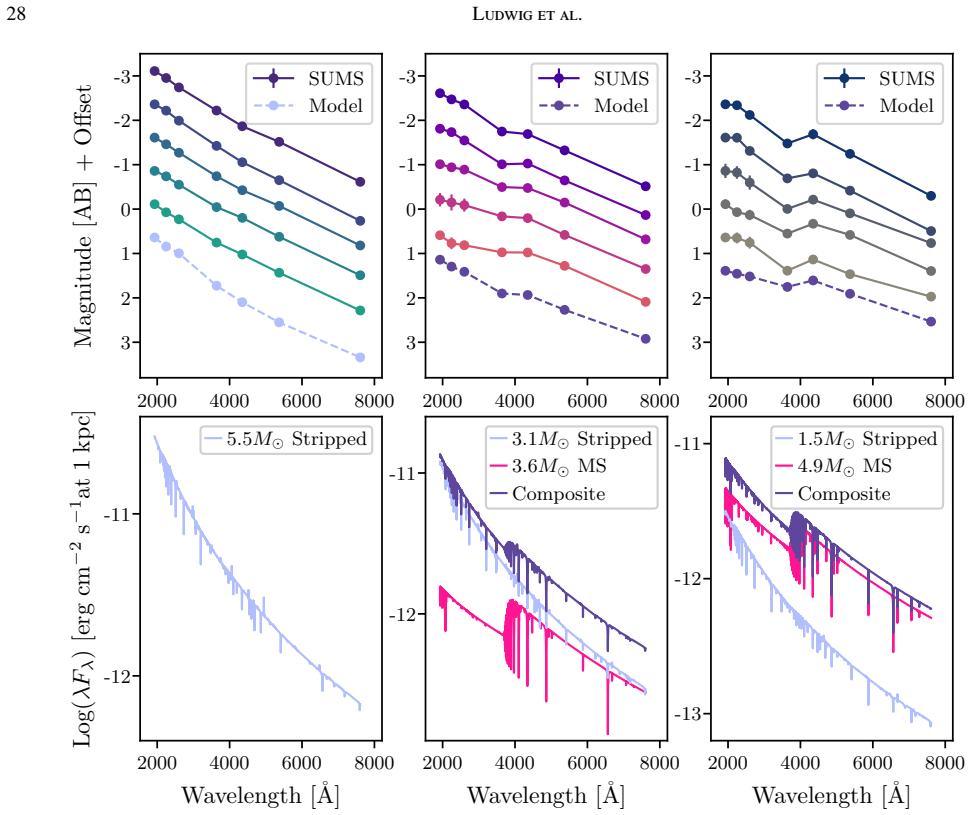
The paper presents three observed SED morphologies as evidence that the candidates resemble stripped-star plus MS binaries, but the same composite model grid was used in §5.4 to reject sources whose SEDs fell outside the grid's expected colors. The observed SED shapes are therefore partly guaranteed by the selection cuts rather than being an independent confirmation of the model grid. The footnote explicitly acknowledges this. This does not undermine the photometric catalog, but the 'consistency' of the candidate SEDs with the stripped-star models is, to some degree, a restatement of the input model rather than a new result.
full rationale
The SUMS catalog itself is built from external data (Swift-UVOT images, MCPS optical positions) and validated against standard uvotsource photometry and against the DGL+23 spectroscopic sample, 18 of 25 of which are recovered by the final cuts. Those checks provide independent grounding for the photometry and for the reality of at least a subset of UV-excess sources. The main circularity concerns are in the candidate-selection calibration: AV is fit so that the theoretical ZAMS matches the blue edge of the observed MS, and candidates are then defined as blueward of that ZAMS, making the candidate count sensitive to the fitted parameter. The paper is unusually transparent about this, including the AV-sensitivity table and the footnote admitting that the SED-shape taxonomy is influenced by the same model grid used for quality cuts. These are real, quotable reductions of parts of the derivation to the input data/models, but they are not a complete circularity: the ZAMS shape is an external theoretical model, the spectroscopic follow-up in DGL+23 provides independent confirmation for a subset, and the paper does not claim the candidate count is a parameter-free prediction. Overall, the central catalog claim is sound; the stripped-star candidate count and the SED-morphology interpretation are partially circular, but honestly disclosed. Score 4 rather than higher because the independent spectroscopic anchor and external model content keep the central result from collapsing into the fit.
Assumptions & free parameters
free parameters (9)
- AV_LMC =
0.38 mag
- AV_SMC =
0.22 mag
- Minimum CMDs for UV excess =
4 of 9
- Flux fraction thresholds =
>25% (if neighbor <2.5 arcsec), >10% otherwise
- Photometric significance threshold =
5 sigma (error <0.217 mag)
- UV magnitude selection range =
14 < m_UV < 19 AB
- f_UVexcess values =
0.2 (stellar companions), 1.0 (compact companions)
- f_extinction values =
0.7 (stellar companions), 0.9 (compact companions)
- f_no_crowding and f_coverage =
0.85, 0.40/0.36
assumptions (4)
- domain assumption Theoretical ZAMS models (Götberg et al. 2018) at Z=0.006/0.002 correctly mark the blue edge of the main sequence in the LMC/SMC.
- domain assumption The DGL+23 composite stripped star plus MS binary grids predict the broadband colors of such systems.
- domain assumption The Gordon et al. (2003) average LMC and SMC extinction curves apply to the sightlines.
- domain assumption Gaia DR3 parallaxes and proper motions can identify foreground contaminants.
Cite this review
Pith. "Pith review of The Stripped-Star Ultraviolet Magellanic Cloud Survey (SUMS): The UV Photometric Catalog and Stripped Star Candidate Selection." pith.science (2026). https://pith.science/paper/QDPFOC7L
@misc{pith2026250518632,
  author       = {Pith},
  title        = {Pith review of: The Stripped-Star Ultraviolet Magellanic Cloud Survey (SUMS): The UV Photometric Catalog and Stripped Star Candidate Selection},
  year         = {2026},
  howpublished = {\url{https://pith.science/paper/QDPFOC7L}},
  note         = {Machine review of arXiv:2505.18632}
}
abstract
Most massive stars will interact with a binary companion during their lifetimes. These interactions can remove the hydrogen-rich envelope, producing intermediate-mass ($\sim$2-8 M$_\odot$) and helium-rich stars. These "stripped stars" are predicted to emit predominantly in the ultraviolet (UV) and can therefore be identified via a UV excess provided they are not outshone by their companion. However, despite their importance to binary evolution, supernovae, and ionizing feedback, few stripped stars have been confirmed. This is likely due to the scarcity of wide-field, high angular resolution, UV surveys of stellar populations with reliable distances and extinction estimates. To address this, we present the Stripped-Star Ultraviolet Magellanic Clouds Survey (SUMS) catalog. We use the Tractor forward modeling software to perform PSF photometry on 2,420 Swift-UVOT images of the LMC and SMC. The resulting public catalog contains 734,869 sources in three UV filters to a depth of $\sim$20 Vega mag. We perform validation tests on the photometry pipeline and highlight the catalog's broad applicability. We then identify sources with excess UV light compared to main-sequence stars and apply a series of quality cuts. From this, we identify 522 candidate stripped stars in the LMC and 298 in the SMC. We assess the potential contamination from other UV excess systems and argue the dominant uncertainty to be dust: early main-sequence stars can mimic the colors of stripped star binaries when extinction is overcorrected. This survey lays the groundwork for the first systematic census of stripped stars and opens new windows into binary evolution and massive star populations.
Figures


Figures from the paper (15 more)







Forward citations
Cited by 4 Pith papers
-
A Galactic intermediate-mass stripped star with a Wolf-Rayet-like wind
WR 2-1 is the first unambiguous intermediate-mass stripped star in the Milky Way: a 3-6 solar mass, 60 kK helium-rich companion in a 5.94-day binary with a rapidly rotating O-star.
-
Binary evolution at the extremes of mass-transfer efficiency: Contact, mergers, and population signatures
Fully conservative mass transfer raises the contact incidence from 11% to 62% and the stellar merger incidence from 16% to 38% in binary evolution models with 0.8 to 20 solar mass primaries.
-
The Best Guess: Testing new and old formalisms for the common envelope against observations
Forward-modeling 193 observed post-common-envelope binaries shows energy-based formalisms (α and Two-stage) match observations while the angular-momentum-based SCATTER formalism does not, with recombination energy con...
-
Accretion from a shock-inflated companion: double-peaked supernova lightcurve with periodic modulations
The study proposes that accretion from a shock-inflated companion star powers the double-peaked, periodically modulated lightcurve of SN2022jli and predicts associated gamma-ray and neutrino emission.
Reference graph
Works this paper leans on
-
[1]
, " * write output.state after.block = add.period write newline
ENTRY address archivePrefix author booktitle chapter doi edition editor eprint howpublished institution journal key month number organization pages publisher school series title misctitle type volume year version url label extra.label sort.label short.list INTEGERS output.state before.all mid.sentence after.sentence after.block FUNCTION init.state.consts ...
-
[2]
write newline
" write newline "" before.all 'output.state := FUNCTION format.url url empty "" new.block "" url * "" * if FUNCTION format.eprint eprint empty "" archivePrefix empty "" archivePrefix "arXiv" = new.block " " eprint * " " * new.block " " eprint * " " * if if if FUNCTION format.doi doi empty "" " " doi * " " * if FUNCTION format.pid doi empty eprint empty ur...
-
[3]
z+If5 ެ zf ߑDKDkt-TIԌ xn D6-Y R[fHЬ Ysk0MJG:Dqk. 3m(=; ML'p2EvDR hIr &ЎI VYn(ZT8˄I ' |=uZtM^:
thebibliography [1] 20pt to REFERENCES 6pt =0pt \@twocolumntrue 12pt -12pt 10pt plus 3pt =0pt =0pt =1pt plus 1pt =0pt =0pt -12pt =13pt plus 1pt =20pt =13pt plus 1pt \@M =10000 =-1.0em =0pt =0pt 0pt =0pt =1.0em @enumiv\@empty 10000 10000 `\.\@m \@noitemerr \@latex@warning Empty `thebibliography' environment \@ifnextchar \@reference \@latexerr Missing key o...
2017
-
[4]
Aadland , E., Massey , P., Neugent , K. F., & Drout , M. R. 2018, , 156, 294, 10.3847/1538-3881/aaeb96
-
[5]
Astropy Collaboration , Robitaille , T. P., Tollerud , E. J., et al. 2013, , 558, A33, 10.1051/0004-6361/201322068
-
[6]
Astropy Collaboration , Price-Whelan , A. M., Sip o cz , B. M., et al. 2018, , 156, 123, 10.3847/1538-3881/aabc4f
-
[7]
Astropy Collaboration , Price-Whelan , A. M., Lim , P. L., et al. 2022, , 935, 167, 10.3847/1538-4357/ac7c74
-
[8]
2015, , 804, L25, 10.1088/2041-8205/804/1/L25
Badenes , C., Maoz , D., & Ciardullo , R. 2015, , 804, L25, 10.1088/2041-8205/804/1/L25
Show all 215 references
-
[9]
2020, , 901, 93, 10.3847/1538-4357/abafbe
B \'e dard , A., Bergeron , P., Brassard , P., & Fontaine , G. 2020, , 901, 93, 10.3847/1538-4357/abafbe
2020 doi
-
[10]
P., Kanbur , S
Bellinger , E. P., Kanbur , S. M., Bhardwaj , A., & Marconi , M. 2020, , 491, 4752, 10.1093/mnras/stz3292
2020 doi
-
[11]
1996, , 117, 393, 10.1051/aas:1996164
Bertin , E., & Arnouts , S. 1996, , 117, 393, 10.1051/aas:1996164
1996 doi
-
[12]
2017, , 230, 24, 10.3847/1538-4365/aa7053
Bianchi , L., Shiao , B., & Thilker , D. 2017, , 230, 24, 10.3847/1538-4365/aa7053
2017 doi
-
[13]
Bodewits , D., Xing , Z., Saki , M., & Morgenthaler , J. P. 2023, Universe, 9, 78, 10.3390/universe9020078
2023 doi
-
[14]
C., Martins , F., Hillier , D
Bouret , J. C., Martins , F., Hillier , D. J., et al. 2021, , 647, A134, 10.1051/0004-6361/202039890
2021 doi
-
[15]
2022, astropy/photutils: 1.5.0, 1.5.0, Zenodo, 10.5281/zenodo.6825092
Bradley, L., Sipőcz, B., Robitaille, T., et al. 2022, astropy/photutils: 1.5.0, 1.5.0, Zenodo, 10.5281/zenodo.6825092
2022 doi
-
[16]
2024, astropy/photutils: 1.13.0, 1.13.0, Zenodo, 10.5281/zenodo.12585239
Bradley, L., Sip o cz, B., Robitaille, T., et al. 2024, astropy/photutils: 1.13.0, 1.13.0, Zenodo, 10.5281/zenodo.12585239
2024 doi
-
[17]
A., Curran , P
Breeveld , A. A., Curran , P. A., Hoversten , E. A., et al. 2010, , 406, 1687, 10.1111/j.1365-2966.2010.16832.x
2010
-
[18]
1999, , 137, 117, 10.1051/aas:1999240
Breysacher , J., Azzopardi , M., & Testor , G. 1999, , 137, 117, 10.1051/aas:1999240
1999 doi
-
[19]
J., Hunter , I., et al
Brott , I., Evans , C. J., Hunter , I., et al. 2011, , 530, A116, 10.1051/0004-6361/201016114
2011 doi
-
[20]
J., Breeveld , A
Brown , P. J., Breeveld , A. A., Holland , S., Kuin , P., & Pritchard , T. 2014, , 354, 89, 10.1007/s10509-014-2059-8
2014 doi
-
[21]
2019, , 876, 62, 10.3847/1538-4357/ab16cf
Chastenet , J., Sandstrom , K., Chiang , I.-D., et al. 2019, , 876, 62, 10.3847/1538-4357/ab16cf
2019 doi
-
[22]
E., Yungelson, L
Chen, H.-L., Woods, T. E., Yungelson, L. R., Gilfanov, M., & Han, Z. 2015, Monthly Notices of the Royal Astronomical Society, 453, 3024, 10.1093/mnras/stv1865
2015 doi
-
[23]
2016, , 823, 102, 10.3847/0004-637X/823/2/102
Choi , J., Dotter , A., Conroy , C., et al. 2016, , 823, 102, 10.3847/0004-637X/823/2/102
2016 doi
-
[24]
2021, , 507, 4752, 10.1093/mnras/stab2446
Choudhury , S., de Grijs , R., Bekki , K., et al. 2021, , 507, 4752, 10.1093/mnras/stab2446
2021 doi
-
[25]
H., Hill , J
Cornett , R. H., Hill , J. K., Bohlin , R. C., et al. 1994, , 430, L117, 10.1086/187452
1994 doi
-
[26]
H., Greason , M
Cornett , R. H., Greason , M. R., Hill , J. K., et al. 1997, , 113, 1011, 10.1086/118317
1997 doi
-
[27]
Crowther , P. A. 2007, , 45, 177, 10.1146/annurev.astro.45.051806.110615
2007 arXiv
-
[28]
S., Tandon , S
Devaraj , A., Joseph , P., Stalin , C. S., Tandon , S. N., & Ghosh , S. K. 2023, , 946, 65, 10.3847/1538-4357/acba9c
2023 doi
-
[29]
2010, , 712, 728, 10.1088/0004-637X/712/1/728
Di Stefano , R. 2010, , 712, 728, 10.1088/0004-637X/712/1/728
2010 doi
-
[30]
2016, , 222, 8, 10.3847/0067-0049/222/1/8
Dotter , A. 2016, , 222, 8, 10.3847/0067-0049/222/1/8
2016 doi
-
[31]
A., Margon , B., Homer , L., & Anderson , S
Downes , R. A., Margon , B., Homer , L., & Anderson , S. F. 2004, , 128, 2288, 10.1086/425055
2004 doi
-
[32]
S., Jeffery , C
Drilling , J. S., Jeffery , C. S., Heber , U., Moehler , S., & Napiwotzki , R. 2013, , 551, A31, 10.1051/0004-6361/201219433
2013 doi
- [33]
-
[34]
R., Soderberg , A
Drout , M. R., Soderberg , A. M., Gal-Yam , A., et al. 2011, , 741, 97, 10.1088/0004-637X/741/2/97
2011 doi
-
[35]
2024, , 685, A82, 10.1051/0004-6361/202347628
Edenhofer , G., Zucker , C., Frank , P., et al. 2024, , 685, A82, 10.1051/0004-6361/202347628
2024 doi
-
[36]
J., Liebert , J., Harris , H
Eisenstein , D. J., Liebert , J., Harris , H. C., et al. 2006, , 167, 40, 10.1086/507110
2006 doi
-
[37]
J., & Howarth , I
Evans , C. J., & Howarth , I. D. 2008, , 386, 826, 10.1111/j.1365-2966.2008.13012.x
2008
-
[38]
2004, , 416, 291, 10.1051/0004-6361:20034459
Foellmi , C. 2004, , 416, 291, 10.1051/0004-6361:20034459
2004 doi
-
[39]
2012, , 539, A12, 10.1051/0004-6361/201118220
Fontaine , G., Brassard , P., Charpinet , S., et al. 2012, , 539, A12, 10.1051/0004-6361/201118220
2012 doi
-
[40]
For , B.-Q., Sneden , C., & Preston , G. W. 2011, , 197, 29, 10.1088/0067-0049/197/2/29
2011 doi
-
[41]
2018, , 616, A12, 10.1051/0004-6361/201832698
Gaia Collaboration , Helmi , A., van Leeuwen , F., et al. 2018, , 616, A12, 10.1051/0004-6361/201832698
2018 doi
-
[42]
2021, , 649, A7, 10.1051/0004-6361/202039588
Gaia Collaboration , Luri , X., Chemin , L., et al. 2021, , 649, A7, 10.1051/0004-6361/202039588
2021 doi
-
[43]
A., Lindegren , L., et al
Gaia Collaboration , Klioner , S. A., Lindegren , L., et al. 2022, , 667, A148, 10.1051/0004-6361/202243483
2022 doi
-
[44]
Gaia Collaboration , Vallenari , A., Brown , A. G. A., et al. 2023, , 674, A1, 10.1051/0004-6361/202243940
2023 doi
-
[45]
S., & Starrfield , S
Gallagher , J. S., & Starrfield , S. 1978, , 16, 171, 10.1146/annurev.aa.16.090178.001131
1978
-
[46]
1994, , 434, 306, 10.1086/174729
Garcia-Berro , E., & Iben , I. 1994, , 434, 306, 10.1086/174729
1994 doi
-
[47]
2004, , 611, 1005, 10.1086/422091
Gehrels , N., Chincarini , G., Giommi , P., et al. 2004, , 611, 1005, 10.1086/422091
2004 doi
-
[48]
2020, , 635, A193, 10.1051/0004-6361/202037526
Geier , S. 2020, , 635, A193, 10.1051/0004-6361/202037526
2020 doi
-
[49]
M., Brasseur , C
Ginsburg , A., Sip o cz , B. M., Brasseur , C. E., et al. 2019, , 157, 98, 10.3847/1538-3881/aafc33
2019 doi
-
[50]
2024, , 682, A70, 10.1051/0004-6361/202346540
G adkowski , M., Hajduk , M., Smolec , R., Szczerba , R., & Soszy \'n ski , I. 2024, , 682, A70, 10.1051/0004-6361/202346540
2024 doi
-
[51]
A., Bianchi , L., & Manchado , A
G \'o mez-Mu \ n oz , M. A., Bianchi , L., & Manchado , A. 2023, , 266, 34, 10.3847/1538-4365/acca77
2023 doi
-
[52]
2015, , 578, A3, 10.1051/0004-6361/201425362
Gonz \'a lez-Fern \'a ndez , C., Dorda , R., Negueruela , I., & Marco , A. 2015, , 578, A3, 10.1051/0004-6361/201425362
2015 doi
-
[53]
D., Cartledge , S., & Clayton , G
Gordon , K. D., Cartledge , S., & Clayton , G. C. 2009, , 705, 1320, 10.1088/0004-637X/705/2/1320
2009 doi
-
[54]
D., Clayton , G
Gordon , K. D., Clayton , G. C., Misselt , K. A., Landolt , A. U., & Wolff , M. J. 2003, , 594, 279, 10.1086/376774
2003 doi
-
[55]
D., Fitzpatrick , E
Gordon , K. D., Fitzpatrick , E. L., Massa , D., et al. 2024, , 970, 51, 10.3847/1538-4357/ad4be1
2024 doi
-
[56]
E., Groh , J
G \"o tberg , Y., de Mink , S. E., Groh , J. H., et al. 2018, , 615, A78, 10.1051/0004-6361/201732274
2018 doi
-
[57]
E., Groh , J
G \"o tberg , Y., de Mink , S. E., Groh , J. H., Leitherer , C., & Norman , C. 2019, , 629, A134, 10.1051/0004-6361/201834525
2019 doi
-
[58]
E., McQuinn , M., et al
G \"o tberg , Y., de Mink , S. E., McQuinn , M., et al. 2020 a , , 634, A134, 10.1051/0004-6361/201936669
2020 doi
-
[59]
2020 b , , 904, 56, 10.3847/1538-4357/abbda5
G \"o tberg , Y., Korol , V., Lamberts , A., et al. 2020 b , , 904, 56, 10.3847/1538-4357/abbda5
2020 doi
-
[60]
R., Ji , A
G \"o tberg , Y., Drout , M. R., Ji , A. P., et al. 2023, , 959, 125, 10.3847/1538-4357/ace5a3
2023 doi
-
[61]
Gr \"a fener , G., Koesterke , L., & Hamann , W. R. 2002, , 387, 244, 10.1051/0004-6361:20020269
2002 doi
-
[62]
Groenewegen , M. A. T. 2021, , 654, A20, 10.1051/0004-6361/202140862
2021 doi
-
[63]
Hagen , L. M. Z., Siegel , M. H., Hoversten , E. A., et al. 2017, , 466, 4540, 10.1093/mnras/stw2954
2017 doi
-
[64]
2015, , 581, A21, 10.1051/0004-6361/201526241
Hainich , R., Pasemann , D., Todt , H., et al. 2015, , 581, A21, 10.1051/0004-6361/201526241
2015 doi
-
[65]
2014, , 565, A27, 10.1051/0004-6361/201322696
Hainich , R., R \"u hling , U., Todt , H., et al. 2014, , 565, A27, 10.1051/0004-6361/201322696
2014 doi
-
[66]
2014, , 561, A8, 10.1051/0004-6361/201321682
Hajduk , M., G adkowski , M., & Soszy \'n ski , I. 2014, , 561, A8, 10.1051/0004-6361/201321682
2014 doi
-
[67]
R., & Gr \"a fener , G
Hamann , W. R., & Gr \"a fener , G. 2003, , 410, 993, 10.1051/0004-6361:20031308
2003 doi
-
[68]
R., Pe \ n a , M., Gr \"a fener , G., & Ruiz , M
Hamann , W. R., Pe \ n a , M., Gr \"a fener , G., & Ruiz , M. T. 2003, , 409, 969, 10.1051/0004-6361:20031109
2003 doi
-
[69]
R., Millman, K
Harris, C. R., Millman, K. J., van der Walt, S. J., et al. 2020, Nature, 585, 357, 10.1038/s41586-020-2649-2
2020 doi
-
[70]
2004, , 127, 1531, 10.1086/381953
Harris , J., & Zaritsky , D. 2004, , 127, 1531, 10.1086/381953
2004 doi
-
[71]
2009, , 138, 1243, 10.1088/0004-6256/138/5/1243
---. 2009, , 138, 1243, 10.1088/0004-6256/138/5/1243
2009 doi
-
[72]
2016, , 128, 082001, 10.1088/1538-3873/128/966/082001
Heber , U. 2016, , 128, 082001, 10.1088/1538-3873/128/966/082001
2016 doi
-
[73]
W., Howarth , I
Hilditch , R. W., Howarth , I. D., & Harries , T. J. 2005, , 357, 304, 10.1111/j.1365-2966.2005.08653.x
2005
-
[74]
Hillier , D. J. 1990, , 231, 116
1990
- [75]
-
[76]
T., Holoien , T
Hinkle , J. T., Holoien , T. W. S., Shappee , B. J., & Auchettl , K. 2021, , 910, 83, 10.3847/1538-4357/abe4d8
2021 doi
-
[77]
L., Cohen , M., Ellis , R
Hora , J. L., Cohen , M., Ellis , R. G., et al. 2008, , 135, 726, 10.1088/0004-6256/135/2/726
2008 doi
- [78]
- [79]
-
[80]
Hunter, J. D. 2007, Computing in Science & Engineering, 9, 90, 10.1109/MCSE.2007.55
2007 doi
-
[81]
R., Tout , C
Hurley , J. R., Tout , C. A., & Pols , O. R. 2002, , 329, 897, 10.1046/j.1365-8711.2002.05038.x
2002
-
[82]
Iglewicz , B., & Hoaglin , D. C. 1993, Volume 16: how to detect and handle outliers, ed. E. F. Mykytka (Quality Press)
1993
-
[83]
T., Breedt , E., et al
Inight , K., G \"a nsicke , B. T., Breedt , E., et al. 2023, , 524, 4867, 10.1093/mnras/stad2018
2023 doi
-
[84]
2011, , 730, 76, 10.1088/0004-637X/730/2/76
Ivanova , N. 2011, , 730, 76, 10.1088/0004-637X/730/2/76
2011 doi
-
[85]
S., Bauer , E
Jermyn , A. S., Bauer , E. B., Schwab , J., et al. 2023, , 265, 15, 10.3847/1538-4365/acae8d
2023 doi
-
[86]
1992, , 393, L79, 10.1086/186456
Joblin , C., Leger , A., & Martin , P. 1992, , 393, L79, 10.1086/186456
1992 doi
-
[87]
Jones, D., & Boffin, H. M. 2017, Nature Astronomy, 1, 0117
2017
-
[88]
Kahabka , P., & van den Heuvel , E. P. J. 1997, , 35, 69, 10.1146/annurev.astro.35.1.69
1997 doi
-
[89]
R., & Van Winckel , H
Kamath , D., Wood , P. R., & Van Winckel , H. 2015, , 454, 1468, 10.1093/mnras/stv1202
2015 doi
-
[90]
1994, , 437, 802, 10.1086/175041
Kato , M., & Hachisu , I. 1994, , 437, 802, 10.1086/175041
1994 doi
-
[91]
2014, , 793, 136, 10.1088/0004-637X/793/2/136
Kato , M., Saio , H., Hachisu , I., & Nomoto , K. 2014, , 793, 136, 10.1088/0004-637X/793/2/136
2014 doi
-
[92]
1988, , 328, 207, 10.1086/166282
Kawai , Y., Saio , H., & Nomoto , K. 1988, , 328, 207, 10.1086/166282
1988 doi
-
[93]
1967, , 65, 251
Kippenhahn , R., & Weigert , A. 1967, , 65, 251
1967
-
[94]
H., Gies , D
Klement , R., Schaefer , G. H., Gies , D. R., et al. 2022, , 926, 213, 10.3847/1538-4357/ac4266
2022 doi
-
[95]
2022, , 662, A56, 10.1051/0004-6361/202142701
Klencki , J., Istrate , A., Nelemans , G., & Pols , O. 2022, , 662, A56, 10.1051/0004-6361/202142701
2022 doi
-
[96]
2016, , 593, A101, 10.1051/0004-6361/201628433
Krti c ka , J., Kub \'a t , J., & Krti c kov \'a , I. 2016, , 593, A101, 10.1051/0004-6361/201628433
2016 doi
-
[97]
R., Harrison , F
Kulkarni , S. R., Harrison , F. A., Grefenstette , B. W., et al. 2021, arXiv e-prints, arXiv:2111.15608. 2111.15608
2021 arXiv
-
[98]
Kurucz , R. L. 1992, in IAU Symposium, Vol. 149, The Stellar Populations of Galaxies, ed. B. Barbuy & A. Renzini , 225
1992
-
[99]
W., Mierle , K., Blanton , M., & Roweis , S
Lang , D., Hogg , D. W., Mierle , K., Blanton , M., & Roweis , S. 2010, , 139, 1782, 10.1088/0004-6256/139/5/1782
2010 doi
-
[100]
W., & Mykytyn , D
Lang , D., Hogg , D. W., & Mykytyn , D. 2016 a , The Tractor: Probabilistic astronomical source detection and measurement , Astrophysics Source Code Library, record ascl:1604.008
2016
-
[101]
W., & Schlegel , D
Lang , D., Hogg , D. W., & Schlegel , D. J. 2016 b , , 151, 36, 10.3847/0004-6256/151/2/36
2016 doi
-
[102]
Lau, M. Y. M., Hirai, R., Mandel, I., & Tout, C. A. 2024, The Astrophysical Journal, 966, L7, 10.3847/2041-8213/ad3d50
2024 doi
-
[103]
2023, , 953, 122, 10.3847/1538-4357/ace25e
Lei , Z., He , R., N \'e meth , P., et al. 2023, , 953, 122, 10.3847/1538-4357/ace25e
2023 doi
-
[104]
2013, , 771, 13, 10.1088/0004-637X/771/1/13
Lepo , K., & van Kerkwijk , M. 2013, , 771, 13, 10.1088/0004-637X/771/1/13
2013 doi
-
[105]
W., Higley , A
Lyke , B. W., Higley , A. N., McLane , J. N., et al. 2020, , 250, 8, 10.3847/1538-4365/aba623
2020 doi
-
[106]
D., Levan , A
Lyman , J. D., Levan , A. J., James , P. A., et al. 2016, , 458, 1768, 10.1093/mnras/stw477
2016 doi
-
[107]
F., Kasen , D., et al
Ma , X., Hopkins , P. F., Kasen , D., et al. 2016, , 459, 3614, 10.1093/mnras/stw941
2016 doi
-
[108]
2012, , 541, A54, 10.1051/0004-6361/201118712
Ma \' z Apell \'a niz , J., & Rubio , M. 2012, , 541, A54, 10.1051/0004-6361/201118712
2012 doi
-
[109]
2014, , 52, 107, 10.1146/annurev-astro-082812-141031
Maoz , D., Mannucci , F., & Nelemans , G. 2014, , 52, 107, 10.1146/annurev-astro-082812-141031
2014 doi
-
[110]
Massey , P., & Duffy , A. S. 2001, , 550, 713, 10.1086/319818
2001 doi
-
[111]
F., & Levesque , E
Massey , P., Neugent , K. F., & Levesque , E. M. 2019, , 157, 227, 10.3847/1538-3881/ab1aa1
2019 doi
-
[112]
F., & Morrell , N
Massey , P., Neugent , K. F., & Morrell , N. 2015, , 807, 81, 10.1088/0004-637X/807/1/81
2015 doi
- [113]
-
[114]
F., Morrell , N., & Hillier , D
Massey , P., Neugent , K. F., Morrell , N., & Hillier , D. J. 2014, , 788, 83, 10.1088/0004-637X/788/1/83
2014 doi
-
[115]
F., & Morrell , N
Massey , P., Neugent , K. F., & Morrell , N. I. 2023, , 947, 77, 10.3847/1538-4357/acc5ed
2023 doi
-
[116]
Massey , P., Olsen , K. A. G., & Parker , J. W. 2003, , 115, 1265, 10.1086/379024
2003 doi
-
[117]
2009, Science, 325, 1222, 10.1126/science.1176252
Mereghetti, S., Tiengo, A., Esposito, P., et al. 2009, Science, 325, 1222, 10.1126/science.1176252
2009 doi
-
[118]
Miller Bertolami , M. M. 2016, , 588, A25, 10.1051/0004-6361/201526577
2016 doi
-
[119]
P., Cordoni , G., Marino , A
Milone , A. P., Cordoni , G., Marino , A. F., et al. 2023, , 672, A161, 10.1051/0004-6361/202244798
2023 doi
-
[120]
D., Meilland, A., et al
Mourard, D., Monnier, J. D., Meilland, A., et al. 2015, Astronomy and Astrophysics, 577, A51, 10.1051/0004-6361/201425141
2015 doi
-
[121]
E., Hasselquist , S., Peek , J
Murray , C. E., Hasselquist , S., Peek , J. E. G., et al. 2024, , 962, 120, 10.3847/1538-4357/ad1591
2024 doi
-
[122]
R., & Portegies Zwart , S
Nelemans , G., Yungelson , L. R., & Portegies Zwart , S. F. 2004, , 349, 181, 10.1111/j.1365-2966.2004.07479.x
2004
-
[123]
F., Massey , P., Hillier , D
Neugent , K. F., Massey , P., Hillier , D. J., & Morrell , N. 2017, , 841, 20, 10.3847/1538-4357/aa6e51
2017 doi
-
[124]
F., Massey , P., & Morrell , N
Neugent , K. F., Massey , P., & Morrell , N. 2012 a , , 144, 162, 10.1088/0004-6256/144/6/162
2012 doi
- [125]
-
[126]
F., Massey , P., Skiff , B., & Meynet , G
Neugent , K. F., Massey , P., Skiff , B., & Meynet , G. 2012 b , , 749, 177, 10.1088/0004-637X/749/2/177
2012 doi
-
[127]
1979, , 31, 287
Nomoto , K., Nariai , K., & Sugimoto , D. 1979, , 31, 287
1979
-
[128]
2007, , 663, 1269, 10.1086/518465
Nomoto , K., Saio , H., Kato , M., & Hachisu , I. 2007, , 663, 1269, 10.1086/518465
2007 doi
-
[129]
Nugis , T., & Lamers , H. J. G. L. M. 2000, , 360, 227
2000
-
[130]
O., Kushnir , D., Polishook , D., et al
Ofek , E. O., Kushnir , D., Polishook , D., et al. 2024, , 527, 10507, 10.1093/mnras/stad3707
2024 doi
-
[131]
O'Grady , A. J. G., Drout , M. R., Neugent , K. F., et al. 2024, , 975, 29, 10.3847/1538-4357/ad778a
2024 doi
-
[132]
O'Grady , A. J. G., Drout , M. R., Gaensler , B. M., et al. 2023, , 943, 18, 10.3847/1538-4357/aca655
2023 doi
-
[133]
A., Wolf , C., Bessell , M
Onken , C. A., Wolf , C., Bessell , M. S., et al. 2024, arXiv e-prints, arXiv:2402.02015, 10.48550/arXiv.2402.02015
2024 doi
-
[134]
2010, , 717, 739, 10.1088/0004-637X/717/2/739
Orio , M., Nelson , T., Bianchini , A., Di Mille , F., & Harbeck , D. 2010, , 717, 739, 10.1088/0004-637X/717/2/739
2010 doi
-
[135]
J., Brindle , C., Talavera , A., et al
Page , M. J., Brindle , C., Talavera , A., et al. 2012, , 426, 903, 10.1111/j.1365-2966.2012.21706.x
2012
-
[136]
J., Yershov , V., Breeveld , A., et al
Page , M. J., Yershov , V., Breeveld , A., et al. 2014, in Proceedings of Swift: 10 Years of Discovery (SWIFT 10), 37. 1503.06597
2014 arXiv
-
[137]
2020, pandas-dev/pandas: Pandas, latest, Zenodo, 10.5281/zenodo.3509134
pandas development team, T. 2020, pandas-dev/pandas: Pandas, latest, Zenodo, 10.5281/zenodo.3509134
2020 doi
-
[138]
W., Hill , J
Parker , J. W., Hill , J. K., Cornett , R. H., et al. 1998, , 116, 180, 10.1086/300419
1998 doi
-
[139]
2011, , 192, 3, 10.1088/0067-0049/192/1/3
Paxton , B., Bildsten , L., Dotter , A., et al. 2011, , 192, 3, 10.1088/0067-0049/192/1/3
2011 doi
-
[140]
2013, , 208, 4, 10.1088/0067-0049/208/1/4
Paxton , B., Cantiello , M., Arras , P., et al. 2013, , 208, 4, 10.1088/0067-0049/208/1/4
2013 doi
-
[141]
2015, , 220, 15, 10.1088/0067-0049/220/1/15
Paxton , B., Marchant , P., Schwab , J., et al. 2015, , 220, 15, 10.1088/0067-0049/220/1/15
2015 doi
-
[142]
B., et al
Paxton , B., Schwab , J., Bauer , E. B., et al. 2018, , 234, 34, 10.3847/1538-4365/aaa5a8
2018 doi
-
[143]
2019, , 243, 10, 10.3847/1538-4365/ab2241
Paxton , B., Smolec , R., Schwab , J., et al. 2019, , 243, 10, 10.3847/1538-4365/ab2241
2019 doi
-
[144]
J., & Mamajek , E
Pecaut , M. J., & Mamajek , E. E. 2013, , 208, 9, 10.1088/0067-0049/208/1/9
2013 doi
-
[145]
Peterson , B. M. 1997, An Introduction to Active Galactic Nuclei (Cambridge, New York Cambridge University Press)
1997
-
[146]
Pickles , A. J. 1998, , 110, 863, 10.1086/316197
1998 doi
-
[147]
2013, , 495, 76, 10.1038/nature11878
Pietrzy \'n ski , G., Graczyk , D., Gieren , W., et al. 2013, , 495, 76, 10.1038/nature11878
2013 doi
-
[148]
S., Breeveld , A
Poole , T. S., Breeveld , A. A., Page , M. J., et al. 2008, , 383, 627, 10.1111/j.1365-2966.2007.12563.x
2008
-
[149]
Ramachandran , V., Klencki , J., Sander , A. A. C., et al. 2023, , 674, L12, 10.1051/0004-6361/202346818
2023 doi
- [150]
-
[151]
A., & Parker , Q
Reid , W. A., & Parker , Q. A. 2006, , 373, 521, 10.1111/j.1365-2966.2006.11087.x
2006
-
[152]
E., et al
Renzo , M., Zapartas , E., de Mink , S. E., et al. 2019, , 624, A66, 10.1051/0004-6361/201833297
2019 doi
-
[153]
2024, Classical Be stars, arXiv, 10.48550/arXiv.2411.06882
Rivinius, T., & Klement, R. 2024, Classical Be stars, arXiv, 10.48550/arXiv.2411.06882
2024 doi
-
[154]
2020, in XIV.0 Scientific Meeting (virtual) of the Spanish Astronomical Society, 182
Rodrigo , C., & Solano , E. 2020, in XIV.0 Scientific Meeting (virtual) of the Spanish Astronomical Society, 182
2020
-
[155]
Roming , P. W. A., Kennedy , T. E., Mason , K. O., et al. 2005, , 120, 95, 10.1007/s11214-005-5095-4
2005 doi
-
[156]
2018, , 478, 5017, 10.1093/mnras/sty1279
Rubele , S., Pastorelli , G., Girardi , L., et al. 2018, , 478, 5017, 10.1093/mnras/sty1279
2018 doi
-
[158]
J., Anderson, J., et al
Sabbi, E., Lennon, D. J., Anderson, J., et al. 2016, The Astrophysical Journal Supplement Series, 222, 11, 10.3847/0067-0049/222/1/11
2016 doi
-
[159]
E., de Koter , A., et al
Sana , H., de Mink , S. E., de Koter , A., et al. 2012, Science, 337, 444, 10.1126/science.1223344
2012 doi
-
[160]
2015, , 577, A13, 10.1051/0004-6361/201425356
Sander , A., Shenar , T., Hainich , R., et al. 2015, , 577, A13, 10.1051/0004-6361/201425356
2015 doi
-
[161]
Sander , A. A. C., & Vink , J. S. 2020, , 499, 873, 10.1093/mnras/staa2712
2020 doi
-
[162]
K., Heiger , M., Badenes , C., et al
Sarbadhicary , S. K., Heiger , M., Badenes , C., et al. 2021, , 912, 140, 10.3847/1538-4357/abca86
2021 doi
-
[163]
N., Geier , S., & Kupfer , T
Schaffenroth , V., Pelisoli , I., Barlow , B. N., Geier , S., & Kupfer , T. 2022, , 666, A182, 10.1051/0004-6361/202244214
2022 doi
-
[164]
Schneider , F. R. N., Ram \' rez-Agudelo , O. H., Tramper , F., et al. 2018, , 618, A73, 10.1051/0004-6361/201833433
2018 doi
-
[165]
Secunda , A., Cen , R., Kimm , T., G \"o tberg , Y., & de Mink , S. E. 2020, , 901, 72, 10.3847/1538-4357/abaefa
2020 doi
-
[166]
2021, , 908, 67, 10.3847/1538-4357/abd2b4
Shao , Y., & Li , X.-D. 2021, , 908, 67, 10.3847/1538-4357/abd2b4
2021 doi
-
[167]
S., Sana , H., & Sander , A
Shenar , T., Gilkis , A., Vink , J. S., Sana , H., & Sander , A. A. C. 2020, , 634, A79, 10.1051/0004-6361/201936948
2020 doi
-
[168]
P., Hainich , R., et al
Shenar , T., Sablowski , D. P., Hainich , R., et al. 2019, , 627, A151, 10.1051/0004-6361/201935684
2019 doi
-
[169]
2024, arXiv e-prints, arXiv:2407.14593, 10.48550/arXiv.2407.14593
Shenar , T., Bodensteiner , J., Sana , H., et al. 2024, arXiv e-prints, arXiv:2407.14593, 10.48550/arXiv.2407.14593
2024 doi
-
[170]
A., Hagen , L., & Hoversten , E
Siegel , M., Gronwall , C. A., Hagen , L., & Hoversten , E. A. 2014, in Proceedings of Swift: 10 Years of Discovery (SWIFT 10, 42
2014
-
[171]
H., Porterfield , B
Siegel , M. H., Porterfield , B. L., Balzer , B. G., & Hagen , L. M. Z. 2015, , 150, 129, 10.1088/0004-6256/150/4/129
2015 doi
-
[172]
2014, Advances in Space Research, 53, 939, 10.1016/j.asr.2013.07.016
Simons , R., Thilker , D., Bianchi , L., & Wyder , T. 2014, Advances in Space Research, 53, 939, 10.1016/j.asr.2013.07.016
2014 doi
-
[173]
V., & Chornock , R
Smith , N., Li , W., Filippenko , A. V., & Chornock , R. 2011, , 412, 1522, 10.1111/j.1365-2966.2011.17229.x
2011
-
[174]
2015, , 447, 598, 10.1093/mnras/stu2430
Smith , N., & Tombleson , R. 2015, , 447, 598, 10.1093/mnras/stu2430
2015 doi
- [175]
-
[176]
2022, , 660, A16, 10.1051/0004-6361/202141915
Souchay , J., Secrest , N., Lambert , S., et al. 2022, , 660, A16, 10.1051/0004-6361/202141915
2022 doi
- [177]
-
[178]
2009, , 496, 399, 10.1051/0004-6361/200811029
Subramanian , S., & Subramaniam , A. 2009, , 496, 399, 10.1051/0004-6361/200811029
2009 doi
-
[179]
2015, , 581, A15, 10.1051/0004-6361/201526617
Sz \'e csi , D., Langer , N., Yoon , S.-C., et al. 2015, , 581, A15, 10.1051/0004-6361/201526617
2015 doi
-
[180]
N., Subramaniam , A., Girish , V., et al
Tandon , S. N., Subramaniam , A., Girish , V., et al. 2017, , 154, 128, 10.3847/1538-3881/aa8451
2017 doi
-
[181]
M., Langer , N., & Podsiadlowski , P
Tauris , T. M., Langer , N., & Podsiadlowski , P. 2015, , 451, 2123, 10.1093/mnras/stv990
2015 doi
-
[182]
M., Kramer , M., Freire , P
Tauris , T. M., Kramer , M., Freire , P. C. C., et al. 2017, , 846, 170, 10.3847/1538-4357/aa7e89
2017 doi
-
[183]
Taylor , M. B. 2005, in Astronomical Society of the Pacific Conference Series, Vol. 347, Astronomical Data Analysis Software and Systems XIV, ed. P. Shopbell , M. Britton , & R. Ebert , 29
2005
-
[184]
Taylor , M. B. 2006, in Astronomical Society of the Pacific Conference Series, Vol. 351, Astronomical Data Analysis Software and Systems XV, ed. C. Gabriel , C. Arviset , D. Ponz , & S. Enrique , 666
2006
-
[185]
1986, in Society of Photo-Optical Instrumentation Engineers (SPIE) Conference Series, Vol
Tody , D. 1986, in Society of Photo-Optical Instrumentation Engineers (SPIE) Conference Series, Vol. 627, Instrumentation in astronomy VI, ed. D. L. Crawford , 733, 10.1117/12.968154
1986 doi
-
[186]
1993, in Astronomical Society of the Pacific Conference Series, Vol
Tody , D. 1993, in Astronomical Society of the Pacific Conference Series, Vol. 52, Astronomical Data Analysis Software and Systems II, ed. R. J. Hanisch , R. J. V. Brissenden , & J. Barnes , 173
1993
-
[187]
van den Heuvel , E. P. J., Bhattacharya , D., Nomoto , K., & Rappaport , S. A. 1992, , 262, 97
1992
-
[188]
2003, , 41, 391, 10.1146/annurev.astro.41.071601.170018
van Winckel , H. 2003, , 41, 391, 10.1146/annurev.astro.41.071601.170018
2003
-
[189]
E., et al
Vasilopoulos , G., Koliopanos , F., Woods , T. E., et al. 2020, , 499, 2007, 10.1093/mnras/staa2922
2020 doi
-
[190]
Vink , J. S. 2017, , 607, L8, 10.1051/0004-6361/201731902
2017 doi
-
[191]
E., et al
Virtanen, P., Gommers, R., Oliphant, T. E., et al. 2020, Nature Methods, 17, 261, 10.1038/s41592-019-0686-2
2020 doi
- [192]
-
[193]
2024, , 975, L20, 10.3847/2041-8213/ad86b7
Wang , C., Bodensteiner , J., Xu , X.-T., et al. 2024, , 975, L20, 10.3847/2041-8213/ad86b7
2024 doi
-
[194]
2022, arXiv e-prints, arXiv:2203.15289
Wang , L., Li , J., Wu , Y., et al. 2022, arXiv e-prints, arXiv:2203.15289. 2203.15289
2022 arXiv
-
[195]
1995, Cataclysmic variable stars , Vol
Warner , B. 1995, Cataclysmic variable stars , Vol. 28
1995
-
[196]
A., & Gamen , R
Weidmann , W. A., & Gamen , R. 2011, , 526, A6, 10.1051/0004-6361/200913984
2011 doi
-
[197]
2000, , 143, 9, 10.1051/aas:2000332
Wenger , M., Ochsenbein , F., Egret , D., et al. 2000, , 143, 9, 10.1051/aas:2000332
2000 doi
-
[198]
2010, in P roceedings of the 9th P ython in S cience C onference, ed
W es M c K inney. 2010, in P roceedings of the 9th P ython in S cience C onference, ed. S t\'efan van der W alt & J arrod M illman, 56 -- 61, 10.25080/Majora-92bf1922-00a
2010 doi
-
[199]
Y., & Browne , S
Wheatley , J., Welsh , B. Y., & Browne , S. E. 2012, , 124, 552, 10.1086/666593
2012 doi
-
[200]
M., Welsh , B
Wheatley , J. M., Welsh , B. Y., & Browne , S. E. 2008, , 136, 259, 10.1088/0004-6256/136/1/259
2008 doi
-
[201]
M., Welsh , B
Wheatley , J. M., Welsh , B. Y., Siegmund , O. H. W., et al. 2005, , 619, L123, 10.1086/422391
2005 doi
-
[202]
M., Bildsten , L., Brooks , J., & Paxton , B
Wolf , W. M., Bildsten , L., Brooks , J., & Paxton , B. 2013, , 777, 136, 10.1088/0004-637X/777/2/136
2013 doi
-
[203]
Wong , T. L. S., & Schwab , J. 2019, , 878, 100, 10.3847/1538-4357/ab1b49
2019 doi
- [204]
-
[205]
2020, , 634, A126, 10.1051/0004-6361/201935792
Wu , Y., Chen , X., Chen , H., Li , Z., & Han , Z. 2020, , 634, A126, 10.1051/0004-6361/201935792
2020 doi
-
[206]
M., Johnson , L
Yanchulova Merica-Jones , P., Sandstrom , K. M., Johnson , L. C., et al. 2017, , 847, 102, 10.3847/1538-4357/aa8a67
2017 doi
-
[207]
2025, , 978, 144, 10.3847/1538-4357/ad8eb7
Yanchulova Merica-Jones , P., Gordon , K., Sandstrom , K., et al. 2025, , 978, 144, 10.3847/1538-4357/ad8eb7
2025 doi
-
[208]
2017, , 840, 10, 10.3847/1538-4357/aa6afe
Yoon , S.-C., Dessart , L., & Clocchiatti , A. 2017, , 840, 10, 10.3847/1538-4357/aa6afe
2017 doi
-
[209]
2024, , 683, A37, 10.1051/0004-6361/202347806
Yungelson , L., Kuranov , A., Postnov , K., et al. 2024, , 683, A37, 10.1051/0004-6361/202347806
2024 doi
-
[210]
T., Girard , T
Zacharias , N., Finch , C. T., Girard , T. M., et al. 2013, , 145, 44, 10.1088/0004-6256/145/2/44
2013 doi
-
[211]
E., Van Dyk , S
Zapartas , E., de Mink , S. E., Van Dyk , S. D., et al. 2017, , 842, 125, 10.3847/1538-4357/aa7467
2017 doi
- [212]
-
[213]
1997, , 114, 1002, 10.1086/118531
Zaritsky , D., Harris , J., & Thompson , I. 1997, , 114, 1002, 10.1086/118531
1997 doi
-
[214]
B., & Grebel , E
Zaritsky , D., Harris , J., Thompson , I. B., & Grebel , E. K. 2004, , 128, 1606, 10.1086/423910
2004 doi
-
[215]
B., Grebel , E
Zaritsky , D., Harris , J., Thompson , I. B., Grebel , E. K., & Massey , P. 2002, , 123, 855, 10.1086/338437
2002 doi
-
[216]
A., & Bredthauer, G
Zaritsky, D., Schectman, S. A., & Bredthauer, G. 1996, Publications of the Astronomical Society of the Pacific, 108, 104, 10.1086/133698
1996 doi
Reviewed August 7, 2026 · model on record in the stance chip above.
Discussion (0). Continue with ORCID to comment.