REVIEW 4 major objections 5 minor 42 references
Human Body Weight Estimation Through Music-Induced Bed Vibrations
T0 review · 4 major / 5 minor · reviewed 2026-08-04 · deepseek-v4-flash
Pith's one-line read This paper claims that a patient's body weight can be estimated from bed vibrations induced by music, reporting mean errors of 1.55 kg on a wooden bed and 4.36 kg on a steel bed.
desk verdict Plausible and honestly evaluated bed-weighing prototype, but the generalization claim rests on an untested fixed frequency band and a small healthy-adult sample. read the letter →
The pith
A machine-rendered reading of the paper's core claim, the machinery that carries it, and where it could break.
The reading
What carries the argument
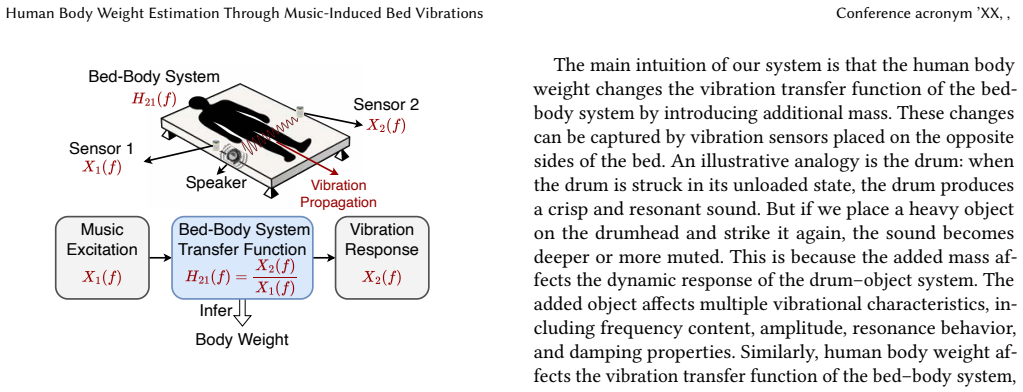
The central object is the vibration transfer function H(ω) = X2(ω)/X1(ω) between two geophones placed on opposite sides of the bed, which the system estimates from power and cross-spectral densities. The paper's theoretical machinery is the loaded-plate vibration model: the body acts as an added mass m0, and the transfer function is approximately a rational function (a Padé approximant) of m0 whose derivative, and therefore weight sensitivity, peaks near the bed's natural frequencies. That functional form is carried into the network as Padé Activation Units, while a learnable sine activation fed by body height represents the bed–body contact area, a confounder that appears in the theory thro
What would settle it
Take a single bed, record the chirp-induced transfer function as an individual's weight is increased in steps larger than 5 kg (for example 10–30 kg) across a range like 40–120 kg, and check whether the peak weight-sensitivity region stays inside the fixed 500–900 Hz (wooden) or 500–800 Hz (steel) window. If the sensitive band shifts out of the fixed window for heavier or differently built subjects, the system's claimed accuracy on unseen people would fail.
Extended reading notes
Core claim
The paper claims that body weight can be recovered from the vibration transfer function of a bed excited by music, where the bed is modeled as a rectangular plate with the body as an added mass. From plate vibration theory it derives that the transfer function's dependence on weight is approximately a rational function—a Padé approximant—and that weight sensitivity concentrates near the bed's natural frequencies. The system finds those bands once per bed type with a chirp sweep (500–900 Hz wooden, 500–800 Hz steel), composes soft music with energy in the band, measures the transfer function between sensors on opposite sides of the bed, and regresses weight with a shallow neural network whose
Load-bearing premise
The load-bearing premise is that the chirp-identified weight-sensitive band (500–900 Hz wooden, 500–800 Hz steel) remains weight-sensitive for all unseen body shapes and heavier weights, even though the tests covered 11 adults and only a simulated 5 kg gain.
Editorial extensions
If this is right
- Gives emergency clinicians a way to weigh immobilized patients without transfers, lifts, or patient cooperation, reducing risk and delay in drug dosing and defibrillation decisions.
- One per-bed-type chirp calibration and one composed music track are enough to estimate weight for individuals never seen in training, under leave-one-person-out evaluation.
- The physics-informed activation functions let the regression work from a small dataset (11 people per bed type), because the network only has to learn structural parameters rather than the whole weight–vibration map from scratch.
- The method transfers across bed types with different structural complexity, with errors growing but remaining clinically acceptable on the more complex steel hospital bed.
- The identified weight-sensitive band can guide music composition, so the acoustic stimulus can be kept soft and natural while still producing weight-sensitive vibrations.
Reading between the lines
- Because the tests covered 11 adults per bed type and only a simulated 5 kg added weight, the fixed frequency windows would likely need to shift or adapt for heavier patients; tracking the resonance peak instead of a fixed window is a testable extension.
- The leave-one-weight-out errors (0.67–1.06 kg) suggest the same hardware could act as a continuous in-bed scale for tracking fluid or weight changes in a single patient, not just one-time admission weights.
- Contact-area variation is a major confounder in the theory; replacing height with a direct posture and contact-area measurement could shrink the steel-bed error more than the wooden-bed error.
- The approach could plausibly be recalibrated for pediatric beds, where length-based tapes are standard and the clinical standard for dosing accuracy is strict.
Editorial analysis
A structured set of objections, weighed in public.
Referee Report
Summary. MelodyBedScale estimates body weight of a person lying on a bed by playing music through an attached speaker and measuring the resulting bed vibrations with geophones. The paper derives a rational (Padé) transfer-function model from a plate-vibration equation, identifies bed-specific weight-sensitive frequency bands using chirp excitation, composes clinically acceptable music with energy in those bands, and trains a small neural network with Padé Activation Units and a learnable sine activation on transfer-function spectra and height. Experiments on wooden and steel beds with 11 participants each report leave-one-person-out MAEs of 1.55 kg (2.37%) and 4.36 kg (6.38%), passing a clinical criterion of >70% estimates within 10% and >95% within 20%. Additional leave-one-weight-out and robustness experiments are reported.
Significance. The application is relevant: weight estimation for immobilized or uncooperative patients has clear clinical value in emergency care. The evaluation has genuine strengths: leave-one-person-out is an appropriate test for cross-individual generalization; LOWO, activation ablations, baseline comparisons, and robustness tests with volume, sensor noise, added-weight material, and posture are useful; and the use of music rather than a chirp as excitation addresses patient comfort. If the reported result holds, the system could be a practical, low-cost bedside weighing method. The main caveats are that the evidence is limited to 11 adults with only 0–5 kg simulated weight change per person, that the single fixed frequency band's generalization across a clinical weight range is not established, and that the physics-informed component is presently a design analogy rather than a formal derivation.
major comments (4)
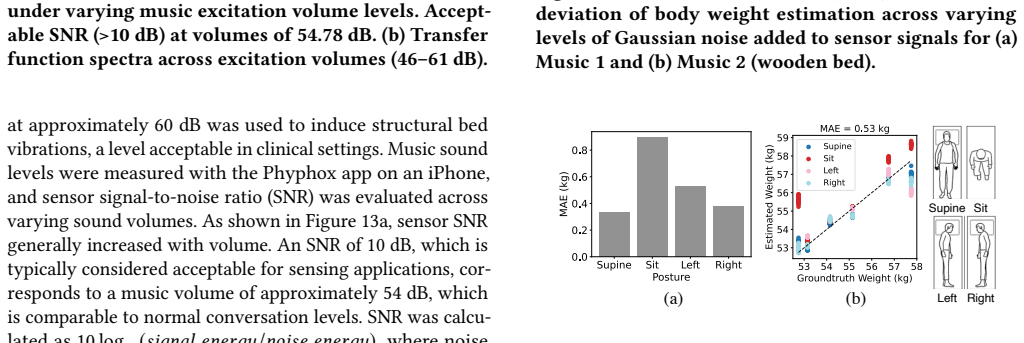
- [§3.1.1, §3.2.2, §4.2] The central generalization claim is tied to a fixed weight-sensitive band (wooden 500–900 Hz, steel 500–800 Hz) used both for music and features. Per the paper's own theory, Eqs. (4)–(5), sensitivity peaks occur where m0+B_mn(ω)=0, so those frequencies shift with mass and contact area. Experiments vary each participant's weight by only 0–5 kg over an 11-person sample (§4.1), and §4.4.1 concedes that real deployment requires covering lower/upper weight bounds in training. No measurement shows the band remains weight-sensitive for untested body types or heavier patients. Because excitation and feature window are both locked to this band, the 'generalization to unseen individuals and weights' claim needs additional evidence or a scope restriction.
- [§3.2.3, Eqs. (3) and (6)] The physics-informed component is currently a design analogy rather than a derivation. Equation (3) gives H(ω) as a rational function of m0, while the PAU in Eq. (6) is a rational function of the hidden feature x, not of mass. No mapping is shown from the Padé coefficients in Eq. (3) to the trainable coefficients in Eq. (6), and the order choice J=5, K=4 is justified only by a loose statement that dominant modes are fewer than five. The ablation in Fig. 10 shows that PAU helps empirically, but it does not establish that the rational form derived from plate theory is the reason. Please either provide a formal connection or describe the activation as physics-inspired rather than physics-derived.
- [§4.5.1–4.5.2] The validation of the weight-sensitive band appears to use the same data on which the band was selected. The band is identified in §3.1.1 and then the performance of features from 500–900 Hz is compared against alternative bands on the same wooden-bed dataset (Fig. 17); the SHAP analysis in Fig. 16 also uses the same bed data. If band selection was performed on the full dataset before LOPO folds were split, the LOPO MAE includes information from test participants. Please state explicitly how the band was selected relative to the cross-validation folds, and, if it was selected on all data, consider nested cross-validation or report the band as a bed-specific hyperparameter with quantified selection uncertainty.
- [§4.3.1, Fig. 7] Performance is reported as point estimates without confidence intervals. With only 11 LOPO folds, the steel-bed value of 76.2% within 10% (against a 70% threshold) and the 4.36 kg MAE may carry substantial uncertainty. A bootstrap or per-fold summary would let the reader judge whether the clinical-standards claim is robust. This is not a correctness error, but it is important for the paper's headline claim.
minor comments (5)
- [Eq. (3)] C1 and C2 appear without definition; C3 is defined only after the equation. Please define all coefficients in place.
- [Ref. [29]] SHAP is attributed to Sundararajan and Najmi (2020); the standard SHAP paper is Lundberg and Lee (2017). Please update the citation.
- [§4.1, §4.4.4] Simulated weight changes by placing water bottles on the abdomen change the mass distribution as well as the total load; the material-invariance test uses one participant and does not rule out distribution effects. Please state this as a limitation.
- [§4.4.5] The posture robustness test uses a single participant. It shows intra-individual posture robustness but cannot establish cross-individual posture robustness.
- [Abstract] The phrase '97.6% accuracy' is potentially misleading; MAE of 1.55 kg on weights around 65 kg is not an accuracy percentage. Use relative MAE or a more precise statement.
Circularity Check
Central LOPO weight estimates are independently held-out; circularity is limited to the in-sample validation of the fixed weight-sensitive frequency band.
-
other
[Section 4.5.2 (Validation of Vibration Transfer Function Feature Selection)]
"To validate its effectiveness, we compared model performance using features from alternative frequency bands on the wooden bed, with results summarized in Figure 17. As shown, the 500–900 Hz band yielded the lowest MAE, thereby confirming the validity of selecting the weight-sensitive frequency band from the transfer function spectra as input to the body weight regression model."
The band being 'confirmed' was identified on the same wooden-bed dataset and already determines both the music excitation and the band-pass-filtered features. Comparing alternative bands on that same dataset and observing that the chosen band has the lowest MAE is in-sample model selection, not independent validation. The confirmation therefore reduces to the fact that the system was built around that band; it provides no out-of-sample evidence that the fixed band remains weight-sensitive for unseen individuals or weights.
-
other
[Section 4.5.1 (Validation of Music Excitation in Weight-Sensitive Frequency Bands)]
"The 500–700 Hz and 600–800 Hz bands demonstrated the strongest negative correlations with coefficients of –0.628 and –0.719, respectively. These findings align with the weight-sensitive modal natural frequencies (500–900 Hz)."
This SHAP-based validation is downstream of the design choices: the music was composed specifically to have high energy in 500–900 Hz, and the regression model inputs are band-pass filtered to that same band. A random forest trained on band energies of these music windows will therefore show 500–800 Hz as important by construction. The alignment of SHAP with the chosen band is a self-consistency check, not an independent measurement that the band is weight-sensitive across the clinical weight range.
full rationale
The central body-weight estimation result is not circular: leave-one-person-out evaluation holds out entire participants, so the reported MAE of 1.55 kg (wooden) and 4.36 kg (steel) is a genuine held-out prediction. The physics-informed PAU is a trainable rational activation function whose coefficients are fitted, not predicted from theory; the paper does not claim those coefficients are derived, so this is an overstatement of theoretical grounding rather than a circular derivation. The main circularity is confined to validating the fixed weight-sensitive frequency band: the band is identified once per bed type and then 'validated' by in-sample comparisons and SHAP on data produced by a system whose music and features are already locked to that band. These checks are self-consistency, not independent confirmation, and the paper itself acknowledges in Section 4.4.1 that real-world deployment requires training coverage of lower and upper weight bounds. No load-bearing self-citation chain or uniqueness import is present; self-citations in related work are not used to justify the central claim. Overall, the circularity score is moderate because the band-validation loop is in-sample, but the headline weight-estimation numbers remain independently evaluated.
Assumptions & free parameters
free parameters (5)
- PAU polynomial orders J, K =
J=5, K=4
- PAU coefficients a_j, b_k =
learned from training data
- Learnable sine frequency nu =
initialized at 1.0, trained
- Weight-sensitive frequency band =
wooden bed 500-900 Hz; steel bed 500-800 Hz
- Repeated-training restart count N =
N=5, lowest validation L1 selected
assumptions (4)
- domain assumption The bed can be modeled as a thin rectangular plate with damping, and the human body as an added distributed static mass m0 over contact area S (Eq. 1).
- ad hoc to paper The infinite modal sum in Eq. (2) can be approximated by a low-order Padé rational function in m0 (Eq. 3) with J=5, K=4.
- domain assumption Weight-sensitive frequency bands coincide with loaded bed natural frequencies, and a chirp identification done once per bed type remains valid across individuals and weights.
- domain assumption Height is a sufficient proxy for bed-body contact area via C3.
Cite this review
Pith. "Pith review of Human Body Weight Estimation Through Music-Induced Bed Vibrations." pith.science (2026). https://pith.science/paper/QDZN3MKO
@misc{pith2026250906257,
  author       = {Pith},
  title        = {Pith review of: Human Body Weight Estimation Through Music-Induced Bed Vibrations},
  year         = {2026},
  howpublished = {\url{https://pith.science/paper/QDZN3MKO}},
  note         = {Machine review of arXiv:2509.06257}
}
read the original abstract
Rapid and accurate body weight estimation is critical in emergency medical care, as it directly influences treatment decisions, such as drug dosing, defibrillation energy selection, and fluid resuscitation. Traditional methods such as stand-on scales, length-based tapes, or transfer-based weighing scales are often impractical for immobilized patients, inaccurate, or labor-intensive and time-consuming. This paper introduces MelodyBedScale, a non-intrusive and rapid on-bed weight estimation system that leverages bed vibration induced by music. The core insight is that body weight affects the vibration transfer function of the bed-body system, which is captured using vibration sensors placed on opposite sides of the bed. First, we identify weight-sensitive frequency bands and compose clinically acceptable soft, natural music with high signal energy in these frequency bands. This music is then played through a speaker mounted on the bed to induce bed vibrations. Additionally, to efficiently capture the complex weight-vibration relationship with limited data and enhance generalizability to unseen individuals and weights, we theoretically analyze the weight-vibration relationship and integrate the results into the activation functions of the neural network for physics-informed weight regression. We evaluated MelodyBedScale on both wooden and steel beds across 11 participants, achieving a mean absolute error of up to 1.55 kg.
Figures


Figures from the paper (12 more)




Reference graph
Works this paper leans on
-
[1]
Jassem Abbasi and Pål Østebø Andersen. 2024. Physical activation functions (PAFs): An approach for more efficient induction of physics into physics-informed neural networks (PINNs).Neurocomputing608 (2024), 128352
work page 2024
-
[2]
Susan M Abdel-Rahman and Anna L Ridge. 2012. An improved pedi- atric weight estimation strategy.Open Med Dev J4, 4 (2012), 87–97
work page 2012
-
[3]
Bradley L Anglemyer, Chris Hernandez, Jane H Brice, and Bin Zou
-
[4]
Andrea Apicella, Francesco Donnarumma, Francesco Isgrò, and Roberto Prevete. 2021. A survey on modern trainable activation func- tions.Neural Networks138 (2021), 14–32
work page 2021
-
[5]
Pennsylvania Patient Safety Authority. 2009. Medication errors: sig- nificance of accurate patient weights.Pa Patient Saf Advis6, 1 (2009), 10–15
work page 2009
-
[6]
Ravneet Bajwa, Erdem Coleri, Ram Rajagopal, Pravin Varaiya, and Christopher Flores. 2017. Development of a cost-effective wireless vibration weigh-in-motion system to estimate axle weights of trucks. Computer-Aided Civil and Infrastructure Engineering32, 6 (2017), 443– 457
work page 2017
-
[7]
JS Bendat and AG Piersol. 1986. Random data: Analysis and measure- ment procedures 2nd Edition A Wiley-Interscience Publication.New York(1986)
work page 1986
-
[8]
Michelle R. Castera and M. B. Borhade. 2025. Fluid Manage- ment. InStatPearls [Internet]. StatPearls Publishing, Treasure Island (FL). https://www.ncbi.nlm.nih.gov/books/NBK532305/?utm_source= chatgpt.com [Updated 2025 Apr 29]
work page 2025
Show all 42 references
-
[9]
Charder Medical. 2024. MS6001 Digital Bed Scale. https://www. chardermedical.com/bed-weighing-scales/MS6001.html
2024
-
[10]
Irit Chelly, Shahaf E Finder, Shira Ifergane, and Oren Freifeld. 2024. Trainable highly-expressive activation functions. InEuropean Confer- ence on Computer Vision. Springer, 200–217
2024
-
[11]
Jesse R Codling, Amelie Bonde, Yiwen Dong, Siyi Cao, Akkarit Sang- petch, Orathai Sangpetch, Hae Young Noh, and Pei Zhang. 2021. MassHog: Weight-sensitive occupant monitoring for pig pens using actuated structural vibrations. InAdjunct Proceedings of the 2021 ACM International...
2021
-
[12]
Vandad Davoodnia, Monet Slinowsky, and Ali Etemad. 2023. Deep multitask learning for pervasive BMI estimation and identity recog- nition in smart beds.Journal of Ambient Intelligence and Humanized Computing14, 5 (2023), 5463–5477
2023
-
[13]
2013.Vibration of solids and structures under moving loads
Ladislav Fr`yba. 2013.Vibration of solids and structures under moving loads. Vol. 1. Springer science & business media
2013
-
[14]
Mary Greenwalt, David Griffen, and Jim Wilkerson. 2017. Elimination of emergency department medication errors due to estimated weights. BMJ Quality Improvement Reports6, 1 (2017)
2017
-
[15]
Nicholas Harrington, Quan M Bui, Zhe Wei, Brandon Hernandez- Pacheco, Pamela N DeYoung, Andrew Wassell, Bayan Duwaik, Ak- shay S Desai, Deepak L Bhatt, Parag Agnihotri, et al . 2021. Passive longitudinal weight and cardiopulmonary monitoring in the home bed. Scientific Reports...
2021
-
[16]
Kaiming He, Xiangyu Zhang, Shaoqing Ren, and Jian Sun. 2015. Delv- ing deep into rectifiers: Surpassing human-level performance on ima- genet classification. InProceedings of the IEEE international conference on computer vision. 1026–1034
2015
-
[17]
Health o meter Professional Scales. 2019. Accuracy Comparison between the Patient Transfer Scale, Typical ICU Bed, and Typical Stretcher. https://www.homscales.com/innovations/patient-transfer- scale/
2019
-
[18]
2012.Dynamics of structures
Jagmohan Humar. 2012.Dynamics of structures. CRC press
2012
-
[19]
Takahiro Ishikawa, Ikuko Sakai, Ayumi Amemiya, Ryou Komatsu, Shoko Sakuraba, and Shiroh Isono. 2022. Long-term body weight change assessed by non-contact load cells under the bed in older people with and without eating assistance: a preliminary study.Scientific Reports12, 1 (2...
2022
-
[20]
Tae-Hwan Kim and Youn-Sik Hong. 2020. Prediction of body weight of a person lying on a smart mat in nonrestraint and unconsciousness conditions.Sensors20, 12 (2020), 3485
2020
-
[21]
Baruch Krauss and Steven M Green. 2006. Procedural sedation and analgesia in children.The Lancet367, 9512 (2006), 766–780
2006
-
[22]
Deborah S Lubitz, James S Seidel, Leon Chameides, Robert C Luten, Arno L Zaritsky, and Frederick W Campbell. 1988. A rapid method for estimating weight and resuscitation drug dosages from length in the pediatric age group.Annals of emergency medicine17, 6 (1988), 576–581
1988
-
[23]
Ningning Ma, Xiangyu Zhang, Ming Liu, and Jian Sun. 2021. Activate or not: Learning customized activation. InProceedings of the IEEE/CVF Conference on Computer Vision and Pattern Recognition. 8032–8042
2021
-
[24]
Massachusetts Department of Public Health. 2025. Emergency Medical Services Pre-Hospital Statewide Treatment Proto- cols. https://www.mass.gov/doc/emergency-medical-services- statewide-treatment-protocols-version-20251-effective-june-16- 2025-0/download. Version 2025.1, Effect...
2025
-
[25]
Renuka Mehta. 2020. The accuracy of the Broselow Tape in overweight and obese patients.Pediatrics146, 1_MeetingAbstract (2020), 158–159
2020
-
[26]
Alejandro Molina, Patrick Schramowski, and Kristian Kersting. 2019. Pad\’e activation units: End-to-end learning of flexible activation func- tions in deep networks.arXiv preprint arXiv:1907.06732(2019)
2019 arXiv
-
[27]
Prajit Ramachandran, Barret Zoph, and Quoc V Le. 2017. Swish: a self-gated activation function.arXiv preprint arXiv:1710.059417, 1 (2017), 5
2017 arXiv
-
[28]
Imran Shafi, Muhammad Siddique Farooq, Isabel De La Torre Díez, Jose Breñosa, Julio César Martínez Espinosa, and Imran Ashraf. 2022. Design and development of smart weight measurement, lateral turn- ing and transfer bedding for unconscious patients in pandemics. In Healthcare,...
2022
-
[29]
Mukund Sundararajan and Amir Najmi. 2020. The many Shapley values for model explanation. InInternational conference on machine learning. PMLR, 9269–9278
2020
-
[30]
Suno AI. 2023. Suno: AI Music Generator. https://www.suno.ai/ Accessed: 2025-08-31
2023
-
[31]
Leon René Sütfeld, Flemming Brieger, Holger Finger, Sonja Füllhase, and Gordon Pipa. 2020. Adaptive blending units: Trainable activa- tion functions for deep neural networks. InScience and Information Conference. Springer, 37–50
2020
-
[32]
Ludovic Trottier, Philippe Giguere, and Brahim Chaib-Draa. 2017. Para- metric exponential linear unit for deep convolutional neural networks. In2017 16th IEEE international conference on machine learning and applications (ICMLA). IEEE, 207–214
2017
-
[33]
ER Vieira and S Kumar. 2009. Safety analysis of patient transfers and handling tasks.BMJ Quality & Safety18, 5 (2009), 380–384
2009
-
[34]
Nicoline Vinter, Mads Z. B. Holst-Hansen, Søren P. Johnsen, Gregory Y. H. Lip, Lars Frost, and Ludovic Trinquart. 2023. Electrical energy by electrode placement for cardioversion of atrial fibrillation: a systematic review and meta-analysis.Open Heart10, 2 (Nov. 2023), e002456...
2023 doi
-
[35]
VPG Force Sensors. 2024. Hospital Beds with Integrated Load Cells for Patient Weighing. VPG Force Sensors Techni- cal Blog. https://blog.vpgforcesensors.com/hospital-beds-with- integrated-load-cells-for-patient-weighing/ Accessed August 7, 2025
2024
-
[36]
Mike Wells, Ashraf Coovadia, Efraim Kramer, and Lara Goldstein. 2013. The PAWPER tape: a new concept tape-based device that increases the accuracy of weight estimation in children through the inclusion of a modifier based on body habitus.Resuscitation84, 2 (2013), 227–232
2013
-
[37]
Mike Wells, Lara Nicole Goldstein, and Alison Bentley. 2017. The accuracy of emergency weight estimation systems in children—a sys- tematic review and meta-analysis.International Journal of Emergency Medicine10 (2017), 1–43
2017
-
[38]
Mike Wells and Penelope Yende. 2023. Is there evidence that length- based tapes with precalculated drug doses increase the accuracy of drug dose calculations in children? A systematic review.Clinical and Experimental Emergency Medicine11, 2 (2023), 145
2023
-
[39]
Ziyu Wu, Quan Wan, Mingjie Zhao, Yi Ke, Yiran Fang, Zhen Liang, Fangting Xie, and Jingyuan Cheng. 2023. Massnet: A deep learning approach for body weight extraction from a single pressure image. In2023 IEEE International Conference on Pervasive Computing and Communications (Pe...
2023
-
[40]
Jiale Zhang, Yuyan Wu, Jesse R Codling, Yen Cheng Chang, Julia Gersey, Pei Zhang, Hae Young Noh, and Yiwen Dong. 2025. WeVibe: Weight Change Estimation Through Audio-Induced Shelf Vibrations In Autonomous Stores.arXiv preprint arXiv:2502.12093(2025)
2025 arXiv
-
[41]
Shibo Zhang, Qiuyang Xu, Sougata Sen, and Nabil Alshurafa. 2020. VibroScale: Turning your smartphone into a weighing scale. InAd- junct Proceedings of the 2020 ACM International Joint Conference on Pervasive and Ubiquitous Computing and Proceedings of the 2020 ACM Internationa...
2020
-
[2004]
The accuracy of visual estimation of body weight in the ED.The American journal of emergency medicine22, 7 (2004), 526–529
2004
Reviewed August 4, 2026 · model on record in the stance chip above.
Discussion (0). Continue with ORCID to comment.