A unified resource-pool architecture for high-dimensional direct-detection optical communication
Pith reviewed 2026-06-26 16:37 UTC · model grok-4.3
The pith
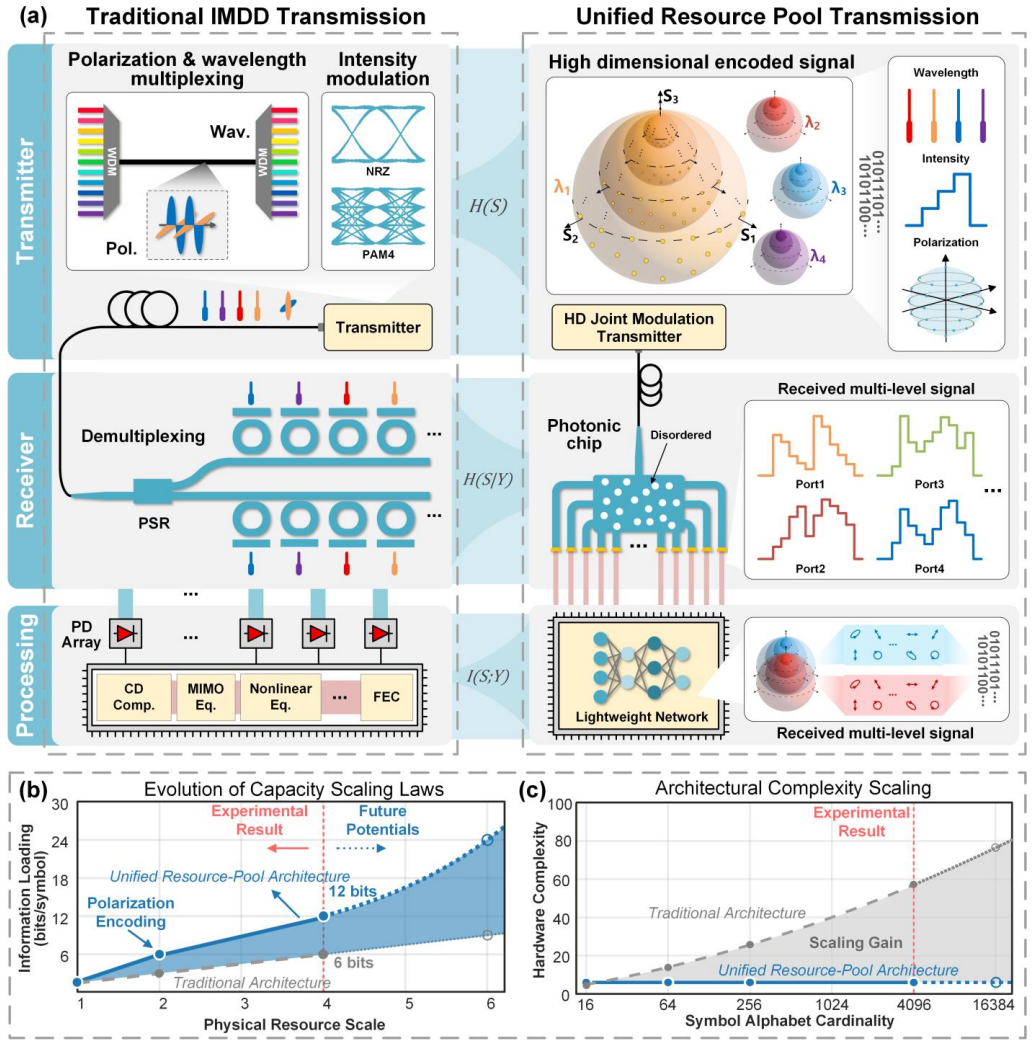
An integrated disordered photonic processor recovers 4096 composite symbols through joint optical projection instead of separating wavelength, polarization and intensity.
A machine-rendered reading of the paper's core claim, the machinery that carries it, and where it could break.
Core claim
The central claim is that disorder-enabled joint projection performed by an integrated photonic processor can map each composite optical state, formed jointly from wavelength, polarization and intensity, onto a reproducible multi-output electrical fingerprint, thereby enabling single-shot recovery of 4096 symbols corresponding to 12 bits per symbol slot with a measured bit error rate of 4.25e-4 after 10 km standard single-mode fiber transmission, and that this route supports hardware-efficient high-dimensional direct-detection communication without conventional dimension-partitioned receiver architecture.
What carries the argument
The integrated disordered photonic processor that performs optical-domain joint projection of composite states into reproducible multi-output electrical fingerprints for single-shot recovery.
If this is right
- The architecture supports dense polarization alphabets and wavelength-indexed state-space expansion without added demultiplexing hardware.
- High-launch-power operation becomes feasible over hollow-core fiber using the same joint-projection receiver.
- Receiver complexity remains independent of the number of dimensions used to form each composite symbol.
- Single-shot direct recovery replaces the need for separate branches and electronic processing for each dimension.
Where Pith is reading between the lines
- The same processor could be tested with additional dimensions such as spatial modes to further expand the symbol space.
- Integration density on photonic chips may allow compact transceivers that maintain performance as symbol cardinality grows.
- The approach might reduce total power consumption in short-reach links by eliminating parallel receiver chains.
Load-bearing premise
The disordered photonic processor produces stable, reproducible electrical fingerprints from each composite optical state that allow accurate single-shot symbol recovery without any conventional separation of wavelength, polarization or intensity.
What would settle it
An experiment in which identical composite symbols produce inconsistent electrical fingerprints across repeated measurements or in which the processor cannot distinguish all 4096 states at the reported error rate after fiber transmission.
Figures
read the original abstract
Increasing optical communication capacity without proportionally increasing receiver complexity remains a key challenge for direct-detection links. Conventional systems typically assign wavelength, polarization and intensity to fixed, separately recovered functions, so that alphabet expansion is accompanied by additional demultiplexing, polarization handling, receiver branches and electronic processing. Here we introduce a unified resource-pool architecture for high-dimensional direct-detection optical communication, in which wavelength, polarization and intensity are jointly organized as a composite optical symbol space and recovered through optical-domain joint projection rather than dimension-by-dimension separation. The receiver is implemented with an integrated disordered photonic processor that transforms each composite optical state into a reproducible multi-output electrical fingerprint for single-shot direct recovery. In a dual-wavelength transmission experiment, the system resolves 4096 composite symbols, corresponding to 12 bits per symbol slot, with a bit error rate of 4.25e-4 after 10 km standard-fiber transmission. Additional experiments demonstrate dense polarization alphabets, wavelength-indexed state-space expansion and high-launch-power operation over hollow-core fiber. These results establish disorder-enabled joint projection in an integrated photonic processor as a route to hardware-efficient high-dimensional direct-detection communication beyond conventional dimension-partitioned receiver architecture.
Editorial analysis
A structured set of objections, weighed in public.
Referee Report
Summary. The manuscript introduces a unified resource-pool architecture for high-dimensional direct-detection optical communication. Wavelength, polarization, and intensity are jointly encoded into composite optical symbols that are recovered via optical-domain joint projection in an integrated disordered photonic processor, which maps each state to a reproducible multi-output electrical fingerprint for single-shot detection. The central experimental result is a dual-wavelength transmission over 10 km standard fiber that resolves 4096 composite symbols (12 bits per symbol slot) at a BER of 4.25e-4, with additional demonstrations of dense polarization alphabets, wavelength-indexed expansion, and operation over hollow-core fiber at high launch power.
Significance. If the results hold, the work demonstrates a concrete path to hardware-efficient scaling of direct-detection capacity by replacing dimension-partitioned receivers with a single disordered processor performing joint projection. The reported 4096-symbol experiment with quantified BER after fiber transmission provides a specific, falsifiable benchmark that strengthens the claim relative to purely theoretical proposals. The approach also highlights potential advantages in resource sharing across dimensions, which could be impactful for integrated photonic systems if the fingerprint uniqueness and stability are rigorously established.
major comments (2)
- [Results] Results section (dual-wavelength experiment): The claim that the disordered photonic processor enables joint projection and single-shot recovery of 4096 symbols without conventional dimension separation is load-bearing, yet the manuscript provides no information on the number of output ports, the condition number of the response matrix, or the orthogonality metrics of the electrical fingerprints. Without these, it is impossible to verify that recovery does not implicitly exploit per-dimension structure.
- [Methods] Experimental methods: The BER of 4.25e-4 is reported after 10 km transmission, but no details are given on the decoding procedure (e.g., whether it is a simple nearest-neighbor classifier on the fingerprint vectors or requires training), temporal stability of the processor response, or how many independent realizations were used to compute the error rate. These omissions directly affect the reproducibility of the 4096-symbol result.
minor comments (1)
- [Abstract] The abstract states 'reproducible multi-output electrical fingerprint' but does not define the output dimensionality or reference the relevant figure or table that quantifies it.
Simulated Author's Rebuttal
We thank the referee for the constructive comments. We address each major comment below and have revised the manuscript to supply the requested details on processor characterization and experimental methods.
read point-by-point responses
-
Referee: [Results] Results section (dual-wavelength experiment): The claim that the disordered photonic processor enables joint projection and single-shot recovery of 4096 symbols without conventional dimension separation is load-bearing, yet the manuscript provides no information on the number of output ports, the condition number of the response matrix, or the orthogonality metrics of the electrical fingerprints. Without these, it is impossible to verify that recovery does not implicitly exploit per-dimension structure.
Authors: We agree that these quantitative metrics are required to substantiate the joint-projection claim. The revised manuscript adds a dedicated paragraph in the Results section reporting the number of output ports, the condition number of the response matrix, and orthogonality metrics (minimum inter-fingerprint distance) for the electrical fingerprints. These values confirm that the disordered processor performs a joint mapping across wavelength, polarization, and intensity dimensions rather than relying on separable per-dimension structure. revision: yes
-
Referee: [Methods] Experimental methods: The BER of 4.25e-4 is reported after 10 km transmission, but no details are given on the decoding procedure (e.g., whether it is a simple nearest-neighbor classifier on the fingerprint vectors or requires training), temporal stability of the processor response, or how many independent realizations were used to compute the error rate. These omissions directly affect the reproducibility of the 4096-symbol result.
Authors: We have expanded the Methods section to specify that decoding uses a nearest-neighbor classifier on the fingerprint vectors with no per-symbol training beyond initial calibration, to report the measured temporal stability of the processor response, and to state the number of independent symbol realizations over which the BER was computed. These additions directly address the reproducibility concern. revision: yes
Circularity Check
No circularity; claims rest on direct experimental demonstration
full rationale
The paper presents an experimental architecture and reports measured BER performance (4.25e-4 for 4096 symbols after 10 km transmission) from a disordered photonic processor. No derivation chain, fitted parameters renamed as predictions, self-definitional equations, or load-bearing self-citations appear in the provided text. The central result is a hardware demonstration whose validity is independent of any internal reduction to its own inputs.
Axiom & Free-Parameter Ledger
axioms (1)
- domain assumption Optical fiber transmission properties are standard and known
invented entities (1)
-
disordered photonic processor
no independent evidence
Reference graph
Works this paper leans on
-
[1]
Agrell, E. et al. Roadmap on optical communications. J. Opt. 26, 093001 (2024)
2024
-
[2]
Miller, D. A. B. Attojoule o ptoelectronics for low -energy information processing and communications. J. Light. Technol. 35, 346–396 (2017)
2017
-
[3]
Han, C. et al. Exploring 400 Gbps/λ and beyond with AI -accelerated silicon photonic slow -light technology. Nat. Commun. 16, 6547 (2025)
2025
-
[4]
J., Fini, J
Richardson, D. J., Fini, J. M. & Nelson, L. E. Space -division multiplexing in optical fibres. Nat. Photonics 7, 354– 362 (2013)
2013
-
[5]
J., Rademacher, G
Puttnam, B. J., Rademacher, G. & Luís, R. S. Space-division multiplexing for optical fiber communications. Optica 8, 1186–1203 (2021)
2021
-
[6]
& Agrell, E
Karlsson, M. & Agrell, E. Multidimensional modulation and coding in optical transport. J. Light. Technol. 35, 876– 884 (2017)
2017
-
[7]
Rahim, A. et al. Taking silicon photonics modulators to a higher performance level: state-of-the-art and a review of new technologies. Adv. Photonics 3, 024001 (2021)
2021
-
[8]
Agrawal, G. P. Fiber-Optic Communication Systems (John Wiley & Sons, 5th edn, 2021)
2021
-
[9]
Optical Communications for Short Reach
Chagnon, M. Optical Communications for Short Reach. J. Lightwave Technol. 37, 1779–1797 (2019)
2019
-
[10]
Pang, X. et al. Beyond 200 Gbps per lane intensity modulation direct detection (IM/DD) transmissions for optical interconnects: challenges and recent developments. In Optical Fiber Communication Conference (OFC) 2019 , paper W4I.7 (Optica Publishing Group, 2019)
2019
-
[11]
Xiong, Y . et al. Robust and hyper-efficient multidimensional optical fiber semantic communication. Adv. Photonics 8, 036001 (2026)
2026
-
[12]
Savory, S. J. Digital filters for coherent optical receivers. Opt. Express 16, 804-817 (2008)
2008
-
[13]
Fundamentals of Coherent Optical Fiber Communications
Kikuchi, K. Fundamentals of Coherent Optical Fiber Communications. J. Lightwave Technol. 34, 157–179 (2016)
2016
-
[14]
Wang, J. et al. Continuous polarization–wavelength mapping with nonlocal metasurfaces. Light Sci. Appl. 15, 170 (2026)
2026
-
[15]
Che, D. et al. Stokes vector direct detection for short-reach optical communication. Opt. Lett. 39, 3110-3113 (2014)
2014
-
[16]
& Shieh, W
Hu, Q., Che, D., Wang, Y . & Shieh, W. Advanced modulation formats for high -performance short-reach optical interconnects. Opt. Express 23, 3245-3259 (2015)
2015
-
[17]
Lin, X. et al. Polarization and wavelength routers based on diffractive neural network. Front. Optoelectron. 17, 22 (2024)
2024
-
[18]
Dong, B. et al. Partial coherence enhances parallelized photonic computing. Nature 632, 55–62 (2024)
2024
-
[19]
Yuan, S. et al. Geometric deep optical sensing. Science 379, eade1220 (2023)
2023
-
[20]
Fan, Y . et al. Dispersion-assisted high-dimensional photodetector. Nature 630, 77–83 (2024)
2024
-
[21]
Xiong, Y . et al. Identification of the mode, polarization, wavelength and intensity of light using a one-pixel device on an optical fibre tip. Nat. Electron. (2026)
2026
-
[22]
Wiersma, D. S. Disordered photonics. Nat. Photonics 7, 188–196 (2013)
2013
-
[23]
Zhang, Y . et al. Miniaturized disordered photonic molecule spectrometer. Light Sci. Appl. 14, 144 (2025)
2025
-
[24]
& Zhang, X
Gu, Z., Zhang, W., Yu, Y . & Zhang, X. Disordered -guiding photonic chip enabled high -dimensional light field detection. Nat. Commun. 16, 7741 (2025)
2025
-
[25]
Petrovich, M. et al. Broadband optical fibre with an attenuation lower than 0.1 decibel per kilometre. Nat. Photonics 19, 1203–1208 (2025)
2025
-
[26]
Feng, L. et al. Demonstration of single-span 100km hollow core fiber bidirectional transmission with 1Tb/s/ λ real- time signals. In Optical Fiber Communication Conference (OFC) 2025, paper M1H.6 (Optica Publishing Group, 2025)
2025
-
[27]
& Ramachandran, S
Ma, Z., Kristensen, P. & Ramachandran, S. Scaling information pathways in optical fibers by topological confinement. Science 380, 278–282 (2023)
2023
-
[28]
Shannon, C. E. A Mathematical Theory of Communication. Bell Syst. Tech. J. 27, 379–423 (1948)
1948
-
[29]
J., Foschini, G
Essiambre, R.-J., Kramer, G., Winzer, P. J., Foschini, G. J. & Goebel, B. Capacity limits of optical fiber networks. J. Lightwave Technol. 28, 662–701 (2010)
2010
-
[30]
Cover, T. M. & Thomas, J. A. Entropy, relative entropy, and mutual information. In Elements of Information Theory 13–55 (John Wiley & Sons, 2005)
2005
-
[31]
& Winzer, P
Cho, J. & Winzer, P . J. Probabilistic constellation shaping for optical fiber communications. J. Lightwave Technol. 37, 1590–1607 (2019)
2019
-
[32]
& Plant, D
Morsy-Osman, M., Chagnon, M. & Plant, D. V . Four -dimensional modulation and Stokes direct detection of polarization division multiplexed intensities, inter polarization phase and inter polarization differential phase. J. Lightwave Technol. 34, 1585–1592 (2016)
2016
-
[33]
H., Kim, H., Park, P
Ji, H.-C., Lee, J. H., Kim, H., Park, P. K. J. & Chung, Y . C. Effect of PDL-induced coherent crosstalk on polarization- division-multiplexed direct-detection systems. Opt. Express 17, 1169-1174 (2009)
2009
-
[34]
Zhong, K. et al. Digital signal processing for short-reach optical communications: a review of current technologies and future trends. J. Lightwave Technol. 36, 377–400 (2018)
2018
-
[35]
& Shieh, W
Li, A., Che, D., Chen, V . & Shieh, W. Spectrally efficient optical transmission based on Stokes vector direct detection. Opt. Express 22, 15662-15677 (2014)
2014
-
[36]
Agrell, E., Lassing, J., Ström, E. G. & Ottosson, T. Gray coding for multilevel constellations in Gaussian noise. IEEE Trans. Inf. Theory 53, 224–235 (2007)
2007
-
[37]
& Mito, I
Aoki, Y ., Tajima, K. & Mito, I. Input power limits of single-mode optical fibers due to stimulated Brillouin scattering in optical communication systems. J. Lightwave Technol. 6, 710–719 (1988)
1988
-
[38]
Mahdiraji, G. A. et al. First triple nested antiresonant nodeless hollow core fiber (TNANF) achieving 0.25 dB/km loss with small 145/250 m glass/coating diameters. In 2025 European Conference on Optical Communications (ECOC) 1–4 (IEEE, 2025)
2025
-
[39]
& Roberts, P
Benabid, F. & Roberts, P. J. Linear and nonlinear optical properties of hollow core photonic crystal fiber. J. Mod. Opt. 58, 87–124 (2011)
2011
-
[40]
Liu, Z. et al. Nonlinearity-free coherent transmission in hollow -core antiresonant fiber. J. Lightwave Technol. 37, 909–916 (2019)
2019
-
[41]
Cuevas, A. R. et al. Machine learning for turning optical fiber specklegram sensor into a spatially -resolved sensing system: proof of concept. J. Lightwave Technol. 36, 3733–3738 (2018)
2018
-
[42]
Wang, H. et al. Large-scale photonic comp uting with nonlinear disordered media. Nat. Comput. Sci. 4, 429–439 (2024). Acknowledgements This work is supported by the National Key Research and Development Program of China (No. 2025YFA1212900), the National Natural Science Foundation of China (No. 62225110,No. 62175079, and No. 62205119), Hubei Province Tech...
2024
discussion (0)
Sign in with ORCID, Apple, or X to comment. Anyone can read and Pith papers without signing in.