REVIEW 2 major objections 3 minor 84 references
Updatable Closed-Form Evaluation of Arbitrarily Complex Multi-Port Network Connections
T0 review · 2 major / 3 minor · reviewed 2026-08-11 · deepseek-v4-flash
Pith's one-line read Updating a previously evaluated network connection after one subsystem changes requires inverting a matrix only as large as that subsystem's connected ports, not the whole connection.
desk verdict Solid closed-form evaluation and update method for connected multi-port networks; the Woodbury update needs an explicit invertibility caveat for rank-deficient changes. read the letter →
The pith
A machine-rendered reading of the paper's core claim, the machinery that carries it, and where it could break.
The reading
What carries the argument
The load-bearing object is the generic cascade-loading formula $\tilde{S} = S_{NN} + S_{NC}\big((S_{\mathrm{con}})^{-1} - S_{CC}\big)^{-1}S_{CN}$, where $S$ is the block-diagonal scattering matrix of a supersystem made from all subsystems and $S_{\mathrm{con}}$ is the scattering matrix of the connection system between their ports. In the common case of $\delta$-connections (delayless, lossless, reflectionless, reciprocal two-port links), $S_{\mathrm{con}}$ is a symmetric permutation matrix equal to its inverse, so the cost sits in the inverse of $(S_{\mathrm{con}})^{-1} - S_{CC}$. The Woodbury matrix identity then updates that inverse when a subsystem's connected-port block changes, producing Eq. (41) with a correction whose rank is the number of changed connected ports.
What would settle it
Take a connected system of two subsystems, compute $S$, then modify one subsystem so that $\Delta S^{E_j}_{CC}$ is a rank-one matrix (a single connected port retuned). Attempting Eq. (41) requires $(-\Delta S^{E_j}_{CC})^{-1}$, which does not exist; comparing the formula's output against a direct evaluation of the connected system would show that this basic update case is not covered.
Extended reading notes
Core claim
On its own terms, the paper claims that every arbitrarily complex connection scheme between multi-port scattering systems can be written as a supersystem plus a connection system, giving the closed-form expression $\tilde{S} = S_{NN} + S_{NC}\big((S_{\mathrm{con}})^{-1} - S_{CC}\big)^{-1}S_{CN}$ for the connected system. It further claims that if one subsystem changes, the updated middle inverse obeys $S' = S - S_{CC_j}\big((-\Delta S^{E_j}_{CC})^{-1} + S_{C_jC_j}\big)^{-1}S_{C_jC}$, obtained from the Woodbury matrix identity. The consequence is that re-evaluating a connection after a subsystem change costs an inversion of size equal to that subsystem's connected ports rather than the size of the full connected-port set. The paper validates the formulas on graph-based transmission-line networks against independently computed ground truths and measures the computational gains.
Load-bearing premise
The load-bearing premise is that the change in the updated subsystem's connected-port scattering block is an invertible matrix; if that change is singular, as in retuning a single port, Eq. (41) as written has no inverse to take.
Editorial extensions
If this is right
- Repeated design evaluations of a reconfigurable composite system need only recompute the parts of the inverse touched by the changed subsystem.
- The closed-form power-wave recovery formulas in Eqs. (42)-(45) give voltages and currents at connected ports without iterating, and they remain compatible with the update shortcut.
- Reducibility via inner-outer equivalency shrinks the matrix inversion problem, although connection cycles with an odd number of systems cannot be fully reduced.
- For connections that are not fully reducible, scattering parameters avoid the quasi-$\delta$ regularization that impedance and admittance parameters require, giving far smaller errors.
- The global method covers serial chains, parallel junctions, and cycles in one non-iterative expression.
Reading between the lines
- The update formula as stated assumes the change block $\Delta S^{E_j}_{CC}$ is invertible; singular changes such as retuning a single connected port form a rank-one update, and a limiting or pseudo-inverse version would be needed to cover them.
- Pushing the update to infinitesimal changes would yield closed-form derivatives of the connected scattering matrix with respect to subsystem parameters, giving gradient-based optimization a direct analytic route.
- Several subsystems changed at once could be handled as one block update by grouping their connected ports, provided the combined change block stays invertible.
- The update could also support closed-form parameter estimation for tunable composite systems, since measured responses can be matched by updating a stored inverse rather than re-solving the connection.
Signed reviews
Editorial analysis
A structured set of objections, weighed in public.
Referee Report
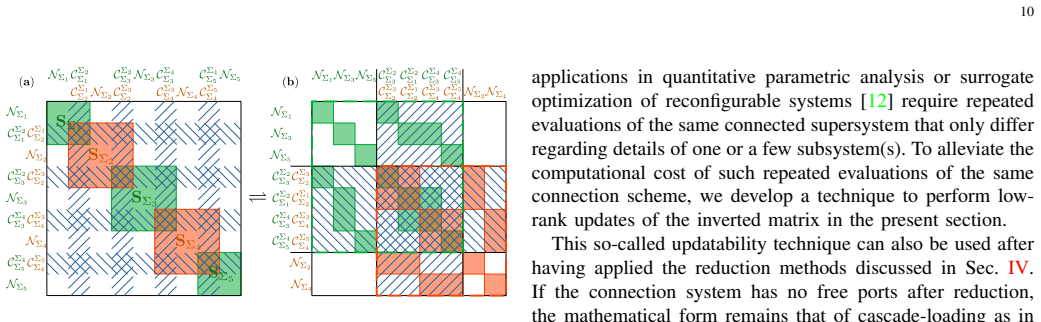
Summary. The paper develops a closed-form method for evaluating the scattering matrix of an arbitrarily complex connection of multi-port networks. The approach gathers all subsystems into a block-diagonal supersystem and represents the connections by a connection system, so that the connected scattering matrix is given by the cascade-loading formula in Eq. (7), specialized in Eq. (24) to a meta-network with serial, parallel and cyclic connections. The authors establish equivalence principles (inner-outer equivalence, derivation of the Redheffer star product from cascade loading), a reducibility technique that reduces the size of the matrix to be inverted, and a Woodbury-based update formula in Eq. (41) that reevaluates the connected system after one subsystem changes by inverting only a matrix of size equal to the changed subsystem's connected ports. They also derive closed-form recovery of the power waves through connected ports, transpose the method to impedance and admittance parameters, and identify a numerical advantage of scattering parameters for non-fully-reducible connections. All formulas are validated against independent analytic scattering matrices of quantum graphs, with relative errors around 1e-14, and the computational benefits are studied numerically.
Significance. If the claims are made precise, the paper gives a useful unifying perspective on diakoptics for multi-port wave systems: the global closed-form expression is a transparent alternative to iterative cascade algorithms, and the update idea is practically valuable for repeated evaluations in reconfigurable systems, filter synthesis and RIS-parametrized channels. The derivations are systematic; the graph-based validation is independent, exact and free of fitting; and the numerical study of speedups is exhaustive. The main caveat is that the update formula as written applies only under invertibility conditions that are not stated, which narrows the universality claimed in the title and abstract.
major comments (2)
- [Sec. V-A, Eq. (41)] The central update formula requires the connected-port change block ΔS^{Ej}_{CC} to be invertible. The Woodbury factorization is set up with C = -ΔS^{Ej}_{CC}, so the inverse of that block appears explicitly. The text states 'The rank of the update is hence n(Cj)', but the rank of ΔS^{Ej}_{CC} can be smaller; a single tunable element coupling to several connected ports is a rank-one change, and in that case (-ΔS^{Ej}_{CC})^{-1} does not exist and Eq. (41) cannot be evaluated. The numerical demonstrations in Fig. 9 use random graph updates that generically produce full-rank ΔS and thus do not exercise this failure mode. This is a scope gap in the central updatability claim rather than an algebraic error, since the underlying problem remains well posed. A simple remedy is to use the equivalent Woodbury factorization with C=I, which reads S' = S + S_{CCj}(I - ΔS^{Ej}_{CC} S_{CjCj})^{-1} ΔS^{Ej}_{CC} S_{CjC} and remains valid for rank-deficient changes (provided the indicated inverse exists). The authors should either state the generic low-rank form or explicitly restrict the claim to invertible ΔS^{Ej}_{CC} in the abstract and in the statement of Eq. (41).
- [Sec. V-A, Eq. (34); Sec. II-D, Eq. (7)] Both the evaluation formula Eq. (7) and the update setup in Eq. (34) are written in terms of (SΓ_con)^{-1}. The paper notes in Remark 3 and Appendix B-C that the evaluation can be rewritten in the forms Scon(I - SΓ_CC Scon)^{-1} or (I - Scon SΓ_CC)^{-1} Scon when Scon is not invertible, but the Woodbury update in Sec. V is not extended to those cases. A connection system with no free ports can nevertheless have a singular scattering matrix in a physically standard situation, for example a perfectly matched load (S=0) used after a reduction. Since the title and abstract promise updates for arbitrarily complex connections, the scope should be made precise: either restrict Sec. V to invertible Scon or derive the corresponding update for the singular-Scon formulations. At minimum, the invertibility assumption should be stated before Eq. (34).
minor comments (3)
- [Sec. V-A] The sentence defining A and ΔA is internally inconsistent: if A = (SΓ_con)^{-1} - SΓ_CC' then S' = A^{-1} is already the desired result, whereas the subsequent Woodbury step requires A to be the old matrix. The authors should define A as the old matrix and write ΔA = A_new - A_old = -(SΓ_CC' - SΓ_CC).
- [Abstract and Sec. V] The abstract should explicitly state that the detailed update formulas apply to problems in cascade-loading form; the Redheffer-star-product case is mentioned but not developed, so the reader may otherwise assume the update covers all reduced configurations.
- [Sec. IV-A] The assertion that systems treated as connections must not be directly connected to each other is stated without proof; a short justification or a reference would help the reader understand the limitation.
Circularity Check
No significant circularity: evaluation and update formulas derive from standard identities and are validated against independent graph-based ground truth.
full rationale
The paper's derivations are self-contained rather than circular. Eq. (7) (generic supersystem connection) is obtained by applying the cascade-loading formula Eq. (1), which is derived in Appendix B-C from the power-wave definitions b = Sa and the connection boundary conditions a_C^(1) = b^(2), a^(2) = b_C^(1); Eq. (24) is just Eq. (7) applied to block-diagonal S^ABCD and the permutation matrix S^ABCD_con. The update formula Eq. (41) follows from the Woodbury identity with ΔA = U C V and C = -ΔS^{Ej}_{CC}; this is a direct algebraic identity, not an assumption of the target result. Validation is external: graph scattering matrices are computed analytically from the quantum-graph formalism [57]-[59], and the connected supergraph serves as an independent ground truth [55], with no fitting or calibrated parameters. The cited prior works by the authors ([43], [52]-[54]) are used for motivation or contextual comparison (e.g., Fig. 2 of [43]), not as justification for the evaluation or update equations. The only notable limitation, that Eq. (41) requires (-ΔS^{Ej}_{CC})^{-1} and hence invertibility of the connected-port change block, is a scope restriction on the update method, not a circular step.
Assumptions & free parameters
free parameters (1)
- epsilon (regularization for quasi-delta connections) =
≈1e-8 (optimal in Fig. 10)
assumptions (4)
- domain assumption The constituent systems are linear, time-invariant, passive, and their ports are monomodal.
- domain assumption The connection between ports can be represented by a scattering matrix Scon, and the needed inverse ((Scon)^{-1} - S_CC) exists or the alternative factorization Eq. (78) applies.
- standard math The graph scattering formula S = I - 2W(M+W^T W)^{-1}W^T (Appendix C, Eq. (102)) correctly describes the validation subsystems and the connected ground truth.
- standard math The Woodbury matrix identity and the blockwise inversion identity of Appendix D are valid.
Cite this review
Pith. "Pith review of Updatable Closed-Form Evaluation of Arbitrarily Complex Multi-Port Network Connections." pith.science (2026). https://pith.science/paper/QEMOJMLM
@misc{pith2026241217884,
  author       = {Pith},
  title        = {Pith review of: Updatable Closed-Form Evaluation of Arbitrarily Complex Multi-Port Network Connections},
  year         = {2026},
  howpublished = {\url{https://pith.science/paper/QEMOJMLM}},
  note         = {Machine review of arXiv:2412.17884}
}
read the original abstract
The design of large complex wave systems (filters, networks, vacuum-electronic devices, metamaterials, smart radio environments, etc.) requires repeated evaluations of the scattering parameters resulting from complex connections between constituent subsystems. Instead of starting each new evaluation from scratch, we propose a computationally efficient method that updates the outcomes of previous evaluations using the Woodbury matrix identity. To enable this method, we begin by identifying a closed-form approach capable of evaluating arbitrarily complex connection schemes of multi-port networks. We pedagogically present unified equivalence principles for interpretations of system connections, as well as techniques to reduce the computational burden of the closed-form approach using these equivalence principles. Along the way, we also achieve the closed-form retrieval of the power waves traveling through connected ports. We illustrate our techniques considering a complex meta-network involving serial, parallel and cyclic connections between multi-port subsystems. We further validate all results with physics-compliant calculations considering graph-based subsystems, and we conduct exhaustive statistical analyses of computational benefits originating from the reducibility and updatability enabled by our approach. Finally, we find that working with scattering parameters (as opposed to impedance or admittance parameters) presents a fundamental advantage regarding an important class of connection schemes whose closed-form analysis requires the treatment of some connections as delayless, lossless, reflectionless and reciprocal two-port scattering systems. We expect our results to benefit the design (and characterization) of large composite (reconfigurable) wave systems.
Figures


Figures from the paper (7 more)




Reference graph
Works this paper leans on
-
[1]
Diakoptics—the solution of system problems by tearing,
H. H. Happ, “Diakoptics—the solution of system problems by tearing,” Proc. IEEE, vol. 62, no. 7, pp. 930–940, 1974
1974
-
[2]
What is diakoptics?
A. Klos, “What is diakoptics?” Int. J. Electr. Power Energy Syst., vol. 4, no. 3, pp. 192–195, 1982
1982
-
[3]
Synthesis of some classes of multivariable cascaded transmission-line networks,
I. Shirakawa, H. Takahashi, and H. Ozaki, “Synthesis of some classes of multivariable cascaded transmission-line networks,” IEEE Trans. Circuit Theory, vol. 15, no. 2, pp. 138–143, 1968
1968
-
[4]
Accelerated microwave design optimization with tuning space mapping,
S. Koziel, J. Meng, J. W. Bandler, M. H. Bakr, and Q. S. Cheng, “Accelerated microwave design optimization with tuning space mapping,” IEEE Trans. Microw. Theory Techn., vol. 57, no. 2, pp. 383– 394, 2009
2009
-
[5]
Space mapping design framework exploiting tuning elements,
Q. S. Cheng, J. W. Bandler, and S. Koziel, “Space mapping design framework exploiting tuning elements,” IEEE Trans. Microw. Theory Techn., vol. 58, no. 1, pp. 136–144, 2009
work page 2009
-
[6]
Progress in simulator-based tuning—the art of tuning space mapping [application notes],
Q. S. Cheng, J. C. Rautio, J. W. Bandler, and S. Koziel, “Progress in simulator-based tuning—the art of tuning space mapping [application notes],” IEEE Microw. Mag., vol. 11, no. 4, pp. 96–110, 2010
work page 2010
-
[7]
S. Bastioli and R. V . Snyder, “Design, modelling, and manufacturing of extremely selective waveguide filters using a multi-port optimization technique,” Proc. NEMO, pp. 338–340, 2017
work page 2017
-
[8]
Efficient calculation of impedance matrices for vacuum electronic device circuit structures,
V . Jabotinski, D. Chernin, T. M. Antonsen, A. N. Vlasov, J. C. Rodgers, I. A. Chernyavskiy, and B. Levush, “Efficient calculation of impedance matrices for vacuum electronic device circuit structures,” IEEE Trans. Electron Dev., vol. 65, no. 6, pp. 2264–2271, 2018
work page 2018
Show all 84 references
-
[9]
Emerging trends in techniques and technology as applied to filter design,
R. V . Snyder, G. Macchiarella, S. Bastioli, and C. Tomassoni, “Emerging trends in techniques and technology as applied to filter design,” IEEE J. Microw., vol. 1, no. 1, pp. 317–344, 2021
2021
-
[10]
All-metal tensor metamaterials: Characterization and design,
J. Ruiz-Garc ´ıa, S. Thakkar, G. Gok, and A. Grbic, “All-metal tensor metamaterials: Characterization and design,” IEEE Trans. Antennas Propag., vol. 72, no. 6, pp. 5117–5128, 2024. 17
2024
-
[11]
Efficient and accurate simulations of metamaterials based on domain decomposition and unit feature database,
M. Jiang, W. J. Ran, J. W. Wu, X. Yang, Y . Li, R. Y . Wu, Q. Cheng, J. Hu, and T. J. Cui, “Efficient and accurate simulations of metamaterials based on domain decomposition and unit feature database,” IEEE Trans. Antennas Propag., 2024
2024
-
[12]
Systematic physics-compliant analysis of over-the-air channel equalization in RIS- parametrized wireless networks-on-chip,
J. Tapie, H. Prod’homme, M. F. Imani, and P. del Hougne, “Systematic physics-compliant analysis of over-the-air channel equalization in RIS- parametrized wireless networks-on-chip,” IEEE J. Sel. Areas Commun. , vol. 42, no. 8, pp. 2026–2038, 2024
2026
-
[13]
End-to-end mutual coupling aware communication model for reconfigurable intelligent surfaces: An electromagnetic-compliant approach based on mutual impedances,
G. Gradoni and M. Di Renzo, “End-to-end mutual coupling aware communication model for reconfigurable intelligent surfaces: An electromagnetic-compliant approach based on mutual impedances,” IEEE Wirel. Commun. Lett. , vol. 10, no. 5, pp. 938–942, 2021
2021
-
[14]
Modeling and architecture design of reconfigurable intelligent surfaces using scattering parameter network analysis,
S. Shen, B. Clerckx, and R. Murch, “Modeling and architecture design of reconfigurable intelligent surfaces using scattering parameter network analysis,” IEEE Trans. Wirel. Commun., vol. 21, no. 2, pp. 1229–1243, 2021
2021
-
[15]
PhysFad: Physics-based end-to-end channel modeling of RIS-parametrized environments with adjustable fading,
R. Faqiri, C. Saigre-Tardif, G. C. Alexandropoulos, N. Shlezinger, M. F. Imani, and P. del Hougne, “PhysFad: Physics-based end-to-end channel modeling of RIS-parametrized environments with adjustable fading,” IEEE Trans. Wirel. Commun. , vol. 22, no. 1, pp. 580–595, 2022
2022
-
[16]
Macromodeling of reconfigurable intelligent surface based on microwave network theory,
Z. Zhang, J. W. Zhang, J. W. Wu, J. C. Liang, Z. X. Wang, Q. Cheng, Q. S. Cheng, T. J. Cui, H. Q. Yang, G. B. Liu, and S. R. Wang, “Macromodeling of reconfigurable intelligent surface based on microwave network theory,” IEEE Trans. Antennas Propag. , vol. 70, no. 10, pp. 8707–...
2022
-
[17]
Accurate modeling of intelligent reflecting surface for communication systems,
D. Badheka, J. Sapis, S. R. Khosravirad, and H. Viswanathan, “Accurate modeling of intelligent reflecting surface for communication systems,” IEEE Trans. Wirel. Commun. , vol. 22, no. 9, pp. 5871–5883, 2023
2023
-
[18]
Experimentally realized physical-model-based frugal wave control in metasurface-programmable complex media,
J. Sol, H. Prod’homme, L. Le Magoarou, and P. del Hougne, “Experimentally realized physical-model-based frugal wave control in metasurface-programmable complex media,” Nat. Commun. , vol. 15, no. 1, p. 2841, 2024
2024
-
[19]
SARIS: Scattering aware reconfigurable intelligent surface model and optimization for complex propagation channels,
P. Mursia, S. Phang, V . Sciancalepore, G. Gradoni, and M. Di Renzo, “SARIS: Scattering aware reconfigurable intelligent surface model and optimization for complex propagation channels,” IEEE Wirel. Commun. Lett., vol. 12, no. 11, pp. 1921–1925, 2023
1921
-
[20]
Physically consistent modeling of wireless links with reconfigurable intelligent surfaces using multiport network analysis,
J. A. Nossek, D. Semmler, M. Joham, and W. Utschick, “Physically consistent modeling of wireless links with reconfigurable intelligent surfaces using multiport network analysis,” IEEE Wirel. Commun. Lett., vol. 13, no. 8, pp. 2240–2244, 2024
2024
-
[21]
On the tacit linearity assumption in common cascaded models of ris-parametrized wireless channels,
A. Rabault, L. Le Magoarou, J. Sol, G. C. Alexandropoulos, N. Shlezinger, H. V . Poor, and P. del Hougne, “On the tacit linearity assumption in common cascaded models of ris-parametrized wireless channels,” IEEE Trans. Wirel. Commun. , vol. 23, no. 8, pp. 10 001– 10 014, 2024
2024
-
[22]
A universal framework for multiport network analysis of reconfigurable intelligent surfaces,
M. Nerini, S. Shen, H. Li, M. D. Renzo, and B. Clerckx, “A universal framework for multiport network analysis of reconfigurable intelligent surfaces,” IEEE Trans. Wirel. Commun. , 2024
2024
-
[23]
Design of reconfigurable intelligent surfaces by using S-parameter multiport network theory – optimization and full-wave validation,
A. Abrardo, A. Toccafondi, and M. Di Renzo, “Design of reconfigurable intelligent surfaces by using S-parameter multiport network theory – optimization and full-wave validation,” IEEE Trans. Wirel. Commun. , 2024
2024
-
[24]
Toward a circuit theory of communication,
M. T. Ivrla ˇc and J. A. Nossek, “Toward a circuit theory of communication,” IEEE Trans. Circuits Syst. I, Reg. Pap. , vol. 57, no. 7, pp. 1663–1683, 2010
2010
-
[25]
Agile free-form signal filtering with a chaotic-cavity-backed non-local programmable metasurface,
F. T. Faul, L. Cronier, A. Alhulaymi, A. D. Stone, and P. del Hougne, “Agile free-form signal filtering with a chaotic-cavity-backed non-local programmable metasurface,” arXiv:2407.00054, 2024
2024 arXiv
-
[26]
A physics-compliant diagonal representation for wireless channels parametrized by beyond-diagonal reconfigurable intelligent surfaces,
P. del Hougne, “A physics-compliant diagonal representation for wireless channels parametrized by beyond-diagonal reconfigurable intelligent surfaces,” arXiv:2409.20509, 2024
2024 arXiv
-
[27]
Stacked intelligent metasurfaces for efficient holographic MIMO communications in 6G,
J. An, C. Xu, D. W. K. Ng, G. C. Alexandropoulos, C. Huang, C. Yuen, and L. Hanzo, “Stacked intelligent metasurfaces for efficient holographic MIMO communications in 6G,” IEEE J. Sel. Areas Commun. , vol. 41, no. 8, pp. 2380–2396, 2023
2023
-
[28]
Physically consistent modeling of stacked intelligent metasurfaces implemented with beyond diagonal RIS,
M. Nerini and B. Clerckx, “Physically consistent modeling of stacked intelligent metasurfaces implemented with beyond diagonal RIS,” IEEE Commun. Lett., vol. 28, no. 7, pp. 1693–1697, 2024
2024
-
[29]
D. M. Pozar, Microwave Engineering , 4th ed. Hoboken, NJ: Wiley, 2011
2011
-
[30]
Dobrowolski, Microwave network design using the scattering matrix
J. Dobrowolski, Microwave network design using the scattering matrix . Artech House, 2010
2010
-
[31]
Analysis of microwave measurement techniques by means of signal flow graphs,
J. Hunton, “Analysis of microwave measurement techniques by means of signal flow graphs,” IRE Trans. Microw. Theory Tech., vol. 8, no. 2, pp. 206–212, 1960
1960
-
[32]
Cascade connection for time- invariant n-port networks,
B. D. O. Anderson and R. W. Newcomb, “Cascade connection for time- invariant n-port networks,” Proc. Inst. Electr. Eng. , vol. 113, no. 6, pp. 970–974, Jun. 1966
1966
-
[33]
A New General Computer Algorithm for S-Matrix Calculation of Interconnected Multiports,
G. Filipsson, “A New General Computer Algorithm for S-Matrix Calculation of Interconnected Multiports,” Proc. Eur. Microw. Conf., pp. 700–704, Sep. 1981
1981
-
[34]
A Generalized n-Port Cascade Connection,
G. Simpson, “A Generalized n-Port Cascade Connection,” Proc. IEEE MTT-S Microw. Symp. Dig., pp. 507–509, Jun. 1981
1981
-
[35]
Krylov’s Solver Based Technique for the Cascade Connection of Multiple n-Port Multimodal Scattering Matrices,
A. Belenguer, E. Diaz Caballero, H. Esteban, A. L. Borja, and J. Cascon, “Krylov’s Solver Based Technique for the Cascade Connection of Multiple n-Port Multimodal Scattering Matrices,” IEEE Trans. Microw. Theory Tech., vol. 61, no. 2, pp. 720–726, Feb. 2013
2013
-
[36]
Extending the cascading by pairs of multiport generalized scattering matrices for characterizing the connected ports,
E. D. Caballero, A. Belenguer, H. Esteban, and V . E. Boria, “Extending the cascading by pairs of multiport generalized scattering matrices for characterizing the connected ports,” IEEE Microw. Wirel. Compon. Lett., vol. 24, no. 11, pp. 733–735, 2014
2014
-
[37]
Perspectives in microwave circuit analysis,
R. Compton, “Perspectives in microwave circuit analysis,” Proc. Midwest Symp. Circuits Syst. , pp. 716–718 vol.2, Aug. 1989
1989
-
[38]
Computer-aided analysis of microwave circuits,
V . Monaco and P. Tiberio, “Computer-aided analysis of microwave circuits,” IEEE Trans. Microw. Theory Tech., vol. 22, no. 3, pp. 249–263, 1974
1974
-
[39]
Generalized Scattering Matrix Method for Analysis of Cascaded and Offset Microstrip Step Discontinuities,
T. S. Chu and T. Itoh, “Generalized Scattering Matrix Method for Analysis of Cascaded and Offset Microstrip Step Discontinuities,” IEEE Trans. Microw. Theory Tech., vol. 34, no. 2, pp. 280–284, Feb. 1986
1986
-
[40]
A New Method to Calculate Cascaded S- Parameters,
L. Yang and G. Yu, “A New Method to Calculate Cascaded S- Parameters,” Proc. EPEPS, pp. 71–73, Oct. 2018, iSSN: 2165-4115
2018
-
[41]
Single-step algorithm for the cascade assembly of multiple S-parameters based multiports networks,
F. de Paulis, S. Scafati, C. Olivieri, and A. Orlandi, “Single-step algorithm for the cascade assembly of multiple S-parameters based multiports networks,” Int. J. RF Microw. Comput.-Aided Eng. , vol. 32, no. 4, p. e23070, 2022
2022
-
[42]
Updating the inverse of a matrix,
W. W. Hager, “Updating the inverse of a matrix,” SIAM Rev., vol. 31, no. 2, pp. 221–239, 1989
1989
-
[43]
Efficient computation of physics- compliant channel realizations for (rich-scattering) RIS-parametrized radio environments,
H. Prod’homme and P. del Hougne, “Efficient computation of physics- compliant channel realizations for (rich-scattering) RIS-parametrized radio environments,” IEEE Communications Letters , vol. 27, no. 12, pp. 3375–3379, 2023
2023
-
[44]
Design of electrically loaded wire antennas using genetic algorithms,
A. Boag, A. Boag, E. Michielssen, and R. Mittra, “Design of electrically loaded wire antennas using genetic algorithms,” IEEE Trans. Antennas Propag., vol. 44, no. 5, p. 687, 1996
1996
-
[45]
Accelerated direct solution of electromagnetic scattering via characteristic basis function method with Sherman-Morrison-Woodbury formula-based algorithm,
X. Chen, C. Gu, Z. Li, and Z. Niu, “Accelerated direct solution of electromagnetic scattering via characteristic basis function method with Sherman-Morrison-Woodbury formula-based algorithm,” IEEE Trans. Antennas Propag., vol. 64, no. 10, pp. 4482–4486, 2016
2016
-
[46]
Analysis of partial geometry modification problems using the partitioned-inverse formula and Sherman–Morrison–Woodbury formula-based method,
X. Chen, C. Gu, Y . Zhang, and R. Mittra, “Analysis of partial geometry modification problems using the partitioned-inverse formula and Sherman–Morrison–Woodbury formula-based method,”IEEE Trans. Antennas Propag., vol. 66, no. 10, pp. 5425–5431, 2018
2018
-
[47]
Fast and accurate optimization of metasurfaces with gradient descent and the Woodbury matrix identity,
J. Budhu and A. Grbic, “Fast and accurate optimization of metasurfaces with gradient descent and the Woodbury matrix identity,” IEEE Trans. Antennas Propag., vol. 71, no. 9, pp. 7679–7683, 2023
2023
-
[48]
Automated network design-the frequency- domain case,
S. Director and R. Rohrer, “Automated network design-the frequency- domain case,” IEEE Trans. Circuit Theory, vol. 16, no. 3, pp. 330–337, 1969
1969
-
[49]
The generalized adjoint network and network sensitivities,
——, “The generalized adjoint network and network sensitivities,” IEEE Trans. Circuit Theory, vol. 16, no. 3, pp. 318–323, 1969
1969
-
[50]
Network sensitivities in terms of scattering parameters,
G. Iuculano, V . Monaco, and P. Tiberio, “Network sensitivities in terms of scattering parameters,” Electron. Lett., vol. 7, no. 2, pp. 53–55, 1971
1971
-
[51]
Adjoint techniques for sensitivity analysis in high-frequency structure CAD,
N. K. Nikolova, J. W. Bandler, and M. H. Bakr, “Adjoint techniques for sensitivity analysis in high-frequency structure CAD,” IEEE Trans. Microw. Theory Tech., vol. 52, no. 1, pp. 403–419, 2004
2004
-
[52]
Virtual VNA: Minimal-ambiguity scattering matrix estimation with load-tunable ports,
P. del Hougne, “Virtual VNA: Minimal-ambiguity scattering matrix estimation with load-tunable ports,” arXiv:2403.08074, 2024
2024 arXiv
-
[53]
Virtual VNA 2.0: Ambiguity-free scattering matrix estimation by terminating inaccessible ports with tunable and coupled loads,
——, “Virtual VNA 2.0: Ambiguity-free scattering matrix estimation by terminating inaccessible ports with tunable and coupled loads,” arXiv:2409.10977, 2024
2024
-
[54]
Optimal blind focusing on perturbation-inducing targets in sub-unitary complex media,
J. Sol, L. Le Magoarou, and P. del Hougne, “Optimal blind focusing on perturbation-inducing targets in sub-unitary complex media,” Laser Photonics Rev., p. 2400619, 2024
2024
-
[55]
The generalized star product and the factorization of scattering matrices on graphs,
V . Kostrykin and R. Schrader, “The generalized star product and the factorization of scattering matrices on graphs,” J. Math. Phys. , vol. 42, no. 4, pp. 1563–1598, Apr. 2001
2001
-
[56]
Experimental simulation of quantum graphs by microwave networks,
O. Hul, S. Bauch, P. Pako ´nski, N. Savytskyy, K. ˙Zyczkowski, and L. Sirko, “Experimental simulation of quantum graphs by microwave networks,” Phys. Rev. E, vol. 69, no. 5, p. 056205, May 2004
2004
-
[57]
Scattering theory on graphs,
C. Texier and G. Montambaux, “Scattering theory on graphs,” J. Phys. A: Math. Gen. , vol. 34, no. 47, p. 10307, Nov. 2001. 18
2001
-
[58]
Quantum Graphs: A simple model for Chaotic Scattering,
T. Kottos and U. Smilansky, “Quantum Graphs: A simple model for Chaotic Scattering,” J. Phys. A: Math. Gen. , vol. 36, no. 12, pp. 3501– 3524, Mar. 2003
2003
-
[59]
Quantum graphs: II. Some spectral properties of quantum and combinatorial graphs,
P. Kuchment, “Quantum graphs: II. Some spectral properties of quantum and combinatorial graphs,” J. Phys. A: Math. Gen. , vol. 38, no. 22, p. 4887, May 2005
2005
-
[60]
Multimode TRL. a new concept in microwave measurements: theory and experimental verification,
C. Seguinot, P. Kennis, J.-F. Legier, F. Huret, E. Paleczny, and L. Hayden, “Multimode TRL. a new concept in microwave measurements: theory and experimental verification,” IEEE Trans. Microw. Theory Tech., vol. 46, no. 5, pp. 536–542, 1998
1998
-
[61]
T. T. Ha, Solid-state microwave amplifier design . Wiley-Interscience, 1981
1981
-
[62]
A new implementation of a multiport automatic network analyzer,
A. Ferrero, U. Pisani, and K. J. Kerwin, “A new implementation of a multiport automatic network analyzer,” IEEE Trans. Microw. Theory Tech., vol. 40, no. 11, pp. 2078–2085, 1992
1992
-
[63]
Signal/power integrity analysis for multilayer printed circuit boards using cascaded s-parameters,
F. De Paulis, Y .-J. Zhang, and J. Fan, “Signal/power integrity analysis for multilayer printed circuit boards using cascaded s-parameters,” IEEE Trans. Electromagn. Compat., vol. 52, no. 4, pp. 1008–1018, 2010
2010
-
[64]
Systematic design of large- scale multiport decoupling networks,
D. Nie, B. M. Hochwald, and E. Stauffer, “Systematic design of large- scale multiport decoupling networks,” IEEE Trans. Circuits Syst. I Regul. Pap., vol. 61, no. 7, pp. 2172–2181, 2014
2014
-
[65]
Beyond diagonal reconfigurable intelligent surfaces with mutual coupling: Modeling and optimization,
H. Li, S. Shen, M. Nerini, M. Di Renzo, and B. Clerckx, “Beyond diagonal reconfigurable intelligent surfaces with mutual coupling: Modeling and optimization,” IEEE Commun. Lett. , 2024
2024
-
[66]
Multiport conversions between S, Z, Y, h, ABCD, and T parameters,
T. Reveyrand, “Multiport conversions between S, Z, Y, h, ABCD, and T parameters,” Proc. INMMIC, pp. 1–3, 2018
2018
-
[67]
Predicting the bistatic scattering of a multi-port loaded structure under arbitrary excitation: The S-parameters approach,
A. D. Kuznetsov, J. Holopainen, and V . Viikari, “Predicting the bistatic scattering of a multi-port loaded structure under arbitrary excitation: The S-parameters approach,” IEEE Trans. Antennas Propag., pp. 1–1, 2024
2024
-
[68]
Kirchhoff’s rule for quantum wires,
V . Kostrykin and R. Schrader, “Kirchhoff’s rule for quantum wires,” J. Phys. A: Math. Gen. , vol. 32, no. 4, p. 595, Jan. 1999
1999
-
[69]
Analysis and synthesis of cascaded metasurfaces using wave matrices,
A. Ranjbar and A. Grbic, “Analysis and synthesis of cascaded metasurfaces using wave matrices,” Phys. Rev. B , vol. 95, no. 20, p. 205114, May 2017
2017
-
[70]
Alternate forms of the generalized composite scattering matrix,
P. Overfelt and D. White, “Alternate forms of the generalized composite scattering matrix,” IEEE Trans. Microw. Theory Tech. , vol. 37, no. 8, pp. 1267–1268, 1989
1989
-
[71]
A novel EM analysis of cascaded thick FSS using mode-matching generalized scattering matrix technique,
S. Narayan, K. Prasad, R. U. Nair, and R. M. Jha, “A novel EM analysis of cascaded thick FSS using mode-matching generalized scattering matrix technique,” Proc. AEMC, pp. 1–4, Dec. 2011
2011
-
[72]
Improved formulation of scattering matrices for semi-analytical methods that is consistent with convention,
R. C. Rumpf, “Improved formulation of scattering matrices for semi-analytical methods that is consistent with convention,” Prog. Electromagn. Res. B , vol. 35, pp. 241–261, 2011
2011
-
[73]
Fully Coherent Electromagnetic Scattering Computation for Snowpacks Based on Statistical S-Matrix Approach,
M. M. Zaky and K. Sarabandi, “Fully Coherent Electromagnetic Scattering Computation for Snowpacks Based on Statistical S-Matrix Approach,” IEEE Trans. Geosci. Remote Sens., vol. 59, no. 8, pp. 6336– 6345, Aug. 2021
2021
-
[74]
Inequalities for a Matrix Riccati Equation,
R. Redheffer, “Inequalities for a Matrix Riccati Equation,” J. Math. Mech., vol. 8, no. 3, pp. 349–367, 1959
1959
-
[75]
R. W. Farebrother, Linear least squares computations. Routledge, 1988
1988
-
[76]
Scattering matrix of a three-terminal junction in one dimension,
T. Itoh, “Scattering matrix of a three-terminal junction in one dimension,” Phys. Rev. B, vol. 52, no. 3, pp. 1508–1511, Jul. 1995
1995
-
[77]
The junction matrix in the analysis of scattering networks,
J. Shekel, “The junction matrix in the analysis of scattering networks,” IEEE Trans. Circuits Syst. , vol. 21, no. 1, pp. 21–25, Jan. 1974
1974
-
[78]
Scattering-matrix formalism of electron transport through three-terminal quantum structures: formulation and application to Y-junction devices,
D. Csontos and H. Q. Xu, “Scattering-matrix formalism of electron transport through three-terminal quantum structures: formulation and application to Y-junction devices,” J. Phys.: Condens. Matter , vol. 14, no. 47, p. 12513, Nov. 2002
2002
-
[79]
Applications of Generalized Cascade Scattering Matrix on the Microwave Circuits and Antenna Arrays,
S.-F. Cao, Y .-C. Jiao, and Z. Zhang, “Applications of Generalized Cascade Scattering Matrix on the Microwave Circuits and Antenna Arrays,” Int. J. Antennas Propag. , vol. 2015, p. e759439, Apr. 2015
2015
-
[80]
Projective Matrix Transformations in Microwave Network Theory,
R. Speciale, “Projective Matrix Transformations in Microwave Network Theory,” Proc. IEEE MTT-S Int. Microw. Symp. Dig., pp. 510–512, Jun. 1981
1981
-
[81]
Block tridiagonal matrix inversion and fast transmission calculations,
D. E. Petersen, H. H. B. Sørensen, P. C. Hansen, S. Skelboe, and K. Stokbro, “Block tridiagonal matrix inversion and fast transmission calculations,” J. Comput. Phys. , vol. 227, no. 6, pp. 3174–3190, Mar. 2008
2008
-
[82]
Efficient Technique for the Cascade Connection of Multiple Two-Port Scattering Matrices,
C. Bachiller, H. E. Gonzalez, V . E. Boria Esbert, A. Belenguer Martinez, and J. V . Morro, “Efficient Technique for the Cascade Connection of Multiple Two-Port Scattering Matrices,” IEEE Trans. Microw. Theory Tech., vol. 55, no. 9, pp. 1880–1886, Sep. 2007
2007
-
[83]
Extending the Cascading by Pairs of Multiport Generalized Scattering Matrices for Characterizing the Connected Ports,
E. Diaz Caballero, A. Belenguer, H. Esteban, and V . E. Boria, “Extending the Cascading by Pairs of Multiport Generalized Scattering Matrices for Characterizing the Connected Ports,” IEEE Microw. Wirel. Compon. Lett., vol. 24, no. 11, pp. 733–735, Nov. 2014
2014
-
[84]
Power Waves and the Scattering Matrix,
K. Kurokawa, “Power Waves and the Scattering Matrix,” IEEE Trans. Microw. Theory Tech., vol. 13, no. 2, pp. 194–202, Mar. 1965
1965
Reviewed August 11, 2026 · model on record in the stance chip above.
Discussion (0). Continue with ORCID to comment.