REVIEW 4 major objections 5 minor 49 references
Cosmological $\gamma$-$\gamma$ Pair-Production Background
T0 review · 4 major / 5 minor · reviewed 2026-08-02 · deepseek-v4-flash
Pith's one-line read Cosmic photon background annihilates with itself to produce a measurable share of the gamma-ray background.
desk verdict A plausible bookkeeping calculation of a guaranteed process, but the headline 10-20% IC contribution is a fiducial, not a floor, given the authors' own 0.075-5.1 normalization band. read the letter →
The pith
A machine-rendered reading of the paper's core claim, the machinery that carries it, and where it could break.
The reading
What carries the argument
The calculation rests on decomposing the full cosmic photon background into 28 diluted blackbody (gray-body) components, fitting their temperatures and amplitudes to observational data. Each component is then evolved in redshift using source-type luminosity functions—pure density evolution, pure luminosity evolution, or luminosity-dependent density evolution—so that the CPB can be reconstructed for redshifts up to 10. The pair-injection spectrum is obtained by integrating the angle- and energy-dependent pair-production cross section (following Boettcher & Schlickeiser) over the evolving CPB, and the resulting electron/positron populations are propagated toward z=0 through a cosmological cont
What would settle it
Measure the cosmic gamma-ray background spectrum in the 1–100 MeV range with significantly better precision and compare it to the sum of established source contributions (Seyferts, FSRQs, supernovae, blazars, neutron stars). If the observed background is already fully explained by known sources alone, or if the sum of known sources plus this predicted Inverse Compton component exceeds the observed flux at the fiducial CPB amplitudes, the central 10–20% claim would be ruled out. Conversely, if the excess tracks the predicted double-peaked shape around 0.1 MeV and tens of MeV, the claim would be
Extended reading notes
Core claim
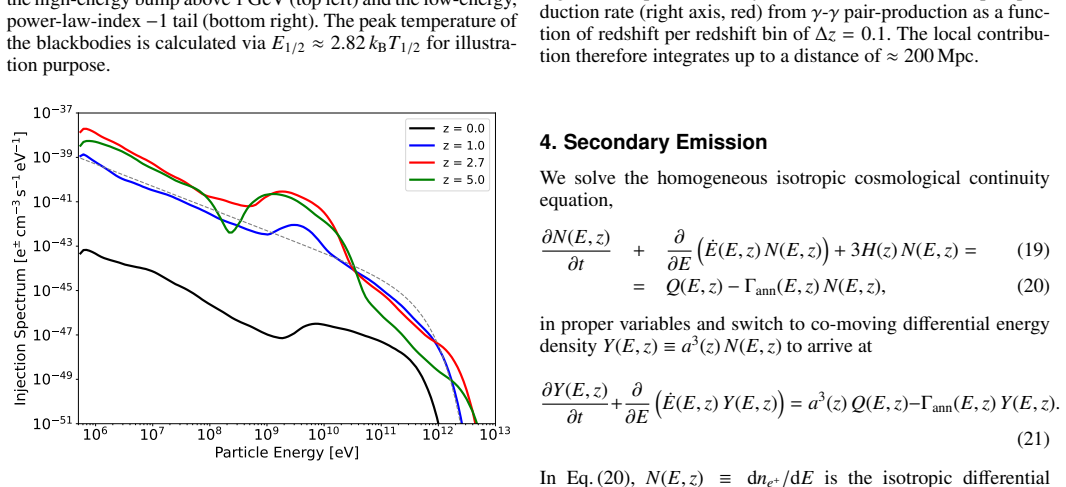
The paper's central claim is that electron-positron pairs produced by gamma-gamma annihilation of the cosmic photon background with itself, after Inverse Compton cooling, contribute 10–20% of the cosmic gamma-ray background between roughly 1 MeV and 1 GeV. The pair-production emissivity rises steeply from about 2×10⁻³⁶ e± cm⁻³ s⁻¹ at z=0 to a peak of 1.8×10⁻³¹ e± cm⁻³ s⁻¹ at z≈2.7, then declines, yielding a total cosmic pair-production rate on the order of 10⁵⁴ e± s⁻¹ up to redshift 10. Because the process is physically inevitable, the authors argue it sets a minimum level of secondary emission that any CGB study must include.
Load-bearing premise
The magnitude of the claimed effect depends on the assumption that the cosmic photon background at every redshift is accurately represented by 28 gray-body components, whose amplitudes at z=0 are uncertain by up to an order of magnitude and whose redshift evolution—especially beyond z=5—is described by luminosity functions the paper itself calls rather uncertain.
Editorial extensions
If this is right
- Any future model of the cosmic gamma-ray background must include this pair-production secondary component as a minimum contribution, especially in the 1–100 MeV band.
- If correct, roughly 10–20% of the measured MeV background could originate from the re-emission of pairs created by photon-photon absorption at higher energies, reducing the need for unknown sources.
- The peak pair-production rate at z≈2.7 means most of this secondary emission is generated during the epoch of peak star formation, linking the gamma-ray background to the cosmic star-formation history.
- The local (Galactic-scale) pair-production rate is about eight orders of magnitude below the Milky Way's positron annihilation rate, so this process does not solve the Galactic positron puzzle—but it does create a substantial intergalactic population of high-energy e± pairs above 1 GeV.
Reading between the lines
- If the central claim holds, precise measurements of the MeV background could be inverted to constrain the amplitude of the cosmic UV/optical background and the GeV background, which are the dominant pair-production partners—offering a new observational probe of those fields.
- The model assumes negligible intergalactic magnetic fields; if the IGMF is actually near 10⁻⁹ G, synchrotron losses would compete with Inverse Compton, shifting the predicted secondary spectrum and possibly producing a radio background—a testable alternative scenario.
- The gray-body decomposition is a modeling choice; a power-law decomposition or an independently fitted CPB evolution could either confirm the 10–20% estimate or reveal how much of it is tied to the assumed 28-component functional form.
- Because the emission peaks around 100 keV and tens of MeV, instruments with improved sensitivity in that band could directly search for the double-peaked spectral signature predicted here.
Editorial analysis
A structured set of objections, weighed in public.
Referee Report
Summary. This paper calculates the cosmological electron–positron pair-production rate from γ–γ interactions of the cosmic photon background (CPB) with itself for 0 ≤ z ≤ 10. The CPB is decomposed into 28 diluted blackbodies fitted to Hill et al. (2018), each evolved by an assumed source luminosity function. The authors integrate the Boettcher & Schlickeiser (1997) differential cross section over the evolving fields, solve a continuity equation with Coulomb/ionization, IC, bremsstrahlung, synchrotron, adiabatic, and annihilation losses, and line-of-sight integrate the resulting IC, bremsstrahlung, and annihilation emission. They find a peak pair emissivity of 1.8×10^-31 cm^-3 s^-1 at z≈2.7, a total rate ~10^54 e±/s, and conclude that IC emission from the pairs contributes 10–20% of the observed CGB in the 1 MeV–1 GeV range, making it an inevitable secondary component that should be included in CGB models.
Significance. If the quantitative claim held, this would be a valuable addition to CGB modeling: it identifies an unavoidable secondary channel operating on the known CPB alone, and it could help close the long-standing MeV-band gap. The use of the exact QED pair-production kernel, the explicit redshift-dependent propagation, and the careful treatment of the IGM cooling channels are strengths. The main limitation is not the formalism but the normalization: the input CPB amplitudes are uncertain by orders of magnitude, the high-z luminosity functions are extrapolated, and no fitted parameters or code are provided. The paper's own uncertainty band reaches values for which the IC contribution is below ~1% of the CGB, so the headline '10–20%' should be read as an upper-end estimate rather than a robust minimum.
major comments (4)
- [§3.1, §4, Fig. 10] The headline claim that the Inverse Compton component contributes 10–20% of the CGB between 1 MeV and 1 GeV is not robust to the input uncertainties stated in the paper itself. Section 3.1 notes that the fitted blackbody amplitudes in the COB and MeV-CGB ranges are “typically uncertain by one order of magnitude, or more”. Section 4 propagates COB/CUV (70%) and CGB (50%) amplitude uncertainties into a normalization range 0.075–5.1 times the fiducial IC prediction. Multiplying the 10–20% fiducial contribution by 0.075 gives ~0.75–1.5%, so the claimed “minimum level” and “sizable contribution” are not established at the low end. The paper should supply the fitted parameters with covariance and present the IC/CGB ratio as a function of the input amplitude uncertainties rather than a single curve.
- [§3.2, Eq. (29)] High-redshift source evolution is a second, unquantified normalization risk. Section 3.2 states that luminosity functions are “rather uncertain” beyond z=5, yet Eq. (29) integrates secondary emission to z_max=10. The peak pair-production rate occurs at z≈2.7, but the line-of-sight integral receives contributions from z>5 where the CPB model is extrapolated. The quoted 0.075–5.1 uncertainty band includes only COB/CGB amplitude and energy-loss factors, not this luminosity-function uncertainty. A sensitivity test with alternative high-z luminosity functions, or a truncated z_max=5 comparison, is needed to determine whether the 10–20% claim survives.
- [§3.1, Table 2] The calculation is not independently reproducible. Section 3.1 states that 54 parameters (27 temperatures and 27 amplitudes) were fit by χ²-minimization, but neither the fitted values nor the fitting residuals are given; Table 2 lists only source identifications and compositions. Since the pair-production emissivity is a direct integral (Eq. 5) over these fitted gray-body fields, the central result cannot be checked without the parameter table or code. Please provide a supplementary table with the fitted temperatures/amplitudes and, ideally, the propagation script.
- [§4, Eq. (27)] The IC emissivity uses the delta-approximation kernel (Dermer & Schlickeiser 1993). Because the secondary spectrum in the 1 MeV–1 GeV band is the quantity compared with CGB data, the delta approximation can shift the predicted spectral shape and the fraction of flux falling in that band. The authors should quantify the effect by comparing with the full IC kernel, at least for the dominant CMB target field; this is particularly relevant to the two-peak structure described in Section 4.
minor comments (5)
- [Eq. (29), Fig. 9] The text says Eq. (29) includes e^{-τ}, but the Fig. 9 caption calls the total spectrum “unabsorbed”. Clarify whether τ=0 is used in the figure; if not, state the attenuation treatment explicitly.
- [Abstract/§4/§5] The claimed band is stated variously as “1–100 MeV” and “1 MeV–1 GeV”, and “10–20%” vs. “20%”. Harmonize these statements and specify whether the percentage is a local maximum in a sub-band or an average over the stated range.
- [§5] The total systematic uncertainty is quoted as “about one order of magnitude”, but Section 4 gives a normalization range 0.075–5.1 (a factor of 68). Reconcile these statements.
- [Table 2] Row 22 lists “0.6 FSRQ+0.5 BL Lac”, which sums to 1.1; check and normalize the composition fractions.
- [§4] Using the total measured CGB as input includes the secondary component being computed. For a 10–20% contribution this is a second-order correction, but a brief self-consistency check, or an explicit statement that the effect is neglected, would strengthen the “minimum level” terminology.
Circularity Check
No significant circularity: the 10–20% IC contribution is a forward QED calculation from measured CPB fields, not a fit to the comparison data.
full rationale
The derivation is self-contained. The CPB is decomposed into 28 gray bodies fitted to Hill et al. (2018) data (Sec. 3.1, Eq. 7); the pair-injection spectrum is the QED integral of Eq. (5); the IC/annihilation emission follows from solving Eq. (21) and line-of-sight integration of Eq. (29). The claimed 10–20% CGB contribution (Sec. 4, Fig. 10) is not equal to any fitted parameter and is not statistically forced to the comparison data: it is a reshuffled, sub-dominant product of a nonlinear integral over the fitted photon fields. The paper's own caveats—amplitudes 'typically uncertain by one order of magnitude, or more' (Sec. 3.1), luminosity functions 'rather uncertain' beyond z=5 (Sec. 3.2), and an IC normalization range of 0.075–5.1× (Sec. 4)—are robustness/accuracy limitations, affecting the strength of the quantitative claim but not creating logical circularity. The z≈2.7 peak is inherited from the assumed SFR/luminosity-function evolution, which is an input dependence, not a tautology. Self-citations (Siegert 2023, Siegert et al. 2016) are background or rate comparisons and are not load-bearing. No uniqueness theorem or ansatz is imported from the authors' prior work. The only near-overlap is that the observed CGB is both part of the fitted input and the comparison target; because the predicted IC is not the same quantity as the input and is small relative to the dominant pair-production partners (COB/CUV with GeV CGB), this is a self-consistency consideration rather than a reduction by construction. Missing code/parameter tables hinder reproducibility but are not circularity.
Assumptions & free parameters
free parameters (5)
- 27 blackbody temperatures T_i =
not given numerically; peak energies from 37 MHz to 236 GeV (Table 2)
- 27 blackbody dilution amplitudes A_i =
not given numerically; amplitudes uncertain by order of magnitude or more in COB/CGB(MeV) ranges
- source-composition fractions per blackbody =
e.g., 0.5 Gal+0.5 AGN, 0.25 SNe+0.75 FSRQ (Table 2)
- luminosity-function parameters (phi*, L*, slopes, evolution e(z)) =
taken from cited AGN/blazar/SF galaxy surveys
- IGM magnetic field / synchrotron cooling =
assumed negligible (B ~ 1e-15 G)
assumptions (7)
- standard math QED gamma-gamma pair-production cross section and differential spectrum (Boettcher & Schlickeiser 1997; Jauch & Rohrlich 1976)
- domain assumption The CPB is well represented by a sum of 28 diluted blackbodies
- domain assumption Each blackbody can be assigned to specific source types and evolved by luminosity functions/redshift
- domain assumption IGM density, temperature, ionization states from Puchwein+15, Silva+13; Ps formation coefficients from Wallyn+96
- domain assumption Delta-approximation for IC kernel and E^-1 bremsstrahlung kernel suffice
- ad hoc to paper Negligible synchrotron cooling (small IGM magnetic field)
- ad hoc to paper All pairs cool fully and only then annihilate; a global factor of 2 covers early annihilation
Cite this review
Pith. "Pith review of Cosmological $\gamma$-$\gamma$ Pair-Production Background." pith.science (2026). https://pith.science/paper/QESGBZQY
@misc{pith2026260714276,
  author       = {Pith},
  title        = {Pith review of: Cosmological $\gamma$-$\gamma$ Pair-Production Background},
  year         = {2026},
  howpublished = {\url{https://pith.science/paper/QESGBZQY}},
  note         = {Machine review of arXiv:2607.14276}
}
abstract
The origin of positrons is one of the unsolved puzzles in astrophysics as the majority of sources are still unidentified. The Cosmic Photon Background (CPB) is the isotropic radiation spanning the entire electromagnetic spectrum. Interactions of the CPB with itself may pose a promising source of positrons and secondary emission. We calculate the electron-positron pair production rate from the $\gamma$-$\gamma$ pair-production of the CPB with itself for redshifts $z \leq 10$, and determine the annihilation spectrum, Inverse Compton emission, and bremsstrahlung. The CPB is decomposed into a sum of gray body functions, of which each is being evolved according to source type luminosity functions and redshift. We compute the pair-production rate by integrating the angle- and energy-dependent cross section over the evolving CPB. The pairs produced at each redshift are then propagated towards $z=0$, taking into account a cosmological, intergalactic, energy loss function. The photon emission is calculated per redshift and then line-of-sight integrated towards a contribution of the Cosmic Gamma-Ray Background (CGB) today. The resulting pair-production emissivity increases steeply from $z=0$ of about $2 \times 10^{-36}$ to a peak of $1.8 \times 10^{-31}\,\mathrm{e^\pm\,cm^{-3}\,s^{-1}}$ at $z=2.7$, then declines again. This yields a total cosmic pair-production rate on the order of $10^{54}\,\mathrm{e^\pm\,s^{-1}}$ up to redshift $10$. The secondary emission of pairs experiencing Inverse Compton scattering off the CPB results in a sizable contribution to the CGB. The pairs from cosmological $\gamma$-$\gamma$ absorption provide a minimum level of secondary emission which needs to be taken into account for any CGB study. Especially in the range from 1 MeV to 1 GeV, this background can make up 20% of the total CGB emission and may substantially reduce the gap between MeV observations and models.
Figures


Figures from the paper (6 more)



Reference graph
Works this paper leans on
-
[1]
2015, The Astrophysical Journal, 799, 86
Ackermann, M., Ajello, M., Albert, A., et al. 2015, The Astrophysical Journal, 799, 86
2015
-
[2]
L., Georgakakis, A., et al
Aird, J., Coil, A. L., Georgakakis, A., et al. 2015, Monthly Notices of the Royal Astronomical Society, 451, 1892
2015
-
[3]
M., et al
Ajello, M., Costamante, L., Sambruna, R. M., et al. 2009, The Astrophysical Journal, 699, 603
2009
-
[4]
2015, The Astrophysical Journal Letters, 800, L27
Ajello, M., Gasparrini, D., Sánchez-Conde, M., et al. 2015, The Astrophysical Journal Letters, 800, L27
2015
-
[5]
D., Paliya, V
Ajello, M., Mauro, M. D., Paliya, V . S., & Garrappa, S. 2020, The Astrophysical Journal, 894, 88
2020
-
[6]
W., Gasparrini, D., et al
Ajello, M., Romani, R. W., Gasparrini, D., et al. 2014, The Astrophysical Jour- nal, 780, 73
2014
-
[7]
S., Romani, R
Ajello, M., Shaw, M. S., Romani, R. W., et al. 2012, The Astrophysical Journal, 751, 108
2012
-
[8]
2015, ApJ, 810, 74
Aversa, R., Lapi, A., de Zotti, G., Shankar, F., & Danese, L. 2015, ApJ, 810, 74
2015
Show all 49 references
-
[9]
& Schlickeiser, R
Boettcher, M. & Schlickeiser, R. 1997, The Pair Production Spectrum from Photon-Photon Annihilation
1997
-
[10]
& Totani, T
Chen, J. & Totani, T. 2025, Monthly Notices of the Royal Astronomical Society, staf928
2025
-
[11]
R., Crocker, R
Das, S., Krumholz, M. R., Crocker, R. M., Siegert, T., & Eisenberger, L. 2025, arXiv e-prints, arXiv:2506.00847
2025 arXiv
-
[12]
Dermer, C. D. & Schlickeiser, R. 1993, ApJ, 416, 458
1993
-
[13]
& Krennrich, F
Dwek, E. & Krennrich, F. 2013, Astroparticle Physics, 43, 112
2013
-
[14]
Fixsen, D. J. 2009, The Astrophysical Journal, 707, 916
2009
-
[15]
2022, The Astro- physical Journal, 931, 138
Fukazawa, Y ., Matake, H., Kayanoki, T., Inoue, Y ., & Finke, J. 2022, The Astro- physical Journal, 931, 138
2022
-
[16]
2007, A&A, 463, 79
Gilli, R., Comastri, A., & Hasinger, G. 2007, A&A, 463, 79
2007
-
[17]
& Reinhardt, J
Greiner, W. & Reinhardt, J. 2008, Quantum electrodynamics (Springer Science & Business Media)
2008
-
[18]
2013, Monthly Notices of the Royal Astronomical Society, 432, 23
Gruppioni, C., Pozzi, F., Rodighiero, G., et al. 2013, Monthly Notices of the Royal Astronomical Society, 432, 23
2013
-
[19]
2012, The Astrophysical Journal, 752, 113
Helgason, K., Ricotti, M., & Kashlinsky, A. 2012, The Astrophysical Journal, 752, 113
2012
-
[20]
W., & Scott, D
Hill, R., Masui, K. W., & Scott, D. 2018, Applied Spectroscopy, 72, 663
2018
-
[21]
Hogg, D. W. 1999, arXiv preprint astro-ph/9905116
1999 arXiv
-
[22]
2014, Cosmic Gamma-ray Background Radiation
Inoue, Y . 2014, Cosmic Gamma-ray Background Radiation
2014
-
[23]
Jauch, J. M. & Rohrlich, F. 1976, The Theory of Photons and Electrons: the relativistic quantum field theory of charged particles with spin one-half, 2nd edn. (Berlin: Springer)
1976
-
[24]
2009, A&A, 508, 1099
Jean, P., Gillard, W., Marcowith, A., & Ferrière, K. 2009, A&A, 508, 1099
2009
-
[25]
& Srianand, R
Khaire, V . & Srianand, R. 2019, Monthly Notices of the Royal Astronomical Society, 484, 4174 Knödlseder, J., Sabri, K., Jean, P., et al. 2025, A&A, 700, A257
2019
-
[26]
2005, Annual Review of Astronomy and Astrophysics, 43, 727
Lagache, G., Puget, J.-L., & Dole, H. 2005, Annual Review of Astronomy and Astrophysics, 43, 727
2005
-
[27]
& Liddle, A
Lahav, O. & Liddle, A. R. 2024, The Cosmological Parameters (2023)
2024
-
[28]
2021, A&A, 652, A80
Locatelli, N., Vazza, F., Bonafede, A., et al. 2021, A&A, 652, A80
2021
-
[29]
Longair, M. S. 2007, Galaxy formation (Springer Science & Business Media)
2007
-
[30]
& Dickinson, M
Madau, P. & Dickinson, M. 2014, Annual Review of Astronomy and Astro- physics, 52, 415
2014
-
[31]
2015, The Astrophysical Journal, 810, 72
Mancuso, C., Lapi, A., Cai, Z.-Y ., et al. 2015, The Astrophysical Journal, 810, 72
2015
-
[32]
M., et al
Marcotulli, L., Ajello, M., Urry, C. M., et al. 2022, The Astrophysical Journal, 940, 77
2022
-
[33]
& V ovk, I
Neronov, A. & V ovk, I. 2010, Science, 328, 73
2010
-
[34]
& Powell, J
Ore, A. & Powell, J. L. 1949, Physical Review, 75, 1696
1949
-
[35]
A., Matteucci, F., Della Valle, M., & Spitoni, E
Palicio, P. A., Matteucci, F., Della Valle, M., & Spitoni, E. 2024, A&A, 689, A203
2024
-
[36]
Penzias, A. A. & Wilson, R. W. 1965, ApJ, 142, 419 Planck Collaboration, Aghanim, N., Akrami, Y ., et al. 2020, A&A, 641, A6
1965
-
[37]
M., et al
Prantzos, N., Boehm, C., Bykov, A. M., et al. 2011, Reviews of Modern Physics, 83, 1001
2011
-
[38]
S., Haehnelt, M
Puchwein, E., Bolton, J. S., Haehnelt, M. G., et al. 2015, MNRAS, 450, 4081
2015
-
[39]
2019, Monthly Notices of the Royal Astronomical Society, 490, 758
Qu, Y ., Zeng, H., & Yan, D. 2019, Monthly Notices of the Royal Astronomical Society, 490, 758
2019
-
[40]
& Korobkin, O
Ruiz-Lapuente, P. & Korobkin, O. 2020, The Astrophysical Journal, 892, 45
2020
-
[41]
H., et al
Ruiz-Lapuente, P., The, L.-S., Hartmann, D. H., et al. 2016, The Astrophysical Journal, 820, 142
2016
-
[42]
1976, Astrophysical Journal, V ol
Schechter, P. 1976, Astrophysical Journal, V ol. 203, p. 297-306, 203, 297
1976
-
[43]
F., Faucher-Giguère, C.-A., et al
Shen, X., Hopkins, P. F., Faucher-Giguère, C.-A., et al. 2020, Monthly Notices of the Royal Astronomical Society, 495, 3252
2020
-
[44]
2023, Astrophysics and Space Science, 368, 27
Siegert, T. 2023, Astrophysics and Space Science, 368, 27
2023
-
[45]
2016, A&A, 586, A84
Siegert, T., Diehl, R., Khachatryan, G., et al. 2016, A&A, 586, A84
2016
-
[46]
B., Santos, M
Silva, M. B., Santos, M. G., Gong, Y ., Cooray, A., & Bock, J. 2013, ApJ, 763, 132
2013
-
[47]
A., Driver, S
Tompkins, S. A., Driver, S. P., Robotham, A. S. G., et al. 2023, Monthly Notices of the Royal Astronomical Society, 521, 332
2023
-
[48]
A., Durouchoux, P., & Chapuis, C
Wallyn, P., Mahoney, W. A., Durouchoux, P., & Chapuis, C. 1996, ApJ, 465, 473
1996
-
[49]
2017, The Astrophysical Jour- nal, 846, 78 Article number, page 11
Yuan, Z., Wang, J., Zhou, M., Qin, L., & Mao, J. 2017, The Astrophysical Jour- nal, 846, 78 Article number, page 11
2017
Reviewed August 2, 2026 · model on record in the stance chip above.
Discussion (0). Sign in to comment.