Powerdomains and nondeterminism in synthetic domain theory
Pith reviewed 2026-06-26 10:36 UTC · model grok-4.3
The pith
Synthetic domain theory contains computationally adequate powerdomains for nondeterminism.
A machine-rendered reading of the paper's core claim, the machinery that carries it, and where it could break.
Core claim
In synthetic domain theory the lower, upper, and convex powerdomains can be defined using the background axioms, and the resulting structures furnish computationally adequate denotational models of nondeterminism. The metalanguage based on these models embeds into dependent type theory, supplying an expressive logic for reasoning, while the adequacy theorems guarantee that denotational reasoning applies to the operational semantics of actual programs.
What carries the argument
The synthetic lower, upper, and convex powerdomains, constructed so that they inherit the automatic continuity of all definable maps from the ambient synthetic domain theory.
If this is right
- A nondeterministic metalanguage embeds directly into dependent type theory.
- Dependent type theory becomes an expressive logic in which to reason about the metalanguage.
- Denotational arguments through the metalanguage apply to the operational behavior of programs.
- All maps definable from the powerdomains remain continuous by construction.
Where Pith is reading between the lines
- The same axiomatic approach might be used to internalize other computational effects while retaining continuity and adequacy.
- The embedding into dependent type theory could support machine-checked proofs of properties of nondeterministic programs.
- Operational equivalence proofs for nondeterministic languages might be carried out entirely inside the synthetic setting.
Load-bearing premise
The axioms of synthetic domain theory are strong enough to define the three powerdomains while keeping every definable map continuous and while supporting the computational-adequacy proofs.
What would settle it
An explicit definition, inside the theory, of a map between any of the constructed powerdomains that fails to be continuous, or a concrete nondeterministic program whose operational behavior is not matched by its denotational semantics in the model.
Figures
read the original abstract
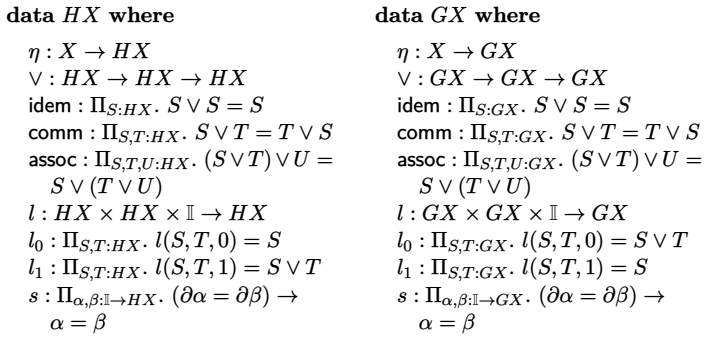
Synthetic domain theory is an axiomatization of domain theory within a constructive universe of sets such that all definable maps between domains are continuous. In this paper we construct the counterparts to the well-known lower, upper, and convex powerdomains in the setting of synthetic domain theory and prove that they produce computationally adequate denotational models of nondeterminism. By developing the theory of powerdomains in synthetic domain theory, we obtain a nondeterministic metalanguage that directly embeds into dependent type theory, where the latter serves as an expressive logic for reasoning about the metalanguage. Moreover, the computational adequacy results imply that denotational reasoning through the metalanguage may be used to study operational behaviors of actual programs.
Editorial analysis
A structured set of objections, weighed in public.
Referee Report
Summary. The paper constructs the lower, upper, and convex powerdomains inside the axiomatic framework of synthetic domain theory (where all definable maps are continuous by construction) and proves that the resulting structures yield computationally adequate denotational models of nondeterminism. The adequacy proofs relate the denotational semantics directly to an operational semantics via the embedding of the nondeterministic metalanguage into dependent type theory, which then serves as a logic for reasoning about the metalanguage.
Significance. If the constructions and adequacy proofs hold, the work supplies a nondeterministic metalanguage that inherits automatic continuity from synthetic domain theory while supporting direct embedding into DTT. This is a clear strength: the adequacy results allow denotational reasoning to be transferred to operational behavior without additional continuity arguments, and the constructive setting avoids classical domain-theoretic overhead. The approach is parameter-free with respect to the background axioms of synthetic domain theory.
minor comments (2)
- [Abstract] The abstract states that the powerdomains 'produce computationally adequate denotational models,' but the precise statement of adequacy (e.g., the relation between denotational and operational semantics) is not previewed; a one-sentence clarification would help readers locate the main theorem.
- [§2] Notation for the three powerdomain constructions (lower, upper, convex) is introduced without an early comparison table; adding such a table in §2 or §3 would make the differences in the synthetic setting easier to track.
Simulated Author's Rebuttal
We thank the referee for their positive assessment of the paper and for recommending acceptance. The report contains no major comments requiring a point-by-point response.
Circularity Check
No significant circularity
full rationale
The paper constructs lower, upper, and convex powerdomains directly from the axioms of synthetic domain theory (SDT), which enforce continuity of all definable maps by construction. Computational adequacy is then proved by embedding the denotational semantics into dependent type theory and relating it to an operational semantics; these steps rely on the independent SDT axioms and standard domain-theoretic arguments rather than any self-referential definition, fitted parameter renamed as prediction, or load-bearing self-citation chain. No equation or theorem reduces to its own input by construction, and the central claims remain externally falsifiable against operational behavior.
Axiom & Free-Parameter Ledger
axioms (1)
- domain assumption Axioms of synthetic domain theory ensuring all definable maps between domains are continuous
Reference graph
Works this paper leans on
-
[1]
Barr, M. and C. Wells,Toposes, Triples, and Theories, Grundlehren der mathematischen Wissenschaften, Springer-Verlag (1985), ISBN 9780387961156. https://books.google.co.jp/books?id=e-iMPwAACAAJ
1985
-
[2]
Birkedal, L., R. E. Mogelberg, J. Schwinghammer and K. Stovring,First steps in synthetic guarded domain theory: Step-indexing in the topos of trees, in:2011 IEEE 26th Annual Symposium on Logic in Computer Science, pages 55–64 (2011). https://doi.org/10.1109/LICS.2011.16
-
[3]
Fiore, M. P.,An enrichment theorem for an axiomatisation of categories of domains and continuous functions, Mathematical Structures in Com- puter Science7, pages 591–618 (1997), ISSN 1469-8072, 0960-1295. https://doi.org/10.1017/S0960129597002429 36
-
[4]
Fiore, M. P., A. M. Pitts and S. C. Steenkamp,Quotients, inductive types, and quotient inductive types, lmcsVolume 18, Issue 2(2022). https://doi.org/10.46298/lmcs-18(2:15)2022
-
[5]
Fiore, M. P. and G. D. Plotkin,An extension of models of axiomatic domain theory to models of synthetic domain theory, in: D. van Dalen and M. Bezem, editors,Computer Science Logic, 10th International Workshop, CSL ’96, Annual Conference of the EACSL, Utrecht, The Netherlands, September 21-27, 1996, Selected Papers, volume 1258 of Lecture Notes in Compute...
-
[6]
Fiore, M. P. and G. Rosolini,The category of cpos from a synthetic view- point, in: S. D. Brookes and M. W. Mislove, editors,Thirteenth Annual Conference on Mathematical Foundations of Progamming Semantics, MFPS 1997, Carnegie Mellon University, Pittsburgh, PA, USA, March 23-26, 1997, volume 6 ofElectronic Notes in Theoretical Computer Science, pages 133–...
-
[7]
Fiore, M. P. and G. Rosolini,Two models of synthetic domain theory 116, pages 151–162, ISSN 0022-4049. https://doi.org/10.1016/S0022-4049(96)00164-8
-
[8]
Frumin, D., H. Geuvers, L. Gondelman and N. v. d. Weide,Finite sets in homotopy type theory, in:Proceedings of the 7th ACM SIGPLAN International Conference on Certified Programs and Proofs, CPP 2018, page 201–214, Association for Computing Machinery, New York, NY, USA (2018), ISBN 9781450355865. https://doi.org/10.1145/3167085
-
[9]
Gunter, C. A., P. D. Mosses and D. S. Scott,Semantic Domains and Denotational Semantics
-
[10]
Hennessy, M. C. B. and G. D. Plotkin,Full abstraction for a simple parallel programming language, in: J. Beˇ cv´ aˇ r, editor,Mathematical Foundations of Computer Science 1979, pages 108–120, Springer, Berlin, Heidelberg (1979), ISBN 978-3-540-35088-0. https://doi.org/10.1007/3-540-09526-8_8
-
[11]
Hyland, J. M. E.,First steps in synthetic domain theory, in: A. Carboni, M. C. Pedicchio and G. Rosolini, editors,Category Theory, pages 131– 156, Springer Berlin Heidelberg, ISBN 978-3-540-46435-8
-
[12]
Katsumata, S.-y.,A Semantic Formulation of tt-Lifting and Logical Pred- icates for Computational Metalanguage, in: D. Hutchison, T. Kanade, 37 J. Kittler, J. M. Kleinberg, F. Mattern, J. C. Mitchell, M. Naor, O. Nier- strasz, C. Pandu Rangan, B. Steffen, M. Sudan, D. Terzopoulos, D. Ty- gar, M. Y. Vardi, G. Weikum and L. Ong, editors,Computer Science Logi...
-
[13]
Carboni, M
Kock, A.,Algebras for the partial map classifier monad, in: A. Carboni, M. C. Pedicchio and G. Rosolini, editors,Category Theory, pages 262– 278, Springer Berlin Heidelberg, Berlin, Heidelberg (1991), ISBN 978-3- 540-46435-8
1991
-
[14]
B.,Call-By-Push-Value, Ph.D
Levy, P. B.,Call-By-Push-Value, Ph.D. thesis (2001). https://www.cs.bham.ac.uk/˜pbl/papers/thesisqmwphd.pdf
2001
-
[15]
Matache, C., S. Moss and S. Staton,Concrete categories and higher-order recursion: With applications including probability, differentiability, and full abstraction, in:Proceedings of the 37th Annual ACM/IEEE Sympo- sium on Logic in Computer Science, LICS ’22, Association for Computing Machinery, New York, NY, USA (2022), ISBN 9781450393515. https://doi.or...
-
[16]
Milne, G. and R. Milner,Concurrent processes and their syntax, J. ACM 26, page 302–321 (1979), ISSN 0004-5411. https://doi.org/10.1145/322123.322134
-
[17]
Møgelberg, R. and A. Vezzosi,Two guarded recursive powerdomains for applicative simulation, Electronic Proceedings in Theoretical Computer Science351, pages 200–217 (2021). https://doi.org/10.4204/EPTCS.351.13
-
[18]
Nakano, H.,A modality for recursion, in:Proceedings of the Fifteenth Annual IEEE Symposium on Logic in Computer Science, pages 255–266, IEEE Computer Society, ISSN 1043-6871. https://doi.org/10.1109/LICS.2000.855774
-
[19]
Niu, Y., J. Sterling and R. Harper,Cost-sensitive computational ade- quacy of higher-order recursion in synthetic domain theory(2024). 40th Conference on Mathematical Foundations of Programming Semantics (MFPS XXXX),2404.00212. https://arxiv.org/abs/2404.00212
arXiv 2024
-
[20]
thesis, Uni- versity of Edinburgh
Phoa, W.,Domain Theory in Realizability Toposes, Ph.D. thesis, Uni- versity of Edinburgh. 38
-
[21]
Phoa, W.,From Term Models to Domains, Information and Computa- tion109, pages 211–255 (1994), ISSN 0890-5401. https://doi.org/https://doi.org/10.1006/inco.1994.1017
-
[22]
Phoa, W. and P. Taylor,The Synthetic Plotkin Powerdomain(1990)
1990
-
[23]
D.,A Powerdomain Construction, SIAM Journal on Comput- ing5, pages 452–487 (1976)
Plotkin, G. D.,A Powerdomain Construction, SIAM Journal on Comput- ing5, pages 452–487 (1976). eprint: https://doi.org/10.1137/0205035. https://doi.org/10.1137/0205035
-
[24]
D.,A structural approach to operational semantics, Technical Report DAIMI FN-19, University of Aarhus (1981)
Plotkin, G. D.,A structural approach to operational semantics, Technical Report DAIMI FN-19, University of Aarhus (1981). http://citeseer.ist.psu.edu/plotkin81structural.html
1981
-
[25]
Pugh, L. and J. Sterling,When is the partial map classifier a sierpi´ nski cone?, in:2025 40th Annual ACM/IEEE Symposium on Logic in Com- puter Science (LICS), pages 718–731 (2025). https://doi.org/10.1109/LICS65433.2025.00060
-
[26]
Reus, B.,Program Verification in Synthetic Domain Theory, Ph.D. thesis
-
[27]
Rijke, E., M. Shulman and B. Spitters,Modalities in homotopy type theory(2020). ArXiv:1706.07526 [cs, math]. https://doi.org/10.23638/LMCS-16(1:2)2020
-
[28]
Rosolini, G.,Continuity and effectiveness in topoi(1986)
1986
-
[29]
Papers presented at the 2002 IEEE Symposium on Logic in Computer Science (LICS)
Simpson, A.,Computational adequacy for recursive types in models of intuitionistic set theory130, pages 207–275, ISSN 0168-0072. Papers presented at the 2002 IEEE Symposium on Logic in Computer Science (LICS). https://doi.org/10.1016/j.apal.2003.12.005
-
[30]
K.,Computational Adequacy in an Elementary Topos, in: G
Simpson, A. K.,Computational Adequacy in an Elementary Topos, in: G. Gottlob, E. Grandjean and K. Seyr, editors,Computer Science Logic, Lecture Notes in Computer Science, pages 323–342, Springer, Berlin, Heidelberg (1999), ISBN 978-3-540-48855-2. https://doi.org/10.1007/10703163_22
-
[31]
Smyth, M. B.,Powerdomains, in: A. Mazurkiewicz, editor,Mathematical Foundations of Computer Science 1976, pages 537–543, Springer, Berlin, Heidelberg (1976), ISBN 978-3-540-38169-3. https://doi.org/10.1007/3-540-07854-1_226
-
[32]
B.,Power domains and predicate transformers: A topological view, in: J
Smyth, M. B.,Power domains and predicate transformers: A topological view, in: J. Diaz, editor,Automata, Languages and Programming, pages 662–675, Springer, Berlin, Heidelberg (1983), ISBN 978-3-540-40038-7. https://doi.org/10.1007/BFb0036946 39
-
[33]
https://arxiv.org/abs/2312.17023
Sterling, J.,Tensorial structure of the lifting doctrine in constructive domain theory(2024).2312.17023. https://arxiv.org/abs/2312.17023
arXiv 2024
-
[34]
Sterling, J., D. Gratzer and L. Birkedal,Denotational semantics of general store and polymorphism(2023). ArXiv:2210.02169 [cs]. https://doi.org/10.48550/arXiv.2210.02169
-
[35]
Sterling, J. and R. Harper,Sheaf semantics of termination-insensitive noninterference, pages 5:1–5:19 (2022).2204.09421. https://doi.org/10.4230/LIPIcs.FSCD.2022.5
-
[36]
Sterling, J. and L. Ye,Domains and Classifying Topoi(2025). ArXiv:2505.13096 [cs]. https://doi.org/10.48550/arXiv.2505.13096
-
[37]
van Oosten, J. and A. K. Simpson,Axioms and (counter)examples in synthetic domain theory, Annals of Pure and Applied Logic104, pages 233–278 (2000), ISSN 01680072. https://doi.org/10.1016/S0168-0072(00)00014-2 40
discussion (0)
Sign in with ORCID, Apple, or X to comment. Anyone can read and Pith papers without signing in.