REVIEW 3 major objections 5 minor 2 cited by
COZMIC. III. Cosmological Zoom-in Simulations of Self-interacting Dark Matter with Suppressed Initial Conditions
T0 review · 3 major / 5 minor · reviewed 2026-08-11 · deepseek-v4-flash
Pith's one-line read Suppressing the initial power spectrum in a self-interacting dark matter model cuts the predicted fraction of core-collapsed dwarf-mass halos from 18% to as low as 2%, with the strongest suppression almost erasing core collapse in…
desk verdict First simulations showing P(k) suppression can weaken or erase SIDM core collapse; the qualitative result is solid, but the headline collapse fractions lean on a parametric model the paper itself flags as untested for this regime. read the letter →
The pith
A machine-rendered reading of the paper's core claim, the machinery that carries it, and where it could break.
The reading
What carries the argument
The load-bearing tool is a parametric gravothermal model developed in earlier work, which predicts SIDM density-profile evolution from a halo's CDM $V_{\max}$ and $R_{\max}$ histories. The paper applies it to matched CDM and $T_{\rm kd}$-only simulations to compute the collapse timescale parameter $\tau_0=\int_{t_f}^{t_0} dt/t_c(t)$, with $\tau_0<0.15$ meaning core formation and $\tau_0>0.75$ meaning core collapse; systems are clipped at $\tau_0=1.1$ because the model is validated only to that point. The same machinery, weighted by effective warm-dark-matter mass functions, separates the two causes of reduced collapse: low-mass halos that never form versus halos whose delayed, suppressed growth leaves them in the core-forming stage. The underlying WSIDM model is a 0.1 GeV dark-matter particle interacting through an 8.11 keV dark photon that also couples to a dark fermion, which sets the $P(k)$ cutoff through the kinetic decoupling temperature $T_{\rm kd}$.
What would settle it
Run direct SIDM simulations of the same $T_{\rm kd}=0.72$ keV initial conditions using the full scattering implementation rather than the analytical collapse recipe, and count halos above $10^8\,M_\odot$ that reach central densities exceeding their initial values; a fraction far above the predicted 2% would refute the claim that strong power-spectrum suppression erases core collapse.
Extended reading notes
Core claim
On its own terms, the paper's discovery is that warm self-interacting dark matter (WSIDM) — a model with velocity-dependent SIDM plus a linear power-spectrum cutoff — changes both the abundances and the internal structure of dwarf-mass halos, and that the two effects are coupled through halo growth histories. The (sub)halo mass function suppression is set almost entirely by the $P(k)$ cutoff, while self-interactions set the density-profile evolution; however, the collapse driven by self-interactions is throttled by the same cutoff, because halos that form late and grow slowly have lower concentrations and longer gravothermal collapse timescales. Quantitatively, the core-collapsed fraction above $10^8\,M_\odot$ falls from 18% (subhalos) and 13% (isolated halos) in SIDM with CDM initial conditions to 2%/8%/17% and 2%/2%/4% in WSIDM with kinetic decoupling temperatures $T_{\rm kd}=0.72$, 1.46, and 2.32 keV. In the most suppressed model the core-collapse signature in isolated halos is almost entirely erased, and in milder models the surviving collapse is accompanied by an increased number of extremely low-concentration isolated halos. These are the first WSIDM simulations to capture the full range of gravothermal evolution, including core collapse.
Load-bearing premise
The prediction of specific collapsed fractions depends on a fast analytical recipe for gravothermal collapse, which was tested on ordinary cold SIDM but not on the suppressed-initial-condition runs it is here applied to, and on one Milky Way-like host standing in for all such systems.
Editorial extensions
If this is right
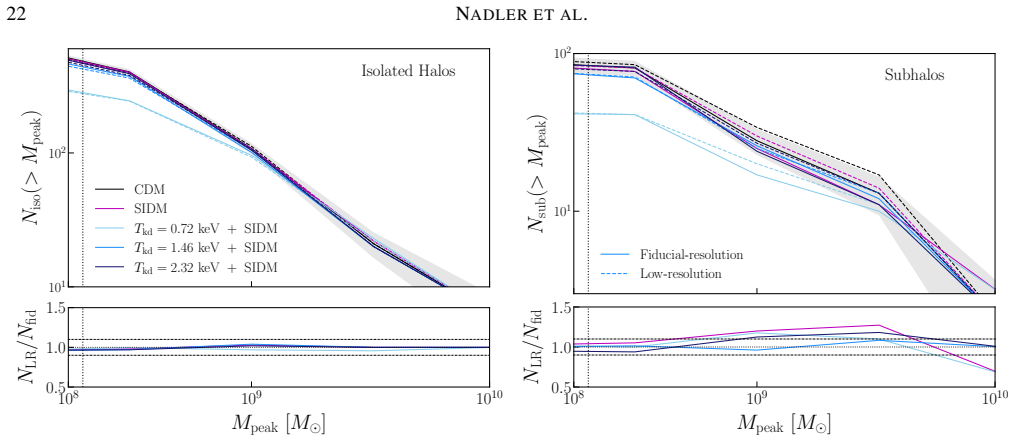
- In WSIDM, (sub)halo mass-function suppression relative to CDM is set by the $P(k)$ cutoff, not by self-interactions, so abundance measurements directly probe the early-Universe side of the model.
- Core-collapsed fractions among resolved dwarf-mass halos are a sensitive probe of the cutoff: even the mildest simulated cutoff ($T_{\rm kd}=2.32$ keV) reduces the isolated-halo collapse fraction by roughly a factor of three.
- Because stronger self-interactions in this model imply stronger $P(k)$ suppression, the core-collapse signature self-regulates; observations of both abundances and density profiles are needed to break the degeneracy.
- WSIDM with mild suppression preserves a sizable collapsed subhalo population while adding low-concentration isolated halos, giving a discovery signature for upcoming strong-lensing and satellite-population data.
- The central density–pericenter anticorrelation seen among Milky Way satellites is reproduced by the $T_{\rm kd}=0.72$ and 1.46 keV WSIDM runs, which contain both cored and collapsing subhalos, while a velocity-independent SIDM that never collapses cannot.
Reading between the lines
- A consequence left implicit is that the collapse fraction may be a more sensitive small-scale-structure observable than the halo mass function: even the mildest cutoff here changes the isolated-halo collapse fraction by a factor of three while suppressing abundances by only a few percent at $10^8\,M_\odot$.
- The paper's three cutoffs bracket the transition; one could interpolate collapse fraction versus $T_{\rm kd}$ and use it as a likelihood for future dwarf surveys, which the paper motivates but does not construct.
- The paper mentions low-concentration isolated halos as potential dark-matter-only counterparts of gas-rich ultradiffuse galaxies; testing that link requires baryonic simulations that include gas and star formation, which are not part of this work.
Editorial analysis
A structured set of objections, weighed in public.
Referee Report
Summary. This paper presents eight new cosmological DM-only zoom-in simulations of a Milky Way-like host (Halo004) exploring the combined effects of a velocity-dependent SIDM cross section (MilkyWaySIDM) and suppressed linear matter power spectra motivated by a dark-photon-mediated WSIDM model. Three kinetic-decoupling temperatures (T_kd = 0.72, 1.46, 2.32 keV) are simulated both with and without self-interactions, along with CDM, SIDM, and WDM reference runs. The main result is that P(k) suppression reduces the fraction of core-collapsed (sub)halos relative to SIDM with CDM initial conditions, with the effect strongest for isolated halos and for the most suppressed P(k). The authors quantify this via the parametric gravothermal model of Yang et al. (2024, 2025) applied to CDM and T_kd-only simulations, and also show direct R_max-V_max relations and matched subhalo evolution histories from the WSIDM simulations. Additional results include (S)HMF suppression, subhalo density profile predictions matched to dwarf galaxies, and a central density-pericenter anticorrelation in some WSIDM models.
Significance. If the central qualitative claim holds, this is the first study to simulate gravothermal evolution, including core collapse, in SIDM models with WDM-like suppressed initial conditions. The paper identifies a physically important degeneracy: the same dark-sector physics that produces strong SIDM also suppresses dwarf-scale structure, partially erasing the core-collapse signature. This is directly relevant for interpreting upcoming dwarf galaxy, strong-lensing, and satellite-population data. The qualitative result is supported by direct simulation outputs, namely the R_max-V_max relations and matched V_max histories, which do not rely on the parametric model. The public release of halo catalogs, merger trees, and particle snapshots is a concrete strength. However, the headline quantitative fractions of core-collapsed halos in Table 1 and the abstract are not measured directly from the WSIDM snapshots; they are derived from a parametric model that the paper itself flags as untested in WSIDM.
major comments (3)
- [Section 3.3, Table 1, Section 4.4] The core-collapsed fractions in Table 1 and quoted in Sections 4.4 and 7.1 are not obtained by classifying core collapse in the actual SIDM/WSIDM simulation snapshots. Instead, they are computed by applying the parametric model of Yang et al. (2024, 2025) to the CDM and T_kd-only simulations. This is stated in Section 3.3, and Section 3.3 explicitly says 'We leave detailed testing of the parametric model in WSIDM for future work.' Given that the abstract and summary list exact percentages such as 18% dropping to 2% and 13% dropping to 2%, the headline quantitative claim rests on an extrapolation beyond the model's validated regime. The manuscript should either classify core collapse directly in the WSIDM runs (e.g., using the simulated density or V_max evolution) or clearly present Table 1 as parametric-model predictions with this caveat. The internal check in Appendix C for T_kd = 2.32 keV makes this concern concrete: the actual WSIDM subhalos show slightly enhanced V_max histories relative to SIDM, while the parametric-model tau_0 distribution shifts to lower values, and the authors state that nonlinear effects not captured by the parametric model may be at play.
- [Section 4.4, Table 1, Appendix A] The core-collapsed fractions are quoted as single numbers without statistical uncertainties, despite being derived from a single zoom-in host. Table 1 reports 100 subhalos and 759 isolated halos above 10^8 M_sun in the CDM run; the SIDM and WSIDM runs have similar or smaller samples. Poisson errors on the quoted fractions are therefore non-negligible (e.g., for 18% of 100 subhalos the 1-sigma error is roughly 4 percentage points, and for 2% it is roughly 1.4 percentage points). Some differences between models, particularly between T_kd = 1.46 and 2.32 keV for subhalos (8% vs. 17%), may be statistically marginal. Additionally, the convergence test in Appendix A validates R_max and V_max distributions only for isolated halos with M_vir > 8 x 10^8 M_sun and does not quantify convergence for subhalos or for the 10^8 M_sun regime used for the core-collapsed fractions. The paper should provide uncertainties and either extend the convergence test to the relevant mass range or soften the precision of the reported fractions.
- [Section 5, Appendix C] The matched-subhalo analysis in Section 5 and Appendix C reveals a qualitative tension for the T_kd = 2.32 keV model. The actual WSIDM V_max histories for the three matched subhalos are slightly enhanced relative to SIDM, yet the parametric model applied to the T_kd-only run predicts tau_0 distributions shifted to lower values. The paper acknowledges this in Appendix C, noting that nonlinear effects not captured by the parametric model may affect gravothermal evolution. This tension directly affects the reliability of the T_kd = 2.32 keV core-collapsed fraction in Table 1 (17% for subhalos). At minimum, the paper should quantify how much of the quoted fraction is robust to the parametric model's failure in this regime, or restrict the quantitative claim to models where the parametric model is validated against the direct WSIDM evolution.
minor comments (5)
- [Figure 12] The legend in the right panel of Figure 12 lists 'Tkd + SIDM' even though the panel compares T_kd-only and WDM subhalo mass functions; this appears to be a labeling error that should be corrected.
- [Section 3.2] The statement that the authors present 'eight new high-resolution simulations' is correct, but it is easy to misread because Section 3.2 first lists eleven total simulations; consider adding an explicit enumeration of which are new.
- [Section 3.3] The definition of the core-collapsed threshold tau_0 > 0.75 is given with a reference to Roberts et al. (2024) in parentheses, but the text would benefit from a sentence explaining how sensitive the quoted fractions are to this threshold, since another threshold (e.g., 0.7 or 0.8) could change the absolute percentages.
- [Section 4.4] The sentence 'The core-collapsed fraction is expected to peak at roughly 10^8 M_sun' is presented without a direct citation or derivation; if this is from Ando et al. (2025), please make the citation explicit at that point.
- [Appendix A] The convergence discussion in Appendix A.2 states that K-S tests yield p > 0.99 for V_max and p ~ 0.3 for R_max, but no p-values are shown for the subhalo distributions; if subhalo R_max-V_max convergence cannot be tested, this should be stated more prominently because the main core-collapse fractions include subhalos.
Circularity Check
No significant circularity: the qualitative suppression of core collapse is directly simulated, and the quantitative fractions come from an externally validated parametric model that is not defined in terms of the reported outputs.
full rationale
The central qualitative claim, that P(k) suppression erases or delays SIDM core collapse, is directly supported by the actual WSIDM simulations: the Rmax-Vmax distributions (Figures 4 and 5) and the matched-subhalo Vmax histories (Figures 7, 13, and 14) are taken from the SIDM and WSIDM runs themselves, not from the parametric model. The quantitative f_cc values in Table 1 are indeed produced by applying the Yang et al. (2024, 2025) parametric model to the CDM and T_kd-only runs, rather than by classifying collapse in the direct WSIDM snapshots. However, this is an extrapolation and a correctness risk, not a circular reduction: the parametric model was developed and validated in prior work against cosmological CDM-initial-condition SIDM simulations, its stated assumptions do not include the WSIDM core-collapsed fractions reported here, and it is not fitted to those fractions in this paper. The paper also performs an internal check, stating that 'the parametric model's accuracy is similar when applied to our simulations with P(k) suppression and compared to our WSIDM results.' The manuscript explicitly flags the remaining limitation: 'We leave detailed testing of the parametric model in WSIDM for future work,' and Appendix C notes that 'it is possible that nonlinear effects that are not captured by the parametric model affect (sub)halos' gravothermal evolution.' These are honest caveats about model validity, not evidence that a prediction is equivalent to its input by construction. The 'effective WDM' weighting in Section 5 is also an explicit fit-and-reweight exercise, and the paper does not present it as a first-principles prediction. No load-bearing claim reduces to a self-citation chain or to a quantity defined in terms of itself. The self-citations to Yang et al. are real external evidence under the review rules. Therefore the appropriate finding is no significant circularity.
Assumptions & free parameters
free parameters (5)
- m_chi =
0.1 GeV
- sigma_0 =
147.1 cm^2 g^-1
- w =
24.33 km s^-1
- T_kd =
0.72, 1.46, 2.32 keV
- tau_0 collapse thresholds =
0.15 and 0.75
assumptions (5)
- domain assumption The Huo et al. (2018) dark sector Lagrangian with g_chi = g_f and relic abundance set by chi chi -> phi phi correctly describes early-Universe cosmology and late-time SIDM phenomenology.
- domain assumption The modified CAMB and CLASS transfer functions accurately capture P(k) suppression and dark acoustic oscillations for the WSIDM model.
- ad hoc to paper The parametric SIDM model from Yang et al. (2024, 2025) remains accurate for WSIDM halos with suppressed P(k).
- domain assumption Halo004 is representative of Milky Way-mass hosts for the (sub)halo abundance and core-collapse statistics.
- domain assumption The abundance-matching model of Nadler et al. (2020b) remains valid for SIDM and WSIDM subhalos.
invented entities (2)
-
Dark photon mediator phi with m_phi = 8.11 keV
independent evidence
-
Massless dark fermion f
independent evidence
Cite this review
Pith. "Pith review of COZMIC. III. Cosmological Zoom-in Simulations of Self-interacting Dark Matter with Suppressed Initial Conditions." pith.science (2026). https://pith.science/paper/QITHNXIL
@misc{pith2026241213065,
  author       = {Pith},
  title        = {Pith review of: COZMIC. III. Cosmological Zoom-in Simulations of Self-interacting Dark Matter with Suppressed Initial Conditions},
  year         = {2026},
  howpublished = {\url{https://pith.science/paper/QITHNXIL}},
  note         = {Machine review of arXiv:2412.13065}
}
abstract
We present eight cosmological dark matter (DM)--only zoom-in simulations of a Milky Way--like system that include suppression of the linear matter power spectrum $P(k)$, and/or velocity-dependent DM self-interactions, as the third installment of the COZMIC suite. We consider a model featuring a massive dark photon that mediates DM self-interactions and decays into massless dark fermions. The dark photon and dark fermions suppress linear matter perturbations, resulting in dark acoustic oscillations in $P(k)$, which ultimately affect dwarf galaxy scales. The model also features a velocity-dependent elastic self-interaction between DM particles (SIDM), with a cross section that can alleviate small-scale structure anomalies. For the first time, our simulations test the impact of $P(k)$ suppression on gravothermal evolution in an SIDM scenario that leads to core collapse in (sub)halos with present-day virial masses below $\approx 10^9~M_{\mathrm{\odot}}$. In simulations with $P(k)$ suppression and self-interactions, the lack of low-mass (sub)halos and the delayed growth of structure reduce the fraction of core-collapsed systems relative to SIDM simulations without $P(k)$ suppression. In particular, $P(k)$ suppression that saturates current warm DM constraints almost entirely erases core collapse in isolated halos. Models with less extreme $P(k)$ suppression produce core collapse in $\approx 20\%$ of subhalos and $\approx 5\%$ of isolated halos above $10^8~M_{\mathrm{\odot}}$, and also increase the abundance of extremely low-concentration isolated low-mass halos relative to SIDM. These results reveal a complex interplay between early and late-Universe DM physics, revealing new discovery scenarios in the context of upcoming small-scale structure measurements.
Figures


Figures from the paper (14 more)




Forward citations
Cited by 2 Pith papers
-
MARVELously Dark: the density profile evolution of dwarf halos in velocity-dependent SIDM
In a new SIDM simulation of isolated dwarf halos, nine low-mass halos are core-collapsed, and inner density slope—rather than central density—best tracks collapse onset and matches analytic collapse-time predictions.
-
Strong-lensing Perturber Signatures in Self-interacting Dark Matter Simulations
Core-collapsed self-interacting dark matter halos in the Concerto simulations reach high enough central densities to match the perturbing masses inferred in J0946, B1938, SDP.81, and SPT2147-50.
Reference graph
Works this paper leans on
-
[1]
thebibliography [1] 20pt to REFERENCES 6pt =0pt 10pt plus 3pt =0pt =0pt =1pt plus 1pt =0pt =0pt -12pt =13pt plus 1pt =20pt =13pt plus 1pt \@M =10000 =-1.0em =0pt =0pt 0pt =0pt =1.0em @enumiv\@empty 10000 10000 `\.\@m \@noitemerr \@latex@warning Empty `thebibliography' environment \@ifnextchar \@reference \@latexerr Missing key on reference command Each re...
arXiv 2019
-
[2]
Adhikari , S., Banerjee , A., Boddy , K. K., et al. 2022, http://dx.doi.org/10.48550/arXiv.2207.10638 arXiv e-prints , arXiv:2207.10638
-
[3]
O., Benson , A., & Gluscevic , V
An , R., Nadler , E. O., Benson , A., & Gluscevic , V. 2024, http://dx.doi.org/10.48550/arXiv.2411.03431 arXiv e-prints , arXiv:2411.03431
-
[4]
Ando , S., Horigome , S., Nadler , E. O., Yang , D., & Yu , H.-B. 2025, http://dx.doi.org/10.1088/1475-7516/2025/02/053 , 2025, 053
-
[5]
E., Fuson , J., Gad-Nasr , S., et al
Andrade , K. E., Fuson , J., Gad-Nasr , S., et al. 2022, http://dx.doi.org/10.1093/mnras/stab3241 , 510, 54
-
[6]
E., Kaplinghat , M., & Valli , M
Andrade , K. E., Kaplinghat , M., & Valli , M. 2024, http://dx.doi.org/10.1093/mnras/stae1716 , 532, 4157
-
[7]
2017, http://dx.doi.org/10.1088/1475-7516/2017/11/010 , 2017, 010
Archidiacono , M., Bohr , S., Hannestad , S., Helboe J rgensen , J., & Lesgourgues , J. 2017, http://dx.doi.org/10.1088/1475-7516/2017/11/010 , 2017, 010
-
[8]
Atrio-Barandela , F. & Davidson , S. 1997, http://dx.doi.org/10.1103/PhysRevD.55.5886 , 55, 5886
Show all 135 references
-
[9]
& Davidson , S
Atrio-Barandela , F. & Davidson , S. 2001, http://dx.doi.org/10.1103/PhysRevD.64.088301 , 64, 088301
2001 doi
-
[10]
L., & Inagaki , S
Balberg , S., Shapiro , S. L., & Inagaki , S. 2002, http://dx.doi.org/10.1086/339038 , 568, 475
2002 doi
-
[11]
S., Wechsler , R
Behroozi , P. S., Wechsler , R. H., & Wu , H.-Y. 2013 a , http://dx.doi.org/10.1088/0004-637X/762/2/109 , 762, 109
2013 doi
-
[12]
S., Wechsler , R
Behroozi , P. S., Wechsler , R. H., Wu , H.-Y., et al. 2013 b , http://dx.doi.org/10.1088/0004-637X/763/1/18 , 763, 18
2013 doi
-
[13]
P., & Turok , N
Bode , P., Ostriker , J. P., & Turok , N. 2001, http://dx.doi.org/10.1086/321541 , 556, 93
2001 doi
-
[14]
2001, http://dx.doi.org/10.1016/S0370-2693(01)01060-7 Phys.\ Lett.\ B , 518, 8
Boehm , C., Fayet , P., & Schaeffer , R. 2001, http://dx.doi.org/10.1016/S0370-2693(01)01060-7 Phys.\ Lett.\ B , 518, 8
2001 doi
-
[15]
H., & Schaeffer , R
B hm , C., Riazuelo , A., Hansen , S. H., & Schaeffer , R. 2002, http://dx.doi.org/10.1103/PhysRevD.66.083505 , 66, 083505
2002 doi
-
[16]
& Schaeffer , R
Boehm , C. & Schaeffer , R. 2005, http://dx.doi.org/10.1051/0004-6361:20042238 , 438, 419
2005 doi
-
[17]
Bond , J. R. & Szalay , A. S. 1983, http://dx.doi.org/10.1086/161460 , 274, 443
1983 doi
-
[18]
Bryan, G. L. & Norman, M. L. 1998, http://dx.doi.org/10.1086/305262 , 495, 80
1998 doi
-
[19]
O., Wechsler , R
Buch , D., Nadler , E. O., Wechsler , R. H., & Mao , Y.-Y. 2024, http://dx.doi.org/10.3847/1538-4357/ad554c , 971, 79
2024 doi
-
[20]
Buckley , M. R. & Peter , A. H. G. 2018, http://dx.doi.org/10.1016/j.physrep.2018.07.003 , 761, 1
2018 doi
-
[21]
R., Zavala , J., Cyr-Racine , F.-Y., Sigurdson , K., & Vogelsberger , M
Buckley , M. R., Zavala , J., Cyr-Racine , F.-Y., Sigurdson , K., & Vogelsberger , M. 2014, http://dx.doi.org/10.1103/PhysRevD.90.043524 , 90, 043524
2014 doi
-
[22]
2023, http://dx.doi.org/10.1093/mnras/stad1138 , 522, 3058
Cardona-Barrero , S., Battaglia , G., Nipoti , C., & Di Cintio , A. 2023, http://dx.doi.org/10.1093/mnras/stad1138 , 522, 3058
2023 doi
-
[23]
G., Hoffman , Y., et al
Carlesi , E., Sorce , J. G., Hoffman , Y., et al. 2016, http://dx.doi.org/10.1093/mnras/stw357 , 458, 900
2016 doi
- [24]
-
[25]
Correa , C. A. 2021, http://dx.doi.org/10.1093/mnras/stab506 , 503, 920
2021 doi
-
[26]
A., Schaller , M., Schaye , J., et al
Correa , C. A., Schaller , M., Schaye , J., et al. 2025, http://dx.doi.org/10.1093/mnras/stae2811 , 536, 3338
2025 doi
-
[27]
2016, http://dx.doi.org/10.1103/PhysRevD.93.123527 , 93, 123527
Cyr-Racine , F.-Y., Sigurdson , K., Zavala , J., et al. 2016, http://dx.doi.org/10.1103/PhysRevD.93.123527 , 93, 123527
2016 doi
- [28]
- [29]
- [30]
-
[31]
2020, http://dx.doi.org/10.3847/1538-4357/ab7eb9 , 893, 47
Drlica-Wagner , A., Bechtol , K., Mau , S., et al. 2020, http://dx.doi.org/10.3847/1538-4357/ab7eb9 , 893, 47
2020 doi
-
[32]
2022, http://dx.doi.org/10.1103/PhysRevD.105.023016 , 105, 023016
Ebisu , T., Ishiyama , T., & Hayashi , K. 2022, http://dx.doi.org/10.1103/PhysRevD.105.023016 , 105, 023016
2022 doi
-
[33]
2021, http://dx.doi.org/10.1088/1475-7516/2021/05/013 , 2021, 013
Egana-Ugrinovic , D., Essig , R., Gift , D., & LoVerde , M. 2021, http://dx.doi.org/10.1088/1475-7516/2021/05/013 , 2021, 013
2021 doi
-
[34]
F., Pe \ n arrubia , J., Famaey , B., & Ibata , R
Errani , R., Navarro , J. F., Pe \ n arrubia , J., Famaey , B., & Ibata , R. 2023, http://dx.doi.org/10.1093/mnras/stac3499 , 519, 384
2023 doi
-
[35]
D., Yu , H.-B., & Zhong , Y.-M
Essig , R., McDermott , S. D., Yu , H.-B., & Zhong , Y.-M. 2019, http://dx.doi.org/10.1103/PhysRevLett.123.121102 , 123, 121102
2019 doi
-
[36]
L., Kaplinghat , M., Tu , H., & Yu , H.-B
Feng , J. L., Kaplinghat , M., Tu , H., & Yu , H.-B. 2009, http://dx.doi.org/10.1088/1475-7516/2009/07/004 , 2009, 004
2009 doi
-
[37]
L., Kaplinghat , M., & Yu , H.-B
Feng , J. L., Kaplinghat , M., & Yu , H.-B. 2010, http://dx.doi.org/10.1103/PhysRevLett.104.151301 , 104, 151301
2010 doi
-
[38]
L., Tu , H., & Yu , H.-B
Feng , J. L., Tu , H., & Yu , H.-B. 2008, http://dx.doi.org/10.1088/1475-7516/2008/10/043 , 2008, 043
2008 doi
-
[39]
2021, http://dx.doi.org/10.3847/2041-8213/ac04b0 , 914, L26
Feng , W.-X., Yu , H.-B., & Zhong , Y.-M. 2021, http://dx.doi.org/10.3847/2041-8213/ac04b0 , 914, L26
2021 doi
-
[40]
S., Dolag , K., & Yu , H.-B
Fischer , M. S., Dolag , K., & Yu , H.-B. 2024, http://dx.doi.org/10.1051/0004-6361/202449849 , 689, A300
2024 doi
-
[41]
2022, http://dx.doi.org/10.1088/1475-7516/2022/07/012 , 2022, 012
Garani , R., Redi , M., & Tesi , A. 2022, http://dx.doi.org/10.1088/1475-7516/2022/07/012 , 2022, 012
2022 doi
-
[42]
2021, http://dx.doi.org/10.1093/mnras/stab2335 , 507, 2432
Gilman , D., Bovy , J., Treu , T., et al. 2021, http://dx.doi.org/10.1093/mnras/stab2335 , 507, 2432
2021 doi
-
[43]
2023, http://dx.doi.org/10.1103/PhysRevD.107.103008 , 107, 103008
Gilman , D., Zhong , Y.-M., & Bovy , J. 2023, http://dx.doi.org/10.1103/PhysRevD.107.103008 , 107, 103008
2023 doi
- [44]
-
[46]
& Scherrer , R
Hannestad , S. & Scherrer , R. J. 2000, http://dx.doi.org/10.1103/PhysRevD.62.043522 , 62, 043522
2000 doi
-
[47]
2013, http://dx.doi.org/10.1088/0067-0049/208/2/19 , 208, 19
Hinshaw, G., Larson, D., Komatsu, E., et al. 2013, http://dx.doi.org/10.1088/0067-0049/208/2/19 , 208, 19
2013 doi
-
[48]
Hunter, J. D. 2007, http://dx.doi.org/10.1109/MCSE.2007.55 Computing in Science Engineering , 9, 90
2007 doi
-
[49]
2020, http://dx.doi.org/10.1016/j.physletb.2020.135251 Physics Letters B , 802, 135251
Huo , R. 2020, http://dx.doi.org/10.1016/j.physletb.2020.135251 Physics Letters B , 802, 135251
2020
-
[50]
2018, http://dx.doi.org/10.1016/j.physletb.2018.06.024 Physics Letters B , 783, 76
Huo , R., Kaplinghat , M., Pan , Z., & Yu , H.-B. 2018, http://dx.doi.org/10.1016/j.physletb.2018.06.024 Physics Letters B , 783, 76
2018 doi
-
[51]
G., et al
Ir s i c , V., Viel, M., Haehnelt, M. G., et al. 2017, http://dx.doi.org/10.1103/PhysRevD.96.023522 , 96, 023522
2017 doi
-
[52]
G., et al
Ir s i c , V., Viel , M., Haehnelt , M. G., et al. 2024, http://dx.doi.org/10.1103/PhysRevD.109.043511 , 109, 043511
2024 doi
-
[53]
M., Tyson , J
Ivezi \'c , Z ., Kahn , S. M., Tyson , J. A., et al. 2008, http://dx.doi.org/10.3847/1538-4357/ab042c , 873, 111
2008 doi
-
[54]
2001, SciPy : Open source scientific tools for Python , [Online; scipy.org http://www.scipy.org/]
Jones, E., Oliphant, T., Peterson, P., et al. 2001, SciPy : Open source scientific tools for Python , [Online; scipy.org http://www.scipy.org/]
2001
-
[55]
R., & Wu , C.-L
Kahlhoefer , F., Kaplinghat , M., Slatyer , T. R., & Wu , C.-L. 2019, http://dx.doi.org/10.1088/1475-7516/2019/12/010 , 2019, 010
2019 doi
-
[56]
E., Linden , T., & Yu , H.-B
Kaplinghat , M., Keeley , R. E., Linden , T., & Yu , H.-B. 2014, http://dx.doi.org/10.1103/PhysRevLett.113.021302 , 113, 021302
2014 doi
-
[57]
2016, http://dx.doi.org/10.1103/PhysRevLett.116.041302 , 116, 041302
Kaplinghat , M., Tulin , S., & Yu , H.-B. 2016, http://dx.doi.org/10.1103/PhysRevLett.116.041302 , 116, 041302
2016 doi
-
[58]
2019, http://dx.doi.org/10.1093/mnras/stz2511 , 490, 231
Kaplinghat , M., Valli , M., & Yu , H.-B. 2019, http://dx.doi.org/10.1093/mnras/stz2511 , 490, 231
2019 doi
- [59]
-
[60]
& Shapiro , P
Koda , J. & Shapiro , P. R. 2011, http://dx.doi.org/10.1111/j.1365-2966.2011.18684.x , 415, 1125
2011
-
[61]
Kong , D., Kaplinghat , M., Yu , H.-B., Fraternali , F., & Mancera Pi \ n a , P. E. 2022, http://dx.doi.org/10.3847/1538-4357/ac8875 , 936, 166
2022 doi
-
[62]
2024, http://dx.doi.org/10.3847/2041-8213/ad394b , 965, L19
Kong , D., Yang , D., & Yu , H.-B. 2024, http://dx.doi.org/10.3847/2041-8213/ad394b , 965, L19
2024 doi
-
[63]
S., Boylan-Kolchin , M., et al
Lazar , A., Bullock , J. S., Boylan-Kolchin , M., et al. 2020, http://dx.doi.org/10.1093/mnras/staa2101 , 497, 2393
2020 doi
- [64]
-
[65]
& Bridle , S
Lewis , A. & Bridle , S. 2002, http://dx.doi.org/10.1103/PhysRevD.66.103511 , 66, 103511
2002 doi
-
[66]
Lovell , M. R. & Zavala , J. 2023, http://dx.doi.org/10.1093/mnras/stad216 , 520, 1567
2023 doi
-
[67]
D., Schaye , J., & Bower , R
Ludlow , A. D., Schaye , J., & Bower , R. 2019, http://dx.doi.org/10.1093/mnras/stz1821 , 488, 3663
2019 doi
-
[68]
C., Peter , A
Mace , C., Zeng , Z. C., Peter , A. H. G., et al. 2024, http://dx.doi.org/10.1103/PhysRevD.110.123024 , 110, 123024
2024 doi
-
[69]
E., Fraternali , F., Oosterloo , T., et al
Mancera Pi \ n a , P. E., Fraternali , F., Oosterloo , T., et al. 2022, http://dx.doi.org/10.1093/mnras/stab3491 , 512, 3230
2022 doi
-
[70]
E., Fraternali , F., Adams , E
Mancera Pi \ n a , P. E., Fraternali , F., Adams , E. A. K., et al. 2019, http://dx.doi.org/10.3847/2041-8213/ab40c7 , 883, L33
2019 doi
-
[71]
E., Fraternali , F., Oman , K
Mancera Pi \ n a , P. E., Fraternali , F., Oman , K. A., et al. 2020, http://dx.doi.org/10.1093/mnras/staa1256 , 495, 3636
2020 doi
-
[72]
2024, http://dx.doi.org/10.3847/1538-4357/ad4e33 , 970, 178
Mansfield , P., Darragh-Ford , E., Wang , Y., et al. 2024, http://dx.doi.org/10.3847/1538-4357/ad4e33 , 970, 178
2024 doi
-
[73]
C., Schaller , M., et al
McAlpine , S., Helly , J. C., Schaller , M., et al. 2022, http://dx.doi.org/10.1093/mnras/stac295 , 512, 5823
2022 doi
-
[74]
R., Crain , R
Meshveliani , T., Lovell , M. R., Crain , R. A., & Pfeffer , J. 2024, http://dx.doi.org/10.1093/mnras/stae1519 , 532, 1296
2024 doi
-
[75]
2021 a , http://dx.doi.org/10.1093/mnras/stab2247 , 507, 1662
Minor , Q., Gad-Nasr , S., Kaplinghat , M., & Vegetti , S. 2021 a , http://dx.doi.org/10.1093/mnras/stab2247 , 507, 1662
2021 doi
-
[76]
H., & Simon , E
Minor , Q., Kaplinghat , M., Chan , T. H., & Simon , E. 2021 b , http://dx.doi.org/10.1093/mnras/stab2209 , 507, 1202
2021 doi
-
[77]
J., Crnojevi \'c , D., et al
Mutlu-Pakdil , B., Sand , D. J., Crnojevi \'c , D., et al. 2021, http://dx.doi.org/10.3847/1538-4357/ac0db8 , 918, 88
2021 doi
- [78]
-
[79]
O., Banerjee , A., Adhikari , S., Mao , Y.-Y., & Wechsler , R
Nadler , E. O., Banerjee , A., Adhikari , S., Mao , Y.-Y., & Wechsler , R. H. 2020 a , http://dx.doi.org/10.3847/1538-4357/ab94b0 , 896, 112
2020 doi
-
[80]
O., Birrer , S., Gilman , D., et al
Nadler , E. O., Birrer , S., Gilman , D., et al. 2021 a , http://dx.doi.org/10.3847/1538-4357/abf9a3 , 917, 7
2021 doi
-
[81]
O., Gluscevic , V., Boddy , K
Nadler , E. O., Gluscevic , V., Boddy , K. K., & Wechsler , R. H. 2019 a , http://dx.doi.org/10.3847/2041-8213/ab1eb2 , 878, L32
2019 doi
-
[82]
O., Gluscevic , V., Driskell , T., et al
Nadler , E. O., Gluscevic , V., Driskell , T., et al. 2024 b , http://dx.doi.org/10.3847/1538-4357/ad3bb1 , 967, 61
2024 doi
-
[83]
O., Mao , Y.-Y., Green , G
Nadler , E. O., Mao , Y.-Y., Green , G. M., & Wechsler , R. H. 2019 b , http://dx.doi.org/10.3847/1538-4357/ab040e , 873, 34
2019 doi
-
[84]
O., Yang , D., & Yu , H.-B
Nadler , E. O., Yang , D., & Yu , H.-B. 2023 a , http://dx.doi.org/10.3847/2041-8213/ad0e09 , 958, L39
2023 doi
-
[85]
O., Wechsler , R
Nadler , E. O., Wechsler , R. H., Bechtol , K., et al. 2020 b , http://dx.doi.org/10.3847/1538-4357/ab846a , 893, 48
2020 doi
-
[86]
O., Drlica-Wagner, A., Bechtol, K., et al
Nadler , E. O., Drlica-Wagner, A., Bechtol, K., et al. 2021 b , http://dx.doi.org/10.1103/PhysRevLett.126.091101 , 126, 091101
2021 doi
-
[87]
O., Mansfield , P., Wang , Y., et al
Nadler , E. O., Mansfield , P., Wang , Y., et al. 2023 b , http://dx.doi.org/10.3847/1538-4357/acb68c , 945, 159
2023 doi
-
[88]
F., Frenk , C
Navarro , J. F., Frenk , C. S., & White , S. D. M. 1997, http://dx.doi.org/10.1086/304888 , 490, 493
1997 doi
-
[89]
K., & Kaplinghat , M
Nishikawa , H., Boddy , K. K., & Kaplinghat , M. 2020, http://dx.doi.org/10.1103/PhysRevD.101.063009 , 101, 063009
2020 doi
-
[90]
B., Erkal , D., & Li , T
Pace , A. B., Erkal , D., & Li , T. S. 2022, http://dx.doi.org/10.3847/1538-4357/ac997b , 940, 136
2022 doi
- [91]
-
[93]
2013, pynbody: N-Body/SPH analysis for python , Astrophysics Source Code Library, record ascl:1305.002
Pontzen , A., Ro s kar , R., Stinson , G., & Woods , R. 2013, pynbody: N-Body/SPH analysis for python , Astrophysics Source Code Library, record ascl:1305.002
2013
-
[94]
I., Walker , M
Read , J. I., Walker , M. G., & Steger , P. 2018, http://dx.doi.org/10.1093/mnras/sty2286 , 481, 860
2018 doi
-
[95]
I., Walker , M
Read , J. I., Walker , M. G., & Steger , P. 2019, http://dx.doi.org/10.1093/mnras/sty3404 , 484, 1401
2019 doi
- [96]
-
[97]
H., Kelley , T., Bullock , J
Robles , V. H., Kelley , T., Bullock , J. S., & Kaplinghat , M. 2019, http://dx.doi.org/10.1093/mnras/stz2345 , 490, 2117
2019 doi
-
[98]
Rocha , M., Peter , A. H. G., Bullock , J. S., et al. 2013, http://dx.doi.org/10.1093/mnras/sts514 , 430, 81
2013 doi
-
[99]
C., Torrey , P., Vogelsberger , M., & O'Neil , S
Rose , J. C., Torrey , P., Vogelsberger , M., & O'Neil , S. 2023, http://dx.doi.org/10.1093/mnras/stac3634 , 519, 5623
2023 doi
-
[100]
2021, http://dx.doi.org/10.1088/1475-7516/2021/01/024 , 2021, 024
Sagunski , L., Gad-Nasr , S., Colquhoun , B., Robertson , A., & Tulin , S. 2021, http://dx.doi.org/10.1088/1475-7516/2021/01/024 , 2021, 024
2021 doi
-
[101]
J., Sales , L
Sameie , O., Benson , A. J., Sales , L. V., et al. 2019, http://dx.doi.org/10.3847/1538-4357/ab0824 , 874, 101
2019 doi
-
[102]
2018, http://dx.doi.org/10.1093/mnras/sty1516 , 479, 359
Sameie , O., Creasey , P., Yu , H.-B., et al. 2018, http://dx.doi.org/10.1093/mnras/sty1516 , 479, 359
2018 doi
-
[103]
V., Vogelsberger , M., & Zavala , J
Sameie , O., Yu , H.-B., Sales , L. V., Vogelsberger , M., & Zavala , J. 2020, http://dx.doi.org/10.1103/PhysRevLett.124.141102 , 124, 141102
2020 doi
-
[104]
S., Kaplinghat , M., Robles , V
Silverman , M., Bullock , J. S., Kaplinghat , M., Robles , V. H., & Valli , M. 2023, http://dx.doi.org/10.1093/mnras/stac3232 , 518, 2418
2023 doi
-
[105]
2023, http://dx.doi.org/10.1103/PhysRevD.107.043014 , 107, 043014
Slone , O., Jiang , F., Lisanti , M., & Kaplinghat , M. 2023, http://dx.doi.org/10.1103/PhysRevD.107.043014 , 107, 043014
2023 doi
-
[106]
Spergel , D. N. & Steinhardt , P. J. 2000, http://dx.doi.org/10.1103/PhysRevLett.84.3760 , 84, 3760
2000 doi
-
[107]
2005, http://dx.doi.org/10.1111/j.1365-2966.2005.09655.x , 364, 1105
Springel , V. 2005, http://dx.doi.org/10.1111/j.1365-2966.2005.09655.x , 364, 1105
2005
-
[108]
V., Dutton , A
Tollet , E., Macci \`o , A. V., Dutton , A. A., et al. 2016, http://dx.doi.org/10.1093/mnras/stv2856 , 456, 3542
2016 doi
-
[109]
2024, http://dx.doi.org/10.1103/PhysRevD.110.043048 , 110, 043048
Tran , V., Gilman , D., Vogelsberger , M., et al. 2024, http://dx.doi.org/10.1103/PhysRevD.110.043048 , 110, 043048
2024 doi
- [110]
-
[111]
& Yu , H.-B
Tulin , S. & Yu , H.-B. 2018, http://dx.doi.org/10.1016/j.physrep.2017.11.004 , 730, 1
2018 doi
-
[112]
Tulin , S., Yu , H.-B., & Zurek , K. M. 2013, http://dx.doi.org/10.1103/PhysRevD.87.115007 , 87, 115007
2013 doi
-
[113]
C., Lovell , M
Turner , H. C., Lovell , M. R., Zavala , J., & Vogelsberger , M. 2021, http://dx.doi.org/10.1093/mnras/stab1725 , 505, 5327
2021 doi
-
[114]
& Yu , H.-B
Valli , M. & Yu , H.-B. 2018, http://dx.doi.org/10.1038/s41550-018-0560-7 Nature Astronomy , 2, 907
2018 doi
-
[115]
G., Bringmann , T., & Pfrommer , C
van den Aarssen , L. G., Bringmann , T., & Pfrommer , C. 2012, http://dx.doi.org/10.1103/PhysRevLett.109.231301 , 109, 231301
2012 doi
-
[116]
C., & Varoquaux, G
van der Walt, S., Colbert, S. C., & Varoquaux, G. 2011, http://dx.doi.org/10.1109/MCSE.2011.37 Computing in Science Engineering , 13, 22
2011 doi
-
[117]
D., Bolton, J
Viel, M., Becker, G. D., Bolton, J. S., & Haehnelt, M. G. 2013, http://dx.doi.org/10.1103/PhysRevD.88.043502 , 88, 043502
2013 doi
-
[118]
2016, http://dx.doi.org/10.1093/mnras/stw1076 , 460, 1399
Vogelsberger , M., Zavala , J., Cyr-Racine , F.-Y., et al. 2016, http://dx.doi.org/10.1093/mnras/stw1076 , 460, 1399
2016 doi
-
[119]
2012, http://dx.doi.org/10.1111/j.1365-2966.2012.21182.x10.1002/asna.19141991009 , 423, 3740
Vogelsberger , M., Zavala , J., & Loeb , A. 2012, http://dx.doi.org/10.1111/j.1365-2966.2012.21182.x10.1002/asna.19141991009 , 423, 3740
2012
- [120]
-
[121]
Wempe , E., Lavaux , G., White , S. D. M., et al. 2024, http://dx.doi.org/10.1051/0004-6361/202450975 , 691, A348
2024 doi
-
[122]
2024, http://dx.doi.org/10.1103/PhysRevD.110.103044 , 110, 103044
Yang , D. 2024, http://dx.doi.org/10.1103/PhysRevD.110.103044 , 110, 103044
2024 doi
-
[123]
O., & Yu , H.-B
Yang , D., Nadler , E. O., & Yu , H.-B. 2023, http://dx.doi.org/10.3847/1538-4357/acc73e , 949, 67
2023 doi
-
[124]
O., & Yu , H.-B
Yang , D., Nadler , E. O., & Yu , H.-B. 2025, http://dx.doi.org/10.1016/j.dark.2025.101807 Physics of the Dark Universe , 47, 101807
2025
-
[125]
O., Yu , H.-B., & Zhong , Y.-M
Yang , D., Nadler , E. O., Yu , H.-B., & Zhong , Y.-M. 2024, http://dx.doi.org/10.1088/1475-7516/2024/02/032 , 2024, 032
2024 doi
-
[126]
& Yu , H.-B
Yang , D. & Yu , H.-B. 2021, http://dx.doi.org/10.1103/PhysRevD.104.103031 , 104, 103031
2021 doi
-
[127]
& Yu , H.-B
Yang , D. & Yu , H.-B. 2022, http://dx.doi.org/10.1088/1475-7516/2022/09/077 , 2022, 077
2022 doi
-
[128]
R., & L \'o pez Nacir , D
Yunis , R., Arg \"u elles , C. R., & L \'o pez Nacir , D. 2020, http://dx.doi.org/10.1088/1475-7516/2020/09/041 , 2020, 041
2020 doi
-
[129]
R., Sc \'o ccola , C
Yunis , R., Arg \"u elles , C. R., Sc \'o ccola , C. G., L \'o pez Nacir , D., & Giordano , G. 2022, http://dx.doi.org/10.1088/1475-7516/2022/02/024 , 2022, 024
2022 doi
-
[130]
R., Vogelsberger , M., & Burger , J
Zavala , J., Lovell , M. R., Vogelsberger , M., & Burger , J. D. 2019, http://dx.doi.org/10.1103/PhysRevD.100.063007 , 100, 063007
2019 doi
-
[131]
C., Peter , A
Zeng , Z. C., Peter , A. H. G., Du , X., et al. 2022, http://dx.doi.org/10.1093/mnras/stac1094 , 513, 4845
2022 doi
-
[132]
C., Peter , A
Zeng , Z. C., Peter , A. H. G., Du , X., et al. 2025, http://dx.doi.org/10.1103/PhysRevD.111.063001 , 111, 063001
2025 doi
-
[133]
2024, http://dx.doi.org/10.3847/2041-8213/ad50cd , 968, L13
Zhang , X., Yu , H.-B., Yang , D., & An , H. 2024, http://dx.doi.org/10.3847/2041-8213/ad50cd , 968, L13
2024 doi
-
[134]
Zhang , X., Yu , H.-B., Yang , D., & Nadler , E. O. 2025, http://dx.doi.org/10.3847/2041-8213/ada02b , 978, L23
2025 doi
-
[135]
2023, http://dx.doi.org/10.1093/mnras/stad2765 , 526, 758
Zhong , Y.-M., Yang , D., & Yu , H.-B. 2023, http://dx.doi.org/10.1093/mnras/stad2765 , 526, 758
2023 doi
-
[136]
write newline
" write newline "" before.all 'output.state := FUNCTION format.archive archivePrefix empty "" archivePrefix ":" * if FUNCTION format.primaryClass primaryClass empty "" " [" primaryClass * "]" * if FUNCTION format.eprint eprint empty pages empty not booktitle empty not or or ""...
-
[137]
write newline
" write newline "" before.all 'output.state := FUNCTION format.archive archivePrefix empty "" archivePrefix ":" * if FUNCTION format.primaryClass primaryClass empty "" " [" primaryClass * "]" * if FUNCTION format.eprint eprint empty pages empty not booktitle empty not or or ""...
Reviewed August 11, 2026 · model on record in the stance chip above.
Discussion (0). Continue with ORCID to comment.