Synchronization of topological signals in higher-order adaptive multilayer network
Pith reviewed 2026-06-27 22:45 UTC · model grok-4.3
The pith
Multilayer higher-order Kuramoto models require stronger coupling for synchronization of node and simplex signals when layers adapt via order parameters.
A machine-rendered reading of the paper's core claim, the machinery that carries it, and where it could break.
Core claim
The central claim is that synchronization transitions of topological signals in these adaptive multilayer higher-order networks occur at higher coupling strengths than in non-adaptive settings, with the annealed-approximation theory for random bilayer networks and the extension to fully connected layers accurately capturing the dynamics of the original model.
What carries the argument
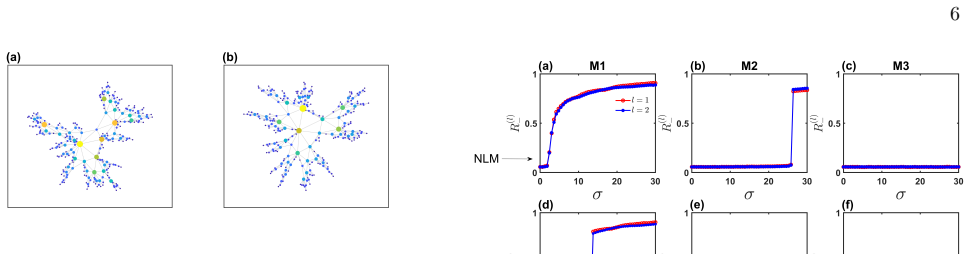
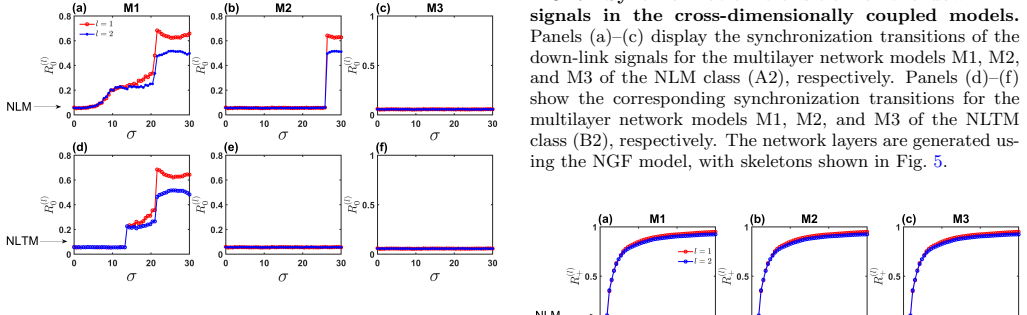
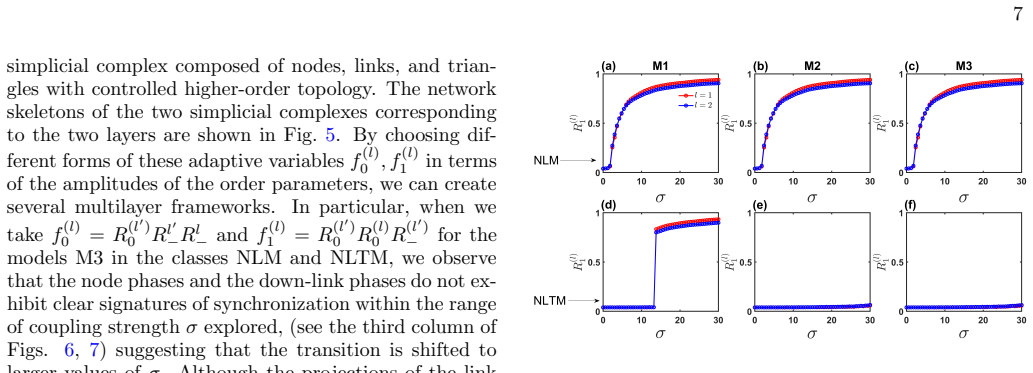
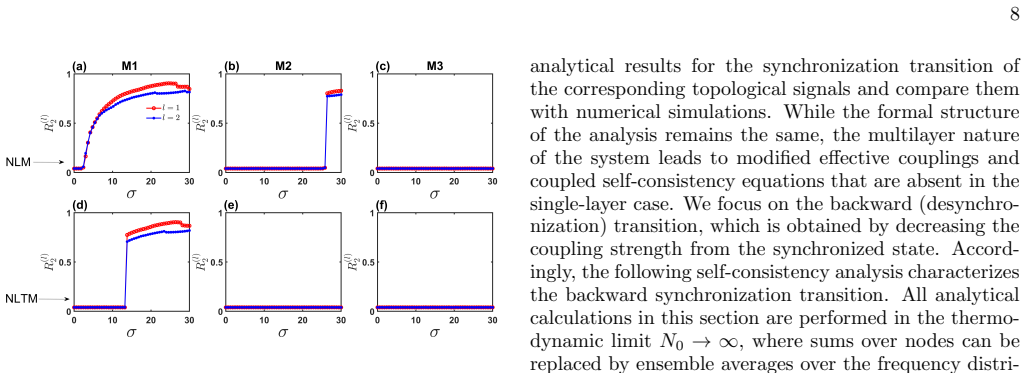
Adaptive coupling of layers through order parameters of oscillators placed on simplices, in two architectures that enable either same-dimension cross-layer interactions or cross-dimensional interactions.
If this is right
- Incorporating node dynamics into link evolution delays the onset of synchronization.
- The theoretical framework applies to both bilayer random networks under annealed approximation and fully connected layers.
- This approach opens analysis of complex dynamical processes within interconnected higher-order structures.
Where Pith is reading between the lines
- The cross-dimensional architecture may produce synchronization patterns between different signal dimensions that do not appear in same-dimension setups.
- The annealed-approximation treatment could be tested against explicit random network realizations to check robustness beyond the mean-field limit.
- Similar adaptive coupling might be examined in other oscillator types to see whether the increased coupling threshold for synchronization is model-independent.
Load-bearing premise
The multilayer architectures allow interactions between signals of the same dimension across layers or cross-dimensional interactions, with layers adaptively coupled through order parameters of the oscillators on simplices, and random networks treated under the annealed approximation.
What would settle it
Numerical simulations of the full adaptive multilayer model in the globally coupled bilayer case that deviate from the theoretical predictions derived under the annealed approximation would show the framework does not capture the dynamics.
Figures

read the original abstract
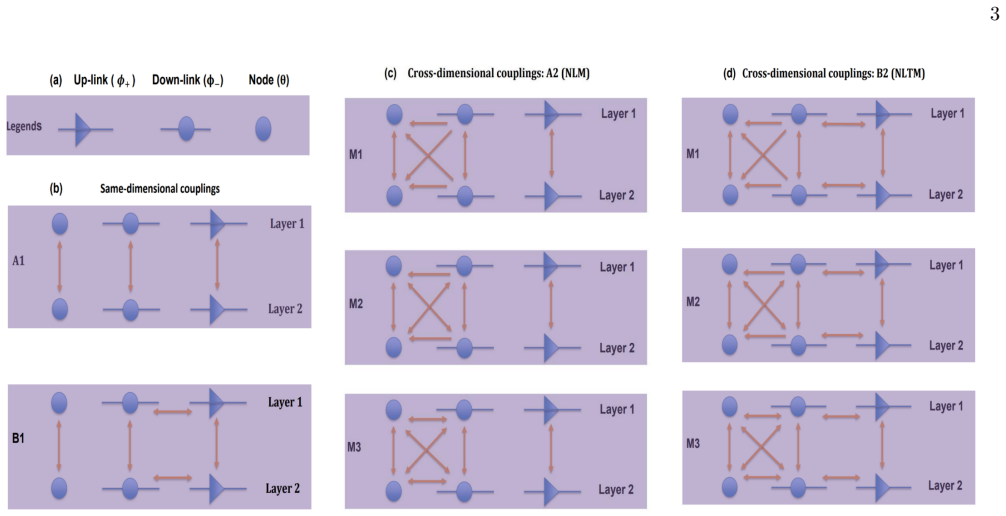
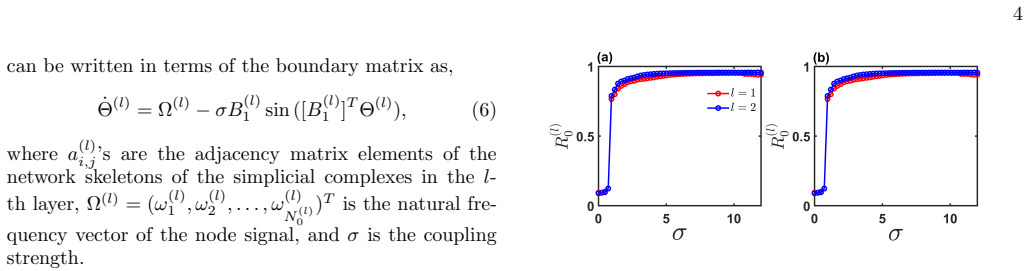
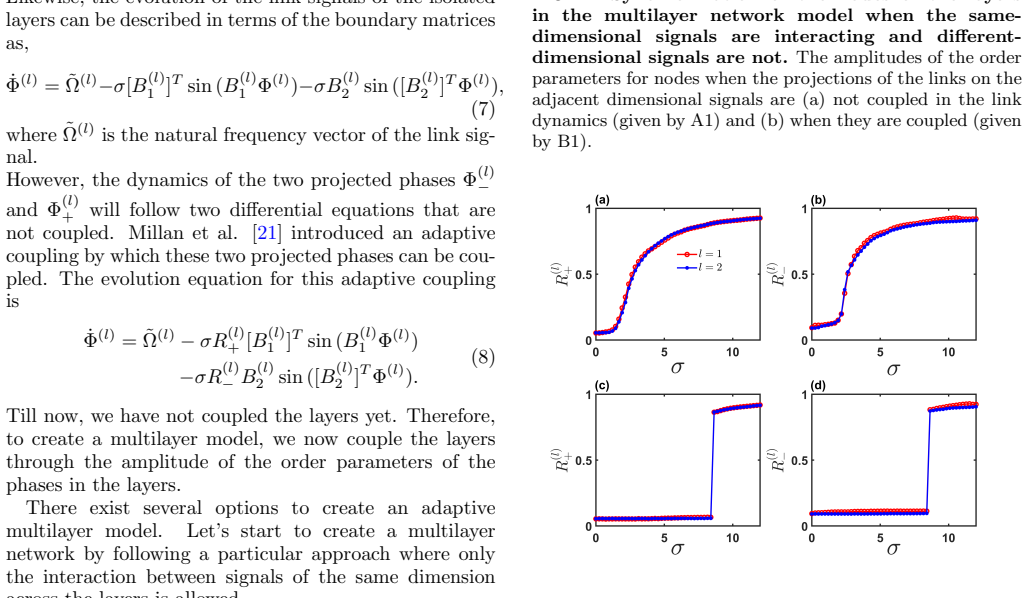
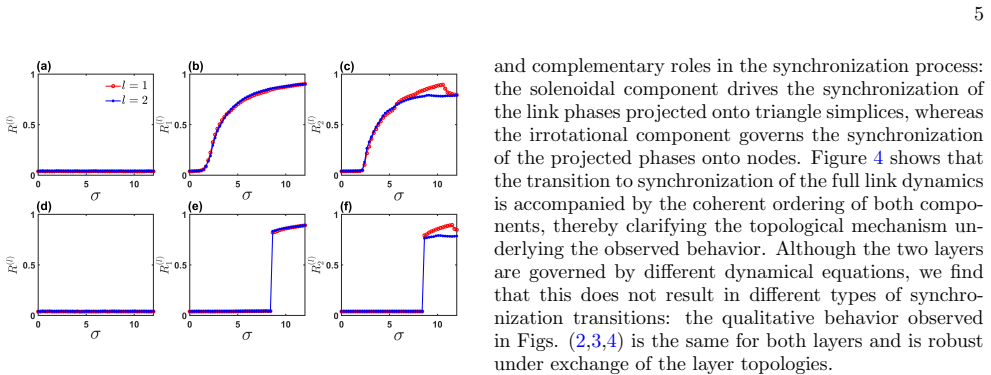
The study of synchronization in complex systems has recently been revolutionized by incorporating higher-order interactions through simplicial complexes. Building in particular upon the higher-order Kuramoto model, which considers oscillators on nodes, links, and higher-dimensional simplices. This work extends the monolayer framework of the higher-order Kuramoto model to multilayer networks where the layers are adaptively coupled through order parameters of the oscillators placed on the simplices. We propose two multilayer architectures: one that allows interactions between signals of the same dimension across layers and the other that permits cross-dimensional interactions. We observe that a higher coupling strength is required for synchronization transitions of the node signals and the projected uplink and downlink signals during adaptation. For example, incorporating node dynamics into link evolution delays the onset of synchronization. This study opens an avenue for understanding complex dynamical processes within interconnected higher-order structures. Finally, we present a comprehensive theoretical framework, first for a bilayer network where layers are random networks treated under the annealed approximation, and then extend the analysis to the case of fully connected layers. The theoretical predictions align remarkably well with numerical simulations, accurately capturing the dynamics of the original model in a globally coupled scenario.
Editorial analysis
A structured set of objections, weighed in public.
Referee Report
Summary. The manuscript extends the higher-order Kuramoto model to adaptive multilayer networks in which layers are coupled through order parameters of simplicial oscillators. It introduces two architectures (same-dimension and cross-dimensional interactions), derives synchronization transitions first for bilayer random networks under the annealed approximation and then for fully connected layers, and reports that theoretical predictions match numerical simulations while noting that node and projected signals require higher coupling strengths for synchronization onset during adaptation.
Significance. If the central derivations hold, the work supplies a concrete theoretical framework for synchronization in adaptive higher-order multilayer systems and demonstrates quantitative agreement between the annealed mean-field predictions and direct simulations in the globally coupled case. This would be a useful incremental advance for the study of topological signals on simplicial complexes.
major comments (1)
- [theoretical framework for bilayer network] Theoretical framework (bilayer random-network case under annealed approximation): the self-consistent equation for the order parameter is obtained by averaging the effective adjacency matrix under the assumption that it remains statistically independent of the instantaneous phases. The adaptive coupling is defined through the order parameters of the simplicial oscillators; when the adaptation timescale is comparable to the oscillator dynamics, this induces temporal correlations that violate the closure used to close the mean-field equations. The manuscript does not provide an explicit separation-of-timescales argument or a numerical check of the approximation's validity in the adaptive regime.
Simulated Author's Rebuttal
We thank the referee for their careful reading and constructive feedback on our manuscript. We address the single major comment below and will incorporate revisions to strengthen the presentation of the theoretical framework.
read point-by-point responses
-
Referee: Theoretical framework (bilayer random-network case under annealed approximation): the self-consistent equation for the order parameter is obtained by averaging the effective adjacency matrix under the assumption that it remains statistically independent of the instantaneous phases. The adaptive coupling is defined through the order parameters of the simplicial oscillators; when the adaptation timescale is comparable to the oscillator dynamics, this induces temporal correlations that violate the closure used to close the mean-field equations. The manuscript does not provide an explicit separation-of-timescales argument or a numerical check of the approximation's validity in the adaptive regime.
Authors: We appreciate the referee's precise identification of the assumptions in our annealed mean-field derivation. The self-consistent equation is indeed obtained by averaging the effective adjacency matrix under the statistical independence assumption. While the adaptive coupling through order parameters could in principle generate temporal correlations when timescales overlap, the manuscript reports strong quantitative agreement between the annealed predictions and direct simulations for the bilayer random networks (as well as the fully connected case). This empirical match provides supporting evidence that the closure remains effective under the parameter regimes explored. We nevertheless agree that an explicit separation-of-timescales discussion and targeted numerical checks would improve rigor. In the revised manuscript we will add a dedicated paragraph analyzing the separation between oscillator and adaptation timescales and include supplementary simulations that vary the adaptation rate to directly test the validity of the mean-field closure in the adaptive regime. revision: yes
Circularity Check
No circularity; derivation uses standard annealed mean-field on random graphs
full rationale
The provided abstract and excerpts describe a theoretical framework that first applies the annealed approximation to bilayer random networks and then extends the analysis to fully connected layers, with predictions compared to numerical simulations. No equations, self-citations, or parameter-fitting steps are quoted that reduce a claimed prediction to its own inputs by construction. The adaptive coupling via order parameters is presented as part of the model definition rather than a fitted output renamed as prediction. Standard mean-field closure is invoked without load-bearing self-citation chains or uniqueness theorems from the same authors. This is the normal case of an independent derivation under stated approximations.
Axiom & Free-Parameter Ledger
Reference graph
Works this paper leans on
-
[1]
The synchronization of chaotic systems,
S. Boccaletti, J. Kurths, G. Osipov, D. Valladares, and C. Zhou, “The synchronization of chaotic systems,” Physics Reports366, 1 (2002)
2002
-
[2]
Synchronization in complex networks,
A. Arenas, A. D´ ıaz-Guilera, J. Kurths, Y. Moreno, and C. Zhou, “Synchronization in complex networks,” Physics Reports469, 93 (2008)
2008
-
[3]
Synchronisation in neural networks,
H. Abarbanel, A. Selverston, M. Bazhenov, R. Huerta, M. Sushchik, and L. Rubchinskii, “Synchronisation in neural networks,” Physics-Uspekhi39, 337 (1996)
1996
-
[4]
Adaptive synchronization of neural networks with or without time-varying delay,
J. Cao and J. Lu, “Adaptive synchronization of neural networks with or without time-varying delay,” Chaos: An Interdisciplinary Journal of Nonlinear Science16, 013133 (2006)
2006
-
[5]
Comparative analysis of existing models for power-grid synchronization,
T. Nishikawa and A. E. Motter, “Comparative analysis of existing models for power-grid synchronization,” New Journal of Physics17, 015012 (2015)
2015
-
[6]
Global patterns of synchronization in human com- munications,
A. J. Morales, V. Vavilala, R. M. Benito, and Y. Bar- Yam, “Global patterns of synchronization in human com- munications,” Journal of The Royal Society Interface14, 20161048 (2017)
2017
-
[7]
Brain-to-brain synchrony tracks real-world dynamic group interactions in the class- room,
S. Dikker, L. Wan, I. Davidesco, L. Kaggen, M. Oost- rik, J. McClintock, J. Rowland, G. Michalareas, J. J. Van Bavel, M. Ding,et al., “Brain-to-brain synchrony tracks real-world dynamic group interactions in the class- room,” Current Biology27, 1375 (2017)
2017
-
[8]
The kuramoto model: A simple paradigm for synchronization phenomena,
J. A. Acebr´ on, L. L. Bonilla, C. J. P´ erez Vicente, F. Ri- tort, and R. Spigler, “The kuramoto model: A simple paradigm for synchronization phenomena,” Reviews of Modern Physics77, 137 (2005)
2005
-
[9]
The physics of higher- order interactions in complex systems,
F. Battiston, E. Amico, A. Barrat, G. Bianconi, G. Fer- raz de Arruda, B. Franceschiello, I. Iacopini, S. K´ efi, V. Latora, Y. Moreno,et al., “The physics of higher- order interactions in complex systems,” Nature Physics 17, 1093 (2021)
2021
-
[10]
Dynamics on higher- order networks: A review,
S. Majhi, M. Perc, and D. Ghosh, “Dynamics on higher- order networks: A review,” Journal of the Royal Society Interface19, 20220043 (2022)
2022
-
[11]
Patterns of neu- ronal synchrony in higher-order networks,
S. Majhi, S. Ghosh, P. K. Pal, S. Pal, T. K. Pal, D. Ghosh, J. Zavrˇ snik, and M. Perc, “Patterns of neu- ronal synchrony in higher-order networks,” Physics of Life Reviews52, 144 (2025)
2025
-
[12]
Dynamics on networks with higher-order in- teractions,
Z. Gao, D. Ghosh, H. Harrington, J. Restrepo, and D. Taylor, “Dynamics on networks with higher-order in- teractions,” Chaos: An Interdisciplinary Journal of Non- linear Science33, 040401 (2023)
2023
-
[13]
Higher-order interactions shape collective dynamics differently in hy- pergraphs and simplicial complexes,
Y. Zhang, M. Lucas, and F. Battiston, “Higher-order interactions shape collective dynamics differently in hy- pergraphs and simplicial complexes,” Nature Communi- cations14, 1605 (2023)
2023
-
[14]
Bianconi,Higher-order networks(Cambridge Univer- sity Press, 2021)
G. Bianconi,Higher-order networks(Cambridge Univer- sity Press, 2021)
2021
-
[15]
Multistable attractors in a network of phase oscillators with three-body interac- tions,
T. Tanaka and T. Aoyagi, “Multistable attractors in a network of phase oscillators with three-body interac- tions,” Physical Review Letters106, 224101 (2011). 18
2011
-
[16]
Higher order interactions in complex networks of phase oscillators promote abrupt synchronization switching,
P. S. Skardal and A. Arenas, “Higher order interactions in complex networks of phase oscillators promote abrupt synchronization switching,” Communications Physics3, 218 (2020)
2020
-
[17]
Higher-order interactions can better op- timize network synchronization,
P. S. Skardal, L. Arola-Fern´ andez, D. Taylor, and A. Arenas, “Higher-order interactions can better op- timize network synchronization,” Physical Review Re- search3, 043193 (2021)
2021
-
[18]
Optimizing higher-order network topology for synchronization of coupled phase oscillators,
Y. Tang, D. Shi, and L. L¨ u, “Optimizing higher-order network topology for synchronization of coupled phase oscillators,” Communications Physics5, 96 (2022)
2022
-
[19]
Multi-population phase oscillator networks with higher-order interac- tions,
C. Bick, T. B¨ ohle, and C. Kuehn, “Multi-population phase oscillator networks with higher-order interac- tions,” Nonlinear Differential Equations and Applications NoDEA29, 64 (2022)
2022
-
[20]
The kuramoto model in complex networks,
F. A. Rodrigues, T. K. D. Peron, P. Ji, and J. Kurths, “The kuramoto model in complex networks,” Physics Re- ports610, 1 (2016)
2016
-
[21]
Explo- sive higher-order kuramoto dynamics on simplicial com- plexes,
A. P. Mill´ an, J. J. Torres, and G. Bianconi, “Explo- sive higher-order kuramoto dynamics on simplicial com- plexes,” Physical Review Letters124, 218301 (2020)
2020
-
[22]
Topological signal pro- cessing over simplicial complexes,
S. Barbarossa and S. Sardellitti, “Topological signal pro- cessing over simplicial complexes,” IEEE Transactions on Signal Processing68, 2992 (2020)
2020
-
[23]
Higher-order simplicial synchronization of coupled topological signals,
R. Ghorbanchian, J. G. Restrepo, J. J. Torres, and G. Bianconi, “Higher-order simplicial synchronization of coupled topological signals,” Communications Physics4, 120 (2021)
2021
-
[24]
A. P. Mill´ an, J. G. Restrepo, J. J. Torres, and G. Bian- coni, inHigher-Order Systems(Springer, 2022) pp. 269– 299
2022
-
[25]
Diffusion-driven instability of topological signals coupled by the dirac operator,
L. Giambagli, L. Calmon, R. Muolo, T. Carletti, and G. Bianconi, “Diffusion-driven instability of topological signals coupled by the dirac operator,” Physical Review E106, 064314 (2022)
2022
-
[26]
Connecting hodge and sakaguchi-kuramoto through a mathematical framework for coupled oscillators on simplicial complexes,
A. Arnaudon, R. L. Peach, G. Petri, and P. Expert, “Connecting hodge and sakaguchi-kuramoto through a mathematical framework for coupled oscillators on simplicial complexes,” Communications Physics5, 211 (2022)
2022
-
[27]
Simplicial complexes: higher-order spectral dimension and dynamics,
J. J. Torres and G. Bianconi, “Simplicial complexes: higher-order spectral dimension and dynamics,” Journal of Physics: Complexity1, 015002 (2020)
2020
-
[28]
Bal- anced hodge laplacians optimize consensus dynamics over simplicial complexes,
C. Ziegler, P. S. Skardal, H. Dutta, and D. Taylor, “Bal- anced hodge laplacians optimize consensus dynamics over simplicial complexes,” Chaos: An Interdisciplinary Jour- nal of Nonlinear Science32(2022)
2022
-
[29]
Global topological synchronization on simplicial and cell com- plexes,
T. Carletti, L. Giambagli, and G. Bianconi, “Global topological synchronization on simplicial and cell com- plexes,” Physical Review Letters130, 187401 (2023)
2023
-
[30]
Local dirac synchronization on networks,
L. Calmon, S. Krishnagopal, and G. Bianconi, “Local dirac synchronization on networks,” Chaos: An Interdis- ciplinary Journal of Nonlinear Science33, 033117 (2023)
2023
-
[31]
Dirac sig- nal processing of higher-order topological signals,
L. Calmon, M. T. Schaub, and G. Bianconi, “Dirac sig- nal processing of higher-order topological signals,” New Journal of Physics25, 093013 (2023)
2023
-
[32]
Higher-order connection laplacians for directed simplicial complexes,
X. Gong, D. J. Higham, K. Zygalakis, and G. Bian- coni, “Higher-order connection laplacians for directed simplicial complexes,” Journal of Physics: Complexity 5, 015022 (2024)
2024
-
[33]
The three way dirac operator and dynamical turing and dirac induced patterns on nodes and links,
R. Muolo, T. Carletti, and G. Bianconi, “The three way dirac operator and dynamical turing and dirac induced patterns on nodes and links,” Chaos, Solitons & Fractals 178, 114312 (2024)
2024
-
[34]
A unified framework for simplicial kuramoto models,
M. Nurisso, A. Arnaudon, M. Lucas, R. L. Peach, P. Ex- pert, F. Vaccarino, and G. Petri, “A unified framework for simplicial kuramoto models,” Chaos: An Interdisci- plinary Journal of Nonlinear Science34(2024)
2024
-
[35]
Topology shapes dynamics of higher-order net- works,
A. P. Mill´ an, H. Sun, L. Giambagli, R. Muolo, T. Car- letti, J. J. Torres, F. Radicchi, J. Kurths, and G. Bian- coni, “Topology shapes dynamics of higher-order net- works,” Nature Physics21, 353–361 (2025)
2025
-
[36]
Designing topological clus- ter synchronization patterns with the dirac operator,
A. A. Zaid and G. Bianconi, “Designing topological clus- ter synchronization patterns with the dirac operator,” Physical Review E113, 014317 (2026)
2026
-
[37]
Global topological synchronization of weighted simpli- cial complexes,
R. Wang, R. Muolo, T. Carletti, and G. Bianconi, “Global topological synchronization of weighted simpli- cial complexes,” Physical Review E110, 014307 (2024)
2024
-
[38]
Topology and higher-order global synchronization on directed and hol- low simplicial and cell complexes,
R. Wang, T. Carletti, and G. Bianconi, “Topology and higher-order global synchronization on directed and hol- low simplicial and cell complexes,” Journal of Statisti- cal Mechanics: Theory and Experiment2026, 034001 (2026)
2026
-
[39]
Higher-order simplicial synchronization in coupled d-dimensional topological kuramoto model,
J. Wang, C. Gu, W. Zou, H. Wang, H. Yang, M. Wang, and J. Kurths, “Higher-order simplicial synchronization in coupled d-dimensional topological kuramoto model,” Physical Review Research7, 023103 (2025)
2025
-
[40]
The topological dirac equation of networks and simplicial complexes,
G. Bianconi, “The topological dirac equation of networks and simplicial complexes,” Journal of Physics: Complex- ity2, 035022 (2021)
2021
-
[41]
Dirac synchronization is rhythmic and explosive,
L. Calmon, J. G. Restrepo, J. J. Torres, and G. Bian- coni, “Dirac synchronization is rhythmic and explosive,” Communications Physics5, 253 (2022)
2022
-
[42]
Global topological dirac synchronization,
T. Carletti, L. Giambagli, R. Muolo, and G. Bianconi, “Global topological dirac synchronization,” Journal of Physics: Complexity6, 025009 (2025)
2025
-
[43]
Chimera states in uncoupled neurons induced by a multilayer structure,
S. Majhi, M. Perc, and D. Ghosh, “Chimera states in uncoupled neurons induced by a multilayer structure,” Scientific Reports6, 39033 (2016)
2016
-
[44]
Chimera states in neuronal networks: A review,
S. Majhi, B. K. Bera, D. Ghosh, and M. Perc, “Chimera states in neuronal networks: A review,” Physics of Life Reviews28, 100 (2019)
2019
-
[45]
Stability of synchronization in simplicial complexes with multiple interaction layers,
M. S. Anwar and D. Ghosh, “Stability of synchronization in simplicial complexes with multiple interaction layers,” Physical Review E106, 034314 (2022)
2022
-
[46]
Intralayer and interlayer synchronization in multiplex network with higher-order interactions,
M. S. Anwar and D. Ghosh, “Intralayer and interlayer synchronization in multiplex network with higher-order interactions,” Chaos: An Interdisciplinary Journal of Nonlinear Science32, 033125 (2022)
2022
-
[47]
Desynchrony induced by higher-order interactions in triplex metapop- ulations,
P. K. Pal, M. S. Anwar, and D. Ghosh, “Desynchrony induced by higher-order interactions in triplex metapop- ulations,” Physical Review E108, 054208 (2023)
2023
-
[48]
Global synchronization in generalized multilayer higher-order networks,
P. K. Pal, M. S. Anwar, M. Perc, and D. Ghosh, “Global synchronization in generalized multilayer higher-order networks,” Physical Review Research6, 033003 (2024)
2024
-
[49]
Synchronization and chimera states in time-varying multilayer networks with higher-order interactions,
X. Li, D. Ghosh, Y. Lei, and M. Small, “Synchronization and chimera states in time-varying multilayer networks with higher-order interactions,” Chaos: An Interdisci- plinary Journal of Nonlinear Science35, 053148 (2025)
2025
-
[50]
Explosive synchronization and chimera in interpinned multilayer networks,
A. D. Kachhvah and S. Jalan, “Explosive synchronization and chimera in interpinned multilayer networks,” Physi- cal Review E104, L042301 (2021)
2021
-
[51]
Multiple first-order transitions in simplicial complexes on multilayer systems,
S. Jalan and A. Suman, “Multiple first-order transitions in simplicial complexes on multilayer systems,” Physical Review E106, 044304 (2022)
2022
-
[52]
Synchronization onset for contrarians with higher-order interactions in multilayer systems,
V. Rathore, A. Suman, and S. Jalan, “Synchronization onset for contrarians with higher-order interactions in multilayer systems,” Chaos: An Interdisciplinary Jour- 19 nal of Nonlinear Science33, 091105 (2023)
2023
-
[53]
Transitions to synchronization in adap- tive multilayer networks with higher-order interactions,
R. Ghosh, M. S. Anwar, D. Ghosh, J. Kurths, and M. D. Shrimali, “Transitions to synchronization in adap- tive multilayer networks with higher-order interactions,” Physical Review E111, 064219 (2025)
2025
-
[54]
Synchronization of topological sig- nals in higher-order adaptive multilayer net- work,
P. K. Pal, “Synchronization of topological sig- nals in higher-order adaptive multilayer net- work,”https://github.com/Palash1996-math/ Synchronization-of-topological-signals-in-higher-order-multilayer-network. git(2026), gitHub repository
2026
-
[55]
Generalized network structures: The configuration model and the canonical ensemble of simplicial complexes,
O. T. Courtney and G. Bianconi, “Generalized network structures: The configuration model and the canonical ensemble of simplicial complexes,” Physical Review E93, 062311 (2016)
2016
-
[56]
Explosive synchronization in adaptive and multilayer networks,
X. Zhang, S. Boccaletti, S. Guan, and Z. Liu, “Explosive synchronization in adaptive and multilayer networks,” Physical Review Letters114, 038701 (2015)
2015
-
[57]
Network geometry with flavor: from complexity to quantum geometry,
G. Bianconi and C. Rahmede, “Network geometry with flavor: from complexity to quantum geometry,” Physical Review E93, 032315 (2016)
2016
-
[58]
Cluster explosive synchronization in complex networks,
P. Ji, T. K. D. Peron, P. J. Menck, F. A. Rodrigues, and J. Kurths, “Cluster explosive synchronization in complex networks,” Physical Review Letters110, 218701 (2013)
2013
-
[59]
Low dimensional behavior of large systems of globally coupled oscillators,
E. Ott and T. M. Antonsen, “Low dimensional behavior of large systems of globally coupled oscillators,” Chaos: An Interdisciplinary Journal of Nonlinear Science18, 093117 (2008)
2008
discussion (0)
Sign in with ORCID, Apple, or X to comment. Anyone can read and Pith papers without signing in.