REVIEW 3 major objections 6 minor 89 references
Challenges in Forming Millisecond Pulsar-Black Holes from Isolated Binaries
T0 review · 3 major / 6 minor · reviewed 2026-08-11 · deepseek-v4-flash
Pith's one-line read The paper argues that isolated binary evolution at solar metallicity cannot form millisecond pulsar–black hole binaries, because no mass transfer onto the neutron star occurs after the first supernova.
desk verdict Solid, transparent population synthesis study whose main null result is only as strong as POSYDON's rotation-limited accretion prescription. read the letter →
The pith
A machine-rendered reading of the paper's core claim, the machinery that carries it, and where it could break.
The reading
What carries the argument
The load-bearing mechanism is the code's treatment of rotationally-limited accretion onto non-degenerate companions: a star can only accept mass until it reaches critical rotation, after which boosted winds eject further transferred material. This makes mass ratio reversal possible only for binaries with zero-age main-sequence mass ratios near unity, and it prevents the companion from later filling its Roche lobe and transferring mass onto the neutron star after the first supernova. The other central element is the double common envelope treatment, which lets near-equal-mass binaries tighten their orbits before the first supernova but still leaves them detached afterward.
What would settle it
A confirmed detection of a millisecond pulsar in a binary with a black hole in the Galactic field, with no evidence of a dynamical exchange history, would falsify the claim that isolated evolution cannot form such systems. A more direct computational test would be to rerun the same populations with an accretion treatment that is not capped by the accretor's critical rotation and check whether any post-first-supernova mass transfer onto the neutron star appears.
Extended reading notes
Core claim
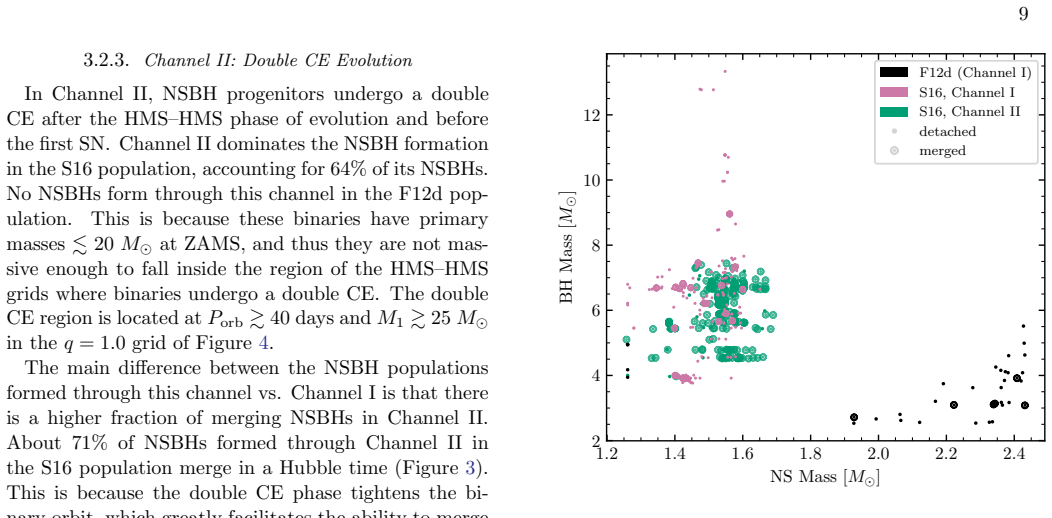
The paper claims that, within the physics implemented in its population synthesis code, every neutron-star-first black hole binary progenitor undergoes a mass ratio reversal before the first supernova, through mass transfer during hydrogen main-sequence evolution. These progenitors then either evolve fully detached (Channel I) or pass through a double common envelope phase before the first supernova (Channel II), but in both channels no mass transfer occurs after the first supernova. Because accretion is required to recycle a neutron star to millisecond periods, the authors conclude that millisecond pulsar–black hole binaries have no isolated formation channel in these models, leaving dynamical formation as the only remaining route.
Load-bearing premise
The null result rests on the code's assumption that a non-degenerate star can only accrete until it reaches critical rotation, so only near-equal-mass binaries reverse their mass ratios and no companion can later dump mass onto the neutron star.
Editorial extensions
If this is right
- If correct, current and upcoming pulsar surveys should expect no Galactic-field millisecond pulsar–black hole detections from isolated binary evolution.
- Dynamically active environments, such as globular clusters and nuclear clusters, become the only plausible birth sites for these systems.
- The neutron-star-first black hole birth rate below 1 Myr$^{-1}$ means these systems contribute negligibly to gravitational-wave merger rates compared with black-hole-first systems.
- The properties of these binaries, including which formation channel dominates, depend strongly on the supernova remnant prescription, natal kick assumptions, and common-envelope efficiency.
- The one detected millisecond pulsar with a compact companion in NGC 1851 is consistent with a dynamical origin, matching the paper's conclusions.
Reading between the lines
- A testable extension left implicit by the paper: if isolated millisecond pulsar–black hole binaries do form, they would most likely appear as wide, detached, unrecycled pulsar–black hole systems, so a field discovery of a recycled pulsar with a black hole companion would directly contradict this channel.
- The gap between this result and an earlier population synthesis study that found recycled neutron stars appears to be driven mainly by the rotation cap on accretion; a systematic comparison of accretion physics, rather than supernova physics, would decide which population's neutron-star-first binaries are closer to reality.
- Future supernova remnant prescriptions that produce different remnant masses, or a revised physical treatment of double common envelope onset, could reopen a narrow isolated formation channel even within this code.
- The rotation-limited accretion assumption could be tested observationally by comparing simulated mass ratios of double neutron star and X-ray binary populations against measured systems, since those constrain how much mass non-degenerate accretors actually retain.
Editorial analysis
A structured set of objections, weighed in public.
Referee Report
Summary. This paper uses the POSYDON v2 population-synthesis code to evolve 10^7 solar-metallicity binaries and isolate the subpopulation of NS\,–\,BH binaries in which the neutron star forms first (NSBH). It reports Galactic NSBH birth rates below about 1.6\,Myr$^{-1}$, two to three orders of magnitude below BH-first systems, and identifies two formation channels: fully detached evolution after the hydrogen main sequence (Channel I) and a double common-envelope phase before the first supernova (Channel II). The central result is that no NSBH binary in any of the tested populations undergoes mass transfer, stable or unstable, after the first supernova, so the neutron star cannot be recycled into a millisecond pulsar. The authors conclude that isolated binary evolution cannot form MSP\,–\,BH binaries and that dynamical environments may be the only remaining channel, placing this result in explicit contrast with the COMPAS-based conclusions of Chattopadhyay et al. (2021).
Significance. If the central null result holds, the paper would settle an important disputed question in binary population synthesis by closing the isolated formation channel for MSP\,–\,BH binaries at solar metallicity, with direct consequences for pulsar-survey targeting. The study's strengths are that the result emerges from detailed MESA-based binary grids rather than from fitted outcomes, and that the authors test multiple supernova remnant prescriptions, kick settings, common-envelope efficiencies, and an alternative interpolation scheme, while transparently listing many model limitations. The main caveat, identified in the paper itself in Section 4.1, is that the absence of post-supernova mass transfer is a direct consequence of POSYDON's rotation-limited accretion prescription for non-degenerate companions. Because that prescription is not independently calibrated or varied here, the categorical statement that MSP\,–\,BH binaries 'cannot form' is stronger than the modeling actually supports.
major comments (3)
- [§4.1, §2.2] The central null result is load-bearing on a single code-specific assumption: POSYDON's treatment of mass accretion onto non-degenerate stars, which is limited by the accretor's critical rotation rate and by rotationally enhanced winds. The paper itself states in §4.1 that COMPAS's more conservative accretion allows mass-ratio reversal for more unequal ZAMS binaries, leading to a common-envelope phase and accretion onto the neutron star after the first supernova, whereas POSYDON restricts mass-ratio reversal to near-unity mass ratios. Section 2.2 also notes that star\,–\,disk interactions could change the accretion and spin-up assumptions. No test, calibration, or quantitative comparison of this assumption is provided. Because the abstract's conclusion "MSP\,–\,BH binaries cannot form" rests on this prescription, the claim is not yet robust. I would ask the authors to add a model variation that relaxes the rotation-limited accretion assumption (for example, allowing a fixed fraction of the transferred mass to be accreted regardless of spin, or adopting a COMPAS-like conservative accretion limit) and to report whether any post-supernova mass-transfer channel appears; alternatively, the conclusion should be explicitly conditional on the accretion treatment rather than stated as a universal formation barrier.
- [§4.2] The model-uncertainties section does not include the rotation-limited accretion assumption among the factors that could change the main result. Section 4.2 discusses uncertainties in the core-collapse prescription, double-CE onset, stellar winds, interpolation, and grid resolution, but the discussion of the comparison with COMPAS in §4.1 makes clear that the absence of post-supernova mass transfer is controlled by the accretion physics. Since the abstract draws a categorical conclusion from this null result, the limitation section should explicitly state that the no-recycling result is conditional on POSYDON's treatment of non-degenerate accretion, and should discuss what would happen if that treatment were modified. This is not a cosmetic omission; it is the difference between a robust population-synthesis result and a code-dependent artifact.
- [Abstract and §5] The conclusion that "MSP\,–\,BH binaries cannot be formed" overstates the scope of the simulations. The models cover only solar metallicity, only isolated binaries, and only the specific set of physical prescriptions adopted in POSYDON. The abstract itself contains the qualifier "in isolation," but the final sentence, "Thus, dynamical environments and processes may provide the only formation channels," presents the result as an absolute barrier. A more accurate statement would be that no MSP\,–\,BH binaries form through the isolated-binary channels modeled here at solar metallicity, given the tested prescriptions. The distinction matters for the paper's survey-strategy implications, and the authors should either soften the claim or provide evidence that the tested parameter space is representative of the physical possibilities.
minor comments (6)
- [Figure 4 caption] In the caption, "potted" should be "plotted": "Binaries with initial mass ratios ≤ 0.95 are potted on the q = 0.9 grid slice."
- [Table 1 caption] The caption begins "T able 1." with a stray space; it should read "Table 1."
- [Introduction] The acronym "F AST" in the list of surveys should be "FAST".
- [Acknowledgments] The phrase "supported by the the Swiss National Science Foundation" contains a duplicated "the" and appears twice.
- [Section 2.2] The sentence describing the rotationally enhanced wind model says the wind keeps the stellar rotation rate "always below its critical threshold," but the same paragraph discusses critically rotating stars; consider writing "at or below" for consistency with the earlier description.
- [Figure 4] The legend labels "Stable reverse mass-transfer phase" and "Unstable reverse mass-transfer phase" are rendered in different colors in the figure, but the caption text does not define all color/symbol combinations unambiguously; a compact legend description in the caption would improve readability.
Circularity Check
No significant circularity: the null result is an emergent population-synthesis outcome, not an input or a fitted target.
full rationale
The paper's derivation chain is self-contained and does not reduce to its own assumptions by construction. The central claim—that no NSBH binary in the modeled populations undergoes mass transfer after the first supernova, so MSP-BH binaries cannot form in isolation—is an emergent property of POSYDON's pre-computed MESA grids, not a fitted or definitional input. Initial conditions (Kroupa IMF, Sana period distribution, flat mass ratios) and physical prescriptions (Fryer+12 delayed, Sukhbold+16 N20, Hobbs+05 and Mandel & Mueller kicks, Podsiadlowski+04 ECSN, alpha-lambda CE) are taken from independent literature and are not tuned to produce the absence of post-supernova mass transfer. The paper explicitly diagnoses the difference from Chattopadhyay et al. (2021) as arising from POSYDON's rotation-limited accretion onto non-degenerate companions, and it flags star-disk interactions as a potential modification (Section 2.2); this is model dependence, which belongs to correctness risk rather than circularity. Self-citations to Fragos et al. (2023) and Andrews et al. (2024) function as code documentation, not as a load-bearing uniqueness theorem, and the relevant accretion physics is described concretely in the text rather than deferred entirely to those citations. No equation is shown to be equivalent to its inputs by construction, and no fitted parameter is renamed as a prediction. Score 0 reflects the absence of circular steps.
Assumptions & free parameters
free parameters (4)
- Common envelope efficiency alpha =
1 (default); 0.5 and 0.1 in variations
- CCSN kick velocity dispersion =
265 km/s (default, Hobbs et al. 2005); 120 km/s NS and 60 km/s BH (low-kick variation, Mandel & Muller 2020)
- Maximum NS mass for F12d remnant model =
2.5 Msun
- Milky Way star formation rate for rate normalization =
1.65 Msun/yr
assumptions (6)
- domain assumption Mass accretion onto non-degenerate stars is limited by the accretor's critical rotation rate, with excess mass lost through boosted winds.
- ad hoc to paper A binary enters a double common envelope when both stars fill their Roche lobes, at least one is post-MS, and unstable MT is initiated.
- domain assumption Hertzsprung-gap donor stars can survive a common envelope phase (the 'optimistic' CE scenario).
- domain assumption Remnant masses and remnant types follow either the Fryer et al. (2012) delayed or Sukhbold et al. (2016) N20 prescriptions.
- domain assumption Ultra-stripped supernovae are not modeled in POSYDON.
- domain assumption The MESA stellar models and the Dutch wind scheme for high-mass stars approximate the binary physics correctly.
Cite this review
Pith. "Pith review of Challenges in Forming Millisecond Pulsar-Black Holes from Isolated Binaries." pith.science (2026). https://pith.science/paper/QIWAP6JK
@misc{pith2026241215521,
  author       = {Pith},
  title        = {Pith review of: Challenges in Forming Millisecond Pulsar-Black Holes from Isolated Binaries},
  year         = {2026},
  howpublished = {\url{https://pith.science/paper/QIWAP6JK}},
  note         = {Machine review of arXiv:2412.15521}
}
abstract
Binaries harboring a millisecond pulsar (MSP) and a black hole (BH) are a key observing target for current and upcoming pulsar surveys. We model the formation and evolution of such binaries in isolation at solar metallicity using the next-generation binary population synthesis code POSYDON. We examine neutron star (NS)-BH binaries where the NS forms first (labeled NSBH), as the NS must be able to spin-up to MSP rotation periods before the BH forms in these systems. We find that NSBHs are very rare and have a birth rate < 1 Myr$^{-1}$ for a Milky Way-like galaxy in our typical models. The NSBH birth rate is 2-3 orders of magnitude smaller than that for NS-BHs where the BH forms first (labeled BHNS). These rates are also sensitive to model assumptions about the supernova (SN) remnant masses, natal kicks, and common-envelope efficiency. We find that 100% of NSBHs undergo a mass ratio reversal before the first SN and up to 64% of NSBHs undergo a double common envelope phase after the mass ratio reversal occurs. Most importantly, no NSBH binaries in our populations undergo a mass transfer phase, either stable or unstable, after the first SN. This implies that there is no possibility of pulsar spin-up via accretion, and thus MSP-BH binaries cannot form. Thus, dynamical environments and processes may provide the only formation channels for such MSP-BH binaries.
Figures


Figures from the paper (3 more)


Reference graph
Works this paper leans on
-
[1]
thebibliography [1] 20pt to REFERENCES 6pt =0pt 10pt plus 3pt =0pt =0pt =1pt plus 1pt =0pt =0pt -12pt =13pt plus 1pt =20pt =13pt plus 1pt \@M =10000 =-1.0em =0pt =0pt 0pt =0pt =1.0em @enumiv\@empty 10000 10000 `\.\@m \@noitemerr \@latex@warning Empty `thebibliography' environment \@ifnextchar \@reference \@latexerr Missing key on reference command Each re...
arXiv 2019
-
[2]
G., Abbott, R., Abouelfettouh, I., et al
Abac, A. G., Abbott, R., Abouelfettouh, I., et al. 2024, The Astrophysical Journal Letters, 970, L34, 10.3847/2041-8213/ad5beb
-
[3]
Abbott, R., Abbott, T. D., Abraham, S., et al. 2020, The Astrophysical Journal Letters, 896, L44, 10.3847/2041-8213/ab960f
-
[4]
2021, The Astrophysical Journal Letters, 915, L5, 10.3847/2041-8213/ac082e
---. 2021, The Astrophysical Journal Letters, 915, L5, 10.3847/2041-8213/ac082e
-
[5]
2023, Physical Review X, 13, 041039, 10.1103/PhysRevX.13.041039
Abbott, R., Abbott, T., Acernese, F., et al. 2023, Physical Review X, 13, 041039, 10.1103/PhysRevX.13.041039
-
[6]
Abbott, R., Abbott, T. D., Acernese, F., et al. 2024, Physical Review D, 109, 022001, 10.1103/PhysRevD.109.022001
-
[7]
Ahmad, A., Jeffery, C. S., & Fullerton, A. W. 2004, Astronomy and Astrophysics, 418, 275, 10.1051/0004-6361:20035917
-
[8]
Amiri, M., Bandura, K. M., Boyle, P. J., et al. 2021, The Astrophysical Journal Supplement Series, 255, 5, 10.3847/1538-4365/abfdcb
Show all 89 references
- [9]
-
[10]
2020, Communications Physics, 3, 1, 10.1038/s42005-020-0310-x
Arca Sedda, M. 2020, Communications Physics, 3, 1, 10.1038/s42005-020-0310-x
2020 doi
-
[11]
O., Sivakoff, G
Bahramian, A., Heinke, C. O., Sivakoff, G. R., & Gladstone, J. C. 2013, The Astrophysical Journal, 766, 136, 10.1088/0004-637X/766/2/136
2013 doi
-
[12]
D., Dutta, A., Freire, P
Barr, E. D., Dutta, A., Freire, P. C. C., et al. 2024, Science, 383, 275, 10.1126/science.adg3005
2024 doi
- [13]
-
[14]
2023, in Bruno Touschek 100 Years , ed
Branchesi, M. 2023, in Bruno Touschek 100 Years , ed. L. Bonolis, L. Maiani, & G. Pancheri (Cham: Springer International Publishing), 255--266, 10.1007/978-3-031-23042-4_19
2023 doi
-
[15]
2019, Anticipated Performance of the Square Kilometre Array -- Phase 1 ( SKA1 ), arXiv, 10.48550/arXiv.1912.12699
Braun, R., Bonaldi, A., Bourke, T., Keane, E., & Wagg, J. 2019, Anticipated Performance of the Square Kilometre Array -- Phase 1 ( SKA1 ), arXiv, 10.48550/arXiv.1912.12699
-
[16]
S., Berger, E., Neijssel, C
Broekgaarden, F. S., Berger, E., Neijssel, C. J., et al. 2021, Monthly Notices of the Royal Astronomical Society, 508, 5028, 10.1093/mnras/stab2716
2021 doi
-
[17]
R., Bailes, M., & Broekgaarden, F
Chattopadhyay, D., Stevenson, S., Hurley, J. R., Bailes, M., & Broekgaarden, F. 2021, Monthly Notices of the Royal Astronomical Society, 504, 3682, 10.1093/mnras/stab973
2021 doi
-
[18]
Clausen, D., Sigurdsson, S., & Chernoff, D. F. 2013, Monthly Notices of the Royal Astronomical Society, 428, 3618, 10.1093/mnras/sts295
2013 doi
-
[19]
2014, Monthly Notices of the Royal Astronomical Society, 442, 207, 10.1093/mnras/stu871
---. 2014, Monthly Notices of the Royal Astronomical Society, 442, 207, 10.1093/mnras/stu871
2014 doi
-
[20]
1991, Monthly Notices of the Royal Astronomical Society, 253, 55, 10.1093/mnras/253.1.55
Colpi, M., Nannurelli, M., & Calvani, M. 1991, Monthly Notices of the Royal Astronomical Society, 253, 55, 10.1093/mnras/253.1.55
1991 doi
- [21]
-
[22]
Drozda, P., Belczynski, K., O’Shaughnessy, R., Bulik, T., & Fryer, C. L. 2022, Astronomy & Astrophysics, 667, A126, 10.1051/0004-6361/202039418
2022 doi
-
[23]
2019, Bulletin of the AAS, 51
Fonseca, E., Demorest, P., Ransom, S., & Stairs, I. 2019, Bulletin of the AAS, 51. https://baas.aas.org/pub/2020n3i425/release/1
2019
-
[24]
2020, The Astrophysical Journal Letters, 901, L16, 10.3847/2041-8213/abb671
Fragione, G., & Banerjee, S. 2020, The Astrophysical Journal Letters, 901, L16, 10.3847/2041-8213/abb671
2020 doi
-
[25]
Fragione, G., Grishin, E., Leigh, N. W. C., Perets, H. B., & Perna, R. 2019, Monthly Notices of the Royal Astronomical Society, 488, 47, 10.1093/mnras/stz1651
2019 doi
-
[26]
2019, Monthly Notices of the Royal Astronomical Society, 486, 4443, 10.1093/mnras/stz1131
Fragione, G., & Loeb, A. 2019, Monthly Notices of the Royal Astronomical Society, 486, 4443, 10.1093/mnras/stz1131
2019 doi
-
[27]
J., Bavera, S
Fragos, T., Andrews, J. J., Bavera, S. S., et al. 2023, The Astrophysical Journal Supplement Series, 264, 45, 10.3847/1538-4365/ac90c1
2023 doi
-
[28]
L., Belczynski, K., Wiktorowicz, G., et al
Fryer, C. L., Belczynski, K., Wiktorowicz, G., et al. 2012, The Astrophysical Journal, 749, 91, 10.1088/0004-637X/749/1/91
2012 doi
-
[29]
2019, Monthly Notices of the Royal Astronomical Society, 482, 2234, 10.1093/mnras/sty2848
Giacobbo, N., & Mapelli, M. 2019, Monthly Notices of the Royal Astronomical Society, 482, 2234, 10.1093/mnras/sty2848
2019 doi
-
[30]
Habets, G. M. H. J. 1986, Astronomy and Astrophysics, 167, 61. https://ui.adsabs.harvard.edu/abs/1986A&A...167...61H
1986
-
[31]
A., Van Dyk, S
Hiramatsu, D., Howell, D. A., Van Dyk, S. D., et al. 2021, Nature Astronomy, 5, 903, 10.1038/s41550-021-01384-2
2021 doi
-
[32]
2020, The Astrophysical Journal, 903, 8, 10.3847/1538-4357/abb66a
Hoang, B.-M., Naoz, S., & Kremer, K. 2020, The Astrophysical Journal, 903, 8, 10.3847/1538-4357/abb66a
2020 doi
-
[33]
R., Lyne, A
Hobbs, G., Lorimer, D. R., Lyne, A. G., & Kramer, M. 2005, Monthly Notices of the Royal Astronomical Society, 360, 974, 10.1111/j.1365-2966.2005.09087.x
2005
-
[34]
Hunter, J. D. 2007, Computing in Science & Engineering, 9, 90, 10.1109/MCSE.2007.55
2007 doi
-
[35]
2020, Common Envelope Evolution (IOP Publishing)
Ivanova, N., Justham, S., & Ricker, P. 2020, Common Envelope Evolution (IOP Publishing). https://iopscience.iop.org/book/mono/978-0-7503-1563-0
2020
-
[36]
2011, Monthly Notices of the Royal Astronomical Society, 410, 984, 10.1111/j.1365-2966.2010.17497.x
Justham, S., Podsiadlowski, P., & Han, Z. 2011, Monthly Notices of the Royal Astronomical Society, 410, 984, 10.1111/j.1365-2966.2010.17497.x
2011
-
[37]
1990, Astronomy and Astrophysics, 236, 385
Kolb, U., & Ritter, H. 1990, Astronomy and Astrophysics, 236, 385. https://ui.adsabs.harvard.edu/abs/1990A&A...236..385K
1990
-
[38]
C., Cordes, J
Kramer, M., Backer, D. C., Cordes, J. M., et al. 2004, New Astronomy Reviews, 48, 993, 10.1016/j.newar.2004.09.020
2004 doi
-
[39]
2001, Monthly Notices of the Royal Astronomical Society, 322, 231, 10.1046/j.1365-8711.2001.04022.x
Kroupa, P. 2001, Monthly Notices of the Royal Astronomical Society, 322, 231, 10.1046/j.1365-8711.2001.04022.x
2001
-
[40]
U., Tauris, T
Kruckow, M. U., Tauris, T. M., Langer, N., Kramer, M., & Izzard, R. G. 2018, Monthly Notices of the Royal Astronomical Society, 481, 1908, 10.1093/mnras/sty2190
2018 doi
-
[41]
M., Knispel, B., et al
Lazarus, P., Tauris, T. M., Knispel, B., et al. 2014, Monthly Notices of the Royal Astronomical Society, 437, 1485, 10.1093/mnras/stt1996
2014 doi
-
[42]
C., & Newman, J
Licquia, T. C., & Newman, J. A. 2015, The Astrophysical Journal, 806, 96, 10.1088/0004-637X/806/1/96
2015 doi
-
[43]
2018, The Astrophysical Journal, 863, 68, 10.3847/1538-4357/aad09f
Liu, B., & Lai, D. 2018, The Astrophysical Journal, 863, 68, 10.3847/1538-4357/aad09f
2018 doi
-
[44]
1988, The Astrophysical Journal, 329, 764, 10.1086/166419
Livio, M., & Soker, N. 1988, The Astrophysical Journal, 329, 764, 10.1086/166419
1988 doi
-
[45]
Lorimer, D. R. 2008, Living Reviews in Relativity, 11, 8, 10.12942/lrr-2008-8
2008 doi
-
[46]
N., Hobbs, G
Manchester, R. N., Hobbs, G. B., Teoh, A., & Hobbs, M. 2005, The Astronomical Journal, 129, 1993, 10.1086/428488
2005 doi
-
[47]
2020, Monthly Notices of the Royal Astronomical Society, 499, 3214, 10.1093/mnras/staa3043
Mandel, I., & Müller, B. 2020, Monthly Notices of the Royal Astronomical Society, 499, 3214, 10.1093/mnras/staa3043
2020 doi
-
[48]
2018, Monthly Notices of the Royal Astronomical Society, 479, 4391, 10.1093/mnras/sty1613
Mapelli, M., & Giacobbo, N. 2018, Monthly Notices of the Royal Astronomical Society, 479, 4391, 10.1093/mnras/sty1613
2018 doi
-
[49]
McKernan, B., Ford, K. E. S., & O’Shaughnessy, R. 2020, Monthly Notices of the Royal Astronomical Society, 498, 4088, 10.1093/mnras/staa2681
2020 doi
-
[50]
2010, in Proceedings of the 9th Python in Science Conference , 56--61, 10.25080/Majora-92bf1922-00a
McKinney, W. 2010, in Proceedings of the 9th Python in Science Conference , 56--61, 10.25080/Majora-92bf1922-00a
2010 doi
-
[51]
B., Hanna, C., & Murase, K
Mészáros, P., Fox, D. B., Hanna, C., & Murase, K. 2019, Nature Reviews Physics, 1, 585, 10.1038/s42254-019-0101-z
2019 doi
-
[52]
2011, International Journal of Modern Physics D, 20, 989, 10.1142/S0218271811019335
Nan, R., Li, D., Jin, C., et al. 2011, International Journal of Modern Physics D, 20, 989, 10.1142/S0218271811019335
2011 doi
-
[53]
J., Vigna-Gómez, A., Stevenson, S., et al
Neijssel, C. J., Vigna-Gómez, A., Stevenson, S., et al. 2019, Monthly Notices of the Royal Astronomical Society, 490, 3740, 10.1093/mnras/stz2840
2019 doi
-
[54]
1984, The Astrophysical Journal, 277, 791, 10.1086/161749
Nomoto, K. 1984, The Astrophysical Journal, 277, 791, 10.1086/161749
1984 doi
-
[55]
1976, 73, 75
Paczynski, B. 1976, 73, 75. http://adsabs.harvard.edu/abs/1976IAUS...73...75P
1976
-
[56]
1991, The Astrophysical Journal, 370, 597, 10.1086/169846
---. 1991, The Astrophysical Journal, 370, 597, 10.1086/169846
1991 doi
-
[57]
2011, The Astrophysical Journal Supplement Series, 192, 3, 10.1088/0067-0049/192/1/3
Paxton, B., Bildsten, L., Dotter, A., et al. 2011, The Astrophysical Journal Supplement Series, 192, 3, 10.1088/0067-0049/192/1/3
2011 doi
-
[58]
2013, The Astrophysical Journal Supplement Series, 208, 4, 10.1088/0067-0049/208/1/4
Paxton, B., Cantiello, M., Arras, P., et al. 2013, The Astrophysical Journal Supplement Series, 208, 4, 10.1088/0067-0049/208/1/4
2013 doi
-
[59]
2015, The Astrophysical Journal Supplement Series, 220, 15, 10.1088/0067-0049/220/1/15
Paxton, B., Marchant, P., Schwab, J., et al. 2015, The Astrophysical Journal Supplement Series, 220, 15, 10.1088/0067-0049/220/1/15
2015 doi
-
[60]
2019, The Astrophysical Journal Supplement Series, 243, 10, 10.3847/1538-4365/ab2241
Paxton, B., Smolec, R., Schwab, J., et al. 2019, The Astrophysical Journal Supplement Series, 243, 10, 10.3847/1538-4365/ab2241
2019 doi
-
[61]
Peters, P. C. 1964, Physical Review, 136, B1224, 10.1103/PhysRev.136.B1224
1964 doi
-
[62]
S., & Kulkarni, S
Phinney, E. S., & Kulkarni, S. R. 1994, Annual Review of Astronomy and Astrophysics, 32, 591, 10.1146/annurev.aa.32.090194.003111
1994
-
[63]
Podsiadlowski, P., Langer, N., Poelarends, A. J. T., et al. 2004, The Astrophysical Journal, 612, 1044, 10.1086/421713
2004 doi
-
[64]
1991, The Astrophysical Journal, 370, 604, 10.1086/169847
Popham, R., & Narayan, R. 1991, The Astrophysical Journal, 370, 604, 10.1086/169847
1991 doi
-
[65]
Ransom, S. M. 2008, 246, 291, 10.1017/S1743921308015810
2008 doi
-
[66]
S., Fragos, T., et al
Román-Garza, J., Bavera, S. S., Fragos, T., et al. 2021, The Astrophysical Journal Letters, 912, L23, 10.3847/2041-8213/abf42c
2021 doi
-
[67]
E., de Koter, A., et al
Sana, H., de Mink, S. E., de Koter, A., et al. 2012, Science, 337, 444, 10.1126/science.1223344
2012 doi
-
[68]
2018, Physical Review D, 98, 124007, 10.1103/PhysRevD.98.124007
Seymour, B., & Yagi, K. 2018, Physical Review D, 98, 124007, 10.1103/PhysRevD.98.124007
2018 doi
-
[69]
2018, Monthly Notices of the Royal Astronomical Society: Letters, 477, L128, 10.1093/mnrasl/sly063
Shao, Y., & Li, X.-D. 2018, Monthly Notices of the Royal Astronomical Society: Letters, 477, L128, 10.1093/mnrasl/sly063
2018 doi
-
[70]
Shapiro, I. I. 1964, Physical Review Letters, 13, 789, 10.1103/PhysRevLett.13.789
1964 doi
-
[71]
C., Kiato, I., Kalogera, V., et al
Siegel, J. C., Kiato, I., Kalogera, V., et al. 2023, The Astrophysical Journal, 954, 212, 10.3847/1538-4357/ace9d9
2023 doi
-
[72]
2019, 233, 110.02
Stairs, I. 2019, 233, 110.02. https://ui.adsabs.harvard.edu/abs/2019AAS...23311002S
2019
-
[73]
P., Naoz, S., Ghez, A
Stephan, A. P., Naoz, S., Ghez, A. M., et al. 2019, The Astrophysical Journal, 878, 58, 10.3847/1538-4357/ab1e4d
2019 doi
-
[74]
2017, Nature Communications, 8, 14906, 10.1038/ncomms14906
Stevenson, S., Vigna-Gómez, A., Mandel, I., et al. 2017, Nature Communications, 8, 14906, 10.1038/ncomms14906
2017 doi
-
[75]
E., Brown, J
Sukhbold, T., Ertl, T., Woosley, S. E., Brown, J. M., & Janka, H.-T. 2016, The Astrophysical Journal, 821, 38, 10.3847/0004-637X/821/1/38
2016 doi
-
[76]
M., & Bailes, M
Tauris, T. M., & Bailes, M. 1996, Astronomy and Astrophysics, 315, 432. https://ui.adsabs.harvard.edu/abs/1996A&A...315..432T
1996
-
[77]
M., Langer, N., & Kramer, M
Tauris, T. M., Langer, N., & Kramer, M. 2012, Monthly Notices of the Royal Astronomical Society, 425, 1601, 10.1111/j.1365-2966.2012.21446.x
2012
-
[78]
M., Langer, N., & Podsiadlowski, P
Tauris, T. M., Langer, N., & Podsiadlowski, P. 2015, Monthly Notices of the Royal Astronomical Society, 451, 2123, 10.1093/mnras/stv990
2015 doi
-
[79]
M., Kramer, M., Freire, P
Tauris, T. M., Kramer, M., Freire, P. C. C., et al. 2017, The Astrophysical Journal, 846, 170, 10.3847/1538-4357/aa7e89
2017 doi
-
[80]
2016, Computational Astrophysics and Cosmology, 3, 6, 10.1186/s40668-016-0019-0
Toonen, S., Hamers, A., & Portegies Zwart, S. 2016, Computational Astrophysics and Cosmology, 3, 6, 10.1186/s40668-016-0019-0
2016 doi
-
[81]
C., & Varoquaux, G
van der Walt, S., Colbert, S. C., & Varoquaux, G. 2011, Computing in Science & Engineering, 13, 22, 10.1109/MCSE.2011.37
2011 doi
-
[82]
J., Stevenson, S., et al
Vigna-Gómez, A., Neijssel, C. J., Stevenson, S., et al. 2018, Monthly Notices of the Royal Astronomical Society, 481, 4009, 10.1093/mnras/sty2463
2018 doi
-
[83]
Voss, R., & Tauris, T. M. 2003, Monthly Notices of the Royal Astronomical Society, 342, 1169, 10.1046/j.1365-8711.2003.06616.x
2003
-
[84]
Webbink, R. F. 1984, The Astrophysical Journal, 277, 355, 10.1086/161701
1984 doi
- [85]
- [86]
-
[87]
S., Fong, W.-f., Kremer, K., et al
Ye, C. S., Fong, W.-f., Kremer, K., et al. 2019 a , The Astrophysical Journal Letters, 888, L10, 10.3847/2041-8213/ab5dc5
2019 doi
-
[88]
S., Kremer, K., Chatterjee, S., Rodriguez, C
Ye, C. S., Kremer, K., Chatterjee, S., Rodriguez, C. L., & Rasio, F. A. 2019 b , The Astrophysical Journal, 877, 122, 10.3847/1538-4357/ab1b21
2019 doi
-
[89]
T., & Jeffery, C
Şener, H. T., & Jeffery, C. S. 2014, Monthly Notices of the Royal Astronomical Society, 440, 2676, 10.1093/mnras/stu397
2014 doi
Reviewed August 11, 2026 · model on record in the stance chip above.
Discussion (0). Continue with ORCID to comment.