PRecover 1.0: Process Rate Recovery with Machine Learning
Pith reviewed 2026-06-26 15:01 UTC · model grok-4.3
The pith
Machine learning recovers most microphysical process rates from standard ICON outputs for short accumulation intervals.
A machine-rendered reading of the paper's core claim, the machinery that carries it, and where it could break.
Core claim
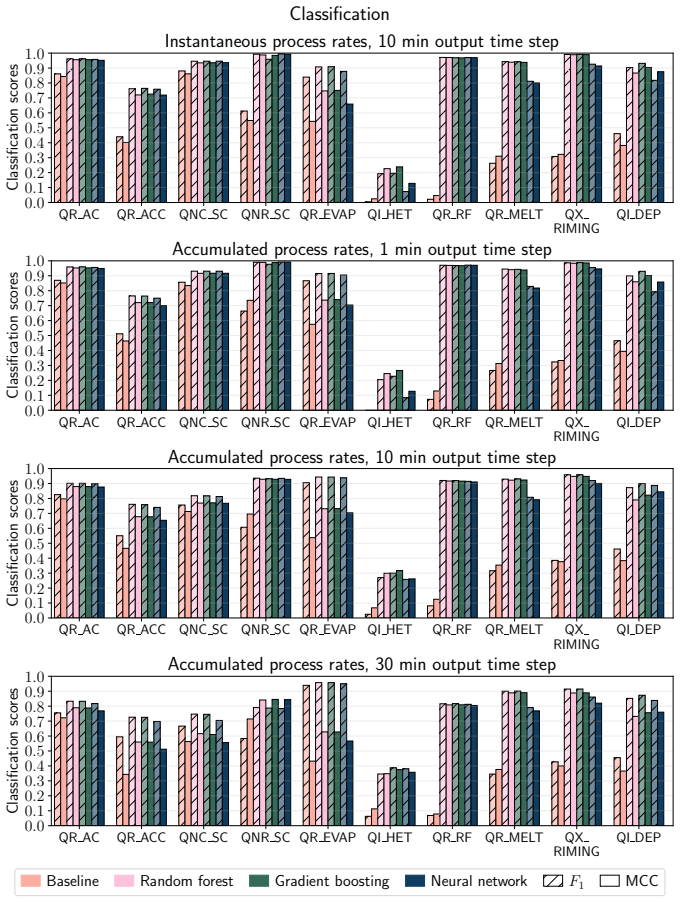
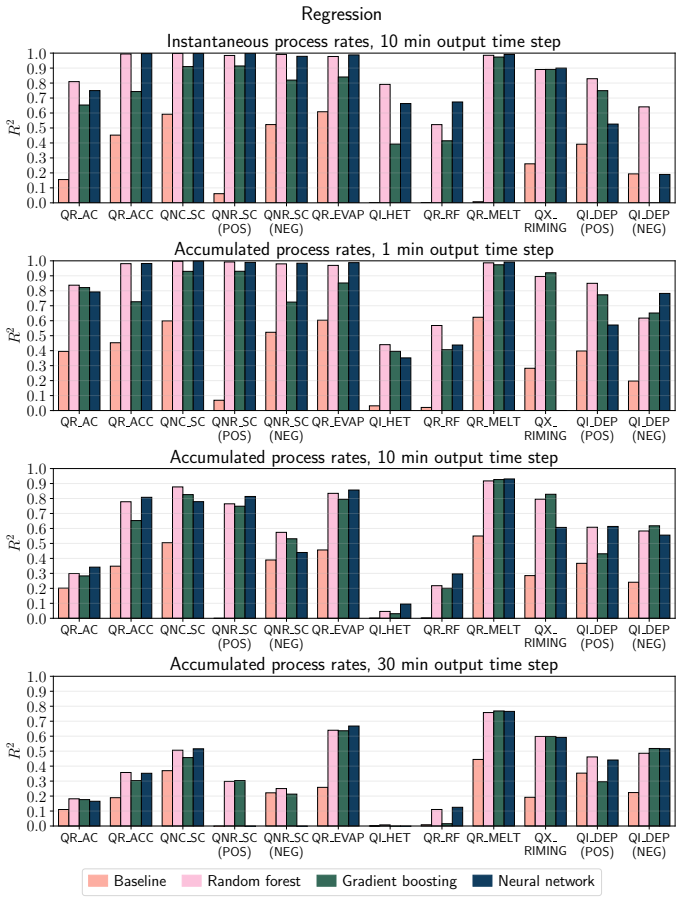
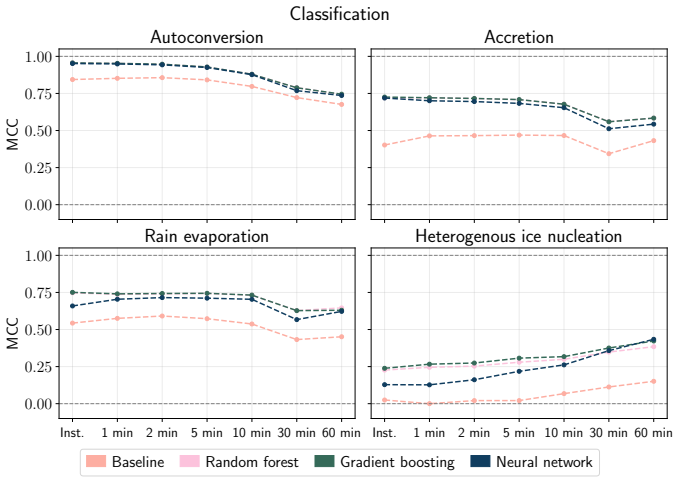
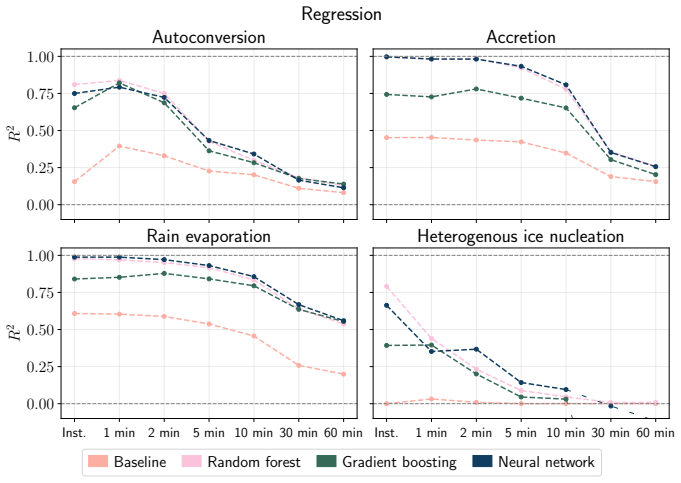
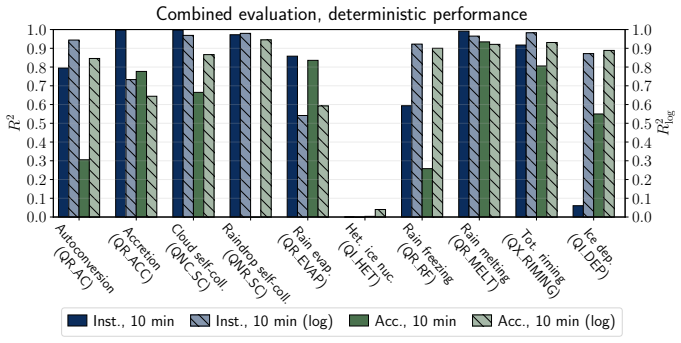
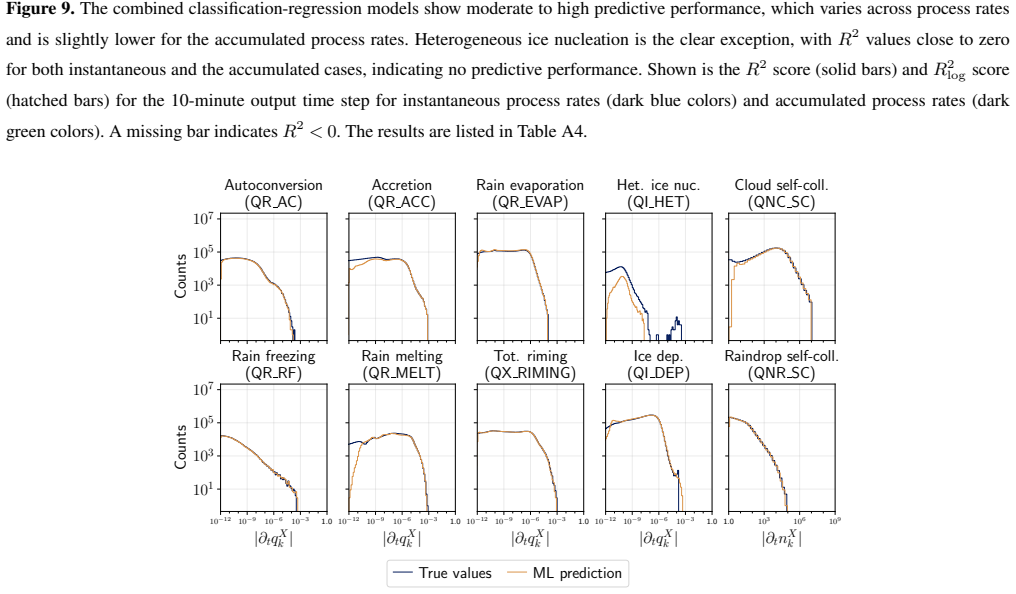
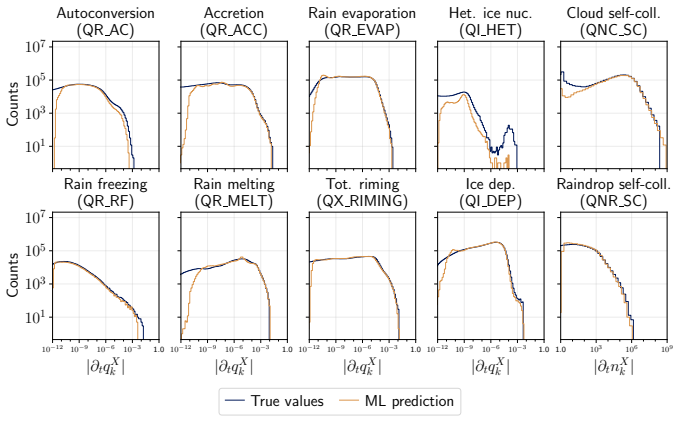
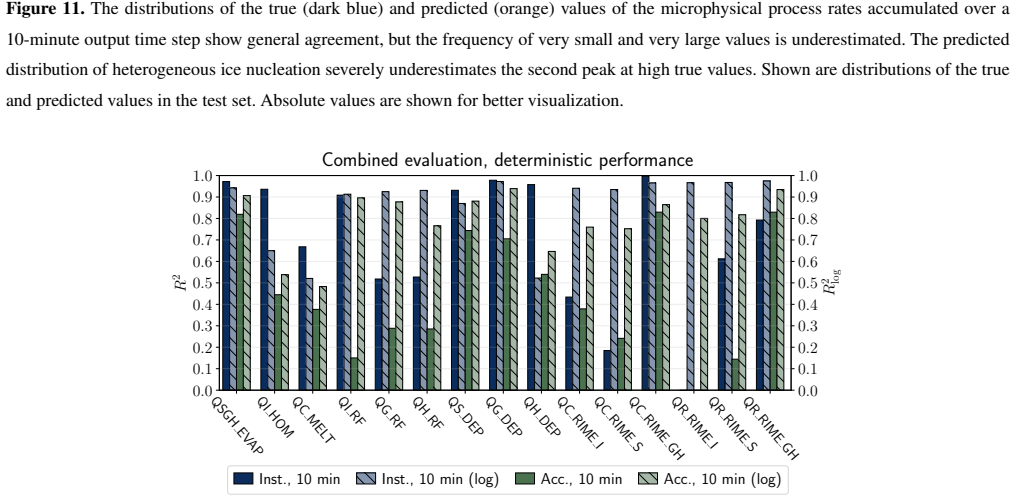
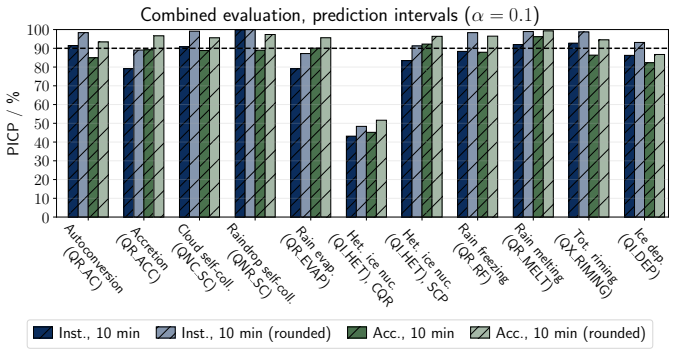
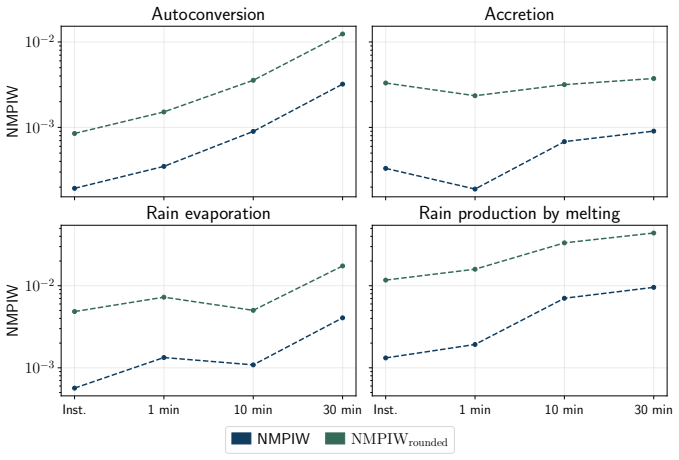
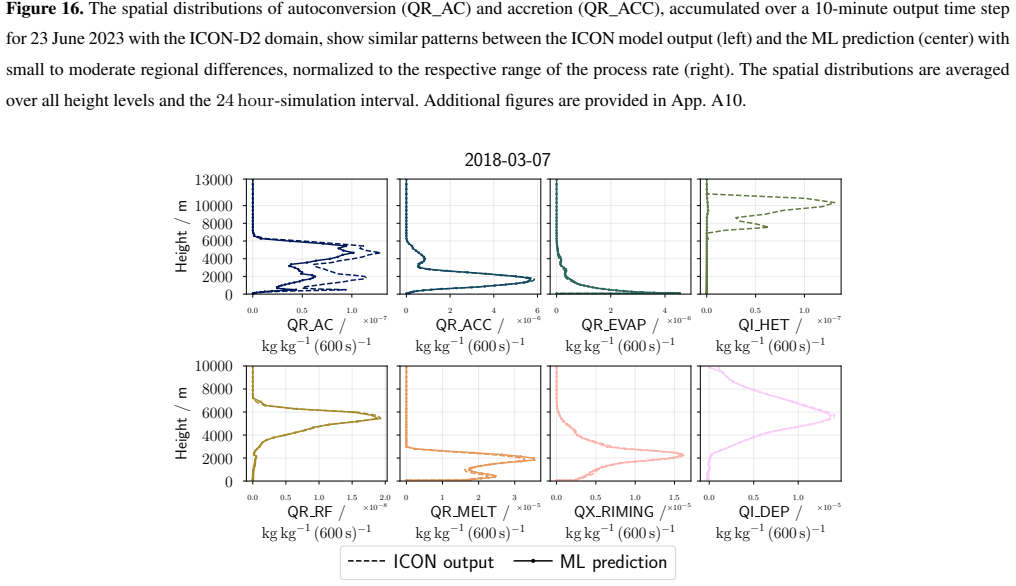
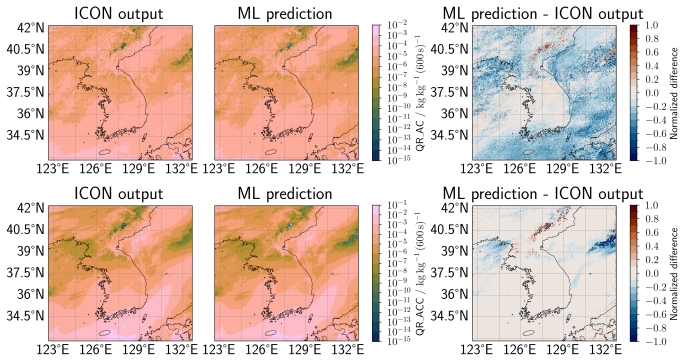
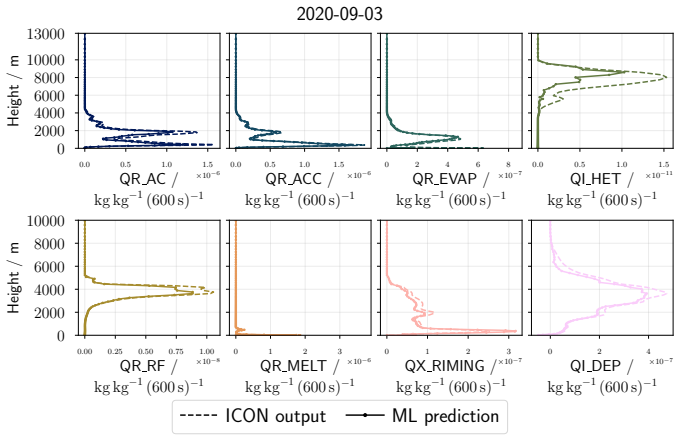
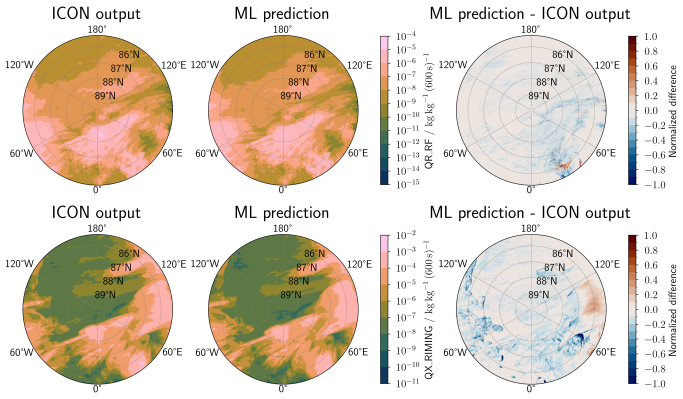
PRecover recovers most of the process rates that are accumulated over output time steps of 10 minutes or less from standard cloud variables using supervised learning, but the values are increasingly difficult to recover for rates accumulated over longer accumulation intervals. A physics-based baseline shows direct recalculation succeeds for rates such as accretion and self-collection but not for autoconversion, rain melting or heterogeneous ice nucleation. The approach includes calibrated prediction intervals via conformalized quantile regression and demonstrates spatial transferability across different regional domains and simulation settings.
What carries the argument
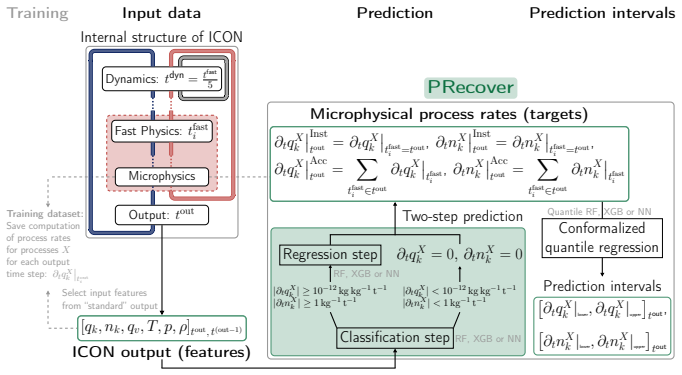
PRecover, a data-driven post-processing approach that trains random forests, gradient boosting models, and feed-forward neural networks on cloud variables to recover microphysical process rates via a two-step classification-regression approach.
If this is right
- Direct recalculation from stored variables succeeds for accretion and self-collection but not for autoconversion, rain melting or heterogeneous ice nucleation.
- Recovery accuracy holds for accumulation intervals of 10 minutes or less and declines for longer intervals.
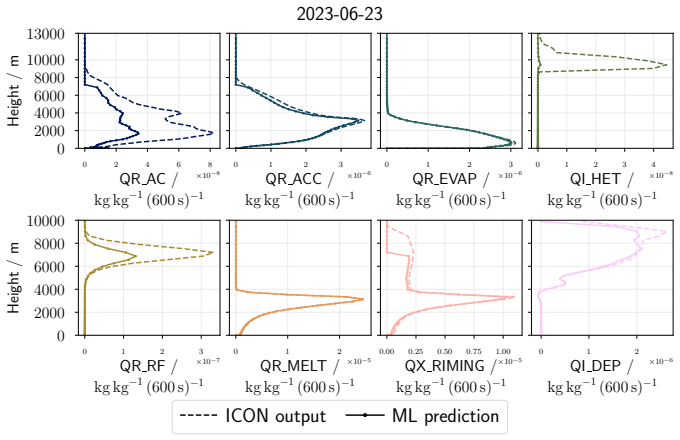
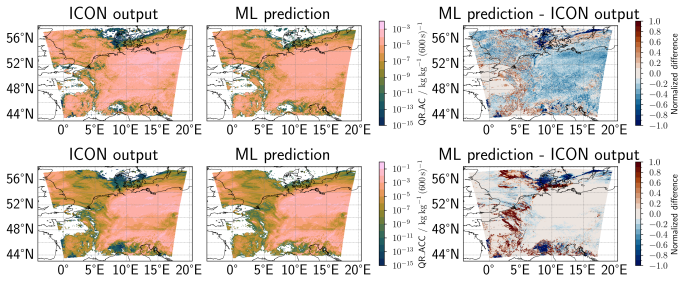
- The trained models transfer to different regional domains and simulation settings not used in training.
- Calibrated prediction intervals provide quantified uncertainty for each recovered rate.
Where Pith is reading between the lines
- Simulations could store fewer variables during runtime and still support detailed post-hoc process analysis.
- The method could extend to other microphysics schemes or global models if similar input variables are available.
- Longer accumulation intervals might require additional input features or hybrid physics-ML constraints to maintain accuracy.
- Output frequency choices in model design could be guided by which processes prove hardest to recover.
Load-bearing premise
Standard cloud variables saved in ICON output contain enough information to reconstruct the missing process rates via supervised learning on high-resolution European simulations.
What would settle it
Applying the trained models to ICON simulations with accumulation intervals longer than 10 minutes and finding that recovery errors exceed those reported for short intervals, or observing failure on a new domain outside the training regions.
Figures
read the original abstract
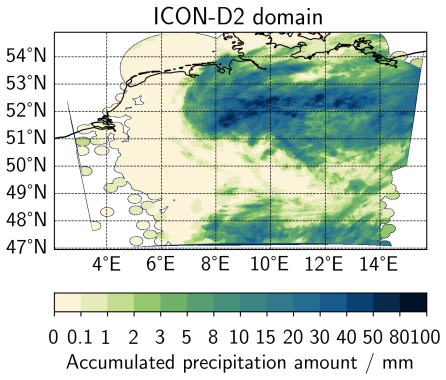
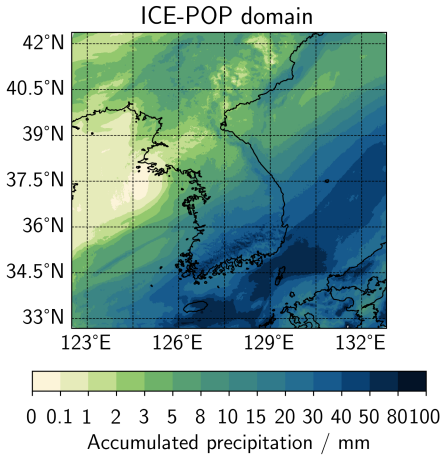
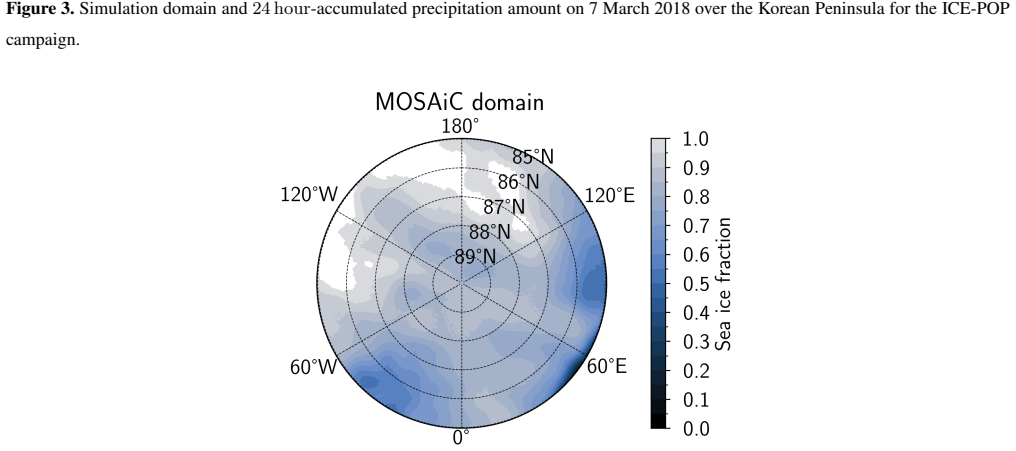
Comprehensive information on cloud microphysical process rates from numerical simulations allows for better understanding of precipitation formation pathways and aerosol-cloud interactions. However, resource limitations often make it impractical to include all microphysical process rates in the model output, limiting in-depth analyses. To address this shortcoming, we introduce PRecover, a data-driven post-processing approach to recover microphysical process rates that are not stored during runtime from standard output of a numerical weather prediction model. In particular, we train random forests, gradient boosting models, and feed-forward neural networks to recover microphysical process rates from a two-moment bulk microphysics scheme in the ICOsahedral Nonhydrostatic (ICON) model. We use cloud variables as input, obtained from high-resolution simulations in a limited-area setup over Europe. Warm-rain and ice microphysical process rates are recovered with a two-step classification-regression approach for both instantaneous and accumulated process rates. As a physics-based baseline, we assess whether process rates can be directly recalculated from stored ICON output variables. Accurate recalculation is possible for process rates such as accretion and self-collection but not for the autoconversion, rain melting or heterogeneous ice nucleation rate. Using PRecover, we successfully recover most of the process rates that are accumulated over output time steps of 10 minutes or less, but the values are increasingly difficult to recover for rates accumulated over longer accumulation intervals. To quantify predictive uncertainty, we provide calibrated prediction intervals through conformalized quantile regression. We demonstrate spatial transferability of the models with two case studies over different regional domains and simulation settings unseen during training.
Editorial analysis
A structured set of objections, weighed in public.
Referee Report
Summary. The paper introduces PRecover 1.0, a supervised ML post-processing method (random forests, gradient boosting, feed-forward NNs) to recover warm-rain and ice microphysical process rates from standard ICON cloud variables. It employs a two-step classification-regression approach for both instantaneous and accumulated rates, compares against a physics-based recalculation baseline, supplies calibrated prediction intervals via conformalized quantile regression, and tests spatial transferability on held-out regional domains. The central result is that most rates are recoverable for accumulation intervals of 10 min or less, with recovery becoming increasingly difficult at longer intervals.
Significance. If the quantitative results hold, the work provides a practical route to extract additional microphysical information from existing NWP output without reruns or expanded storage, directly supporting analyses of precipitation pathways and aerosol-cloud interactions. Explicit strengths include the physics baseline that isolates under-determined rates, the conformal prediction for uncertainty, and the spatial transferability checks on unseen domains.
major comments (2)
- [Results] Results section: the central claim that 'most' process rates are successfully recovered for accumulation intervals ≤10 min is not supported by any reported quantitative metrics (R², MAE, bias, or error distributions) for individual rates or intervals; without these the extent of success cannot be evaluated and the trend with accumulation interval remains qualitative.
- [Physics baseline] Physics baseline subsection: the statement that accurate recalculation is possible for accretion and self-collection but not for autoconversion, rain melting or heterogeneous ice nucleation is presented without the explicit formulas, stored-variable mappings, or error statistics used to reach that conclusion, leaving the baseline comparison load-bearing for the claim that ML adds value.
minor comments (3)
- [Abstract] Abstract: replace the qualitative phrase 'successfully recover most' with at least one concrete performance number (e.g., median R² across rates for the 10-min case) so readers can immediately gauge the result.
- [Methods] Methods: list the exact set of ICON cloud variables used as input features and any normalization or feature-selection steps applied before training.
- [Figures] Figure captions: ensure every panel reports the accumulation interval and the specific process rate shown so that the degradation trend with interval is immediately visible.
Simulated Author's Rebuttal
We thank the referee for the constructive report and positive recommendation. We address each major comment below.
read point-by-point responses
-
Referee: [Results] Results section: the central claim that 'most' process rates are successfully recovered for accumulation intervals ≤10 min is not supported by any reported quantitative metrics (R², MAE, bias, or error distributions) for individual rates or intervals; without these the extent of success cannot be evaluated and the trend with accumulation interval remains qualitative.
Authors: We agree that quantitative metrics are required to substantiate the claim. The revised manuscript will add tables and supplementary figures reporting R², MAE, bias, and full error distributions for every individual process rate at each accumulation interval (1 min, 5 min, 10 min, 30 min, 60 min). These will also quantify the degradation trend with longer intervals. revision: yes
-
Referee: [Physics baseline] Physics baseline subsection: the statement that accurate recalculation is possible for accretion and self-collection but not for autoconversion, rain melting or heterogeneous ice nucleation is presented without the explicit formulas, stored-variable mappings, or error statistics used to reach that conclusion, leaving the baseline comparison load-bearing for the claim that ML adds value.
Authors: We accept that the physics baseline description is insufficiently detailed. The revision will include the explicit diagnostic formulas, the precise mappings from stored ICON two-moment variables to each rate, and the quantitative error statistics (mean relative error, RMSE) that support the distinction between accurately recalculable rates and under-determined ones. revision: yes
Circularity Check
No significant circularity
full rationale
The paper applies supervised ML (random forests, gradient boosting, neural nets) to map standard ICON cloud variables to microphysical process rates, training and validating on independent high-resolution simulations where the target rates are directly available. The central claim is an empirical test of information content in stored fields, supported by physics baselines, held-out regional domains, and conformal prediction intervals. No derivation, equation, or claim reduces to its own inputs by construction; no self-citation chains, ansatzes, or fitted-input renamings appear in the load-bearing steps.
Axiom & Free-Parameter Ledger
free parameters (1)
- ML model hyperparameters
axioms (1)
- domain assumption Saved cloud variables contain sufficient information to reconstruct the target process rates
Reference graph
Works this paper leans on
-
[1]
Angelopoulos, A. N. and Bates, S.: A Gentle Introduction to Conformal Prediction and Distribution-Free Uncertainty Quantification, https://doi.org/10.48550/arXiv.2107.07511,
work page internal anchor Pith review Pith/arXiv arXiv doi:10.48550/arxiv.2107.07511
-
[2]
Theoretical Foundations of Conformal Prediction
Angelopoulos, A. N., Barber, R. F., and Bates, S.: Theoretical Foundations of Conformal Prediction, https://doi.org/10.48550/arXiv.2411.11824,
work page internal anchor Pith review Pith/arXiv arXiv doi:10.48550/arxiv.2411.11824
-
[3]
Baker, A. H., Xu, H., Dennis, J. M., Levy, M. N., Nychka, D., Mickelson, S. A., Edwards, J., Vertenstein, M., and Wegener, A.: A method- ology for evaluating the impact of data compression on climate simulation data, in: Proceedings of the 23rd International Symposium on High-Performance Parallel and Distributed Computing, HPDC ’14, Association for Comput...
-
[4]
Baker, A. H., Hammerling, D. M., Mickelson, S. A., Xu, H., Stolpe, M. B., Naveau, P., Sanderson, B., Ebert-Uphoff, I., Samarasinghe, S., De Simone, F., Carbone, F., Gencarelli, C. N., Dennis, J. M., Kay, J. E., and Lindstrom, P.: Evaluating lossy data compression on climate simulation data within a large ensemble, Geoscientific Model Development, 9, https...
-
[5]
Baldauf, M., Seifert, A., Förstner, J., Majewski, D., Raschendorfer, M., and Reinhardt, T.: Operational Convective-Scale Numerical Weather Prediction with the COSMO Model: Description and Sensitivities, Monthly Weather Review, 139, https://doi.org/10.1175/MWR-D-10- 05013.1,
-
[6]
Barrett, A. I. and Hoose, C.: Microphysical Pathways Active Within Thunderstorms and Their Sensitivity to CCN Concentration and Wind Shear, Journal of Geophysical Research: Atmospheres, 128, https://doi.org/https://doi.org/10.1029/2022JD036965,
-
[7]
Barthlott, C. and Hoose, C.: Aerosol Effects on Clouds and Precipitation over Central Europe in Different Weather Regimes, Journal of the Atmospheric Sciences, 75, https://doi.org/10.1175/JAS-D-18-0110.1,
-
[8]
Barthlott, C., Czajka, B., Kunz, M., Saathoff, H., Zhang, H., Böhmländer, A., Gasch, P., Handwerker, J., Kohler, M., Wilhelm, J., Wieser, A., and Hoose, C.: The impact of aerosols and model grid spacing on a supercell storm from Swabian MOSES 2021, Quarterly Journal of the Royal Meteorological Society, 150, https://doi.org/https://doi.org/10.1002/qj.4687,
-
[9]
Bauer, P., Thorpe, A., and Brunet, G.: The Quiet Revolution of Numerical Weather Prediction, Nature, 525, https://doi.org/10.1038/nature14956,
-
[10]
Bechtold, P., Köhler, M., Jung, T., Doblas-Reyes, F., Leutbecher, M., Rodwell, M. J., Vitart, F., and Balsamo, G.: Advances in simulating atmospheric variability with the ECMWF model: From synoptic to decadal time-scales, Quarterly Journal of the Royal Meteorological Society, 134, https://doi.org/https://doi.org/10.1002/qj.289,
-
[11]
Behrens, G., Beucler, T., Iglesias-Suarez, F., Yu, S., Gentine, P., Pritchard, M., Schwabe, M., and Eyring, V .: Simulating Atmospheric Processes in Earth System Models and Quantifying Uncertainties With Deep Learning Multi-Member and Stochastic Parameteriza- tions, Journal of Advances in Modeling Earth Systems, 17, https://doi.org/https://doi.org/10.1029...
-
[12]
Beucler, T., Ebert-Uphoff, I., Rasp, S., Pritchard, M., and Gentine, P.: Machine Learning for Clouds and Climate, chap. 16, American Geophysical Union (AGU), ISBN 9781119700357, https://doi.org/https://doi.org/10.1002/9781119700357.ch16,
-
[13]
K., Sherwood, S., Stevens, B., and Zhang, X
67 Boucher, O., Randall, D., Artaxo, P., Bretherton, C., Feingold, G., Forster, P., Kerminen, V .-M., Kondo, Y ., Liao, H., Lohmann, U., Rasch, P., Satheesh, S. K., Sherwood, S., Stevens, B., and Zhang, X. Y .: Clouds and Aerosols, Cambridge University Press, https://doi.org/10.1017/CBO9781107415324.016,
-
[14]
Chen, T. and Guestrin, C.: XGBoost: A Scalable Tree Boosting System, in: Proceedings of the 22nd ACM SIGKDD Interna- tional Conference on Knowledge Discovery and Data Mining, KDD ’16, ACM, New York, NY , USA, ISBN 978-1-4503-4232-2, https://doi.org/10.1145/2939672.2939785,
-
[15]
Nature Communications , year = 2020, month = oct, volume =
Crameri, F., Shephard, G. E., and Heron, P. J.: The Misuse of Colour in Science Communication, Nature Communications, 11, https://doi.org/10.1038/s41467-020-19160-7,
-
[16]
de Burgh-Day, C. O. and Leeuwenburg, T.: Machine Learning for Numerical Weather and Climate Modelling: A Review, Geoscientific Model Development, 16, https://doi.org/10.5194/gmd-16-6433-2023,
-
[17]
Deutscher Wetterdienst, 2025: Verbesserte Gewittervorhersage, Deutscher Wetterdienst nimmt neues Wettervorhersagemodell in Betrieb, https://www.dwd.de/DE/presse/pressemitteilungen/DE/2025/20250512_pm_verbesserte_gewittervorhersage_news.html,
2025
-
[18]
Eyring, V ., Collins, W. D., Gentine, P., Barnes, E. A., Barreiro, M., Beucler, T., Bocquet, M., Bretherton, C. S., Christensen, H. M., Dagon, K., Gagne, D. J., Hall, D., Hammerling, D., Hoyer, S., Iglesias-Suarez, F., Lopez-Gomez, I., McGraw, M. C., Meehl, G. A., Molina, M. J., Monteleoni, C., Mueller, J., Pritchard, M. S., Rolnick, D., Runge, J., Stier,...
-
[19]
Gagne II, D. J., Christensen, H. M., Subramanian, A. C., and Monahan, A. H.: Machine Learning for Stochastic Parameter- ization: Generative Adversarial Networks in the Lorenz ’96 Model, Journal of Advances in Modeling Earth Systems, 12, https://doi.org/https://doi.org/10.1029/2019MS001896,
-
[20]
Gehring, J., Oertel, A., Vignon, E., Jullien, N., Besic, N., and Berne, A.: Microphysics and dynamics of snowfall associated with a warm conveyor belt over Korea, Atmospheric Chemistry and Physics, 20, https://doi.org/10.5194/acp-20-7373-2020,
-
[21]
Gehring, J., Ferrone, A., Billault-Roux, A.-C., Besic, N., Ahn, K. D., Lee, G., and Berne, A.: Radar and ground-level measurements of precip- itation collected by the École Polytechnique Fédérale de Lausanne during the International Collaborative Experiments for PyeongChang 2018 Olympic and Paralympic winter games, Earth System Science Data, 13, https://d...
-
[22]
Gentine, P., Eyring, V ., and Beucler, T.: Deep Learning for the Parametrization of Subgrid Processes in Climate Models, ISBN 9781119646143, https://doi.org/10.1002/9781119646181.ch21,
-
[23]
J., Chen, C.-C., Christensen, M
Gettelman, A., Gagne, D. J., Chen, C.-C., Christensen, M. W., Lebo, Z. J., Morrison, H., and Gantos, G.: Machine Learning the Warm Rain Process, Journal of Advances in Modeling Earth Systems, 13, https://doi.org/https://doi.org/10.1029/2020MS002268,
-
[24]
D., Cavallaro, G., Pebesma, E., Marszalek, M., Belenguer-Plomer, M
Gomes, C., Wittmann, I., Robert, D., Jakubik, J., Reichelt, T., Maurogiovanni, S., Vinge, R., Hurst, J., Scheurer, E., Sedona, R., Brunschwiler, T., Kesselheim, S., Batic, M., Stier, P., Wegner, J. D., Cavallaro, G., Pebesma, E., Marszalek, M., Belenguer-Plomer, M. A., Adriko, K., Fraccaro, P., Kienzler, R., Briq, R., Benassou, S., Lazzarini, M., and Albr...
-
[25]
URLhttps://doi.org/10.1088/2632-2153/ae2e7b
68 Gopakumar, V ., Gray, A., Oskarsson, J., Zanisi, L., Giles, D., Kusner, M. J., Pamela, S., and Deisenroth, M. P.: Uncertainty Quantification of Surrogate Models Using Conformal Prediction, Machine Learning: Science and Technology, https://doi.org/10.1088/2632-2153/ae2e7b,
-
[26]
Grayson, K., Thober, S., Lacima-Nadolnik, A., Alsina-Ferrer, I., Lledó, L., Sharifi, E., and Doblas-Reyes, F.: Statistical sum- maries for streamed data from climate simulations: one-pass algorithms, Geoscientific Model Development, 18, 5873–5890, https://doi.org/10.5194/gmd-18-5873-2025,
-
[27]
Grzegorczyk, P., Wobrock, W., Canzi, A., Tridon, F., Lee, G., Kim, K., Sunny Lim, K.-S., and Planche, C.: Implementation of predicted rime mass in the bin microphysics scheme DESCAM 3D: Heavy Snowfall event during ICE-POP 2018, EGUsphere, 2025, 1–34, https://doi.org/10.5194/egusphere-2025-3202,
-
[28]
Hande, L. B., Engler, C., Hoose, C., and Tegen, I.: Seasonal variability of Saharan desert dust and ice nucleating particles over Europe, Atmospheric Chemistry and Physics, 15, https://doi.org/10.5194/acp-15-4389-2015,
-
[29]
Heikenfeld, M., White, B., Labbouz, L., and Stier, P.: Aerosol Effects on Deep Convection: The Propagation of Aerosol Perturbations through Convective Cloud Microphysics, Atmospheric Chemistry and Physics, 19, https://doi.org/10.5194/acp-19-2601-2019,
-
[30]
F., Baehr, J., Schulthess, T., Stocker, T
Hoefler, T., Stevens, B., Prein, A. F., Baehr, J., Schulthess, T., Stocker, T. F., Taylor, J., Klocke, D., Manninen, P., Forster, P. M., Kölling, T., Gruber, N., Anzt, H., Frauen, C., Ziemen, F., Klöwer, M., Kashinath, K., Schär, C., Fuhrer, O., and Lawrence, B. N.: Earth Virtualization Engines: A Technical Perspective, Computing in Science and Engineerin...
-
[31]
Hogan, R. J. and Bozzo, A.: A Flexible and Efficient Radiation Scheme for the ECMWF Model, Journal of Advances in Modeling Earth Systems, 10, https://doi.org/https://doi.org/10.1029/2018MS001364,
-
[32]
Hoose, C. and Möhler, O.: Heterogeneous Ice Nucleation on Atmospheric Aerosols: A Review of Results from Laboratory Experiments, Atmospheric Chemistry and Physics, 12, https://doi.org/10.5194/acp-12-9817-2012,
-
[33]
Huang, L., Fusco, L., Scheidl, F., Zibell, J., Sprenger, M. A., Schemm, S., and Hoefler, T.: Error bounded compression for weather and climate applications, https://arxiv.org/abs/2510.22265,
-
[34]
Jeoung, H., Liu, G., Kim, K., Lee, G., and Seo, E.-K.: Microphysical properties of three types of snow clouds: implication for satellite snowfall retrievals, Atmospheric Chemistry and Physics, 20, https://doi.org/10.5194/acp-20-14491-2020,
-
[35]
Johnson, R. A.: quantile-forest: A Python Package for Quantile Regression Forests, Journal of Open Source Software, 9, 5976, https://doi.org/10.21105/joss.05976,
-
[36]
Juni 2023, https://www.dwd.de/DE/leistungen/besondereereignisse/niederschlag/20230627_starkniederschlaege_tief-lambert.pdf?__ blob=publicationFile&v=1,
arXiv 2023
-
[37]
Kim, K., Bang, W., Chang, E.-C., Tapiador, F. J., Tsai, C.-L., Jung, E., and Lee, G.: Impact of wind pattern and complex topography on snow microphysics during International Collaborative Experiment for PyeongChang 2018 Olympic and Paralympic winter games (ICE-POP 2018), Atmospheric Chemistry and Physics, 21, https://doi.org/10.5194/acp-21-11955-2021,
-
[38]
Kingma, D. P. and Ba, J.: Adam: A Method for Stochastic Optimization, https://arxiv.org/abs/1412.6980,
-
[39]
Kiszler, T., Ori, D., and Schemann, V .: Microphysical Processes Involving the Vapour Phase Dominate in Simulated Low-Level Arctic Clouds, Atmospheric Chemistry and Physics, 24, https://doi.org/10.5194/acp-24-10039-2024,
-
[40]
Klocke, D., Frauen, C., Engels, J. F., Alexeev, D., Redler, R., Schnur, R., Haak, H., Kornblueh, L., Brüggemann, N., Chegini, F., Römmer, M., Hoffmann, L., Griessbach, S., Bode, M., Coles, J., Gila, M., Sawyer, W., Calotoiu, A., Budanaz, Y ., Mazumder, P., Copik, M., Weber, 69 B., Herten, A., Bockelmann, H., Hoefler, T., Hohenegger, C., and Stevens, B.: C...
-
[41]
Knust, R.: Polar Research and Supply Vessel POLARSTERN operated by the Alfred-Wegener-Institute, Journal of large-scale research facilities JLSRF, 3, https://doi.org/10.17815/jlsrf-3-163,
-
[42]
Ko, J.-S., Lim, K.-S. S., Kim, K., Lee, G., Thompson, G., and Berne, A.: Simulated microphysical properties of winter storms from bulk- type microphysics schemes and their evaluation in the Weather Research and Forecasting (v4.1.3) model during the ICE-POP 2018 field campaign, Geoscientific Model Development, 15, https://doi.org/10.5194/gmd-15-4529-2022,
-
[43]
Kärcher, B. and Lohmann, U.: A parameterization of cirrus cloud formation: Homogeneous freezing of supercooled aerosols, Journal of Geophysical Research: Atmospheres, 107, https://doi.org/https://doi.org/10.1029/2001JD000470,
-
[44]
Kärcher, B., Hendricks, J., and Lohmann, U.: Physically based parameterization of cirrus cloud formation for use in global atmospheric models, Journal of Geophysical Research: Atmospheres, 111, https://doi.org/https://doi.org/10.1029/2005JD006219,
-
[45]
Lamb, K. D., Singer, C. E., Loftus, K., Morrison, H., Powell, M., Ko, J., Buch, J., Hu, A. Z., van Lier Walqui, M., and Gentine, P.: Perspectives on Systematic Cloud Microphysics Scheme Development With Machine Learning, Journal of Advances in Modeling Earth Systems, 18, e2025MS005 341, https://doi.org/https://doi.org/10.1029/2025MS005341, e2025MS005341 2...
-
[46]
Leuenberger, D., Koller, M., Fuhrer, O., and Schär, C.: A Generalization of the SLEVE Vertical Coordinate, Monthly Weather Review, 138, https://doi.org/10.1175/2010MWR3307.1,
-
[47]
Lim, K.-S., Chang, E.-C., Sun, R., Kim, K., Tapiador, F., and Lee, G.: Evaluation of Simulated Winter Precipitation Using WRF-ARW during the ICE-POP 2018 Field Campaign, Weather and Forecasting, 35, https://doi.org/10.1175/W AF-D-19-0236.1,
work page doi:10.1175/w 2018
-
[48]
Lott, F. and Miller, M. J.: A new subgrid-scale orographic drag parametrization: Its formulation and testing, Quarterly Journal of the Royal Meteorological Society, 123, https://doi.org/https://doi.org/10.1002/qj.49712353704,
-
[49]
D., Gettelman, A., Ming, Y ., Neelin, J
Maloney, E. D., Gettelman, A., Ming, Y ., Neelin, J. D., Barrie, D., Mariotti, A., Chen, C.-C., Coleman, D. R. B., Kuo, Y .-H., Singh, B., Annamalai, H., Berg, A., Booth, J. F., Camargo, S. J., Dai, A., Gonzalez, A., Hafner, J., Jiang, X., Jing, X., Kim, D., Kumar, A., Moon, Y ., Naud, C. M., Sobel, A. H., Suzuki, K., Wang, F., Wang, J., Wing, A. A., Xu, ...
-
[50]
Matthews, B.: Comparison of the predicted and observed secondary structure of T4 phage lysozyme, Biochimica et Biophysica Acta (BBA) - Protein Structure, 405, https://doi.org/https://doi.org/10.1016/0005-2795(75)90109-9,
-
[51]
Molina, M. J., O’Brien, T. A., Anderson, G., Ashfaq, M., Bennett, K. E., Collins, W. D., Dagon, K., Restrepo, J. M., and Ullrich, P. A.: A Review of Recent and Emerging Machine Learning Applications for Climate Variability and Weather Phenomena, Artificial Intelligence for the Earth Systems, 2, https://doi.org/10.1175/AIES-D-22-0086.1,
-
[52]
Morrison, H., Van Lier-Walqui, M., Fridlind, A. M., Grabowski, W. W., Harrington, J. Y ., Hoose, C., Korolev, A., Kumjian, M. R., Milbrandt, J. A., Pawlowska, H., Posselt, D. J., Prat, O. P., Reimel, K. J., Shima, S.-I., Van Diedenhoven, B., and Xue, L.: Con- fronting the Challenge of Modeling Cloud and Precipitation Microphysics, Journal of Advances in M...
-
[53]
S., Kim, K., Lee, G., and Milbrandt, J
70 Park, S.-Y ., Lim, K.-S. S., Kim, K., Lee, G., and Milbrandt, J. A.: Introducing graupel density prediction in Weather Research and Forecasting (WRF) double-moment 6-class (WDM6) microphysics and evaluation of the modified scheme during the ICE-POP field campaign, Geoscientific Model Development, 17, 7199–7218, https://doi.org/10.5194/gmd-17-7199-2024,
-
[54]
Park, S.-Y ., Lim, K.-S. S., and Jo, J.: Assessing the relative importance of the prognostic hail mixing ratio and predicted grau- pel density on the vertical reflectivity structure in bulk cloud microphysics schemes, Atmospheric Research, 328, 108 440, https://doi.org/https://doi.org/10.1016/j.atmosres.2025.108440,
-
[55]
Paszke, A., Gross, S., Massa, F., Lerer, A., Bradbury, J., Chanan, G., Killeen, T., Lin, Z., Gimelshein, N., Antiga, L., Desmaison, A., Köpf, A., Yang, E., DeVito, Z., Raison, M., Tejani, A., Chilamkurthy, S., Steiner, B., Fang, L., Bai, J., and Chintala, S.: PyTorch: An Imperative Style, High-Performance Deep Learning Library, https://arxiv.org/abs/1912.01703,
Pith/arXiv arXiv 1912
-
[56]
Prill, F., Reinert, D., and Rieger, D.: ICON Tutorial: Working with the ICON Model, https://doi.org/10.5676/DWD_pub/nwv/icon_tutorial2024,
-
[57]
and Klett, J.: Microphysics of Clouds and Precipitation, vol
Pruppacher, H. and Klett, J.: Microphysics of Clouds and Precipitation, vol. 18 ofAtmospheric and Oceanographic Sciences Library, Springer Dodrecht, 2nd edn., https://doi.org/10.1007/978-0-306-48100-0, 2010a. Pruppacher, H. and Klett, J.: Mechanics of the Atmospheric Aerosol, vol. 18 ofAtmospheric and Oceanographic Sciences Library, Springer Dodrecht, 2nd...
-
[58]
Sarauer, E., Schwabe, M., Weiss, P., Lauer, A., Stier, P., and Eyring, V .: A physics-informed machine learning parameterization for cloud microphysics in ICON, Environmental Data Science, 4, https://doi.org/10.1017/eds.2025.10016,
-
[59]
Segal, Y . and Khain, A.: Dependence of droplet concentration on aerosol conditions in different cloud types: Application to droplet concen- tration parameterization of aerosol conditions, Journal of Geophysical Research, 111, https://doi.org/10.1029/2005JD006561,
-
[60]
Segura, H., Pedruzo-Bagazgoitia, X., Weiss, P., Müller, S. K., Rackow, T., Lee, J., Dolores-Tesillos, E., Benedict, I., Aengenheyster, M., Aguridan, R., Arduini, G., Baker, A. J., Bao, J., Bastin, S., Baulenas, E., Becker, T., Beyer, S., Bockelmann, H., Brüggemann, N., Brunner, L., Cheedela, S. K., Das, S., Denissen, J., Dragaud, I., Dziekan, P., Ekblom, ...
-
[61]
Seifert, A. and Beheng, K. D.: A Double-Moment Parameterization for Simulating Autoconversion, Accretion and Selfcollection, Atmo- spheric Research, 59–60, https://doi.org/10.1016/S0169-8095(01)00126-0,
-
[62]
Seifert, A. and Beheng, K. D.: A Two-Moment Cloud Microphysics Parameterization for Mixed-Phase Clouds. Part 1: Model Description, Meteorology and Atmospheric Physics, 92, https://doi.org/10.1007/s00703-005-0112-4,
-
[63]
Seifert, A. and Rasp, S.: Potential and Limitations of Machine Learning for Modeling Warm-Rain Cloud Microphysical Processes, Journal of Advances in Modeling Earth Systems, 12, https://doi.org/10.1029/2020MS002301,
-
[64]
Seifert, A. and Siewert, C.: An ML-Based P3-Like Multimodal Two-Moment Ice Microphysics in the ICON Model, Journal of Advances in Modeling Earth Systems, 16, https://doi.org/10.1029/2023MS004206,
-
[65]
and V ovk, V .: A tutorial on conformal prediction, https://arxiv.org/abs/0706.3188,
Shafer, G. and V ovk, V .: A tutorial on conformal prediction, https://arxiv.org/abs/0706.3188,
-
[66]
Sharma, S. and Greenberg, D. S.: SuperdropNet: A Stable and Accurate Machine Learning Proxy for Droplet-Based Cloud Microphysics, Journal of Advances in Modeling Earth Systems, 17, https://doi.org/https://doi.org/10.1029/2024MS004279,
-
[67]
Shin, J. and Baik, J.-J.: Parameterization of Stochastically Entraining Convection Using Machine Learning Technique, Journal of Advances in Modeling Earth Systems, 14, https://doi.org/https://doi.org/10.1029/2021MS002817,
-
[68]
D., Rex, M., Blomquist, B., Persson, P
Shupe, M. D., Rex, M., Blomquist, B., Persson, P. O. G., Schmale, J., Uttal, T., Althausen, D., Angot, H., Archer, S., Bariteau, L., Beck, I., Bilberry, J., Bucci, S., Buck, C., Boyer, M., Brasseur, Z., Brooks, I. M., Calmer, R., Cassano, J., Castro, V ., Chu, D., Costa, D., Cox, C. J., Creamean, J., Crewell, S., Dahlke, S., Damm, E., de Boer, G., Deckelm...
-
[69]
Stevens, B., Satoh, M., Auger, L., Biercamp, J., Bretherton, C., Chen, X., Düben, P., Judt, F., Khairoutdinov, M., Klocke, D., Kodama, C., Kornblueh, L., Lin, S.-J., Neumann, P., Putman, W., Röber, N., Shibuya, R., Vannière, B., Vidale, P., and Zhou, L.: DY AMOND: the DYnamics of the Atmospheric general circulation Modeled On Non-hydrostatic Domains, Prog...
-
[70]
72 Tiedtke, M.: A Comprehensive Mass Flux Scheme For Cumulus Parameterization In Large-Scale Models, Monthly Weather Review, 117, https://doi.org/10.1175/1520-0493(1989)117<1779:ACMFSF>2.0.CO;2,
-
[71]
V ovk, V ., Gammerman, A., and Shafer, G.: Algorithmic Learning in a Random World, Springer Cham, 2nd edn., https://doi.org/10.1007/978- 3-031-06649-8,
-
[72]
Wallentin, G., Oertel, A., Ickes, L., Achtert, P., Tesche, M., and Hoose, C.: Sensitivities of simulated mixed-phase Arctic multilayer clouds to primary and secondary ice processes, Atmospheric Chemistry and Physics, https://doi.org/10.5194/acp-25-6607-2025,
-
[73]
Wang, P., Yuval, J., and O’Gorman, P. A.: Non-Local Parameterization of Atmospheric Subgrid Processes With Neural Networks, Journal of Advances in Modeling Earth Systems, 14, https://doi.org/10.1029/2022ms002984,
-
[74]
Wieners, K.-H., Rackow, T., Aguridan, R., Becker, T., Beyer, S., Cheedela, S. K., Dreier, N.-A., Engels, J. F., Esch, M., Frauen, C., Klocke, D., Kölling, T., Pedruzo-Bagazgoitia, X., Putrasahan, D., Schnur, R., Sidorenko, D., Stevens, B., and Zimmermann, J.: nextGEMS: Catalogs of full output of the production simulations for ICON and IFS, https://doi.org...
-
[75]
Zängl, G., Reinert, D., Rípodas, P., and Baldauf, M.: The ICON (ICOsahedral Non-hydrostatic) Modelling Framework of DWD and MPI-M: Description of the Non-Hydrostatic Dynamical Core, Quarterly Journal of the Royal Meteorological Society, 141, https://doi.org/10.1002/qj.2378,
discussion (0)
Sign in with ORCID, Apple, or X to comment. Anyone can read and Pith papers without signing in.