REVIEW 3 major objections 5 minor 41 references
Tabular Foundation Models and the Unity of Economic Behaviour
T0 review · 3 major / 5 minor · reviewed 2026-08-10 · deepseek-v4-flash
Pith's one-line read The same estimated utility map predicts behaviour across risk, time, loss, and social domains.
desk verdict Careful, unusually honest empirical paper whose predictive result is credible, but the headline 'unity' claim overstates what the leave-domain-out test can show because target labels stay in the encoder's context. read the letter →
The pith
A machine-rendered reading of the paper's core claim, the machinery that carries it, and where it could break.
The reading
What carries the argument
The load-bearing object is the learned common choice domain $\mathcal{M} \equiv \mathbb{R}^p \times [0,1]$. The frozen encoder maps the decision problem and behavioural context to a state $h_{it} \in \mathbb{R}^{2048}$; each feasible response plan $r$ is normalized to a share $s_t(r) \in [0,1]$; together they form $e_{it}(r) = (h_{it}, s_t(r))$. A single estimated index $g_{it} = \alpha + \beta^\top \Pi h_{it}$, with $\Pi$ a fixed random projection to $k=128$ coordinates, is transformed by the logistic map to $\mu_{it}$, an ideal normalized response. One systematic utility function $V_\theta(e) = -|s_t(r) - \mu_{it}|$ ranks every feasible plan in every domain, and one common type I extreme value shock law converts those utilities into stochastic choice via the conditional logit formula. The work this machinery does: it separates representation (learned by the frozen model) from valuation (estimated once and shared), so that cross-domain transfer can be tested by hiding a whole domain and asking whether the same $V$ and $\theta$ predict it.
What would settle it
Run the leave-domain-out exercise a second time with every target-domain label also removed from the encoder's context table; if the common-index accuracy falls to the task-median level once those 100 in-context labels are gone, the claim that one estimated utility map transfers across domains would be refuted. A weaker but still informative check is to vary the fixed projection seed and compare the 85 percent retention across many seeds.
Extended reading notes
Core claim
The central discovery is that the same valuation direction learned from seven economic domains predicts the eighth. Concretely: a fixed random projection and one coefficient vector map each of TabFM's 2,048-dimensional contextual states into a scalar index $\mu_{it}$; each feasible switch plan is valued by its absolute distance from that index, $V(e) = -|s - \mu|$; and independent type I extreme value shocks turn those valuations into conditional-logit choice probabilities. The same index, utility, and shock law are applied to all 26 multiple-price-list tasks. With one index and one utility rule, the model places 65.83 percent of choices within two rows versus 40.42 percent for the task population median; when every outcome from the target domain is excluded while fitting the index, accuracy remains 63.16 percent. The same estimated map also reproduces the ordering of the 66 correlations among 12 Econographics constructs (rank alignment 0.939, and 0.935 in the leave-domain-out fit). The paper's claim is therefore that random utility over a learned common representation is not merely a formal unification but an economically meaningful compression that transfers across domains.
Load-bearing premise
The cross-domain transfer claim depends on the assumption that the 100 labelled target-task rows still present in the frozen encoder's context table do not by themselves let the model infer the hidden domain's local response mapping; if they do, the common utility index is a convenient summarizer rather than the carrier of transfer.
Editorial extensions
If this is right
- If the central claim is right, a single estimated utility map—not 26 domain-specific decoders—captures most of the predictable structure in this 26-task behavioural battery.
- The leave-domain-out result implies that the valuation rule transfers to domains it never saw in training, which is the minimal form of portability needed for out-of-sample welfare or menu evaluation.
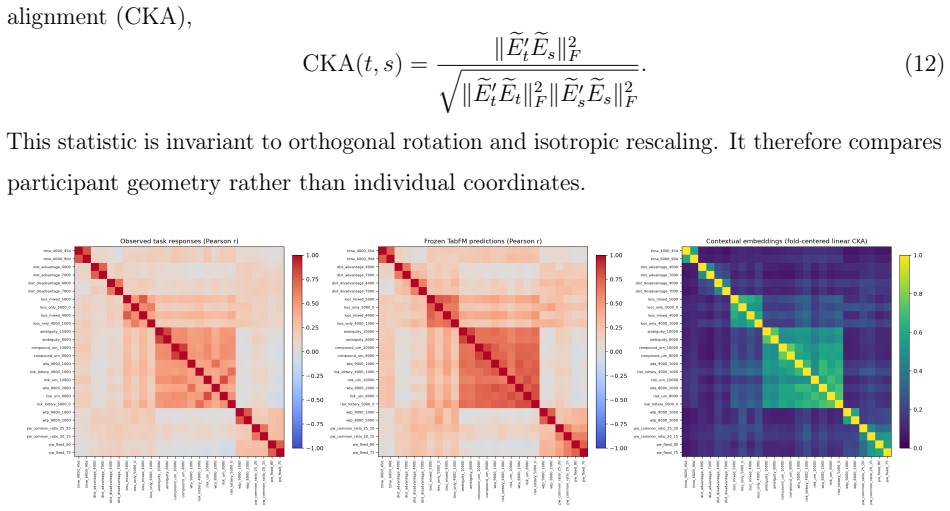
- The 0.939 rank alignment with the observed Econographics correlation matrix implies that the coordination of preferences across risk, time, loss, and social domains is substantially mediated by one systematic utility component, with the random shock component playing a smaller role.
- The prediction ordering generalizes to other behavioural batteries: the same pattern appears in the 37-task Self-Regulation Ontology replication.
- A universal structural model would require replacing the estimated index with an in-context valuation learner that updates $\theta$ from context without refitting, which the paper identifies as the remaining gap.
Reading between the lines
- One testable extension the paper leaves implicit: the same common-index compression could be applied to demographic and cognitive features alone, and the drop in correlation-geometry alignment would quantify how much of the 'unity' is behavioural as opposed to demographic.
- If projection seed and dimension sensitivity were checked, the ridge-plus-projection step could become a minimal structural summary of the foundation model's economic content; high sensitivity would mean the common index is not yet a stable economic object.
- The covariance decomposition shows that residual and cross covariances are not negligible, so a fully orthogonal common-utility explanation would require a richer shock structure; that is a natural next model comparison.
- Because the zero-label results show TabFM and a locally fitted trees model essentially tied, the economic value of the foundation representation may lie in portability across tasks rather than accuracy within a single task; a test of this would compare the common index built on TabFM states versus one built on a classical learned representation.
Editorial analysis
A structured set of objections, weighed in public.
Referee Report
Summary. The paper proposes a unified random-utility model built on a frozen tabular foundation model (TabFM). A frozen encoder maps each decision maker's profile, visible choices, and labelled context into a common learned state; a single linear index and one absolute-distance utility function over normalized switch plans are then applied to every task in a 26-task multiple-price-list battery from Chapman et al. (2023). The paper reports three main results: (i) the frozen model predicts a held-out economic domain better than a population median, and the gain disappears when visible choices are shuffled across decision makers; (ii) one common utility index, estimated without target-domain outcomes, retains most of the foundation model's error reduction and reproduces the ordering of the Chapman correlation matrix; and (iii) internal representation geometry separates economic domains in a way consistent with a unified predictive model. The design includes an outcome-blind SHA-256 domain assignment, a locked confirmatory protocol, participant cross-fits, bootstrap intervals, and destructive interventions. The paper is careful to distinguish predictive transfer from zero-shot utility learning, but the main transfer claim is weakened by the fact that exact-target labels remain in the context table used to compute the frozen representation.
Significance. If the central claim survives scrutiny, the paper is significant: it offers a concrete bridge between large pretrained tabular models and classical random utility, and it proposes an operational test of whether one valuation map can serve multiple economic domains. The confirmatory design is unusually strong for this literature: the protocol was locked before test outcomes were loaded, the domain assignment is outcome-blind, the comparisons include matched nonlinear learners, and the paper openly discloses the limits of the zero-label exercises. The replication culture is exemplary, including hashed checkpoints, participant-level bootstrap inference, and a Lean-verified formal statement of the architecture. The main weakness is interpretive: the leave-domain-out test does not isolate cross-domain valuation transfer because target-domain labels remain in the context table, and the single random projection used for the common utility index is not subjected to sensitivity analysis. These issues are load-bearing for the paper's headline claim, but they are fixable by reframing or additional analyses.
major comments (3)
- [Section 5.2, Table 4, Eq. (3), Section 3.2] The leave-domain-out test does not isolate cross-domain valuation transfer: the context table D_t used to compute the representation h_it in Eq. (3) still contains 100 labelled target-task rows, and only the ridge coefficients in Eq. (10) are estimated without target-domain outcomes. The paper acknowledges this in the text and in Table 7 notes, but the abstract and conclusion assert that the model 'predicts domains excluded from utility estimation' and that 'one estimated utility map unifies valuation across domains.' The reported 78% retention of the normalized-error improvement and 0.935 rank alignment are therefore consistent with a weaker reading in which the common index is a calibrated projection of a representation already conditioned on exact-target examples. Please either add a genuinely label-free context condition to the main analysis, or revise the central claim to state that the valuation map transfers conditional on target-task context labels and treat the zero-label exercises as exploratory. The exploratory Table 9, where TabFM is statistically tied with Extra Trees in the domain holdout, should be discussed in the main text because it bears directly on this distinction.
- [Section 3.1, Section 3.2, Eq. (4), Eq. (10)] The common utility index is estimated on a single random Gaussian projection Pi with k=128 and a fixed seed (20,260,806). No sensitivity analysis is reported for the projection seed or dimension. Because the index is linear in the projected state, the substantive claims about one utility map rest on the assumption that this particular projection preserves the utility-relevant geometry of the 2,048-dimensional representation. Please report results across several projections/dimensions or replace the random projection with a deterministic reduction (e.g., PCA) to demonstrate that the headline numbers are not an artifact of one draw.
- [Section 5.3, Table 12, Appendix D.3] The correlation-reproduction exercise uses task-masked states, so other tasks in the same domain remain visible in the representation used to construct the utility forecasts. The paper notes this in Appendix D.3, but Section 5.3 presents the 0.939 rank alignment as evidence that 'one utility map reproduces joint behaviour' without carrying the caveat into the main statement. Since the same-domain choices could plausibly supply much of the dependence structure, please either add a whole-domain-masked extraction for the correlation exercise or qualify the Section 5.3 claim to indicate that the representation has access to same-domain choices.
minor comments (5)
- [Abstract] The abstract says 'The foundation model improves on the training-sample median'; this should specify that the held-out whole-domain comparison in Section 5.1 is against a training-sample median, whereas the complete-sample comparisons in Section 5.4 use a context median from the opposite participant fold.
- [Section 6, Figure 3 caption] The caption refers to 'the same hierarchical task order' but does not define what that order is; please state the ordering rule or refer to the appendix where it is defined.
- [Eq. (9), Section 3.1] The statement that 'the two cross terms vanish by iterated expectations' should spell out the conditioning set explicitly; the decomposition is only valid if the expectations are conditioned on the appropriate information set (e.g., H_i and the task characteristics).
- [Section 5.6 and Appendix C.4] The complete-sample whole-domain mask shows that TabFM improves within-two accuracy in only six of eight domains, with time discounting and distributional choices favouring the median under that loss. The main text reports the aggregate advantage but not these negative cells; they should be mentioned in Section 5.6 rather than only in the appendix.
- [Table 4 note] The note says 'validation and test outcomes are not loaded' for the 20,800 train-only predictions; this is clear, but the row label 'Leave one domain out utility index' could be clarified to indicate that only the valuation coefficients, not the representation, exclude target-domain outcomes.
Circularity Check
No circular derivation: the predictive gains are tested against external baselines; the only reservations are a disclosed confound in the domain-exclusion wording and one non-load-bearing self-citation.
full rationale
The core claims are not equivalent to their inputs by construction. TabFM's improvement is compared with the population median, shuffled decision-maker, shuffled-label, CatBoost, Extra Trees, and ridge baselines, so the primary predictive gain is externally anchored. The hybrid utility index is fit on training participants and evaluated out of sample by participant fold; retaining 85 percent of TabFM's normalized-error improvement is a supervised compression result rather than an identity. The leave-domain-out row is the closest thing to a concern: the paper's own Table 4 note states, 'The frozen representation retains the 100 target task context labels used in the main design,' and Appendix B.1/Table 7 adds that 'only estimation of the valuation coefficients excludes target-domain outcomes.' Thus the phrase in Section 5.2, 'The same valuation direction learned from the other seven domains therefore predicts the eighth,' overstates isolation, because Eq. (3) builds hit from a context table still containing 100 labelled target-task rows; exact-target labels can inform the frozen encoder, and the common ridge coefficients may be summarizing a label-conditioned representation rather than being the sole carrier of transfer. This is a disclosed confound, not a construction-level reduction: the target participant's own hidden outcomes are excluded, the index coefficients are genuinely estimated outside the target domain, and the external baselines still bind. There is one author self-citation (Aguiar and Kashaev 2021) in the literature review (Section F.3), but it is not load-bearing and does not justify any model choice. The Lean verification covers only algebraic properties of the architecture and is not used to claim empirical content. Overall, the derivation chain is self-contained against external benchmarks; no fitted parameter is renamed as a prediction and no load-bearing claim reduces to its own inputs.
Assumptions & free parameters
free parameters (5)
- Common utility coefficients (alpha, beta) =
estimated by ridge regression, values in replication package
- Ridge regularization lambda =
selected by participant-grouped four-fold CV from {0.01, 0.1, 1, 10, 100, 1000}
- Random projection matrix Pi =
drawn from N(0,1/k), k=128, seed 20,260,806
- Utility scale kappa =
1
- Shrinkage coefficients for the held-out forecast =
selected on validation, not reported
assumptions (5)
- domain assumption TabFM's undisclosed pretraining distribution P_pre transfers to human economic choice data.
- domain assumption The attention mask prevents a query's own target outcome from entering its prediction.
- ad hoc to paper One absolute-distance utility V_theta(e) = -|s - mu| with type I extreme value shocks is an adequate common valuation and shock law.
- ad hoc to paper A linear ridge map on a random Gaussian projection captures the utility-relevant variation of the learned state.
- standard math Linear CKA on projected states measures behavioural task nearness.
invented entities (2)
-
Learned common choice domain M = R^p x [0,1]
-
Ideal normalized response plan mu_it
Cite this review
Pith. "Pith review of Tabular Foundation Models and the Unity of Economic Behaviour." pith.science (2026). https://pith.science/paper/QJXHIUMM
@misc{pith2026260806842,
  author       = {Pith},
  title        = {Pith review of: Tabular Foundation Models and the Unity of Economic Behaviour},
  year         = {2026},
  howpublished = {\url{https://pith.science/paper/QJXHIUMM}},
  note         = {Machine review of arXiv:2608.06842}
}
read the original abstract
Economics uses different behavioural models for risk, time, losses, valuation, and social choice. I study a unified choice experiment in which the same decision makers face all these domains. I hide a decision maker's choices in one domain and ask a frozen tabular foundation model to recover them from that decision maker's choices elsewhere and labelled choices by other participants. The foundation model improves on the training-sample median, and the gain disappears when visible choices are shuffled across decision makers. I then estimate one random-utility model over the foundation model's learned representation. This structural model applies the same utility function in every domain, retains most of the foundation model's reduction in prediction error, predicts domains excluded from utility estimation, and reproduces how behavioural measures co-move across people. The resulting model separates three objects: a learned common choice domain, one systematic utility function on that domain, and one random component that generates stochastic choice on observed menus.
Figures


Figures from the paper (1 more)

Reference graph
Works this paper leans on
-
[1]
Journal of Political Economy Microeconomics , year =
Chapman, Jonathan and Dean, Mark and Ortoleva, Pietro and Snowberg, Erik and Camerer, Colin , title =. Journal of Political Economy Microeconomics , year =. doi:10.1086/723044 , note =
-
[2]
Lucas, Robert E. , title =. Carnegie-Rochester Conference Series on Public Policy , year =. doi:10.1016/S0167-2231(76)80003-6 , note =
-
[3]
Chapman, Jonathan and Dean, Mark and Ortoleva, Pietro and Snowberg, Erik and Camerer, Colin , title =. 2022 , version =. doi:10.7910/DVN/IGVOFO , note =
-
[4]
Kong, Weihao and Das, Abhimanyu , title =. 2026 , howpublished =
work page 2026
-
[5]
2026 , howpublished =
2026
-
[6]
Hollmann, Noah and Müller, Samuel and Purucker, Lennart and Krishnakumar, Arjun and Körfer, Max and Hoo, Shi Bin and Schirrmeister, Robin Tibor and Hutter, Frank , title =. Nature , year =. doi:10.1038/s41586-024-08328-6 , note =
-
[7]
Advances in Neural Information Processing Systems 38 , year =
Erickson, Nick and Purucker, Lennart and Tschalzev, Andrej and Holzm. Advances in Neural Information Processing Systems 38 , year =
-
[8]
Geurts, Pierre and Ernst, Damien and Wehenkel, Louis , title =. Machine Learning , year =. doi:10.1007/s10994-006-6226-1 , note =
Show all 41 references
-
[9]
Advances in Neural Information Processing Systems 31 , year =
Prokhorenkova, Liudmila and Gusev, Gleb and Vorobev, Aleksandr and Dorogush, Anna Veronika and Gulin, Andrey , title =. Advances in Neural Information Processing Systems 31 , year =
-
[10]
Journal of Economic Perspectives , year =
Mullainathan, Sendhil and Spiess, Jann , title =. Journal of Economic Perspectives , year =. doi:10.1257/jep.31.2.87 , note =
-
[11]
Journal of Economic Literature , year =
Liang, Annie , title =. Journal of Economic Literature , year =. doi:10.1257/jel.20261783 , note =
-
[12]
Frontiers in Econometrics , editor =
McFadden, Daniel , title =. Frontiers in Econometrics , editor =. 1974 , pages =
1974
-
[13]
, title =
Train, Kenneth E. , title =. 2009 , doi =
2009
-
[14]
Journal of Political Economy , year =
Gillen, Ben and Snowberg, Erik and Yariv, Leeat , title =. Journal of Political Economy , year =. doi:10.1086/701681 , note =
-
[15]
Proceedings of the 36th International Conference on Machine Learning , series =
Kornblith, Simon and Norouzi, Mohammad and Lee, Honglak and Hinton, Geoffrey , title =. Proceedings of the 36th International Conference on Machine Learning , series =. 2019 , publisher =
2019
-
[16]
, title =
Gneiting, Tilmann and Raftery, Adrian E. , title =. Journal of the American Statistical Association , year =. doi:10.1198/016214506000001437 , note =
-
[17]
, title =
Scheuerer, Michael and Hamill, Thomas M. , title =. Monthly Weather Review , year =. doi:10.1175/MWR-D-14-00269.1 , note =
-
[18]
Quarterly Journal of Economics , year =
Falk, Armin and Becker, Anke and Dohmen, Thomas and Enke, Benjamin and Huffman, David and Sunde, Uwe , title =. Quarterly Journal of Economics , year =. doi:10.1093/qje/qjy013 , note =
-
[19]
Management Science , year =
Falk, Armin and Becker, Anke and Dohmen, Thomas and Huffman, David and Sunde, Uwe , title =. Management Science , year =. doi:10.1287/mnsc.2022.4455 , note =
2022
- [20]
-
[21]
arXiv preprint arXiv:2601.08181 , year =
Gupta, Aviral and Sethi, Armaan and Kumar, Dhruv , title =. arXiv preprint arXiv:2601.08181 , year =. doi:10.48550/arXiv.2601.08181 , note =
- [22]
-
[23]
Advances in Neural Information Processing Systems 37 , year =
Feuer, Benjamin and Schirrmeister, Robin Tibor and Cherepanova, Valeriia and Hegde, Chinmay and Hutter, Frank and Goldblum, Micah and Cohen, Niv and White, Colin , title =. Advances in Neural Information Processing Systems 37 , year =. doi:10.52202/079017-2654 , note =
-
[24]
and Bissett, Patrick G
Eisenberg, Ian W. and Bissett, Patrick G. and Enkavi, A. Zeynep and Li, Jamie and MacKinnon, David P. and Marsch, Lisa A. and Poldrack, Russell A. , title =. Nature Communications , year =. doi:10.1038/s41467-019-10301-1 , note =
-
[25]
, title =
Apesteguia, Jose and Ballester, Miguel A. , title =. 2025 , note =
2025
-
[26]
and Lu, Jay , title =
Apesteguia, Jose and Ballester, Miguel A. and Lu, Jay , title =. Econometrica , year =. doi:10.3982/ECTA14230 , note =
-
[27]
Econometrica , year =
Gul, Faruk and Pesendorfer, Wolfgang , title =. Econometrica , year =. doi:10.1111/j.1468-0262.2006.00651.x , note =
2006
-
[28]
Econometrica , year =
Fudenberg, Drew and Iijima, Ryota and Strzalecki, Tomasz , title =. Econometrica , year =. doi:10.3982/ECTA12660 , note =
-
[29]
Econometrica , year =
Frick, Mira and Iijima, Ryota and Strzalecki, Tomasz , title =. Econometrica , year =. doi:10.3982/ECTA15456 , note =
-
[30]
Econometrica , year =
Kitamura, Yuichi and Stoye, J\"org , title =. Econometrica , year =. doi:10.3982/ECTA14478 , note =
-
[31]
American Economic Review , year =
Kono, Haruki and Saito, Kota and Sandroni, Alec , title =. American Economic Review , year =. doi:10.1257/aer.20240712 , note =
-
[32]
, title =
Dardanoni, Valentino and Manzini, Paola and Mariotti, Marco and Tyson, Christopher J. , title =. Econometrica , year =. doi:10.3982/ECTA16382 , note =
-
[33]
American Economic Review , year =
Caplin, Andrew and Dean, Mark , title =. American Economic Review , year =. doi:10.1257/aer.20140117 , note =
-
[34]
and Ma, Xinwei and Masatlioglu, Yusufcan and Suleymanov, Elchin , title =
Cattaneo, Matias D. and Ma, Xinwei and Masatlioglu, Yusufcan and Suleymanov, Elchin , title =. Journal of Political Economy , year =. doi:10.1086/706861 , note =
-
[35]
American Economic Review , year =
Barseghyan, Levon and Molinari, Francesca and Thirkettle, Matthew , title =. American Economic Review , year =. doi:10.1257/aer.20190253 , note =
-
[36]
American Economic Review , year =
Cerreia-Vioglio, Simone and Dillenberger, David and Ortoleva, Pietro and Riella, Gil , title =. American Economic Review , year =. doi:10.1257/aer.20180688 , note =
-
[37]
Time Will Tell: Recovering Preferences When Choices Are Noisy , journal =
Al. Time Will Tell: Recovering Preferences When Choices Are Noisy , journal =. 2021 , volume =. doi:10.1086/713732 , note =
2021 doi
-
[38]
and Juster, F
Barsky, Robert B. and Juster, F. Thomas and Kimball, Miles S. and Shapiro, Matthew D. , title =. Quarterly Journal of Economics , year =. doi:10.1162/003355397555280 , note =
-
[39]
American Economic Review , year =
Choi, Syngjoo and Kariv, Shachar and M\"uller, Wieland and Silverman, Dan , title =. American Economic Review , year =. doi:10.1257/aer.104.6.1518 , note =
-
[40]
and Kashaev, Nail , title =
Aguiar, Victor H. and Kashaev, Nail , title =. Review of Economic Studies , year =. doi:10.1093/restud/rdaa067 , note =
-
[41]
American Economic Review , year =
Fudenberg, Drew and Liang, Annie , title =. American Economic Review , year =. doi:10.1257/aer.20180654 , note =
Reviewed August 10, 2026 · model on record in the stance chip above.
Discussion (0). Continue with ORCID to comment.