REVIEW 4 major objections 6 minor 51 references
Impact of micro-scale stochastic Zonal Flows on the macro-scale V-RMHD modes
T0 review · 4 major / 6 minor · reviewed 2026-08-14 · deepseek-v4-flash
Pith's one-line read This paper claims that micro-scale stochastic zonal flows, modelled as white-noise poloidal-flow perturbations, can stabilise the (2,1) tearing mode and the (1,1) kink mode even at Prandtl number Pr = 1, where the modes are linearly…
desk verdict A plausible but under-supported numerical case that grid-scale stochastic poloidal flow noise can damp tearing and kink modes; the mechanism may be enhanced dissipation rather than zonal-flow shearing. read the letter →
The pith
A machine-rendered reading of the paper's core claim, the machinery that carries it, and where it could break.
The reading
What carries the argument
The central object is the stochastic zonal-flow vorticity $W_S = \frac{1}{r}\frac{d}{dr}(r\,\delta v_S)$, with $\delta v_S = M_S v_A X(\rho,t)$, where $X$ is white Gaussian noise of zero mean and unit variance, updated every $2\,\mu\mathrm{s}$ at each radial grid point. In the semi-stochastic model the amplitude is multiplied by $\langle \tilde{j}^2 + \tilde{W}^2\rangle$, the flux-surface average of the fluctuation energy, coupling the flow to the mode. This Langevin-type forcing enters the vorticity equation of the paper's global visco-resistive MHD model, and it is this stochastic advective term that redistributes free energy of the equilibrium current into high-$k$ vorticity, allowing viscous dissipation to saturate the mode.
What would settle it
Run the same visco-resistive MHD model with the stochastic forcing replaced by zonal flows generated self-consistently from drift-wave turbulence, at the same parameters (S = $10^{6}$, Pr = 1, M_S near $10^{{-2}}$); if the (2,1) mode remains linearly unstable and grows without saturation, the stabilisation is an artefact of the white-noise idealisation. Alternatively, in an experiment, measure poloidal flow fluctuations of amplitude about 5 x $10^{{-3}}$ v_A and check whether the (2,1) magnetic-island amplitude decreases as the model predicts.
Extended reading notes
Core claim
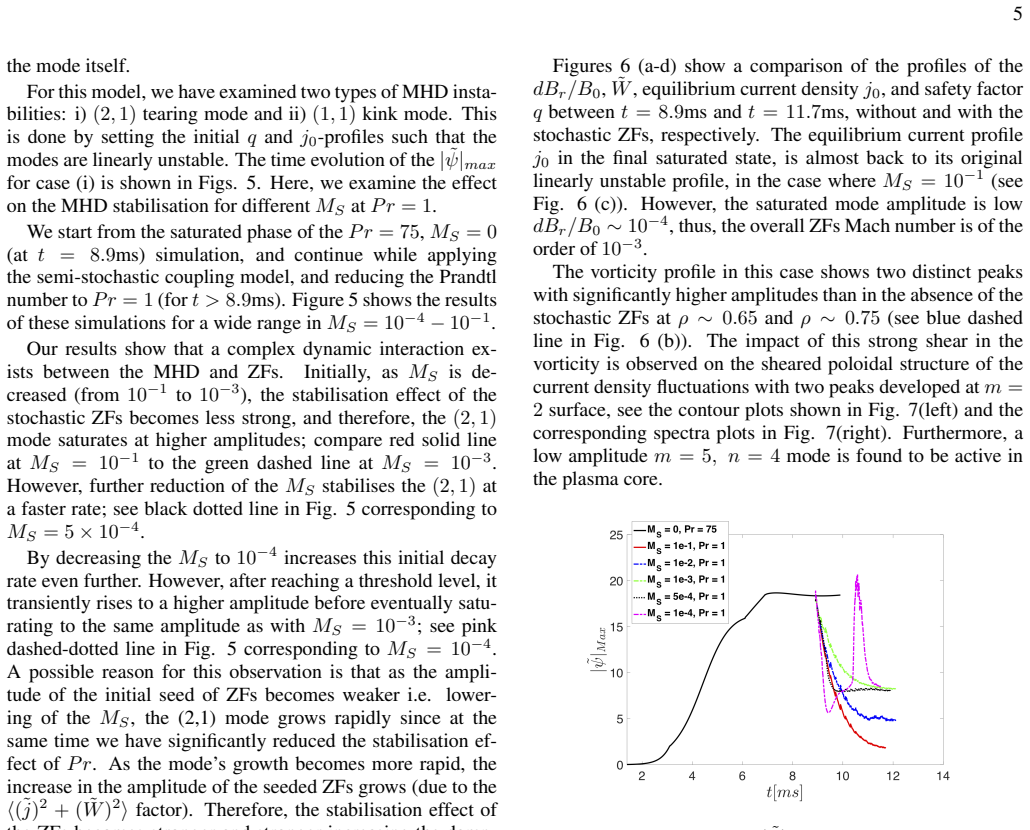
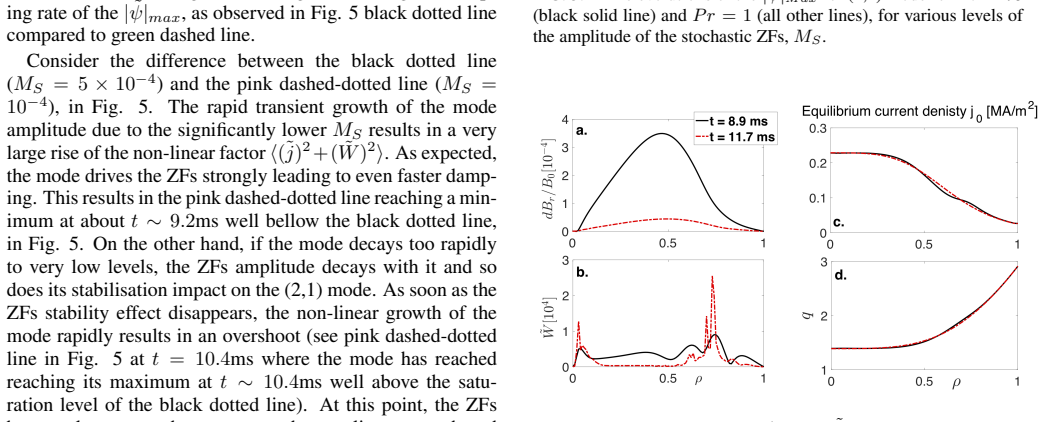
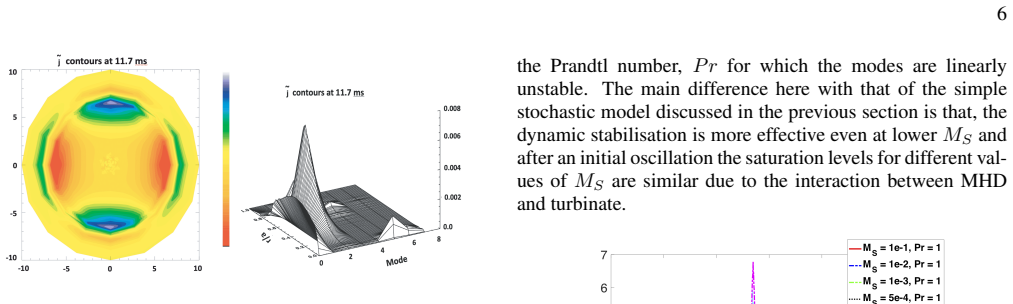
The central claim is that small-amplitude stochastic poloidal flows can act as a dynamic stabiliser for macro-scale resistive MHD modes. In the passive model, flow noise with M_S roughly 5 x $10^{{-3}}$ suppresses the (2,1) mode at Pr greater than or equal to 2, and increasing M_S to about 1.5 x $10^{{-2}}$ keeps it saturated even at Pr close to 1; the stabilising effect weakens at high Pr because viscosity damps the small-scale fluctuations. In the semi-stochastic model, where the zonal-flow amplitude is proportional to the flux-surface-averaged fluctuation energy, both the (2,1) and (1,1) modes are stabilised at low Pr and reach a common saturated level; small initial seeds lead to transient growth followed by rapid decay, which the authors interpret as mode-driven growth of the zonal flows through a direct cascade. The proposed mechanism transfers free energy of the equilibrium current density into high-wavenumber vorticity, where viscosity dissipates it, and leaves the equilibrium current profile close to its original linearly unstable form.
Load-bearing premise
The load-bearing premise is that real turbulence-driven zonal flows can be represented as white Gaussian noise in the poloidal flow with a fixed amplitude and a prescribed 2-microsecond correlation time; if the physical zonal-flow spectrum has different amplitude, correlation, or radial coherence, the stabilisation reported here may not survive.
Editorial extensions
If this is right
- At Pr > 2, stochastic poloidal-flow noise of amplitude $M_S \approx 5\times10^{-3}$ (in units of $v_A$) is sufficient to keep a linearly unstable (2,1) tearing mode at a low saturated amplitude.
- At very low viscosity ($1 < Pr < 2$), stabilisation requires a larger amplitude, rising to $M_S \approx 1.5\times10^{-2}$ at $Pr \approx 1$; lowering viscosity while keeping $M_S$ fixed actually lowers the saturation amplitude for $Pr > 4$.
- In the semi-stochastic model, the mode itself drives the zonal-flow amplitude through the $\langle \tilde{j}^2 + \tilde{W}^2\rangle$ factor, so even small seeds ($M_S$ down to $10^{-4}$ for (2,1) and $5\times10^{-5}$ for (1,1)) can stabilise the modes, after an initial transient overshoot.
- The stabilisation mechanism is a transfer of equilibrium current free energy into high-wavenumber vorticity, where viscosity dissipates it, leaving $j_0$ close to its original linearly unstable profile.
- The authors suggest this indicates a possible route to MHD control via small-scale poloidal-flow perturbations, for instance through radio-frequency heating, which is known to affect sawteeth.
Reading between the lines
- If the white-noise idealisation captures the essential shearing effect, the same stabilisation should appear in codes that resolve the turbulent cascade explicitly, but with a modified effective amplitude and correlation time; testing this would separate the physical mechanism from the noise model.
- The inverse relation between required $M_S$ and $Pr$ below $Pr \approx 2$ suggests an optimal viscosity window for zonal-flow-mediated stabilisation; scanning $Pr$ more finely could reveal a threshold below which the effect disappears entirely at any $M_S$.
- The semi-stochastic model's predator-prey transient leaves open a Hopf-bifurcation regime in which (1,1) or (2,1) amplitudes oscillate periodically rather than saturating; the paper notes this possibility is not ruled out and it could be searched for numerically.
- Because the stabilisation relies on small-scale poloidal flow rather than on changing resistivity, it suggests a control strategy decoupled from current-profile control: externally driven flow noise near rational surfaces might be tested as a disruption-avoidance actuator.
Signed reviews
Editorial analysis
A structured set of objections, weighed in public.
Referee Report
Summary. This paper proposes a stochastic representation of micro-scale, turbulence-driven zonal flows (ZFs) and studies its impact on macroscopic (2,1) tearing and (1,1) kink modes in the visco-resistive MHD code CUTIE. In the passive model the ZF velocity is δv_S = M_S X(ρ,t) v_A with X a white Gaussian noise updated at each radial grid point on a time scale δt = 2 μs, independent of the mode amplitude; in the semi-stochastic model the amplitude is multiplied by the flux-surface-averaged fluctuation energy ⟨(j̃)²+(W̃)²⟩, so that the ZFs are driven by the mode itself. The central result is that, for sufficiently large M_S (≈5×10⁻³ for Pr > 2), the stochastic ZFs stabilize the (2,1) mode even at low Prandtl number where the mode is linearly unstable, and that the semi-stochastic model stabilizes both the (2,1) and (1,1) modes with a transient predator-prey-like interplay. The authors interpret the stabilization as a direct cascade of mode free energy to small scales where viscosity dissipates it, and suggest RF-generated small-scale perturbations as a possible actuator in future devices.
Significance. If the reported effect is robust, the paper identifies a plausible mechanism by which small-scale turbulence-generated flows could suppress two of the most damaging macroscopic instabilities in tokamaks, which would be of practical interest for disruption avoidance and sawtooth control. The study has genuine strengths: the parameter scan in (Pr, M_S) is systematic; the passive model is a clean, non-circular probe in which the ZF amplitude is independent of the mode amplitude; the paper is candid about its limitations (constant ν and η, acknowledged in Sec. V); and the model makes a concrete, falsifiable prediction (the stability boundary in Fig. 4, with M_S ≈ 5×10⁻³ for Pr > 2). The significance is, however, conditional: the stochastic forcing is prescribed rather than derived from turbulence, and its grid-scale character means the quantitative claims must first survive a resolution study and an ensemble analysis.
major comments (4)
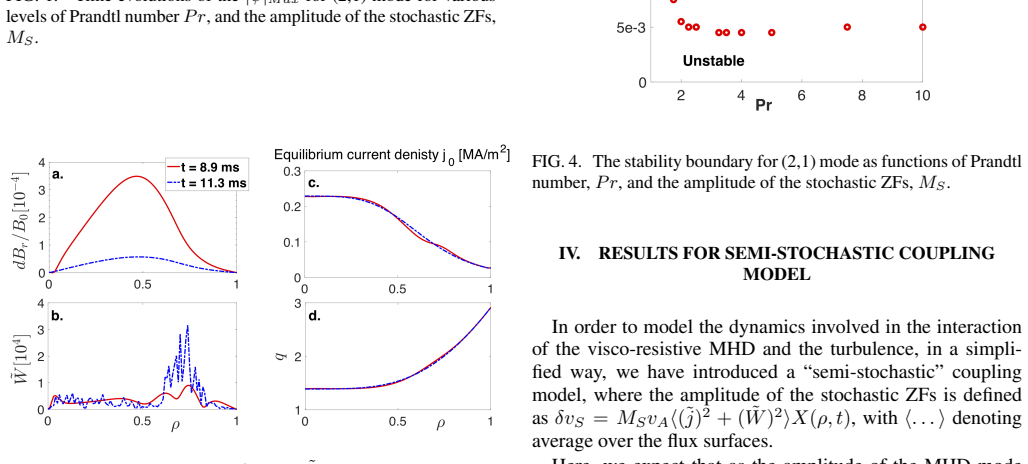
- [Section II (Eq. 1)] The stochastic forcing in Eq. (1) is not a physically defined zonal flow: X(ρ,t) is white Gaussian noise "updated at each radial grid point," no radial correlation length δρ is ever assigned a value, and the forcing enters through dW_S/dr, i.e., discrete derivatives of grid-scale noise. The effective forcing amplitude therefore scales with the grid spacing (with 101 radial points, Δr ≈ 0.01a), and since no resolution study is reported, the stabilization in Figs. 1 and 4 cannot be distinguished from grid-scale numerical dissipation acting as an effective turbulent viscosity. A resolution scan (e.g., 51, 101, and 201 radial points) together with a specification of δρ and a convergence check are required before the M_S ≈ 5×10⁻³ threshold can be claimed as a physical result.
- [Section III (Figs. 1 and 4)] The (Pr, M_S) stability boundary in Fig. 4 is constructed from single stochastic realizations; because the model is explicitly a Langevin-type system, "stabilized" versus "blow-up" is a stochastic outcome, and a single run per parameter point does not establish the boundary location. Ensemble statistics (at minimum 10-20 realizations at the boundary points and at the key parameters quoted in the abstract, Pr = 1.25 and Pr = 10) and variation of the random seed are needed to quantify the uncertainty of the central claim.
- [Section IV (Fig. 5)] In the semi-stochastic model the ZF amplitude is proportional to ⟨(j̃)² + (W̃)²⟩, so the stabilizing feedback loop (mode growth drives ZFs, which damp the mode) is assumed by construction; the predator-prey-like transients in Fig. 5 and the similar final saturation levels across M_S are consequences of this ansatz rather than emergent physics. The (1,1) results in Sec. IV rest entirely on this model, so the paper should state explicitly that the semi-stochastic simulations demonstrate the behavior of the chosen feedback ansatz and cannot independently validate the turbulence-mode coupling it represents.
- [Section III and Section V] The paper's own mechanism statement, that the ZFs promote "a direct cascade... where viscosity is able to dissipate it," is an enhanced-dissipation picture rather than the eddy-shearing decorrelation usually attributed to zonal flows, and Sec. V acknowledges that turbulence would also modify ν and η, which are held fixed. As it stands, the simulations establish that prescribed small-scale vorticity forcing of amplitude M_S v_A damps the (2,1) and (1,1) modes in this model; they do not establish that turbulence-driven zonal flows with a physical spectrum, correlation length, and self-consistent transport feedback would act in the same way. The abstract's phrasing ("turbulence driven ZFs") should be softened or supported by a test with a finite-correlation-length, physically motivated ZF profile.
minor comments (6)
- [Section II] The correlation length δρ is mentioned ("uncorrelated... for radial distances greater than δρ") but never given a value or related to the grid spacing; the normalization of X (variance 1 per grid point versus per physical length) should also be specified so that M_S has a unique meaning at different resolutions.
- [Section IV] Several typographical errors obscure the otherwise clear narrative: "the mode has reached reaching its maximum" (Sec. IV), "agin" for "again" (Sec. IV, Fig. 9 discussion), "waxing and wining" for "waxing and waning" (Sec. V), and "turbinate" for "turbulence" (Sec. IV).
- [Section II] With 17 poloidal and 9 toroidal Fourier modes, the model's accessible small scales are strongly anisotropic: the "high-k" states available for the cascade are essentially radial, so a sentence clarifying the scale separation between the resolved (m,n) spectrum and the grid-scale radial noise would help the reader assess the mechanism.
- [Section III (Fig. 4)] The stability boundary in Fig. 4 would be much more informative if the individual (Pr, M_S) data points were overlaid and the two regimes (Pr ≲ 2 and Pr ≳ 4) were demarcated, given the opposite trends reported in these regimes and the single-run nature of the data.
- [Abstract and Section I] The phrase "very low kinematic viscosity, Pr" conflates the Prandtl number with the viscosity; since S and η are fixed, Pr is proportional to ν, but the text should state this once to avoid confusion.
- [Section V] The concluding suggestion that RF waves could generate the required small-scale perturbations is speculative and not supported by the model presented; either supporting references or a clear caveat should be added.
Circularity Check
No significant circularity; stochastic ZF stabilization is a direct simulation result, with the semi-stochastic feedback an explicit modeling ansatz rather than a disguised input.
full rationale
The paper makes no analytic derivation in which a predicted quantity is defined from the target quantity. The passive model inserts δv_S = M_S X(ρ,t) v_A with prescribed noise; stabilization of the (2,1) mode is then obtained by solving Eqs. (1)-(2) and comparing runs with different M_S and Pr. This is a parameter study, not a fitted prediction. The semi-stochastic model changes the ansatz to δv_S = M_S v_A ⟨(j̃)^2 + (W̃)^2⟩ X(ρ,t), making the ZF amplitude depend on mode fluctuation energy by explicit construction; the paper openly labels this as an attempted model of direct-cascade back-reaction and does not present the resulting mode-ZF feedback as an independent prediction. Saturation levels, thresholds, and the overshoot dynamics are emergent numerical results. Self-citations to the CUTIE code (Refs. [7], [16], [51]) are used as the simulation tool and are not invoked to justify the central physical claim; no uniqueness theorem or load-bearing self-citation appears. The acknowledged exclusion of turbulence-induced changes to ν and η is a stated limitation, not a circular step. Therefore the derivation chain is self-contained: inputs are the prescribed noise and equations, and outputs are time evolutions and stability boundaries.
Assumptions & free parameters
free parameters (3)
- M_S (stochastic ZF Alfven Mach number) =
10^-2 to 10^-4 depending on case
- Noise correlation time delta_t =
10^4 Delta_t = 2 microseconds
- Noise variance of X(rho, t) =
1
assumptions (5)
- domain assumption Visco-resistive reduced MHD in large-aspect-ratio cylinder with no linear toroidal curvature is adequate for the modes considered.
- domain assumption Fourier decomposition and mean-field splitting with the specified mode set (17 poloidal, 9 toroidal) captures the nonlinear dynamics.
- ad hoc to paper Stochastic ZFs are represented by white Gaussian noise delta_v_S = M_S v_A X(rho, t) with correlation time delta_t = 2 microseconds.
- domain assumption Resistivity and viscosity are fixed in time; the model excludes turbulence modifications to transport coefficients.
- domain assumption The q-profile is prescribed and not evolved self-consistently with a bootstrap current.
Cite this review
Pith. "Pith review of Impact of micro-scale stochastic Zonal Flows on the macro-scale V-RMHD modes." pith.science (2026). https://pith.science/paper/QKHGGEBT
@misc{pith2026190805149,
  author       = {Pith},
  title        = {Pith review of: Impact of micro-scale stochastic Zonal Flows on the macro-scale V-RMHD modes},
  year         = {2026},
  howpublished = {\url{https://pith.science/paper/QKHGGEBT}},
  note         = {Machine review of arXiv:1908.05149}
}
read the original abstract
A model is developed to simulate micro-scale turbulence driven ZFs, and their impact on the MHD tearing and kink modes is examined. The model is based on a stochastic representation of the micro-scale ZFs with a given Alfv\'{e}n Mach number, M_S. Two approaches were explored: i) passive stochastic model where the ZFs amplitudes are independent of the MHD mode amplitude, and ii) the semi-stochastic model where the amplitudes of the ZFs have a dependence on the amplitude of the MHD mode itself. The results show that the stochastic ZFs can significantly stabilise the (2,1) and (1,1) MHD modes even at very low kinematic viscosity, Pr, where the mode is linearly unstable. Our results, therefore indicate a possible mechanism for stabilisation of the MHD modes via small-scale perturbations in poloidal flow, simulating the turbulence driven ZFs.
Figures


Figures from the paper (7 more)


Reference graph
Works this paper leans on
-
[1]
P. Marshall, N. Rosenbluth, and R. Y . Dagazian,Phys. of Fluids 16, 1894-1902 (1973)
work page 1973
-
[2]
S. V on Goeler, W. Stodiek, and N. Sauthoff, Phys. Rev. Lett. 33(20), 1201-1203 (1974)
work page 1974
-
[3]
Disruptive instability in Tokamaks,
B. B. Kadomtsev, “ Disruptive instability in Tokamaks,” Fiz. Plazmy 1, 710-715 (1975). B. B. Kadomtsev, [ Sov. J. Plasma Phys. 1, 389-391 (1975)]
work page 1975
- [4]
-
[5]
F. Porcelli, D. Boucher, and M. N. Rosenbluth, Plasma Phys. Controlled Fusion 38, 2163-2186 (1996)
work page 1996
-
[6]
D. A. Monticello, W. Park, R. Izzo, and K. McGuire, Comput. Phys. Commun. 43(1), 57-67 (1986)
work page 1986
-
[7]
J. Mendonca, D. Chandra, A. Sen, and A. Thyagaraja, Phys. of Plasmas 25, 022504 (2018)
work page 2018
-
[8]
Kai-Qi Cao and Xian-Qu Wang, Matter and Radiation at Ex- tremes 3, 243 (2018)
work page 2018
Show all 51 references
-
[9]
Wilson, J
H. Wilson, J. Connor, R. Hastie, and C. Hegna, Phys. of Plas- mas 3, 248 (1996)
1996
-
[10]
R. L. Haye, S. Gunter, D. Humphreys, J. Lohr, T. Luce, M. Maraschek, C. Petty, R. Prater, J. Scoville, and E. Strait, Phys. of Plasmas 9, 2051 (2002)
2002
-
[11]
A. I. Smolyakov, Plasma Phys. and Controlled Fusion 35(6), 657 (1993)
1993
-
[12]
Hegna, Phys
C. Hegna, Phys. of Plasmas 5, 1767 (1998)
1998
-
[13]
Chang, J
Z. Chang, J. Callen, E. Fredrickson, R. Budny, C. Hegna, K. Mcguire, and M. Zarnstorff, Phys. Rev. Lett. 74, 4663 (1995)
1995
-
[14]
Carrera, R
R. Carrera, R. Hazeltime, and M. Kotschenreuther,Phys. Fluids 8 29, 899 (1986)
1986
-
[15]
C. J. McDevitt and P. H. Diamond,Phys. of Plasmas13, 032302 (2006)
2006
-
[16]
Chandra, A
D. Chandra, A. Thyagaraja, A. Sen, C. Ham, T. Hender, R. Hastie, J. Connor, P. Kaw, and J. Mendonca, Nucl. Fusion 55(5), 053016 (2015)
2015
-
[17]
Lerche, M
E. Lerche, M. Lennholm, I.S. Carvalho, P. Dumortier, F. Durodie, D. Van Eester, J. Graves, P. Jacquet, A. Murari and JET Contributors, Nucl. Fusion 57, 036027 (2017)
2017
-
[18]
D. J. Campbell, D. F. H. Start, J. A. Wesson, C. V . Bartlett, V . P. Bhatnagar, M. Bures, J. G. Cordey, G. A. Cottrell, P. A. Dupperex, A. W. Edwards, C. D. Challis, C. Gormezano, C. W. Gowers, R. S. Granetz, H. Hamnen, T. Hellsten, J. Jacquinot, E. Lazzaro, P. J. Lomas, N. L...
1988
-
[19]
K. G. McClements, R. O. Dendy, R. J. Hastie, and T. J. Martin, Phys. of Plasmas 3, 2994 (1996)
1996
-
[20]
Yang, Sh
Xi. Yang, Sh. Wang, and W.Yang,Phys. of Plasmas 19, 072503 (2012)
2012
-
[21]
Phillips, K.W
Jianshan Mao, P.E. Phillips, K.W. Gentle, Junyu Zhao, Xian- mei Zhang, Jiarong Luo, Jiangang Li, Shouyin Zhang, Xiang Gao, Yadong Li, Yinxian Jie, Zhenwei Wu, Guangli Kuang, Liqun Hu, Shengxia Liu, Xiaodong Zhang, Ning Qiu, Xiaoning Liu, Yi Bao, Yuhong Xu, Kun Yang, Guangxin W...
2001
-
[22]
P. C. De Vries, A. J. H. Donne, S. H. HeijnenH, C. A. J. Hugen- holtz, A. Kramer-Flecken, F. C. Schuller, G. Waidmann, Nucl. Fusion 37, 1641 (1997)
1997
-
[23]
P. C. de Vries, M. F. Johnson, I. Segui and JET EFDA Contrib- utors, Nucl. Fusion 49(5), 055011 (2009)
2009
-
[24]
P. C. de Vries, M. Baruzzo, G. M. D. Hogeweij, S. Jachmich, E. Joffrin, P. J. Lomas, G. F. Matthews, A. Murari, I. Nunes, T. P¨utterich, C. Reux, J. Vega, and JET-EFDA Contributors,Phys. of Plasmas 21, 056101 (2014)
2014
-
[25]
Lehnen, G
M. Lehnen, G. Arnoux, S. Brezinsek, J. Flanagan, S.N. Gerasi- mov, N. Hartmann, T.C. Hender, A. Huber, S. Jachmich, V . Kip- tily, Nucl. Fusion 53 (9), 093007 (2013)
2013
-
[26]
Ishizawa, Y
A. Ishizawa, Y . Kishimoto and Y . Nakamura, Plasma Phys. Control. Fusion 61, 054006 (2019)
2019
-
[27]
Ishizawa, S
A. Ishizawa, S. Maeyama, T-H. Watanabe, H. Sugama and N. Nakajima, J. Plasma Phys. 81, 435810203 (2015)
2015
-
[28]
Coppi and C
B. Coppi and C. Spight, Phys. Rev. Lett. 41, 551 (1977)
1977
-
[29]
B. B. Kadomtsev and O.P. Pogutse, Nucl. Fusion 11(1), 67 (1971)
1971
-
[30]
Dorland, F
W. Dorland, F. Jenko, M. Kotschenreuther, and B. N. Rogers, Phys. Rev. Lett. 85, 5579 (2000)
2000
-
[31]
M. J. Pueschel, M. Kammerer and F. Jenko, Phys. of Plasmas 15, 102310 (2008)
2008
-
[32]
Doerk, F
H. Doerk, F. Jenko, M. J. Pueschel and D. R. Hatch, Phys. Rev. Lett. 106, 155003 (2011)
2011
-
[33]
Guttenfelder, J
W. Guttenfelder, J. Candy, S. M. Kaye, W. M. Nevins, E. Wang, J. Zhang, R. E. Bell, N. A. Crocker, G. W. Hammett, B. P. LeBlanc, D. R. Mikkelsen, Y . Ren, and H. Yuh,Phys. of Plas- mas 19, 022506 (2012)
2012
-
[34]
Moradi, I
S. Moradi, I. Pusztai, W. Guttenfelder, T. F¨ul¨op and A. Moll´en, Nucl. Fusion 53 (6), 063025 (2013)
2013
-
[35]
Li and Y
J. Li and Y . Kishimoto, Phys. of Plasmas 19, 030705 (2012)
2012
-
[36]
Ishizawa and F.L
A. Ishizawa and F.L. Waelbroeck, Phys. of Plasmas 20, 122301 (2013)
2013
-
[37]
P. J. Sun, Y . D. Li, Y . Ren, X. D. Zhang, G. J. Wu, L. Q. Xu, R. Chen, Q. Li, H. L. Zhao, J. Z. Zhang, T. H. Shi, Y . M. Wang, B. Lyu , L. Q. Hu, J. Li and The EAST Team, Nucl. Fusion 58, 016003 (2018)
2018
-
[38]
J. Li, Y . Kishimoto, Y . Kouduki, Z. X. Wang and M. Janvier, Nucl. Fusion 49, 095007 (2009)
2009
-
[39]
E. Poli, A. Bottino and A. G. Peeters, Nucl. Fusion 49, 075010 (2009)
2009
-
[40]
Hariri, P
F. Hariri, P. Hill, M. Ottaviani and Y . Sarazin, Plasma Phys. Control. Fusion 57, 054001 (2015)
2015
-
[41]
W. A. Hornsby, P. Migliano, R. Buchholz, D. Zarzoso, F. J. Cas- son, E. Poli and A. G. Peeters, Plasma Phys. Control. Fusion 57, 054018 (2015)
2015
-
[42]
Bardoczi, T
L. Bardoczi, T. A. Carter, R. J. La Haye, T. L. Rhodes and G. R. McKee, Phys. of Plasmas 24, 122503 (2017)
2017
-
[43]
Bardoczi, T
L. Bardoczi, T. L. Rhodes, T. A. Carter, A. Banon Navarro, W. A. Peebles, F. Jenko and G. R. McKee, Phys. Rev. Lett. 116, 215001 (2016)
2016
-
[44]
P. H. Diamond, S-I. Itoh, K. Itoh and T. S. Hahm,Plasma Phys. Control. Fusion 47, R35 (2005)
2005
-
[45]
Biskamp and H
D. Biskamp and H. Welter, Phys. Lett. A 96, 25 (1983)
1983
-
[46]
P. H. Diamond, R. D. Hazeltine, Z. G. An, B. A. Carreras and H. R. Hicks, Phys. of Fluids 27, 1449 (1984)
1984
-
[47]
T. S. Hahm and K. H. Burrell, Phys. of Plasmas 2, 1648 (1995)
1995
-
[48]
G. J. Choi and T. S. Hahm, Nucl. Fusion 55(9), 093026 (2015)
2015
-
[49]
Thyagaraja, R
A. Thyagaraja, R. D. Hazeltine, and A. Y . Aydemir, Physics of Fluids B: Plasma Physics 4, 2733 (1992)
1992
-
[50]
Thyagaraja, and F
A. Thyagaraja, and F. A. Haas, Physics of Fluids B: Plasma Physics 5, 3252 (1993)
1993
-
[51]
Thyagaraja, M
A. Thyagaraja, M. Valovi ˇc, and P. J. Knight, Phys. of Plasmas 17, 042507 (2010)
2010
Reviewed August 14, 2026 · model on record in the stance chip above.
Discussion (0). Continue with ORCID to comment.