REVIEW 3 major objections 5 minor 24 references
Lossless 4:2:0 Screen Content Coding Using Luma-Guided Soft Context Formation
T0 review · 3 major / 5 minor · reviewed 2026-08-05 · deepseek-v4-flash
Pith's one-line read Soft context formation is extended to lossless 4:2:0 screen content by coding luma first and using luma-guided chroma prediction, beating HEVC-SCC by 5.66% bitrate on average.
desk verdict Solid 4:2:0 extension of SCF with a likely real but slightly over-stated bitrate advantage; the tuning-on-SIQAD issue is a genuine soft spot. read the letter →
The pith
A machine-rendered reading of the paper's core claim, the machinery that carries it, and where it could break.
The reading
What carries the argument
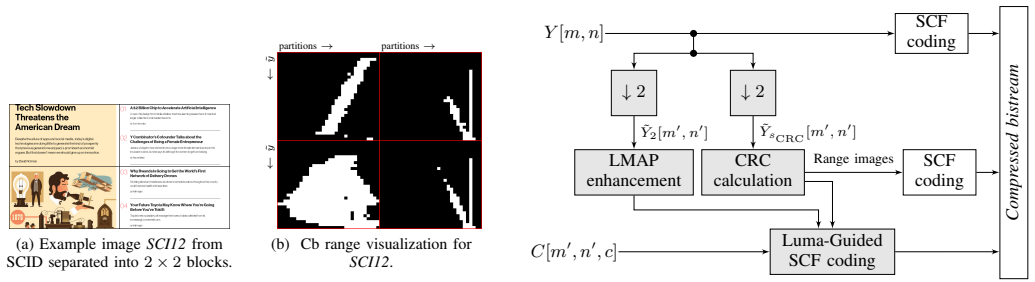
The load-bearing mechanism is a two-pass pipeline: the luma plane is coded first, and a downsampled, quantized luma map then drives chroma prediction and side-information generation. LMAP uses equality of downsampled luma values to choose the top or left chroma neighbor as predictor, and doubles the count of the predicted color in the histograms. CRC partitions the Cb and Cr ranges, divides the image into blocks, and transmits binary range images marking each occurring quantized-luma and chroma combination; removing entries absent from these ranges elevates the estimated probability of every real symbol.
What would settle it
Compress a held-out set of screen-content frames containing photographic backgrounds and many unique colors with SCF 420 both with and without CRC; if the no-CRC version ties or beats the CRC version, the range side information is not generally beneficial. Alternatively, re-run the five datasets with the CRC parameters excluded from the training set and check whether the 5.66% margin over HEVC-SCC shrinks materially.
Extended reading notes
Core claim
SCF coding is extended to YCbCr 4:2:0 by coding the Y plane with the existing SCF stages, then coding the Cb and Cr pair together as color doubles. Two enhancements exploit luma-chroma correlation: LMAP, which substitutes the top or left chroma neighbor when the downsampled luma value equals that neighbor's luma value, and chroma range coding (CRC), which transmits binary images marking which quantized luma-chroma combinations occur per block. CRC lets the histogram-based probability models exclude impossible chroma entries, raising the odds of real colors. Reported results: 1.582 bpp on average over five screen-content datasets, versus 1.672 bpp for HEVC-SCC and 1.728 bpp for VTM 17.2.
Load-bearing premise
The reported advantage depends on the CRC side-information settings having been tuned on one screen-content dataset, which is also included in the final averaged numbers; images with less luma-chroma structure could make that side information cost more than it saves.
Editorial extensions
If this is right
- SCF-based lossless coding now covers YCbCr 4:2:0, the common video chroma format, without per-plane workarounds that lose the benefit of joint color-triplet coding.
- On the five datasets tested, SCF 420 outperforms both HEVC-SCC and VVC reference implementations in lossless screen-content coding.
- The luma-guided chroma prediction mainly helps screen content: it improves chroma match rates from 81.3% to 82.7% on SCID while leaving natural-image prediction almost unchanged.
- The CRC side-information overhead is small on screen content: disabling it costs only 0.56% bitrate, while the total gain over HEVC-SCC is 5.66%.
- Encoding time for SCF 420 is slower than HEVC-SCC but about ten times faster than VTM 17.2; decoding is symmetric rather than asymmetric.
Reading between the lines
- A natural extension not explored in the paper is per-block or per-image adaptation of the CRC parameters; textual content showed the largest gain (10.31% over HEVC), so content-adaptive settings could widen the margin where luma-chroma structure is strong and shrink it where it is weak.
- The same histogram-restriction idea could transfer to near-lossless or lossy screen-content coding, or to palette and intra-block-copy modes in video codecs, where side information about possible luma-chroma combinations could sharpen entropy coding.
- Because Cb-Cr mutual information stays relatively high for screen content even after the YCbCr transform, coding the two chroma planes jointly rather than separately is the structurally important choice; other pixel-wise lossless codecs that code planes independently could gain from the same pairing.
- A held-out test crossing from pure screen content toward photographic backgrounds would likely reduce the measured advantage, since the paper already notes LMAP leaves natural images nearly unaffected and CRC relies on few occurring luma-chroma combinations.
Signed reviews
Editorial analysis
A structured set of objections, weighed in public.
Referee Report
Summary. The paper extends the soft context formation (SCF) lossless screen-content coder from RGB 4:4:4 to YCbCr 4:2:0. The luma plane is coded first with SCF, and the Cb/Cr planes are coded jointly as color pairs. Two new tools are proposed: a luma-guided predictor (LMAP) for chroma samples, and a luma-dependent chroma range coding (CRC) scheme that transmits side information about which luma-chroma combinations occur in blocks, allowing the coder to discard impossible symbols from its histograms. Evaluation on five screen-content datasets (173 images) reports that the proposed SCF 420 outperforms both VTM 17.2 and HM-16.21+SCM-8.8 on every dataset, with HEVC-SCC needing 5.66% more bitrate on average than SCF 420.
Significance. If the reported results hold, this is a useful and nontrivial extension: SCF was previously limited to 4:4:4 formats, and 4:2:0 is the dominant chroma format in video and conferencing applications. The algorithmic description is clear, the ablation in Table V isolates the contributions of CRC (0.56%) and LMAP (0.25%), and the comparisons use standard reference codecs. However, the overall advantage over HEVC is modest, the CRC hyperparameters appear to be selected on a dataset that is also used in the final evaluation, and no per-image variance or statistical significance is reported. The qualitative claim that SCF 420 beats HEVC on the evaluated datasets is plausible, but the exact magnitude and generalization of the gain are not yet established.
major comments (3)
- [Section IV, Tables III and IV] There is a direct inconsistency in the parameter-selection description. The text says: "we evaluate the dataset SIQAD with multiple parameter combinations as visualized in Table III" and chooses the best average bitrate on SIQAD. The caption of Table III, however, says the parameters were obtained by training on the SCID dataset. If the parameters were indeed tuned on SIQAD, then the SIQAD row in Table IV and the pooled 'All' row are partly test-set-selected, inflating the reported 1.582 bpp and the 5.66% HEVC comparison. If the parameters were tuned on SCID, the same circularity applies to the SCID row. This must be corrected. Because Table V shows the combined CRC+LMAP gain is only 0.81% (1.595 vs 1.582 bpp), the choice of hyperparameters could plausibly change the outcome on a given dataset. The authors should separate tuning and test data, report results with the tuning dataset exclu
- [Table IV] The central quantitative claim is that HEVC requires 5.66% more bitrate on average, with dataset-specific differences as small as 3.43% (SC-Mixed) and as large as 10.31% (SC-Text). However, only dataset-averaged bitrates are reported; there are no per-image results, standard deviations, confidence intervals, or paired significance tests. With 173 images and small average differences, the claim should be supported by a per-image distribution or at least by per-dataset variance. Without this, the reader cannot tell whether the reported advantage is consistent or driven by a few images. This is load-bearing for the magnitude of the contribution and should be added in the revision.
- [Section III-B, Table II] Table II shows that LMAP improves chroma MAE on SCID (1.317 to 1.175) but slightly worsens it on Kodak (0.708 to 0.711). The method is intended for screen content, so this alone is not fatal, but the evaluation datasets include 'mixed' and 'textual' webpage stimuli from [19], which may contain natural-image-like regions. The paper does not report how often the LMAP condition in Eq. (5) is active on each dataset, nor whether any individual images are harmed by LMAP or CRC. Given the small average gains in Table V, the authors should report the distribution of gains/losses per image, and specifically how many images are worse with the proposed tools than without them.
minor comments (5)
- [Abstract] Typo: 'A veraged' should be 'Averaged'.
- [Table III caption vs Section IV] The caption says 'obtained by training on SCID dataset' while the text says the parameters are chosen on SIQAD. Even if this is a typo, it must be fixed because it affects the interpretation of the evaluation.
- [Section III-C, Eq. (4)] The floor operation in Eq. (4) is not typeset clearly. Please define the rounding/flooring explicitly. Similarly, the precision scaling parameter sCRC would benefit from a one-sentence explanation of how it quantizes luma values.
- [Table VI] The version designation for HEVC is inconsistent: Table IV and the text use HM-16.21+SCM-8.8, while Table VI lists 'HM 21.18 SCF-8.8'. Please use the same version string throughout.
- [Section IV, preprocessing] The conversion from RGB 4:4:4 to YCbCr 4:2:0 uses ffmpeg, but the exact filter (e.g., yuv420p with default chroma siting) is not specified. Since lossless coding results depend on the exact subsampling and chroma siting, this should be documented.
Circularity Check
CRC parameters tuned on SIQAD and SIQAD included in final averages; qualitative claim survives, but the SIQAD row and pooled 'All' magnitudes are partly test-set-selected.
-
fitted input called prediction
[Section IV, Table III and Table IV (parameter selection and final evaluation)]
"First, we chose optimal parameters b, p and sCRC for CRC. To this end, we evaluate the dataset SIQAD with multiple parameter combinations as visualized in Table III. We chose the parameter combination with the best average bitrate as b = 4, p = 64and sCRC = 64. Finally, we evaluate our resulting method in Table IV."
The CRC hyperparameters b, p, sCRC are selected by minimizing average bitrate on SIQAD (Table III). SIQAD is then included as one of the five datasets in Table IV and contributes to the pooled 'All' row. Thus the reported SIQAD row (107.07%) and the pooled average (105.66%) are not independent test-set results for that dataset; they are partially a statement that the parameters were chosen to optimize that same data. The other four datasets are unaffected, so the qualitative 'outperforms both VVC and HEVC for every dataset' claim is not reduced to the fit, but the exact SIQAD and 'All' magnitudes are optimistically biased by the evaluation protocol.
full rationale
Apart from the SIQAD tuning/evaluation overlap, the paper's derivation is self-contained: SCF 420 is an experimental codec extension, and the central 4:2:0-specific contributions (luma-guided prediction in Eq. 5, chroma range coding in Section III-C) are evaluated against external standard codecs (VTM 17.2, HM-16.21+SCM-8.8) on four datasets that were not used for parameter selection. The base SCF algorithm is prior work by Strutz and Möller (Ref. [8]), and the self-citations [9,13,14] are incremental improvements whose relevant claims (e.g., probability increase when impossible histogram entries are removed, Eqs. 7-8) are elementary and independently checkable rather than load-bearing uniqueness theorems. The luma-guided prediction is motivated by standard cross-component prediction references [11,12], not by an ansatz smuggled via self-citation. Thus the only noteworthy circular component is the mild test-set selection on SIQAD; it does not invalidate the independent dataset rows. Score 2 reflects this minor evaluation circularity, not a derivation-level equivalence.
Assumptions & free parameters
free parameters (5)
- CRC precision scaling sCRC =
64
- CRC partitions p =
64
- CRC block size b =
4
- LMAP precision scaling s =
2
- Histogram count-doubling factor for luma-guided chroma prediction =
2
assumptions (4)
- domain assumption Screen content images have few unique colors and strong spatial redundancy (large uniform areas, text-like repetitive structure).
- domain assumption The YCbCr transform sufficiently decorrelates luma from chroma, but Cb and Cr remain correlated.
- domain assumption Chroma planes have similar spatial structure as downsampled luma for screen content.
- domain assumption Transmitting side information about occurring luma-chroma combinations is cheaper than the probability-model savings.
Cite this review
Pith. "Pith review of Lossless 4:2:0 Screen Content Coding Using Luma-Guided Soft Context Formation." pith.science (2026). https://pith.science/paper/QKIYQEJF
@misc{pith2026250818968,
  author       = {Pith},
  title        = {Pith review of: Lossless 4:2:0 Screen Content Coding Using Luma-Guided Soft Context Formation},
  year         = {2026},
  howpublished = {\url{https://pith.science/paper/QKIYQEJF}},
  note         = {Machine review of arXiv:2508.18968}
}
read the original abstract
The soft context formation coder is a pixel-wise state-of-the-art lossless screen content coder using pattern matching and color palette coding in combination with arithmetic coding. It achieves excellent compression performance on screen content images in RGB 4:4:4 format with few distinct colors. In contrast to many other lossless compression methods, it codes entire color pixels at once, i.e., all color components of one pixel are coded together. Consequently, it does not natively support image formats with downsampled chroma, such as YCbCr 4:2:0, which is an often used chroma format in video compression. In this paper, we extend the soft context formation coding capabilities to 4:2:0 image compression, by successively coding Y and CbCr planes based on an analysis of normalized mutual information between image planes. Additionally, we propose an enhancement to the chroma prediction based on the luminance plane. Furthermore, we propose to transmit side-information about occurring luma-chroma combinations to improve chroma probability distribution modelling. Averaged over a large screen content image dataset, our proposed method outperforms HEVC-SCC, with HEVC-SCC needing 5.66% more bitrate compared to our method.
Figures

Reference graph
Works this paper leans on
-
[19]
C. Shen and Q. Zhao, “Webpage saliency,” in Proc. European Confer- ence on Computer Vision (ECCV) . Springer International Publishing, Sep. 2014, pp. 33–46
work page 2014
-
[1]
Overview of the high efficiency video coding (HEVC) standard,
G. Sullivan, J. Ohm, W. Han, and T. Wiegand, “Overview of the high efficiency video coding (HEVC) standard,” IEEE Transactions on Circuits and Systems for Video Technology , vol. 22, no. 12, pp. 1649– 1668, Dec. 2012
work page 2012
-
[2]
Overview of the emerging HEVC screen content coding extension,
J. Xu, R. Joshi, and R. Cohen, “Overview of the emerging HEVC screen content coding extension,” IEEE Transactions on Circuits and Systems for Video Technology, vol. 26, no. 1, pp. 50–62, Jan. 2016
work page 2016
-
[3]
Overview of the versatile video coding (VVC) standard and its applications,
B. Bross et al., “Overview of the versatile video coding (VVC) standard and its applications,” IEEE Transactions on Circuits and Systems for Video Technology, vol. 31, no. 10, pp. 3736–3764, Oct. 2021
work page 2021
-
[4]
Overview of the screen content support in VVC: Applications, coding tools, and performance,
T. Nguyen et al. , “Overview of the screen content support in VVC: Applications, coding tools, and performance,” IEEE Transactions on Circuits and Systems for Video Technology , vol. 31, no. 10, pp. 3801– 3817, Oct. 2021
work page 2021
-
[5]
Overview of screen content video coding: Technologies, standards, and beyond,
W. Peng et al., “Overview of screen content video coding: Technologies, standards, and beyond,” IEEE Journal on Emerging and Selected Topics in Circuits and Systems , vol. 6, no. 4, pp. 393–408, Dec. 2016. TABLE VI AVERAGE CODING TIMES IN SECONDS . Enc. time Dec. time VTM 17.2 153.0 0.1 HM 21.18 SCF-8.8 5.8 0.1 SCF 420 (prop.) 16.8 15.8
work page 2016
-
[6]
FLIF: Free lossless image format based on maniac compression,
J. Sneyers and P. Wuille, “FLIF: Free lossless image format based on maniac compression,” in Proc. IEEE International Conference on Image Processing (ICIP), Sep. 2016, pp. 66–70
work page 2016
-
[7]
The LOCO-I lossless image compression algorithm: principles and standardization into JPEG-LS,
M. Weinberger, G. Seroussi, and G. Sapiro, “The LOCO-I lossless image compression algorithm: principles and standardization into JPEG-LS,” IEEE Transactions on Image Processing , vol. 9, no. 8, pp. 1309–1324, Aug. 2000
work page 2000
Show all 24 references
-
[8]
Screen content compression based on enhanced soft context formation,
T. Strutz and P. M ¨oller, “Screen content compression based on enhanced soft context formation,” IEEE Transactions on Multimedia , vol. 22, no. 5, pp. 1126–1138, May 2020
2020
-
[9]
Enhanced color palette modeling for lossless screen content compression,
H. Och, S. Uddehal, T. Strutz, and A. Kaup, “Enhanced color palette modeling for lossless screen content compression,” in Proc. IEEE International Conference on Acoustics, Speech and Signal Processing (ICASSP), Apr. 2024, pp. 3670–3674
2024
-
[10]
Intra block copy in HEVC screen content coding extensions,
X. Xu et al. , “Intra block copy in HEVC screen content coding extensions,” IEEE Journal on Emerging and Selected Topics in Circuits and Systems , vol. 6, no. 4, pp. 409–419, Dec. 2016
2016
-
[11]
Adaptive chroma prediction based on luma difference for H.266/VVC,
J. Huo, D. Wang, H. Yuan, S. Wan, and F. Yang, “Adaptive chroma prediction based on luma difference for H.266/VVC,”IEEE Transactions on Image Processing , vol. 32, pp. 6318–6331, Nov. 2023
2023
-
[12]
Adaptive cross component linear model for chroma intra-prediction in VVC,
W. Li, X. Jiang, T. Song, and D. Han, “Adaptive cross component linear model for chroma intra-prediction in VVC,” in Proc. International Conference on Communications and Broadband Networking (ICCBN) , Feb. 2022, pp. 52–59
2022
-
[13]
Improved screen con- tent coding in VVC using soft context formation,
H. Och, S. Uddehal, T. Strutz, and A. Kaup, “Improved screen con- tent coding in VVC using soft context formation,” in Proc. IEEE International Conference on Acoustics, Speech and Signal Processing (ICASSP), Apr. 2024, pp. 3685–3689
2024
-
[14]
Optimization of probability distri- butions for residual coding of screen content,
H. Och, T. Strutz, and A. Kaup, “Optimization of probability distri- butions for residual coding of screen content,” in Proc. International Conference on Visual Communications and Image Processing (VCIP) , Dec. 2021, pp. 1–5
2021
-
[15]
Improved lossless image compression using adaptive image rotation,
P. M ¨oller and T. Strutz, “Improved lossless image compression using adaptive image rotation,” in Proc. European Signal Processing Confer- ence (EUSIPCO) , Sep. 2019, pp. 1–4
2019
-
[16]
R. Franzen. Kodak lossless true color image suite. [accessed 2025-02]. [Online]. Available: https://r0k.us/graphics/kodak/
2025
-
[17]
SCID: A database for screen content images quality assessment,
Z. Ni, L. Ma, H. Zeng, Y . Fu, L. Xing, and K. Ma, “SCID: A database for screen content images quality assessment,” in Proc. International Symposium on Intelligent Signal Processing and Communication Sys- tems (ISPACS), Nov. 2017, pp. 774–779
2017
-
[18]
Perceptual quality assessment of screen content images,
H. Yang, Y . Fang, and W. Lin, “Perceptual quality assessment of screen content images,” IEEE Transactions on Image Processing , vol. 24, no. 11, pp. 4408–4421, Nov. 2015
2015
-
[20]
Common test conditions for screen content coding,
H. Yu, R. Cohen, K. Rapaka, and J. Xu, “Common test conditions for screen content coding,” Joint Collaborative Team on Video Coding (JCT- VC) of ITU-T SG 16 WP 3 and ISO/IEC JTC 1/SC 29/WG 11, JCTVC- U1015, Jun. 2015
2015
-
[21]
ITU-R BT.709-6: Parameter values for the HDTV standards for pro- duction and international programme exchange,
“ITU-R BT.709-6: Parameter values for the HDTV standards for pro- duction and international programme exchange,” International Telecom- munication Union, Technical Report, Jun. 2015
2015
-
[22]
[accessed 2024-02]
(2024) Fast Forwards MPEG (FFmpeg). [accessed 2024-02]. [Online]. Available: http://ffmpeg.org
2024
-
[23]
VVC test model reference software (VTM)
Joint Video Experts Team (JVET). VVC test model reference software (VTM). [accessed 2024-02]. [Online]. Available: https: //vcgit.hhi.fraunhofer.de/jvet/VVCSoftware VTM
2024
-
[24]
JVET common test conditions and software reference configurations for lossless, near lossless, and mixed lossy/lossless coding,
T. Nguyen, T. Ma, and A. Nalci, “JVET common test conditions and software reference configurations for lossless, near lossless, and mixed lossy/lossless coding,” Joint Video Exploration Team (JVET) of ITU-T SG 16 WP 3 and ISO/IEC JTC 1/SC 29/WG 11, AHG Report, JVET- Q2014, Jan. 2020
2020
Reviewed August 5, 2026 · model on record in the stance chip above.
Discussion (0). Continue with ORCID to comment.