REVIEW 4 major objections 3 minor 161 references
Towards Automatic and Reliable Localized Model Order Reduction
T0 review · 4 major / 3 minor · reviewed 2026-08-14 · deepseek-v4-flash
Pith's one-line read The paper claims a complete localized model order reduction pipeline that makes resimulation after local geometry changes nearly independent of the unchanged global mesh.
desk verdict A solid, honest MOR thesis with rigorous localized error bounds and randomized training, but the certified-reliability claim is only demonstrated for coercive problems and the estimator constants are never actually computed. read the letter →
The pith
A machine-rendered reading of the paper's core claim, the machinery that carries it, and where it could break.
The reading
What carries the argument
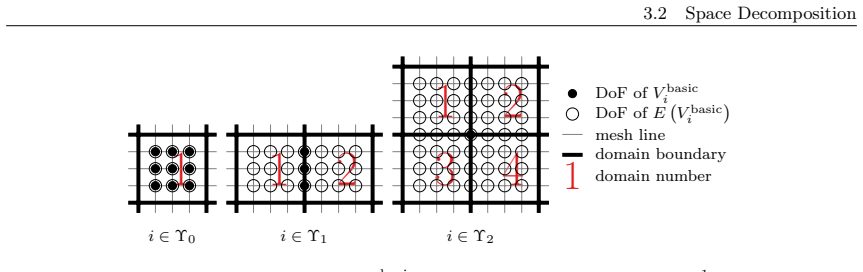
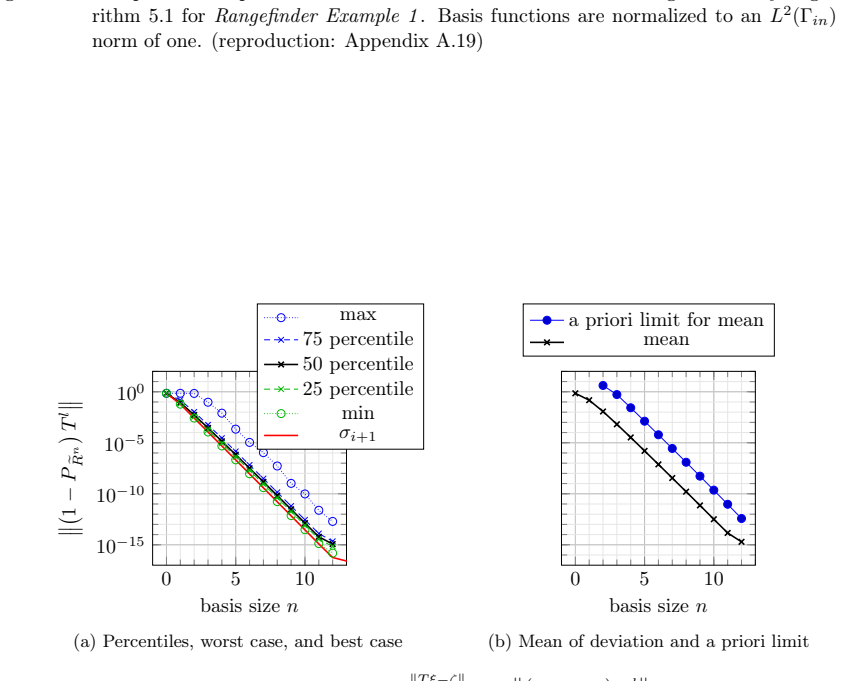
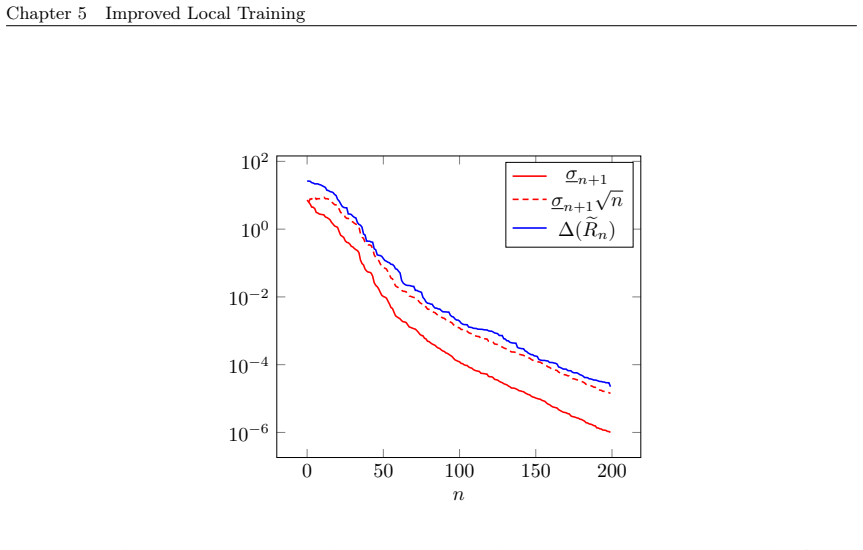
The wirebasket space decomposition is the backbone: each degree of freedom is assigned to a coarse mesh entity and extended to neighboring cells by solving the homogeneous equation, giving a direct-sum splitting of the global space into local subspaces. The transfer operator $T$ maps boundary or coupling data on a local training domain to the local solution within it; the randomized range finder approximates the image of its linear part, and the training a priori estimate $\|u-\tilde u\|/\|u\| \le \sqrt{\gamma/\alpha}\, \sqrt{\bar J J^*}\,\max_i \|(1-P_{\tilde V_i})T_i^l\|\,\|P_{S_i}\|$ turns the global error into a bound on local projection errors. The partition-of-unity dual norm localization bounds the residual norm by $\sqrt{\bar J}\,c_{pu,\tilde V}\,(\sum_i \|R_\mu(\tilde u_\mu)\|_{V_i'}^2)^{1/2}$, which makes the error estimator computable from local solves.
What would settle it
For the 2D Maxwell or Olimex A64 example, compute an independently certified lower bound for the inf-sup constant; if the localized error estimator then fails to be an upper bound on the true reduction error, or if the bound cannot be computed without a global solve, the reliability claim fails.
Extended reading notes
Core claim
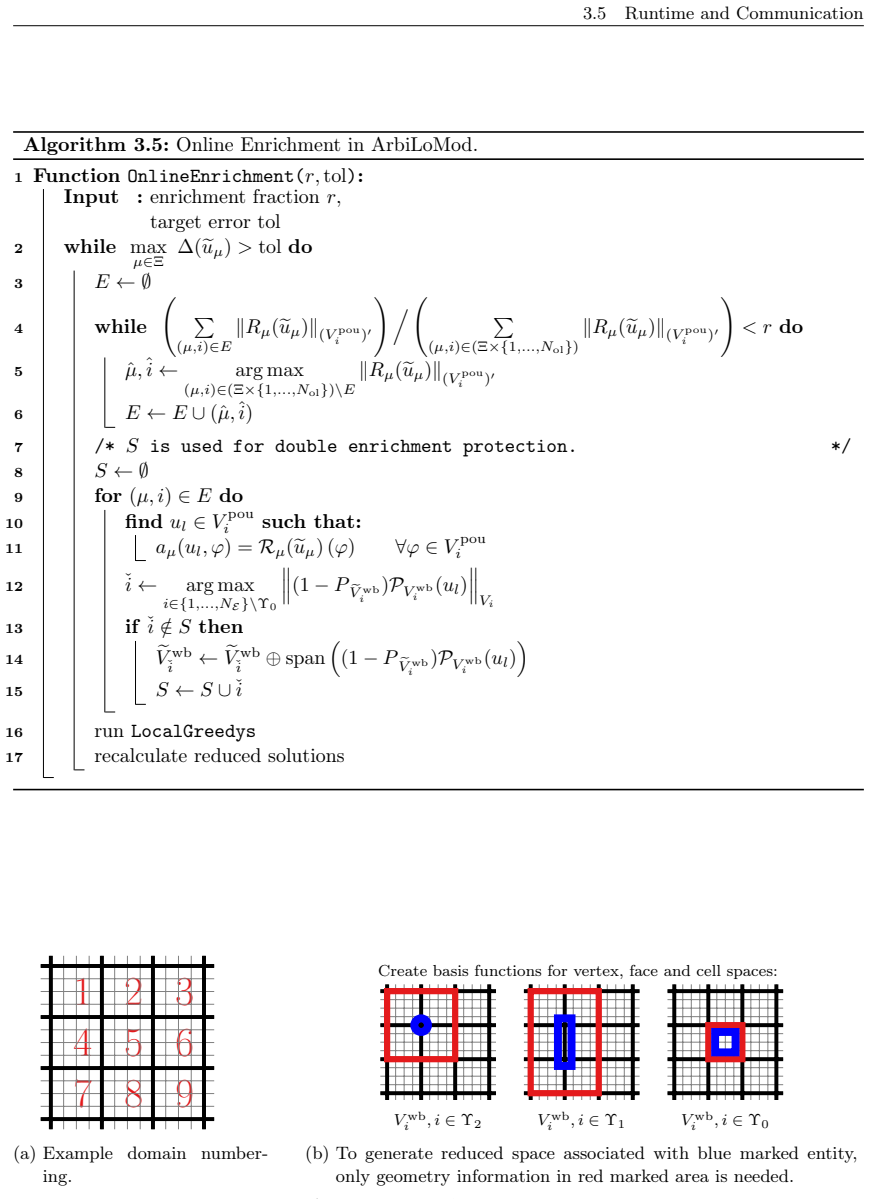
ArbiLoMod decomposes the global finite-element space via a wirebasket decomposition: reduced subspaces are attached to coarse vertices, edges, faces, and cells, with basis functions extended into neighboring cells by solving homogeneous local problems. The initial reduced spaces are built by local trainings (random boundary data on a patch around each interface) and by local greedy algorithms; a partition-of-unity based a posteriori error estimator bounds the residual dual norm by the sum (or root-sum-square) of local residual norms, with constants that can be computed or bounded, and an online enrichment loop adds the steepest residual components until the estimated error falls below tolerance. The principal new analytical claims are a probabilistic a priori bound for the randomized training, showing the generated local spaces are nearly as good as the optimal singular-value spaces of the transfer operator, and exponential convergence of the proposed online enrichment algorithms. All ingredients are demonstrated on thermal-channel, two-dimensional Maxwell, and a 65-million-degree-of-freedom printed-circuit-board example; for the inf-sup stable Maxwell problems the author reports that a certified inf-sup lower bound is not provided.
Load-bearing premise
The entire certified error bound rests on having a global lower bound for the coercivity constant (or the inf-sup constant) of the bilinear form, and the thesis computes such a bound only for simple heat-conduction examples, not for the inf-sup stable Maxwell or PCB cases that motivate the work.
Editorial extensions
If this is right
- After a localized geometry change, only reduced spaces whose training domains intersect the change need to be regenerated; the rest of the offline data can be reused.
- The localized a posteriori estimator gives a rigorous upper bound on the reduction error with computable constants in coercive problems, and it can steer where to enrich.
- The randomized training algorithm replaces the user-chosen number of random samples with an adaptive choice, and its convergence rate is tied to the singular-value decay of the transfer operator.
- The online enrichment loop converges exponentially and can even start from empty local bases, so it provides a fallback when initial training is insufficient.
Reading between the lines
- The missing certified inf-sup lower bound for the Maxwell and PCB examples is the one gap between the proven reliability statement and the stated target application; a localized or randomized inf-sup estimator would close it.
- Because the training a priori estimate is independent of the number of local subdomains, the method should scale to very large domain decompositions; a three-dimensional PCB example with thousands of subdomains would be a natural stress test.
- The same randomized range finder could be warm-started with reduced bases from previous geometries, potentially making the reuse after local changes even cheaper than rebuilding from scratch.
Signed reviews
Editorial analysis
A structured set of objections, weighed in public.
Referee Report
Summary. The manuscript is a PhD thesis proposing ArbiLoMod, a localized model order reduction methodology for sequences of PDE simulations with arbitrary local geometry modifications. It develops a wirebasket space decomposition with local training, a localized residual-based a posteriori error estimator via dual norm localization, randomized range finder training algorithms with probabilistic a priori convergence bounds, and online enrichment algorithms. The main claims are that ArbiLoMod delivers a complete localized pipeline, that the localized error estimator is certified with computable constants, and that randomized training converges nearly as fast as the singular value decay of the transfer operator. Numerical experiments cover heat conduction, a 2D Maxwell problem, and a large PCB example, with reproduction scripts.
Significance. The strongest contributions are the abstract localized training configuration with the transfer-operator formulation and the randomized range finder analysis in Chapter 5, including a probabilistic a posteriori norm estimator and an a priori convergence theorem; these are rigorous and are supported by numerical experiments on the Olimex A64 example. The numerically stable offline/online splitting for the reduced basis error estimator in Section 4.5 is a useful practical contribution, and the emphasis on reproducible source code is commendable. If the certification gap described below is resolved, the localized a posteriori estimator would be a significant step toward localized model order reduction for engineering applications. As it stands, however, the certified reliability claim is not established for the targeted Maxwell/PCB application, which is the central weakness of the manuscript.
major comments (4)
- [Sections 4.2–4.3, Corollary 4.2.4; Sections 2.6.4 and 3.6.2] The localized error estimator is certified only for coercive problems. Corollary 4.2.4 applies Proposition 4.2.3 to the standard error bound Δ(ũμ) = 1/αμ ‖Rμ(ũμ)‖, which requires a computable lower bound on the coercivity constant αμ. The time-harmonic Maxwell problem in H(curl) (Section 2.6.4) is inf-sup stable but not coercive, and the text states that a lower bound for the inf-sup constant is not computed. Therefore the reliable/certified status claimed in the abstract and in design goal (5) of Section 3.1 is not demonstrated for the main target application; Section 3.6.2 indeed runs the 2D Maxwell experiment without the a posteriori error estimator. The authors should either present an inf-sup lower bound for the Maxwell setting (or its 2D normal-magnetic reduction) or explicitly restrict the certification claim to coercive problems.
- [Section 3.6.1, Figure 3.11] The sole numerical demonstration of the localized estimator in the Thermal Channels example is plotted for αμ = cpu,~V = 1. This means the constants whose computability is claimed in the abstract are not actually computed or bounded by their certified estimates in the experiment, and the effectivity of the estimator is not shown. Since the main selling point of Corollary 4.2.4 over the standard global estimator is a localized, computable, certified bound, the demonstration should report the computed or estimated constants, or at least compare the estimator with a certified lower bound using the bounds from Propositions 4.3.2 and 4.3.3.
- [Section 5.1, Proposition 5.1.3, Eq. (5.16)] The a priori training estimate rests on the assumption T_a^i ∈ ~V_i (Eq. 5.16), i.e., the affine part of each transfer operator is contained in the reduced local space. In the parameterized ArbiLoMod pipeline, the training algorithms only include snapshots for a finite set Ξ (e.g., Algorithm 3.3, and the randomized range finder in Section 5.2 targets the linear part T_l^i), so this hypothesis is not guaranteed for parameters outside the training set. The text should either prove that the construction enforces Eq. (5.16) for all parameters, or restate the theorem with an additional affine-part/residual term and explain how training controls it.
- [Section 3.6.2, Figures 3.16–3.17] For the inf-sup stable Maxwell example, the reduced Galerkin problem is observed to become unstable at certain basis sizes, with the reduced inf-sup constant dropping and the maximum error jumping at a basis size of about 900. The thesis acknowledges this and defers stable Petrov-Galerkin reduction to future work in Section 3.7. This is an honest limitation, but it further means that the method as presented cannot yet be certified for the target inf-sup stable application, and this restriction should be stated prominently in the abstract and conclusions rather than only in the experiment section.
minor comments (3)
- [Section 1.4.4 and Bibliography] There are copy-editing problems, for example the sentence fragment in Section 1.4.4 ('CMS Component Mode Synthesis (CMS) component mode synthesis (CMS) introduced in a [Hurty(1965),Bampton and Craig(1968)]') and bibliography entries with 'doi: n/a'; these should be cleaned up before submission.
- [Section 3.6.1, Figure 3.11] The text says the factor cpu,~V is 'neglected' while the caption says 'Plotted for αμ = cpu,~V = 1'; the terminology should be unified so that the reader knows whether the plotted quantity is an upper bound, a lower bound, or a heuristic indicator.
- [Section 4.3, Proposition 4.3.2] In the proof, the estimate is first obtained with H_i in the denominator and then stated with H = min_i H_i; a one-line clarification that H ≤ H_i justifies the uniform bound would improve readability.
Circularity Check
Derivation chain is self-contained; no circularity found.
full rationale
The paper's main derived results are self-contained in the sense that their statements do not coincide by definition with their inputs. The ArbiLoMod training pipeline is analyzed in Proposition 5.1.3, where the reduction error is bounded by the projection error of the transfer operator under the explicit decomposition assumption u = Σ_i T_i P_{S_i} u|_{ω*_i} (Definition 5.1.1, Eq. 5.3); this is an assumption of the framework, not the conclusion of the theorem, and the subsequent randomized range finder bounds that projection error by a standard RandNLA estimate involving the singular values of the operator (Section 5.2). Similarly, the localized a posteriori error estimator in Corollary 4.2.4 is derived from the residual dual norm and the localized stability constants c_{i,~V} and c_{pu,~V}; these constants are defined directly in terms of the reduced space and the space decomposition, and no fitted parameter is renamed as a prediction. The only caveats are explicit limitations: Section 2.6.4 states "we cannot in general estimate the inf-sup constant from below. Obtaining a lower bound for the inf-sup constant is a challenging task which we omit", and Section 3.6.2 applies ArbiLoMod to the 2D Maxwell problem "without ... a posteriori error estimator", so the certified-reliability claim is not demonstrated for the target inf-sup-stable application; Figure 3.11 is plotted for αµ = cpu,~V = 1, so the constants' computability is not numerically demonstrated. These are correctness or validation gaps, not circular reductions. The thesis also cites the author's own prior journal articles (e.g., Buhr and Smetana 2018, Buhr et al. 2017a), but the corresponding analyses are reproduced in the thesis itself and the cited publications are peer-reviewed, so the self-citations are not load-bearing in the derivation chain.
Assumptions & free parameters
free parameters (4)
- M (number of random samples in heuristic training)
- epsilon_train (training tolerance)
- epsilon_greedy (greedy tolerance)
- r (enrichment fraction)
assumptions (6)
- domain assumption The localizing space decomposition satisfies sum V_i = V and sum P_V_i(phi) = phi for all phi in V.
- domain assumption The bilinear form has an affine parameter dependence.
- ad hoc to paper A computable lower bound for the coercivity constant alpha_LB (or inf-sup lower bound) is available.
- ad hoc to paper The affine part T_a^i of each transfer operator is contained in the reduced space ~V_i (Eq 5.16).
- domain assumption The partition of unity functions rho_i are contained in the reduced space ~V (Prop 4.3.3).
- standard math Random coefficient vectors produce inner products with a Gaussian distribution with variance bounded by the extreme eigenvalues of the inner product matrix (Lemma 5.2.1).
Cite this review
Pith. "Pith review of Towards Automatic and Reliable Localized Model Order Reduction." pith.science (2026). https://pith.science/paper/QKMLCFAP
@misc{pith2026190802074,
  author       = {Pith},
  title        = {Pith review of: Towards Automatic and Reliable Localized Model Order Reduction},
  year         = {2026},
  howpublished = {\url{https://pith.science/paper/QKMLCFAP}},
  note         = {Machine review of arXiv:1908.02074}
}
read the original abstract
Finite element based simulation of phenomena governed by partial differential equations is a standard tool in many engineering workflows today. However, the simulation of complex geometries is computationally expensive. Many engineering workflows require multiple simulations with small, non parametric changes in between. The use of localized model order reduction for subsequent simulations of geometries with localized changes is very promising. It produces lots of computational tasks with little dependencies and thus parallelizes well. Furthermore, the possibility to reuse intermediary results in the subsequent simulations can lead to large computational savings. In this thesis, we investigate different aspects of localized model order reduction and propose various improvements. A simulation methodology named ArbiLoMod, comprising a localized training, a localized a posteriori error estimator and an enrichment procedure is proposed. A new localized a posteriori error estimator with computable constants is presented and analyzed. A new training algorithm which is based on a transfer operator is derived. It can be shown to converge nearly as fast as the singular value decay of this operator. The transfer operator's spectrum is observed to decay fast in electromagnetic simulations in printed circuit boards. New online enrichment algorithms are proposed. All results are supported by numerical experiments, for which the source code for reproduction is provided.
Figures


Figures from the paper (48 more)












Reference graph
Works this paper leans on
-
[1]
J. Aarnes, T. Y. Hou . Multiscale domain decomposition methods for elliptic problems with high aspect ratios. Acta Mathematicae Applicatae Sinica, English Series, 18 (2002) (1), pp. 63--76. doi:10.1007/s102550200004
-
[2]
A. Abdulle . On a priori error analysis of fully discrete heterogeneous multiscale FEM . Multiscale Modeling and Simulation, 4 (2005) (2), pp. 447--459. doi:10.1137/040607137
-
[3]
F. Albrecht, M. Ohlberger . The localized reduced basis multi-scale method with online enrichment. Oberwolfach Reports, 7 (2013), pp. 406--409. doi:10.4171/OWR/2013/07
-
[4]
Albrecht, B
F. Albrecht, B. Haasdonk, M. Ohlberger, S. Kaulmann . The Localized Reduced Basis Multiscale Method. Proceedings of Algoritmy 2012, Conference on Scientific Computing, Vysoke Tatry, Podbanske, September 9-14, 2012, (2012), pp. 393--403. doi:n/a
2012
-
[5]
M. S. Aln s, J. Blechta, J. Hake, A. Johansson, B. Kehlet, A. Logg, C. Richardson, J. Ring, M. E. Rognes, G. N. Wells . The FEniCS Project Version 1.5. Archive of Numerical Software, 3 (2015) (100). doi:10.11588/ans.2015.100.20553
-
[6]
G. Alzetta, D. Arndt, W. Bangerth, V. Boddu, B. Brands, D. Davydov, R. Gassmoeller, T. Heister, L. Heltai, K. Kormann, M. Kronbichler, M. Maier, J.-P. Pelteret, B. Turcksin, D. Wells . The deal.II Library, Version 9.0 . Journal of Numerical Mathematics, 26 (2018) (4), pp. 173--183. doi:10.1515/jnma-2018-0054
-
[7]
P. F. Antonietti, P. Pacciarini, A. Quarteroni . A discontinuous G alerkin Reduced Basis Element method for elliptic problems . ESAIM: Mathematical Modelling and Numerical Analysis, 50 (2016) (2), pp. 337--360. doi:10.1051/m2an/2015045
arXiv 2016
-
[8]
I. Babuska, R. Lipton . Optimal Local Approximation Spaces for Generalized Finite Element Methods with Application to Multiscale Problems. Multiscale Modeling & Simulation, 9 (2011) (1), pp. 373--406. doi:10.1137/100791051
Show all 161 references
-
[9]
Balay, S
S. Balay, S. Abhyankar, M. F. Adams, J. Brown, P. Brune, K. Buschelman, L. Dalcin, V. Eijkhout, W. D. Gropp, D. Kaushik, M. G. Knepley, D. A. May, L. C. McInnes, R. T. Mills, T. Munson, K. Rupp, P. Sanan, B. F. Smith, S. Zampini, H. Zhang, H. Zhang . PETS c W eb page . http://...
2018
-
[10]
M. C. C. Bampton , R. R. Craig , Jr. Coupling of substructures for dynamic analyses. AIAA Journal, 6 (1968) (7), pp. 1313--1319. doi:10.2514/3.4741
1968 doi
-
[11]
Bastian, M
P. Bastian, M. Blatt, A. Dedner, C. Engwer, R. Klöfkorn, M. Ohlberger, O. Sander . A generic grid interface for parallel and adaptive scientific computing. Part I: abstract framework. Computing, 82 (2008 a ) (2-3), pp. 103--119. doi:10.1007/s00607-008-0003-x
2008 doi
-
[12]
Bastian, M
P. Bastian, M. Blatt, A. Dedner, C. Engwer, R. Kl \"o fkorn, R. Kornhuber, M. Ohlberger, O. Sander . A generic grid interface for parallel and adaptive scientific computing. Part II: implementation and tests in DUNE. Computing, 82 (2008 b ) (2), pp. 121--138. doi:10.1007/s0060...
2008 doi
-
[13]
o ddeke, O. Iliev, O. Ippisch, M. Ohlberger, S. Turek, J. Fahlke, S. Kaulmann, S. M \
P. Bastian, C. Engwer, D. G \"o ddeke, O. Iliev, O. Ippisch, M. Ohlberger, S. Turek, J. Fahlke, S. Kaulmann, S. M \"u thing, D. Ribbrock . EXA-DUNE: Flexible PDE Solvers, Numerical Methods and Applications. In L. Lopes, J. Z ilinskas, A. Costan, R. G. Cascella, G. Kecskemeti, ...
2014
-
[14]
Bastian, C
P. Bastian, C. Engwer, J. Fahlke, M. Geveler, D. Göddeke, O. Iliev, O. Ippisch, R. Milk, J. Mohring, S. Müthing, M. Ohlberger, D. Ribbrock, S. Turek . Hardware-Based Efficiency Advances in the EXA - DUNE Project . In Lecture Notes in Computational Science and Engineering, pp. ...
2016 doi
-
[15]
Benner, M
P. Benner, M. Hess . The Reduced Basis Method for Time-Harmonic Maxwell's Equations. Proceedings in Applied Mathematics and Mechanics, 12 (2012) (1), pp. 661--662. doi:10.1002/pamm.201210319
2012 doi
-
[16]
Benner, M
P. Benner, M. Ohlberger, A. Cohen, K. E. Wilcox . Model Reduction and Approximation: Theory and Algorithms. SIAM-Society for Industrial & Applied Mathematics, 2017. ISBN 9781611974829
2017
-
[17]
Bourquin
F. Bourquin . Component mode synthesis and eigenvalues of second order operators: discretization and algorithm. ESAIM : Mathematical Modelling and Numerical Analysis, 26 (1992) (3), pp. 385--423. doi:10.1051/m2an/1992260303851
1992
-
[18]
A. Buhr . Finite Elements in PCB Structures . Master's thesis, TU Darmstadt, Darmstadt, Germany, 2009
2009
-
[19]
A. Buhr . Exponential Convergence of Online Enrichment in Localized Reduced Basis Methods. IFAC-PapersOnLine, 51 (2017) (2), pp. 302--306. doi:n/a. MATHMOD 2018
2017
-
[20]
A. Buhr . Source Code for PhD Thesis by Andreas Buhr, 2019. doi:10.5281/zenodo.2555623
2019 doi
-
[21]
A. Buhr, K. Smetana . Randomized Local Model Order Reduction. SIAM Journal on Scientific Computing, 40 (2018) (4), pp. A2120--A2151. doi:10.1137/17M1138480
2018 doi
-
[22]
A. Buhr, C. Engwer, M. Ohlberger, S. Rave . A Numerically Stable a Posteriori Error Estimator for Reduced Basis Approximations of Elliptic Equations. In X. O. E. Onate, A. Huerta , eds., Proceedings of the 11th World Congress on Computational Mechanics. CIMNE, Barcelona, 2014 ...
2014
-
[23]
A. Buhr, C. Engwer, M. Ohlberger, S. Rave . ArbiLoMod, a Simulation Technique Designed for Arbitrary Local Modifications . SIAM Journal on Scientific Computing, 39 (2017 a ) (4), pp. A1435--A1465. doi:10.1137/15M1054213
2017 doi
-
[24]
A. Buhr, C. Engwer, M. Ohlberger, S. Rave . ArbiLoMod : Local Solution Spaces by Random Training in Electrodynamics , pp. 137--148. Springer International Publishing, Cham. ISBN 978-3-319-58786-8, 2017 b . doi:10.1007/978-3-319-58786-8_9
2017 doi
-
[25]
A. Buhr, L. Iapichino, M. Ohlberger, S. Rave, F. Schindler, K. Smetana . Handbook on Model Order Reduction, chap. Localized model reduction for parameterized problems. Walter De Gruyter GmbH, 2019+. Submitted for publication
2019
-
[26]
Carlberg, C
K. Carlberg, C. Bou-Mosleh, C. Farhat . Efficient non-linear model reduction via a least-squares Petrov-Galerkin projection and compressive tensor approximations. International Journal for Numerical Methods in Engineering, 86 (2010) (2), pp. 155--181. doi:10.1002/nme.3050
2010 doi
-
[27]
Casenave
F. Casenave . Accurate a posteriori error evaluation in the reduced basis method. Comptes Rendus Mathematique, 350 (2012) (9-10), pp. 539--542. doi:10.1016/j.crma.2012.05.012
2012 doi
-
[28]
Casenave, A
F. Casenave, A. Ern, T. Leli \` e vre . Accurate and online-efficient evaluation of the a posteriori error bound in the reduced basis method. ESAIM : Mathematical Modelling and Numerical Analysis, 48 (2014) (1), pp. 207--229. doi:10.1051/m2an/2013097
2014
-
[29]
J. C \'e a . Approximation variationnelle des probl \`e mes aux limites . Université de Grenoble, 14 (1964) (fasc. 2), pp. 345--444
1964
-
[30]
Y. Chen, J. S. Hesthaven, Y. Maday, J. Rodríguez . A monotonic evaluation of lower bounds for inf-sup stability constants in the frame of reduced basis approximations. Comptes Rendus Mathematique, 346 (2008) (23), pp. 1295--1300. doi:10.1016/j.crma.2008.10.012
2008 doi
-
[31]
Y. Chen, J. S. Hesthaven, Y. Maday, J. Rodríguez . Improved successive constraint method based a posteriori error estimate for reduced basis approximation of 2D Maxwell 's problem . ESAIM: Mathematical Modelling and Numerical Analysis, 43 (2009) (6), pp. 1099--1116. doi:10.105...
2009
-
[32]
Y. Chen, J. S. Hesthaven, Y. Maday, J. Rodríguez . Certified Reduced Basis Methods and Output Bounds for the Harmonic Maxwell's Equations. SIAM Journal on Scientific Computing, 32 (2010) (2), pp. 970--996. doi:10.1137/09075250X
2010 doi
-
[33]
Y. Chen, J. S. Hesthaven, Y. Maday . A seamless reduced basis element method for 2 D M axwell's problem: an introduction . In Spectral and high order methods for partial differential equations, vol. 76 of Lect. Notes Comput. Sci. Eng., pp. 141--152. Springer, Heidelberg, 2011....
2011 doi
-
[34]
Y. Chen, J. Jiang, A. Narayan . Robust residual-based and residual-free greedy algorithms for reduced basis methods. arXiv e-prints, (2017). http://arxiv.org/abs/1710.08999v1
2017 arXiv
-
[35]
Y. Chen, J. Jiang, A. Narayan . A robust error estimator and a residual-free error indicator for reduced basis methods. Computers & Mathematics with Applications, (2018). doi:10.1016/j.camwa.2018.11.032
2018 doi
-
[36]
Z. Chen, J. J. Dongarra . Condition numbers of G aussian random matrices . SIAM Journal on Matrix Analysis and Applications, 27 (2005) (3), pp. 603--620. doi:10.1137/040616413
2005 doi
-
[37]
Cheng, Z
H. Cheng, Z. Gimbutas, P. G. Martinsson, V. Rokhlin . On the compression of low rank matrices. SIAM Journal on Scientific Computing, 26 (2005) (4), pp. 1389--1404. doi:10.1137/030602678
2005 doi
-
[38]
E. T. Chung, Y. Efendiev, W. T. Leung . Generalized multiscale finite element methods for wave propagation in heterogeneous media. Multiscale Modeling and Simulation, 12 (2014) (4), pp. 1691--1721. doi:10.1137/130926675
2014 doi
-
[39]
E. T. Chung, Y. Efendiev, C. S. Lee . Mixed generalized multiscale finite element methods and applications. Multiscale Modeling and Simulation, 13 (2015) (1), pp. 338--366. doi:10.1137/140970574
2015 doi
-
[40]
E. T. Chung, Y. Efendiev, W. T. Leung . An adaptive generalized multiscale discontinuous G alerkin method for high-contrast flow problems . Multiscale Modeling and Simulation, 16 (2018 a ) (3), pp. 1227--1257. doi:10.1137/140986189. 1409.3474
2018 arXiv
-
[41]
E. T. Chung, Y. Efendiev, W. T. Leung . Constraint Energy Minimizing Generalized Multiscale Finite Element Method. Computer Methods in Applied Mechanics and Engineering, 339 (2018 b ), pp. 298--319. doi:10.1016/j.cma.2018.04.010
2018 doi
-
[42]
E. T. Chung, Y. Efendiev, W. T. Leung . Fast Online Generalized Multiscale Finite Element Method using Constraint Energy Minimization. Journal of Computational Physics, 355 (2018 c ), pp. 450--463. doi:10.1016/j.jcp.2017.11.022
2018 doi
-
[43]
Cohen, R
A. Cohen, R. DeVore, R. H. Nochetto . Convergence rates of AFEM with H^ -1 data . Foundations of Computational Mathematics, 12 (2012) (5), pp. 671--718. doi:10.1007/s10208-012-9120-1
2012 doi
-
[44]
Dahmen, C
W. Dahmen, C. Plesken, G. Welper . Double greedy algorithms: Reduced basis methods for transport dominated problems. ESAIM : Mathematical Modelling and Numerical Analysis, 48 (2014) (3), pp. 623--663. doi:10.1051/m2an/2013103
2014
-
[45]
J. W. Demmel, S. C. Eisenstat, J. R. Gilbert, X. S. Li, J. W. H. Liu . A supernodal approach to sparse partial pivoting. SIAM J. Matrix Analysis and Applications, 20 (1999) (3), pp. 720--755. doi:10.1137/S0895479895291765
1999 doi
-
[46]
Dolean, H
V. Dolean, H. Fol, S. Lanteri, R. Perrussel . Solution of the time-harmonic Maxwell equations using discontinuous Galerkin methods. Journal of Computational and Applied Mathematics, 218 (2008) (2), pp. 435--445. doi:10.1016/j.cam.2007.05.026. The Proceedings of the Twelfth Int...
2008 doi
-
[47]
Dolean, F
V. Dolean, F. Nataf, R. Scheichl, N. Spillane . Analysis of a Two-level Schwarz Method with Coarse Spaces Based on Local Dirichlet-to-Neumann Maps. Computational Methods in Applied Mathematics, 12 (2012) (4). doi:10.2478/cmam-2012-0027
2012 doi
-
[48]
D \"o rfler
W. D \"o rfler . A convergent adaptive algorithm for Poisson's equation. SIAM Journal on Numerical Analysis, 33 (1996) (3), pp. 1106--1124. doi:10.1137/0733054
1996 doi
-
[49]
Drineas, R
P. Drineas, R. Kannan, M. Mahoney . Fast Monte Carlo Algorithms for Matrices I: Approximating Matrix Multiplication. SIAM Journal on Computing, 36 (2006 a ) (1), pp. 132--157. doi:10.1137/S0097539704442684
2006 doi
-
[50]
Drineas, R
P. Drineas, R. Kannan, M. Mahoney . Fast Monte Carlo Algorithms for Matrices II: Computing a Low-Rank Approximation to a Matrix. SIAM Journal on Computing, 36 (2006 b ) (1), pp. 158--183. doi:10.1137/S0097539704442696
2006 doi
-
[51]
Drineas, R
P. Drineas, R. Kannan, M. W. Mahoney . Fast M onte C arlo Algorithms for Matrices. III . C omputing a compressed approximate matrix decomposition . SIAM Journal on Computing, 36 (2006 c ) (1), pp. 184--206. doi:10.1137/S0097539704442702
2006 doi
-
[52]
W. E, B. Engquist . The Heterognous Multiscale Methods. Communications in Mathematical Sciences, 1 (2003) (1), pp. 87--132. doi:10.4310/cms.2003.v1.n1.a8
2003 doi
-
[53]
W. E, B. Engquist . The Heterogeneous Multi-Scale Method for Homogenization Problems. In Lecture Notes in Computational Science and Engineering, vol. 44 of Lect. Notes Comput. Sci. Eng., pp. 89--110. Springer-Verlag, Berlin, 2005. doi:10.1007/3-540-26444-2_4
-
[54]
Efendiev, T
Y. Efendiev, T. Y. Hou . Multiscale Finite Element Methods: Theory and Applications (Surveys and Tutorials in the Applied Mathematical Sciences, Vol. 4), vol. 4 of Surveys and Tutorials in the Applied Mathematical Sciences. Springer, New York, 2009. ISBN 0387094954. Theory and...
2009
-
[55]
Efendiev, J
Y. Efendiev, J. Galvis, X.-H. Wu . Multiscale finite element methods for high-contrast problems using local spectral basis functions. Journal of Computational Physics, 230 (2011) (4), pp. 937--955. doi:10.1016/j.jcp.2010.09.026
2011 doi
-
[56]
Efendiev, J
Y. Efendiev, J. Galvis, T. Y. Hou . Generalized Multiscale Finite Element Methods ( GMsFEM ) . Journal of Computational Physics, 251 (2013), pp. 116--135. doi:10.1016/j.jcp.2013.04.045
2013 doi
-
[57]
J. L. Eftang, A. T. Patera . Port reduction in parametrized component static condensation: approximation and a posteriori error estimation. International Journal for Numerical Methods in Engineering, 96 (2013) (5), pp. 269--302. doi:10.1002/nme.4543
2013 doi
-
[58]
J. L. Eftang, A. T. Patera . A port-reduced static condensation reduced basis element method for large component-synthesized structures: approximation and A posteriori error estimation . Advanced Modeling and Simulation in Engineering Sciences, 1 (2014) (3), p. 3. doi:10.1186/...
2014 doi
-
[59]
Eickhorn
D. Eickhorn . Randomisierte lokalisierte Modellreduktion mit Robin-Transferoperator. Master's thesis, Westfälische Wilhelms Universität Münster, 2019. https://www.uni-muenster.de/AMM/includes/ohlberger/team/eickhorn/MA_Eickhorn.pdf
2019
-
[60]
Engwer, P
C. Engwer, P. Henning, A. Målqvist, D. Peterseim . Efficient implementation of the localized orthogonal decomposition method. Computer Methods in Applied Mechanics and Engineering, 350 (2019), pp. 123--153. doi:10.1016/j.cma.2019.02.040
2019 doi
-
[61]
Feuers \"a nger
C. Feuers \"a nger . Manual for Package pgfplots. online, 17 (2011)
2011
-
[62]
J. P. Fink, W. C. Rheinboldt . On the Error Behavior of the Reduced Basis Technique for Nonlinear Finite Element Approximations. ZAMM-Journal of Applied Mathematics and Mechanics/Zeitschrift f \"u r Angewandte Mathematik und Mechanik, 63 (1983) (1), pp. 21--28. doi:10.1002/zam...
1983 doi
-
[63]
S. Fu, E. Chung, G. Li . Edge Multiscale Methods for elliptic problems with heterogeneous coefficients. arXiv, (2018). http://arxiv.org/abs/1810.10398v1
2018 arXiv
-
[64]
Galvis, Y
J. Galvis, Y. Efendiev . Domain decomposition preconditioners for multiscale flows in high-contrast media. Multiscale Modeling & Simulation, 8 (2010) (4), pp. 1461--1483. doi:10.1137/090751190
2010 doi
-
[65]
M. J. Gander, A. Loneland . S HEM : an optimal coarse space for RAS and its multiscale approximation . In Domain decomposition methods in science and engineering XXIII , vol. 116 of Lecture Notes in Computational Science and Engineering, pp. 313--321. Springer, Cham, 2017. doi...
2017 doi
-
[66]
Graham, R
I. Graham, R. Scheichl . Robust domain decomposition algorithms for multiscale PDEs . Numerical Methods for Partial Differential Equations, 23 (2007) (4), pp. 859--878. doi:10.1002/num.20254
2007 doi
-
[67]
I. G. Graham, P. O. Lechner, R. Scheichl . Domain decomposition for multiscale PDE s . Numerische Mathematik, 106 (2007) (4), pp. 589--626. doi:10.1007/s00211-007-0074-1
2007 doi
-
[68]
J. P. Gram . Ueber die Entwickelung reeller Functionen in Reihen mittelst der Methode der kleinsten Quadrate. Journal für die reine und angewandte Mathematik, 94 (1883), pp. 41--73
-
[69]
Guennebaud, B
G. Guennebaud, B. Jacob, et al. Eigen v3. http://eigen.tuxfamily.org, 2010
2010
-
[70]
Haasdonk
B. Haasdonk . Chapter 2: Reduced Basis Methods for Parametrized PDEs A Tutorial Introduction for Stationary and Instationary Problems . In Model Reduction and Approximation, pp. 65--136. Society for Industrial and Applied Mathematics, 2017. doi:10.1137/1.9781611974829.ch2
2017 doi
-
[71]
Halko, P.-G
N. Halko, P.-G. Martinsson, J. A. Tropp . Finding structure with randomness: Probabilistic algorithms for constructing approximate matrix decompositions. SIAM Review, 53 (2011) (2), pp. 217--288. doi:10.1137/090771806
2011 doi
-
[72]
Heaviside
O. Heaviside . Electrical Papers. Macmilland And Company, 1892
-
[73]
Heinlein, A
A. Heinlein, A. Klawonn, J. Knepper, O. Rheinbach . Multiscale coarse spaces for overlapping Schwarz methods based on the ACMS space in 2D. Electronic Transactions on Numerical Analysis, 48 (2018), pp. 156--182. doi:10.1553/etna_vol48s156
2018 doi
-
[74]
Henning, D
P. Henning, D. Peterseim . Oversampling for the Multiscale Finite Element Method. Multiscale Modeling & Simulation, 11 (2013) (4), pp. 1149--1175. doi:10.1137/120900332
2013 doi
-
[75]
Henning, A
P. Henning, A. M lqvist, D. Peterseim . A localized orthogonal decomposition method for semi-linear elliptic problems. ESAIM : Mathematical Modelling and Numerical Analysis, 48 (2014 a ) (5), pp. 1331--1349. doi:10.1051/m2an/2013141
2014
-
[76]
Henning, M
P. Henning, M. Ohlberger, B. Schweizer . An Adaptive Multiscale Finite Element Method. Multiscale Modeling & Simulation, 12 (2014 b ) (3), pp. 1078--1107. doi:10.1137/120886856
2014 doi
-
[77]
M. W. Hess . Reduced Basis Approximations for Electromagnetic Applications. Ph.D. thesis, Otto-von-Guericke Universit \"a t Magdeburg, 2016
2016
-
[78]
J. S. Hesthaven, G. Rozza, B. Stamm . Certified Reduced Basis Methods for Parametrized Partial Differential Equations. SpringerBriefs in Mathematics, Springer International Publishing, New York, 2016. ISBN 978-3-319-22469-5; 978-3-319-22470-1. doi:10.1007/978-3-319-22470-1. BC...
2016 doi
-
[79]
Hetmaniuk, A
U. Hetmaniuk, A. Klawonn . Error estimates for a two-dimensional special finite element method based on component mode synthesis. Electronic Transactions on Numerical Analysis, 41 (2014), pp. 109--132. doi:n/a
2014
-
[80]
U. L. Hetmaniuk, R. B. Lehoucq . A special finite element method based on component mode synthesis. ESAIM: Mathematical Modelling and Numerical Analysis, 44 (2010) (3), pp. 401--420. doi:10.1051/m2an/2010007
2010
-
[81]
R. A. Horn, C. R. Johnson . Matrix Analysis. Cambridge University Press, 2012. ISBN 978-0521548236
2012
-
[82]
T. Y. Hou, X.-H. Wu . A Multiscale Finite Element Method For Elliptic Problems In Composite Materials And Porous Media. Journal of Computational Physics, 134 (1997) (1), pp. 169--189. doi:10.1006/jcph.1997.5682
1997
-
[83]
T. J. Hughes . Multiscale phenomena: Green's functions, the Dirichlet-to-Neumann formulation, subgrid scale models, bubbles and the origins of stabilized methods. Computer Methods in Applied Mechanics and Engineering, 127 (1995) (1--4), pp. 387--401. doi:10.1016/0045-7825(95)00844-9
1995 doi
-
[84]
T. J. Hughes, G. R. Feijóo, L. Mazzei, J.-B. Quincy . The variational multiscale method --- a paradigm for computational mechanics. Computer Methods in Applied Mechanics and Engineering, 166 (1998) (1), pp. 3--24. doi:10.1016/S0045-7825(98)00079-6
1998 doi
-
[85]
W. C. Hurty . Dynamic analysis of structural systems using component modes. AIAA journal, 3 (1965) (4), pp. 678--685. doi:10.2514/3.2947
1965 doi
-
[86]
Huynh, G
D. Huynh, G. Rozza, S. Sen, A. Patera . A successive constraint linear optimization method for lower bounds of parametric coercivity and inf–sup stability constants. Comptes Rendus Mathematique, 345 (2007) (8), pp. 473--478. doi:10.1016/j.crma.2007.09.019
2007 doi
-
[87]
Iapichino
L. Iapichino . Reduced basis methods for the solution of parametrized PDEs in repetitive and complex networks with application to CFD. Ph.D. thesis, École polytechnique fédérale de Lausanne, 2012. doi:10.5075/epfl-thesis-5529
2012 doi
-
[88]
Iapichino, A
L. Iapichino, A. Quarteroni, G. Rozza . A reduced basis hybrid method for the coupling of parametrized domains represented by fluidic networks. Computer Methods in Applied Mechanics and Engineering, 221-222 (2012), pp. 63--82. doi:10.1016/j.cma.2012.02.005
2012 doi
-
[89]
Iapichino, A
L. Iapichino, A. Quarteroni, G. Rozza . Reduced basis method and domain decomposition for elliptic problems in networks and complex parametrized geometries. Computers & Mathematics with Applications, 71 (2016) (1), pp. 408--430. doi:10.1016/j.camwa.2015.12.001
2016 doi
-
[90]
Ihlenburg
F. Ihlenburg . Finite element analysis of acoustic scattering, vol. 132. Springer Science & Business Media, 2006. doi:10.1007/b98828
2006 doi
-
[91]
Jakobsson, F
H. Jakobsson, F. Bengzon, M. G. Larson . Adaptive component mode synthesis in linear elasticity. International Journal for Numerical Methods in Engineering, 86 (2011) (7), pp. 829--844
2011
-
[92]
Kaulmann, M
S. Kaulmann, M. Ohlberger, B. Haasdonk . A new local reduced basis discontinuous Galerkin approach for heterogeneous multiscale problems. Comptes Rendus Mathematique, 349 (2011) (23), pp. 1233--1238. doi:10.1016/j.crma.2011.10.024
2011 doi
-
[93]
Kerfriden, O
P. Kerfriden, O. Goury, T. Rabczuk, S. Bordas . A partitioned model order reduction approach to rationalise computational expenses in nonlinear fracture mechanics. Computer Methods in Applied Mechanics and Engineering, 256 (2013), pp. 169--188. doi:10.1016/j.cma.2012.12.004
2013 doi
-
[94]
Klawonn, O
A. Klawonn, O. B. Widlund . Dual-primal FETI methods for linear elasticity . Communications on Pure and Applied Mathematics, 59 (2006) (11), pp. 1523--1572. doi:10.1002/cpa.20156
2006 doi
-
[95]
Klawonn, P
A. Klawonn, P. Radtke, O. Rheinbach . A comparison of adaptive coarse spaces for iterative substructuring in two dimensions. Electronic Transactions on Numerical Analysis, 45 (2016), pp. 75--106
2016
-
[96]
Kornhuber, H
R. Kornhuber, H. Yserentant . Numerical homogenization of elliptic multiscale problems by subspace decomposition. Multiscale Modeling and Simulation, 14 (2016) (3), pp. 1017--1036. doi:10.1137/15M1028510
2016 doi
-
[97]
Kornhuber, J
R. Kornhuber, J. Podlesny, H. Yserentant . Direct and iterative methods for numerical homogenization. In Domain decomposition methods in science and engineering XXIII , vol. 116 of Lecture Notes in Computational Science and Engineering, pp. 217--225. Springer International Pub...
2017 doi
-
[98]
Kornhuber, D
R. Kornhuber, D. Peterseim, H. Yserentant . An analysis of a class of variational multiscale methods based on subspace decomposition. Mathematics of Computation, 87 (2018) (314), pp. 2765--2774. doi:10.1090/mcom/3302
2018 doi
-
[99]
M. G. Larson, A. M lqvist . Adaptive Variational Multiscale Methods Based on A Posteriori Error Estimation: Duality Techniques for Elliptic Problems. In Lecture Notes in Computational Science and Engineering, vol. 44 of Lect. Notes Comput. Sci. Eng., pp. 181--193. Springer, Be...
2005 doi
-
[100]
M. G. Larson, A. M lqvist . Adaptive variational multiscale methods based on a posteriori error estimation: energy norm estimates for elliptic problems. Computer Methods in Applied Mechanics and Engineering, 196 (2007) (21-24), pp. 2313--2324. doi:10.1016/j.cma.2006.08.019
2007 doi
-
[101]
M. G. Larson, A. M lqvist . An adaptive variational multiscale method for convection-diffusion problems. Communications in Numerical Methods in Engineering, 25 (2009 a ) (1), pp. 65--79. doi:10.1002/cnm.1106
2009 doi
-
[102]
M. G. Larson, A. M lqvist . A mixed adaptive variational multiscale method with applications in oild reservoid simulation. Mathematical Models and Methods in Applied Sciences, 19 (2009 b ) (07), pp. 1017--1042. doi:10.1142/s021820250900370x
2009 doi
-
[103]
P. Lax, A. Milgram . Contributions to the Theory of Partial Differential Equations, vol. 33, chap. Ix. parabolic equations, pp. 167--190. Princeton University Press, 1954
1954
-
[104]
M. A. Lee . An approach for efficient, conceptual-level aerospace structural design using the static condensation reduced basis element method. Ph.D. thesis, Georgia Institute of Technology, 2018
2018
-
[105]
R. B. Lehoucq, D. C. Sorensen, C. Yang . ARPACK Users' Guide . online, 6 (1998), pp. xvi+142. doi:10.1137/1.9780898719628
1998 doi
-
[106]
X. Li, J. Demmel, J. Gilbert, iL. Grigori, M. Shao, I. Yamazaki . SuperLU Users' Guide . Tech. Rep. LBNL-44289, Lawrence Berkeley National Laboratory, 1999. http://crd.lbl.gov/ xiaoye/SuperLU/. Last update: August 2011
1999
-
[107]
Liberty, F
E. Liberty, F. Woolfe, P.-G. Martinsson, V. Rokhlin, M. Tygert . Randomized algorithms for the low-rank approximation of matrices. Proceedings of the National Academy of Sciences, 104 (2007) (51), pp. 20167--20172. doi:10.1073/pnas.0709640104
2007 doi
-
[108]
A. E. L vgren, Y. Maday, E. M. R nquist . A reduced basis element method for the steady Stokes problem. ESAIM : Mathematical Modelling and Numerical Analysis, 40 (2006) (3), pp. 529--552. doi:10.1051/m2an:2006021
2006 doi
-
[109]
Maday, E
Y. Maday, E. M. R nquist . A reduced-basis element method. Journal of scientific computing, 17 (2002) (1-4), pp. 447--459. doi:10.1023/a:1015197908587
2002 doi
-
[110]
Maday, E
Y. Maday, E. M. R nquist . The Reduced Basis Element Method: Application to a Thermal Fin Problem. SIAM Journal on Scientific Computing, 26 (2004) (1), pp. 240--258 (electronic). doi:10.1137/s1064827502419932
2004 doi
-
[111]
Maier, B
I. Maier, B. Haasdonk . A D irichlet- N eumann reduced basis method for homogeneous domain decomposition problems . Applied Numerical Mathematics, 78 (2014), pp. 31--48. doi:10.1016/j.apnum.2013.12.001
2014 doi
-
[112]
M lqvist, D
A. M lqvist, D. Peterseim . Localization of elliptic multiscale problems. Mathematics of Computation, 83 (2014) (290), pp. 2583--2603. doi:10.1090/s0025-5718-2014-02868-8
2014 doi
-
[113]
Mandel, B
J. Mandel, B. Soused\' i k . Adaptive selection of face coarse degrees of freedom in the BDDC and the FETI - DP iterative substructuring methods . Computer Methods in Applied Mechanics and Engineering, 196 (2007) (8), pp. 1389--1399. doi:10.1016/j.cma.2006.03.010
2007 doi
-
[114]
Martini, G
I. Martini, G. Rozza, B. Haasdonk . Reduced basis approximation and a-posteriori error estimation for the coupled S tokes- D arcy system . Advances in Computational Mathematics, 41 (2014) (5), pp. 1131--1157. doi:10.1007/s10444-014-9396-6
2014 doi
-
[115]
Martini, G
I. Martini, G. Rozza, B. Haasdonk . Certified Reduced Basis Approximation for the Coupling of Viscous and Inviscid Parametrized Flow Models. Journal of Scientific Computing, (2017). doi:10.1007/s10915-017-0430-y
2017 doi
-
[116]
Martinsson, V
P.-G. Martinsson, V. Rokhlin, M. Tygert . A randomized algorithm for the decomposition of matrices. Applied and Computational Harmonic Analysis, 30 (2011) (1), pp. 47--68. doi:10.1016/j.acha.2010.02.003
2011 doi
-
[117]
J. C. Maxwell . On physical lines of force. The London, Edinburgh, and Dublin Philosophical Magazine and Journal of Science, 21 (1861) (139), pp. 161--175. doi:10.1080/14786431003659180
-
[118]
J. C. Maxwell . A dynamical theory of the electromagnetic field. Proceedings of the Royal Society of London, 13 (1865), pp. 531--536. doi:10.1098/rspl.1863.0098
-
[119]
J. M. Melenk, I. Babu s ka . The partition of unity finite element method: basic theory and applications. Computer Methods in Applied Mechanics and Engineering, 139 (1996) (1), pp. 289--314. doi:10.1016/s0045-7825(96)01087-0
1996 doi
-
[120]
J. M. Melenk, K. Gerdes, C. Schwab . Fully discrete hp-finite elements: fast quadrature. Computer Methods in Applied Mechanics and Engineering, 190 (2001) (32--33), pp. 4339--4364. doi:10.1016/S0045-7825(00)00322-4
2001 doi
-
[121]
R. Milk, S. Rave, F. Schindler . py MOR -- G eneric A lgorithms and I nterfaces for M odel O rder R eduction . SIAM Journal on Scientific Computing, 38 (2016) (5), pp. S194--S216. doi:10.1137/15M1026614
2016 doi
-
[122]
R. Milk, F. T. Schindler, T. Leibner . Extending DUNE: The dune-xt modules. Archive of Numerical Software, Vol 5, No 1 (2017), (2017). doi:10.11588/ans.2017.1.27720
2017 doi
-
[123]
P. Monk . Finite element methods for Maxwell's equations. Oxford University Press, 2003. ISBN 9780191545221
2003
-
[124]
Nataf, H
F. Nataf, H. Xiang, V. Dolean . A two level domain decomposition preconditioner based on local Dirichlet-to-Neumann maps. Comptes Rendus Mathematique, 348 (2010) (21-22), pp. 1163--1167. doi:10.1016/j.crma.2010.10.007
2010 doi
-
[125]
J. C. Nedelec . Mixed finite elements in R^3 . Numerische Mathematik, 35 (1980) (3), pp. 315--341. doi:10.1007/bf01396415
1980 doi
-
[126]
J. C. Nedelec . A new family of mixed finite elements in R^3 . Numerische Mathematik, 50 (1986) (1), pp. 57--81. doi:10.1007/bf01389668
1986 doi
-
[127]
Nethercote, J
N. Nethercote, J. Seward . Valgrind. ACM SIGPLAN Notices, 42 (2007) (6), p. 89. doi:10.1145/1273442.1250746
2007
-
[128]
J. Nečas . Sur une méthode pour résoudre les équations aux dérivées partielles du type elliptique, voisine de la variationnelle. Annali della Scuola Normale Superiore di Pisa - Classe di Scienze, 16 (1962) (4), pp. 305--326
1962
-
[129]
A. K. Noor, J. M. Peters . Reduced basis technique for nonlinear analysis of structures. AIAA Journal, 18 (1980) (4), pp. 455--462
1980
-
[130]
Ohlberger
M. Ohlberger . A Posteriori Error Estimates for the Heterogeneous Multiscale Finite Element Method for Elliptic Homogenization Problems. Multiscale Modeling & Simulation, 4 (2005) (1), pp. 88--114. doi:10.1137/040605229
2005 doi
-
[131]
Ohlberger, S
M. Ohlberger, S. Rave . Localized Reduced Basis Approximation of a Nonlinear Finite Volume Battery Model with Resolved Electrode Geometry. In Model Reduction of Parametrized Systems, vol. 17 of MS&A. Modeling, Simulation and Applications, pp. 201--212. Springer International P...
2017 doi
-
[132]
Ohlberger, F
M. Ohlberger, F. Schindler . A-Posteriori Error Estimates for the Localized Reduced Basis Multi-Scale Method, vol. 77 of Springer Proc. Math. Stat., pp. 421--429. Springer International Publishing, Cham. ISBN 978-3-319-05684-5, 2014. doi:10.1007/978-3-319-05684-5_41
2014 doi
-
[133]
Ohlberger, F
M. Ohlberger, F. Schindler . Error control for the localized reduced basis multi-scale method with adaptive on-line enrichment. SIAM Journal on Scientific Computing, 37 (2015) (6), pp. A2865--A2895. doi:10.1137/151003660
2015 doi
-
[134]
Ohlberger, F
M. Ohlberger, F. Schindler . Non-conforming Localized Model Reduction with Online Enrichment: Towards Optimal Complexity in PDE Constrained Optimization . In Springer Proceedings in Mathematics & Statistics , vol. 200 of Springer Proc. Math. Stat., pp. 357--365. Springer Inter...
2017 doi
-
[135]
Ohlberger, B
M. Ohlberger, B. Verfürth . A New Heterogeneous Multiscale Method for the Helmholtz Equation with High Contrast. Multiscale Modeling and Simulation, 16 (2018) (1), pp. 385--411. doi:10.1137/16m1108820
2018 doi
-
[136]
Ohlberger, M
M. Ohlberger, M. Schaefer, F. Schindler . Localized Model Reduction in PDE Constrained Optimization . In V. Schulz, D. Seck , eds., Shape Optimization, Homogenization and Optimal Control, pp. 143--163. Springer International Publishing, Cham. ISBN 978-3-319-90469-6, 2018. doi:...
2018 doi
-
[137]
K. B. lgaard, G. N. Wells . Optimisations for Quadrature Representations of Finite Element Tensors Through Automated Code Generation. ACM Transactions on Mathematical Software, 37 (2010). doi:10.1145/1644001.1644009
2010
-
[138]
Project files for Olimex A64 PCB, 2019
Olimex . Project files for Olimex A64 PCB, 2019. doi:10.5281/zenodo.2547973
2019 doi
-
[139]
Pacciarini
P. Pacciarini . Discontinuous Galerkin Reduced Basis Element Methods for Parametrized Partial Differential Equations in Partitioned Domains. Ph.D. thesis, Politecnico Di Milano, Milan, Italy, 2016
2016
-
[140]
Pacciarini, P
P. Pacciarini, P. Gervasio, A. Quarteroni . Spectral based discontinuous G alerkin reduced basis element method for parametrized S tokes problems . Computers & Mathematics with Applications, 72 (2016) (8), pp. 1977--1987. doi:10.1016/j.camwa.2016.01.030
2016 doi
-
[141]
Patera, G
A. Patera, G. Rozza . Reduced Basis Approximation and A Posteriori Error Estimation for Parametrized Partial Differential Equations. Version 1.0, Copyright MIT (2006-2007), to appear in (tentative rubric) MIT Pappalardo Graduate Monographs in Mechanical Engineering., 2007
2006
-
[142]
Pechstein, R
C. Pechstein, R. Scheichl . Analysis of FETI methods for multiscale PDEs . Numerische Mathematik, 111 (2008) (2), pp. 293--333. doi:10.1007/s00211-008-0186-2
2008 doi
-
[143]
D. B. Phuong Huynh, D. J. Knezevic, A. T. Patera . A Static condensation Reduced Basis Element method: approximation and a posteriori error estimation. ESAIM: Mathematical Modelling and Numerical Analysis, 47 (2013) (1), pp. 213--251. doi:10.1051/m2an/2012022
2013
-
[144]
Quarteroni, A
A. Quarteroni, A. Manzoni, F. Negri . Reduced Basis Methods for Partial Differential Equations, vol. 92 of La Matematica per il 3+2. Springer, 2016. ISBN 978-3-319-15430-5; 978-3-319-15431-2. doi:10.1007/978-3-319-15431-2. An introduction, La Matematica per il 3+2
2016 doi
-
[145]
Sangalli
G. Sangalli . Capturing Small Scales in Elliptic Problems Using a Residual-Free Bubbles Finite Element Method. Multiscale Modeling & Simulation, 1 (2003) (3), pp. 485--503. doi:10.1137/s1540345902411402
2003 doi
-
[146]
E. Schmidt . Zur Theorie der linearen und nichtlinearen Integralgleichungen. Mathematische Annalen, 63 (1907), pp. 433--476
1907
-
[147]
K. Smetana . A new certification framework for the port reduced static condensation reduced basis element method. Computer Methods in Applied Mechanics and Engineering, 283 (2015), pp. 352--383. doi:10.1016/j.cma.2014.09.020
2015 doi
-
[148]
Smetana, A
K. Smetana, A. T. Patera . Optimal Local Approximation Spaces for Component-Based Static Condensation Procedures. SIAM Journal on Scientific Computing, 38 (2016) (5), pp. A3318--A3356. doi:10.1137/15M1009603
2016 doi
-
[149]
Smetana, O
K. Smetana, O. Zahm, A. T. Patera . Randomized Residual-Based Error Estimators for Parametrized Equations. SIAM Journal on Scientific Computing, 41 (2019) (2), pp. A900--A926. doi:10.1137/18m120364x
2019 doi
-
[150]
Sommer, O
A. Sommer, O. Farle, R. Dyczij-Edlinger . A New Method for Accurate and Efficient Residual Computation in Adaptive Model-Order Reduction. IEEE Transactions on Magnetics, 51 (2015) (3), pp. 1--4. doi:10.1109/tmag.2014.2352812
2015
-
[151]
Spillane, V
N. Spillane, V. Dolean, P. Hauret, F. Nataf, C. Pechstein, R. Scheichl . Abstract robust coarse spaces for systems of PDEs via generalized eigenproblems in the overlaps . Numerische Mathematik, 126 (2014) (4), pp. 741--770. doi:10.1007/s00211-013-0576-y
2014 doi
-
[152]
Strouboulis, K
T. Strouboulis, K. Copps, I. Babu s ka . The generalized finite element method. Computer Methods in Applied Mechanics and Engineering, 190 (2001) (32), pp. 4081--4193. doi:10.1016/S0045-7825(01)00188-8
2001 doi
-
[153]
Taddei, A
T. Taddei, A. T. Patera . A Localization Strategy for Data Assimilation; Application to State Estimation and Parameter Estimation. SIAM Journal on Scientific Computing, 40 (2018) (2), pp. B611--B636. doi:10.1137/17m1116830
2018 doi
-
[154]
Toselli, O
A. Toselli, O. Widlund . Domain decomposition methods---algorithms and theory, vol. 34 of Springer Series in Computational Mathematics. Springer-Verlag, Berlin, 2005. ISBN 3-540-20696-5. doi:10.1007/b137868
2005 doi
-
[155]
Travis E
O. Travis E . A guide to NumPy. Trelgol Publishing, 2006
2006
-
[156]
Voronin, P.-G
S. Voronin, P.-G. Martinsson . RSVDPACK: An implementation of randomized algorithms for computing the singular value, interpolative, and CUR decompositions of matrices on multi-core and GPU architectures . Tech. rep., arXiv:1502.05366, 2015. doi:n/a
2015 arXiv
-
[157]
Weinan, B
E. Weinan, B. Engquist . Multiscale modeling and computation. Notices of the AMS, 50 (2003) (9), pp. 1062--1070. doi:n/a
2003
-
[158]
H. Whitney . Geometric integration theory. Princeton Univ. Press, 1957
1957
-
[159]
J. Xu, L. Zikatanov . Some observations on Babu s ka and Brezzi theories . Numerische Mathematik, 94 (2003) (1), pp. 195--202. doi:10.1007/s002110100308
2003 doi
-
[160]
M. Yano . A Space-Time Petrov--Galerkin Certified Reduced Basis Method: Application to the Boussinesq Equations. SIAM Journal on Scientific Computing, 36 (2014) (1), pp. A232--A266. doi:10.1137/120903300
2014 doi
-
[161]
Zaglmayr
S. Zaglmayr . High Order Finite Elements for Electromagnetic Field Computation. Ph.D. thesis, Universität Linz, 2006
2006
Reviewed August 14, 2026 · model on record in the stance chip above.
Discussion (0). Continue with ORCID to comment.