The science of compressional heating on the LM26 magnetized target fusion experiment
Pith reviewed 2026-06-26 05:45 UTC · model grok-4.3
The pith
Compressional heating accounts for most temperature rise in LM26 plasma shots
A machine-rendered reading of the paper's core claim, the machinery that carries it, and where it could break.
Core claim
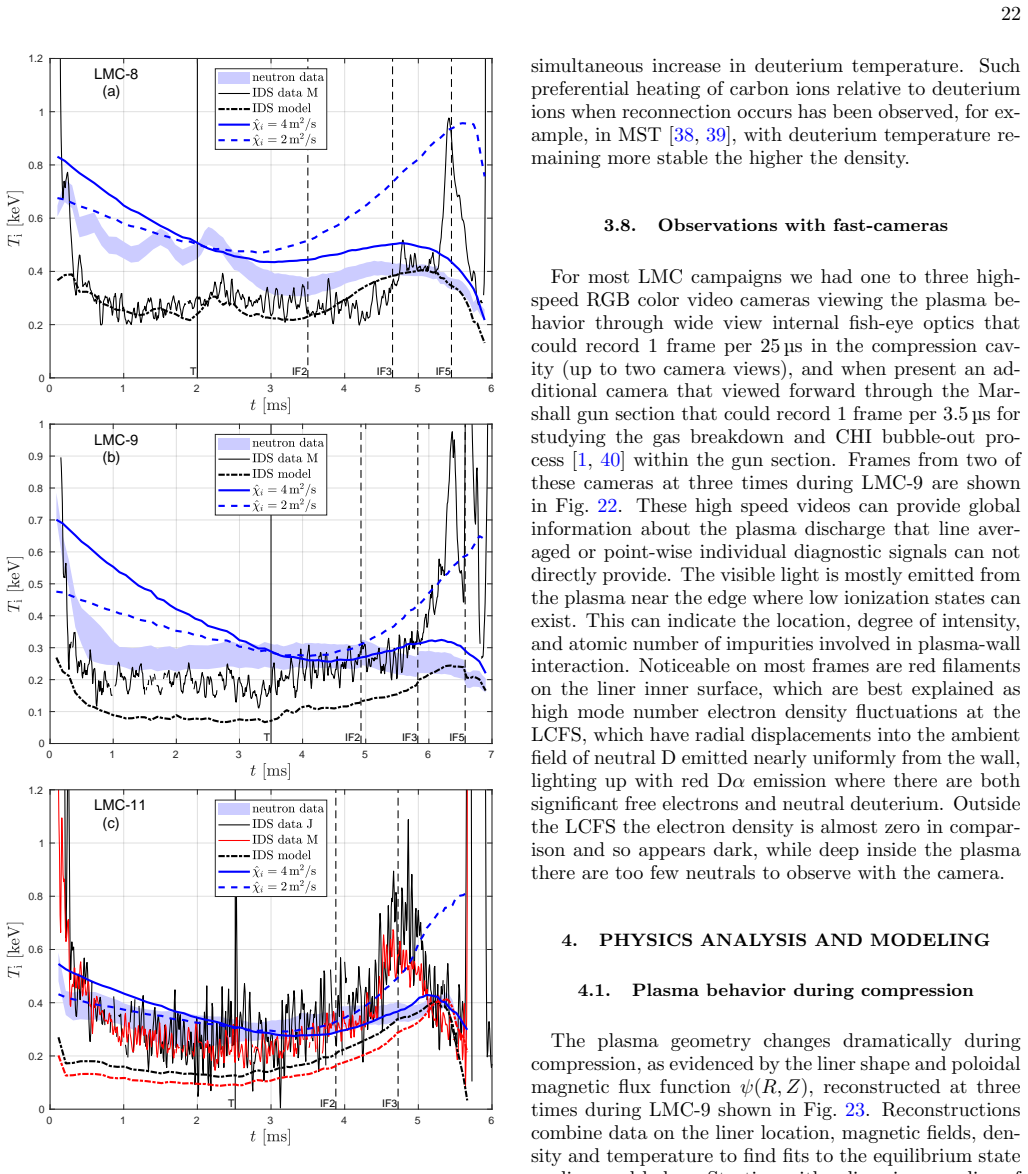
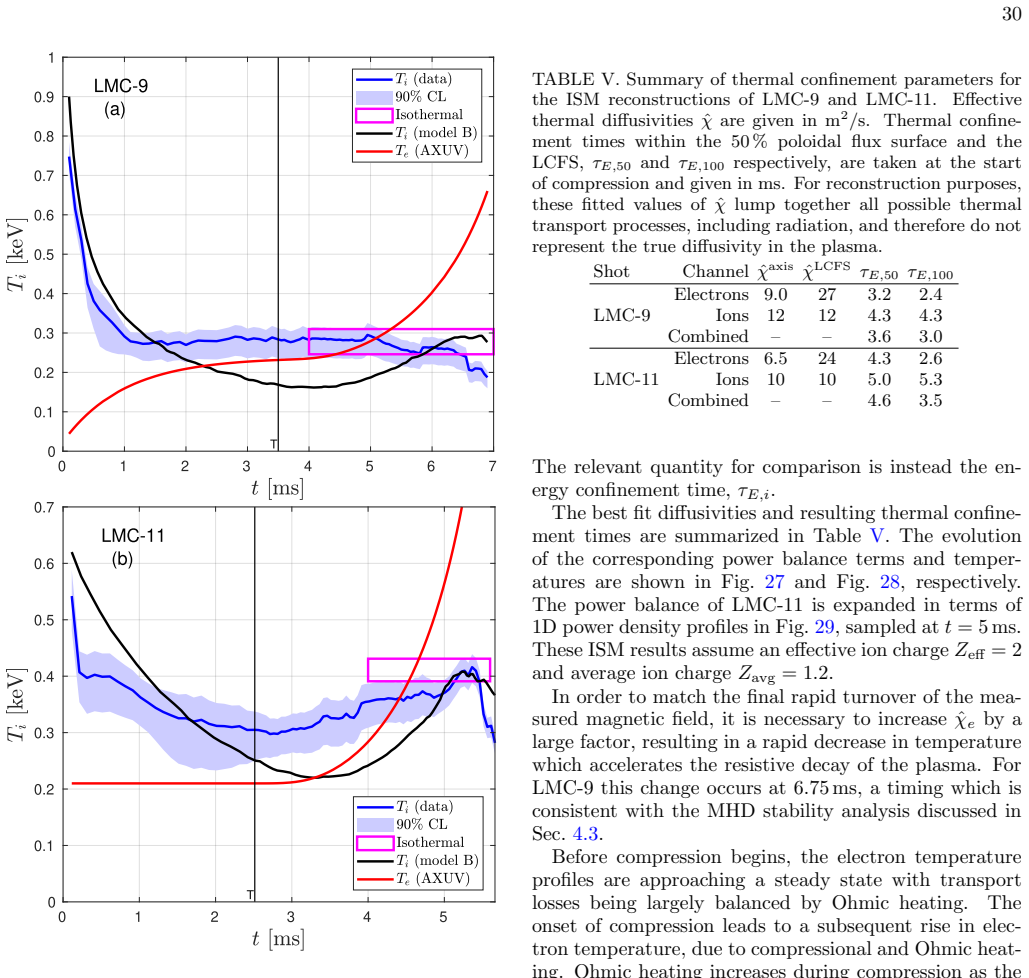
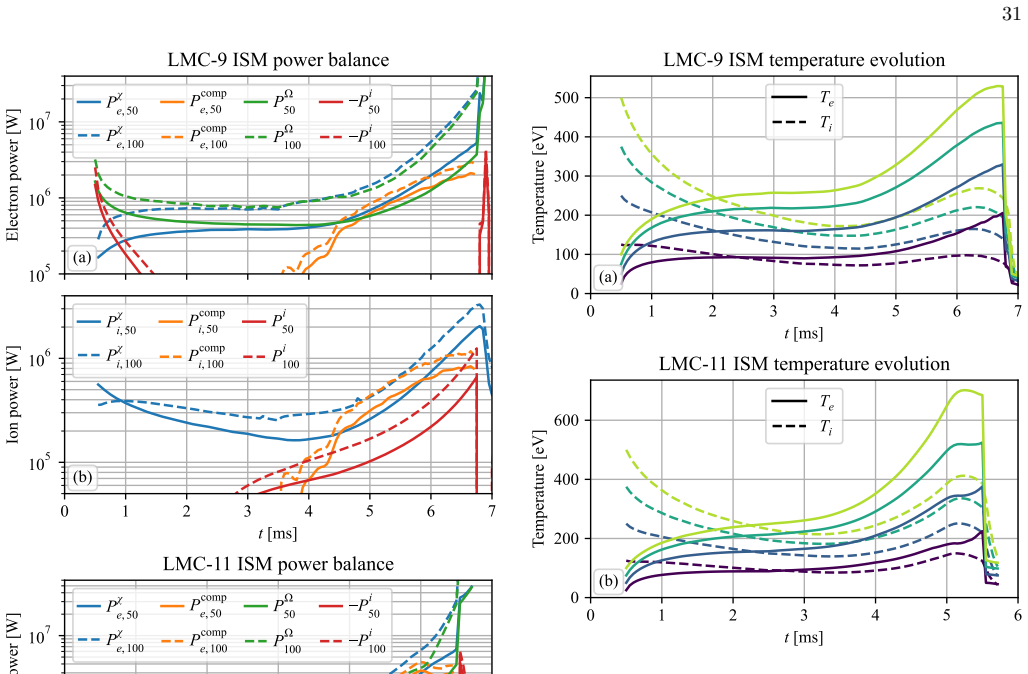
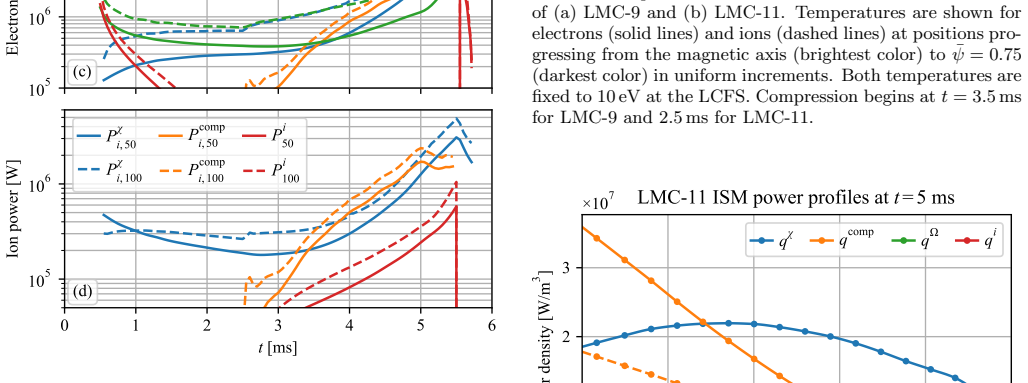
The central claim is that compressional heating was achieved. The integrated physics model balances heating power from compression, Ohmic heating from plasma current, and losses to the boundary; this three-term balance reproduces the measured temperature rise, with the majority of the increase attributable to compression work rather than other mechanisms. The same model supports the observed increases in neutron flux during compression.
What carries the argument
The integrated physics model that reconstructs the experimental equilibrium state versus time and partitions the energy balance into compression work, Ohmic heating, and boundary losses.
If this is right
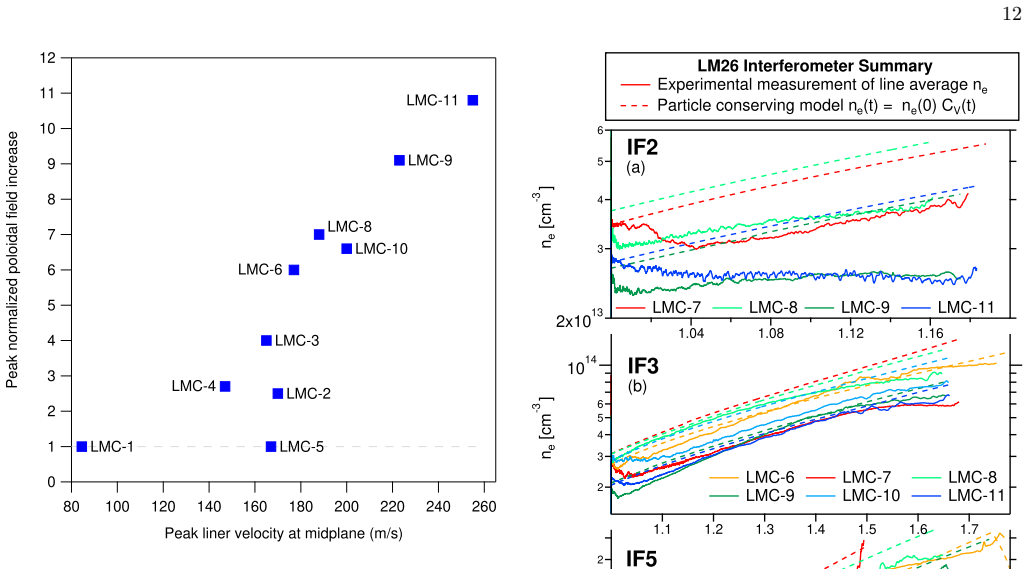
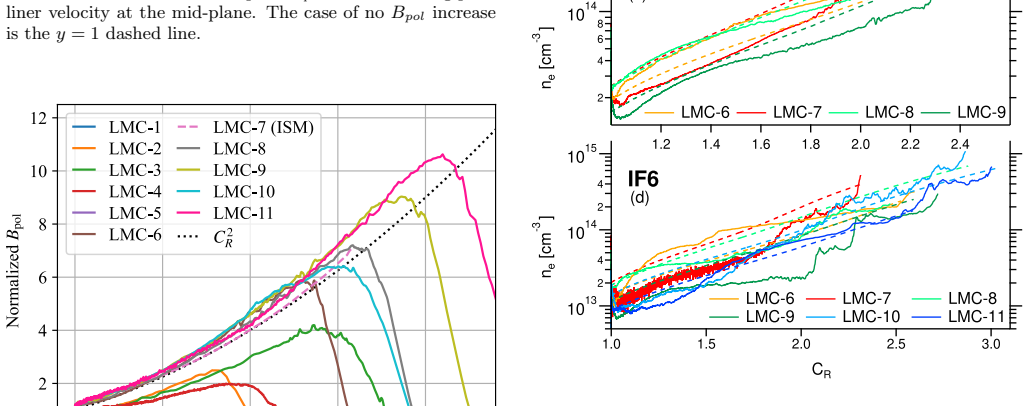
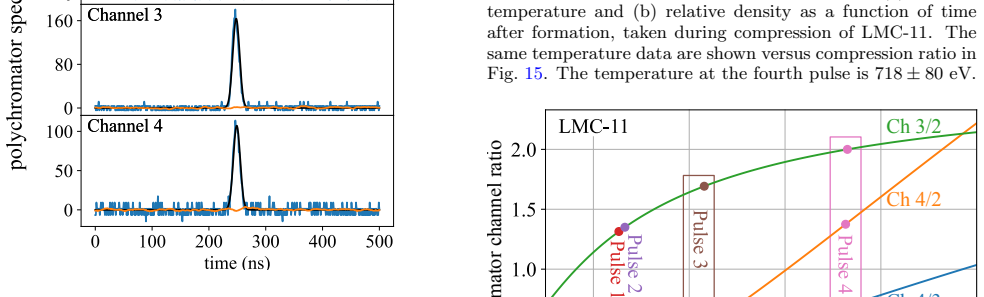
- The observed 3x radial compression produces >3x Te, 10x ne, and 10x B_pol in the best shots.
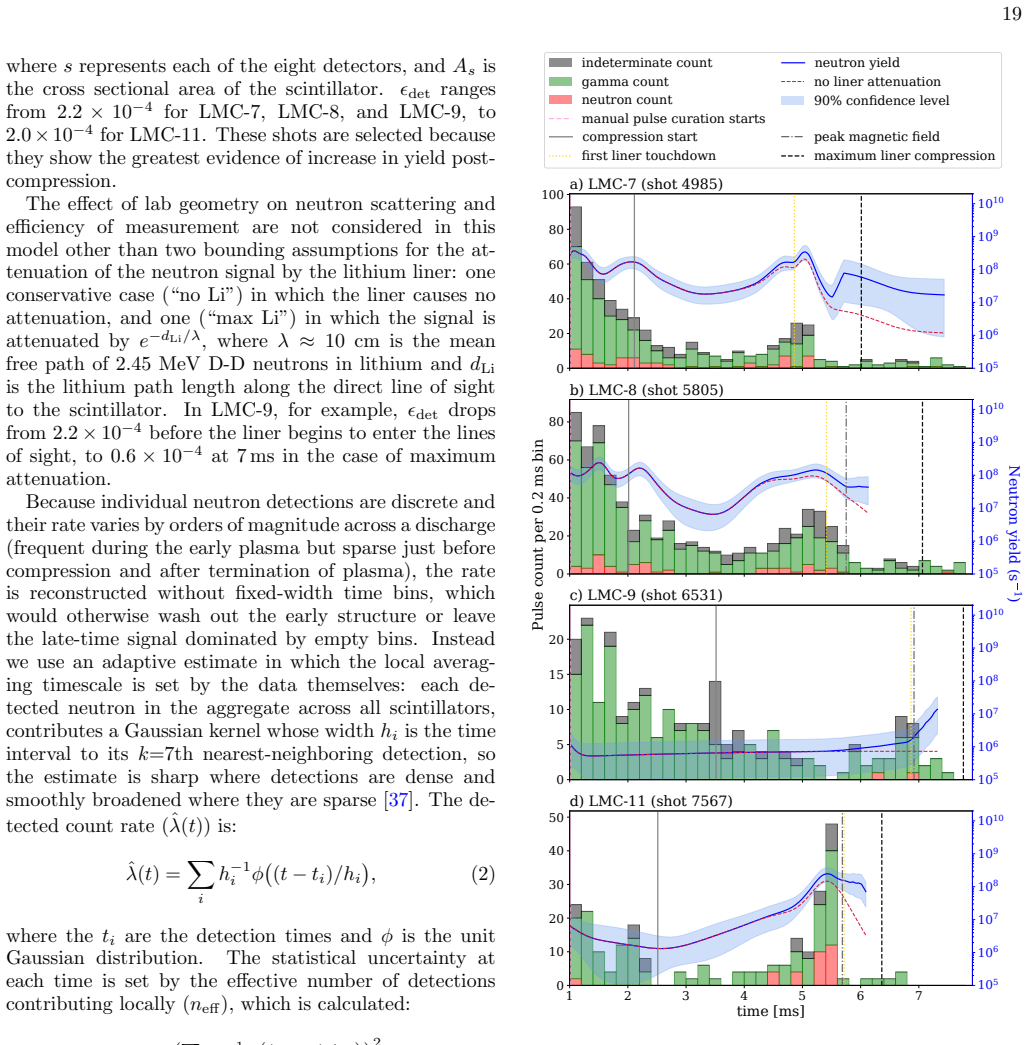
- Neutron flux rises during the compression phase.
- The same modeling framework supports stability and transport conclusions drawn from the shots.
- The data set provides a quantitative starting point for planned facility upgrades that increase final density and temperature.
Where Pith is reading between the lines
- If the compression scaling continues without new loss channels, further increases in liner velocity or initial plasma size could reach higher fusion-relevant parameters.
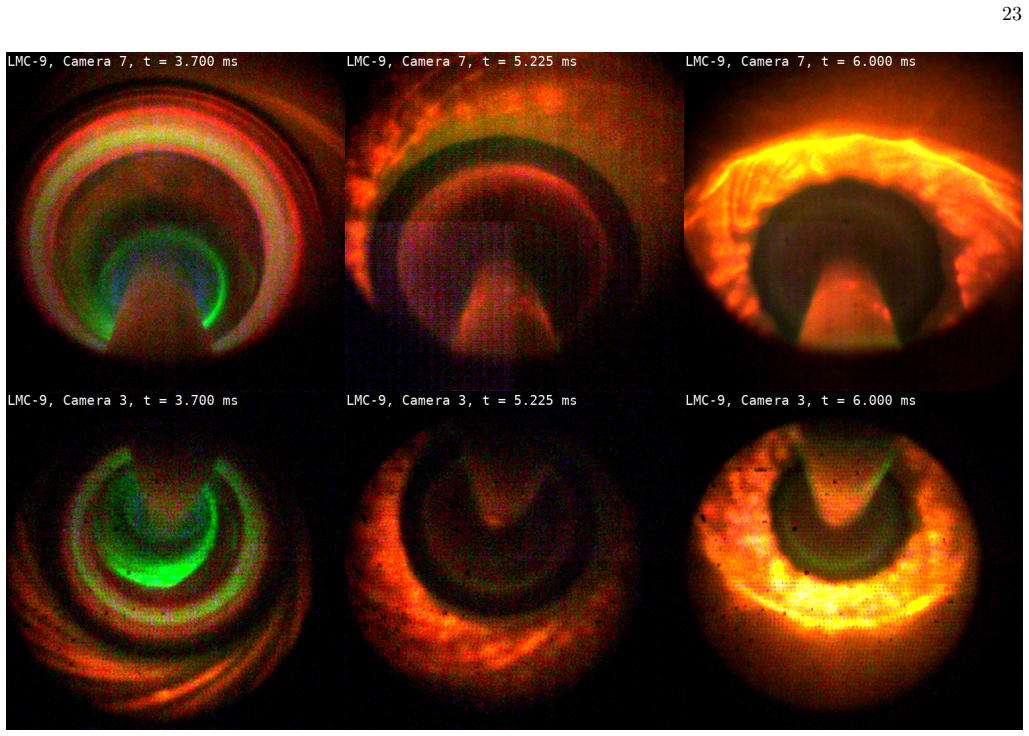
- Fast-camera images of plasma-wall interaction during compression supply spatial information that could be used to refine boundary-loss terms in future runs.
- The same liner-driven compression geometry might be tested on other spherical-tokamak or field-reversed configurations to isolate the role of initial magnetic geometry.
Load-bearing premise
Diagnostic measurements and the computational equilibrium reconstruction accurately capture the time-dependent plasma state, and the three-term energy balance contains every significant contribution.
What would settle it
A re-analysis of the same diagnostic data in which the observed temperature rise is fully reproduced by Ohmic heating and boundary losses alone, without any compression-work term, would falsify the central claim.
Figures

read the original abstract
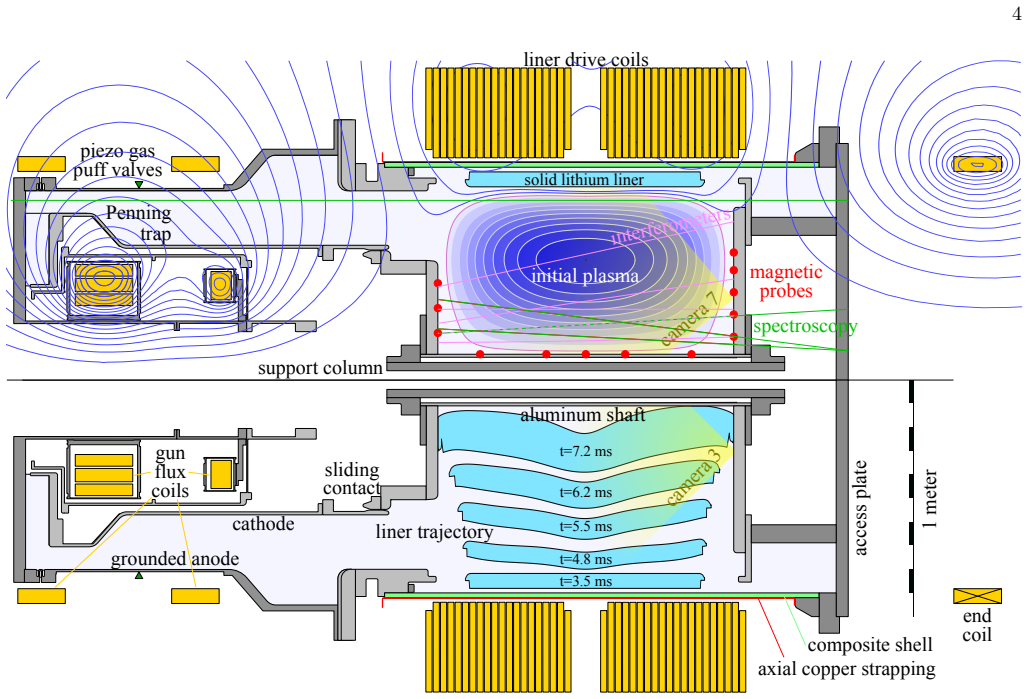
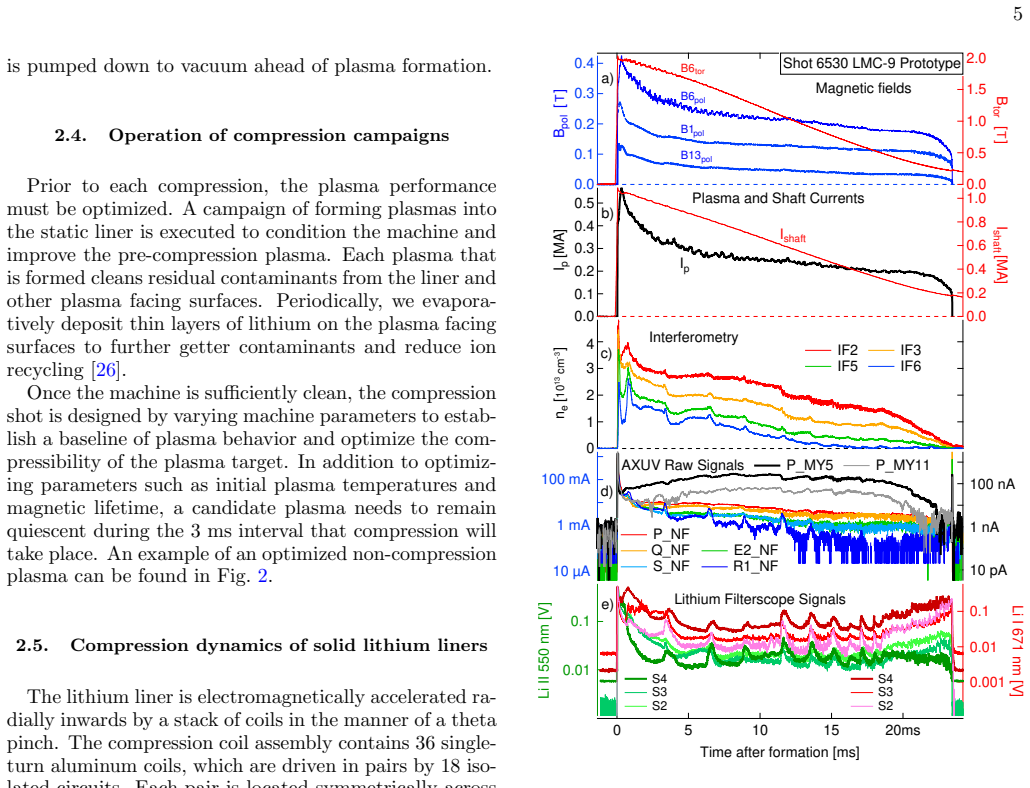
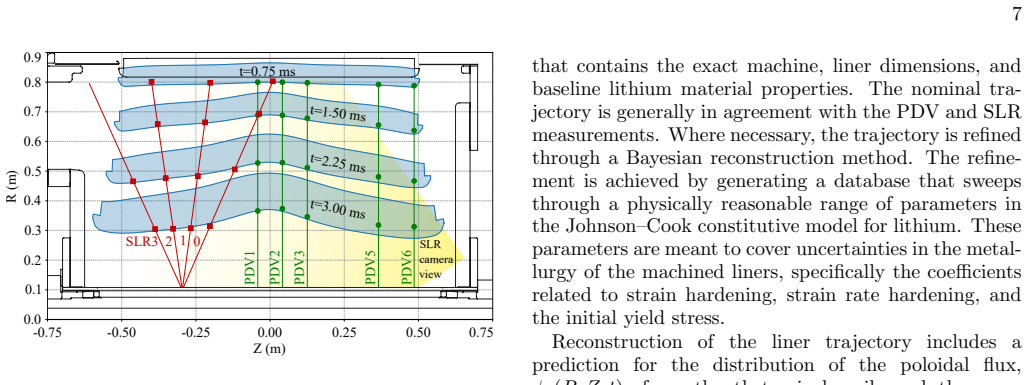
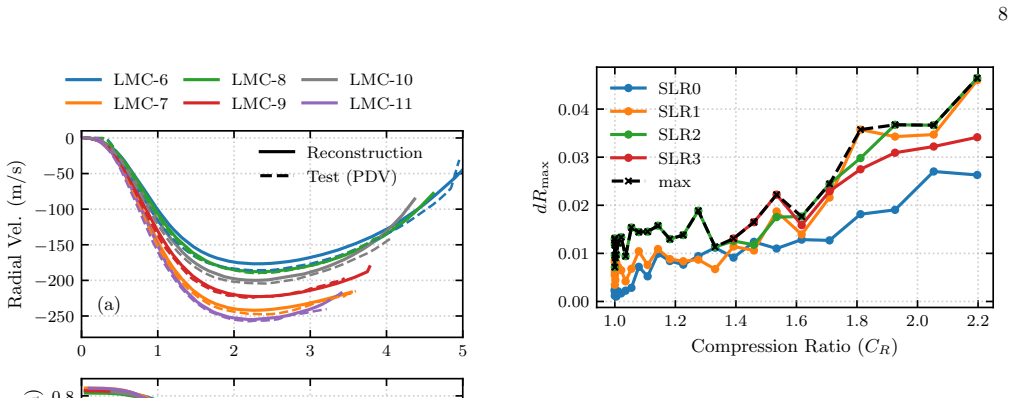
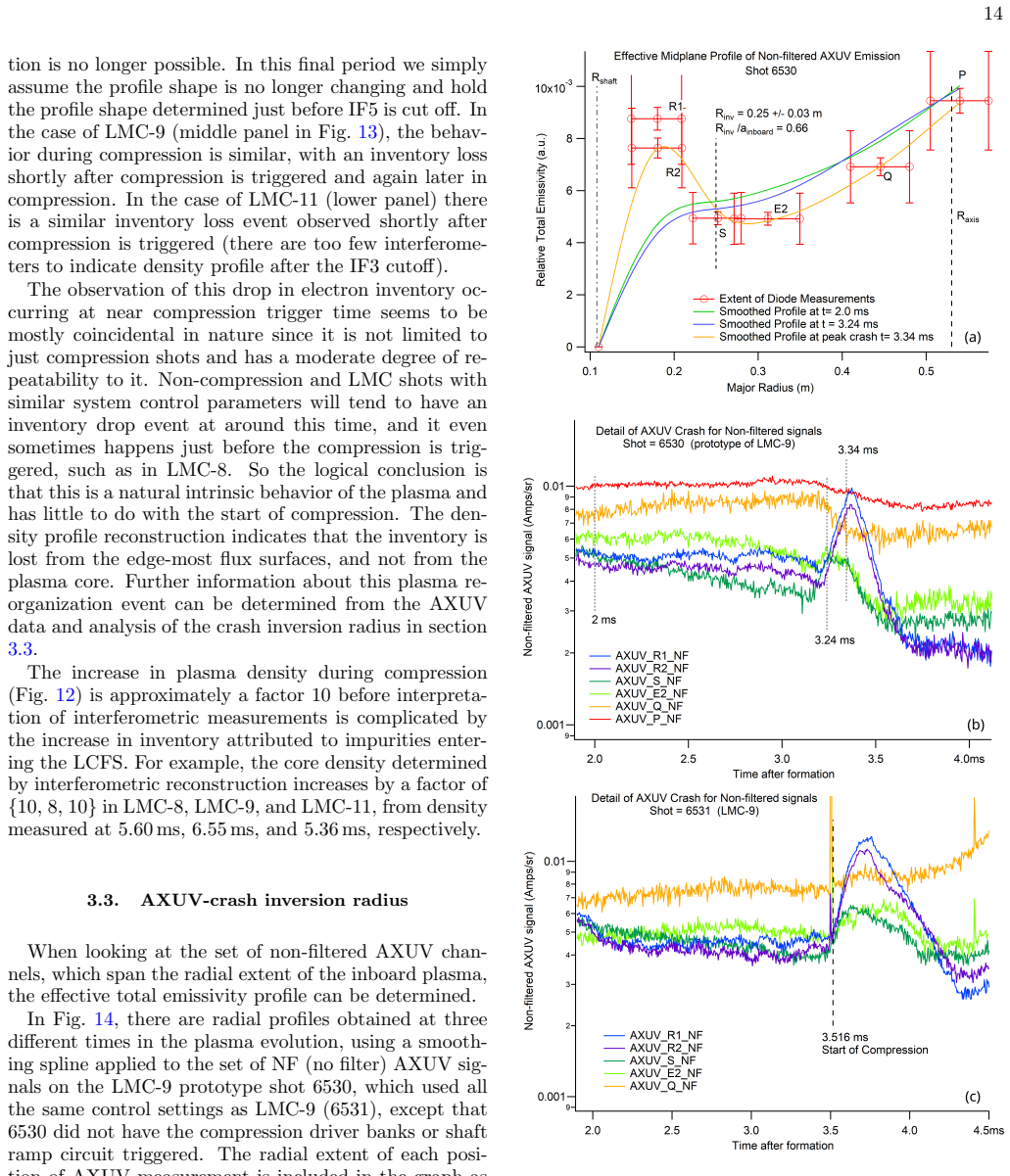
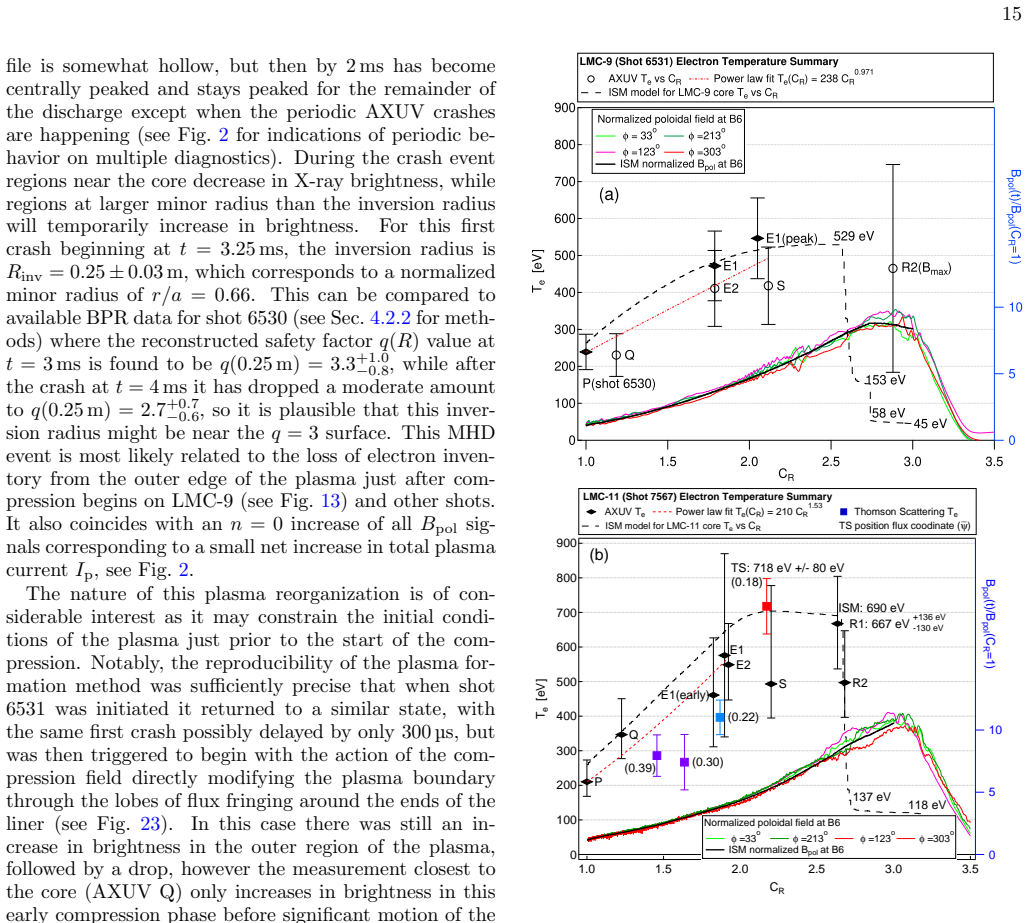
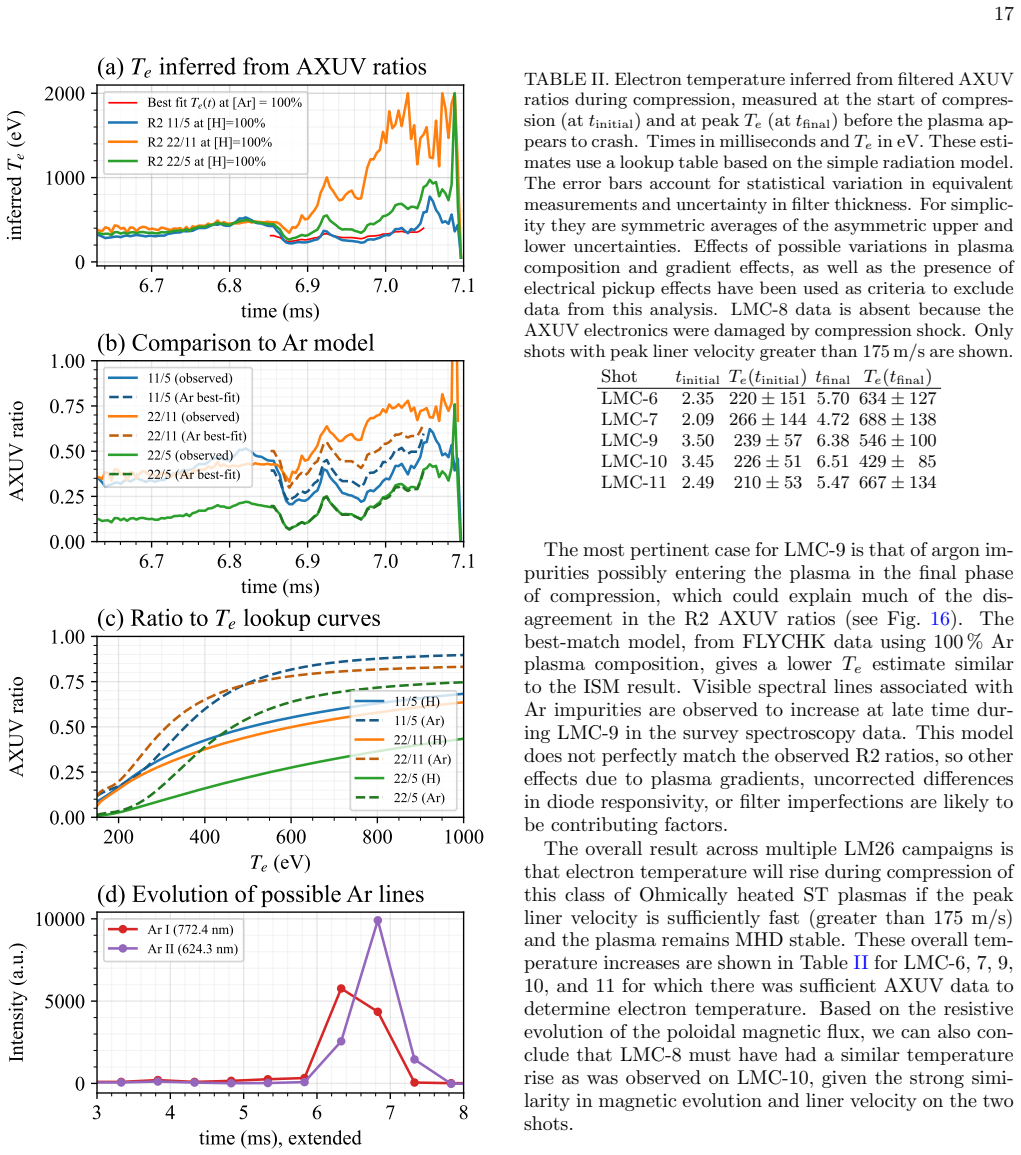
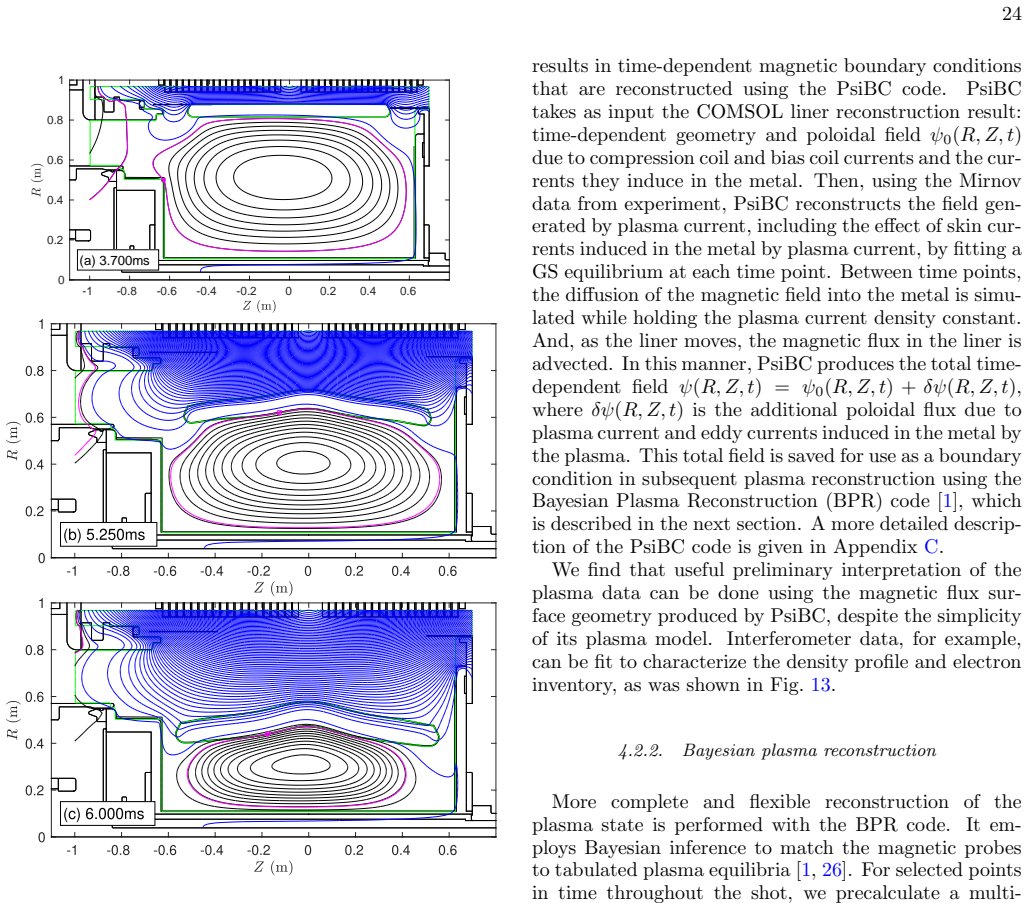
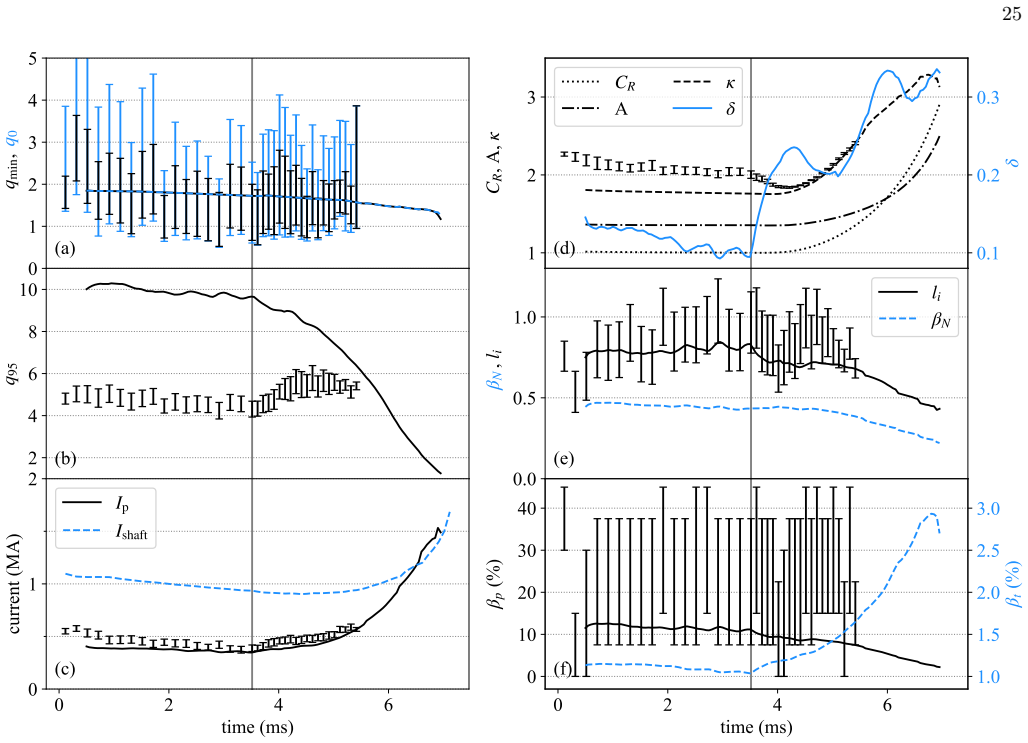
The Lawson Machine 26 (LM26) at General Fusion has demonstrated compressional heating of a spherical tokamak deuterium plasma as it was compressed by an imploding solid lithium liner. Results from the first 11 compression shots on LM26 are presented, the highest-performing of which show more than a 3x increase in $T_e$, a 10x increase in $n_e$, and a 10x increase in $B_{pol}$ within the plasma driven by 3x radial compression. The experimental device and instrumentation are reviewed in detail, followed by observations about the liner trajectory and evolution of plasma properties, including increases in emission of neutrons, X-rays, and visible radiation. Observations from fast-camera images during compression provide context for interpreting the spatial structure of plasma-wall interaction. Overviews of relevant models and analysis are presented. Diagnostic data are used to reconstruct the experimental equilibrium state in computational framework as a function of time. The results build confidence in the stability and transport analyses that support the primary conclusions. Trends across the full set of 11 compression shots are presented, and detailed examinations of the high-performance shots are given individually. The central conclusions of the integrated physics model specifically indicate that compressional heating was achieved in this set of experiments, as evidenced by the balance of heating power from compression, Ohmic heating from plasma current, and losses to the boundary needed to match the experimental data. A majority of the temperature rise is attributable to compressional heating. An increase in neutron flux is also observed during compression. The results provide a basis for planned improvements to the LM26 facility that will enable the compression of magnetized plasma to increasingly higher densities and temperatures.
Editorial analysis
A structured set of objections, weighed in public.
Referee Report
Summary. The paper reports results from the first 11 compression shots on the LM26 magnetized target fusion experiment at General Fusion. A spherical tokamak deuterium plasma is compressed radially by a factor of ~3 using an imploding solid lithium liner, yielding >3x increase in Te, 10x in ne, and 10x in B_pol in the best shots. Diagnostic data are used to reconstruct time-dependent equilibria; an integrated physics model balancing compressional work, Ohmic heating from plasma current, and boundary losses is fitted to the data and concludes that compressional heating accounts for the majority of the observed temperature rise. Neutron, X-ray, and visible emission increases are noted, along with fast-camera observations of plasma-wall interaction.
Significance. Demonstration of controlled compressional heating in a magnetized target fusion geometry would be a notable experimental result for the field, directly addressing a key physics question for liner-driven MTF concepts. The reported trends across 11 shots and the explicit attribution of heating fractions via a three-term energy balance provide a concrete data set against which future modeling and facility upgrades can be benchmarked.
major comments (2)
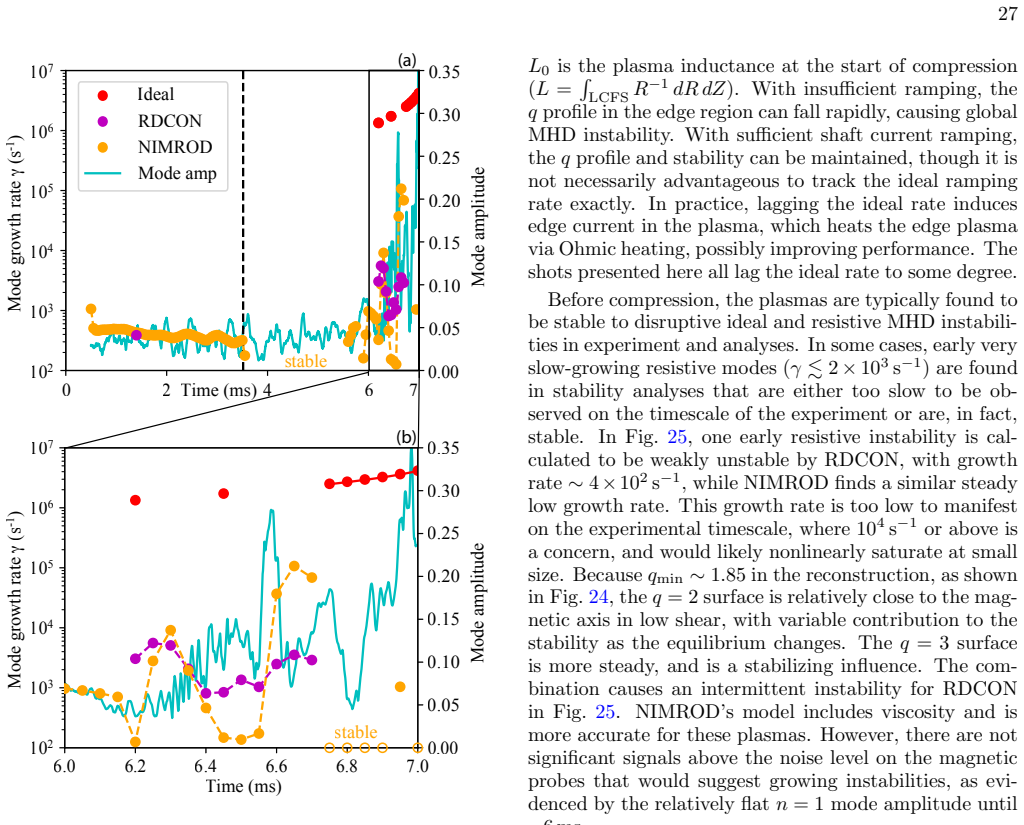
- [Abstract and models/analysis section] The central claim that compressional heating dominates the temperature rise rests on the integrated physics model matching the observed Te evolution after subtracting Ohmic heating and boundary losses. However, the manuscript provides no quantitative sensitivity analysis of the derived compression-heating fraction to plausible variations in the time-dependent equilibrium reconstruction (e.g., assumptions about axisymmetry, profile shapes, or diagnostic weighting) or to possible omitted terms such as impurity radiation or anomalous transport. This directly affects the load-bearing conclusion stated in the abstract.
- [Abstract and models/analysis section] The energy-balance attribution is obtained by fitting the three-term model to the same diagnostic time traces used to reconstruct the plasma state. No independent cross-check (e.g., direct measurement of compression work via liner trajectory and magnetic-flux conservation, or comparison against a null model without compression) is reported, raising the risk that the majority-compression conclusion is partly a consequence of model choice rather than an independent test.
minor comments (1)
- [Abstract] The abstract states that 'stability and transport analyses support the primary conclusions,' but no quantitative metrics (growth rates, transport coefficients, or comparison to data) are given in the provided text; these should be expanded with explicit references to figures or tables.
Simulated Author's Rebuttal
We thank the referee for their positive assessment of the significance of the LM26 results and for the constructive major comments. We address each point below and will revise the manuscript accordingly where appropriate.
read point-by-point responses
-
Referee: [Abstract and models/analysis section] The central claim that compressional heating dominates the temperature rise rests on the integrated physics model matching the observed Te evolution after subtracting Ohmic heating and boundary losses. However, the manuscript provides no quantitative sensitivity analysis of the derived compression-heating fraction to plausible variations in the time-dependent equilibrium reconstruction (e.g., assumptions about axisymmetry, profile shapes, or diagnostic weighting) or to possible omitted terms such as impurity radiation or anomalous transport. This directly affects the load-bearing conclusion stated in the abstract.
Authors: We agree that a quantitative sensitivity analysis is not presented in the current manuscript. The equilibrium reconstructions rely on standard assumptions for axisymmetry and profile shapes consistent with the diagnostic set, and the three-term energy balance omits explicit impurity radiation and anomalous transport terms. In the revised manuscript we will add an appendix or subsection performing sensitivity studies on the compression-heating fraction, including variations in diagnostic weighting, profile assumptions, and estimates of the magnitude of omitted terms. This will directly quantify the robustness of the majority-compression conclusion. revision: yes
-
Referee: [Abstract and models/analysis section] The energy-balance attribution is obtained by fitting the three-term model to the same diagnostic time traces used to reconstruct the plasma state. No independent cross-check (e.g., direct measurement of compression work via liner trajectory and magnetic-flux conservation, or comparison against a null model without compression) is reported, raising the risk that the majority-compression conclusion is partly a consequence of model choice rather than an independent test.
Authors: The integrated model is fitted to the reconstructed time traces, as noted. The liner trajectory is measured independently via imaging and is used to constrain the radial compression factor in the equilibrium reconstruction; magnetic-flux conservation is enforced in the equilibrium solver. However, a direct, separate calculation of compression work from liner dynamics alone or an explicit null-model comparison is not reported. We will add a short discussion clarifying the independent elements of the reconstruction and will include a comparison of the observed Te evolution against a simplified model with the compression term set to zero, to the extent the existing data permit. We acknowledge that a fully decoupled cross-check would strengthen the result but is limited by the current diagnostic suite. revision: partial
Circularity Check
No significant circularity in the derivation chain
full rationale
The paper reports direct experimental observations from 11 LM26 compression shots (increases in Te by >3x, ne and Bpol by 10x under 3x radial compression) together with diagnostic-based equilibrium reconstructions and a three-term energy balance model (compression work, Ohmic heating, boundary losses) that is adjusted to reproduce the measured time evolution. The central attribution that compressional heating accounts for the majority of the temperature rise is an output of that matching procedure applied to the observed data, not a self-referential definition or a fitted parameter relabeled as an independent prediction. No equations are shown that reduce the claimed result to its inputs by construction, no load-bearing self-citations are invoked to establish uniqueness, and the supporting stability/transport analyses are presented as external checks rather than tautological inputs. The derivation therefore remains self-contained against the reported measurements.
Axiom & Free-Parameter Ledger
axioms (2)
- domain assumption The computational framework accurately reconstructs the experimental equilibrium state as a function of time from the available diagnostics.
- domain assumption The three heating and loss channels (compression work, Ohmic heating, boundary losses) contain all significant contributions to the observed temperature evolution.
discussion (0)
Sign in with ORCID, Apple, or X to comment. Anyone can read and Pith papers without signing in.