On profinite rigidity, Grothendieck pairs, and the second homology of some 3-orbifold groups
Pith reviewed 2026-06-27 14:44 UTC · model grok-4.3
The pith
Lattices between the Weeks manifold fundamental group and its normalizer in PSL(2,C) are absolutely profinitely rigid, with some yielding Grothendieck pairs.
A machine-rendered reading of the paper's core claim, the machinery that carries it, and where it could break.
Core claim
The lattices between π1(W) and its normalizer in PSL2(C) are absolutely profinitely rigid. Moreover H2(Γ_O, Z) ≅ Z/2Z, and there exist lattices whose derived subgroup is Γ_O^1 with vanishing second homology, yielding Grothendieck pairs. The method computes these homologies explicitly for the relevant orbifold groups and also for some finite extensions of Fibonacci manifold groups.
What carries the argument
An effective algorithm for computing H2 of orbifold groups arising as finite extensions of the fundamental group of hyperbolic rational homology 3-spheres, which makes the general theoretical computability practical in this case.
If this is right
- All cocompact lattices between π1(W) and its normalizer are absolutely profinitely rigid.
- H2(Γ_O, Z) is isomorphic to Z/2Z.
- Certain lattices with derived subgroup Γ_O^1 have vanishing second homology and therefore yield Grothendieck pairs.
- The method also computes second homology for finite extensions by orientable isometries of Fibonacci manifold fundamental groups.
Where Pith is reading between the lines
- The effective H2 method may apply to other hyperbolic 3-orbifold groups satisfying the same extension hypothesis.
- The combination of rigidity and controlled homology could be used to produce further examples of groups with identical profinite completions.
Load-bearing premise
The orbifold groups in question arise as finite extensions of the fundamental group of a hyperbolic rational homology 3-sphere.
What would settle it
An explicit computation or construction showing that H2 of one of the lattices between π1(W) and its normalizer differs from the reported value, or that one such lattice shares its profinite completion with a non-isomorphic group.
Figures
read the original abstract
The second homology group is of central importance in the study of profinite rigidity of $3$-manifold groups. Although general and deep results imply that the integral homology of cocompact hyperbolic $3$-orbifold groups is computable in principle, the resulting algorithm is not practical. We develop an effective method for computing $H_2$ in the case of orbifold groups arising as finite extensions of the fundamental group of hyperbolic rational homology $3$-spheres. As a special case, this yields explicit computations of the second homology groups of all cocompact lattices between $\pi_1(\mathcal{W})$ and its normalizer in $\mathrm{PSL}_2(\mathbb C)$, where $\mathcal{W}$ is the Weeks manifold. We also show that these lattices are absolutely profinitely rigid, completing work by Bridson, McReynolds, Reid & Spitler in this setting. As a special case, we determine that $H_2(\Gamma_{\mathcal{O}}, \mathbb Z) \cong \mathbb{Z} / 2\mathbb{Z}$, where $\Gamma_{\mathcal{O}}$ is the normalizer of the group of units $\Gamma_{\mathcal{O}}^1$ in a choice of maximal order $\mathcal{O}$ of the quaternion algebra associated to $\mathcal{W}$, thereby answering a question of Bridson & Reid. Although this non-vanishing obstructs one possible construction of Grothendieck pairs in $\Gamma_{\mathcal{O}}^1 \times \Gamma_{\mathcal{O}}^1$, we use our computations to show the vanishing of the second homology of another lattice whose derived subgroup is $\Gamma_{\mathcal{O}}^1$, which then yields Grothendieck pairs in this direct product by a theorem of Bridson & Reid. Finally, to showcase the generality of the techniques, we also compute the second homology of some finite extensions by orientable isometries of the fundamental group of some Fibonacci manifolds $M_n$.
Editorial analysis
A structured set of objections, weighed in public.
Referee Report
Summary. The manuscript develops an effective algorithm for computing the second homology H_2(Γ, ℤ) of 3-orbifold groups Γ that are finite extensions of the fundamental group of a hyperbolic rational homology 3-sphere. It applies the algorithm to all cocompact lattices between π_1(W) and its normalizer in PSL_2(C), where W is the Weeks manifold, proving they are absolutely profinitely rigid. It computes H_2(Γ_O, ℤ) ≅ ℤ/2ℤ for the normalizer Γ_O of the unit group in a maximal order, answering a question of Bridson & Reid. Using a lattice with vanishing H_2 whose derived subgroup is Γ_O^1, it constructs Grothendieck pairs in the direct product. The method is also used to compute H_2 for some finite extensions of Fibonacci manifold groups.
Significance. If the algorithm and its applications are correct, the paper makes a significant contribution by providing a practical computational tool for homology in this class of groups, where general methods are not effective. It completes the profinite rigidity results for the Weeks lattices from prior work by Bridson et al., resolves an open question on the homology of Γ_O, and gives new examples of Grothendieck pairs via the Bridson-Reid theorem. The explicit computations and the generality shown with Fibonacci manifolds strengthen the case for the method's utility in the field of profinite rigidity of 3-manifold and orbifold groups.
minor comments (3)
- [Abstract] The abstract refers to computations for 'some Fibonacci manifolds M_n' without indicating the range of n or the number of cases treated; adding a short clause would clarify the scope of the generality claim.
- [Introduction (method paragraph)] The effective algorithm is described as relying on the finite-extension hypothesis for rational homology sphere orbifolds; a brief remark on why this hypothesis makes the computation practical (e.g., reduction to a finite check) would help readers follow the logic without consulting the cited prior works.
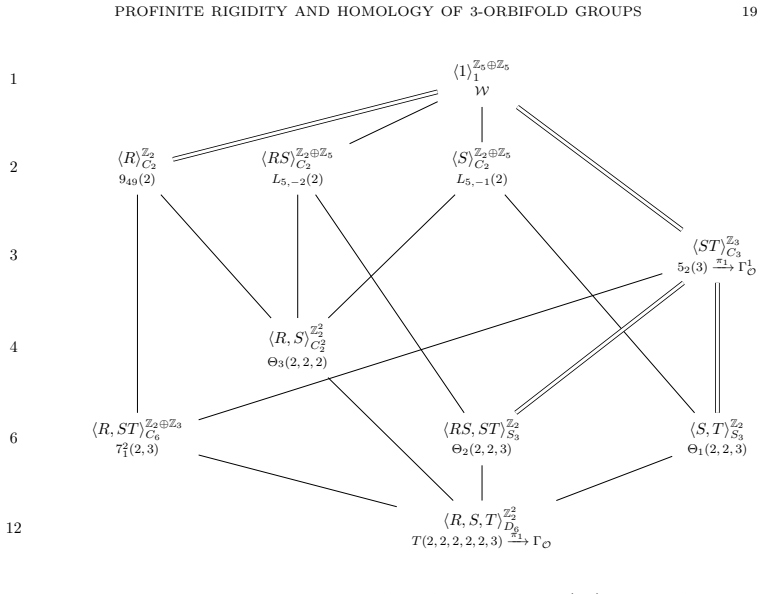
- [Preliminaries] Notation for the various lattices (e.g., Γ_O versus Γ_O^1) is introduced in the abstract and used throughout; a small table or diagram in the preliminaries section summarizing the inclusion relations and derived-subgroup relations would improve readability.
Simulated Author's Rebuttal
We thank the referee for their positive assessment of the manuscript, the accurate summary of its contributions, and the recommendation for minor revision. No specific major comments were raised.
Circularity Check
No significant circularity; derivation relies on new effective algorithm and external theorems
full rationale
The paper develops an original effective algorithm for computing H2(Γ, Z) specifically for orbifold groups that are finite extensions of fundamental groups of hyperbolic rational homology 3-spheres. It then applies this algorithm to concrete lattices (Weeks normalizer and Fibonacci extensions) to obtain explicit values such as H2(Γ_O, Z) ≅ Z/2Z. Rigidity statements complete prior external work by Bridson–McReynolds–Reid–Spitler, and Grothendieck-pair constructions invoke a theorem of Bridson & Reid. No load-bearing step reduces by definition, fitted parameter, or self-citation chain to the paper's own inputs; all central claims rest on independently verifiable computations and cited external results. The derivation is therefore self-contained against external benchmarks.
Axiom & Free-Parameter Ledger
axioms (1)
- standard math Standard theorems on the homology of groups and on profinite rigidity of hyperbolic 3-manifold groups
Reference graph
Works this paper leans on
-
[1]
Agol, Ian , TITLE =. Doc. Math. , FJOURNAL =. 2013 , PAGES =
2013
-
[2]
Anick, David J. , TITLE =. Trans. Amer. Math. Soc. , FJOURNAL =. 1986 , NUMBER =. doi:10.2307/2000383 , URL =
-
[3]
Compositio Math
Baumslag, Gilbert , TITLE =. Compositio Math. , FJOURNAL =. 1974 , PAGES =
1974
-
[4]
arXiv preprint , FJOURNAL =
Bridson, Martin and Reid, Alan , TITLE =. arXiv preprint , FJOURNAL =
-
[5]
Bridson, M. R. and McReynolds, D. B. and Reid, A. W. and Spitler, R. , TITLE =. Ann. of Math. (2) , FJOURNAL =. 2020 , NUMBER =. doi:10.4007/annals.2020.192.3.1 , URL =
-
[6]
Bridson, Martin R. and Grunewald, Fritz J. , TITLE =. Ann. of Math. (2) , FJOURNAL =. 2004 , NUMBER =. doi:10.4007/annals.2004.160.359 , URL =
-
[7]
, TITLE =
Brown, Kenneth S. , TITLE =. 1982 , PAGES =
1982
-
[8]
Book, Ronald V. and Otto, Friedrich , TITLE =. 1993 , PAGES =. doi:10.1007/978-1-4613-9771-7 , URL =
-
[9]
Borel, A. and Serre, J.-P. , TITLE =. Comment. Math. Helv. , FJOURNAL =. 1964 , PAGES =. doi:10.1007/BF02566948 , URL =
-
[10]
Bridson, M. R. and Reid, A. W. , TITLE =. Michigan Math. J. , FJOURNAL =. 2022 , PAGES =. doi:10.1307/mmj/20217218 , URL =
-
[11]
Button, J. O. , TITLE =. Experiment. Math. , FJOURNAL =. 2005 , NUMBER =
2005
-
[12]
1986 , PAGES =
Le Chenadec, Philippe , TITLE =. 1986 , PAGES =
1986
-
[13]
and Reid, Alan W
Chinburg, Ted and Friedman, Eduardo and Jones, Kerry N. and Reid, Alan W. , TITLE =. Ann. Scuola Norm. Sup. Pisa Cl. Sci. (4) , FJOURNAL =. 2001 , NUMBER =
2001
-
[14]
Conder, Marston , TITLE =. New Zealand J. Math. , FJOURNAL =. 2021 [2021--2022] , PAGES =. doi:10.53733/193 , URL =
-
[15]
Conway, John , TITLE =. Amer. Math. Monthly , FJOURNAL =. 1965 , PAGES =
1965
-
[16]
Dixon, John D. and Formanek, Edward W. and Poland, John C. and Ribes, Luis , TITLE =. J. Pure Appl. Algebra , FJOURNAL =. 1982 , NUMBER =. doi:10.1016/0022-4049(82)90098-6 , URL =
-
[17]
Gabai, David and Meyerhoff, Robert and Milley, Peter , TITLE =. J. Amer. Math. Soc. , FJOURNAL =. 2009 , NUMBER =. doi:10.1090/S0894-0347-09-00639-0 , URL =
-
[18]
Groves, J. R. J. and Smith, G. C. , TITLE =. Proc. Edinburgh Math. Soc. (2) , FJOURNAL =. 1993 , NUMBER =. doi:10.1017/S0013091500018381 , URL =
-
[19]
Grothendieck, Alexander , TITLE =. Manuscripta Math. , FJOURNAL =. 1970 , PAGES =. doi:10.1007/BF01719593 , URL =
-
[20]
Groves, J. R. J. , TITLE =. Groups---. 1990 , ISBN =. doi:10.1007/BFb0100735 , URL =
-
[21]
Grunewald, Fritz and Zalesskii, Pavel , TITLE =. J. Algebra , FJOURNAL =. 2011 , PAGES =. doi:10.1016/j.jalgebra.2010.05.018 , URL =
-
[22]
Guba, V. S. and Pride, S. J. , TITLE =. J. Pure Appl. Algebra , FJOURNAL =. 1996 , NUMBER =. doi:10.1016/0022-4049(95)00038-0 , URL =
-
[23]
Guba, V. S. and Pride, S. J. , TITLE =. Bull. London Math. Soc. , FJOURNAL =. 1998 , NUMBER =. doi:10.1112/S0024609398004676 , URL =
-
[24]
and Kim, A
Helling, H. and Kim, A. C. and Mennicke, J. L. , TITLE =. J. Lie Theory , FJOURNAL =. 1998 , NUMBER =
1998
-
[25]
Hermiller, Susan M. , TITLE =. J. Pure Appl. Algebra , FJOURNAL =. 1994 , NUMBER =. doi:10.1016/0022-4049(94)90019-1 , URL =
-
[26]
Hermiller, Susan and Meier, John , TITLE =. J. Algebra , FJOURNAL =. 1995 , NUMBER =. doi:10.1006/jabr.1995.1010 , URL =
-
[27]
Hermiller, Susan M. and Meier, John , TITLE =. J. Pure Appl. Algebra , FJOURNAL =. 1999 , NUMBER =. doi:10.1016/S0022-4049(97)00171-0 , URL =
-
[28]
Hermiller, Susan and Shapiro, Michael , TITLE =. Geom. Dedicata , FJOURNAL =. 1999 , NUMBER =. doi:10.1023/A:1005064309732 , URL =
-
[29]
and Lozano, Mar\'
Hilden, Hugh M. and Lozano, Mar\'. The arithmeticity of the figure eight knot orbifolds , BOOKTITLE =. 1992 , ISBN =
1992
-
[30]
and Weeks, Jeffrey R
Hodgson, Craig D. and Weeks, Jeffrey R. , TITLE =. Experiment. Math. , FJOURNAL =. 1994 , NUMBER =
1994
-
[31]
Howie, James and Williams, Gerald , TITLE =. Topology Appl. , FJOURNAL =. 2017 , PAGES =. doi:10.1016/j.topol.2016.10.012 , URL =
-
[32]
Kobayashi, Yuji , TITLE =. J. Pure Appl. Algebra , FJOURNAL =. 1990 , NUMBER =. doi:10.1016/0022-4049(90)90106-R , URL =
-
[33]
Kobayashi, Yuji , TITLE =. Internat. J. Algebra Comput. , FJOURNAL =. 2007 , NUMBER =. doi:10.1142/S0218196707003743 , URL =
-
[34]
Liu, Yi , TITLE =. Invent. Math. , FJOURNAL =. 2023 , NUMBER =. doi:10.1007/s00222-022-01155-4 , URL =
-
[35]
Maclachlan, C. and Reid, A. W. , TITLE =. Transform. Groups , FJOURNAL =. 1997 , NUMBER =. doi:10.1007/BF01235939 , URL =
-
[36]
Maclachlan, Colin and Reid, Alan W. , TITLE =. 2003 , PAGES =. doi:10.1007/978-1-4757-6720-9 , URL =
-
[37]
Matveev, S. V. and Fomenko, A. T. , TITLE =. Uspekhi Mat. Nauk , FJOURNAL =. 1988 , NUMBER =. doi:10.1070/RM1988v043n01ABEH001554 , URL =
-
[38]
1966 , PAGES =
Magnus, Wilhelm and Karrass, Abraham and Solitar, Donald , TITLE =. 1966 , PAGES =
1966
-
[39]
Mednykh, Alexander and Vesnin, Andrei , TITLE =. J. Lie Theory , FJOURNAL =. 1998 , NUMBER =
1998
-
[40]
2014 , PAGES =
Morgan, John and Tian, Gang , TITLE =. 2014 , PAGES =
2014
-
[41]
Mostow, G. D. , TITLE =. Inst. Hautes \'. 1968 , PAGES =
1968
-
[42]
Newman, M. H. A. , TITLE =. Ann. of Math. (2) , FJOURNAL =. 1942 , PAGES =. doi:10.2307/1968867 , URL =
-
[43]
Nikolov, Nikolay and Segal, Dan , TITLE =. Ann. of Math. (2) , FJOURNAL =. 2007 , NUMBER =. doi:10.4007/annals.2007.165.171 , URL =
-
[44]
Nikolov, Nikolay and Segal, Dan , TITLE =. New Zealand J. Math. , FJOURNAL =. 2021 [2021--2022] , PAGES =. doi:10.53733/89 , URL =
work page doi:10.53733/89 2021
-
[45]
Noskov, G. A. and Remeslennikov, V. N. and Roman'kov, V. A. , TITLE =. Algebra. 1979 , MRCLASS =
1979
-
[46]
Paoluzzi, Luisa and Zimmermann, Bruno , TITLE =. Rend. Istit. Mat. Univ. Trieste , FJOURNAL =. 2001 , NUMBER =
2001
-
[47]
arXiv preprint , FJOURNAL =
Perelman, Grisha , TITLE =. arXiv preprint , FJOURNAL =
-
[48]
Pickel, P. F. , TITLE =. Trans. Amer. Math. Soc. , FJOURNAL =. 1971 , PAGES =. doi:10.2307/1995809 , URL =
-
[49]
Pickel, P. F. , TITLE =. Trans. Amer. Math. Soc. , FJOURNAL =. 1973 , PAGES =. doi:10.2307/1996471 , URL =
-
[50]
Pickel, P. F. , TITLE =. Bull. Austral. Math. Soc. , FJOURNAL =. 1974 , PAGES =. doi:10.1017/S0004972700043689 , URL =
-
[51]
Platonov, V. P. and Tavgen' , O. I. , TITLE =. Dokl. Akad. Nauk SSSR , FJOURNAL =. 1986 , NUMBER =
1986
-
[52]
Prasad, Gopal , TITLE =. Invent. Math. , FJOURNAL =. 1973 , PAGES =. doi:10.1007/BF01418789 , URL =
-
[53]
, TITLE =
Rotman, Joseph J. , TITLE =. 1979 , PAGES =
1979
-
[54]
Squier, Craig C. , TITLE =. J. Pure Appl. Algebra , FJOURNAL =. 1987 , NUMBER =. doi:10.1016/0022-4049(87)90129-0 , URL =
-
[55]
, TITLE =
Thurston, William P. , TITLE =. Princeton lecture notes , FJOURNAL =
-
[56]
Vesnin, A. Yu. and Mednykh, A. D. , TITLE =. Sibirsk. Mat. Zh. , FJOURNAL =. 1995 , NUMBER =. doi:10.1007/BF02110146 , URL =
-
[57]
Vesnin, A. Yu. and Rasskazov, A. A. , TITLE =. Sibirsk. Mat. Zh. , FJOURNAL =. 1999 , NUMBER =. doi:10.1007/BF02674286 , URL =
-
[58]
Bridson, Martin R. and McReynolds, D. B. and Reid, Alan W. and Spitler, Ryan , TITLE =. Bull. Lond. Math. Soc. , FJOURNAL =. 2021 , NUMBER =. doi:10.1112/blms.12546 , URL =
-
[59]
, TITLE =
Wise, Daniel T. , TITLE =. [2021] 2021 , PAGES =
2021
-
[60]
Xu, Xiaoyu , TITLE =. Adv. Math. , FJOURNAL =. 2025 , NUMBER =. doi:10.1016/j.aim.2025.110505 , URL =
discussion (0)
Sign in with ORCID, Apple, or X to comment. Anyone can read and Pith papers without signing in.