REVIEW 2 major objections 4 minor 71 references
Toward Human-Quantum Computer Interaction: Interface Techniques for Usable Quantum Computing
T0 review · 2 major / 4 minor · reviewed 2026-08-09 · deepseek-v4-flash
Pith's one-line read The paper claims that embedding interaction techniques into computational notebooks can make quantum computing usable by beginners and domain experts alike.
desk verdict A well-scoped design exploration with shipped code; the utility claim runs ahead of the evidence, but the feasibility and integration story hold up. read the letter →
The pith
A machine-rendered reading of the paper's core claim, the machinery that carries it, and where it could break.
The reading
What carries the argument
The central object is a set of high-fidelity notebook widgets (a circuit writer, machine explorer, circuit viewer, and result viewer) built as interactive components for computational notebooks. The mechanism that carries the argument is the integration of these widgets into the existing notebook workflow: problem-oriented circuit writing encapsulates low-level gate encoding behind conceptual inputs (e.g., integers, images, truth tables) and automates qubit selection; the circuit viewer uses a greedy logical-to-physical gate mapping to support cross-highlighting and computes layer-wise and cumulative estimated success probability; the result viewer streams state-vector counts in chunks to avoid browser memory limits and applies Monte-Carlo simulation to generate hypothetical error-adjusted counts with confidence intervals; and a job-data API bundles circuit, machine properties, and results into a shareable object.
What would settle it
A controlled user study comparing the prototypes against existing QC tooling on representative tasks (writing a Shor circuit, selecting a machine, comparing optimizations, interpreting results) would settle the utility claim; if participants are not faster, make fewer errors, or report lower workload with the prototypes, the central claim fails.
Extended reading notes
Core claim
The paper claims that usable quantum computing interfaces are attainable by integrating interaction techniques directly into the computational notebook environment where QC developers already work, rather than relying on separate dashboards or standalone tools. Anchored by three design principles—linking conceptual ideas to low-level quantum information, supporting different levels of computing detail, and applying established usability standards—the work contributes a suite of techniques: problem-oriented circuit writing with automated qubit selection and verification, a machine explorer with time-serial property data and reusable code snippets, a circuit viewer that links logical and physical circuits with cross-highlighting and fidelity (estimated success probability) overlays, and a result viewer that streams large outputs, visualizes measurements as integers, images, or truth tables, and offers Monte-Carlo-based hypothetical error adjustment. The paper demonstrates these techniques through three use cases with high-fidelity prototypes in computational notebooks, arguing that the prototypes show both technical soundness and practical utility.
Load-bearing premise
The load-bearing premise is that the proposed interfaces will actually be easier and more useful for QC beginners and domain experts than the current tooling; the paper infers this utility from three self-authored use cases rather than measuring it with representative users.
Editorial extensions
If this is right
- Beginners can run algorithms like Shor's on real hardware without manually encoding factors into low-level gates, because the circuit writer accepts conceptual inputs and auto-selects qubits.
- Machine selection no longer requires switching between an IDE and external dashboards, since the machine explorer shows time-serial QPU properties inside the notebook and exports reusable code.
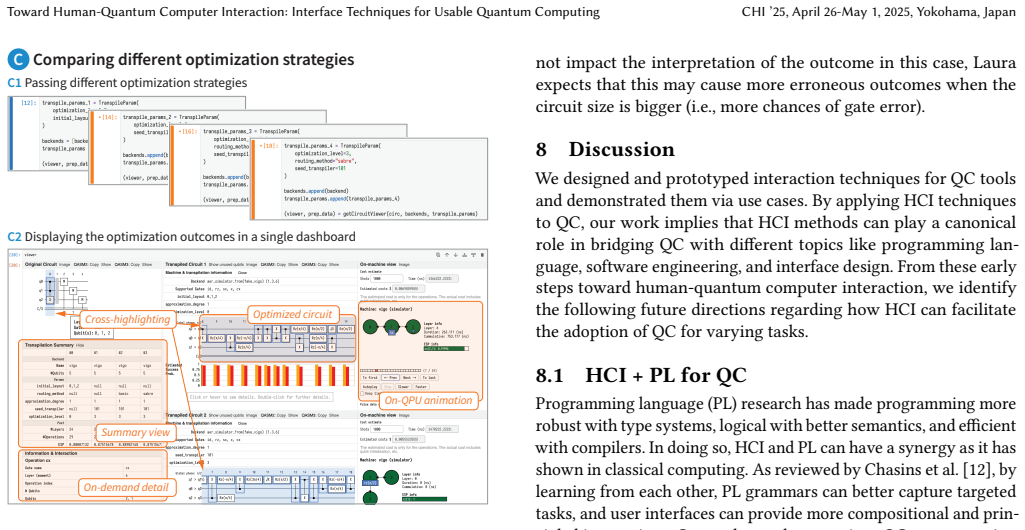
- Researchers can compare multiple optimization outcomes side by side, using cross-highlighting and fidelity metrics, to make informed choices about transpilation strategies.
- QC results can be interpreted directly in problem terms (numbers, images, truth tables) with uncertainty information, rather than raw bit-string histograms.
- Sharing and replication become easier because job data (circuit, machine properties, results) can be saved to a file and retrieved, and a simulator can be reconstructed from saved machine properties.
Reading between the lines
- If the techniques prove effective in controlled studies, they could be generalized to other QC toolkits beyond the one used for prototyping, provided standardized data representations for circuits, machine properties, and job results are adopted.
- The Monte-Carlo error adjustment could double as a benchmarking tool for comparing QPU noise profiles, since it yields confidence intervals that quantify how much measured counts might shift under gate errors.
- The problem-oriented circuit writing approach suggests a path toward domain-specific quantum tools—e.g., chemistry or physics interfaces that let users specify molecules or systems and receive outputs in domain terms.
- The techniques' usefulness for beginners is currently inferred from use cases; a testable next step is a user study comparing task completion and error rates against existing QC toolkits.
Editorial analysis
A structured set of objections, weighed in public.
Referee Report
Summary. The paper proposes interaction techniques for quantum computing (QC) interfaces, implemented as high-fidelity Jupyter Notebook widgets, and demonstrates them through three designer-authored use cases. The techniques span circuit composition, machine selection, optimization review, and result analysis, and are motivated by a survey of ten QC tools, an iterative design process by a team of one HCI researcher and two QC researchers, and three design principles (P1-P3). The manuscript also includes an open-source implementation ('patoka') and discusses future directions for HCI and PL research, interoperable representations, domain-specific tools, and evaluation methods.
Significance. If the contribution is taken as a design and feasibility exploration, the paper has clear strengths: it ships open-source code and demo notebooks, grounds the design in a structured tool survey, spans the QC lifecycle rather than a single task, and includes a use case that runs against IBM Q Cloud, which supports technical feasibility. The paper also explicitly acknowledges in Sections 8.4 and 8.5 that dedicated user studies are needed. However, the abstract and introduction claim to demonstrate 'feasibility and utility' for QC beginners and domain experts, and that utility claim is not supported by the evidence presented: the three use cases are authored by the same team, reflect the team's own challenges from Section 4.2, and are not compared against existing Qiskit/IDE workflows or evaluated with representative users. Thus the central claim, as currently worded, is stronger than the evidence.
major comments (2)
- [Abstract and Section 7; Sections 8.4-8.5] The claim that the techniques are demonstrated to have 'feasibility and utility' is only partially supported. The use cases in Section 7 are narratives written by the authors based on their own experiences described in Section 4.2, so they demonstrate that the designers can complete tasks with their own tools, but not that actual QC beginners or domain experts find the interfaces learnable, efficient, or less error-prone than existing tooling. The manuscript itself concedes in Section 8.4 that 'each interface in our work would need a designated user study for further evaluation' and in Section 8.5 that 'user evaluation-based future research will benefit extending our approaches.' This is a load-bearing gap for the utility half of the central claim. I recommend either adding a controlled user study with representative users and baseline tools, or revising the abstract and introduction to claim feasibility and designer-illustrated utility only.
- [Section 6.5, T4c and Figure 5] The 'hypothetical error adjustment' technique is not specified in enough detail to be assessed. The text says that Monte-Carlo simulation approximates gate errors, but it does not state the sampling model, how gate error rates enter the simulation, how the confidence intervals are computed, or how the method is validated. The claim that the visualization can help developers assess whether they ran enough shots depends on the correctness of this procedure. Please provide the full algorithmic specification (in the main text or a complete supplementary appendix) and at least a sanity-check comparison against known-error simulations.
minor comments (4)
- [Figure captions, Figures 8-11] The cross-references in the figure captions are inconsistent with the section numbering: Figure 8 is captioned as Section 7.3 but describes Case 2 (Section 7.2), and Figures 9-11 are captioned as Section 7.2 but describe Case 3 (Section 7.3).
- [Section 7.1 and Section 6.5] The technique labels are inconsistent: the text in Section 7.1 refers to T5a, T5b, T5d, and T5e, while Section 6.5 defines the corresponding techniques as T4a-T4f. Please unify the numbering.
- [Section 5, P1; Section 7.3; References] There are several typos: 'interger' should be 'integer' in Section 5 (P1); 'Simpliy' should be 'Simply' in Section 7.3; 'NVDIA' should be 'NVIDIA' in Table 1 and reference [49]; and 'PenyLane' should be 'PennyLane' in reference [71].
- [Section 7.1] In Case 1, 'James sets a base factor to 7 and a divider to 15' uses the term 'divider' where 'divisor' (or 'the number to factor') is the intended meaning. Please clarify the terminology.
Circularity Check
No significant circularity: the design principles and techniques are grounded in an independent tool survey and open-source prototypes, and the utility claim rests on acknowledged self-authored use cases, which is an evidence limitation rather than a derivation loop.
full rationale
This is an HCI systems/design paper, not a mathematical derivation, so most of the enumerated circularity patterns do not apply. There is no quantity defined in terms of another that is then 'predicted'; no fitted parameters are renamed as predictions; no uniqueness theorem is imported from the authors' prior work; and no ansatz is smuggled in via self-citation. The central design principles (P1-P3) are derived from a survey of ten external QC tools and from prior published work by others (e.g., Ashktorab et al. [4], QuFlow [34], QuantumEyes [54], VACSEN [56], VIOLET [55], VENUS [57], Quantivine [67]), not from a self-citation chain. The interface techniques are implemented as open-sourced prototypes whose feasibility is independently checkable through the public repository, demo notebooks, and integration with real external artifacts such as Qiskit and IBM Q Cloud. The main weakness is that the utility claim is demonstrated through three self-authored use cases that 'represent our prior QC usages and challenges' (Section 7), and the authors explicitly concede in Sections 8.4 and 8.5 that 'each interface in our work would need a designated user study for further evaluation' and that 'user evaluation-based future research will benefit extending our approaches.' That is a limitation in the strength of the utility evidence, not circularity: the authors do not claim to derive the utility from a definition or from a fitted model; they present designer-authored scenarios as illustrative demonstrations and acknowledge their evidentiary limits. The two self-citations present in the paper ([28] for image convolution, [30] for a sonification grammar example) are ancillary references to prior published work, not load-bearing justifications for the paper's central claim. Therefore, no circular step can be exhibited with the required specificity, and the appropriate finding is no significant circularity.
Assumptions & free parameters
assumptions (5)
- domain assumption Computational notebooks are the primary working environment for quantum computing developers.
- domain assumption The design principles P1-P3 derived from a three-month iterative design process are general enough to guide QC interface design.
- domain assumption Estimated Success Probability (ESP), defined as the product of (1 - error) over all gates in a physical circuit, is a meaningful proxy for circuit fidelity.
- domain assumption Monte Carlo simulation using machine-reported gate error rates appropriately approximates the uncertainty of quantum measurement outcomes.
- domain assumption Qiskit is representative enough of quantum computing tools to build and evaluate the proposed interfaces.
Cite this review
Pith. "Pith review of Toward Human-Quantum Computer Interaction: Interface Techniques for Usable Quantum Computing." pith.science (2026). https://pith.science/paper/QLX662MT
@misc{pith2026250200202,
  author       = {Pith},
  title        = {Pith review of: Toward Human-Quantum Computer Interaction: Interface Techniques for Usable Quantum Computing},
  year         = {2026},
  howpublished = {\url{https://pith.science/paper/QLX662MT}},
  note         = {Machine review of arXiv:2502.00202}
}
read the original abstract
By leveraging quantum-mechanical properties like superposition, entanglement, and interference, quantum computing (QC) offers promising solutions for problems that classical computing has not been able to solve efficiently, such as drug discovery, cryptography, and physical simulation. Unfortunately, adopting QC remains difficult for potential users like QC beginners and application-specific domain experts, due to limited theoretical and practical knowledge, the lack of integrated interface-wise support, and poor documentation. For example, to use quantum computers, one has to convert conceptual logic into low-level codes, analyze quantum program results, and share programs and results. To support the wider adoption of QC, we, as designers and QC experts, propose interaction techniques for QC through design iterations. These techniques include writing quantum codes conceptually, comparing initial quantum programs with optimized programs, sharing quantum program results, and exploring quantum machines. We demonstrate the feasibility and utility of these techniques via use cases with high-fidelity prototypes.
Figures


Figures from the paper (7 more)



Reference graph
Works this paper leans on
- [1]
-
[2]
2024. Svelte. Last accessed on Sep 10, 2024. https://svelte.dev/
work page 2024
-
[3]
Bardin, Rami Barends, Rupak Biswas, Sergio Boixo, Fernando G
Frank Arute, Kunal Arya, Ryan Babbush, Dave Bacon, Joseph C. Bardin, Rami Barends, Rupak Biswas, Sergio Boixo, Fernando G. S. L. Brandao, David A. Buell, Brian Burkett, Yu Chen, Zijun Chen, Ben Chiaro, Roberto Collins, William Court- ney, Andrew Dunsworth, Edward Farhi, Brooks Foxen, Austin Fowler, Craig Gid- ney, Marissa Giustina, Rob Graff, Keith Guerin...
2019
-
[4]
Zahra Ashktorab, Justin D. Weisz, and Maryam Ashoori. 2019. Thinking Too Classically: Research Topics in Human-Quantum Computer Interaction. In Pro- ceedings of the 2019 CHI Conference on Human Factors in Computing Systems (Glasgow, Scotland Uk) (CHI ’19). Association for Computing Machinery, New York, NY, USA, 1–12. https://doi.org/10.1145/3290605.3300486
arXiv 2019
-
[5]
AWS. 2019. Braket. https://aws.amazon.com/braket/
work page 2019
-
[6]
AWS. 2024. Braket Developer Guide. Last accessed Sept 4, 2024. https://docs. aws.amazon.com/braket/latest/developerguide. Toward Human-Quantum Computer Interaction: Interface Techniques for Usable Quantum Computing CHI ’25, April 26-May 1, 2025, Yokohama, Japan
work page 2024
-
[7]
Leilani Battle, Danni Feng, and Kelli Webber. 2022. Exploring D3 Implementation Challenges on Stack Overflow. In 2022 IEEE Visualization and Visual Analytics (VIS). 1–5. https://doi.org/10.1109/VIS54862.2022.00009
arXiv 2022
-
[8]
Stephane Beauregard. 2003. Circuit for Shor’s algorithm using 2n+3 qubits. Quantum Info. Comput. 3, 2 (2003), 175–185. https://doi.org/10.5555/2011517. 2011525
Show all 71 references
-
[9]
Wes Bethel, Mercy G
E. Wes Bethel, Mercy G. Amankwah, Jan Balewski, Roel Van Beeumen, Daan Camps, Daniel Huang, and Talita Perciano. 2023. Quantum Computing and Visu- alization: A Disruptive Technological Change Ahead. IEEE Computer Graphics and Applications 43, 6 (2023), 101–111. https://doi.org...
2023
-
[10]
F. Bloch. 1946. Nuclear Induction. Physical Review 70 (1946), 460–474. Issue 7-8. https://doi.org/10.1103/PhysRev.70.460
1946 doi
-
[11]
Y. Cao, J. Romero, and A. Aspuru-Guzik. 2018. Potential of quantum computing for drug discovery. IBM Journal of Research and Development 62, 6 (2018), 6:1–6:20. https://doi.org/10.1147/JRD.2018.2888987
2018
-
[12]
Chasins, Elena L
Sarah E. Chasins, Elena L. Glassman, and Joshua Sunshine. 2021. PL and HCI: better together. Commun. ACM 64, 8 (2021), 98–106. https://doi.org/10.1145/ 3469279
2021
-
[13]
Melissa Chen, Yinmiao Li, and Eleanor O’Rourke. 2024. Understanding the Reasoning Behind Students’ Self-Assessments of Ability in Introductory Com- puter Science Courses. In Proceedings of the 2024 ACM Conference on Inter- national Computing Education Research - Volume 1 (ICER...
2024
-
[14]
Classiq. 2024. Classiq. https://www.classiq.io/
2024
-
[15]
Coppersmith
D. Coppersmith. 2002. An approximate Fourier transform useful in quantum factoring. arXiv:quant-ph/0201067 [quant-ph] https://arxiv.org/abs/quant- ph/0201067
2002 arXiv
-
[16]
Anamaria Crisan, Brittany Fiore-Gartland, and Melanie Tory. 2021. Passing the data baton: A retrospective analysis on data science work and workers. IEEE Transactions on Visualization and Computer Graphics (Proceedings of Visualization in Data Science) 27, 2 (2021), 1860–1870....
2021 doi
-
[17]
Cross, Lev S
Andrew W. Cross, Lev S. Bishop, John A. Smolin, and Jay M. Gambetta. 2017. Open Quantum Assembly Language. arXiv:1707.03429 [quant-ph] https://arxiv. org/abs/1707.03429
2017 arXiv
-
[18]
Samudra Dasgupta and Travis S. Humble. 2021. Stability of noisy quantum computing devices. arXiv:2105.09472 [quant-ph] https://arxiv.org/abs/2105. 09472
2021 arXiv
-
[19]
Paul Denny, Andrew Luxton-Reilly, and Ewan Tempero. 2012. All syntax errors are not equal. In Proceedings of the 17th ACM Annual Conference on Innovation and Technology in Computer Science Education (ITiCSE ’12) . ACM, 75–80. https: //doi.org/10.1145/2325296.2325318
2012
-
[20]
Craig Gidney. 2016. Quirk. https://algassert.com/quirk
2016
-
[21]
Google. 2018. Cirq. https://quantumai.google/cirq
2018
-
[22]
Google. 2024. Cirq basics. Last accessed Sept 4, 2024. https://quantumai.google/ cirq/start/basics
2024
-
[23]
Isaacs, Nurit Kir- shenbaum, John Wenskovitch, Jian Zhao, and Chris North
Jesse Harden, April Yi Wang, Rebecca Faust, Katherine E. Isaacs, Nurit Kir- shenbaum, John Wenskovitch, Jian Zhao, and Chris North. 2024. Human- Notebook Interactions: The CHI of Computational Notebooks. In Extended Abstracts of the 2024 CHI Conference on Human Factors in Comp...
2024
-
[24]
Peter Hu, Yangqiuting Li, and Chandralekha Singh. 2024. Investigating and improving student understanding of the basics of quantum computing. Phys. Rev. Phys. Educ. Res. 20 (2024). https://doi.org/10.1103/PhysRevPhysEducRes.20. 020108
2024 doi
-
[25]
IBM. 2016. IBM Quantum Composer. https://quantum.ibm.com/composer/
2016
-
[26]
IBM. 2017. Qiskit. https://www.ibm.com/quantum/qiskit
2017
-
[27]
IBM. 2024. Introduction to Qiskit. Last accessed Sept 4, 2024. https://docs. quantum.ibm.com/guides
2024
-
[28]
Mingyoung Jeng, Alvir Nobel, Vinayak Jha, David Levy, Dylan Kneidel, Manu Chaudhary, Ishraq Islam, Muhammad Momin Rahman, and Esam El-Araby. 2023. Generalized Quantum Convolution for Multidimensional Data. Entropy 25, 11 (2023). https://doi.org/10.3390/e25111503
2023 doi
-
[29]
Eunice Jun, Audrey Seo, Jeffrey Heer, and René Just. 2022. Tisane: Authoring Statistical Models via Formal Reasoning from Conceptual and Data Relationships. In Proceedings of the 2022 CHI Conference on Human Factors in Computing Systems (New Orleans, LA, USA) (CHI ’22). ACM, N...
2022
-
[30]
Hyeok Kim, Yea-Seul Kim, and Jessica Hullman. 2024. Erie: a Declarative Gram- mar for Data Sonification. In ACM Proc. CHI. https://doi.org/10.1145/3613904. 3642442
2024 doi
-
[31]
Thomas Kluyver, Benjamin Ragan-Kelley, Fernando Pérez, Brian Granger, Matthias Bussonnier, Jonathan Frederic, Kyle Kelley, Jessica Hamrick, Jason Grout, Sylvain Corlay, Paul Ivanov, Damián Avila, Safia Abdalla, Carol Will- ing, and Jupyter Development Team. 2016. Jupyter Noteb...
2016 doi
-
[32]
Lam, Janice Teoh, James A
Michelle S. Lam, Janice Teoh, James A. Landay, Jeffrey Heer, and Michael S. Bernstein. 2024. Concept Induction: Analyzing Unstructured Text with High- Level Concepts Using LLooM. In Proceedings of the 2024 CHI Conference on Human Factors in Computing Systems (CHI ’24) . ACM, N...
2024
-
[33]
Gushu Li, Yufei Ding, and Yuan Xie. 2019. Tackling the Qubit Mapping Problem for NISQ-Era Quantum Devices. In Proceedings of the Twenty-Fourth International Conference on Architectural Support for Programming Languages and Operating Systems (Providence, RI, USA) (ASPLOS ’19). ...
2019
-
[34]
Siyuan Lin, Jiang Hao, and Lingyun Sun. 2018. QuFlow: Visualizing Parameter Flow in Quantum Circuits for Understanding Quantum Computation. In 2018 IEEE Scientific Visualization Conference (SciVis) . 37–41. https://doi.org/10.1109/ SciVis.2018.8823602
2018
-
[35]
Yang Liu, Alex Kale, Tim Althoff, and Jeffrey Heer. 2021. Boba: Authoring and Visualizing Multiverse Analyses. IEEE Transactions on Visualization and Computer Graphics 27, 2 (2021), 1753–1763. https://doi.org/10.1109/TVCG.2020.3028985
2021
-
[36]
Honghui Mei, Yuxin Ma, Yating Wei, and Wei Chen. 2018. The design space of construction tools for information visualization: A survey. Journal of Visual Languages & Computing 44 (2018), 120–132. https://doi.org/10.1016/j.jvlc.2017. 10.001
2018 doi
-
[37]
Meyer, Thomas Fritz, Gail C
André N. Meyer, Thomas Fritz, Gail C. Murphy, and Thomas Zimmermann. 2014. Software developers’ perceptions of productivity. In Proceedings of the 22nd ACM SIGSOFT International Symposium on Foundations of Software Engineering (Hong Kong, China) (FSE 2014). Association for Com...
2014
-
[38]
Microsoft. 2023. Azure Quantum. https://quantum.microsoft.com/
2023
-
[39]
Microsoft. 2024. Copilot. https://copilot.microsoft.com/
2024
-
[40]
H. Mili, F. Mili, and A. Mili. 1995. Reusing software: issues and research directions. IEEE Transactions on Software Engineering 21, 6 (1995), 528–562. https://doi.org/ 10.1109/32.391379
1995 doi
-
[41]
Christopher Z Mooney. 1997. Monte carlo simulation. Number 116. Sage
1997
-
[43]
Myers, Amy J
Brad A. Myers, Amy J. Ko, Thomas D. LaToza, and YoungSeok Yoon. 2016. Pro- grammers Are Users Too: Human-Centered Methods for Improving Programming Tools. Computer 49, 7 (2016), 44–52. https://doi.org/10.1109/MC.2016.200
2016 doi
-
[44]
Myers, John F
Brad A. Myers, John F. Pane, and Amy J. Ko. 2004. Natural programming languages and environments. Commun. ACM 47, 9 (2004), 47–52. https: //doi.org/10.1145/1015864.1015888
2004
-
[45]
Mariia Mykhailova and Krysta M. Svore. 2020. Teaching Quantum Computing through a Practical Software-driven Approach: Experience Report. InProceedings of the 51st ACM Technical Symposium on Computer Science Education (SIGCSE ’20). ACM, 1019–1025. https://doi.org/10.1145/332877...
2020
-
[46]
Arpit Narechania, Alireza Karduni, Ryan Wesslen, and Emily Wall. 2022. VI- TALITY: Promoting Serendipitous Discovery of Academic Literature with Trans- formers & Visual Analytics. IEEE Transactions on Visualization and Computer Graphics 28, 1 (2022), 486–496. https://doi.org/1...
2022
-
[47]
Nielsen and Isaac L
Michael A. Nielsen and Isaac L. Chuang. 2010. Quantum Computation and Quantum Information: 10th Anniversary Edition . Cambridge University Press. https://doi.org/10.1017/CBO9780511976667
2010 doi
-
[48]
Shin Nishio, Yulu Pan, Takahiko Satoh, Hideharu Amano, and Rodney Van Meter
-
[49]
NVDIA. 2023. CUDA-Q. https://developer.nvidia.com/cuda-q
2023
-
[50]
Papadopoulos and Hoi Yeung
Christos E. Papadopoulos and Hoi Yeung. 2001. Uncertainty estimation and Monte Carlo simulation method. Flow Measurement and Instrumentation 12, 4 (2001), 291–298. https://doi.org/10.1016/S0955-5986(01)00015-2
2001 doi
-
[51]
PennyLane. [n. d.]. Circuit Ansatz. Last accessed Sep 10, 2024. https://pennylane. ai/qml/glossary/circuit_ansatz/
2024
-
[52]
qBraid. 2022. qBraid. https://www.qbraid.com/
2022
-
[53]
QuTip. 2011. QuTip. https://qutip.org/
2011
-
[54]
Shaolun Ruan, Qiang Guan, Paul Griffin, Ying Mao, and Yong Wang. 2024. QuantumEyes: Towards Better Interpretability of Quantum Circuits. IEEE Transactions on Visualization and Computer Graphics 30, 9 (2024), 6321–6333. https://doi.org/10.1109/TVCG.2023.3332999
2024
-
[55]
Shaolun Ruan, Zhiding Liang, Qiang Guan, Paul Griffin, Xiaolin Wen, Yanna Lin, and Yong Wang. 2024. VIOLET: Visual Analytics for Explainable Quantum Neural Networks. IEEE Transactions on Visualization and Computer Graphics 30, 6 (2024), 2862–2874. https://doi.org/10.1109/TVCG....
2024
-
[56]
Shaolun Ruan, Yong Wang, Weiwen Jiang, Ying Mao, and Qiang Guan. 2023. VACSEN: A Visualization Approach for Noise Awareness in Quantum Computing. IEEE Transactions on Visualization and Computer Graphics 29, 1 (2023), 462–472. https://doi.org/10.1109/TVCG.2022.3209455 CHI ’25, ...
2023
-
[57]
Shaolun Ruan, Ribo Yuan, Qiang Guan, Yanna Lin, Ying Mao, Weiwen Jiang, Zhepeng Wang, Wei Xu, and Yong Wang. 2023. VENUS: A Geometrical Represen- tation for Quantum State Visualization. Computer Graphics Forum 42, 3 (2023), 247–258
2023
-
[58]
Özlem Salehi, Zeki Seskir, and İlknur Tepe. 2022. A Computer Science-Oriented Approach to Introduce Quantum Computing to a New Audience. IEEE Transac- tions on Education 65, 1 (2022), 1–8. https://doi.org/10.1109/TE.2021.3078552
2022
-
[59]
Abhraneel Sarma, Kyle Hwang, Jessica Hullman, and Matthew Kay. 2024. Mil- liways: Taming Multiverses through Principled Evaluation of Data Analysis Paths. In Proceedings of the 2024 CHI Conference on Human Factors in Com- puting Systems (Honolulu, HI, USA) (CHI ’24) . ACM, New...
2024
-
[60]
Arvind Satyanarayan, Ryan Russell, Jane Hoffswell, and Jeffrey Heer. 2016. Re- active Vega: A Streaming Dataflow Architecture for Declarative Interactive Vi- sualization. In IEEE Trans. Visualization & Comp. Graphics (Proc. InfoVis ’15) . https://doi.org/10.1109/TVCG.2015.2467091
2016
-
[61]
P.W. Shor. 1994. Algorithms for quantum computation: discrete logarithms and factoring. In Proceedings 35th Annual Symposium on Foundations of Computer Science. 124–134
1994
-
[62]
Nischal Shrestha, Colton Botta, Titus Barik, and Chris Parnin. 2020. Here we go again: why is it difficult for developers to learn another programming language?. In Proceedings of the ACM/IEEE 42nd International Conference on Software Engi- neering (Seoul, South Korea) (ICSE ’...
2020
-
[63]
Mathias Soeken. 2019. RevKit. https://github.com/msoeken/revkit
2019
-
[64]
Rolando Somma, Gerardo Ortiz, Emanuel Knill, and James Gubernatis. 2003. Quantum Simulations of Physics Problems. International Journal of Quantum Information 01, 02 (2003), 189–206. https://doi.org/10.1142/S0219749903000140
2003 doi
-
[65]
Charles C Tappert, Ronald I Frank, Istvan Barabasi, Avery M Leider, Daniel Evans, and Lewis Westfall. 2019. Experience Teaching Quantum Computing.Association Supporting Computer Users in Education (2019)
2019
-
[66]
Wang, David Munechika, Seongmin Lee, and Duen Horng Chau
Zijie J. Wang, David Munechika, Seongmin Lee, and Duen Horng Chau. 2024. SuperNOVA: Design Strategies and Opportunities for Interactive Visualization in Computational Notebooks. In Extended Abstracts of the 2024 CHI Conference on Human Factors in Computing Systems (CHI EA ’24)...
2024
-
[67]
Zhen Wen, Yihan Liu, Siwei Tan, Jieyi Chen, Minfeng Zhu, Dongming Han, Jianwei Yin, Mingliang Xu, and Wei Chen. 2024. Quantivine: A Visualization Approach for Large-Scale Quantum Circuit Representation and Analysis. IEEE Transactions on Visualization and Computer Graphics 30, ...
2024
-
[68]
Jacqueline Whalley, Amber Settle, and Andrew Luxton-Reilly. 2021. Analysis of a Process for Introductory Debugging. In Proceedings of the 23rd Australasian Computing Education Conference (ACE ’21). ACM, 11–20. https://doi.org/10.1145/ 3441636.3442300
2021
-
[69]
Wootton, Francis Harkins, Nicholas T
James R. Wootton, Francis Harkins, Nicholas T. Bronn, Almudena Carrera Vazquez, Anna Phan, and Abraham T. Asfaw. 2021. Teaching quantum computing with an interactive textbook. In 2021 IEEE International Conference on Quantum Computing and Engineering (QCE) . 385–391. https://d...
2021
-
[70]
Xanadu. 2018. StrawberryFields. https://strawberryfields.ai/
2018
-
[71]
Xanadu. 2021. PenyLane. https://pennylane.ai/
2021
-
[2020]
Extracting Success from IBM’s 20-Qubit Machines Using Error-Aware Compilation. J. Emerg. Technol. Comput. Syst. 16, 3 (2020). https://doi.org/10. 1145/3386162
2020
Reviewed August 9, 2026 · model on record in the stance chip above.
Discussion (0). Continue with ORCID to comment.