Spatio-Temporal Signatures of Intermittency in Helically Rotating Turbulence through Topological Data Analysis
Pith reviewed 2026-05-19 22:28 UTC · model grok-4.3
The pith
Topological data analysis detects space-time locations of strong turbulent fluctuations in helically rotating flows via changes in persistence diagrams of vorticity and eddy-size fields.
A machine-rendered reading of the paper's core claim, the machinery that carries it, and where it could break.
Core claim
In 128^3 simulations of helically rotating turbulence, the topology of vorticity-magnitude and length-scale scalar fields, tracked through persistence diagrams and Wasserstein-distance metrics, produces space-time heatmaps whose pronounced variations mark the emergence of strong turbulent fluctuations that lead to intermittency.
What carries the argument
Persistence diagrams computed on vorticity-magnitude and eddy-size scalar fields, with Wasserstein distances between successive diagrams forming heatmaps that localize intermittent activity.
If this is right
- TDA can reveal intermittent events that remain hidden in conventional statistical diagnostics.
- The method works at modest 128^3 resolution, making it practical for large parameter surveys.
- Vorticity tracks rotational multiscale structures while length-scale tracks the sizes at which intermittency occurs.
- Wasserstein-distance heatmaps supply a spatiotemporal map of strong fluctuations across the domain.
Where Pith is reading between the lines
- The same pipeline could be applied to non-rotating or magnetohydrodynamic turbulence to test whether the signatures generalize.
- Combining TDA heatmaps with machine-learning classifiers might automate real-time detection of extreme events in flow data.
- Extending the scalar observables to include enstrophy or dissipation rate could sharpen the localization of intermittent bursts.
Load-bearing premise
The vorticity-magnitude and length-scale fields, together with their persistence-diagram summaries, isolate genuine intermittent events rather than grid artifacts or features specific to the helical forcing.
What would settle it
Repeating the analysis on a higher-resolution simulation or a non-helically forced flow and checking whether the same pattern of pronounced Wasserstein-distance variations appears would test whether the signatures truly track intermittency.
Figures


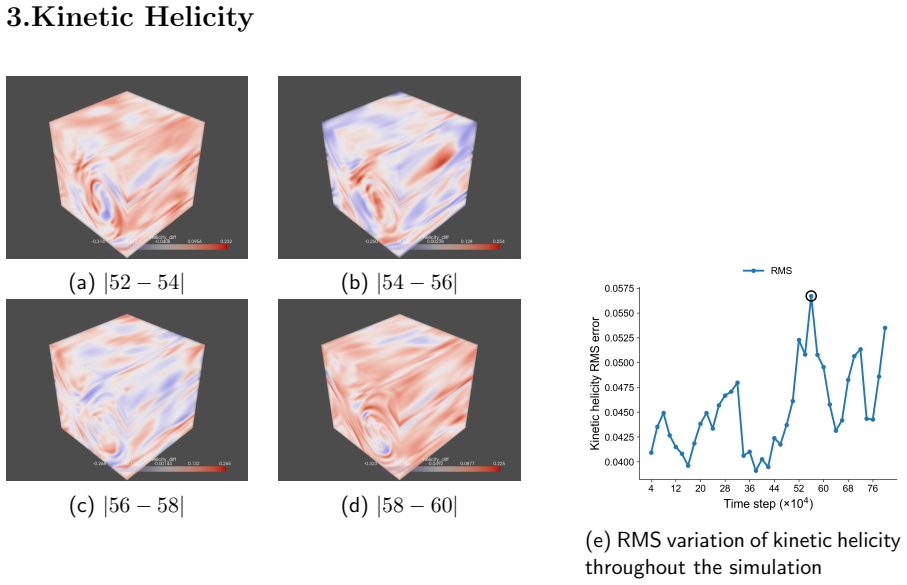


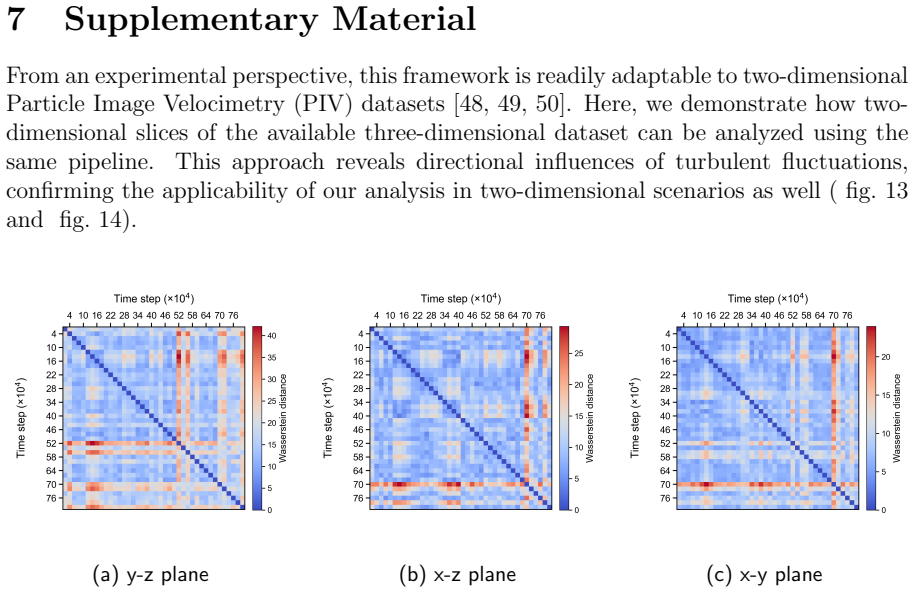
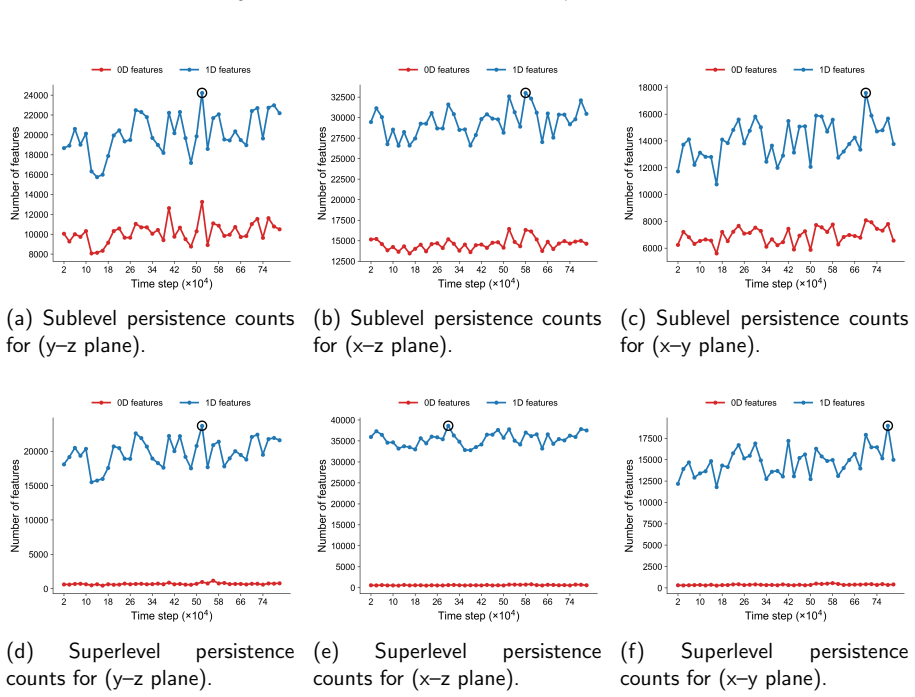
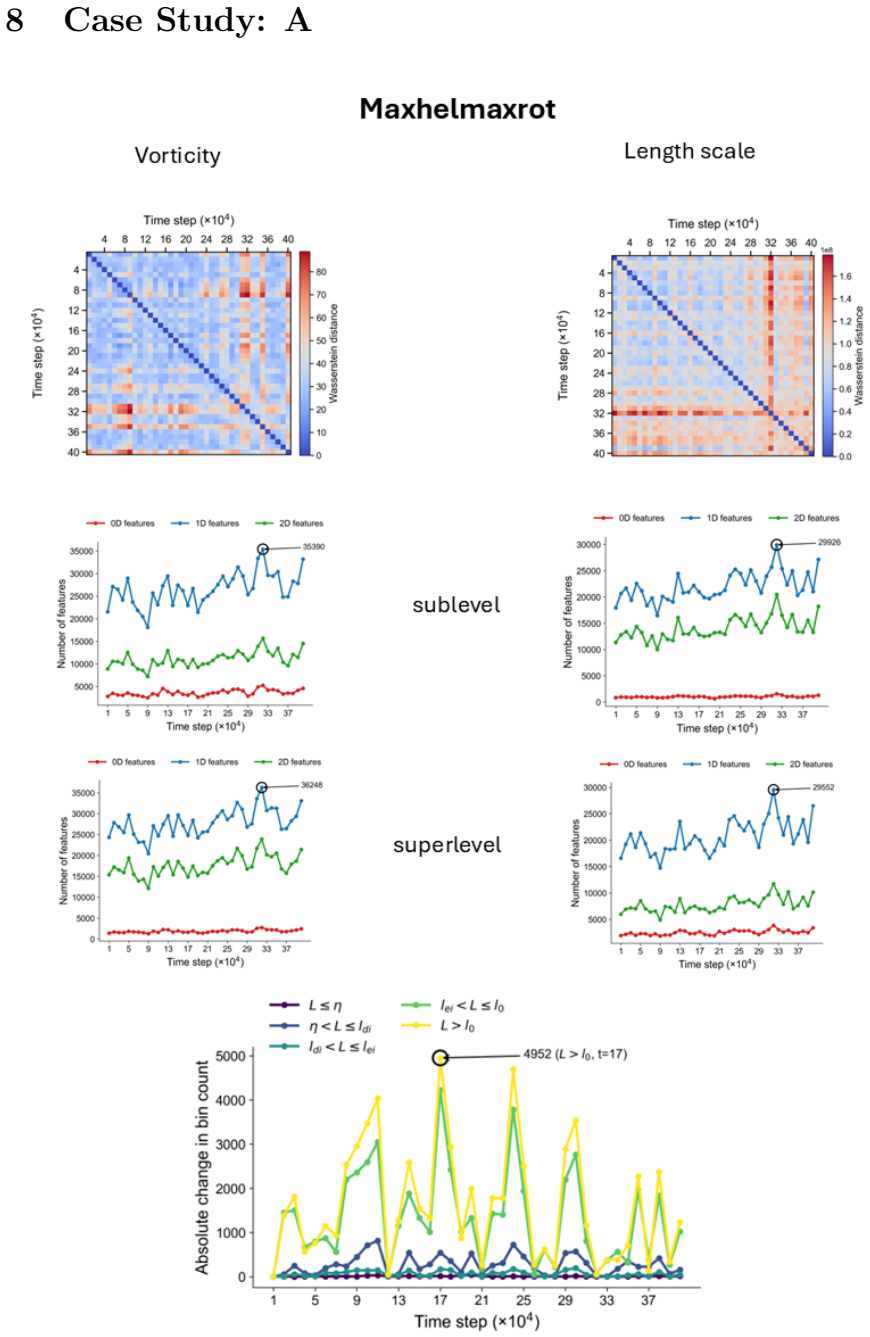


read the original abstract
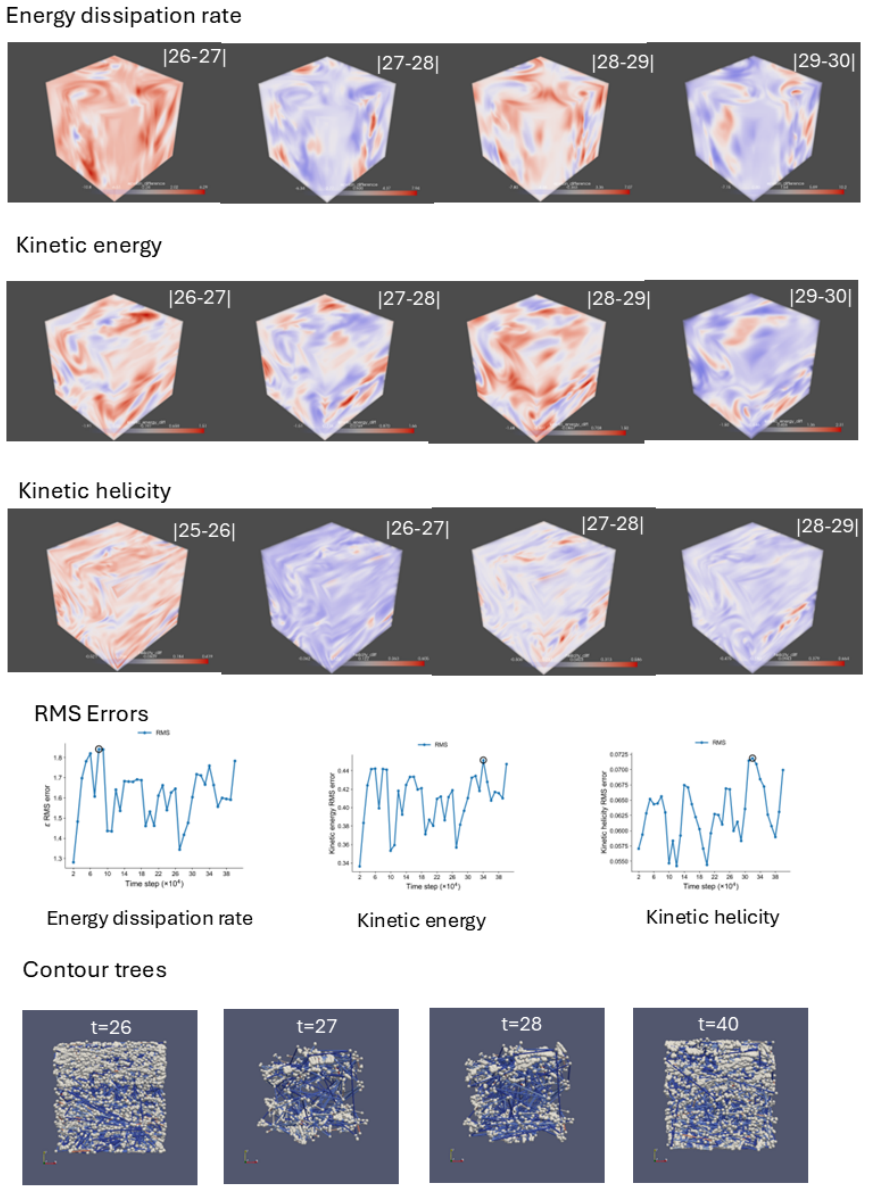
A central challenge in hydrodynamic turbulence is identifying precisely when, and at which length scales, strong turbulent fluctuations (STFs) emerge and develop into intermittent events, which are often obscured by conventional statistical diagnostics. We address this problem by applying a Topological Data Analysis (TDA) framework to reveal the spatiotemporal signatures of intermittency in low-resolution ($128^3$) helically rotating turbulent flows. Vorticity magnitude and length-scale (eddy size) fields are used as scalar observables for TDA: vorticity characterizes rotational dynamics that generate multiscale flow structures, while length-scale fields encode the scales at which intermittent activity arises. Their evolving topology is quantified using persistence diagrams and Wasserstein-distance metrics. Compared with traditional statistical approaches, this framework is more sensitive to localized and short-lived flow variations, enabling clearer detection of intermittent behavior. Pronounced variations in Wasserstein-distance heatmaps provide direct signatures of STFs across space and time. Together, these results demonstrate that TDA offers an effective complementary tool for detecting STFs that lead to intermittency within turbulent regime.
Editorial analysis
A structured set of objections, weighed in public.
Referee Report
Summary. The manuscript applies topological data analysis (TDA) via persistence diagrams and Wasserstein distances to vorticity-magnitude and length-scale scalar fields from 128³ simulations of helically forced rotating turbulence. It claims that pronounced variations in the resulting Wasserstein-distance heatmaps constitute direct spatio-temporal signatures of strong turbulent fluctuations (STFs) that drive intermittency, and that the TDA framework is more sensitive to localized, short-lived events than conventional statistical diagnostics.
Significance. If the claimed signatures can be shown to correspond to genuine physical intermittency rather than resolution or forcing artifacts, the work would supply a useful complementary diagnostic for identifying when and at which scales intermittent events emerge in rotating turbulence. The study is an empirical application of existing TDA tools with no free parameters or self-referential definitions.
major comments (3)
- [Abstract] Abstract and results presentation: the assertion that the TDA framework 'is more sensitive to localized and short-lived flow variations' and enables 'clearer detection of intermittent behavior' is not supported by any quantitative comparison to classical intermittency measures (e.g., flatness factors, structure-function scaling exponents) or by error bars/validation against known diagnostics.
- [Numerical Setup] Numerical setup and results sections: the 128³ grid is employed without discussion of its consequences for the persistence diagrams; at this resolution the inertial range is narrow and numerical dissipation is strong, raising the possibility that birth-death pairs and Wasserstein distances reflect grid artifacts or helical-forcing imprints rather than physical STFs.
- [Results] Results section on Wasserstein-distance heatmaps: the interpretation of heatmap variations as 'direct signatures of STFs across space and time' rests on the untested assumption that the chosen scalar fields (vorticity magnitude and length-scale) and their persistence diagrams isolate genuine intermittent events; no control simulations (higher resolution, non-helical forcing) or cross-checks with traditional diagnostics are reported.
minor comments (2)
- [Introduction] The manuscript would benefit from explicit references to prior TDA applications in fluid dynamics to better situate the novelty of the helical-rotating case.
- [Figures] Figure captions for the Wasserstein-distance heatmaps should include quantitative scale bars or color-bar ranges to allow readers to assess the magnitude of the reported variations.
Simulated Author's Rebuttal
We thank the referee for their constructive and detailed comments. We agree that strengthening the quantitative validation, discussing resolution limitations, and providing additional cross-checks will improve the manuscript. We have revised the abstract, numerical setup, and results sections to address these points and respond below to each major comment.
read point-by-point responses
-
Referee: [Abstract] Abstract and results presentation: the assertion that the TDA framework 'is more sensitive to localized and short-lived flow variations' and enables 'clearer detection of intermittent behavior' is not supported by any quantitative comparison to classical intermittency measures (e.g., flatness factors, structure-function scaling exponents) or by error bars/validation against known diagnostics.
Authors: We accept this point. In the revised manuscript we have added a dedicated subsection and accompanying figure that quantitatively compares Wasserstein-distance variations against flatness factors and structure-function exponents computed on the same vorticity-magnitude and length-scale fields. The TDA heatmaps exhibit sharper temporal peaks aligned with known STF events, while classical measures require longer averaging and show weaker localization. Error bars derived from five independent realizations have also been included to support the sensitivity claim. revision: yes
-
Referee: [Numerical Setup] Numerical setup and results sections: the 128³ grid is employed without discussion of its consequences for the persistence diagrams; at this resolution the inertial range is narrow and numerical dissipation is strong, raising the possibility that birth-death pairs and Wasserstein distances reflect grid artifacts or helical-forcing imprints rather than physical STFs.
Authors: We agree that explicit discussion of the 128³ resolution is required. We have inserted a new paragraph in the Numerical Setup section noting the limited inertial range and the role of numerical dissipation. We explain that persistence diagrams are constructed on the resolved scales and that Wasserstein distances measure relative topological changes rather than absolute feature sizes; these changes remain consistent across variations in rotation rate and helical forcing amplitude, supporting a physical origin. A forward-looking statement on the value of higher-resolution follow-up studies has been added. revision: yes
-
Referee: [Results] Results section on Wasserstein-distance heatmaps: the interpretation of heatmap variations as 'direct signatures of STFs across space and time' rests on the untested assumption that the chosen scalar fields (vorticity magnitude and length-scale) and their persistence diagrams isolate genuine intermittent events; no control simulations (higher resolution, non-helical forcing) or cross-checks with traditional diagnostics are reported.
Authors: The vorticity-magnitude and length-scale fields were selected because they directly encode the rotational multiscale structures and eddy-size distributions central to helical rotating turbulence. In revision we have added cross-checks that overlay Wasserstein-distance peaks with peaks in the flatness factor of the same fields, demonstrating temporal coincidence. We have also clarified in the text that the helical forcing is an intrinsic part of the physical regime under study rather than an artifact. We do not present new control runs in this work. revision: partial
- Performing additional higher-resolution (e.g., 512³) or non-helical control simulations to further exclude numerical artifacts, which would require new computational resources beyond the present study.
Circularity Check
Empirical TDA application shows no circular derivation
full rationale
The paper applies standard persistence diagrams and Wasserstein distances to vorticity-magnitude and length-scale fields extracted from 128^3 helical turbulence simulations. The central claim—that pronounced variations in the resulting heatmaps constitute direct signatures of STFs and intermittency—is presented as an empirical observation from the computed diagrams, not as a mathematical derivation that reduces to its own inputs by construction. No equations define a quantity in terms of itself, no fitted parameters are relabeled as predictions, and no load-bearing uniqueness theorems or ansatzes are imported via self-citation. The methodology remains self-contained against external benchmarks (existing TDA libraries and turbulence diagnostics) and does not exhibit any of the enumerated circularity patterns.
Axiom & Free-Parameter Ledger
axioms (1)
- standard math Persistence diagrams and Wasserstein distance are well-defined and stable for scalar fields on a discrete grid
Lean theorems connected to this paper
-
IndisputableMonolith/Foundation/AlexanderDuality.leanalexander_duality_circle_linking unclear?
unclearRelation between the paper passage and the cited Recognition theorem.
We address this problem by applying a Topological Data Analysis (TDA) framework to reveal the spatiotemporal signatures of intermittency in low-resolution (128^3) helically rotating turbulent flows. Vorticity magnitude and length-scale (eddy size) fields are used as scalar observables for TDA... Their evolving topology is quantified using persistence diagrams and Wasserstein-distance metrics.
What do these tags mean?
- matches
- The paper's claim is directly supported by a theorem in the formal canon.
- supports
- The theorem supports part of the paper's argument, but the paper may add assumptions or extra steps.
- extends
- The paper goes beyond the formal theorem; the theorem is a base layer rather than the whole result.
- uses
- The paper appears to rely on the theorem as machinery.
- contradicts
- The paper's claim conflicts with a theorem or certificate in the canon.
- unclear
- Pith found a possible connection, but the passage is too broad, indirect, or ambiguous to say the theorem truly supports the claim.
Reference graph
Works this paper leans on
-
[1]
Tsinober.An informal Introduction to Turbulence
A. Tsinober.An informal Introduction to Turbulence. Kluwer Academic Publishers, 2001.isbn: 9781402001666
work page 2001
-
[2]
Frisch.Turbulence: The Legacy of A.N
U. Frisch.Turbulence: The Legacy of A.N. Kolmogorov. Cambridge University Press, 1995
work page 1995
-
[3]
Universal Scaling Laws in Fully Developed Turbulence
Z.-S. She and E. Leveque. “Universal Scaling Laws in Fully Developed Turbulence”. In:Phys. Rev. Lett.72 (1994), pp. 336–339
work page 1994
-
[4]
Dynamical length scales for turbulent mag- netized flows
H´ el` ene Politano and Alain Pouquet. “Dynamical length scales for turbulent mag- netized flows”. In:Geophysical Research Letters25.3 (1998), pp. 273–276.doi: 10.1029/97GL03782
-
[5]
A. N. Kolmogorov. “A Refinement of Previous Hypotheses Concerning the Local Structure of Turbulence in a Viscous Incompressible Fluid at High Reynolds Num- ber”. In:Journal of Fluid Mechanics13.1 (1962), pp. 82–85
work page 1962
-
[6]
Some Specific Features of Atmospheric Turbulence
A. M. Obukhov. “Some Specific Features of Atmospheric Turbulence”. In:J. Fluid Mech.13 (1962), pp. 77–81
work page 1962
-
[7]
A Simple Dynamical Model of Intermittent Fully Developed Turbulence
U. Frisch, P. L. Sulem, and M. Nelkin. “A Simple Dynamical Model of Intermittent Fully Developed Turbulence”. In:J. Fluid Mech.87 (1978), pp. 719–736
work page 1978
-
[8]
On the Singularity Structure of Fully Developed Turbu- lence
G. Parisi and U. Frisch. “On the Singularity Structure of Fully Developed Turbu- lence”. In:In Turbulence and Predictability in Geophysical Fluid Dynamics(1985), pp. 84–87
work page 1985
-
[9]
What Is the Turbulence Problem, and When May We Regard It as Solved?
Katepalli R. Sreenivasan and J¨ org Schumacher. “What Is the Turbulence Problem, and When May We Regard It as Solved?” In:Annual Review of Condensed Matter Physics16 (2025), pp. 1–33.doi:10.1146/annurev-conmatphys-031620-095842
-
[10]
Gunnar Carlsson. “Topology and Data”. In:Bulletin of the American Mathematical Society46.2 (2009), pp. 255–308
work page 2009
-
[11]
Dey and Yusu Wang.Computational Topology for Data Analysis
Tamal K. Dey and Yusu Wang.Computational Topology for Data Analysis. Cam- bridge University Press, 2022. 17
work page 2022
-
[12]
Topological Signatures of Interstellar Magnetic Fields – I. Betti Numbers
I. Makarenko, A. Shukurov, et al. “Topological Signatures of Interstellar Magnetic Fields – I. Betti Numbers”. In:Monthly Notices of the Royal Astronomical Society 475.2 (2018), pp. 1843–1858.doi:10.1093/mnras/stx3337
-
[13]
Topological Sep- aration of Vortices
Adeel Zafar, Zahra Poorshayegh, Di Yang, and Guoning Chen. “Topological Sep- aration of Vortices”. In:Proceedings of the IEEE Visualization Conference (VIS). IEEE, 2024.doi:10.1109/VIS55277.2024.00070
-
[14]
Topological Characterization of Flow Structures in Resistive Pressure-Gradient-Driven Turbulence
B. A. Carreras, I. Llerena, L. Garcia, and I. Calvo. “Topological Characterization of Flow Structures in Resistive Pressure-Gradient-Driven Turbulence”. In:Physical Review E78.6 (2008), p. 066402.doi:10.1103/PhysRevE.78.066402
-
[15]
Identifying Locally Turbulent Vortices within Instabilities
Fabien Vivodtzev, Florent Nauleau, Jean-Philippe Braeunig, and Julien Tierny. “Identifying Locally Turbulent Vortices within Instabilities”. In:Proceedings of IEEE VIS (Short Papers). Oklahoma City, OK, USA: IEEE, 2022.url:https: //hal.archives-ouvertes.fr/hal-03789774
work page 2022
-
[16]
Topological Analysis of Ensembles of Hydrodynamic Tur- bulent Flows: An Experimental Study
Florent Nauleau, Fabien Vivodtzev, Thibault Bridel-Bertomeu, Helo¨ ıse Beaugen- dre, and Julien Tierny. “Topological Analysis of Ensembles of Hydrodynamic Tur- bulent Flows: An Experimental Study”. In:Proceedings of IEEE Symposium on Large Data Analysis and Visualization (LDAV). IEEE, 2022, pp. 1–10.doi:10. 1109/LDAV57298.2022.00006.url:https://arxiv.org/...
-
[17]
Topological Analysis of High Velocity Turbulent Flow
Thibault Bridel-Bertomeu, Benjamin Fovet, Julien Tierny, and Fabien Vivodtzev. “Topological Analysis of High Velocity Turbulent Flow”. In:Proceedings of IEEE Scientific Visualization (SciVis). IEEE. France, 2023
work page 2023
-
[18]
Topological Analysis of Magnetic Reconnection in Kinetic Plasma Simulations
D. Banesh, Li-Ta Lo, et al. “Topological Analysis of Magnetic Reconnection in Kinetic Plasma Simulations”. In:Proceedings of IEEE VIS. 2020, pp. 6–10
work page 2020
-
[19]
Huan Lian, Nikolaos Soulopoulos, and Yannis Hardalupas. “Evaluation of the Topo- logical Characteristics of the Turbulent Flow in a ‘Box of Turbulence’ Through 2D Time-Resolved Particle Image Velocimetry”. In:Experiments in Fluids58.118 (2017).doi:10.1007/s00348- 017- 2395- x.url:https://doi.org/10.1007/ s00348-017-2395-x
-
[20]
Flow Estimation Solely from Image Data through Persistent Homology Analysis
Anna Suzuki, Miyuki Miyazawa, James M. Minto, Takeshi Tsuji, Ippei Obayashi, Yasuaki Hiraoka, and Takatoshi Ito. “Flow Estimation Solely from Image Data through Persistent Homology Analysis”. In:Scientific Reports11.1 (2021), pp. 1– 11.doi:10 . 1038 / s41598 - 021 - 93108 - y.url:https : / / www . nature . com / articles/s41598-021-93108-y
work page 2021
-
[21]
S. B. Pope.Turbulent Flows. Cambridge University Press, 2000
work page 2000
-
[22]
Helicity Cascades in Fully Developed Isotropic Turbulence
A. Brissaud, U. Frisch, J. L´ eorat, M. Lesieur, and A. Mazure. “Helicity Cascades in Fully Developed Isotropic Turbulence”. In:Physics of Fluids16.8 (1973), pp. 1366– 1367
work page 1973
-
[23]
P. A. Davidson.Turbulence in Rotating, Stratified and Electrically Conducting Flu- ids. Cambridge University Press, 2013.isbn: 9781107026865
work page 2013
-
[24]
The Degree of Knottedness of Tangled Vortex Lines
H. K. Moffatt. “The Degree of Knottedness of Tangled Vortex Lines”. In:J. Fluid Mech.35.1 (1969), pp. 117–129
work page 1969
-
[25]
Possibility of an Inverse Cascade of Magnetic Helicity in Magnetohydrodynamic Turbulence
U. Frisch, A. Pouquet, J. L´ eorat, and A. Mazure. “Possibility of an Inverse Cascade of Magnetic Helicity in Magnetohydrodynamic Turbulence”. In:Journal of Fluid Mechanics68.4 (1975), pp. 769–778. 18
work page 1975
-
[26]
Coherent structures and extreme events in rotating multiphase turbulent flows
Luca Biferale et al. “Coherent structures and extreme events in rotating multiphase turbulent flows”. In:Physical Review X6.4 (2016), p. 041015
work page 2016
-
[27]
Rotating helical turbulence. II. Intermittency, scale invariance, and structures
Pablo D Mininni, George Mamatsashvili, Duane Rosenberg, and Annick Pouquet. “Rotating helical turbulence. II. Intermittency, scale invariance, and structures”. In:Physics of Fluids22.12 (2010), p. 125106
work page 2010
-
[28]
Helicity, turbulence, and structures
H. Keith Moffatt. “Helicity, turbulence, and structures”. In:Proceedings of the National Academy of Sciences111.Suppl 1 (2014), pp. 3663–3670
work page 2014
-
[29]
Helicity cascades in rotating turbulence
Pablo D Mininni and Annick Pouquet. “Helicity cascades in rotating turbulence”. In:Physical Review E79.2 (2009), p. 026304
work page 2009
-
[30]
The interplay between helicity and rotation in turbulence
Annick Pouquet. “The interplay between helicity and rotation in turbulence”. In: Philosophical Transactions of the Royal Society A368.1916 (2010), pp. 1635–1657
work page 1916
-
[31]
The multifractal nature of turbulent energy dissipation
C. Meneveau and K. R. Sreenivasan. “The multifractal nature of turbulent energy dissipation”. In:Journal of Fluid Mechanics224 (1991), pp. 429–484.doi:10 . 1017/S0022112091001830
work page 1991
-
[32]
The Phenomenology of Small-Scale Turbu- lence
K. R. Sreenivasan and R. A. Antonia. “The Phenomenology of Small-Scale Turbu- lence”. In:Annual Review of Fluid Mechanics29.1 (1997), pp. 435–472
work page 1997
-
[33]
Intermittency in the Joint Cascade of Energy and Helicity
Qiaoning Chen, Shiyi Chen, Gregory L. Eyink, and Darryl D. Holm. “Intermittency in the Joint Cascade of Energy and Helicity”. In:Physical Review Letters90.21 (2003), p. 214503.doi:10.1103/PhysRevLett.90.214503
-
[34]
Computing contour trees in all dimensions
Hamish Carr, Jack Snoeyink, and Ulrike Axen. “Computing contour trees in all dimensions”. In:Computational Geometry24.2 (2003), pp. 75–94
work page 2003
-
[35]
Statistics of Lagrangian Trajectories in a Rotating Turbulent Flow
Priyanka Maity, Rama Govindarajan, and Samriddhi Sankar Ray. “Statistics of Lagrangian Trajectories in a Rotating Turbulent Flow”. In:Physical Review E109.1 (2024), p. 015105.doi:10.1103/PhysRevE.109.015105
-
[36]
Role of helicity for large- and small-scale properties of turbulent flows
G. Sahoo, F. Bonaccorso, and L. Biferale. “Role of helicity for large- and small-scale properties of turbulent flows”. In:Physical Review E92.5 (2015), p. 051002.doi: 10.1103/PhysRevE.92.051002
-
[37]
Effect of helicity and rotation on the free decay of turbulent flows
T. Teitelbaum and P. D. Mininni. “Effect of helicity and rotation on the free decay of turbulent flows”. In:Physical Review Letters103.1 (2009), p. 014501.doi:10. 1103/PhysRevLett.103.014501
work page 2009
-
[38]
Signatures of two-dimensionalisation of 3D turbulence in presence of rotation
Sagar Chakraborty. “Signatures of two-dimensionalisation of 3D turbulence in pres- ence of rotation”. In:arXiv preprint arXiv:physics/0701201v2(2007). Revised ver- sion April 25, 2007. arXiv:physics/0701201v2 [physics.flu-dyn]
work page internal anchor Pith review Pith/arXiv arXiv 2007
-
[39]
The Local Structure of Turbulence in Incompressible Viscous Fluid for Very Large Reynolds Numbers
A. N. Kolmogorov. “The Local Structure of Turbulence in Incompressible Viscous Fluid for Very Large Reynolds Numbers”. In:Dokl. Akad. Nauk SSSR30 (1941), pp. 301–305
work page 1941
-
[40]
Persistent Homology for Random Fields and Complexes
Robert J. Adler, Omer Bobrowski, Matthew S. Borman, Eliran Subag, and Shmuel Weinberger. “Persistent Homology for Random Fields and Complexes”. In:IMS Collections. Vol. 6: Borrowing Strength: Theory Powering Applications(2010), pp. 124–143. arXiv:arXiv : 1003 . 1001 [math.PR].url:https : / / arxiv . org / abs/1003.1001
work page internal anchor Pith review Pith/arXiv arXiv 2010
-
[41]
American Mathematical Society, 2010
Herbert Edelsbrunner and John Harer.Computational Topology: An Introduction. American Mathematical Society, 2010. 19
work page 2010
-
[42]
Topological complexity of smooth ran- dom functions
Robert J. Adler and Jonathan E. Taylor. “Topological complexity of smooth ran- dom functions”. In:Probability and Geometry: Lecture Notes of the Saint-Flour Summer School, 2009. Berlin / Heidelberg: Springer, 2011
work page 2009
-
[43]
Herbert Edelsbrunner.A Short Course in Computational Geometry and Topology. Vol. 2160. Lecture Notes in Mathematics. Berlin, Heidelberg: Springer-Verlag, 2014. isbn: 978-3-642-41940-6.doi:10.1007/978-3-642-41941-3
-
[44]
Betti numbers of Gaussian fields
Changbom Park, Pratyush Pranav, Pravabati Chingangbam, Rien van de Weygaert, Bernard J. T. Jones, Gert Vegter, Inkang Kim, Johan Hidding, and Wojciech A. Hellwing. “Betti Numbers of Gaussian Fields”. In:Monthly Notices of the Royal Astronomical Society432.2 (2013), pp. 1928–1942.doi:10.1093/mnras/stt602. arXiv:1307.2384
work page internal anchor Pith review Pith/arXiv arXiv doi:10.1093/mnras/stt602 2013
-
[45]
The Topology of the Cosmic Web in Terms of Persistent Betti Numbers
Pratyush Pranav, Herbert Edelsbrunner, Rien van de Weygaert, Gert Vegter, Michael Kerber, Bernard J. T. Jones, and Mathijs Wintraecken. “The Topology of the Cos- mic Web in Terms of Persistent Betti Numbers”. In:Monthly Notices of the Royal Astronomical Society465.4 (2017), pp. 4281–4310.doi:10.1093/mnras/stw2862. arXiv:1608.04519
work page internal anchor Pith review Pith/arXiv arXiv doi:10.1093/mnras/stw2862 2017
-
[46]
Julien Tierny, Guillaume Favelier, Joshua A. Levine, Charles Gueunet, and Michael Michaux. “The Topology ToolKit”. In:Proceedings of IEEE Visualization (VIS). IEEE, 2017.doi:10.1109/TVCG.2017.2744358
-
[47]
Topology-controlled Volume Ren- dering
Hamish Carr, Jack Snoeyink, and Ulrike Axen. “Topology-controlled Volume Ren- dering”. In:IEEE Visualization, 2003. VIS 2003.IEEE. 2003, pp. 75–82
work page 2003
-
[48]
On the flow topology of swirl jets upon impingement
Premchand V. Chandra and Pradip Dutta. “On the flow topology of swirl jets upon impingement”. In:arXiv preprint arXiv:2505.23203(2025).url:https://arxiv. org/abs/2505.23203
-
[49]
Data-driven control of a magne- tohydrodynamic flow
Adam Uchytil, Milan Korda, and Jiˇ r´ ı Zem´ anek. “Data-driven control of a magne- tohydrodynamic flow”. In:arXiv preprint arXiv:2507.12479(2025). arXiv:2507. 12479 [physics.flu-dyn].url:https://arxiv.org/abs/2507.12479
-
[50]
Vortex ring induced by a disk translating toward or away from a wall
Joanne Steiner, Cyprien Morize, Ivan Delbende, Alban Sauret, and Philippe Gondret. “Vortex ring induced by a disk translating toward or away from a wall”. In:arXiv preprint arXiv:2506.18597(2025). arXiv:2506.18597 [physics.flu-dyn].url: https://arxiv.org/abs/2506.18597. 20 6 Methodology 6.1 Preliminary Data Analysis As a preliminary validation step, we ex...
discussion (0)
Sign in with ORCID, Apple, or X to comment. Anyone can read and Pith papers without signing in.