REVIEW 4 major objections 3 minor 8 references
Generalized ODE reduction algorithm for bounded degree transformation
T0 review · 4 major / 3 minor · reviewed 2026-08-06 · deepseek-v4-flash
Pith's one-line read This paper presents an algorithm that, given an exact bound on the degree of $A(x,y)$, computes the rational transformation $y\to A(x,y)/B(x,y)$ and reduces $y'=M(x,y)/N(x,y)$ to $y'=\sum_{i=0}^n f_i(x)y^i$ by solving linear equations…
desk verdict An honest but incomplete extension: the new canceled-factor handling is real, but the algorithm's core selection step is unspecified, and the central claim is unsubstantiated. read the letter →
The pith
A machine-rendered reading of the paper's core claim, the machinery that carries it, and where it could break.
The reading
What carries the argument
The load-bearing object is the equality (6) --- with $c(x,y)\mid A(x,y)$ --- together with its linearized form (7), which encodes that $M,N$ become the numerator and denominator of the transformed ODE once the canceled factor is restored. The algorithm's second engine is the degree-test procedure inherited from the author's earlier work: it converts the recovered degree guesses into candidate values of $n$ and candidate polynomials $B$ without solving polynomial systems. The key move is to search $\deg_y c$ from $0$ to $\deg_y A-1$, since $c$ is a factor of $A$ and hence cannot reach the degree of $A$ itself. With $B$ and $n$ fixed, equation (7) is linear in the coefficients of $c$ and $A$, which is what makes the whole reduction efficient when the linear system is sufficiently constrained.
What would settle it
Take the construction behind Example 2.2, where the canceled factor has degree 3 and $A$ has degree 4, and run the proposed linear solve: the general solution contains free parameters $b_{3,0}$ and $b_{2,1}$. Checking all algebraic specializations of these parameters against $c\mid A$ and equality (6) would show whether any selection rule can recover the known transformation, and a single such case with no valid specialization would disprove the "quite a lot" claim.
Extended reading notes
Core claim
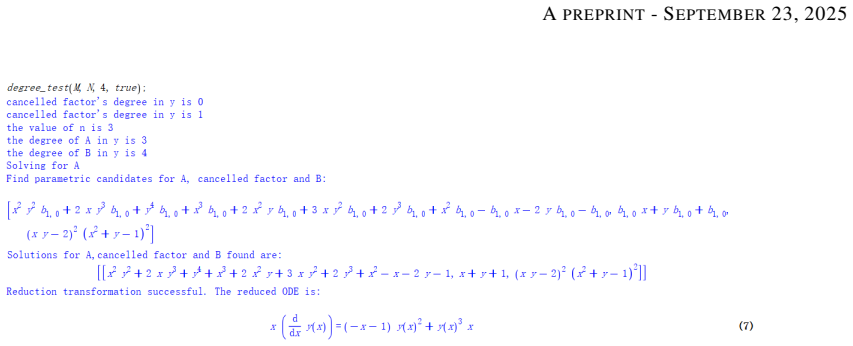
Working from the assumption that the given ODE arises from the structure (5) before common factors are removed, the paper treats the canceled factor $c(x,y)$ and the transformation numerator $A(x,y)$ as separate unknowns, exploiting that $c\mid A$ and therefore $\deg_y c<\deg_y A$. The algorithm searches the possible degree of $c$ in $y$, adds it to the degrees of $M$ and $N$ to reconstruct the pre-cancellation form, and applies the earlier degree-test procedure to obtain candidate values of $n$ and candidate polynomials $B$. For each candidate it solves the linear system $Nc=t(B\,\partial A/\partial y - A\,\partial B/\partial y)B^{n-2}$ for the undetermined coefficients of $c$ and $A$, then uses the result to solve for the coefficients $f_i(x)$, producing the reduced ODE (2). The worked example reduces a degree-19 ODE with $A$ of degree 4 and a first-degree canceled factor; a second example, where the canceled factor has degree 3, shows the same strategy can yield a parametric family of solutions with no rule for picking the valid member.
Load-bearing premise
The whole reduction rests on the assumption that the linear equations produced by the method always have a solution that makes the canceled factor divide $A$, and that the degree-test procedure borrowed from the earlier paper works; neither is proved here.
Editorial extensions
If this is right
- For any ODE satisfying the structural assumption (6) with a known exact bound on $\deg A$, reduction to $y'=\sum f_i(x)y^i$ is obtainable by linear algebra, avoiding the costly polynomial-system solving normally used for bounded-degree first integrals.
- Once reduced, the ODE's integrability under transformations of the form $x\to F(x)$, $y\to P(x)y+Q(x)$ can be tested by existing computer algebra routines, making the Darboux-polynomial search substantially easier.
- The implementation resolves an ODE of degree 47 with $\deg A=17$ in about 5.7 seconds, and a subsequent Darboux-polynomial check on the reduced equation took 0.125 seconds.
- If the user supplies a degree bound larger than the true one, the algorithm returns nothing rather than a wrong transformation; the appearance of a parametric family can be used as an indication that a lower-degree transformation may exist.
Reading between the lines
- If a principled parameter-selection rule for the "too general" solution families were found, the algorithm would likely cover essentially all non-coprime reductions, not just the "quite a lot" claimed here.
- The freedom in the solution family of Example 2.2 suggests a refined test: the dimension of the solution variety of (7) might itself serve as a certificate that a lower-degree transformation exists, turning a failed run into a search heuristic.
- Because the correctness of the entire pipeline rests on the black-box degree test rather than on a proof reproduced here, an independent implementation or proof of that test would be the smallest change that makes the method self-contained.
Editorial analysis
A structured set of objections, weighed in public.
Referee Report
Summary. The paper considers rational first-order ODEs y' = M(x,y)/N(x,y) and seeks a rational transformation y -> A(x,y)/B(x,y) that reduces the ODE to the polynomial (in y) form y' = sum_i f_i(x) y^i, even when M and N share a common factor c that is canceled. The proposed method assumes a known tight degree bound for A, uses a degree-test procedure from the author's prior paper [7] to enumerate candidates for B and the degree n, then solves a linear system (equation (7)) for A and the canceled factor c, and finally computes the f_i(x). The paper claims this gives an efficient algorithm for "quite a lot of" cases and reports a Maple implementation with a 5.7-second example of degree 47. Section 2.2, however, presents Example 2.2 in which the linear system yields a parametric family of solutions for which no automatic selection rule is given to obtain a valid pair (A,c); the paper explicitly calls the required choice "non-trivial." Thus the central step of the algorithm is not fully specified, and the paper itself provides a counterexample to the completeness of the method as stated.
Significance. The problem is relevant: computing bounded-degree Darboux polynomials or first integrals is computationally expensive, and a reduction to the tractable form (2) would be useful for integrability analysis. The idea of treating the canceled factor c separately and solving linear equations for A and c is a natural and potentially useful direction, and the reported Maple implementation is a concrete asset. However, the paper provides no correctness proof for the algorithm, does not describe the degree-test procedure from [7] on which the whole enumeration relies, and its own Example 2.2 demonstrates that solving (7) is not enough to determine a valid (A,c) in general. As presented, the central claim that an efficient algorithm exists for a substantial class of non-coprime cases is not established; the contribution is best viewed as a heuristic with worked examples rather than a verified algorithm.
major comments (4)
- [Section 2.2, Example 2.2] The paper itself constructs an ODE from a known transformation with A=(y+x+1)^4, B=(xy-2)^3(y+x^2-1), so with the exact degree bound a correct algorithm should detect this transformation. Instead, solving equation (7) yields A and c expressed with free parameters b3,0 and b2,1, and the text states that "not all the non-zero parametric solutions for c are valid" and that the parameters "require further selection," without providing any automatic selection rule. This directly contradicts the abstract's claim that A, B, and the canceled factor can be computed by solving linear equations for "quite a lot" of cases. The load-bearing step of the algorithm is therefore missing for a case the paper itself identifies.
- [Section 2.1, Algorithm 1] The pseudo-code steps "Verifying candidates of B and solve for A and canceled factor" are not specified at the level needed to reproduce or check the algorithm. The numerical loop conditions (for example, index2+index3-1+(index1-2)index3=jnew and inew = index1*index2) are presented without derivation or a correctness argument. Since the algorithm's completeness depends on these enumeration ranges and on the verification step, their absence makes it impossible to establish that the algorithm will find a transformation whenever one exists within the given degree bound.
- [Section 2.1, definition of t(x)] The algorithm sets t(x) to the product of all x-only factors of N, but Section 2.2 immediately acknowledges that when A(a,y)=B(a,y), the expression B*partial A/partial y - A*partial B/partial y can acquire a factor (x-a), so t(x) may need to include factors that are not x-only factors of N. The paper says "We will not discuss that issue for simplicity." This is not a mere simplification: it means the proposed algorithm will fail on inputs where such factors occur, and the limitation is not incorporated into the paper's main correctness claim.
- [Section 1 and Section 2.1, reliance on [7]] The entire outer search over n and B depends on the "degree test procedure" from the author's prior paper [7], which is neither reproduced nor proved here. Since the current paper extends [7] and its main claim is an algorithmic improvement, the reader cannot verify even the existence of a terminating, correct enumeration without consulting [7] in full. At a minimum, the relevant definitions, termination conditions, and correctness statements from [7] should be restated so that the present algorithm is self-contained enough to be checked.
minor comments (3)
- [Abstract and Section 2.1] The phrase "quite a lot of" is never defined formally; it should be replaced by a precise characterization of the input class (or an explicit list of sufficient conditions) so that the algorithm's scope is testable.
- [Examples 2.1 and 2.2] The polynomials M and N are given with ellipses ("..."), so the examples are not self-contained; readers cannot reproduce the computations from the text alone and must consult the Maple code.
- [Section 1] There are wording issues, for example "In [7] we consider a more general problem, we consider a more general transformation" repeats the phrase and should be rewritten.
Circularity Check
No significant circularity: the reduction algorithm solves the defining system directly; the main weaknesses are a self-cited black-box degree test and an acknowledged parameter-selection gap, which are correctness concerns, not circular reductions.
full rationale
The derivation chain starts from assumption (6), which is the defining system for the desired objects. The algorithm solves (7) for A and c, and then the first equation of (6) for f_i; this is a direct algebraic characterization, not a circular use of the target. No fitted parameter is relabeled as a prediction: all examples are generated from known transformations and used as tests. The acknowledged failure in Example 2.2, where the linear solution space leaves free parameters and c|A must be imposed by a non-trivial choice, is an incompleteness of the claimed efficient algorithm, not a circularity. The paper also flags that the assumption on t(x) may fail, again a limitation. The only self-citation issue is the 'degree test procedure described in [7]' being used as a black box to find n and B candidates; this is a dependency on the author's prior work and is not reproduced, so it weakens self-contained verification. But it does not make the central claim equivalent to its input, because the degree test is a subroutine rather than a restatement of the conclusion. Hence no significant circularity; score 2 reflects the self-citation/verifiability concern.
Assumptions & free parameters
free parameters (1)
- coefficients of A and c in the parametric solution =
unresolved (e.g., b3,0, b2,1 in Example 2.2)
assumptions (4)
- domain assumption The input ODE is exactly of the reducible form (6) for some A,B,c, f_i, t
- domain assumption The degree test procedure from [7] is correct and can be used as a black box
- domain assumption The user supplies the exact tight degree bound for A
- ad hoc to paper t(x) is the product of all x-only factors of N
Cite this review
Pith. "Pith review of Generalized ODE reduction algorithm for bounded degree transformation." pith.science (2026). https://pith.science/paper/QMP2YZ6D
@misc{pith2026250701878,
  author       = {Pith},
  title        = {Pith review of: Generalized ODE reduction algorithm for bounded degree transformation},
  year         = {2026},
  howpublished = {\url{https://pith.science/paper/QMP2YZ6D}},
  note         = {Machine review of arXiv:2507.01878}
}
abstract
The integrability problem of rational first-order ODEs $y^{\prime}=\frac{M(x,y)}{N(x,y)}$, where $M,N \in \mathbb{R}[x,y]$ is a long-term research focus in the area of dynamical systems, physics, etc. Although the computer algebra system such as Mathematica, Maple has developed standard algorithms to tackle its first integral expressed by Liouvillian or special function, this problem is quite difficult and the general method requires specifying a tight degree bound for the Darboux polynomial. Computing the bounded degree first integral, in general, is very expensive for a computer algebra system\cite{duarte2021efficient}\cite{cheze2020symbolic} and becomes impractical for ODE of large size. In \cite{huang2025algorithm}, we have proposed an algorithm to find the inverse of a local rational transformation $y \to \frac{A(x,y)}{B(x,y)}$ that transforms a rational ODE to a simpler and more tractable structure $y^{\prime}=\sum_{i=0}^nf_i(x)y^i$, whose integrability under linear transformation $\left\{x \to F(x),y \to P(x)y+Q(x)\right\}$ can be detected by Maple efficiently \cite{CHEBTERRAB2000204}\cite{cheb2000first}. In that paper we have also mentioned when $M(x,y),N(x,y)$ of the reducible structure are not coprime, canceling the common factors in $y$ will alter the structure which makes that algorithm fail. In this paper, we consider this issue. We conclude that with the exact tight degree bound for the polynomial $A(x,y)$ given, we have an efficient algorithm to compute such transformation and the reduced ODE for "quite a lot of" cases where $M,N$ are not coprime. We have also implemented this algorithm in Maple and the code is available in researchgate.
Figures


Figures from the paper (3 more)


Reference graph
Works this paper leans on
-
[7]
Algorithm for finding reduction transformation that transforms a rational ode to solvable structure
Shaoxuan Huang. Algorithm for finding reduction transformation that transforms a rational ode to solvable structure. Maple Transactions, 5(2), 2025
work page 2025
-
[1]
Sur les invariants de quelques équations différentielles
Paul Appell. Sur les invariants de quelques équations différentielles. Journal de mathématiques pures et appliquées , 5:361–423, 1889
-
[2]
First order ODEs, Symmetries and Linear Transformations
ES Cheb-Terrab and T Kolokolnikov. First order odes, symmetries and linear transformations. arXiv preprint math-ph/0007023, 2000
work page Pith review arXiv 2000
-
[3]
E.S. Cheb-Terrab and A.D. Roche. Abel odes: Equivalence and integrable classes. Computer Physics Communica- tions, 130(1):204–231, 2000
work page 2000
-
[4]
Symbolic computations of first integrals for polynomial vector fields
Guillaume Chèze and Thierry Combot. Symbolic computations of first integrals for polynomial vector fields. F oundations of Computational Mathematics, 20(4):681–752, 2020
work page 2020
-
[5]
An efficient method for computing liouvillian first integrals of planar polynomial vector fields
LGS Duarte and LACP Da Mota. An efficient method for computing liouvillian first integrals of planar polynomial vector fields. Journal of Differential Equations, 300:356–385, 2021
work page 2021
-
[6]
Integrability and nonintegrability of dynamical systems , volume 19
Alain Goriely. Integrability and nonintegrability of dynamical systems , volume 19. World Scientific, 2001
work page 2001
-
[8]
Differentialgleichungen lösungsmethoden und lösungen
Erich Kamke. Differentialgleichungen lösungsmethoden und lösungen. Springer-Verlag, 2013. 7
work page 2013
Reviewed August 6, 2026 · model on record in the stance chip above.
Discussion (0). Sign in to comment.