Pulsar Science with the SKAO
Pith reviewed 2026-07-03 19:44 UTC · model grok-4.3
The pith
The SKAO telescopes will enable deep surveys that discover thousands of new pulsars, feeding tests of relativistic gravity, nano-Hz gravitational waves, and the nuclear equation of state.
A machine-rendered reading of the paper's core claim, the machinery that carries it, and where it could break.
Core claim
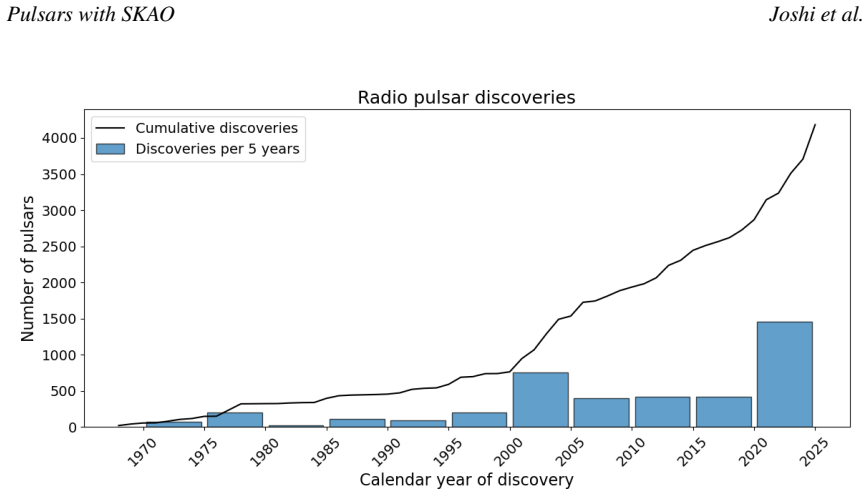
Owing to the large instantaneous sensitivity, wide frequency coverage and flexible observation modes with large number of beams in the sky, the SKAO telescopes are going to be a game-changer for pulsar astronomy. New deep surveys covering the Galactic field, globular clusters and the Galactic centre will discover thousands of new pulsars; these will form the backbone for studies of neutron star physics and of their environments. The enhanced understanding provided by these studies will feed into the main contributions to fundamental physics from pulsar astronomy: testing relativistic gravity, studying gravitational waves in the nano-Hz regime and studying the equation of state of nuclear mat
What carries the argument
The SKAO telescopes' combination of high instantaneous sensitivity, wide frequency coverage, and large number of simultaneous beams, which supports efficient deep pulsar surveys.
If this is right
- Deep surveys will discover thousands of new pulsars in the Galactic field, globular clusters, and Galactic centre.
- The new sample will support detailed studies of neutron star physics and their environments.
- These studies will contribute to tests of relativistic gravity.
- Pulsar timing will enable investigation of gravitational waves in the nano-Hz regime.
- Insights will be gained into the equation of state of nuclear matter.
Where Pith is reading between the lines
- A much larger set of precisely timed pulsars could strengthen pulsar timing array efforts beyond current projections.
- Early SKAO data may reveal whether survey strategies need adjustment to maximise returns in crowded regions like the Galactic centre.
- Multi-wavelength follow-up will likely be required to fully characterise the new pulsar population and its environments.
Load-bearing premise
The stated telescope capabilities will translate into the projected discovery rates and scientific returns without major unforeseen limitations in data processing, calibration, or source confusion.
What would settle it
If SKAO surveys after full operation yield far fewer than thousands of new pulsars or fail to deliver measurable improvements in constraints on relativistic gravity, nano-Hz gravitational waves, or the nuclear equation of state, the central projections would be falsified.
Figures
read the original abstract
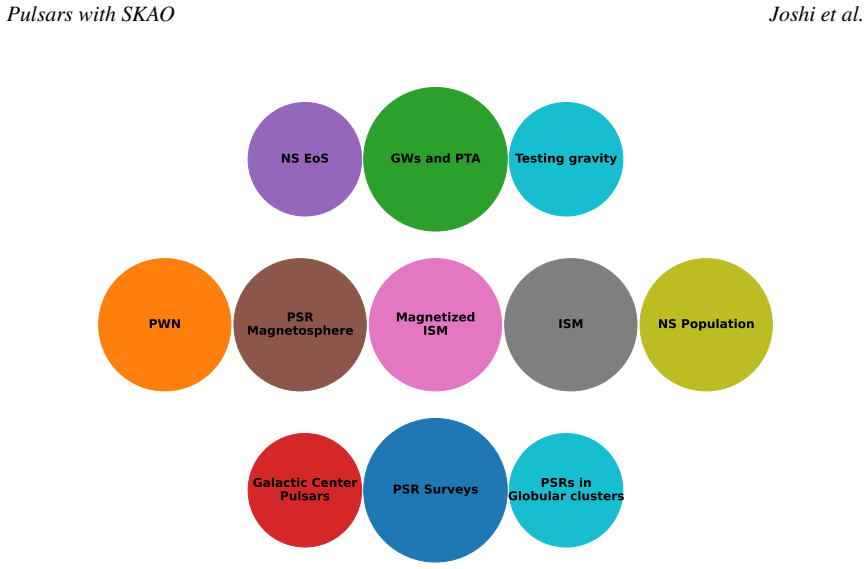
The large instantaneous sensitivity, wide frequency coverage and flexible observation modes, with large number of beams in the sky, are the main features of the SKA observatory's two telescopes, the SKA-Low and the SKA-Mid. Owing to these capabilities, the SKAO telescopes are going to be a game-changer for radio astronomy in general and pulsar astronomy in particular. Eleven chapters in this book describe their impact on different areas of pulsar science. In this overview article each chapter is briefly summarised and the inter-relationship between different pulsar science use cases are explored: new deep surveys, covering the Galactic field, globular clusters and the Galactic centre, will discover thousands of new pulsars; these will form the backbone for studies of neutron star physics and of their environments. The enhanced understanding provided by these studies will feed into the main contributions to fundamental physics from pulsar astronomy: testing relativistic gravity, studying gravitational waves in the nano-Hz regime and studying the equation of state of nuclear matter. Synergies with other science cases are also highlighted throughout this overview.
Editorial analysis
A structured set of objections, weighed in public.
Referee Report
Summary. This overview article summarizes eleven chapters on the impact of the SKAO's SKA-Low and SKA-Mid telescopes on pulsar science. It highlights the telescopes' large instantaneous sensitivity, wide frequency coverage, and large number of beams as enabling deep surveys that will discover thousands of new pulsars across the Galactic field, globular clusters, and Galactic centre. These discoveries are positioned as the foundation for neutron star physics and environment studies, which in turn support contributions to fundamental physics including tests of relativistic gravity, nano-Hz gravitational waves, and the nuclear equation of state, with synergies to other science cases noted throughout.
Significance. If the high-level projections hold, the paper offers a useful synthesis for coordinating pulsar science priorities ahead of SKAO operations. Its value lies in framing inter-related use cases rather than in new derivations, data, or quantitative forecasts.
major comments (1)
- [Abstract] Abstract: the claim that sensitivity, frequency coverage and beam counts will enable surveys discovering thousands of new pulsars (which then underpin tests of relativistic gravity, nano-Hz GWs and the nuclear EOS) rests on the assumption that these capabilities translate directly to yields and timing precision. The manuscript supplies no quantitative error budget, pipeline simulations or contingency analysis for data-volume, real-time multi-band calibration or source-confusion limitations in dense fields.
Simulated Author's Rebuttal
We thank the referee for their constructive review of our overview paper. We address the single major comment below.
read point-by-point responses
-
Referee: [Abstract] Abstract: the claim that sensitivity, frequency coverage and beam counts will enable surveys discovering thousands of new pulsars (which then underpin tests of relativistic gravity, nano-Hz GWs and the nuclear EOS) rests on the assumption that these capabilities translate directly to yields and timing precision. The manuscript supplies no quantitative error budget, pipeline simulations or contingency analysis for data-volume, real-time multi-band calibration or source-confusion limitations in dense fields.
Authors: This manuscript is an overview article synthesising eleven detailed chapters rather than a technical methods paper. The quantitative projections for pulsar yields, timing precision, error budgets, pipeline performance, data volumes, multi-band calibration and source-confusion limits (particularly in the Galactic centre) are developed and justified within those individual chapters; the present text focuses on the inter-relationships among the science cases. We nevertheless agree that the abstract would benefit from a brief clarification of this division of content. We will therefore revise the abstract to state that the supporting quantitative analyses appear in the referenced chapters. revision: partial
Circularity Check
No circularity: descriptive overview of planned capabilities with no derivations or self-referential predictions
full rationale
The manuscript is an overview article that summarizes eleven chapters on SKAO impacts for pulsar science. It contains no equations, no fitted parameters, no claimed first-principles derivations, and no predictions that reduce to its own inputs by construction. All statements about discovery rates and science returns are forward-looking descriptions of telescope features rather than outputs derived from the paper's own analysis. No self-citation chains or ansatzes are invoked to support load-bearing claims. The text is therefore self-contained as a high-level summary and receives the default non-circularity finding.
Axiom & Free-Parameter Ledger
Reference graph
Works this paper leans on
-
[1]
doi: 10.3847/2041-8213/ae0c06. F. Abbate et al. InAdvancing Astrophysics with the SKA – II (AASKAII)
-
[2]
doi: 10.3847/2041-8213/acda9a. T. An et al. InAdvancing Astrophysics with the SKA – II (AASKAII)
-
[3]
A.Basuetal
arXiv search: Report number AASKAII/Bagchi01. A.Basuetal. InAdvancingAstrophysicswiththeSKA–II(AASKAII).2026. arXivsearch: Report number AASKAII/AvishekBasu01. M. Besancon et al. InAdvancing Astrophysics with the SKA – II (AASKAII)
2026
-
[4]
doi: 10.1051/0004-6361/202452550. M. J. Cruz et al. InAdvancing Astrophysics with the SKA – II (AASKAII)
-
[5]
doi: 10.1051/0004-6361/202346841. J. D. Gelfand et al. InAdvancing Astrophysics with the SKA – II (AASKAII)
-
[6]
doi: 10.1007/s10509-025-04463-2. A. Jenkins et al. InAdvancing Astrophysics with the SKA – II (AASKAII)
-
[7]
doi: 10.22323/1.215.0036. V. V. Krishnan et al. InAdvancing Astrophysics with the SKA – II (AASKAII)
-
[8]
L.Levinetal
arXiv search: Report number AASKAII/VenkatramanKrishnan01. L.Levinetal. InAdvancingAstrophysicswiththeSKA–II(AASKAII).2026. arXivsearch: Report number AASKAII/Levin01. Z. Lin et al. InAdvancing Astrophysics with the SKA – II (AASKAII)
2026
-
[9]
Y.K.Maetal
arXiv search: Report number AASKAII/Lin01. Y.K.Maetal. InAdvancingAstrophysicswiththeSKA–II(AASKAII).2026. arXivsearch: Report number AASKAII/Ma01. M. T. Miles et al.MNRAS, 536(2):1467–1488, Jan
2026
-
[10]
doi: 10.1093/mnras/stae2572. L. Oswald et al. InAdvancing Astrophysics with the SKA – II (AASKAII)
-
[11]
M.Regisetal
arXiv search: Report number AASKAII/Ragavendra01. M.Regisetal. InAdvancingAstrophysicswiththeSKA–II(AASKAII).2026. arXivsearch: Report number AASKAII/Regis01. M.Riojaetal. InAdvancingAstrophysicswiththeSKA–II(AASKAII).2026. arXivsearch: Report number AASKAII/Rioja01. R. M. Shannon et al. InAdvancing Astrophysics with the SKA – II (AASKAII)
2026
-
[12]
doi: 10.1017/pasa.2023.36. 13
discussion (0)
Sign in with ORCID, Apple, or X to comment. Anyone can read and Pith papers without signing in.