Taming Complexity in Intuitionistic Modal Logic: The Case of FIK and Its Shallow Calculus
Pith reviewed 2026-07-01 02:48 UTC · model grok-4.3
The pith
FIK admits a shallow nested sequent calculus that places its decision problem in EXPSPACE.
A machine-rendered reading of the paper's core claim, the machinery that carries it, and where it could break.
Core claim
FIK possesses a complete shallow sequent calculus consisting of nested sequents with at most one level of nesting; cut is admissible in this calculus, and the resulting decision procedure for FIK lies in EXPSPACE.
What carries the argument
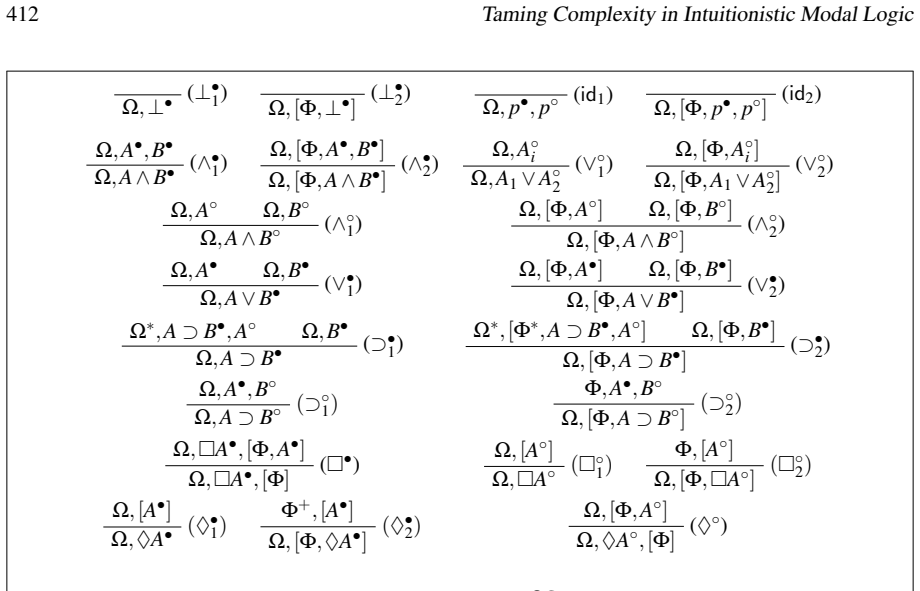
The shallow sequent calculus: nested sequents restricted to at most one level of nesting, which carries both the cut-admissibility proof and the EXPSPACE bound.
If this is right
- The decision problem for FIK is in EXPSPACE.
- Cut is admissible in the shallow calculus for FIK.
- FIK is strictly easier to decide than IK under the conjectured bounds for the latter.
- The shallow restriction suffices for completeness despite FIK sharing IK's semantics.
Where Pith is reading between the lines
- The complexity gap between FIK and IK may arise precisely from formulas whose proofs in IK demand deeper nesting.
- The same one-level restriction might be tested on other logics intermediate between CCDL and IK to locate the exact point where EXPSPACE becomes insufficient.
- An EXPSPACE procedure for FIK could be implemented directly from the shallow calculus and compared against existing solvers for related modal logics.
- The result separates the semantic strength of the bi-relational models from the syntactic depth needed for proofs.
Load-bearing premise
The shallow calculus is complete for FIK under the same bi-relational forcing conditions used for IK.
What would settle it
A sequent belonging to FIK whose shortest derivation in any complete calculus requires two or more nesting levels, or a counterexample to cut admissibility within the shallow system.
Figures
read the original abstract
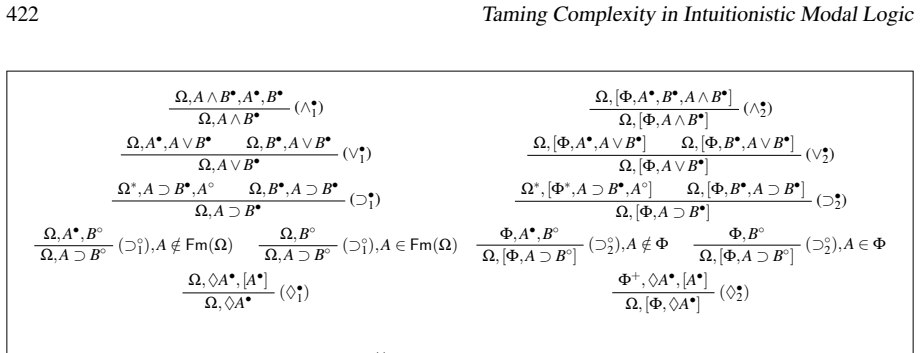
Intuitionistic modal logics (IMLs) comprise many systems: from constructive modal logics such as CK and Wijesekera's CCDL to Fischer Servi/Simpson's IK, as well as some recently introduced variants. All of them are characterized by bi-relational semantics and have complete axiomatisations. However, from the perspective of proof theory and complexity, there are strong differences: while for constructive modal logics simple Gentzen calculi suffice, for IK more complex calculi, based on nested or labelled sequents, are needed. As a consequence, the decision problem for constructive modal logics has a PSPACE upper bound, whereas for IK is not known and it is even conjectured to be non-elementary. We study here the proof theory and complexity of FIK, a natural intuitionistic modal logic recently introduced. FIK is strictly in between CCDL and IK, yet it has the same forcing conditions as IK. We define a "shallow" sequent calculus for FIK which is a nested sequent calculus where sequents have at most one level of nesting. We prove its syntactic completeness by showing the admissibility of cut. By means of this calculus we show that decision problem for FIK is in EXPSPACE, whence significantly lower than the complexity conjectured for IK.
Editorial analysis
A structured set of objections, weighed in public.
Referee Report
Summary. The paper introduces FIK, an intuitionistic modal logic strictly between CCDL and IK that shares the same bi-relational forcing conditions as IK. It defines a shallow nested sequent calculus (nested sequents with at most one level of nesting) for FIK, establishes syntactic completeness by proving cut admissibility, and extracts an EXPSPACE upper bound for the decision problem for FIK from the restricted nesting depth, which is claimed to be significantly lower than the non-elementary complexity conjectured for IK.
Significance. If the shallow calculus is complete for FIK, the result provides a concrete EXPSPACE bound that improves on existing conjectures for related intuitionistic modal logics and demonstrates how restricting nesting depth can tame complexity while preserving completeness via cut admissibility. The syntactic focus and the explicit contrast with IK are strengths that could guide further work on proof systems for this family of logics.
major comments (2)
- [Abstract and the section establishing syntactic completeness via cut admissibility] The completeness claim for the shallow calculus (at most one level of nesting) rests on cut admissibility under the bi-relational semantics shared with IK, but the manuscript does not explicitly show that every FIK-valid sequent has a shallow derivation; an additional argument is needed that the nesting restriction does not exclude any theorems, otherwise the EXPSPACE bound applies only to the fragment captured by the calculus rather than to FIK itself.
- [The complexity analysis following the cut-admissibility proof] The extraction of the EXPSPACE bound from the one-level nesting structure (as stated in the abstract) presupposes that the calculus is complete; if the completeness step requires deeper nesting for some FIK theorems, the complexity result does not transfer to the full logic.
minor comments (2)
- Clarify the precise statement of the bi-relational semantics used for FIK versus IK to make the shared forcing conditions explicit.
- Ensure all rule schemas in the shallow calculus are accompanied by side-condition explanations for readability.
Simulated Author's Rebuttal
Thank you for your detailed review and valuable feedback on our manuscript. We appreciate the recognition of the significance of our results on FIK and its shallow calculus. We address each major comment below.
read point-by-point responses
-
Referee: [Abstract and the section establishing syntactic completeness via cut admissibility] The completeness claim for the shallow calculus (at most one level of nesting) rests on cut admissibility under the bi-relational semantics shared with IK, but the manuscript does not explicitly show that every FIK-valid sequent has a shallow derivation; an additional argument is needed that the nesting restriction does not exclude any theorems, otherwise the EXPSPACE bound applies only to the fragment captured by the calculus rather than to FIK itself.
Authors: We agree that an explicit demonstration is required to confirm that the shallow calculus is complete for the full FIK, meaning every semantically valid sequent admits a shallow derivation. The cut admissibility establishes equivalence between the cut-free and cut versions of the calculus, but to connect to FIK validity, we will add in the revision a proof that the nesting depth restriction is without loss for FIK. This will be based on the specific modal axioms of FIK allowing us to simulate deeper nestings with shallow ones using the bi-relational models. This addresses the concern and ensures the result applies to FIK. revision: yes
-
Referee: [The complexity analysis following the cut-admissibility proof] The extraction of the EXPSPACE bound from the one-level nesting structure (as stated in the abstract) presupposes that the calculus is complete; if the completeness step requires deeper nesting for some FIK theorems, the complexity result does not transfer to the full logic.
Authors: As noted in our response to the first comment, we will provide the missing completeness argument showing that no deeper nesting is required for FIK theorems. Consequently, the EXPSPACE upper bound derived from the one-level nesting will apply to the full logic. We will revise the complexity section to explicitly tie the bound to the now-established completeness of the shallow calculus. revision: yes
Circularity Check
No circularity in shallow calculus completeness or EXPSPACE bound for FIK
full rationale
The paper defines a shallow nested sequent calculus (at most one level of nesting), proves syntactic completeness for FIK by cut admissibility under the standard bi-relational semantics, and derives the EXPSPACE upper bound directly from the restricted proof depth. No quoted step reduces a claimed result to a fitted parameter, self-citation, or definitional renaming; the derivation is self-contained via standard syntactic methods without invoking prior author results as load-bearing uniqueness theorems or ansatzes.
Axiom & Free-Parameter Ledger
axioms (2)
- domain assumption Cut is admissible in the shallow sequent calculus for FIK
- standard math Standard structural rules (weakening, contraction) are admissible in nested sequent systems
Reference graph
Works this paper leans on
-
[1]
In: 32nd EACSL Annual Conference on Computer Science Logic (CSL 2024), 288, pp
Philippe Balbiani, Han Gao, Çi ˘gdem Gencer & Nicola Olivetti (2024): A Natural Intuitionistic Modal Logic: Axiomatization and Bi-Nested Calculus. In: 32nd EACSL Annual Conference on Computer Science Logic (CSL 2024), 288, pp. 13:1–13:21, doi:10.4230/LIPIcs.CSL.2024.13
-
[2]
In: International Joint Conference on Automated Reasoning , Springer, pp
Philippe Balbiani, Han Gao, Çi ˘gdem Gencer & Nicola Olivetti (2024): Local Intuitionistic Modal Log- ics and Their Calculi . In: International Joint Conference on Automated Reasoning , Springer, pp. 78–96, doi:10.1007/978-3-031-63501-4_5
-
[3]
Philippe Balbiani & Çi ˘gdem Gencer (2026): Intuitionistic Modal Logics: A Minimal Setting. Studia Logica, pp. 1–68, doi:10.1007/s11225-025-10224-7
-
[4]
Logic Journal of the IGPL 34(1), p
Philippe Balbiani & Çi ˘gdem Gencer (2026): Intuitionistic modal logics: tips and clips. Logic Journal of the IGPL 34(1), p. jzaf089, doi:10.1093/jigpal/jzaf089
-
[5]
In: Proceedings of methods for modalities, 2
Gianluigi Bellin, Valeria De Paiva & Eike Ritter (2001):Extended Curry-Howard correspondence for a basic constructive modal logic. In: Proceedings of methods for modalities, 2. Available athttps://hdl.handle. net/11562/110
2001
-
[6]
Gavin Bierman & Valeria de Paiva (2000): On an Intuitionistic Modal Logic . Studia Logica 65(3), pp. 383–416, doi:10.1023/A:1005291931660
-
[7]
Kai Brünnler (2009): Deep sequent systems for modal logic . Arch. Math. Log. 48(6), pp. 551–577, doi:10.1007/S00153-009-0137-3
-
[8]
Anupam Das & Sonia Marin (2023): On Intuitionistic Diamonds (and Lack Thereof) . In Revantha Ra- manayake & Josef Urban, editors: Automated Reasoning with Analytic Tableaux and Related Methods - 32nd International Conference, TABLEAUX 2023, Lecture Notes in Computer Science 14278, Springer, pp. 283–301, doi:10.1007/978-3-031-43513-3_16
-
[9]
Fischer Servi (1977): On modal logic with an intuitionistic base
Gisèle Fischer Servi (1977): On Modal Logic with an Intuitionistic Base. Studia Logica 36(3), pp. 141–149, doi:10.1007/BF02121259
-
[10]
Gisèle Fischer Servi (1981): Semantics for a Class of Intuitionistic Modal Calculi , pp. 59–72. Springer Netherlands, Dordrecht, doi:10.1007/978-94-009-8937-5_5
-
[11]
Rendiconti del Semi- nario Matematico Università e Politecnico di Torino 42
Gisèle Fischer Servi (1984): Axiomatizations for some intuitionistic modal logics . Rendiconti del Semi- nario Matematico Università e Politecnico di Torino 42. Available at https://cir.nii.ac.jp/crid/ 1371132818982119684
1984
-
[12]
Fitch (1948): Intuitionistic modal logic with quantifiers
Frederic B. Fitch (1948): Intuitionistic modal logic with quantifiers. Portugaliae mathematica 7(2), pp. 113–
1948
-
[13]
Available at http://eudml.org/doc/114664
-
[14]
169, Springer Science & Business Media, doi:10.1007/978-94-017-2794-5
Melvin Fitting (2013): Proof methods for modal and intuitionistic logics. 169, Springer Science & Business Media, doi:10.1007/978-94-017-2794-5
-
[15]
Melvin Fitting (2014): Nested Sequents for Intuitionistic Logics . Notre Dame J. Formal Log. 55(1), pp. 41–61, doi:10.1215/00294527-2377869
-
[16]
Journal of Applied Non-Classical Logics 20(4), pp
Didier Galmiche & Yakoub Salhi (2010): Label-free natural deduction systems for intuitionistic and classical modal logics. Journal of Applied Non-Classical Logics 20(4), pp. 373–421, doi:10.3166/jancl.20.373-421. 426 Taming Complexity in Intuitionistic Modal Logic
-
[17]
Journal of Applied Non-Classical Logics , pp
Han Gao, Marianna Girlando & Nicola Olivetti (2026): A bi-nested calculus for intuitionistic K: proofs and countermodels. Journal of Applied Non-Classical Logics , pp. 1–40, doi:10.1080/11663081.2026.2658653
-
[18]
In: International Workshop on Logic, Language, Information, and Computa- tion, Springer, pp
Marianna Girlando, Roman Kuznets, Sonia Marin, Marianela Morales & Lutz Straßburger (2024): A simple loopcheck for intuitionistic K. In: International Workshop on Logic, Language, Information, and Computa- tion, Springer, pp. 47–63, doi:10.1007/978-3-031-62687-6_4
-
[19]
Logical Methods in Computer Science V olume 7, Issue 2:8, doi:10.2168/LMCS-7(2:8)2011
Rajeev Goré, Linda Postniece & Alwen F Tiu (2011): On the Correspondence between Display Postulates and Deep Inference in Nested Sequent Calculi for Tense Logics . Logical Methods in Computer Science V olume 7, Issue 2:8, doi:10.2168/LMCS-7(2:8)2011
-
[20]
Jim de Groot, Ian Shillito & Ranald Clouston (2025): Semantical analysis of intuitionistic modal logics between CK and IK. In: 2025 40th Annual ACM/IEEE Symposium on Logic in Computer Science (LICS) , IEEE, pp. 169–182, doi:10.1109/LICS65433.2025.00020
-
[21]
Archive for Mathematical Logic 58(3), pp
Roman Kuznets & Lutz Straßburger (2019): Maehara-style modal nested calculi. Archive for Mathematical Logic 58(3), pp. 359–385, doi:10.1007/s00153-018-0636-1
-
[22]
Sonia Marin, Marianela Morales & Lutz Straßburger (2021): A fully labelled proof system for intuitionistic modal logics. J. Log. Comput. 31(3), pp. 998–1022, doi:10.1093/LOGCOM/EXAB020
-
[23]
Context Representation and Reasoning (CRR-2005) 13
Michael Mendler & Valeria de Paiva (2005): Constructive CK for contexts . Context Representation and Reasoning (CRR-2005) 13. Available at https://ceur-ws.org/Vol-136/143.pdf
2005
-
[24]
Odintsov & Heinrich Wansing (2008): Inconsistency-tolerant description logic
Sergei P. Odintsov & Heinrich Wansing (2008): Inconsistency-tolerant description logic. Part II: A tableau algorithm for CALCC. Journal of Applied Logic 6(3), pp. 343–360, doi:10.1016/j.jal.2007.06.001
-
[25]
Gordon Plotkin & Colin Stirling (1986): A framework for intuitionistic modal logics . In: Proceed- ings of the 1st Conference on Theoretical Aspects of Reasoning about Knowledge (TARK) , pp. 399–406, doi:10.5555/1029786.1029823
-
[26]
Dover Publications, Mineola, N.Y ., doi:10.2307/2271676
Dag Prawitz (1965): Natural Deduction: A Proof-Theoretical Study . Dover Publications, Mineola, N.Y ., doi:10.2307/2271676
-
[27]
Alex K Simpson (1994): The proof theory and semantics of intuitionistic modal logic . Ph.D. thesis, School of College of Science and Engineering, University of Edinburgh. Available at http://hdl.handle.net/ 1842/407
1994
-
[28]
Lutz Straßburger (2013): Cut elimination in nested sequents for intuitionistic modal logics. In: Foundations of Software Science and Computation Structures: 16th International Conference, FOSSACS 2013, Held as Part of the European Joint Conferences on Theory and Practice of Software, ETAPS 2013, Rome, Italy, March 16-24, 2013. Proceedings 16 , Springer, p...
-
[29]
Duminda Wijesekera (1990): Constructive Modal Logics I . Ann. Pure Appl. Log. 50(3), pp. 271–301, doi:10.1016/0168-0072(90)90059-B
discussion (0)
Sign in with ORCID, Apple, or X to comment. Anyone can read and Pith papers without signing in.