OlfactProfile: Profile-Conditioned Odor Prediction from Audiovisual Content
Pith reviewed 2026-06-26 21:50 UTC · model grok-4.3
The pith
Structured field-wise conditioning on observer olfactory profiles improves audiovisual odor prediction while naive concatenation degrades it.
A machine-rendered reading of the paper's core claim, the machinery that carries it, and where it could break.
Core claim
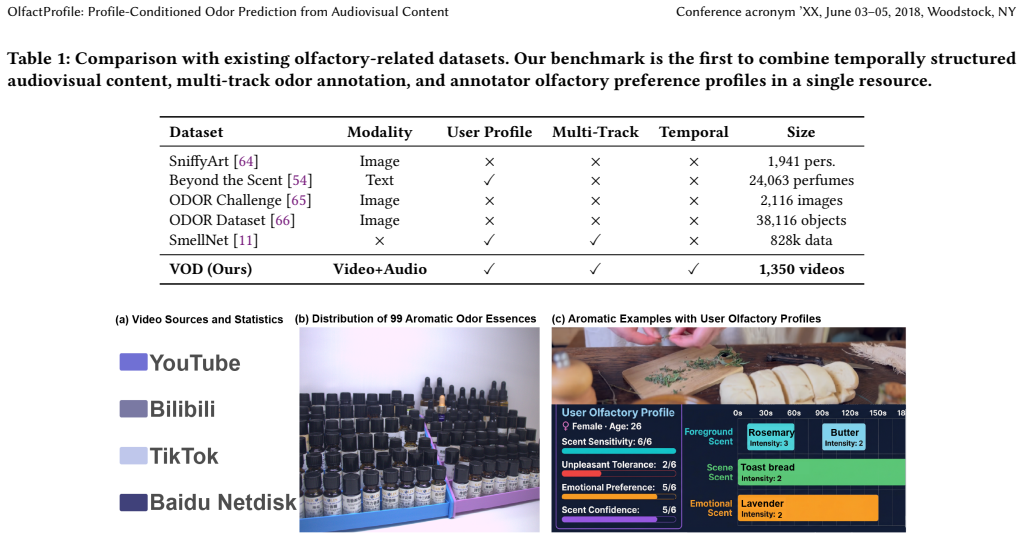
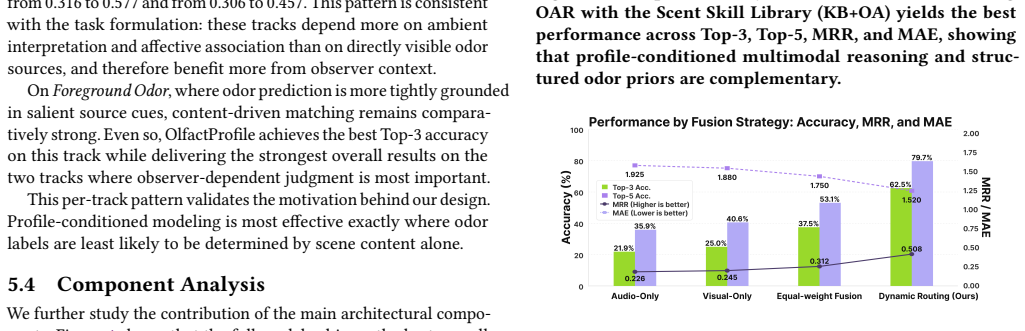
OlfactProfile shows that olfactory profiles are not beneficial by default; with matched feature backbones, naive profile concatenation and uniform profile modulation can degrade performance, while structured field-wise profile conditioning consistently improves prediction on an audiovisual benchmark containing 1,350 clips, a 99-class scent vocabulary, and three semantic odor tracks.
What carries the argument
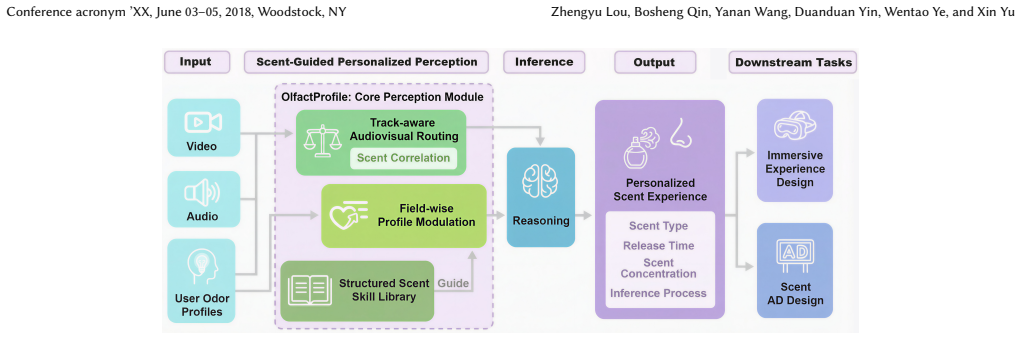
OAR (Olfactory-Aware Routing), a multimodal fusion module that performs track-aware audiovisual routing with field-wise profile modulation.
If this is right
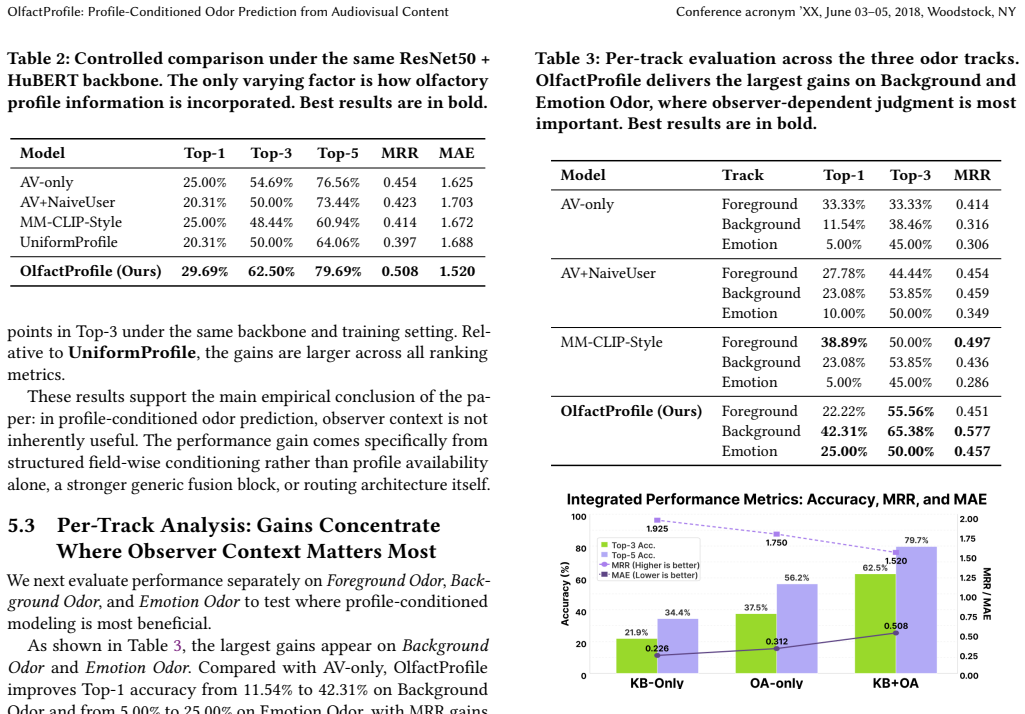
- Prediction gains are strongest for Background Odor and Emotion Odor tracks.
- The method outperforms supervised baselines and general-purpose multimodal large models.
- It is competitive with odor experts in a small human comparison.
- It improves perceived scent fit in scent-enhanced applications without task-specific fine-tuning.
Where Pith is reading between the lines
- The per-track variation suggests that observer dependence is higher for certain odor categories, which could prioritize data collection for those tracks in future benchmarks.
- The same structured conditioning pattern may apply to other subjective multimodal tasks such as emotion or taste prediction from video.
- Real-time scent delivery systems could use the routing logic to adjust output dynamically per user profile without retraining the core audiovisual encoder.
Load-bearing premise
The constructed audiovisual benchmark with 1,350 clips and annotator profiles accurately captures real-world observer-dependent odor judgments, and observed performance gains are attributable to the structured conditioning rather than dataset artifacts.
What would settle it
An independent replication on a new set of videos and observers in which OAR produces no improvement over naive concatenation on the same metrics would falsify the central claim.
Figures
read the original abstract
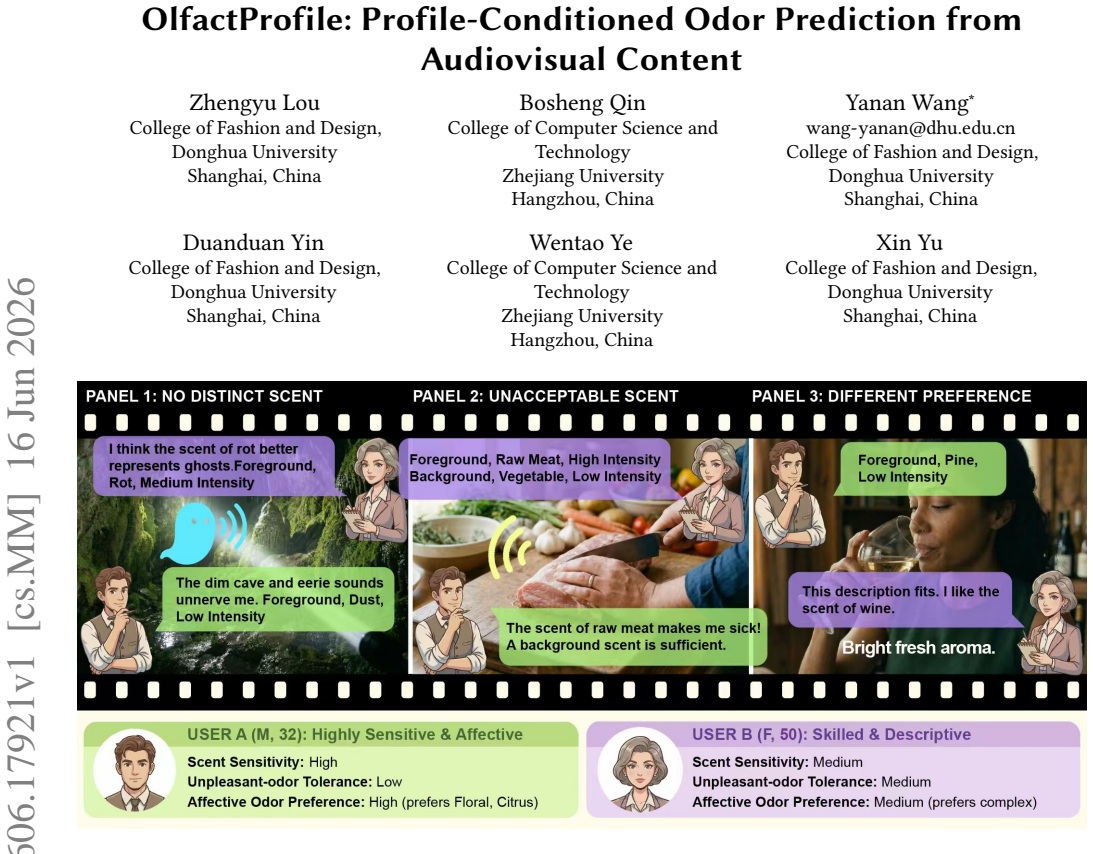
Automated video-odor matching predicts scents aligned with audiovisual content for scent-enhanced media. Existing methods usually treat odor labels as determined only by scene content, but odor judgment also depends on individual olfactory profiles, including scent sensitivity, tolerance to unpleasant odors, and affective preference. Ignoring this observer context limits current systems' ability to predict scents that match perceived experience. We present OlfactProfile, a framework for profile-conditioned odor prediction from audiovisual content. Our results show that olfactory profiles are not beneficial by default: with matched feature backbones, naive profile concatenation and uniform profile modulation can degrade performance, while structured field-wise profile conditioning consistently improves prediction. Thus, the key challenge is not merely whether observer context is available, but how it is integrated into multimodal reasoning. To study this setting, we construct an audiovisual benchmark pairing temporally aligned odor annotations with annotator olfactory preference profiles. It contains 1,350 video clips, a 99-class scent vocabulary, and three semantic odor tracks: Foreground Odor, Background Odor, and Emotion Odor. We also propose OAR (Olfactory-Aware Routing), a multimodal fusion module that performs track-aware audiovisual routing with field-wise profile modulation, allowing profile dimensions to influence odor reasoning according to perceptual role. Experiments show that OlfactProfile outperforms supervised baselines and general-purpose multimodal large models, is competitive with odor experts in a small human comparison, and improves perceived scent fit in scent-enhanced applications without task-specific fine-tuning. Per-track analysis shows that gains are strongest for Background Odor and Emotion Odor, where observer-dependent judgment is most important.
Editorial analysis
A structured set of objections, weighed in public.
Referee Report
Summary. The paper presents OlfactProfile, a framework for profile-conditioned odor prediction from audiovisual content. It constructs a new benchmark of 1,350 video clips with temporally aligned odor annotations (Foreground, Background, Emotion Odor tracks) and annotator olfactory profiles, and introduces the OAR module for track-aware audiovisual routing with field-wise profile modulation. The central empirical claim is that, with matched backbones, naive profile concatenation and uniform modulation degrade performance while structured field-wise conditioning improves it; the method outperforms supervised baselines and general multimodal models, is competitive with odor experts in a small human study, and yields gains strongest on observer-dependent tracks.
Significance. If the benchmark validity and attribution of gains to the conditioning structure hold, the work makes a useful contribution by demonstrating that observer context is not automatically beneficial and that integration method matters for multimodal olfactory reasoning. The per-track analysis and comparison to naive baselines provide a concrete, falsifiable demonstration relevant to scent-enhanced media applications.
major comments (3)
- [Benchmark construction paragraph] Benchmark construction paragraph and experimental section: no inter-rater reliability scores (e.g., Fleiss' kappa or ICC stratified by profile), no validation of annotator profiles against standardized olfactory tests, and no reported checks for correlation between profile dimensions and audiovisual content features are provided. Without these, it is impossible to rule out that observed deltas arise from dataset artifacts or confounds rather than the OAR field-wise modulation.
- [Experiments section] Experiments section (results tables and ablation studies): the manuscript reports consistent outperformance but provides no details on data splits, statistical significance tests, error bars, or ablation isolating the field-wise modulation component from other OAR design choices. This leaves the load-bearing claim that 'structured field-wise profile conditioning consistently improves prediction' without verifiable quantitative support.
- [OAR module description and per-track analysis] § on OAR module and per-track analysis: the claim that gains are strongest for Background Odor and Emotion Odor (where observer dependence is highest) is presented without quantitative evidence that profile dimensions are uncorrelated with content features within those tracks; if such correlation exists, the improvement cannot be attributed to the conditioning structure.
minor comments (2)
- [Abstract] The abstract and introduction use 'consistent improvement' without defining the threshold or reporting the magnitude of gains relative to variance.
- [Introduction] Notation for the three odor tracks (Foreground Odor, Background Odor, Emotion Odor) should be introduced with explicit symbols or abbreviations at first use for clarity.
Simulated Author's Rebuttal
We thank the referee for the constructive and detailed feedback. We address each major comment below and will incorporate revisions to improve the manuscript's rigor and transparency.
read point-by-point responses
-
Referee: [Benchmark construction paragraph] Benchmark construction paragraph and experimental section: no inter-rater reliability scores (e.g., Fleiss' kappa or ICC stratified by profile), no validation of annotator profiles against standardized olfactory tests, and no reported checks for correlation between profile dimensions and audiovisual content features are provided. Without these, it is impossible to rule out that observed deltas arise from dataset artifacts or confounds rather than the OAR field-wise modulation.
Authors: We agree these validations would strengthen the benchmark. In the revised manuscript we will add inter-rater reliability metrics (Fleiss' kappa, stratified by profile), describe the profile collection procedure and any supporting validation steps, and include explicit correlation analyses between profile dimensions and audiovisual features to rule out confounds. revision: yes
-
Referee: [Experiments section] Experiments section (results tables and ablation studies): the manuscript reports consistent outperformance but provides no details on data splits, statistical significance tests, error bars, or ablation isolating the field-wise modulation component from other OAR design choices. This leaves the load-bearing claim that 'structured field-wise profile conditioning consistently improves prediction' without verifiable quantitative support.
Authors: We acknowledge the need for fuller experimental transparency. The revision will specify the data splits, report statistical significance tests with p-values, include error bars on all metrics, and add a targeted ablation isolating the field-wise modulation component from other OAR elements. revision: yes
-
Referee: [OAR module description and per-track analysis] § on OAR module and per-track analysis: the claim that gains are strongest for Background Odor and Emotion Odor (where observer dependence is highest) is presented without quantitative evidence that profile dimensions are uncorrelated with content features within those tracks; if such correlation exists, the improvement cannot be attributed to the conditioning structure.
Authors: The per-track analysis follows from the benchmark's semantic track definitions, which explicitly distinguish observer-dependent aspects. To address the attribution concern directly, the revised manuscript will add quantitative correlation checks between profile dimensions and content features, computed per track, to confirm that observed gains are not driven by spurious correlations. revision: yes
Circularity Check
No circularity; empirical results rest on independent benchmark experiments
full rationale
The paper advances an empirical claim about profile-conditioning methods via performance comparisons on a newly constructed 1,350-clip audiovisual benchmark with three odor tracks. No equations, derivations, fitted-parameter predictions, or self-citation chains appear in the provided text; the central results are obtained by training and evaluating models on held-out data rather than reducing to inputs by definition. The benchmark construction and OAR module are presented as novel contributions whose validity is tested externally through baseline comparisons and human evaluation, satisfying the criteria for a self-contained empirical study.
Axiom & Free-Parameter Ledger
Reference graph
Works this paper leans on
-
[1]
O. Ademoye and G. Ghinea. 2013. Information recall task impact in olfaction- enhanced multimedia.ACM Trans. Multim. Comput. Commun. Appl.9 (2013), 17:1–17:16. doi:10.1145/2487268.2487270
-
[2]
Yun Ai, Juan Yang, Haoyu Nie, Thomas Hummel, and Pengfei Han. 2023. Increased sensitivity to unpleasant odor following acute psychological stress.Hormones and Behavior150 (2023), 105325
2023
-
[3]
Amany Al Luhaybi, Fahad Alqurashi, Georgios Tsaramirsis, and Seyed M Buhari
-
[4]
Automatic Association of Scents Based on Visual Content.Applied Sciences 9, 8 (2019), 1697
2019
-
[5]
Safaa Alraddadi, Fahad Alqurashi, Georgios Tsaramirsis, Amany Al Luhaybi, and Seyed M. Buhari. 2019. Aroma release of olfactory displays based on audio-visual content.Applied Sciences9, 22 (2019), 4866
2019
-
[6]
PLoS ONE (2021) https://doi.org/10.1371/journal.pone
N. Archer, Andrew Bluff, Andrew Eddy, Chreshall K. Nikhil, Nick Hazell, Damian Frank, and Andrew Johnston. 2022. Odour enhances the sense of presence in a virtual reality environment.PLoS ONE17 (2022). doi:10.1371/journal.pone. 0265039
-
[7]
Jas Brooks and Pedro Lopes. 2023. Smell & paste: Low-fidelity prototyping for olfactory experiences. InProceedings of the 2023 CHI Conference on Human Factors in Computing Systems. 1–16
2023
-
[8]
Kirsten Cowan, Seth Ketron, Alena Kostyk, and Kirk Kristofferson. 2023. Can you smell the (virtual) roses? The influence of olfactory cues in virtual reality on immersion and positive brand responses.Journal of retailing99, 3 (2023), 385–399
2023
-
[9]
Ilona Croy, W Maboshe, and T Hummel. 2013. Habituation effects of pleasant and unpleasant odors.International Journal of Psychophysiology88, 1 (2013), 104–108
2013
-
[10]
Dmitrijs Dmitrenko, Emanuela Maggioni, Giada Brianza, Brittany E. Holthausen, Bruce N. Walker, and Marianna Obrist. 2020. CARoma Therapy: Pleasant Scents Promote Safer Driving, Better Mood, and Improved Well-Being in Angry Drivers. InProceedings of the 2020 CHI Conference on Human Factors in Computing Systems. doi:10.1145/3313831.3376176
-
[11]
Xiang Fei, Yanan Wang, Yucheng Li, Zhengyu Lou, Yifan Yan, Yujing Tian, and Qingjun Chen. 2024. OdorCarousel: A Design Tool for Customizing Smell- Enhanced Virtual Experiences.International Journal of Human–Computer Inter- action(2024), 1–16
2024
-
[12]
Dewei Feng, Wei Dai, Carol Li, Alistair Pernigo, Yunge Wen, and Paul Pu Liang
-
[13]
Smellnet: A large-scale dataset for real-world smell recognition.arXiv preprint arXiv:2506.00239(2025)
Pith/arXiv arXiv 2025
-
[14]
C. Ferdenzi, J. Poncelet, C. Rouby, and M. Bensafi. 2014. Repeated exposure to odors induces affective habituation of perception and sniffing.Frontiers in Behavioral Neuroscience8 (2014). doi:10.3389/fnbeh.2014.00119
-
[15]
Carlos Flavián, Sergio Ibáñez-Sánchez, and Carlos Orús. 2021. The influence of scent on virtual reality experiences: The role of aroma-content congruence. Journal of Business Research123 (2021), 289–301
2021
-
[16]
Shihan Fu, Jianhao Chen, Yi Cai, and Mingming Fan. 2024. Aromablendz: an olfactory system for crafting personalized scents. InExtended Abstracts of the CHI Conference on Human Factors in Computing Systems. 1–5
2024
-
[17]
Shihan Fu, Jianhao Chen, Yi Cai, and Mingming Fan. 2024. AromaBlendz: An Olfactory System for Crafting Personalized Scents.Extended Abstracts of the CHI Conference on Human Factors in Computing Systems(2024). doi:10.1145/3613905. 3648670
-
[18]
Peizhong Gao, Fan Liu, Di Wen, Yuze Gao, Linxin Zhang, Chikelei Wang, Qiwei Zhang, Yu Zhang, Shao-en Ma, Qi Lu, et al. 2024. Mul-O: Encouraging Olfactory Innovation in Various Scenarios Through a Task-Oriented Development Platform. InProceedings of the 37th Annual ACM Symposium on User Interface Software and Technology. 1–17
2024
-
[19]
Gheorghita Ghinea and Oluwakemi Ademoye. 2012. The sweet smell of suc- cess: Enhancing multimedia applications with olfaction.ACM transactions on multimedia computing, communications, and applications (TOMM)8, 1 (2012), 1–17
2012
-
[20]
Gheorghita Ghinea and Oluwakemi Ademoye. 2012. User perception of media content association in olfaction-enhanced multimedia.ACM Trans. Multimedia Comput. Commun. Appl.8, 4, Article 52 (Nov. 2012), 19 pages. doi:10.1145/2379790. 2379794
-
[21]
Kaiming He, Xiangyu Zhang, Shaoqing Ren, and Jian Sun. 2016. Deep Residual Learning for Image Recognition. InProceedings of the IEEE Conference on Computer Vision and Pattern Recognition (CVPR). 770–778. doi:10.1109/CVPR.2016.90
-
[22]
Rachel S Herz. 2025. Smell Is Emotion.Brain Sciences16, 1 (2025), 59
2025
-
[23]
Jingming Hou, Nazlia Omar, Sabrina Tiun, Saidah Saad, and Qian He. 2025. TF- BERT: Tensor-based fusion BERT for multimodal sentiment analysis.Neural networks : the official journal of the International Neural Network Society185 (2025), 107222. doi:10.1016/j.neunet.2025.107222
-
[24]
Wei-Ning Hsu, Benjamin Bolte, Yao-Hung Hubert Tsai, Kushal Lakhotia, Ruslan Salakhutdinov, and Abdelrahman Mohamed. 2021. HuBERT: Self- Supervised Speech Representation Learning by Masked Prediction of Hidden Units.IEEE/ACM Transactions on Audio, Speech, and Language Processing29 Conference acronym ’XX, June 03–05, 2018, Woodstock, NY Zhengyu Lou, Bosheng...
-
[25]
Hung, Nguyen Quan, Nguyen Tan, Tran Hai, Dang Trung, Le Nam, Bui Loan, and N
N. Hung, Nguyen Quan, Nguyen Tan, Tran Hai, Dang Trung, Le Nam, Bui Loan, and N. Nga. 2025. Building Predictive Smell Models for Virtual Reality Environments.Informatics and Automation(2025). doi:10.15622/ia.24.2.7
-
[26]
M. Ischer, Naem Baron, C. Mermoud, I. Cayeux, C. Porcherot, D. Sander, and S. Delplanque. 2014. How incorporation of scents could enhance immersive virtual experiences.Frontiers in Psychology5 (2014). doi:10.3389/fpsyg.2014.00736
-
[27]
Sara R Jaeger, Jeremy F McRae, Christina M Bava, Michelle K Beresford, Denise Hunter, Yilin Jia, Sok Leang Chheang, David Jin, Mei Peng, Joanna C Gamble, et al. 2013. A Mendelian trait for olfactory sensitivity affects odor experience and food selection.Current Biology23, 16 (2013), 1601–1605
2013
-
[28]
Elahe Kani-Zabihi, Nadia Hussain, Gebremariam Mesfin, Alexandra Covaci, and Gheorghita Ghinea. 2021. On the influence of individual differences in cross- modal Mulsemedia QoE.Multimedia Tools and Applications80, 2 (2021), 2377– 2394
2021
-
[29]
Sangyun Kim, Junseok Park, Junseong Bang, and Haeryong Lee. 2018. Seeing is Smelling: Localizing Odor-Related Objects in Images. InProceedings of the 9th Augmented Human International Conference(Seoul, Republic of Korea)(AH ’18). Association for Computing Machinery, New York, NY, USA, Article 15, 9 pages. doi:10.1145/3174910.3174922
-
[30]
Fjaeldstad, Umar Rehman, Jacklyn Liu, David Boniface, Jim Boardman, D
Matt Lechner, A. Fjaeldstad, Umar Rehman, Jacklyn Liu, David Boniface, Jim Boardman, D. Boak, A. Altundag, Johannes Frasnelli, S. Gane, Eric H Holbrook, J. Hsieh, C. Huart, I. Konstantinidis, Baslie N Landis, Valerie J. Lund, Alberto Macchi, E. Mori, Christian Mueller, J. Mullol, S. Negoias, Z. Patel, Jayant M. Pinto, S. Poletti, V. Ramakrishnan, P. Romba...
-
[31]
Yuxuan Lei, Qi Lu, and Yingqing Xu. 2022. O&O: A DIY toolkit for designing and rapid prototyping olfactory interfaces. InProceedings of the 2022 CHI Conference on Human Factors in Computing Systems. 1–21
2022
-
[32]
Hongyang Li, B. Panwar, G. Omenn, and Y. Guan. 2017. Accurate prediction of personalized olfactory perception from large-scale chemoinformatic features. GigaScience7 (2017), 1 – 11. doi:10.1093/gigascience/gix127
-
[33]
Yi-Bing Lin, Ming-Ta Yang, and Yun-Wei Lin. 2019. Low-Cost Four-Dimensional Experience Theater Using Home Appliances.IEEE Transactions on Multimedia (May 2019), 1161–1168. doi:10.1109/tmm.2018.2876043
-
[34]
May O Lwin and Maureen Morrin. 2012. Scenting movie theatre commercials: The impact of scent and pictures on brand evaluations and ad recall.Journal of Consumer Behaviour11, 3 (2012), 264–272
2012
-
[35]
Emanuela Maggioni, Robert Cobden, and Marianna Obrist. 2019. OWidgets: A toolkit to enable smell-based experience design.International Journal of Human- Computer Studies130 (2019), 248–260
2019
-
[36]
Rolando Gonzales Martinez. 2024. Bayesian algorithmic perfumery: A Hierar- chical Relevance Vector Machine for the Estimation of Personalized Fragrance Preferences based on Three Sensory Layers and Jungian Personality Archetypes. ArXivabs/2411.03965 (2024). doi:10.48550/arxiv.2411.03965
-
[37]
Niall Murray, Yuansong Qiao, Brian Lee, and Gabriel-Miro Muntean. 2014. User- profile-based perceived olfactory and visual media synchronization.ACM Trans- actions on Multimedia Computing, Communications, and Applications (TOMM)10, 1s (2014), 1–24
2014
-
[38]
Takamichi Nakamoto and Kenjiro Yoshikawa. 2006. Movie with scents generated by olfactory display using solenoid valves.IEICE transactions on fundamentals of electronics, communications and computer sciences89, 11 (2006), 3327–3332
2006
-
[39]
Lunden, Marie Ehrndal, and Jonas K
Simon Niedenthal, William Fredborg, P. Lunden, Marie Ehrndal, and Jonas K. Olofsson. 2022. A graspable olfactory display for virtual reality.Int. J. Hum. Comput. Stud.169 (2022), 102928. doi:10.1016/j.ijhcs.2022.102928
-
[40]
Simon Niedenthal, William Fredborg, Peter Lundén, Marie Ehrndal, and Jonas K Olofsson. 2023. A graspable olfactory display for virtual reality.International journal of human-computer studies169 (2023), 102928
2023
-
[41]
Anna Oleszkiewicz, Rafieh Alizadeh, Aytug Altundag, Ben Chen, Alessandra Corrai, Rachele Fanari, Mohammad Farhadi, Neelima Gupta, Rebecca Habel, Robyn Hudson, et al. 2020. Global study of variability in olfactory sensitivity. Behavioral Neuroscience134, 5 (2020), 394
2020
-
[42]
S. Pizzoli, D. Monzani, K. Mazzocco, Emanuela Maggioni, and G. Pravettoni. 2021. The Power of Odor Persuasion: The Incorporation of Olfactory Cues in Virtual Environments for Personalized Relaxation.Perspectives on Psychological Science 17 (2021), 652 – 661. doi:10.1177/17456916211014196
-
[43]
Chomtip Pornpanomchai, Khanti Benjathanachat, Suradej Prechaphuet, and Jaruwat Supapol. 2009. Ad-Smell. InProceedings of the First International Confer- ence on Internet Multimedia Computing and Service. doi:10.1145/1734605.1734634
-
[44]
Wasifur Rahman, Md Kamrul Hasan, Sangwu Lee, AmirAli Bagher Zadeh, Chengfeng Mao, Louis-Philippe Morency, and Ehsan Hoque. 2020. Integrat- ing multimodal information in large pretrained transformers. InProceedings of the 58th annual meeting of the association for computational linguistics. 2359–2369
2020
-
[45]
Nimesha Ranasinghe, Pravar Jain, Nguyen Thi Ngoc Tram, Koon Chuan Raymond Koh, David Tolley, Shienny Karwita, Lin Lien-Ya, Yan Liangkun, Kala Shamaiah, Chow Eason Wai Tung, et al. 2018. Season traveller: Multisensory narration for enhancing the virtual reality experience. InProceedings of the 2018 CHI conference on human factors in computing systems. 1–13
2018
-
[46]
Jacob M Rigby, Duncan P Brumby, Sandy JJ Gould, and Anna L Cox. 2019. Devel- opment of a questionnaire to measure immersion in video media: The Film IEQ. InProceedings of the 2019 ACM International Conference on Interactive Experiences for TV and Online Video. 35–46
2019
-
[47]
John Patrick Sexton, Anderson Augusto Simiscuka, Kevin Mcguinness, and Gabriel-Miro Muntean. 2021. Automatic CNN-based enhancement of 360-degree video experience with multisensorial effects.IEEE Access9 (2021), 133156–133169
2021
-
[48]
Silva, Igor H Sanches, Joyce V
M. Silva, Igor H Sanches, Joyce V. B. Borba, Ana Carolina de Amorim Barros, F. L. Feitosa, Rodrigo Mendes De Carvalho, Arlindo Rodrigues Galvao Filho, and C. Andrade. 2024. Elevating Virtual Reality Experiences with Olfactory Integration: A Preliminary Review.J. Braz. Comput. Soc.30 (2024), 639–652. doi:10.5753/jbcs.2024.4632
-
[49]
A. Simiscuka, Matis Picoreau, Gabriel-Miro Muntean, Gianluca Fadda, Maurizio Murroni, Mario Montagud, Massimo Mancini, Marco Carli, F. Battisti, and V. Popescu. 2025. Enhancing XR Theatre with Remote Scent Delivery Using Audio Speech Recognition and Convolutional Neural Network-Based Scene Detection. 2025 IEEE 6th International Symposium on the Internet o...
-
[50]
Anderson Augusto Simiscuka, Dhairyasheel Avinash Ghadge, and Gabriel- Miro Muntean. 2023. OmniScent: An Omnidirectional Olfaction-Enhanced Virtual Reality 360 𝑐𝑖𝑟𝑐 Video Delivery Solution for Increasing Viewer Qual- ity of Experience.IEEE Transactions on Broadcasting(Dec 2023), 941–950. doi:10.1109/tbc.2023.3277215
-
[51]
Josep Solves, Sebastián Sánchez-Castillo, and Begoña Siles. 2024. Step right up and take a whiff! Does incorporating scents in film projection increase viewer enjoyment?Studies in European Cinema21, 1 (2024), 4–17
2024
-
[52]
Charles Spence. 2020. Scent and the Cinema.i-Perception11, 6 (2020), 2041669520969710
2020
-
[53]
Risa Suzuki, Shutaro Homma, Eri Matsuura, and Ken-ichi Okada. 2014. System for presenting and creating smell effects to video. InProceedings of the 16th International Conference on Multimodal Interaction. 208–215
2014
-
[54]
Tortell, Ae D P Luigi, Ae A Dozois, Ae S Bouchard, Ae J F Morie, Ae D Ilan, O
R. Tortell, Ae D P Luigi, Ae A Dozois, Ae S Bouchard, Ae J F Morie, Ae D Ilan, O. Springer-Verlag, and London. 2007. The effects of scent and game play experience on memory of a virtual environment.Virtual Reality11 (2007), 61–68. doi:10.1007/s10055-006-0056-0
-
[55]
Papoutsidakis, Morched Derbali, F
Georgios Tsaramirsis, M. Papoutsidakis, Morched Derbali, F. Khan, and Fotis Michailidis. 2020. Towards Smart Gaming Olfactory Displays.Sensors (Basel, Switzerland)20 (2020). doi:10.3390/s20041002
-
[56]
Simay Turan, Fatih Kerem Doğan, and Tolga Kaya. 2024. Beyond the Scent: A Holistic NLP Study of the Fragrance World. InInternational Conference on Intelligent and Fuzzy Systems. Springer, 11–19
2024
-
[57]
Yanan Wang, Zhitong Cui, Hebo Gong, and Ting Chen. 2024. Olfackit: A toolkit for integrating atomization-based olfactory interfaces into daily scenarios.Inter- national Journal of Human–Computer Interaction40, 16 (2024), 4392–4411
2024
-
[58]
Yanan Wang, Yucheng Li, Mingyi Yuan, Xiang Fei, Shihang Ma, and Preben Hansen. 2024. ScentClue: Enhancing Story Engagement in Virtual Reality Through Hedonically Varied Olfactory Hints.International Journal of Human– Computer Interaction(2024), 1–20
2024
-
[59]
Minchao Wu, Wei Teng, Cunhang Fan, Shengbing Pei, Ping Li, and Zhao Lv. 2023. An investigation of olfactory-enhanced video on EEG-based emotion recognition. IEEE Transactions on Neural Systems and Rehabilitation Engineering31 (2023), 1602–1613
2023
-
[60]
Lucy Xu, Jia Liu, Kristen E Wroblewski, Martha K McClintock, and Jayant M Pinto
-
[61]
Odor sensitivity versus odor identification in older US adults: associations with cognition, age, gender, and race.Chemical Senses45, 4 (2020), 321–330
2020
-
[62]
Mi-Yun Yoon and Shin hyeong Choi. 2022. Perfume matching system with internet of things-based body odor analysis sensing.Journal of Cosmetic Medicine (2022). doi:10.25056/jcm.2022.6.2.84
-
[63]
In: Palmer, M., Hwa, R., Riedel, S
Amir Zadeh, Minghai Chen, Soujanya Poria, E. Cambria, and Louis philippe Morency. 2017. Tensor Fusion Network for Multimodal Sentiment Analysis. (2017), 1103–1114. doi:10.18653/v1/d17-1115
-
[64]
Marta Zakrzewska, Marco Tullio Liuzza, and Jonas K Olofsson. 2023. Body odor disgust sensitivity (BODS) is related to extreme odor valence perception.Plos one18, 4 (2023), e0284397
2023
-
[65]
Yu Zhang, Peizhong Gao, Fangzhou Kang, Jiaxiang Li, Jiacheng Liu, Qi Lu, and Yingqing Xu. 2024. OdorAgent: Generate Odor Sequences for Movies Based on Large Language Model. In2024 IEEE Conference Virtual Reality and 3D User Interfaces (VR). IEEE, 105–114
2024
-
[66]
Leijing Zhou, Yiqing Zhang, Xin An, and Junxian Li. 2025. E-scent Coach: A Wearable Olfactory System to Guide Deep Breathing Synchronized with Yoga Postures. InProceedings of the Nineteenth International Conference on Tangible, Embedded, and Embodied Interaction. 1–14. OlfactProfile: Profile-Conditioned Odor Prediction from Audiovisual Content Conference ...
2025
-
[67]
Mathias Zinnen, Azhar Hussian, Hang Tran, Prathmesh Madhu, Andreas Maier, and Vincent Christlein. 2023. SniffyArt: The dataset of smelling persons. In Proceedings of the 5th Workshop on analySis, Understanding and proMotion of heritAge Contents. 49–58
2023
-
[68]
Mathias Zinnen, Prathmesh Madhu, Ronak Kosti, Peter Bell, Andreas Maier, and Vincent Christlein. 2022. Odor: The icpr2022 odeuropa challenge on olfactory object recognition. In2022 26th International conference on pattern recognition (ICPR). IEEE, 4989–4994
2022
-
[69]
Mathias Zinnen, Prathmesh Madhu, Inger Leemans, Peter Bell, Azhar Hussian, Hang Tran, Ali Hürriyetoğlu, Andreas Maier, and Vincent Christlein. 2024. Smelly, dense, and spreaded: The Object Detection for Olfactory References (ODOR) dataset.Expert Systems with Applications255 (2024), 124576
2024
discussion (0)
Sign in with ORCID, Apple, or X to comment. Anyone can read and Pith papers without signing in.