REVIEW 4 major objections 4 minor 62 references
A Splitting Architecture for Exact Reduced Coulomb Friction
T0 review · 4 major / 4 minor · reviewed 2026-08-01 · deepseek-v4-flash
Pith's one-line read A splitting iteration solves the exact reduced Coulomb law without smoothing, reproducing stick, slip, and separation behavior in rigid-body simulation.
desk verdict A clean splitting architecture for the exact reduced Coulomb law, but the empirical convergence claim is undercut by the paper's own budget sweep; referee it, but require an explanation of Table 3. read the letter →
The pith
A machine-rendered reading of the paper's core claim, the machinery that carries it, and where it could break.
The reading
What carries the argument
The load-bearing mechanism is the forward-backward-forward (FBF) outer iteration, a three-step update: evaluate the non-associated coupling B at the current reaction, solve a strongly convex cone-constrained quadratic program with that coupling frozen, and apply an explicit correction that compensates for the change in B between the current and intermediate iterates, followed by a projection onto the friction cone. The inner cone QP is modular — any second-order cone solver can be used — and its proximal regularization makes it well-conditioned even when the Delassus operator is rank-deficient. The outer iteration is safeguarded by an adaptive step-size rule that shrinks the step when a loca
What would settle it
One concrete test: run the algorithm on a contact set with strong global coupling (for example, a 200-stone arch or a cyclic chain of contacts) in double precision, and check whether the dimensionless residual r_c drops below a tolerance of, say, 1e-12. If the residual stalls at the old single-precision floor or fails to decrease with more outer iterations, then the observed convergence was an artifact of the float32 floor rather than true convergence of the exact law. A second falsifier is a constructed two-contact configuration where the explicit correction is known to be non-contractive; if
Extended reading notes
Core claim
The central discovery is that the reduced inclusion for exact Coulomb friction decomposes as A(λ)+B(λ)=0, where A is a linear response plus the normal cone of the friction cone (a strongly convex cone QP when regularized) and B is a scalar non-associated coupling that adds the tangential sliding speed into the normal velocity. The paper's solver freezes B, solves the cone QP, then corrects the reaction by subtracting the change in B and projecting back onto the cone. At convergence, this correction reinstates the full coupling, so the fixed point satisfies the De Saxcé–Feng cone complementarity condition exactly. The paper validates this by measuring a dimensionless residual that scores prim
Load-bearing premise
The paper's load-bearing premise is that the FBF outer iteration converges for the non-monotone coupling B — a property it states it establishes empirically, using a single-precision Coulomb residual as the convergence signal — so if convergence fails on larger or more tightly coupled contact graphs, the claim that the iterate satisfies the exact Coulomb law is unsupported.
Editorial extensions
If this is right
- The method produces the exact Coulomb complementarity — separation, stick, and slip — without introducing a smoothing parameter, so the user does not have to trade accuracy against solver cost.
- The inner solve is a standard strongly convex cone QP, so the outer loop can be combined with different cone solvers chosen for a particular hardware or contact count.
- The algorithm is matrix-free and parallel over contacts, so it scales to contact-rich scenes; the benchmarks include a 101-stone arch and a ten-level house of cards.
- Structures that depend on frictional support (arches, card houses) remain standing under the exact law, whereas convex-relaxed solvers exhibit creep or premature collapse in the same scenes.
- Since the outer update is explicit in B, the method's cost per iteration is low; the paper reports wall times competitive with or faster than a leading industrial solver on the tested scenes.
Reading between the lines
- The paper's empirical convergence results suggest a testable hypothesis: if the contact graph is globally coupled (force transmitted across the whole structure), the explicit correction loses contractivity and the outer iteration becomes iteration-bound; a partial implicit treatment of B — suggested by the paper's own discussion — is a natural next step and could restore a formal guarantee.
- The dimensionless residual r_c is defined with scale floors; the paper treats the single-precision floor as a convergence ceiling. In a float64 pipeline the same residual would be smaller, but the distinction between 'converged' and 'at the precision floor' would need a tighter tolerance or a different convergence criterion.
- The decomposition A+B is not restricted to the rigid-body velocity-level setting; it may extend to deformable contact if paired with a position-level treatment, which the paper lists as future work. A reader could test that extension by pairing the FBF outer loop with a position-level contact solver.
- The paper's comparison against an 'industrial-strength' exact-law solver indicates the method is competitive, but the comparison is on a few benchmarks; a systematic benchmark across random contact configurations would quantify how often the empirical convergence holds.
Signed reviews
Editorial analysis
A structured set of objections, weighed in public.
Referee Report
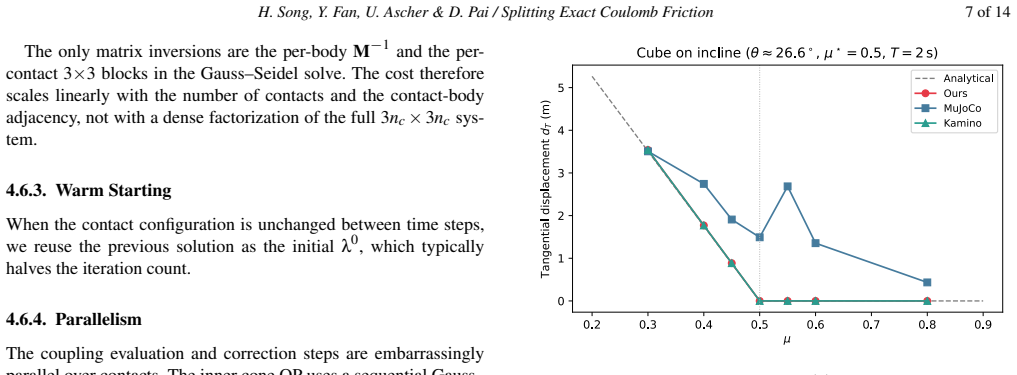
Summary. The paper presents a splitting solver for the exact reduced Coulomb friction law. It rewrites the reduced inclusion (7) as the sum of a cone-constrained linear response A(λ) and a scalar non-associated De Saxcé–Feng coupling B(λ), then applies a Tseng-style forward–backward–forward (FBF) outer iteration: evaluate B at the current iterate, solve a strongly convex cone QP (12), apply the explicit correction (14), and project onto the friction cone (15). The inner cone QP is modular and can be solved by different SOCP solvers. The authors implement the method on NVIDIA Warp/Newton and evaluate it on cube-on-incline, backspin ball, turntable, Painlevé box, house-of-cards, and masonry-arch benchmarks, reporting that the dimensionless Coulomb residual r_c of §4.5 approaches the single-precision floor and that the method reproduces exact complementarity without smoothing or relaxation.
Significance. If the convergence claim held, the paper would make a useful contribution: it cleanly isolates the non-monotone De Saxcé coupling from the cone QP, gives a modular inner-solve architecture, provides a matrix-free implementation, and targets the exact reduced law rather than a relaxed or smoothed surrogate. The algebraic derivation from (7) to the cone QP (12) and the correction (14)–(15) is sound, and the comparison with MuJoCo and Kamino on the frictional stacking benchmarks is well motivated. However, the central claim that the outer iteration converges to the exact reduced law is currently supported only by empirical evidence, and the empirical record in Appendix A/Table 3 contains a direct contradiction. The paper also honestly acknowledges that Tseng’s theorem does not apply because B is non-monotone (§4.4, §6), so the missing formal convergence guarantee is not an omission but a stated limitation.
major comments (4)
- [Appendix A / Table 3] The empirical convergence claim is contradicted by the outer-budget sweep. For the house of cards, raising the outer-iteration cap from 200 to 2000 changes the median r_c from 6.3e-7 to 1.5e-5, the share of substeps with r_c ≤ 1e-6 from 93% to 3%, and the median outer-iteration count from 5 to 40. This is not 'the extra budget does nothing' as §6 states; running longer makes the monitored residual an order of magnitude worse on the same scene. Since §4.4 and §6 establish convergence only empirically, this anomaly directly undermines the central claim that the converged iterate satisfies the exact reduced law.
- [§4.4 / §6] The paper explicitly concedes that Tseng’s convergence theorem cannot be applied because B(λ) is not monotone, and that 'convergence here is therefore established empirically' (§6). This is a load-bearing gap because the title and abstract claim convergence to the exact law. The contradiction in Table 3 makes the empirical support unreliable. A formal convergence result for a restricted class (e.g., when B is contractive relative to W+γ^{-1}I), or a clearly stated local/global condition under which the FBF iteration converges, would be needed to support the exact-law claim; otherwise the claims should be softened to a residual-based stopping heuristic.
- [Algorithm 1, line 8 / §4.5] The stopping criterion r_c < ε is the same quantity used to report success, and Algorithm 1 stops as soon as this condition is met. Reporting that 93% of substeps reach r_c ≤ 1e-6 on the house of cards is therefore partly tautological: the solver stops precisely when that condition holds, and the arch’s 47% share simply reflects the 200-iteration cap. The more informative evidence would be a demonstration that the iteration actually settles at a fixed point, e.g., monitoring r_c over continued iterations after first crossing ε, or comparing against a known exact solution on a small problem. The Table 3 cards10x row shows that the residual can rise after an early low crossing, so a single low r_c at the stopping time is not a certificate of convergence.
- [§4.4, Eq. (18)] The safeguarded adaptive rule introduces thresholds θ=0.9, β=0.7, and cγ=0.5 without a sensitivity study. Appendix A sweeps fixed γ but does not vary θ, β, or the acceptance policy. Since the step-size rule is a central algorithmic contribution and is claimed to be 'tuned to the stick-slip boundary', the robustness of the method to these choices should be documented, especially because the convergence claim is empirical.
minor comments (4)
- [§6 / Table 3] The text says 'on the house of cards, which already converges in a few iterations, the extra budget does nothing', but Table 3 reports cards10x with median 40 iterations and a worse residual. This inconsistency should be corrected regardless of the explanation.
- [§4.5, Eq. (21)] The scale choices s_r and s_u are not fully described: the floor ϵ_0=1e-12 is introduced without motivation, and the use of ∥λ_0∥ in s_r makes the residual scale depend on the initial guess. Clarifying the initialization-dependence would make the reported r_c values more reproducible.
- [Table 5 / Appendix B] The notation 'MuJoCo' and 'Kamino' columns as relative factors is clear, but the kamino factor 0.38× on the arch should be explicitly labeled as 'faster than FBF' to avoid ambiguity in the table.
- [§4.6 / Table 7] The GPU timing table is useful, but the statement that FBF is slower on GPU than on CPU, due to an unoptimized port, should be flagged more prominently in the main text; currently it appears only in the appendix and could be misread as a performance claim against the architecture.
Circularity Check
No significant circularity: the exact-law target, the A+B decomposition, and the Tseng FBF template all come from external references or from independent fixed-point algebra, and no benchmark-derived quantity is fed back as a prediction.
full rationale
The paper's derivation chain is self-contained against external, non-self sources: the exact reduced Coulomb law (6)-(7) is attributed to De Saxcé and Feng [DSF98], and the A+B decomposition (8)-(9) is explicitly adopted from Acary et al. [ACLM11], an external mechanics work. The FBF outer iteration follows Tseng [Tse00], also external. The paper does not define any target quantity in terms of its own output. The stopping residual r_c of §4.5 is constructed as a fixed-point gap for the exact complementarity condition (19)-(23), so it is an independent certificate rather than a fitted target; its scales s_r and s_u are fixed from initial data and unit roundoff floors, not tuned to benchmark outcomes. The benchmark equilibria are not used to set the algorithmic constants γ, θ, β; the step-size sweeps in Appendix A are sensitivity analysis, not parameter fitting. The honest limitation statements in §4.4 and §6—that Tseng's convergence theorem does not apply because B is non-monotone and convergence is therefore established empirically—are soundness/correctness caveats, not circular reductions. Likewise the Table 3 outer-budget discrepancy noted by a skeptical reader would be a correctness or evidence objection, not a case of a prediction reducing to its inputs. The only self-citations ([LLA*24], [KSJP08]) appear in related-work comparisons and do not carry the central claim. Accordingly, there is no circular step to exhibit, and the appropriate circularity score is 0.
Assumptions & free parameters
free parameters (5)
- Outer step size γ (and adaptive rule θ, β, cγ) =
γ_safe = 0.5/(μ_max λ̂_max(W)); θ=0.9, β=0.7; adaptive
- Inner block Gauss–Seidel sweep budget =
10 sweeps per outer step (30 on masonry arch)
- Outer iteration cap =
200 (2000 in sensitivity test)
- Baumgarte stabilization coefficient =
not reported
- Residual tolerance ε and scale floors =
ε=1e-6, ε0=1e-12, single precision
assumptions (5)
- domain assumption Velocity-level time-stepping with semi-implicit Euler and Delassus operator W=JM^{-1}J^T is an adequate discrete model of rigid-body frictional contact.
- domain assumption The De Saxcé-Feng augmented-velocity cone complementarity K* ∋ ṽ ⊥ λ ∈ K is equivalent to the exact Coulomb law.
- standard math The decomposition A(λ)=Wλ+v_f+N_K(λ), B(λ)=μ||v_T(λ)||e_N and the strongly convex cone QP (12) have unique solutions for frozen B.
- ad hoc to paper The FBF outer iteration converges for benchmark contact graphs despite B being non-monotone.
- domain assumption Truncated BGS inner solves (10-30 sweeps) accurately approximate the cone QP minimizer to the level needed for outer convergence.
Cite this review
Pith. "Pith review of A Splitting Architecture for Exact Reduced Coulomb Friction." pith.science (2026). https://pith.science/paper/QOHPSBNS
@misc{pith2026260719599,
  author       = {Pith},
  title        = {Pith review of: A Splitting Architecture for Exact Reduced Coulomb Friction},
  year         = {2026},
  howpublished = {\url{https://pith.science/paper/QOHPSBNS}},
  note         = {Machine review of arXiv:2607.19599}
}
read the original abstract
Existing approaches to frictional contact dynamics typically either modify the Coulomb law to improve numerical robustness or solve the exact law in a fully coupled monolithic form. However, in its reduced form, exact Coulomb friction can be written as a cone complementarity problem with an augmented velocity, which reveals a natural split between a cone-constrained linear response and a scalar non-associated coupling induced by tangential velocity. We exploit this structure in the solver design. Our method uses an outer iteration to update the non-associated coupling explicitly, and an inner solve for a strongly convex cone-constrained quadratic program. This separation also makes the inner solver modular, so different numerical schemes can be used without changing the outer iteration. We evaluate the method on rigid-body benchmarks with stick-slip transitions and frictional stacking, and show that it reproduces exact Coulomb complementarity without smoothing or relaxing the friction law.
Figures


Figures from the paper (5 more)


Reference graph
Works this paper leans on
-
[1]
Mathematical and computer modelling , volume=
The bipotential method: a constructive approach to design the complete contact law with friction and improved numerical algorithms , author=. Mathematical and computer modelling , volume=. 1998 , publisher=
1998
-
[2]
2008 , publisher=
Numerical methods for nonsmooth dynamical systems: applications in mechanics and electronics , author=. 2008 , publisher=
2008
-
[3]
ACM SIGGRAPH 2022 Courses , publisher=
Contact and friction simulation for computer graphics , author=. ACM SIGGRAPH 2022 Courses , publisher=
2022
-
[4]
Advanced Topics in Nonsmooth Dynamics: Transactions of the European Network for Nonsmooth Dynamics , pages=
On solving contact problems with Coulomb friction: formulations and numerical comparisons , author=. Advanced Topics in Nonsmooth Dynamics: Transactions of the European Network for Nonsmooth Dynamics , pages=. 2018 , publisher=
2018
-
[5]
ACM Transactions on Graphics (TOG) , volume=
Incremental potential contact: intersection-and inversion-free, large-deformation dynamics , author=. ACM Transactions on Graphics (TOG) , volume=. 2020 , publisher=
2020
-
[6]
ACM Transactions on Graphics (TOG) , volume=
Add: Analytically differentiable dynamics for multi-body systems with frictional contact , author=. ACM Transactions on Graphics (TOG) , volume=. 2020 , publisher=
2020
-
[7]
IEEE Transactions on Visualization and Computer Graphics , volume=
Implicit frictional dynamics with soft constraints , author=. IEEE Transactions on Visualization and Computer Graphics , volume=. 2024 , publisher=
2024
-
[8]
ACM Transactions on Graphics (TOG) , volume=
A nonsmooth Newton solver for capturing exact Coulomb friction in fiber assemblies , author=. ACM Transactions on Graphics (TOG) , volume=. 2011 , publisher=
2011
Show all 62 references
-
[9]
ACM Transactions on Graphics (TOG) , volume=
Non-smooth newton methods for deformable multi-body dynamics , author=. ACM Transactions on Graphics (TOG) , volume=. 2019 , publisher=
2019
-
[10]
International journal for numerical methods in engineering , volume=
A time-stepping method for stiff multibody dynamics with contact and friction , author=. International journal for numerical methods in engineering , volume=. 2002 , publisher=
2002
-
[11]
2012 IEEE/RSJ international conference on intelligent robots and systems , pages=
Mujoco: A physics engine for model-based control , author=. 2012 IEEE/RSJ international conference on intelligent robots and systems , pages=. 2012 , organization=
2012
-
[12]
International Journal for Numerical Methods in Engineering , volume=
Solving variational inequalities and cone complementarity problems in nonsmooth dynamics using the alternating direction method of multipliers , author=. International Journal for Numerical Methods in Engineering , volume=. 2021 , publisher=
2021
-
[14]
ZAMM-Journal of Applied Mathematics and Mechanics/Zeitschrift f
A formulation of the linear discrete Coulomb friction problem via convex optimization , author=. ZAMM-Journal of Applied Mathematics and Mechanics/Zeitschrift f. 2011 , publisher=
2011
-
[15]
Computational Optimization and Applications , volume=
An iterative approach for cone complementarity problems for nonsmooth dynamics , author=. Computational Optimization and Applications , volume=. 2010 , publisher=
2010
-
[16]
Proceedings of the 2011 SIGGRAPH Asia Conference , pages=
A hybrid iterative solver for robustly capturing coulomb friction in hair dynamics , author=. Proceedings of the 2011 SIGGRAPH Asia Conference , pages=
2011
-
[17]
ACM Transactions on Graphics (TOG) , volume=
Simple and scalable frictional contacts for thin nodal objects , author=. ACM Transactions on Graphics (TOG) , volume=. 2020 , publisher=
2020
-
[18]
Proceedings of the ACM SIGGRAPH/Eurographics Symposium on Computer Animation , pages=
Rigid body contact problems using proximal operators , author=. Proceedings of the ACM SIGGRAPH/Eurographics Symposium on Computer Animation , pages=
-
[19]
ACM Transactions on Graphics (TOG) , volume=
Intersection-free rigid body dynamics , author=. ACM Transactions on Graphics (TOG) , volume=. 2021 , publisher=
2021
-
[20]
ACM SIGGRAPH 2024 Conference Papers , pages=
Primal-dual non-smooth friction for rigid body animation , author=. ACM SIGGRAPH 2024 Conference Papers , pages=
2024
-
[21]
SIAM Journal on Control and Optimization , volume=
A modified forward-backward splitting method for maximal monotone mappings , author=. SIAM Journal on Control and Optimization , volume=. 2000 , publisher=
2000
-
[22]
ACM Transactions on Graphics (TOG) , volume=
Staggered projections for frictional contact in multibody systems , author=. ACM Transactions on Graphics (TOG) , volume=. 2008 , publisher=
2008
-
[23]
Warp: A Python framework for high-performance simulation and graphics , year =
-
[24]
Newton: A GPU-Accelerated Physics Engine , year =
-
[25]
Goulart and Y
P. Goulart and Y. Chen , title =
-
[26]
O'Donoghue , title =
B. O'Donoghue , title =. SIAM J.\ Optim. , volume =
-
[28]
2011 , publisher=
A First Course in Numerical Methods , author=. 2011 , publisher=
2011
-
[29]
ACM Transactions on Graphics (TOG) , volume=
Projective dynamics with dry frictional contact , author=. ACM Transactions on Graphics (TOG) , volume=. 2020 , publisher=
2020
-
[30]
ACM Transactions on Graphics (TOG) , volume=
Projective dynamics: Fusing constraint projections for fast simulation , author=. ACM Transactions on Graphics (TOG) , volume=. 2014 , publisher=
2014
-
[31]
2017 , publisher=
Overby, Matthew and Brown, George E and Li, Jie and Narain, Rahul , journal=. 2017 , publisher=
2017
-
[32]
ACM Transactions on Graphics (TOG) , volume=
Accurate dissipative forces in optimization integrators , author=. ACM Transactions on Graphics (TOG) , volume=. 2018 , publisher=
2018
-
[33]
: Numerical methods for nonsmooth dynamical systems: applications in mechanics and electronics
Acary V., Brogliato B. : Numerical methods for nonsmooth dynamical systems: applications in mechanics and electronics. Springer Science & Business Media, 2008
2008
-
[34]
: On solving contact problems with coulomb friction: formulations and numerical comparisons
Acary V., Br \'e mond M., Huber O. : On solving contact problems with coulomb friction: formulations and numerical comparisons. In Advanced Topics in Nonsmooth Dynamics: Transactions of the European Network for Nonsmooth Dynamics. Springer, 2018, pp. 375--457
2018
-
[35]
: A formulation of the linear discrete coulomb friction problem via convex optimization
Acary V., Cadoux F., Lemar \'e chal C., Malick J. : A formulation of the linear discrete coulomb friction problem via convex optimization. ZAMM-Journal of Applied Mathematics and Mechanics/Zeitschrift f \"u r Angewandte Mathematik und Mechanik 91 , 2 (2011), 155--175
2011
-
[36]
: Contact and friction simulation for computer graphics
Andrews S., Erleben K., Ferguson Z. : Contact and friction simulation for computer graphics. In ACM SIGGRAPH 2022 Courses. Association for Computing Machinery, 2022, pp. 1--172
2022
-
[37]
M., Greif C
Ascher U. M., Greif C. : A First Course in Numerical Methods. Computational Science and Engineering. Society for Industrial and Applied Mathematics, Philadelphia, PA, 2011. https://doi.org/10.1137/9780898719987 doi:10.1137/9780898719987
2011 doi
-
[38]
Anitescu M., Potra F. A. : A time-stepping method for stiff multibody dynamics with contact and friction. International journal for numerical methods in engineering 55, 7 (2002), 753--784
2002
-
[39]
: An iterative approach for cone complementarity problems for nonsmooth dynamics
Anitescu M., Tasora A. : An iterative approach for cone complementarity problems for nonsmooth dynamics. Computational Optimization and Applications 47, 2 (2010), 207--235
2010
-
[40]
: A nonsmooth newton solver for capturing exact coulomb friction in fiber assemblies
Bertails-Descoubes F., Cadoux F., Daviet G., Acary V. : A nonsmooth newton solver for capturing exact coulomb friction in fiber assemblies. ACM Transactions on Graphics (TOG) 30, 1 (2011), 1--14
2011
-
[41]
: Projective dynamics: Fusing constraint projections for fast simulation
Bouaziz S., Martin S., Liu T., Kavan L., Pauly M. : Projective dynamics: Fusing constraint projections for fast simulation. ACM Transactions on Graphics (TOG) 33, 4 (2014), 1--11
2014
-
[42]
E., Overby M., Forootaninia Z., Narain R
Brown G. E., Overby M., Forootaninia Z., Narain R. : Accurate dissipative forces in optimization integrators. ACM Transactions on Graphics (TOG) 37, 6 (2018), 1--14
2018
-
[43]
: Primal-dual non-smooth friction for rigid body animation
Chen Y.-L., Ly M., Wojtan C. : Primal-dual non-smooth friction for rigid body animation. In ACM SIGGRAPH 2024 Conference Papers (2024), pp. 1--10
2024
-
[44]
: Simple and scalable frictional contacts for thin nodal objects
Daviet G. : Simple and scalable frictional contacts for thin nodal objects. ACM Transactions on Graphics (TOG) 39, 4 (2020), 61--1
2020
-
[45]
: A hybrid iterative solver for robustly capturing coulomb friction in hair dynamics
Daviet G., Bertails-Descoubes F., Boissieux L. : A hybrid iterative solver for robustly capturing coulomb friction in hair dynamics. In Proceedings of the 2011 SIGGRAPH Asia Conference (2011), pp. 1--12
2011
-
[46]
: The bipotential method: a constructive approach to design the complete contact law with friction and improved numerical algorithms
De Saxc \'e G., Feng Z.-Q. : The bipotential method: a constructive approach to design the complete contact law with friction and improved numerical algorithms. Mathematical and computer modelling 28, 4-8 (1998), 225--245
1998
-
[47]
: Rigid body contact problems using proximal operators
Erleben K. : Rigid body contact problems using proximal operators. In Proceedings of the ACM SIGGRAPH/Eurographics Symposium on Computer Animation (2017), pp. 1--12
2017
-
[48]
M., Panozzo D
Ferguson Z., Li M., Schneider T., Gil-Ureta F., Langlois T., Jiang C., Zorin D., Kaufman D. M., Panozzo D. : Intersection-free rigid body dynamics. ACM Transactions on Graphics (TOG) 40, 4 (2021), 1--16
2021
-
[49]
: Clarabel: An interior-point solver for conic programs, 2024
Goulart P., Chen Y. : Clarabel: An interior-point solver for conic programs, 2024
2024
-
[50]
: Add: Analytically differentiable dynamics for multi-body systems with frictional contact
Geilinger M., Hahn D., Zehnder J., B \"a cher M., Thomaszewski B., Coros S. : Add: Analytically differentiable dynamics for multi-body systems with frictional contact. ACM Transactions on Graphics (TOG) 39, 6 (2020), 1--15
2020
-
[51]
M., Sueda S., James D
Kaufman D. M., Sueda S., James D. L., Pai D. K. : Staggered projections for frictional contact in multibody systems. ACM Transactions on Graphics (TOG) 27, 5 (2008), 1--11
2008
-
[52]
Li M., Ferguson Z., Schneider T., Langlois T., Zorin D., Panozzo D., Jiang C., Kaufman D. M. : Incremental potential contact: intersection-and inversion-free, large-deformation dynamics. ACM Transactions on Graphics (TOG) 39, 4 (2020), 1--20
2020
-
[53]
: Projective dynamics with dry frictional contact
Ly M., Jouve J., Boissieux L., Bertails-Descoubes F. : Projective dynamics with dry frictional contact. ACM Transactions on Graphics (TOG) 39, 4 (2020), 57--1
2020
-
[54]
M., Bender J., Pai D
Larionov E., Longva A., Ascher U. M., Bender J., Pai D. K. : Implicit frictional dynamics with soft constraints. IEEE Transactions on Visualization and Computer Graphics 30, 12 (2024), 7776--7787
2024
-
[55]
: Non-smooth newton methods for deformable multi-body dynamics
Macklin M., Erleben K., M \"u ller M., Chentanez N., Jeschke S., Makoviychuk V. : Non-smooth newton methods for deformable multi-body dynamics. ACM Transactions on Graphics (TOG) 38, 5 (2019), 1--20
2019
-
[56]
https://github.com/NVIDIA/warp, 2022
NVIDIA : Warp: A python framework for high-performance simulation and graphics. https://github.com/NVIDIA/warp, 2022
2022
-
[57]
https://github.com/newton-physics/newton, 2025
NVIDIA : Newton: A gpu-accelerated physics engine. https://github.com/newton-physics/newton, 2025
2025
-
[58]
E., Li J., Narain R
Overby M., Brown G. E., Li J., Narain R. : ADMM projective dynamics: Fast simulation of hyperelastic models with dynamic constraints. IEEE transactions on visualization and computer graphics 23, 10 (2017), 2222--2234
2017
-
[59]
: Operator splitting for a homogeneous embedding of the linear complementarity problem
O'Donoghue B. : Operator splitting for a homogeneous embedding of the linear complementarity problem. SIAM J.\ Optim. 31, 3 (2021), 1999--2023
2021
-
[60]
: Mujoco: A physics engine for model-based control
Todorov E., Erez T., Tassa Y. : Mujoco: A physics engine for model-based control. In 2012 IEEE/RSJ international conference on intelligent robots and systems (2012), IEEE, pp. 5026--5033
2012
-
[61]
: On solving the dynamics of constrained rigid multi-body systems with kinematic loops
Tsounis V., Grandia R., B \"a cher M. : On solving the dynamics of constrained rigid multi-body systems with kinematic loops. arXiv preprint arXiv:2504.19771 (2025)
2025 arXiv
-
[62]
: Solving variational inequalities and cone complementarity problems in nonsmooth dynamics using the alternating direction method of multipliers
Tasora A., Mangoni D., Benatti S., Garziera R. : Solving variational inequalities and cone complementarity problems in nonsmooth dynamics using the alternating direction method of multipliers. International Journal for Numerical Methods in Engineering 122, 16 (2021), 4093--4113
2021
-
[63]
u ller D., Amevor C., Widmer T., B \
Tsounis V., Maloisel G., Schumacher C., Grandia R., Serifi A., M \"u ller D., Amevor C., Widmer T., B \"a cher M. : Kamino: Gpu-based massively parallel simulation of multi-body systems with challenging topologies. arXiv preprint arXiv:2603.16536 (2026)
2026
-
[64]
: A modified forward-backward splitting method for maximal monotone mappings
Tseng P. : A modified forward-backward splitting method for maximal monotone mappings. SIAM Journal on Control and Optimization 38, 2 (2000), 431--446
2000
Reviewed August 1, 2026 · model on record in the stance chip above.
Discussion (0). Continue with ORCID to comment.