REVIEW 3 major objections 6 minor 67 references
User Diverse Preference Modeling by Multimodal Attentive Metric Learning
T0 review · 3 major / 6 minor · reviewed 2026-08-14 · deepseek-v4-flash
Pith's one-line read A pair-specific attention vector, built from an item's text and image features and applied inside the Euclidean distance of metric learning, captures a user's varying preferences and beats matrix-factorization baselines on four Amazon…
desk verdict Sound empirical paper with a promising method, but the attention vector's interpretation as capturing diverse user preferences is not established; it may be a learned distance gate. read the letter →
The pith
A machine-rendered reading of the paper's core claim, the machinery that carries it, and where it could break.
The reading
What carries the argument
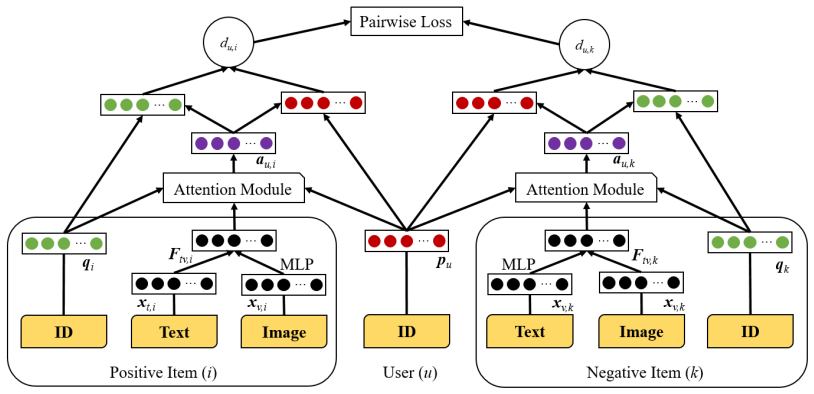
The load-bearing object is the pair-specific attention vector $a_{u,i}$ from Eqs. (2)-(6). A two-layer neural network maps the concatenation of the user vector $p_u$, the item vector $q_i$, and a fused multimodal feature $F_{tv,i}$ to an attention score, and the score is rescaled by $\alpha = f$ so the summed weights match the embedding dimension instead of forming a softmax distribution. Multiplying both $p_u$ and $q_i$ by $a_{u,i}$ before taking the Euclidean distance is what turns a fixed-space metric into a per-pair metric; the paper argues that this both encodes aspect-level preferences and projects each pair into its own space, avoiding the geometric restriction of CML.
What would settle it
Train MAML and inspect the converged attention vectors: if high attention weights concentrate on coordinates where $|p_{u,l} - q_{i,l}|$ is already large, or where the attention network can shrink the loss without moving the user and item vectors, then $a_{u,i}$ is acting as a gate rather than a preference signal. A second check is to replace $a_{u,i}$ with a scalar per pair or with random fixed weights and measure whether recommendation accuracy drops; if it does not, the per-coordinate attention pattern is not the source of the gains.
Extended reading notes
Core claim
The central claim is that the same user vector should not be used to score all items. For each user $u$ and item $i$, MAML computes an attention vector $a_{u,i}$ from the user embedding, the item embedding, and a fusion of the item's textual and visual features; the distance between $u$ and $i$ becomes $\|a_{u,i} \odot p_u - a_{u,i} \odot q_i\|$. Because $a_{u,i}$ differs per pair, the model can emphasize plot for one movie and special effects for another. The paper further claims that this weighted metric avoids both the triangle-inequality limitation of dot-product matrix factorization and the geometric inflexibility of CML, where a user and all their items would be forced toward one point. Experiments report that MAML outperforms BPR, NeuCF, VBPR, DeepCoNN, JRL, and CML variants on all four datasets, with the full multimodal version giving the best results.
Load-bearing premise
The model assumes the 64 coordinates used to describe users and items each stand for a stable aspect of an item, so the learned attention vector can be read as the user's emphasis on that aspect; if the network instead learns to shrink weights on coordinates where the two vectors already differ, the attention becomes a distance-modulating shortcut rather than a preference signal.
Editorial extensions
If this is right
- If the central claim holds, recommenders can treat preference as aspect-level and pair-specific rather than as a single global user vector.
- Metric learning with pair-specific weighting should retain the triangle-inequality advantage of CML while avoiding its geometric-overconstraint problem.
- Combining text and image features should yield better attention estimates than either modality alone, as the paper's multimodal variant outperforms its text-only and image-only variants.
- The learned attention vectors can serve as interpretable output, showing which aspects a user emphasizes for a given item.
Reading between the lines
- One testable extension is to probe whether $a_{u,i}$ predicts aspect-level review sentiment (for example, plot versus special effects) on items the user rated; the paper visualizes attention but does not connect it to external aspect labels.
- If the embedding coordinates are not semantically aligned across users and items, imposing an orthogonality or interpretability constraint on the latent space could make the attention interpretation more reliable; the paper's covariance regularization reduces redundancy but does not guarantee semantic alignment.
- Replacing the Euclidean distance with a learned Mahalanobis metric would reveal whether the attention vector carries preference signal or simply re-weights an already flexible distance; the paper does not test this variant.
Signed reviews
Editorial analysis
A structured set of objections, weighed in public.
Referee Report
Summary. The paper proposes Multimodal Attentive Metric Learning (MAML) for top-n recommendation. For each user-item pair, an attention network computes a weight vector from the user embedding, the item embedding, and fused textual and visual item features; the pair distance is then a weighted Euclidean distance (Eq. 2), trained with a WARP-style hinge loss (Eq. 3) plus feature and covariance regularization. Experiments on four Amazon product categories compare MAML with matrix factorization, neural, and metric-learning baselines, report small but statistically significant improvements, and include attention heatmaps and t-SNE visualizations intended to show that users attend to different aspects of different items. The paper's central claims are that the attention vector captures a user's varying aspect-level preferences and that this modeling is responsible for the accuracy gains over CML.
Significance. If the interpretative claim is valid, the paper is a useful step toward combining metric learning with multimodal side information for user-item-specific preference modeling. The empirical recommendation accuracy result is credible: the evaluation uses four datasets, multiple baselines, and a released codebase, and the improvements over CML are consistent across datasets. However, the current evidence does not identify the attention weights as semantic preference signals; the learned weights can serve as a per-pair distance gate without encoding aspect preferences. Because the title and central narrative depend on diverse preference modeling, this identification issue is load-bearing. The paper's code release and reproducible parameter settings are strengths that should make the requested additional analyses feasible.
major comments (3)
- [3.2.2, Eq. (6)] Equation (6) as typeset is not the softmax normalization described in the text: the denominator is the sum of the raw scores \(\hat{a}_{u,i,l}\), not the sum of their exponentials. With raw scores that can be negative, the resulting weights are not guaranteed to be positive and do not sum to \(\alpha\). This makes the definition of the attention vector in Eq. (2) ambiguous and the comparison in Section 4.3 hard to interpret. If the implementation uses a standard softmax, the equation should be corrected; if not, the model should be described with the actual normalization.
- [3.2.2, Eqs. (2)-(6); 3.2.4; 4.2; 4.4] The central claim that \(a_{u,i}\) encodes a user's aspect-level diverse preferences is not identified by the training objective. Because \(a_{u,i}\) is computed from \(p_u\) and \(q_i\) (Eqs. 4-6), the ranking loss in Eq. (3) can be minimized by a shortcut: shrink the attention weights on dimensions where \(p_u\) and \(q_i\) differ for positive pairs and enlarge them for negative pairs, making \(a_{u,i}\) a per-pair distance gate rather than a preference vector. The covariance regularizer in Eq. (11) only decorrelates dimensions, and Eq. (9) ties item vectors to extracted features but does not assign semantic aspects to dimensions. Consequently, Section 4.2's attribution of the improvement over CML to 'user diverse preferences' and the visualizations in Section 4.4 do not establish the interpretative claim; a masking gate would also vary per pair. I suggest constraining the attention to depend on item features only (e.g., not on \(p_u, q_i\)), adding an ablation with a non-preferential gate of comparable capacity, and validating attention weights against held-out aspect-level signals.
- [4.2] The statement that 'the only difference between MAML and CML is that the former models user diverse preferences by using the attention mechanism' is not supported by the model description: MAML introduces the attention network and the multimodal feature-fusion network of Section 3.2.2, which add parameters that CML (and even CMLall) does not contain. The consistent gains in Table 2 might therefore reflect additional model capacity rather than the proposed attention semantics. A controlled ablation isolating the attention module, with comparable parameter counts, is needed before the accuracy gain can be attributed to diverse preference modeling.
minor comments (6)
- [Table 2] The header 'NCDG' should be 'NDCG'.
- [3.2.2, Eq. (6)] The motivation for \(\alpha = f\) is under-specified. Since Eq. (3) uses squared distances, multiplying all attention weights by a constant simply rescales every squared distance, and the comparison in Fig. 2 may be confounded with the separately tuned margin \(m\). Please clarify the role of \(\alpha\) beyond a global scaling.
- [3.2.4, Eq. (9)] Equation (9) is described as an L2 loss but written without a square on the norm. Please use the squared norm or clarify the intended loss.
- [3.2.4, Eq. (11)] The notation \(\|C\|_f\) should be \(\|C\|_F\) for the Frobenius norm.
- [4.1.2 and Table 2] The baseline naming is inconsistent: Section 4.1.2 refers to CMLF, while Table 2 uses CMLtext, CMLimage, and CMLall. Please align the notation.
- [Table 2] The paired t-test significance markers report only p-values. Given the small absolute differences (e.g., MAMLall vs CMLall on Office: NDCG 7.139 vs 7.032), please also report effect sizes or confidence intervals.
Circularity Check
No circularity: MAML is an empirical model evaluated on held-out test data; no equation or fitted parameter reduces the central claim to its inputs.
full rationale
The paper's central claim is that the multimodal attention-weighted metric in Eq. (2), with attention computed by Eqs. (4)-(6), improves top-n recommendation over CML and MF baselines. This is an empirical claim tested on held-out 30% interactions (Section 4.1.1), with paired t-tests reported in Table 2. The components are all learned from training data: p_u, q_i, attention network parameters, and feature fusion network. No target quantity is defined in terms of the predicted quantity, and no fitted parameter is renamed as a prediction. Eq. (9) is a regularizer that encourages q_i to be close to the extracted feature vector F_tv,i; this is a modeling choice, not a circular definition, and it does not make test predictions equal to training inputs. The alpha = f choice in Eq. (6) is a tuned scaling constant, and its tuning is reported in Section 4.3, but it does not force any test result. The paper's self-citations (e.g., [9], [10], [17]) appear in related-work and feature-extraction contexts and are not load-bearing for the main derivation. The interpretive claim that a_{u,i} encodes aspect-level user preference is not guaranteed by the objective, since the model may learn a per-pair distance gate, but that is an identification or interpretability concern, not circularity. There is no derivation chain here that reduces to its own inputs; the appropriate finding is no significant circularity.
Assumptions & free parameters
free parameters (6)
- margin m =
1.6 (1.5 for Toys Games)
- negative sample count s =
8 (4 for Office and Men Clothing)
- feature regularization weight λ_f =
7 (2 for Toys Games)
- covariance regularization weight λ_c =
5
- learning rate ℓ0 =
0.001
- attention scaling factor α =
α = f = 64
assumptions (4)
- domain assumption Latent dimensions correspond to interpretable item aspects that are shared across users.
- domain assumption Text and image features extracted by PV-DM and Caffe capture the aspects users care about, and aligning item embeddings to them (Eq. 9) improves recommendation.
- domain assumption The attention network learns aspect importance rather than exploiting the shortcut of shrinking weights on large coordinate differences to minimize the ranking loss.
- ad hoc to paper Scaling softmax weights by α = f preserves relative attention while preventing numerical shrinkage of distances.
Cite this review
Pith. "Pith review of User Diverse Preference Modeling by Multimodal Attentive Metric Learning." pith.science (2026). https://pith.science/paper/QORBMVDZ
@misc{pith2026190807738,
  author       = {Pith},
  title        = {Pith review of: User Diverse Preference Modeling by Multimodal Attentive Metric Learning},
  year         = {2026},
  howpublished = {\url{https://pith.science/paper/QORBMVDZ}},
  note         = {Machine review of arXiv:1908.07738}
}
read the original abstract
Most existing recommender systems represent a user's preference with a feature vector, which is assumed to be fixed when predicting this user's preferences for different items. However, the same vector cannot accurately capture a user's varying preferences on all items, especially when considering the diverse characteristics of various items. To tackle this problem, in this paper, we propose a novel Multimodal Attentive Metric Learning (MAML) method to model user diverse preferences for various items. In particular, for each user-item pair, we propose an attention neural network, which exploits the item's multimodal features to estimate the user's special attention to different aspects of this item. The obtained attention is then integrated into a metric-based learning method to predict the user preference on this item. The advantage of metric learning is that it can naturally overcome the problem of dot product similarity, which is adopted by matrix factorization (MF) based recommendation models but does not satisfy the triangle inequality property. In addition, it is worth mentioning that the attention mechanism cannot only help model user's diverse preferences towards different items, but also overcome the geometrically restrictive problem caused by collaborative metric learning. Extensive experiments on large-scale real-world datasets show that our model can substantially outperform the state-of-the-art baselines, demonstrating the potential of modeling user diverse preference for recommendation.
Figures


Figures from the paper (1 more)

Reference graph
Works this paper leans on
-
[1]
Yoram Bachrach, Yehuda Finkelstein, Ran Gilad-Bachrach, Liran Katzir, Noam Koenigstein, Nir Nice, and Ulrich Paquet. 2014. Speeding up the xbox recom- mender system using a euclidean transformation for inner-product spaces. In RecSys. ACM, 257–264
work page 2014
-
[2]
Robert M Bell and Yehuda Koren. 2007. Lessons from the Netflix prize challenge. SIGKDD Explorations Newsletter 9, 2 (2007), 75–79
work page 2007
-
[3]
Yoshua Bengio, Aaron Courville, and Pascal Vincent. 2013. Representation learning: A review and new perspectives. TPAMI 35, 8 (2013), 1798–1828
work page 2013
-
[4]
Rose Catherine and William Cohen. 2017. TransNets: Learning to Transform for Recommendation. In RecSys. ACM
work page 2017
-
[5]
Chong Chen, Min Zhang, Yiqun Liu, and Shaoping Ma. 2018. Neural attentional rating regression with review-level explanations. In WWW. IW3C2, 1583–1592
work page 2018
-
[6]
Jingyuan Chen, Hanwang Zhang, Xiangnan He, Liqiang Nie, Wei Liu, and Tat- Seng Chua. 2017. Attentive collaborative filtering: Multimedia recommendation with item-and component-level attention. In SIGIR. ACM, 335–344
work page 2017
-
[7]
Jingwu Chen, Fuzhen Zhuang, Xin Hong, Xiang Ao, Xing Xie, and Qing He. 2018. Attention-driven Factor Model for Explainable Personalized Recommendation. In SIGIR. ACM, 909–912
work page 2018
-
[8]
Heng-Tze Cheng, Levent Koc, Jeremiah Harmsen, Tal Shaked, Tushar Chandra, Hrishi Aradhye, Glen Anderson, Greg Corrado, Wei Chai, Mustafa Ispir, et al
Show all 67 references
-
[9]
Zhiyong Cheng, Xiaojun Chang, Lei Zhu, Rose C Kanjirathinkal, and Mohan Kankanhalli. 2019. MMALFM: Explainable recommendation by leveraging re- views and images. TOIS 37, 2 (2019), 16
2019
-
[10]
Zhiyong Cheng, Ying Ding, Xiangnan He, Lei Zhu, Xuemeng Song, and Mohan S Kankanhalli. 2018. A 3NCF: An Adaptive Aspect Attention Model for Rating Prediction.. In IJCAI. AAAI Press, 3748–3754
2018
-
[11]
Zhiyong Cheng, Ying Ding, Lei Zhu, and Kankanhalli Mohan. 2018. Aspect-aware latent factor model: Rating prediction with ratings and reviews. InWWW. IW3C2, 639–648
2018
-
[12]
Jin Yao Chin, Kaiqi Zhao, Shafiq Joty, and Gao Cong. 2018. ANR: Aspect-based Neural Recommender. In CIKM. ACM, 147–156
2018
-
[13]
Michael Cogswell, Faruk Ahmed, Ross Girshick, Larry Zitnick, and Dhruv Batra
-
[14]
Travis Ebesu, Bin Shen, and Yi Fang. 2018. Collaborative memory network for recommendation systems. In SIGIR. ACM, 515–524
2018
-
[15]
Li Gao, Hong Yang, Jia Wu, Chuan Zhou, Weixue Lu, and Yue Hu. 2018. Recom- mendation with multi-source heterogeneous information. In IJCAI. AAAI Press, 3378–3384
2018
-
[16]
Xavier Glorot, Antoine Bordes, and Yoshua Bengio. 2011. Deep sparse rectifier neural networks. In AISTATS. JMLR, 315–323
2011
-
[17]
Yangyang Guo, Zhiyong Cheng, Liqiang Nie, Xin-Shun Xu, and Mohan Kankan- halli. 2018. Multi-modal preference modeling for product search. In MM. ACM, 1865–1873
2018
-
[18]
Ruining He and Julian McAuley. 2016. VBPR: visual bayesian personalized ranking from implicit feedback. In AAAI. AAAI Press, 144–150
2016
-
[19]
Xiangnan He, Lizi Liao, Hanwang Zhang, Liqiang Nie, Xia Hu, and Tat-Seng Chua. 2017. Neural collaborative filtering. In WWW. IW3C2, 173–182
2017
-
[20]
Cheng-Kang Hsieh, Longqi Yang, Yin Cui, Tsung-Yi Lin, Serge Belongie, and Deborah Estrin. 2017. Collaborative metric learning. In WWW. IW3C2, 193–201
2017
-
[21]
Yifan Hu, Yehuda Koren, and Chris Volinsky. 2008. Collaborative filtering for implicit feedback datasets. In ICDM. IEEE, 263–272
2008
-
[22]
Kalervo Järvelin and Jaana Kekäläinen. 2002. Cumulated gain-based evaluation of IR techniques. TOIS 20, 4 (2002), 422–446
2002
-
[23]
Yangqing Jia, Evan Shelhamer, Jeff Donahue, Sergey Karayev, Jonathan Long, Ross Girshick, Sergio Guadarrama, and Trevor Darrell. 2014. Caffe: Convolutional architecture for fast feature embedding. In MM. ACM, 675–678
2014
-
[24]
Yannis Kalantidis, Lyndon Kennedy, and Li-Jia Li. 2013. Getting the look: clothing recognition and segmentation for automatic product suggestions in everyday photos. In ICMR. ACM, 105–112
2013
-
[25]
Mohammad Khoshneshin and W Nick Street. 2010. Collaborative filtering via euclidean embedding. In RecSys. ACM, 87–94
2010
-
[26]
Diederik P Kingma and Jimmy Ba. 2015. Adam: A method for stochastic opti- mization. In ICLR
2015
-
[27]
Yehuda Koren, Robert Bell, and Chris Volinsky. 2009. Matrix factorization tech- niques for recommender systems. Computer 42, 8 (2009), 42–49
2009
-
[28]
Quoc Le and Tomas Mikolov. 2014. Distributed Representations of Sentences and Documents. In ICML. JMLR, 1188–1196
2014
-
[29]
Meng Liu, Xiang Wang, Liqiang Nie, Xiangnan He, Baoquan Chen, and Tat-Seng Chua. 2018. Attentive Moment Retrieval in Videos. In SIGIR. ACM, 15–24
2018
-
[30]
Meng Liu, Xiang Wang, Liqiang Nie, Qi Tian, Baoquan Chen, and Tat-Seng Chua
-
[31]
Julian McAuley and Jure Leskovec. 2013. Hidden factors and hidden topics: understanding rating dimensions with review text. In RecSys. ACM, 165–172
2013
-
[32]
Julian McAuley, Christopher Targett, Qinfeng Shi, and Anton Van Den Hengel
-
[33]
Andriy Mnih and Ruslan R Salakhutdinov. 2008. Probabilistic matrix factorization. In NIPS. MIT Press, 1257–1264
2008
-
[34]
Liqiang Nie, Xuemeng Song, and Tat Seng Chua. 2016. Learning from Multiple Social Networks. Synthesis Lectures on Information Concepts Retrieval & Services 8 (2016), 1–118
2016
-
[35]
Steffen Rendle, Christoph Freudenthaler, Zeno Gantner, and Lars Schmidt-Thieme
-
[36]
In SIGIR
Image-based recommendations on styles and substitutes. In SIGIR. ACM, 43–52
-
[37]
Xuemeng Song, Fuli Feng, Jinhuan Liu, Zekun Li, Liqiang Nie, and Jun Ma. 2017. Neurostylist: Neural compatibility modeling for clothing matching. In MM. ACM, 753–761
2017
-
[38]
Nitish Srivastava and Ruslan R Salakhutdinov. 2012. Multimodal learning with deep boltzmann machines. In NIPS. MIT press, 2222–2230
2012
-
[39]
Yunzhi Tan, Min Zhang, Yiqun Liu, and Shaoping Ma. 2016. Rating-boosted latent topics: Understanding users and items with ratings and reviews. In IJCAI. AAAI Press
2016
-
[40]
Duyu Tang, Bing Qin, Ting Liu, and Yuekui Yang. 2015. User modeling with neural network for review rating prediction. In IJCAI. AAAI Press, 1340–1346
2015
-
[41]
Xuemeng Song, Fuli Feng, Xianjing Han, Xin Yang, Wei Liu, and Liqiang Nie
-
[42]
In SIGIR
Neural compatibility modeling with attentive knowledge distillation. In SIGIR. ACM, 5–14
-
[43]
Laurens van der Maaten and Geoffrey Hinton. 2008. Visualizing Data using t-SNE. JMLR 9 (2008), 2579–2605
2008
-
[44]
Meng Wang, Yue Gao, Ke Lu, and Yong Rui. 2013. View-Based Discriminative Probabilistic Modeling for 3D Object Retrieval and Recognition. TOIS 22 (2013), 1395–1407
2013
-
[45]
Meng Wang, Hao Li, Dacheng Tao, Ke Lu, and Xindong Wu. 2012. Multimodal Graph-Based Reranking for Web Image Search. TOIS 21 (2012), 4649–4661
2012
-
[46]
Mingyu Wang, Changzhi Luo, Bingbing Ni, Jun Yuan, Jianfeng Wang, and Shuicheng Yan. 2018. First-Person Daily Activity Recognition With Manipulated Object Proposals and Non-Linear Feature Fusion. TCSVT 28 (2018), 2946–2955
2018
-
[47]
Yi Tay, Luu Anh Tuan, and Siu Cheung Hui. 2018. Latent relational metric learning via memory-based attention for collaborative ranking. InWWW. IW3C2, 729–739
2018
-
[48]
Amos Tversky and Itamar Gati. 1982. Similarity, separability, and the triangle inequality. Psychological review 89, 2 (1982), 123
1982
-
[49]
Hong-Jian Xue, Xin-Yu Dai, Jianbing Zhang, Shujian Huang, and Jiajun Chen
-
[50]
Xun Yang, Mingyu Wang, and Dacheng Tao. 2018. Person Re-Identification With Metric Learning Using Privileged Information. TOIS 27 (2018), 791–805
2018
-
[51]
Fuzheng Zhang, Nicholas Jing Yuan, Defu Lian, Xing Xie, and Wei-Ying Ma. 2016. Collaborative knowledge base embedding for recommender systems. In SIGKDD. ACM, 353–362
2016
-
[52]
Hanwang Zhang, Yang Yang, Huanbo Luan, Shuicheng Yang, and Tat-Seng Chua
-
[53]
Suhang Wang, Yilin Wang, Jiliang Tang, Kai Shu, Suhas Ranganath, and Huan Liu
-
[54]
Yongfeng Zhang, Qingyao Ai, Xu Chen, and W Bruce Croft. 2017. Joint repre- sentation learning for top-n recommendation with heterogeneous information sources. In WSDM. ACM, 1449–1458
2017
-
[55]
Jason Weston, Samy Bengio, and Nicolas Usunier. 2010. Large scale image annotation: learning to rank with joint word-image embeddings.Machine learning 81, 1 (2010), 21–35
2010
-
[56]
Lei Zheng, Chun-Ta Lu, Lifang He, Sihong Xie, Vahid Noroozi, He Huang, and Philip S Yu. 2018. MARS: Memory attention-aware recommender system. arXiv e-prints (2018)
2018
-
[57]
In IJCAI
Deep matrix factorization models for recommender systems. In IJCAI. AAAI Press, 3203–3209
-
[58]
Guorui Zhou, Xiaoqiang Zhu, Chenru Song, Ying Fan, Han Zhu, Xiao Ma, Yanghui Yan, Junqi Jin, Han Li, and Kun Gai. 2018. Deep interest network for click-through rate prediction. In KDD. ACM, 1059–1068. 9
2018
-
[62]
Shuai Zhang, Lina Yao, Yi Tay, Xiwei Xu, Xiang Zhang, and Liming Zhu. 2019. Metric Factorization: Recommendation beyond Matrix Factorization. In ICDE. IEEE
2019
-
[64]
Tong Zhao, Julian McAuley, and Irwin King. 2015. Improving latent factor models via personalized feature projection for one class recommendation. InCIKM. ACM, 821–830
2015
-
[66]
Lei Zheng, Vahid Noroozi, and Philip S Yu. 2017. Joint deep modeling of users and items using reviews for recommendation. In WSDM. ACM, 425–434
2017
-
[2009]
BPR: Bayesian personalized ranking from implicit feedback. In UAI. AUAI, 452–461
-
[2014]
Start from Scratch: Towards Automatically Identifying, Modeling, and Naming Visual Attributes. In MM. ACM, 187–196
-
[2015]
arXiv e-prints (2015)
Reducing overfitting in deep networks by decorrelating representations. arXiv e-prints (2015)
2015
-
[2016]
In Proceedings of the 1st Workshop on Deep Learning for Recommender Systems
Wide & deep learning for recommender systems. In Proceedings of the 1st Workshop on Deep Learning for Recommender Systems . ACM, 7–10
-
[2017]
What your images reveal: Exploiting visual contents for point-of-interest recommendation. In WWW. IW3C2, 391–400
-
[2018]
Cross-modal Moment Localization in Videos. In MM. ACM, 843–851
Reviewed August 14, 2026 · model on record in the stance chip above.
Discussion (0). Continue with ORCID to comment.