Musings on the Riemann Hypothesis
Pith reviewed 2026-06-28 21:58 UTC · model grok-4.3
The pith
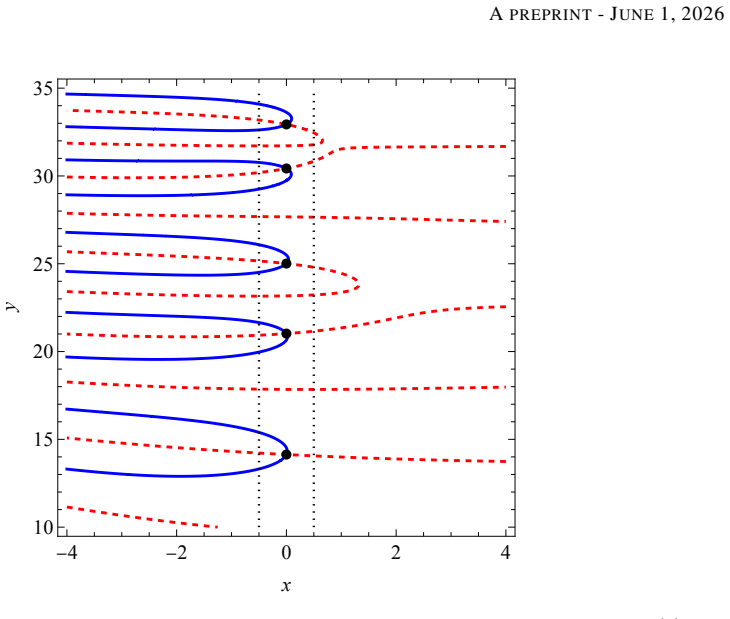
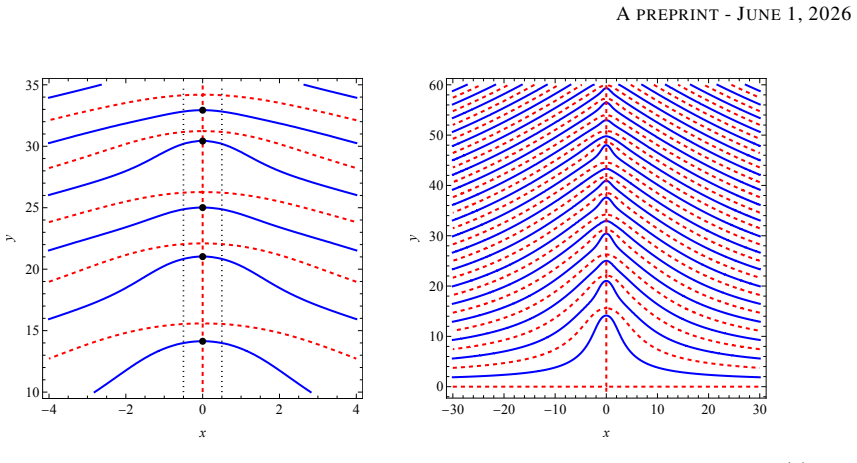
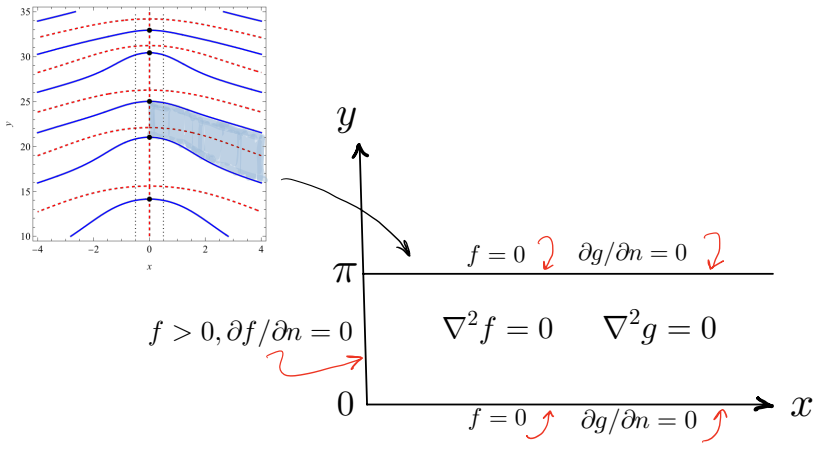
Whether zeta zeros can occur off the critical line is equivalent to whether zero contours of two harmonic functions can intersect inside a semi-infinite strip.
A machine-rendered reading of the paper's core claim, the machinery that carries it, and where it could break.
Core claim
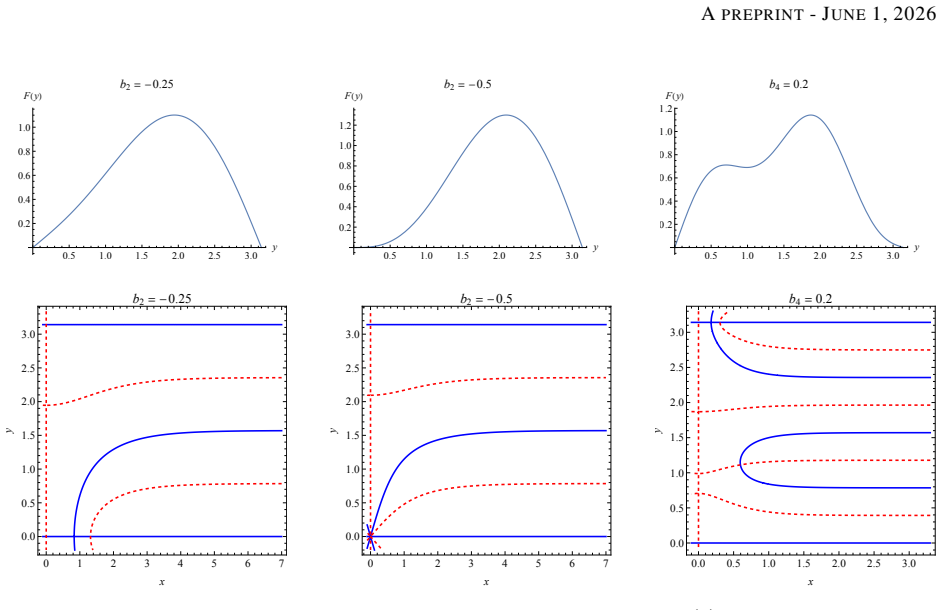
The question of whether a zero could occur away from the critical line becomes equivalent to whether the solutions of a pair of Laplace's equations with well-defined boundary conditions in some semi-infinite strip can possess zero contour lines that intersect within that strip.
What carries the argument
The zero contour lines of the real and imaginary parts of xi, which solve Laplace's equation subject to boundary conditions on the edges of the semi-infinite strip.
If this is right
- Absence of interior contour intersections would force all non-trivial zeros onto the critical line.
- The specific boundary data on the three edges of the strip determine whether interior crossings are possible.
- Any zero off the line must arise as an interior intersection point of the two harmonic zero contours.
Where Pith is reading between the lines
- Standard maximum principles or uniqueness results for harmonic functions in strips might be applied to rule out interior crossings.
- The formulation invites direct numerical solution of the Laplace problems to inspect contour behavior for concrete approximations of xi.
- Growth conditions at infinity in the strip could be used to constrain possible contour intersections without assuming the Riemann Hypothesis in advance.
Load-bearing premise
The boundary conditions for the real and imaginary parts of xi on the edges of the semi-infinite strip are sufficiently well-defined and independent of any zero locations.
What would settle it
A numerical or analytic demonstration that the zero level set of Re(xi) and the zero level set of Im(xi) cross at a point strictly inside the strip and off the central line would show that the equivalence permits off-line zeros.
Figures
read the original abstract
We present a few ideas on the Riemann Hypothesis based on properties of analytic functions in the complex plane. In particular, we focus on the real and imaginary parts of the Riemann xi ($\xi$) function whose zeros coincide with those of the zeta ($\zeta$) function within the critical strip. We discuss the forms of the zero contour lines of the two conjugate harmonic functions (the real and imaginary parts of xi) and consider where their intersections could conceivably occur. Those intersections would be the roots of both $\xi$ and $\zeta$ functions. The question of whether a zero could occur away from the critical line becomes equivalent to whether the solutions of a pair of Laplace's equations with well-defined boundary conditions in some semi-infinite strip can possess zero contour lines that intersect within that strip.
Editorial analysis
A structured set of objections, weighed in public.
Referee Report
Summary. The manuscript proposes that whether the Riemann xi function has zeros off the critical line is equivalent to whether the zero contours of its real and imaginary parts (viewed as solutions to a pair of Laplace equations) can intersect inside a semi-infinite strip with well-defined boundary conditions on its edges.
Significance. If the claimed equivalence were rigorously derived, it would recast the Riemann Hypothesis as a question about interior intersections of nodal lines for harmonic functions in a strip, potentially opening avenues for applying tools from potential theory. The manuscript supplies no such derivation, explicit boundary data, or conformal mapping, so the significance remains speculative.
major comments (3)
- [Abstract] Abstract: the claim that an off-critical-line zero 'becomes equivalent' to an interior intersection of zero contours is asserted without any derivation, explicit boundary conditions, or verification that the contour-intersection statement is mathematically identical to the original hypothesis.
- [Abstract] Abstract: no explicit expressions are supplied for the boundary values on the three sides of the semi-infinite strip (images of Re(s)=0, Re(s)=1, and the critical line) nor for the conformal map sending the critical strip to the semi-infinite strip.
- [Abstract] Abstract: it is not shown that the boundary data remain well-defined and independent of zero locations or growth estimates when |Im(s)|→∞, which is required for the equivalence to hold without additional assumptions on contour growth or distribution.
minor comments (1)
- The title indicates informal 'musings,' yet the abstract advances a precise equivalence claim that requires the missing technical steps to be supplied.
Simulated Author's Rebuttal
We thank the referee for the careful reading and for identifying points where the presentation of our exploratory ideas could be strengthened. The manuscript is framed as musings rather than a rigorous derivation, and we address each major comment below.
read point-by-point responses
-
Referee: [Abstract] Abstract: the claim that an off-critical-line zero 'becomes equivalent' to an interior intersection of zero contours is asserted without any derivation, explicit boundary conditions, or verification that the contour-intersection statement is mathematically identical to the original hypothesis.
Authors: The manuscript is presented as musings on possible reformulations of the Riemann Hypothesis. The suggested equivalence follows from the observation that zeros of ξ coincide with simultaneous zeros of its real and imaginary parts (which are harmonic and satisfy Laplace's equation) together with the existence of a conformal map taking the critical strip to a semi-infinite strip. The paper does not contain a complete derivation establishing mathematical identity; it offers a conceptual perspective that might invite further analysis via potential theory. We therefore do not claim a proven equivalence. revision: no
-
Referee: [Abstract] Abstract: no explicit expressions are supplied for the boundary values on the three sides of the semi-infinite strip (images of Re(s)=0, Re(s)=1, and the critical line) nor for the conformal map sending the critical strip to the semi-infinite strip.
Authors: Explicit formulas for the boundary values and the conformal map are omitted because the discussion remains at a qualitative level. The boundary data are the images under the map of the known values of Re(ξ) and Im(ξ) on Re(s)=0, Re(s)=1, and the critical line; these follow from the functional equation of ξ. The conformal map itself is the standard one sending the vertical strip 0<Re(s)<1 to a semi-infinite horizontal strip. Adding explicit expressions would shift the paper away from its intended exploratory character. revision: no
-
Referee: [Abstract] Abstract: it is not shown that the boundary data remain well-defined and independent of zero locations or growth estimates when |Im(s)|→∞, which is required for the equivalence to hold without additional assumptions on contour growth or distribution.
Authors: The boundary values on the three sides are fixed by the definition and functional equation of ξ and therefore do not depend on the locations of any interior zeros. Standard growth estimates for ξ(s) as |Im(s)|→∞ (available in the literature) ensure these boundary data remain well-defined. While the manuscript does not spell out an explicit verification of independence from contour growth, the reformulation assumes only the classical properties of ξ. revision: no
Circularity Check
Proposed equivalence is a conceptual reframing with no reduction to self-defined inputs or fitted predictions
full rationale
The manuscript states that off-critical-line zeros of xi become equivalent to interior intersections of zero contours of its real and imaginary parts when viewed as Laplace solutions in a semi-infinite strip. This equivalence is asserted directly from the harmonicity of Re(xi) and Im(xi) inside the critical strip and the existence of boundary data on the strip edges; no parameter is fitted to data and then relabeled as a prediction, no self-citation chain is invoked to justify uniqueness or an ansatz, and no equation is shown to equal its own input by construction. The boundary-condition independence is presented as an assumption rather than derived from the zero set itself, leaving the claim open to external verification against the known analytic continuation and functional equation of xi.
Axiom & Free-Parameter Ledger
axioms (2)
- standard math Real and imaginary parts of an analytic function satisfy Laplace's equation
- domain assumption The xi function admits a representation whose real and imaginary parts possess well-defined zero contours inside the critical strip with boundary values on the edges of a semi-infinite strip
Reference graph
Works this paper leans on
-
[1]
The Riemann Hypothesis.Notices of the AMS, 50(3):341–353, 2003
J Brian Conrey. The Riemann Hypothesis.Notices of the AMS, 50(3):341–353, 2003
2003
-
[2]
https://dlmf.nist.gov/, Release 1.2.6 of 2026-03-15
NIST Digital Library of Mathematical Functions. https://dlmf.nist.gov/, Release 1.2.6 of 2026-03-15. F. W. J. Olver, A. B. Olde Daalhuis, D. W. Lozier, B. I. Schneider, R. F. Boisvert, C. W. Clark, B. R. Miller, B. V . Saunders, H. S. Cohl, and M. A. McClain, eds
2026
-
[3]
Problems of the millennium: The Riemann Hypothesis (2004).Pàgina web de la fundació Clay, 2004
Peter Sarnak. Problems of the millennium: The Riemann Hypothesis (2004).Pàgina web de la fundació Clay, 2004
2004
-
[4]
Xi-function
Eric W Weisstein. Xi-function. From MathWorld–A Wolfram Resource. https://mathworld.wolfram.com/ Xi-Function.html
-
[5]
SIAM, 2005
George F Carrier, Max Krook, and Carl E Pearson.Functions of a complex variable: theory and technique. SIAM, 2005
2005
-
[6]
Springer Science & Business Media, 2013
Sheldon Axler, Paul Bourdon, and Ramey Wade.Harmonic function theory. Springer Science & Business Media, 2013. 11
2013
discussion (0)
Sign in with ORCID, Apple, or X to comment. Anyone can read and Pith papers without signing in.