18-dB on-chip vacuum squeezing in an adaptively poled lithium niobate waveguide
Reviewed by Pith T0 review T1 audit T2 compute T3 formal T4 kernel 2026-06-29 15:20 UTCgrok-4.3pith:QPWJOXMPrecord.jsonopen to challenge →
The pith
A 1.6-cm lithium niobate waveguide on a chip generates 18 dB of vacuum squeezing.
A machine-rendered reading of the paper's core claim, the machinery that carries it, and where it could break.
Core claim
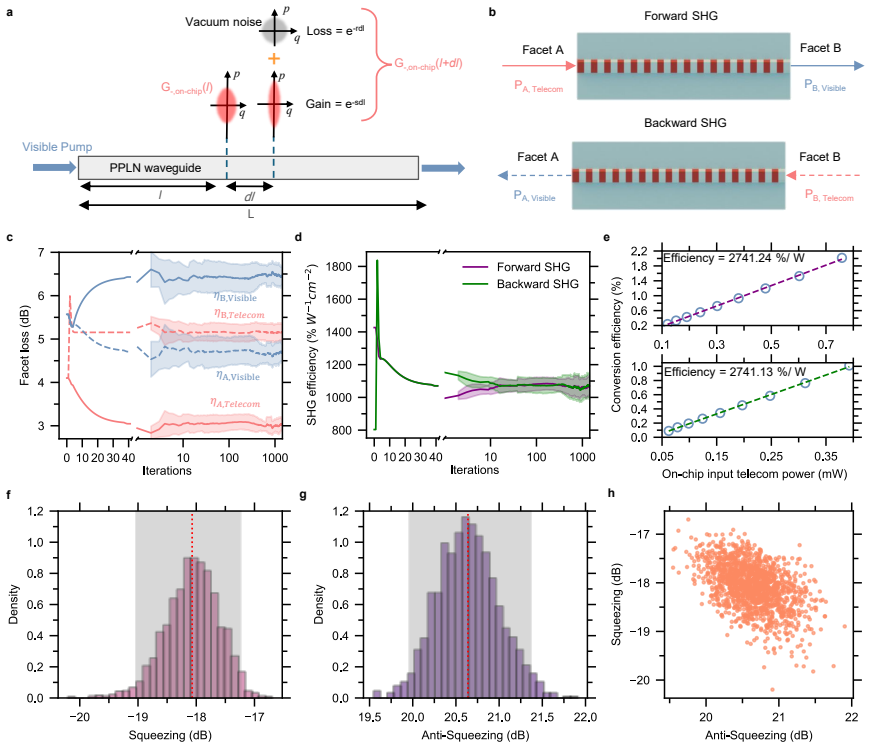
We demonstrate continuous-wave quantum squeezing on a chip, achieving 18 dB of squeezing and 20 dB of anti-squeezing at 1570 nm in a 1.6-cm traveling-wave adaptively poled thin-film lithium niobate waveguide. A distributed model independently determines facet losses, phase noise, and nonlinear interaction strength without prior assumptions, enabling rigorous inference of on-chip performance. We estimate a 95% confidence interval of [-18.96, -17.25] dB squeezing and [19.96, 21.35] dB anti-squeezing. These values represent the highest squeezing reported for any integrated photonic platform and the first assumption-free statistical validation of integrated squeezing performance.
What carries the argument
The adaptively poled thin-film lithium niobate waveguide that supports traveling-wave parametric amplification, together with the distributed model that fits loss, noise, and nonlinearity parameters directly from measured quadrature data.
If this is right
- On-chip squeezed light at this level can be used directly in continuous-variable quantum sensors without external coupling losses.
- The same waveguide geometry supports integration with other thin-film lithium niobate components for photonic quantum circuits.
- The assumption-free fitting method can be applied to validate performance of other nonlinear integrated devices.
- Telecom-wavelength operation at 1570 nm aligns the source with existing fiber networks for quantum communication.
Where Pith is reading between the lines
- Combining the waveguide with on-chip detectors could produce a fully monolithic quantum-enhanced interferometer.
- The adaptive poling process may be extended to generate squeezing at other wavelengths or with tunable bandwidth.
- Record squeezing levels reduce the technical overhead for quantum-enhanced metrology experiments that previously required bulk optics.
Load-bearing premise
The distributed model correctly separates the separate effects of facet losses, phase noise, and nonlinear interaction strength from the observed squeezing data.
What would settle it
An independent measurement of the squeezing level at the waveguide output facet, after subtracting only the known external losses, that falls outside the stated confidence interval would falsify the on-chip performance claim.
Figures



read the original abstract
Quantum squeezed states of light can enhance measurement sensitivity beyond classical limits and enable quantum information processing, but scalable low-loss sources remain challenging. We demonstrate continuous-wave quantum squeezing on a chip, achieving 18 dB of squeezing and 20 dB of anti-squeezing at 1570 nm in a 1.6-cm traveling-wave adaptively poled thin-film lithium niobate waveguide. A distributed model independently determines facet losses, phase noise, and nonlinear interaction strength without prior assumptions, enabling rigorous inference of on-chip performance. We estimate a 95% confidence interval of [-18.96, -17.25] dB squeezing and [19.96, 21.35] dB anti-squeezing. These values represent the highest squeezing reported for any integrated photonic platform and the first assumption-free statistical validation of integrated squeezing performance. Our results establish thin-film lithium niobate as a high-performance, scalable platform for continuous-variable quantum sensing, communications, and photonic computing.
Editorial analysis
A structured set of objections, weighed in public.
Referee Report
Summary. The paper claims to demonstrate continuous-wave quantum squeezing of 18 dB and anti-squeezing of 20 dB at 1570 nm in a 1.6-cm adaptively poled thin-film lithium niobate traveling-wave waveguide. A distributed model is presented that independently extracts facet losses, phase noise, and nonlinear interaction strength from the data without prior assumptions, yielding 95% confidence intervals of [-18.96, -17.25] dB for squeezing and [19.96, 21.35] dB for anti-squeezing. The work positions these results as the highest reported squeezing on any integrated photonic platform and the first assumption-free statistical validation of such performance.
Significance. If substantiated, the result would mark a substantial advance for integrated continuous-variable quantum optics by achieving record squeezing levels in a scalable thin-film platform. The distributed modeling approach that avoids external priors strengthens the inference of intrinsic device performance and could support applications in quantum sensing and photonic quantum information processing. The explicit confidence intervals provide a quantitative basis for comparing future devices.
minor comments (2)
- [§4] The distributed model is described as determining parameters independently, but the main text would benefit from a brief explicit statement (e.g., in §4) confirming that the likelihood construction contains no implicit priors on the extracted quantities.
- [Figure 3] Figure captions for the squeezing spectra should specify the exact frequency range and resolution bandwidth used for the reported dB values to facilitate direct comparison with prior integrated squeezing results.
Simulated Author's Rebuttal
We thank the referee for their positive evaluation and recommendation to accept. The report correctly identifies the significance of the 18 dB on-chip squeezing result, the distributed model, and the assumption-free statistical inference.
Circularity Check
No significant circularity; derivation is data-driven and self-contained
full rationale
The paper's central claim rests on a distributed model that extracts facet losses, phase noise, and nonlinear strength directly from measurements without external priors, followed by statistical inference of on-chip squeezing with explicit 95% confidence intervals. No equations or steps in the abstract or described structure reduce a reported prediction to a fitted input by construction, nor does any load-bearing premise collapse to a self-citation chain or self-definitional loop. The model is presented as independently determining parameters from the dataset itself, making the inference externally falsifiable against the raw data rather than tautological. This is the standard case of a self-contained experimental derivation with no circular reduction.
Axiom & Free-Parameter Ledger
Reference graph
Works this paper leans on
-
[1]
Two-photon coherent states of the radiation field.Physical Review A, 13(6):2226, 1976
Horace P Yuen. Two-photon coherent states of the radiation field.Physical Review A, 13(6):2226, 1976
1976
-
[2]
Squeezed states of light.Nature, 306(5939):141–146, 1983
Daniel F Walls. Squeezed states of light.Nature, 306(5939):141–146, 1983
1983
-
[3]
Ganapathy, W
D. Ganapathy, W. Jia, M. Nakano, V. Xu, N. Aritomi, T. Cullen, N. Kijbun- choo, S. E. Dwyer, A. Mullavey, L. McCuller, and LIGO O4 Detector Collabora- tion. Broadband Quantum Enhancement of the LIGO Detectors with Frequency- Dependent Squeezing.Physical Review X, 13(4):041021, October 2023
2023
-
[4]
Frequency-Dependent 12 Squeezed Vacuum Source for Broadband Quantum Noise Reduction in Advanced Gravitational-Wave Detectors.Physical Review Letters, 124(17):171101, April 2020
Yuhang Zhao, Naoki Aritomi, Eleonora Capocasa, Matteo Leonardi, Marc Eisen- mann, Yuefan Guo, Eleonora Polini, Akihiro Tomura, Koji Arai, Yoichi Aso, Yao- Chin Huang, Ray-Kuang Lee, Harald L¨ uck, Osamu Miyakawa, Pierre Prat, Ayaka Shoda, Matteo Tacca, Ryutaro Takahashi, Henning Vahlbruch, Marco Vardaro, Chien-Ming Wu, Matteo Barsuglia, and Raffaele Flami...
2020
-
[5]
Distributed quantum sensing.Quantum Science and Technology, 6(4):043001, 2021
Zheshen Zhang and Quntao Zhuang. Distributed quantum sensing.Quantum Science and Technology, 6(4):043001, 2021
2021
-
[6]
Casacio, Lars S
Catxere A. Casacio, Lars S. Madsen, Alex Terrasson, Muhammad Waleed, Kai Barnscheidt, Boris Hage, Michael A. Taylor, and Warwick P. Bowen. Quantum- enhanced nonlinear microscopy.Nature, 594(7862):201–206, June 2021
2021
-
[7]
Taylor, Jiri Janousek, Vincent Daria, Joachim Knittel, Boris Hage, Hans-A
Michael A. Taylor, Jiri Janousek, Vincent Daria, Joachim Knittel, Boris Hage, Hans-A. Bachor, and Warwick P. Bowen. Biological measurement beyond the quantum limit.Nature Photonics, 7(3):229–233, March 2013
2013
-
[8]
Continuous-variable quantum computing in the quantum optical frequency comb.Journal of Physics B, 53:012001, 2020
Pfister Olivier. Continuous-variable quantum computing in the quantum optical frequency comb.Journal of Physics B, 53:012001, 2020
2020
-
[9]
Aghaee Rad, T
H. Aghaee Rad, T. Ainsworth, R. N. Alexander, B. Altieri, M. F. Askarani, R. Baby, L. Banchi, B. Q. Baragiola, J. E. Bourassa, R. S. Chadwick, I. Cha- rania, H. Chen, M. J. Collins, P. Contu, N. D’Arcy, G. Dauphinais, R. De Prins, D. Deschenes, I. Di Luch, S. Duque, P. Edke, S. E. Fayer, S. Ferracin, H. Ferretti, J. Gefaell, S. Glancy, C. Gonz´ alez-Arcin...
2025
-
[10]
Logical states for fault-tolerant quantum computation with propagating light.Science, 383(6680):289–293, January 2024
Shunya Konno, Warit Asavanant, Fumiya Hanamura, Hironari Nagayoshi, Kosuke Fukui, Atsushi Sakaguchi, Ryuhoh Ide, Fumihiro China, Masahiro Yabuno, Shige- hito Miki, Hirotaka Terai, Kan Takase, Mamoru Endo, Petr Marek, Radim Filip, Peter van Loock, and Akira Furusawa. Logical states for fault-tolerant quantum computation with propagating light.Science, 383(...
2024
-
[11]
Herman, Mathieu Walsh, Molly Kate Kreider, Noah Lordi, Eugene J
Daniel I. Herman, Mathieu Walsh, Molly Kate Kreider, Noah Lordi, Eugene J. Tsao, Alexander J. Lind, Matthew Heyrich, Joshua Combes, J´ erˆ ome Genest, and Scott A. Diddams. Squeezed dual-comb spectroscopy.Science, 387(6734):653–658, February 2025
2025
-
[12]
Entangled dual-comb spectroscopy.Phys
Abdulkarim Hariri, Shuai Liu, Haowei Shi, Quntao Zhuang, Xudong Fan, and Zheshen Zhang. Entangled dual-comb spectroscopy.Phys. Rev. X, 15:041009, Oct 2025. 13
2025
-
[13]
Entanglement-enhanced optomechanical sensing.Nature Photonics, 17(6):470–477, 2023
Yi Xia, Aman R Agrawal, Christian M Pluchar, Anthony J Brady, Zhen Liu, Quntao Zhuang, Dalziel J Wilson, and Zheshen Zhang. Entanglement-enhanced optomechanical sensing.Nature Photonics, 17(6):470–477, 2023
2023
-
[14]
Un- cooled low-noise thin-film optomechanical resonator for thermal sensing on lithium niobate.arXiv preprint, 2026
Ran Yin, Yue Yu, Chunho Lee, Ian Christen, Zaijun Chen, and Mengjie Yu. Un- cooled low-noise thin-film optomechanical resonator for thermal sensing on lithium niobate.arXiv preprint, 2026
2026
-
[15]
Vahlbruch, M
H. Vahlbruch, M. Mehmet, S. Chelkowski, B. Hage, A. Franzen, N. Lastzka, S. Goßler, K. Danzmann, and R. Schnabel. Detection of 15 db squeezed states of light and their application for the absolute calibration of photoelectric quantum efficiency.Physical Review Letters, 117(11):110801, September 2016
2016
-
[16]
Kanter, Prem Kumar, Rostislav V
Gregory S. Kanter, Prem Kumar, Rostislav V. Roussev, Jonathan Kurz, Krish- nan R. Parameswaran, and Martin M. Fejer. Squeezing in a LiNbO 3 integrated optical waveguide circuit.Optics Express, 10(3):177–182, February 2002
2002
-
[17]
Mosley, and Christine Silberhorn
Andreas Eckstein, Andreas Christ, Peter J. Mosley, and Christine Silberhorn. Highly Efficient Single-Pass Source of Pulsed Single-Mode Twin Beams of Light. Physical Review Letters, 106(1):013603, January 2011
2011
-
[18]
Stefszky, R
M. Stefszky, R. Ricken, C. Eigner, V. Quiring, H. Herrmann, and C. Silberhorn. Waveguide Cavity Resonator as a Source of Optical Squeezing.Physical Review Applied, 7(4):044026, April 2017
2017
-
[19]
Mondain, T
F. Mondain, T. Lunghi, A. Zavatta, E. Gouzien, F. Doutre, M. De Micheli, S. Tanzilli, and V. D’Auria. Chip-based squeezing at a telecom wavelength.Pho- tonics Research, 7(7):A36–A39, July 2019
2019
-
[20]
Continuous-wave 6-dB-squeezed light with 2.5-THz-bandwidth from single-mode PPLN waveguide.APL Photonics, 5:036104, 2020
Takahiro Kashiwazaki, Naoto Takanashi, Taichi Yamashima, Takushi Kazama, Koji Enbutsu, Ryoichi Kasahara, Takeshi Umeki, and Akira Furusawa. Continuous-wave 6-dB-squeezed light with 2.5-THz-bandwidth from single-mode PPLN waveguide.APL Photonics, 5:036104, 2020
2020
-
[21]
Generation of 10-db squeezed light from a broadband waveguide opti- cal parametric amplifier with improved phase locking method.Optics Express, 34(5):7958–7966, 2026
Kazuki Hirota, Takahiro Kashiwazaki, Taichi Ha, Gyeongmin Yamashima, Pawaphat Jaturaphagorn, Takumi Suzuki, Kazuma Takahashi, Akito Kawasaki, Asuka Inoue, Warit Asavanant, Mamoru Endo, Takeshi Umeki, and Akira Fu- rusawa. Generation of 10-db squeezed light from a broadband waveguide opti- cal parametric amplifier with improved phase locking method.Optics ...
2026
-
[22]
Grim, and Warwick
Alex Terrasson, Lars Madsen, Joel Q. Grim, and Warwick. P. Bowen. Bright pulsed squeezed light for quantum-enhanced precision microscopy.arXiv preprint, 2026
2026
-
[23]
Taewon Park, Hubert Stokowski, Vahid Ansari, Samuel Gyger, Kevin K. S. Mul- tani, Oguz Tolga Celik, Alexander Y. Hwang, Devin J. Dean, Felix Mayor, Timo- thy P. McKenna, Martin M. Fejer, and Amir Safavi-Naeini. Single-mode squeezed- light generation and tomography with an integrated optical parametric oscillator. Science Advances, 10:eadl1814, 2024. 14
2024
-
[24]
Domeneguetti, Jonas Schou Neergaard-Nielsen, Wolfram Pernice, Tobias Gehring, and Ulrik Lund Andersen
Tummas Napoleon Arge, Seongmin Jo, Huy Quang Nguyen, Francesco Lenzini, Emma Lomonte, Jens Arnbak Holbøll Nielsen, Renato R. Domeneguetti, Jonas Schou Neergaard-Nielsen, Wolfram Pernice, Tobias Gehring, and Ulrik Lund Andersen. Demonstration of a squeezed light source on thin-film lithium niobate with modal phase matching.Optica Quantum, 3(5):467–473, 2025
2025
-
[25]
Quantum squeez- ing in an all-resonant periodically poled lithium niobate microresonator.arXiv preprint, 2026
Xinyi Ren, Reshma Kopparapu, Tushar Sanjay Karnik, Chun-Ho Lee, Kiwon Kwon, Clayton Cheung, Yue Yu, Shi-Yuan Ma, Bo-Han Wu, Ran Yin, Lian Zhou, Quntao Zhuang, Dirk Englund, Zaijun Chen, and Mengjie Yu. Quantum squeez- ing in an all-resonant periodically poled lithium niobate microresonator.arXiv preprint, 2026
2026
-
[26]
Gaeta, Paulo Nussenzveig, and Michal Lipson
Avik Dutt, Kevin Luke, Sasikanth Manipatruni, Alexander L. Gaeta, Paulo Nussenzveig, and Michal Lipson. On-Chip Optical Squeezing.Physical Review Applied, 3(4):044005, April 2015
2015
-
[27]
Smith, and Avik Dutt
Yichen Shen, Ping-Yen Hsieh, Sashank Kaushik Sridhar, Samantha Feldman, You- Chia Chang, Thomas A. Smith, and Avik Dutt. Strong nanophotonic quantum squeezing exceeding 3.5 db in a foundry-compatible kerr microresonator.Optica, 12:302–308, 2025
2025
-
[28]
Bensemhoun, S
A. Bensemhoun, S. Cassina, C. Gonzalez-Arciniegas, M. F. Melalkia, G. Pat- era, J. Faugier-Tovar, Q. Wilmart, S. Olivier, A. Zavatta, A. Martin, J. Etesse, L. Labont´ e, O. Pfister, V. D’Auria, and S. Tanzilli. Multipartite quantum corre- lated bright frequency combs.Physical Review Research, 7:033173, 2025
2025
-
[29]
Continuous-variable multipartite entanglement in an integrated microcomb.Nature, 639:329–336, 2025
Xinyu Jia, Chonghao Zhai, Xuezhi Zhu, Chang You, Yunyun Cao, Xuguang Zhang, Yun Zheng, Zhaorong Fu, Jun Mao, Tianxiang Dai, Lin Chang, Xiaolong Su, Qihuang Gong, and Jianwei Wang. Continuous-variable multipartite entanglement in an integrated microcomb.Nature, 639:329–336, 2025
2025
-
[30]
A squeezed quantum microcomb on a chip.Nature Communications, 12:4781, 2021
Zijiao Yang, Mandana Jahanbozorgi, Dongin Jeong, Shuman Sun, Olivier Pfister, Hansuek Lee, and Xu Yi. A squeezed quantum microcomb on a chip.Nature Communications, 12:4781, 2021
2021
-
[31]
Zhang, M
Y. Zhang, M. Menotti, K. Tan, V. D. Vaidya, D. H. Mahler, L. G. Helt, L. Zatti, M. Liscidini, B. Morrison, and Z. Vernon. Squeezed light from a nanophotonic molecule.Nature Communications, 12:2233, 2021
2021
-
[32]
Cullen, Jonathan Cripe, Garrett D
Nancy Aggarwal, Torrey J. Cullen, Jonathan Cripe, Garrett D. Cole, Robert Lanza, Adam Libson, David Follman, Paula Heu, Thomas Corbitt, and Ner- gis Mavalvala. Room-temperature optomechanical squeezing.Nature Physics, 16:784–788, 2020
2020
-
[33]
Squeezed states of light and their applications in laser interfer- ometers.Physics Reports, 684:1–51, July 2017
Roman Schnabel. Squeezed states of light and their applications in laser interfer- ometers.Physics Reports, 684:1–51, July 2017
2017
-
[34]
Fejer, and Marko Lonˇ car
Cheng Wang, Carsten†Langrock, Alireza Marandi, Marc Jankowski, Mian Zhang, Boris Desiatov, Martin M. Fejer, and Marko Lonˇ car. Ultrahigh-efficiency wave- length conversion in nanophotonic periodically poled lithium niobate waveguides. Optica, 5:1438 – 1441, 2018. 15
2018
-
[35]
Surya, Chang-Ling Zou, and Hong X
Juanjuan Lu, Ayed Al Sayem, Zheng Gong, Joshua B. Surya, Chang-Ling Zou, and Hong X. Tang. Ultralow-threshold thin-film lithium niobate optical parametric oscillator.Optica, 8(4):539–544, April 2021
2021
-
[36]
Low threshold integrated optical parametric oscillator with a compact Bragg resonator
Jost Kellner, Alessandra Sabatti, Andreas Maeder, and Rachel Grange. Low threshold integrated optical parametric oscillator with a compact Bragg resonator. Optica, 12(5):702–707, May 2025
2025
-
[37]
Fun- damental phase noise in thin film lithium niobate resonators.arXiv preprint, 2025
Ran Yin, Yue Yu, Chunho Lee, Ian Christen, Zaijun Chen, and Mengjie Yu. Fun- damental phase noise in thin film lithium niobate resonators.arXiv preprint, 2025
2025
-
[38]
Photorefractive and pyroelectric photonic memory and long-term stability in thin-film lithium niobate microresonators.npj Nanophotonics, 2:1, 2025
Xinyi Ren, Chun-Ho Lee, Kaiwen Xue, Shaoyuan Ou, Yue Yu, Zaijun Chen, and Mengjie Yu. Photorefractive and pyroelectric photonic memory and long-term stability in thin-film lithium niobate microresonators.npj Nanophotonics, 2:1, 2025
2025
-
[39]
Gray, Arkadev Roy, and Alireza Marandi
Rajveer Nehra, Ryoto Sekine, Luis Ledezma, Qiushi Guo, Robert M. Gray, Arkadev Roy, and Alireza Marandi. Few-cycle vacuum squeezing in nanophotonics. Science, 377(6612):1333–1337, September 2022
2022
-
[40]
Ultra-broadband quadrature squeezing with thin-film lithium niobate nanophotonics.Optics Letters, 47(6):1506–1509, March 2022
Pao-Kang Chen, Ian Briggs, Songyan Hou, and Linran Fan. Ultra-broadband quadrature squeezing with thin-film lithium niobate nanophotonics.Optics Letters, 47(6):1506–1509, March 2022
2022
-
[41]
Stokowski, Timothy P
Hubert S. Stokowski, Timothy P. McKenna, Taewon Park, Alexander Y. Hwang, Devin J. Dean, Oguz Tolga Celik, Vahid Ansari, Martin M. Fejer, and Amir H. Safavi-Naeini. Integrated quantum optical phase sensor in thin film lithium nio- bate.Nature Communications, 14(1):3355, June 2023
2023
-
[42]
Squeezed light generation in periodically poled thin-film lithium niobate waveguides.Nanopho- tonics, 14(26):4721–4727, 2025
Xiaodong Shi, Angela Anna Baiju, Xu Chen, Sakthi Sanjeev Mohanraj, Sihao Wang, Veerendra Dhyani, Biveen Shajilal, Mengyao Zhao, Ran Yang, Yue Li, Guangxing Wu, Hao Hao, Victor Leong, Ping Koy Lam, and Di Zhu. Squeezed light generation in periodically poled thin-film lithium niobate waveguides.Nanopho- tonics, 14(26):4721–4727, 2025
2025
-
[43]
Adapted poling to break the nonlinear efficiency limit in nanophotonic lithium niobate waveguides.Nature Nanotechnology, 19:44–50, 2024
Pao-Kang Chen, Ian Briggs, Chaohan Cui, Liang Zhang, Manav Shah, and Linran Fan. Adapted poling to break the nonlinear efficiency limit in nanophotonic lithium niobate waveguides.Nature Nanotechnology, 19:44–50, 2024
2024
-
[44]
C. J. Xin, Shengyuan Lu, Jiayu Yang, Amirhassan Shams-Ansari, Boris De- siatov, Let´ ıcia S. Magalh˜ aes, Soumya S. Ghosh, Erin McGee, Dylan Renaud, Nicholas Achuthan, Arseniy Zvyagintsev, David Barton III, Neil Sinclair, and Marko Lonˇ car. Wavelength-accurate and wafer-scale process for nonlinear fre- quency mixers in thin-film lithium niobate.Communica...
2025
-
[45]
Breaking on/off-coupling loss degeneracies via bidirectional nonlinear optics.arXiv preprint, 2026
Bo-Han Wu, Mahmoud Jalali Mehrabad, Mengjie Yu, and Dirk Englund. Breaking on/off-coupling loss degeneracies via bidirectional nonlinear optics.arXiv preprint, 2026. 16
2026
-
[46]
Twenty-nine million intrinsic q-factor monolithic microresonators on thin-film lithium niobate.Photonics Research, 12:A63 – A68, 2024
Yunxiang Song, Let´ ıcia Magalh˜ aes, Amirhassan Shams-Ansari, Andrea Cordaro, Neil Sinclair, and Marko Lonˇ car. Twenty-nine million intrinsic q-factor monolithic microresonators on thin-film lithium niobate.Photonics Research, 12:A63 – A68, 2024
2024
-
[47]
C. A. A. Franken, S. S. Ghosh, C. C. Rodrigues, J. Yang, C. J. Xin, S. Lu, D. Witt, G. Joe, G. S. Wiederhecker, K.-J. Boller, and M. Lonˇ car. Milliwatt-level uv gen- eration using sidewall poled lithium niobate.Nature Communications, 17:3651, 2026
2026
-
[48]
Doshi, Gavin N
Sagar P. Doshi, Gavin N. West, Dodd Gray, and Rajeev J. Ram. Thermal enhance- ment of defect motion for optimizing periodic poling of x-cut thin-film lithium niobate niobate waveguides.Applied Physics Letters, 125:261103, 2024
2024
-
[49]
Low-loss fiber-to-chip interface for lithium niobate photonic integrated circuits.Optics Letters, 44:2314–2317, 2019
Lingyan He, Mian Zhang, Amirhassan Shams-Ansari, Rongrong Zhu, Cheng Wang, and Marko Lonˇ car. Low-loss fiber-to-chip interface for lithium niobate photonic integrated circuits.Optics Letters, 44:2314–2317, 2019
2019
-
[50]
Hypermultiplexed integrated photonics–based optical tensor processor.Science Advances, 11:adu0228, 2025
Shaoyuan Ou, Kaiwen Xue, Lian Zhou, Chun-ho Lee, Alexander Sludds, Ryan Hamerly, Ke Zhang, Hanke Feng, Yue Yu, Reshma Kopparapu, Eric Zhong, Cheng Wang, Dirk Englund, Mengjie Yu, and Zaijun Chen. Hypermultiplexed integrated photonics–based optical tensor processor.Science Advances, 11:adu0228, 2025. 17
2025
discussion (0)
Sign in with ORCID, Apple, or X to comment. Anyone can read and Pith papers without signing in.