Solutocapillary instability in slipping falling films
Pith reviewed 2026-05-19 22:37 UTC · model grok-4.3
The pith
Wall slip reduces Marangoni back-stress and stabilizes surfactant-laden falling films into single broad crests or flat sheets.
A machine-rendered reading of the paper's core claim, the machinery that carries it, and where it could break.
Core claim
The analysis shows that wall slip emerges as a key control parameter by reducing viscous resistance and mitigating Marangoni back-stress. This produces a non-monotonic variation of the critical Reynolds number with equilibrium coverage Γ_e, a maximum at intermediate Γ_e, and a slip-induced shift from single- to double-hump solitary structures with increasing Marangoni number together with attenuated capillary ripples. Under fast adsorption the surface field homogenizes while preserving mean film shape and flux. The revised conservative surface balance eliminates the spurious mass growth reported in earlier work. Slip therefore prevents fragile multi-hump bound states and promotes either a单一宽
What carries the argument
Navier slip condition β coupled to the conservative bulk-surface surfactant mass balance within the long-wave equations
If this is right
- Critical Reynolds number varies non-monotonically with equilibrium surfactant coverage, reaching a maximum at intermediate Γ_e.
- Increasing Marangoni number produces a transition from single- to double-hump solitary waves accompanied by attenuated capillary ripples.
- Fast adsorption kinetics homogenize surface concentration Γ and bulk inventory while preserving the mean film shape and flux.
- Slip prevents fragile multi-hump bound states, favoring single broad crests or nearly uniform sheets.
Where Pith is reading between the lines
- Controlled slip lengths on real substrates could be used to suppress unwanted wave patterns in industrial coating or lubrication flows involving surfactants.
- The same slip mechanism may influence wave selection in other thin-film instabilities where surface tension gradients and substrate friction interact.
- Direct comparison of predicted wave profiles against high-resolution simulations without the long-wave assumption would test the quantitative reach of the model.
Load-bearing premise
The long-wave approximation together with the chosen conservative bulk-surface mass balance and Navier slip condition remain quantitatively accurate across the full range of equilibrium surfactant coverages, Marangoni strengths, and adsorption kinetics examined.
What would settle it
Laboratory experiments on substrates with controlled slip lengths that still exhibit persistent multi-hump bound states at high β values would falsify the claim that slip promotes single broad crests or flat sheets.
Figures




read the original abstract
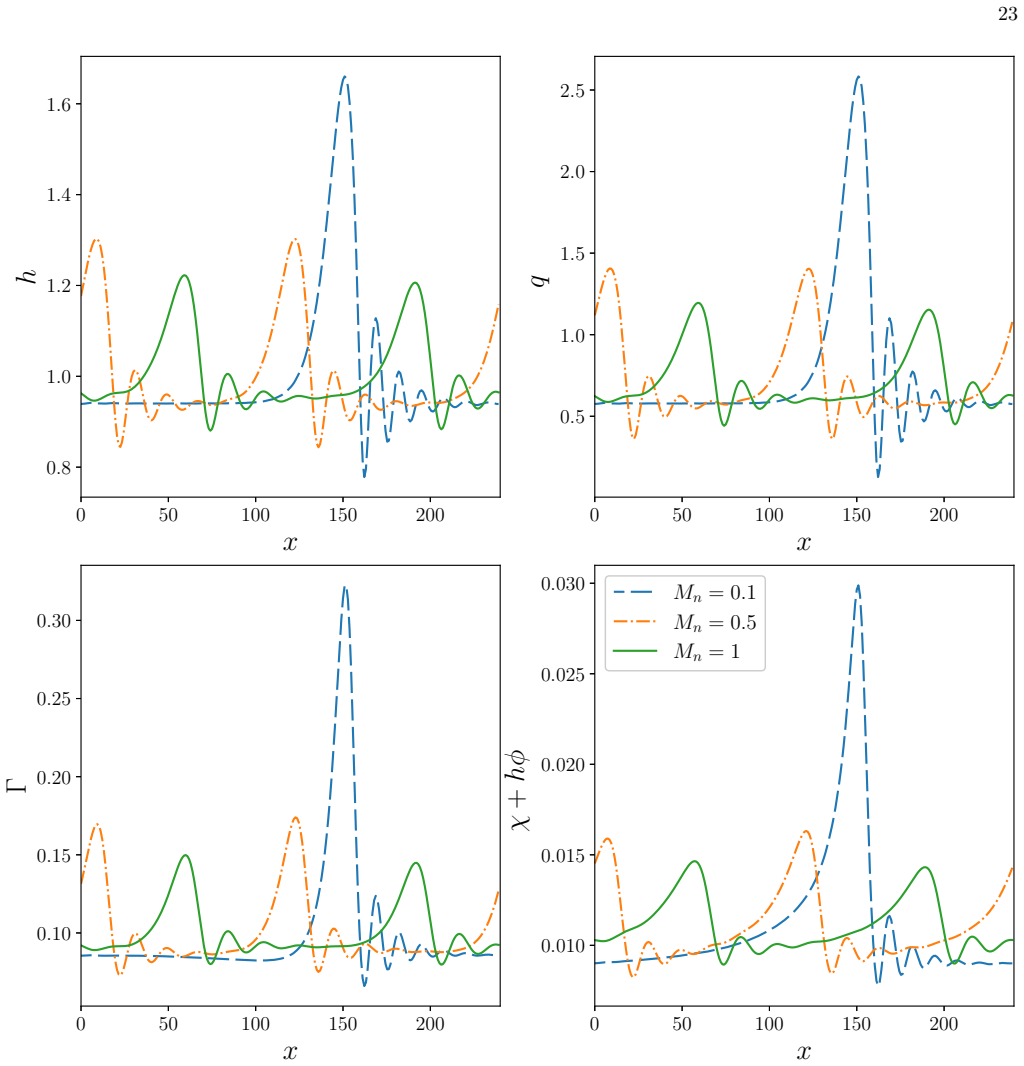
We present a comprehensive framework for gravity-driven, surfactant-laden thin films flowing over slippery substrates, elucidating how wall slip modifies the coupled hydrodynamics and interfacial transport. A long-wave model is formulated with a conservative bulk-surface mass balance and a Navier slip condition. The Orr-Sommerfeld eigenvalue problem governs the linear regime, while a weighted-residual model captures the nonlinear evolution over a range of equilibrium surfactant coverages, Marangoni strengths, and adsorption kinetics. The analysis predicts a non-monotonic variation of the critical Reynolds number with equilibrium coverage, exhibiting a maximum at intermediate $\Gamma_e$, and a slip-induced transition from single- to double-hump solitary structures with increasing Marangoni number, accompanied by attenuated capillary ripples. Under fast adsorption kinetics, the surface field homogenizes, preserving the mean film shape and flux while flattening both the surface concentration $\Gamma$ and the bulk inventory $\chi + h\phi$. A spurious interfacial mass growth reported by Pascal et al.(PRF, 2019) and D'Alessio et al.(JFM, 2020) is resolved through a revised surface balance ensuring strict conservation. Wall slip thus emerges as a key control parameter, reducing viscous resistance and mitigating Marangoni back-stress. The slip parameter $\beta$ is a useful control knob for surfactant-laden films. Slip prevents fragile multi-hump bound states, promoting a single broad crest or an almost flat, uniform sheet by carefully bonding $\beta$ to wave selection, ripple damping, and the bulk-surface surfactant balance.
Editorial analysis
A structured set of objections, weighed in public.
Referee Report
Summary. The manuscript develops a long-wave model for gravity-driven surfactant-laden thin films on slippery substrates, incorporating a conservative bulk-surface mass balance and Navier slip condition. Linear stability is analyzed via the Orr-Sommerfeld eigenvalue problem, while nonlinear evolution is captured using a weighted-residual integral method over ranges of equilibrium surfactant coverage Γ_e, Marangoni number, and adsorption kinetics. Key predictions include non-monotonic variation of the critical Reynolds number with Γ_e (maximum at intermediate coverage), a slip-induced transition from single- to double-hump solitary waves with increasing Marangoni strength, attenuation of capillary ripples, and homogenization of surface and bulk surfactant fields under fast adsorption. The revised mass balance resolves spurious interfacial mass growth reported in prior literature.
Significance. If the long-wave predictions hold quantitatively, the work establishes wall slip (parameter β) as a useful control knob that reduces viscous resistance, mitigates Marangoni back-stress, suppresses fragile multi-hump bound states, and promotes single broad crests or uniform sheets. This has potential implications for coating processes and microfluidic applications involving surfactant-laden films. The resolution of the conservation issue via the revised bulk-surface balance is a clear modeling improvement. The systematic exploration of adsorption kinetics and the non-monotonic Re(Γ_e) result add value, though the absence of direct Navier-Stokes benchmarks limits immediate quantitative trust in the nonlinear claims for large β.
major comments (2)
- [§4] §4 (nonlinear evolution and solitary-wave computations): the central claim that β prevents multi-hump states and damps ripples rests on the weighted-residual model remaining accurate for the reported ranges of Γ_e, Ma, and kinetic rates. No convergence study with respect to the number of modes is shown, and no direct comparison to full Navier-Stokes solutions is provided for β > 0 or fast adsorption; this is load-bearing for treating β as a reliable control parameter.
- [Linear stability section] Linear stability section (Orr-Sommerfeld analysis): while the base-flow linearization is standard, the reported non-monotonic critical Reynolds number versus Γ_e lacks an explicit check against the long-wave asymptotic limit or against the β = 0 case from the cited prior literature (Pascal et al., D'Alessio et al.) to confirm the maximum at intermediate coverage is robust.
minor comments (2)
- [Model formulation] The notation for the bulk inventory (χ + hϕ) and its relation to the conservative mass balance could be introduced with a brief table of symbols to improve readability for readers unfamiliar with the revised formulation.
- [Figures] Figure captions for the nonlinear wave profiles should explicitly state the values of β, Γ_e, and adsorption rate used in each panel to allow direct comparison with the text claims.
Simulated Author's Rebuttal
We thank the referee for the careful reading and constructive comments on our manuscript. We address each major comment point by point below and indicate the revisions planned for the next version.
read point-by-point responses
-
Referee: [§4] §4 (nonlinear evolution and solitary-wave computations): the central claim that β prevents multi-hump states and damps ripples rests on the weighted-residual model remaining accurate for the reported ranges of Γ_e, Ma, and kinetic rates. No convergence study with respect to the number of modes is shown, and no direct comparison to full Navier-Stokes solutions is provided for β > 0 or fast adsorption; this is load-bearing for treating β as a reliable control parameter.
Authors: We agree that demonstrating numerical convergence of the weighted-residual method is essential to support the nonlinear claims. In the revised manuscript we will add a convergence study showing that solitary-wave profiles, speeds, and hump structures stabilize with increasing number of modes for the reported ranges of Γ_e, Ma, and adsorption rates. Direct Navier-Stokes comparisons for β > 0 and fast adsorption are not available in the literature and would require new high-fidelity simulations outside the present long-wave framework; we will instead add validation against the β = 0 limit from prior work and discuss the small-slope assumption that underpins the model’s applicability. These additions will strengthen the case for β as a control parameter while clarifying its quantitative limitations at large slip. revision: partial
-
Referee: [Linear stability section] Linear stability section (Orr-Sommerfeld analysis): while the base-flow linearization is standard, the reported non-monotonic critical Reynolds number versus Γ_e lacks an explicit check against the long-wave asymptotic limit or against the β = 0 case from the cited prior literature (Pascal et al., D'Alessio et al.) to confirm the maximum at intermediate coverage is robust.
Authors: We thank the referee for this observation. To confirm robustness, the revised linear stability section will include direct comparisons of the Orr-Sommerfeld critical Reynolds numbers to the long-wave asymptotic predictions at small wavenumbers. We will also overlay our β = 0 results with the corresponding curves from Pascal et al. and D’Alessio et al. to verify consistency and demonstrate that the non-monotonic maximum at intermediate Γ_e is preserved across these checks. revision: yes
- Direct full Navier-Stokes benchmarks for β > 0 and fast adsorption kinetics, which would require extensive new simulations beyond the scope and resources of the current long-wave study.
Circularity Check
Standard long-wave derivation with independent prior citations; no reduction by construction
full rationale
The paper starts from the standard long-wave approximation for gravity-driven films, augments it with a Navier slip condition at the wall, and adopts a revised conservative bulk-surface surfactant balance to eliminate the known spurious mass growth identified in independent prior works (Pascal et al. 2019, D'Alessio et al. 2020). The linear Orr-Sommerfeld problem is solved exactly on the base flow, while the weighted-residual nonlinear model follows established Galerkin projection techniques. No parameter is fitted inside the paper and then relabeled as a prediction; no uniqueness theorem or ansatz is imported solely via self-citation; and the central claims about slip as a control parameter follow directly from the solved equations rather than from definitional equivalence. The derivation therefore remains self-contained against external benchmarks.
Axiom & Free-Parameter Ledger
free parameters (2)
- slip length β
- equilibrium surfactant coverage Γ_e
axioms (2)
- domain assumption Long-wave approximation remains valid for the film thicknesses and wavelengths considered.
- domain assumption The revised bulk-surface mass balance enforces strict conservation of surfactant.
Lean theorems connected to this paper
-
IndisputableMonolith/Foundation/Cost/FunctionalEquation.leanwashburn_uniqueness_aczel unclear?
unclearRelation between the paper passage and the cited Recognition theorem.
A long-wave model is formulated with a conservative bulk-surface mass balance and a Navier slip condition... weighted-residual model captures the nonlinear evolution over a range of equilibrium surfactant coverages, Marangoni strengths, and adsorption kinetics.
-
IndisputableMonolith/Foundation/DimensionForcing.leanreality_from_one_distinction unclear?
unclearRelation between the paper passage and the cited Recognition theorem.
The slip parameter β is a useful control knob... Rec = 5(1 + 2β)/... + 45(1 + 2β)^3/... Mn Γe ...
What do these tags mean?
- matches
- The paper's claim is directly supported by a theorem in the formal canon.
- supports
- The theorem supports part of the paper's argument, but the paper may add assumptions or extra steps.
- extends
- The paper goes beyond the formal theorem; the theorem is a base layer rather than the whole result.
- uses
- The paper appears to rely on the theorem as machinery.
- contradicts
- The paper's claim conflicts with a theorem or certificate in the canon.
- unclear
- Pith found a possible connection, but the passage is too broad, indirect, or ambiguous to say the theorem truly supports the claim.
Reference graph
Works this paper leans on
-
[1]
Solutocapillary instability in slipping falling films
and Benjamin [3] demonstrated that insoluble surfactants can have a pronounced stabilizing effect on the primary instability of falling films through Marangoni stresses, effectively imparting an elastic character to the interface. Subsequent work investigated the nonlinear evolution and rupture of thin surfactant-laden films. For example, Jensen & Grotber...
work page internal anchor Pith review Pith/arXiv arXiv 2026
-
[2]
∂Γ ∂t + 1p 1 +ε 2h2x ∂(Γus) ∂x # = ε2 P es p 1 +ε 2h2x ∂ ∂x
experimentally determined that an estimate of the slip length for a polydimethylsiloxane (PDMS) slippery plane is 250µm [59]. The first equation of (4) is called the Navier slip boundary condition, which states that the velocity at the boundary is proportional to the tangential component of the wall stress. The second equation of (4) is the non-penetratio...
-
[3]
The choice is of the velocity scale ˆV=⟨u⟩=gsinθ ˆh2 N /3νthe average Nusselt velocity for flat rigid plate, we getRe/F r 2 = (gsinθ ˆh2 N /ν)(1/ ˆV) = 3 [42]. 2 This eigen value corresponds to the hydrodynamic Kapitza modeα (1); for more information, see Appendix B. 9
-
[4]
For, ˆV= 2 ˆUN = (gsinθ ˆh2 N /ν)(1 + 2β) as twice the dimensional Nusselt free surface velocity and redefine the Reynolds number asRe= ˆUNˆhN /ν, thenRe/F r 2 = 2/(1 + 2β)[52]
-
[5]
For detailed information, see Mukhopadhyay & Mukhopadhyay [36]
If we choose the viscous gravity length scalel ν =ν 2/3(gsinθ) −1/3 andt ν =ν 1/3(gsinθ) −2/3 and the velocity scale ˆV=U N = (gsinθ ˆh2 N /ν)(1 + 2β), we getRe/F r 2 = 1/(1 + 2β) [25]. For detailed information, see Mukhopadhyay & Mukhopadhyay [36]. Therefore, if we choose the velocity scale as the twice the dimensional Nusselt free surface velocity and r...
work page 2000
-
[6]
6 h 0 500 1000 1500 2000 t
work page 2000
-
[7]
6 hmin hmax 0 50 100 150 200 x
-
[9]
030 χ + hφ t=0.0 t=500.0 t=1000.0 t=1500.0 t=2000.0 FIG. 10: Formation of solitary waves over the time forβ= 0.04, Γ e = 0.1,M n= 0.1 andκ= 10 δ= (Re−Re c)/Rec ≃1.9, indicating a strongly supercritical regime. is most apparent in Γ, which exhibits its largest spatial fluctuations at Γ e ≈0.5. This intermediate state corresponds to the maximum inRe c obser...
work page 2000
-
[12]
35 Γ 0 50 100 150 200 x
-
[13]
035 χ + hφ β = 0 β = 0. 02 β = 0. 04 β = 0. 08 FIG. 11: Permanent solitary waves at timet= 2000 for different slip variableβ, when Γ e = 0.1,M n= 0.1 and κ= 10, κ= 10 and 100 while keeping the rest the same as in Figure 12 withM n= 0.1. The parameterκcharacterizes the strength of exchange between the bulk and the interface: higher values correspond to fas...
work page 2000
-
[16]
0 Γ 0 50 100 150 200 x
-
[17]
0 χ + hφ Γ e = 0. 1 Γ e = 0. 5 Γ e = 0. 9 FIG. 12: Permanent solitary waves at timet= 2000 for different Γ e, whenβ= 0.04,M n= 0.1 andκ= 10 V. CONCLUSION In this work we have examined the stability and nonlinear dynamics of a gravity-driven thin liquid film laden with a soluble surfactant flowing down an inclined substrate with wall slip. Slip at the soli...
work page 2000
-
[21]
030 χ + hφ Mn = 0. 1 Mn = 0. 5 Mn = 1 FIG. 13: Permanent solitary waves at timet= 2000 for differentM n, whenβ= 0.04, Γ e = 0.1 andκ= 10 beyond a threshold value, leading to destabilization. This non-monotonic behavior reflects the competing effects of Marangoni stresses and bulk-surface exchange. Both the Marangoni number and the solubility parameter ten...
work page 2000
-
[22]
6 h 0 50 100 150 200 x
-
[23]
5 q 0 50 100 150 200 x
-
[24]
30 Γ 0 50 100 150 200 x
-
[25]
030 χ + hφ κ = 10 κ = 100 FIG. 14: Permanent solitary waves at timet= 2000 for differentκ, whenβ= 0.04, Γ e = 0.1 andM n= 0.1 recovers the limiting cases of clean films, insoluble surfactants, and no-slip substrates. Nonlinear simulations reveal that increasing the Marangoni number drives a transition from single-hump to double-hump solitary-wave structur...
work page 2000
-
[26]
16: Surface, bulk and total mass and mass flux for model equations (54 - 57) withβ= 0
30 ∫ Γdx ∫ φh + χdx ∫ Γ + φh + χdx 0 200 400 600 800 1000 t −4 −3 −2 −1 0 1 2 3 ×10⁻⁵ ∫ ε P es ∂2Γ ∂x2 dx ∫ 1 4M a [ h ∂2Γ ∂x2 Γ + h ( ∂Γ ∂x ) 2 + Γ ∂Γ ∂x ∂h ∂x ] dx ∫ 3 P ebε χ h2 dx 0 200 400 600 800 1000 t −3 −2 −1 0 1 2 3 4 ×10⁻⁵ ∫ 3Ma 80 [ ∂2Γ ∂x2 hχ + ∂χ ∂x ∂Γ ∂x h + χ ∂Γ ∂x ∂h ∂x ] dx ∫ − 3 P ebε χ h2 dx ∫ ε Peb [ ∂2χ ∂x2 − 3χ h2 ( ∂h ∂x ) 2 + h ∂2...
-
[27]
6 ∫ Γdx ∫ φh + χdx ∫ Γ + φh + χdx 0 200 400 600 800 1000 t −0. 002 −0. 001
-
[28]
003 ∫ ε P es ∂2Γ ∂x2 dx ∫ 1 4M a [ h ∂2Γ ∂x2 Γ + h ( ∂Γ ∂x ) 2] + 5 4M aΓ ∂Γ ∂x ∂h ∂x dx ∫ 3 P ebε χ h2 dx 0 200 400 600 800 1000 t
-
[29]
0025 ∫ 3Ma 80 [ ∂2Γ ∂x2 hχ + ∂χ ∂x ∂Γ ∂x h + χ ∂Γ ∂x ∂h ∂x ] dx ∫ − 3 P ebε χ h2 dx ∫ ε Peb [ ∂2χ ∂x2 − 3χ h2 ( ∂h ∂x ) 2 + h ∂2φ ∂x2 ] dx 0 200 400 600 800 1000 t
-
[30]
17: Total mass and mass flux for model equations of [43] without density fluctuations
0030 ∫ ∂Γ ∂t dx ∫ ∂(φh+χ) ∂t dx ∫ ∂(Γ+φh+χ) ∂t dx FIG. 17: Total mass and mass flux for model equations of [43] without density fluctuations. Upper left: Surfactant mass, bulk mass and total mass. Upper right: mass fluxes for surface concentration. Lower left: mass fluxes for bulk concentration. Lower right: time derivative of surface, bulk and total mass...
work page 2013
discussion (0)
Sign in with ORCID, Apple, or X to comment. Anyone can read and Pith papers without signing in.