Stateless Network-Aware Adaptive Bitrate Streaming over IPFS
Pith reviewed 2026-06-30 01:50 UTC · model grok-4.3
The pith
A stateless network-aware ABR policy for IPFS video streaming recomputes bitrates from local signals and carries adaptation state in HTTP headers.
A machine-rendered reading of the paper's core claim, the machinery that carries it, and where it could break.
Core claim
Network-aware ABR remains effective without synchronized adaptation state when the client recomputes bitrate for each segment from locally observable request-time signals and embeds its own adaptation state in HTTP headers, thereby preserving context across requests under client control and improving robustness to peer churn, provider migrations, and network partitions.
What carries the argument
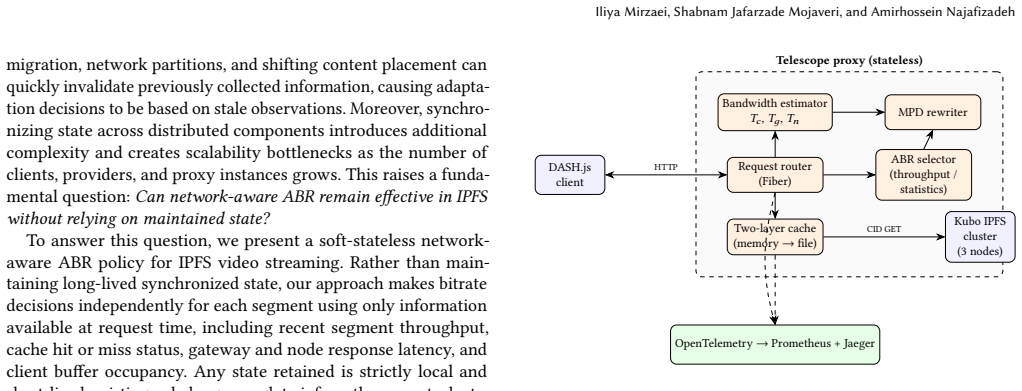
Observation-driven policy that recomputes bitrate per segment from request-time signals, with adaptation context preserved by embedding state in HTTP headers.
If this is right
- Removes the requirement for continuous provider-side state synchronization.
- Increases tolerance to peer churn, migrations, and network partitions.
- Reduces deployment complexity for large-scale decentralized streaming.
- Preserves high QoE in faulty network conditions.
Where Pith is reading between the lines
- The header-embedding technique could transfer to other peer-to-peer content networks that lack reliable cross-node state.
- Removing synchronization overhead may lower latency in any decentralized streaming system that experiences frequent topology changes.
- Direct comparison under controlled churn rates would isolate how much of the reported QoE gain comes from the stateless design.
Load-bearing premise
Embedding adaptation state in HTTP headers lets the client keep context across requests without provider-side synchronization even when peers churn or networks partition.
What would settle it
A measurement showing that under sustained high peer churn and partitions the stateless policy produces lower QoE than a correctly synchronized stateful baseline.
Figures
read the original abstract
Modern content delivery is increasingly decentralized, improving availability, cost, and reach for geographically distributed users. The InterPlanetary File System (IPFS) is a promising approach that uses content-based identifiers distributed across a global peer-to-peer network. Although IPFS improves fault tolerance, resilience, and censorship resistance, its unpredictable environment introduces significant performance variability that limits conventional Adaptive Bitrate (ABR) streaming and degrades Quality of Experience (QoE). Recent network-aware ABR solutions address this by incorporating IPFS-specific information into bitrate decisions. However, they rely on maintaining continuously synchronized state across consumers and providers, which can quickly become stale under peer churn, provider migrations, network partitions, and changing content distributions, making existing policies less effective. We investigate whether network-aware ABR can remain effective without synchronized adaptation state, and present a stateless network-aware ABR policy for IPFS-based video streaming. Our approach replaces provider-stateful adaptation with an observation-driven policy that recomputes the bitrate for each segment using only locally observable request-time signals. To preserve adaptation context without provider-side state, the client embeds its adaptation state in HTTP headers, keeping it under client control and carried transparently across requests. By eliminating cross-provider state synchronization, the framework improves robustness to failures and network reconfigurations while simplifying deployment at scale. Early results show the approach maintains high QoE in faulty conditions, improving it by up to roughly 6x over existing solutions. These findings demonstrate that stateless network-aware adaptation provides a practical and scalable foundation for decentralized video delivery.
Editorial analysis
A structured set of objections, weighed in public.
Referee Report
Summary. The paper proposes a stateless network-aware adaptive bitrate (ABR) streaming policy for IPFS-based video delivery. It replaces provider-stateful adaptation with an observation-driven policy that recomputes bitrate per segment from local signals only. Adaptation context is preserved by embedding state in HTTP headers under client control, avoiding cross-provider synchronization. Early results claim the approach maintains high QoE under faulty conditions and improves it by up to roughly 6x over existing solutions, positioning stateless network-aware adaptation as a practical foundation for decentralized video delivery.
Significance. If the central claim holds, the work would demonstrate that network-aware ABR can be made robust to peer churn and partitions in P2P systems without requiring synchronized state, simplifying deployment and improving resilience for decentralized content delivery.
major comments (2)
- [Abstract] Abstract: the claim of 'up to roughly 6x' QoE improvement is presented with no information on experimental setup, baselines, metrics, statistical analysis, or conditions under which the gain was measured. This prevents assessment of whether the data supports the central claim that the stateless policy is effective.
- [Abstract] Abstract: the mechanism of embedding adaptation state in HTTP headers to 'preserve adaptation context' and 'carry it transparently across requests' assumes all fetches occur through a header-preserving HTTP gateway. In native IPFS (Bitswap/libp2p), successive segments can be served by different peers with no knowledge of prior header values; the paper does not address how local observation windows survive such switches or non-HTTP transports, which is load-bearing for the stateless claim under churn.
Simulated Author's Rebuttal
We thank the referee for the constructive comments on the abstract. We address each point below and will revise the manuscript accordingly to improve clarity and support for the claims.
read point-by-point responses
-
Referee: [Abstract] Abstract: the claim of 'up to roughly 6x' QoE improvement is presented with no information on experimental setup, baselines, metrics, statistical analysis, or conditions under which the gain was measured. This prevents assessment of whether the data supports the central claim that the stateless policy is effective.
Authors: The abstract condenses early results whose full details appear in Section 5 of the manuscript (testbed with 50 peers, 30% injected provider failures and churn, comparison to BOLA and a stateful network-aware baseline, QoE as weighted sum of selected bitrate, rebuffering ratio and smoothness, with gains reported as mean over 20 runs). The 'up to roughly 6x' figure is the maximum observed ratio under the highest-fault condition. We will revise the abstract to include a brief parenthetical summary of setup, baseline, metric and condition to make the claim self-contained. revision: yes
-
Referee: [Abstract] Abstract: the mechanism of embedding adaptation state in HTTP headers to 'preserve adaptation context' and 'carry it transparently across requests' assumes all fetches occur through a header-preserving HTTP gateway. In native IPFS (Bitswap/libp2p), successive segments can be served by different peers with no knowledge of prior header values; the paper does not address how local observation windows survive such switches or non-HTTP transports, which is load-bearing for the stateless claim under churn.
Authors: The design targets HTTP-gateway access to IPFS content, which is the common path for video streaming clients and where headers are preserved end-to-end under client control. The core policy recomputes bitrate from local signals on every request and therefore does not depend on header state for correctness; headers are an optional convenience for carrying context when the transport supports them. In native libp2p/Bitswap the same local-observation policy applies without headers. We will revise the abstract and Section 3 to state the assumed transport model explicitly and note that the stateless claim holds independently of header preservation. revision: partial
Circularity Check
No circularity: descriptive systems approach with no derivations or self-referential reductions
full rationale
The paper describes a stateless ABR policy that recomputes bitrate from local signals and embeds state in HTTP headers. No equations, fitted parameters, or predictions appear in the provided text. No self-citations are used to justify uniqueness theorems or ansatzes. The central claim is a design choice presented as observation-driven, with no reduction of the result to its own inputs by construction. This is a standard non-circular systems description.
Axiom & Free-Parameter Ledger
Reference graph
Works this paper leans on
-
[1]
Begen, and Constantine Dovrolis
Saamer Akhshabi, Ali C. Begen, and Constantine Dovrolis. 2011. An Experimental Evaluation of Rate-Adaptation Algorithms in Adaptive Streaming over HTTP. InProceedings of the 2nd Annual ACM Conference on Multimedia Systems. doi:10. 1145/1943552.1943572
-
[2]
Amirhossein Najafizadeh and Seyyed Ahmad Javadi. 2023. Jump over Golang channels.ResearchGate(2023). doi:10.13140/RG.2.2.28045.92646
- [3]
-
[4]
Juan Benet. 2014. IPFS – Content Addressed, Versioned, P2P File System. arXiv:1407.3561
work page internal anchor Pith review Pith/arXiv arXiv 2014
-
[5]
Begen, Christian Timmerer, and Roger Zimmermann
Abdelhak Bentaleb, Bayan Taani, Ali C. Begen, Christian Timmerer, and Roger Zimmermann. 2019. A Survey on Bitrate Adaptation Schemes for Streaming Media Over HTTP.IEEE Communications Surveys & Tutorials(2019)
2019
-
[6]
Divyashri Bhat, Amr Rizk, Michael Zink, and Ralf Steinmetz. 2018. SABR: Network-assisted content distribution for QoE-driven ABR video streaming. ACM Transactions on Multimedia Computing, Communications, and Applications (TOMM)14, 2s (2018), 1–25
2018
-
[7]
Sitaraman
Tianyu Chen, Yiheng Lin, Nicolas Christianson, Zahid Akhtar, Sharath Dharmaji, Mohammad Hajiaghayi, Adam Wierman, and Ramesh K. Sitaraman. 2024. SODA: An Adaptive Bitrate Controller for Consistent High-Quality Video Streaming. In Proceedings of ACM SIGCOMM
2024
-
[8]
Cloud Native Computing Foundation. 2026. Jaeger: Open source, end-to-end distributed tracing. https://www.jaegertracing.io. Accessed: 2026-06-14
2026
-
[9]
Cloud Native Computing Foundation. 2026. OpenTelemetry: An observability framework for cloud-native software. https://opentelemetry.io. Accessed: 2026- 06-14
2026
-
[10]
Cloud Native Computing Foundation. 2026. Prometheus: Monitoring system and time series database. https://prometheus.io. Accessed: 2026-06-14
2026
-
[11]
Erik Daniel and Florian Tschorsch. 2022. IPFS and Friends: A Qualitative Com- parison of Next Generation Peer-to-Peer Data Networks.IEEE Communications Surveys & Tutorials(2022)
2022
- [12]
-
[13]
DASH Industry Forum. 2026. dash.js: A reference client implementation for MPEG-DASH. https://github.com/Dash-Industry-Forum/dash.js. Accessed: 2026- 06-14
2026
-
[14]
DASH Industry Forum. 2026. MPEG-DASH: Dynamic Adaptive Streaming over HTTP. https://dashif.org. Accessed: 2026-06-14
2026
-
[15]
2021.Accelerating Content Routing with Bitswap: A Multi-Path File Transfer Protocol in IPFS and Filecoin
Alfonso de la Rocha, David Dias, and Yiannis Psaras. 2021.Accelerating Content Routing with Bitswap: A Multi-Path File Transfer Protocol in IPFS and Filecoin. Technical Report. Protocol Labs Research
2021
-
[16]
Florin Dobrian, Vyas Sekar, Asad Awan, Ion Stoica, Dilip Joseph, Aditya Ganjam, Jibin Zhan, and Hui Zhang. 2011. Understanding the Impact of Video Quality on User Engagement. InACM SIGCOMM 2011
2011
-
[17]
Hao Fang, Haoyuan Zhao, Jianxin Shi, Miao Zhang, Guanzhen Wu, Yi Ching Chou, Feng Wang, and Jiangchuan Liu. 2024. Robust Live Streaming over LEO Satellite Constellations: Measurement, Analysis, and Handover-Aware Adap- tation. InProceedings of the 32nd ACM International Conference on Multimedia. doi:10.1145/3664647.3680712
-
[18]
FFmpeg Project. 2026. FFmpeg: A complete cross-platform solution to record, convert and stream audio and video. https://ffmpeg.org. Accessed: 2026-06-14
2026
-
[19]
Prateesh Goyal, Ravi Netravali, Mohammad Alizadeh, and Hari Balakrishnan
-
[20]
In2nd USENIX Workshop on Hot Topics in Edge Computing (HotEdge 19)
Secure incentivization for decentralized content delivery. In2nd USENIX Workshop on Hot Topics in Edge Computing (HotEdge 19)
-
[21]
Jun He and Deying Yu. 2026. Post-Deterministic Distributed Systems: A New Foundation for Trustworthy Autonomous Infrastructure.arXiv preprint arXiv:2606.01722(2026)
work page internal anchor Pith review Pith/arXiv arXiv 2026
-
[22]
Te-Yuan Huang, Ramesh Johari, Nick McKeown, Matthew Trunnell, and Mark Watson. 2014. A Buffer-Based Approach to Rate Adaptation: Evidence from a Large Video Streaming Service. InACM SIGCOMM 2014
2014
-
[23]
Junchen Jiang, Vyas Sekar, and Hui Zhang. 2012. Improving Fairness, Efficiency, and Stability in HTTP-Based Adaptive Video Streaming with FESTIVE. InPro- ceedings of the 8th International Conference on Emerging Networking Experiments and Technologies. doi:10.1145/2413176.2413189
-
[24]
Amirhossein Khanlari and Amir Rahmati. 2026. Taking a Bite Out of the For- bidden Fruit: Characterizing Third-Party Iranian iOS App Stores.arXiv preprint arXiv:2604.26343(2026)
work page internal anchor Pith review Pith/arXiv arXiv 2026
-
[25]
Kyoungmin Kim, Youngin You, Mookyu Park, and Kyungho Lee. 2018. DDoS mit- igation: Decentralized CDN using private blockchain. In2018 Tenth International Conference on Ubiquitous and Future Networks (ICUFN). IEEE, 693–696
2018
-
[26]
Hongzi Mao, Ravi Netravali, and Mohammad Alizadeh. 2017. Neural Adaptive Video Streaming with Pensieve. InACM SIGCOMM 2017
2017
-
[27]
Petar Maymounkov and David Mazières. 2002. Kademlia: A Peer-to-Peer Infor- mation System Based on the XOR Metric. InProc. International Workshop on Peer-to-Peer Systems (IPTPS)
2002
-
[28]
Shota Minegishi and Masaki Bandai. 2025. Video segment prefetching for IPFS video streaming with scalable video coding.IEICE Transactions on Communica- tions(2025)
2025
-
[29]
Ricky K. P. Mok, Edmond W. W. Chan, and Rocky K. C. Chang. 2011. Measuring the Quality of Experience of HTTP Video Streaming. InIFIP/IEEE International Symposium on Integrated Network Management (IM)
2011
-
[30]
Basabdatta Palit, Argha Sen, Abhijit Mondal, Ayan Zunaid, Jay Jayatheerthan, and Sandip Chakraborty. 2023. Improving UE energy efficiency through network- aware video streaming over 5G.IEEE Transactions on Network and Service Management20, 3 (2023), 3487–3500
2023
-
[31]
Protocol Labs. 2026. IPFS: The InterPlanetary File System. https://ipfs.tech. Accessed: 2026-06-14
2026
-
[32]
Protocol Labs. 2026. Kubo: IPFS implementation in Go. https://github.com/ipfs/ kubo. Accessed: 2026-06-14
2026
-
[33]
Chunyu Qiao, Tong Liu, Yucheng Zhang, Zhiwei Fan, Pengjin Xie, Zhen Wang, and Liang Liu. 2025. PIRA: Pan-CDN Intra-video Resource Adaptation for Short Video Streaming. InProceedings of the 33rd ACM International Conference on Multimedia. 11987–11995
2025
- [34]
-
[35]
Ruizhe Shi, Ruizhi Cheng, Bo Han, Yue Cheng, and Songqing Chen. 2024. A Closer Look into IPFS: Accessibility, Content, and Performance.Proceedings of the ACM on Measurement and Analysis of Computing Systems8, 2, Article 20 (2024). doi:10.1145/3656015
-
[36]
Sitaraman
Kevin Spiteri, Rahul Urgaonkar, and Ramesh K. Sitaraman. 2016. BOLA: Near- Optimal Bitrate Adaptation for Online Videos. InIEEE INFOCOM 2016
2016
-
[37]
Yi Sun, Xiaoqi Yin, Junchen Jiang, Vyas Sekar, Fuyuan Lin, Nanshu Wang, Tao Liu, and Bruno Sinopoli. 2016. CS2P: Improving Video Bitrate Selection and Adaptation with Data-Driven Throughput Prediction. InProceedings of ACM SIGCOMM. doi:10.1145/2934872.2934898
-
[38]
Dennis Trautwein, Aravindh Raman, Gareth Tyson, Ignacio Castro, Will Scott, Moritz Schubotz, Bela Gipp, and Yiannis Psaras. 2022. Design and Evaluation of IPFS: A Storage Layer for the Decentralized Web. InACM SIGCOMM 2022
2022
- [39]
-
[40]
Thang X Vu, Symeon Chatzinotas, and Björn Ottersten. 2019. Blockchain-based content delivery networks: Content transparency meets user privacy. In2019 IEEE Wireless Communications and Networking Conference (WCNC). IEEE, 1–6
2019
-
[41]
Zhengyu Wu, ChengHao Ryan Yang, Santiago Vargas, and Aruna Balasubrama- nian. 2023. Is IPFS Ready for Decentralized Video Streaming?. InProceedings of the ACM Web Conference 2023 (WWW ’23). ACM. doi:10.1145/3543507.3583404
-
[42]
Xiaoqi Yin, Abhishek Jindal, Vyas Sekar, and Bruno Sinopoli. 2015. A Control- Theoretic Approach for Dynamic Adaptive Video Streaming over HTTP. InACM SIGCOMM 2015
2015
discussion (0)
Sign in with ORCID, Apple, or X to comment. Anyone can read and Pith papers without signing in.