REVIEW 3 major objections 5 minor 39 references
An efficient Fourier spectral algorithm for the Bogoliubov-de Gennes excitation eigenvalue problem
T0 review · 3 major / 5 minor · reviewed 2026-08-07 · deepseek-v4-flash
Pith's one-line read The paper proposes a matrix-free Fourier spectral eigensolver that computes Bogoliubov-de Gennes excitation eigenpairs of spin-1 Bose-Einstein condensates with spectral accuracy and $O(DOF\log DOF)$ complexity.
desk verdict Solid, useful paper on a FFT-based eigensolver for spin-1 BdG, but the anti-ferromagnetic convergence proof rests on a stated conjecture and the BOSP solver is not self-contained. read the letter →
The pith
A machine-rendered reading of the paper's core claim, the machinery that carries it, and where it could break.
The reading
What carries the argument
The load-bearing object is the linear-response Hamiltonian $\mathcal{H}=\begin{pmatrix}0&H_-\\H_+&0\end{pmatrix}$ obtained by the change of variables $u=f+g$, $v=f-g$. The bi-orthogonal structure-preserving subspace eigensolver (BOSP) iterates on $H_+$ and $H_-$ actions while maintaining the biorthogonality constraint that eigenmodes with different frequency magnitudes decouple, and it is seeded with the analytically known generalized nullspace of $\mathcal{H}$—for ferromagnetic condensates the modes $\Phi_1,\Phi_2$ and their generalized partners, and for anti-ferromagnetic condensates the analogous pair under a stated conjecture. Each $H_\pm$ application costs two FFT/iFFT pairs plus pointwise multiplications, which is what keeps the algorithm matrix-free and gives the claimed $O(DOF\log DOF)$ complexity.
What would settle it
Compute the smallest eigenvalue of the discretized $H_+$ operator for the anti-ferromagnetic parameters used in the paper ($\beta_n=240.8$, $\beta_s=7.5$) as $N$ grows; if it approaches zero, or if an extra independent function appears in the nullspace of $H_-$ beyond $\Phi_1,\Phi_2$, the conjectured nullspace characterization and the convergence rates built on it are false.
Extended reading notes
Core claim
The paper's central claim is that the BdG eigenvalue problem for spin-1 Bose-Einstein condensates can be solved stably, spectrally accurately, and with near-optimal complexity by exploiting its algebraic structure. Starting from a real ground state, the equations are recast through $u=f+g$, $v=f-g$ into the linear-response form $\mathcal{H}(f;g)^\top=(H_-g;H_+f)^\top=\omega(f;g)^\top$ with Hermitian blocks $H_+=A+B$ and $H_-=A-B$. The authors characterize the generalized nullspace explicitly in the ferromagnetic case (Theorem 2.5) and conjecture it in the anti-ferromagnetic case (Remark 2.2), prove biorthogonality of eigenspaces with different $|\omega|$, and give analytic eigenpairs at the harmonic trapping frequencies. On top of this, the Fourier pseudospectral discretization is combined with a bi-orthogonal Gram-Schmidt subspace iteration; the discrete problem is solved without storing the dense matrices, and the paper's convergence analysis yields the $N^{-(m-\sigma)}$ and $N^{-2(m-\sigma)}$ error bounds of Theorem 3.2.
Load-bearing premise
For anti-ferromagnetic condensates, the solver's fast convergence and the coercivity step in the convergence proof rely on a conjecture (Remark 2.2) that $H_+$ is invertible and $\mathrm{null}(H_-)=\mathrm{span}\{\Phi_1,\Phi_2\}$; if that conjecture fails, the nullspace seeding and the error estimates built on it lose their foundation.
Editorial extensions
If this is right
- For a fixed number of wanted eigenpairs $n_{ev}$, the total cost is about $O(n_{ev}\,DOF\log DOF)+O(n_{ev}^3)$, so in the large-$DOF$ regime the work per eigenpair is nearly optimal.
- Smooth, fast-decaying ground states make the Fourier pseudospectral error behave as $\|u-u_N\|+\|v-v_N\|\lesssim N^{-(m-\sigma)}$ and $|\omega-\omega_N|\lesssim N^{-2(m-\sigma)}$, so a modest mesh already gives machine precision in the reported 1D, 2D, and 3D examples.
- The solver stays matrix-free: $H_+$ and $H_-$ actions need only a few FFT/iFFT pairs plus pointwise multiplications, so no dense matrix storage is required.
- The analytically known eigenpairs with frequencies equal to the trapping frequencies provide exact benchmarks for checking any implementation.
- Because the generalized nullspace is built into the iteration, the solver avoids the slow or failed convergence that generic eigensolvers encounter near the zero eigenvalue.
Reading between the lines
- Editorial: the same nullspace-aware FFT strategy should transfer to other Bogoliubov-type linear-response problems such as multi-component or spinor-dipolar condensates, but the conjectured anti-ferromagnetic nullspace characterization would have to be re-established case by case.
- Editorial: because the matrix is never formed and storage is $O(DOF)$, the practical ceiling is not memory but the number of FFTs per eigenpair, so distributed parallel FFTs should push the method well beyond the paper's 12-million-DOF demonstration.
- Editorial: the biorthogonality theorem only needs $|\omega_i|\neq|\omega_j|$, so replacing the analytical nullspace by a numerical detection routine could turn this into a general-purpose linear-response eigensolver even for systems whose nullspace is not known analytically.
Editorial analysis
A structured set of objections, weighed in public.
Referee Report
Summary. The manuscript derives the Bogoliubov-de Gennes (BdG) eigenvalue system for spin-1 Bose-Einstein condensates, establishes several analytical properties (exact eigenpairs for harmonic traps, eigenspace bi-orthogonality, and generalized nullspace structure for the ferromagnetic case), and proposes a matrix-free Fourier spectral eigensolver with FFT-accelerated operator evaluation. A stability estimate and a convergence theorem with explicit rates are stated, and extensive 1D/2D/3D numerical experiments are reported for both ferromagnetic and anti-ferromagnetic parameters. The anti-ferromagnetic nullspace characterization, however, is explicitly conjectural, and the convergence proof for that case invokes the conjecture as a theorem.
Significance. The analytical eigenpairs of Theorem 2.2 and the spectral-convergence framework give the paper a solid starting point, and the matrix-free FFT-based implementation addresses a real practical bottleneck: the dense, large-scale BdG matrix is never formed. If the convergence claims were fully established for both magnetic phases, the solver would be a useful contribution to the spinor-BEC community, and the numerical study of excitation spectra and Bogoliubov amplitudes in 2D/3D is valuable. The paper is careful to verify the discretization against exact eigenpairs, which is a genuine strength. The main limitation is that the anti-ferromagnetic branch of the convergence theory rests on an openly stated conjecture; this must be resolved or explicitly conditionalized before the advertised rigor is achieved.
major comments (3)
- [Section 2.3, Remark 2.2; Section 3.4, Remark 3.2 and Theorem 3.2] The convergence theorem for the anti-ferromagnetic case is conditional on an explicit conjecture. Remark 2.2 states 'we conjecture that H_+ is invertible and null(H_-) = span{Phi_1, Phi_2}', and Remark 3.2 then asserts 'From Theorem 2.5 or Remark 2.2, we can prove that there exists c_0 > 0 such that a(Phi,Phi) >= c_0 ||Phi||_1' on U = null(H_+)^perp x null(H_-)^perp. Since Remark 2.2 is not proved, the coercivity input to Lemma 3.3 and the rates in Theorem 3.2 are not established for the anti-ferromagnetic results reported in Tables 1-4. Either Remark 2.2 must be proved, or Theorem 3.2 and the corresponding numerical claims must be restated as conditional on a verified hypothesis.
- [Section 2.3, Theorem 2.5] The proof that Phi_1 lies in the range of H_+ is not valid as written. The text says that because H_+ is a self-adjoint compact operator and Phi_1 is not in null(H_+), it follows that Phi_1 is in R(H_+); however, for a compact self-adjoint operator the range need not be closed, so an element orthogonal to the nullspace can still fail to be in the range. The existence of hat_Phi_1 with H_+ hat_Phi_1 = Phi_1, and therefore the equality null(H^2) = null(H) oplus span{(hat_Phi_1,0)}, requires a direct argument based on the explicit form of H_+ (for example, the diagonal representation already used in the proof of Theorem 2.4).
- [Section 3.4, Theorem 3.2] The hypotheses of Theorem 3.2 are inconsistent with the stated convergence rates. The theorem assumes m >= 1, but the bound N^{-(m-sigma)} with sigma = max{1,d/2} is a decaying error only when m > sigma, and Lemma 3.1 already requires m > d/2 for the pointwise estimates used in the proof. The theorem should state m > sigma (with the additional condition m > d/2), and the vector-valued derivation of (3.20) should be written out rather than transferred from the scalar Lemma A.2 by the phrase 'similar as Lemma A.2'.
minor comments (5)
- [Abstract] There is a typo: 'arsing' should be 'arising'.
- [Section 3.4, Remark 3.2 and Eq. (3.17)] The coercivity inequality should read a(Phi,Phi) >= c_0 ||Phi||_1^2; as printed, with ||Phi||_1 on the right-hand side, the inequality is not homogeneous and fails under scaling Phi -> t Phi for small t.
- [Section 3.2 and Section 3.3] There are typos in the text: 'neveigenpairs' should be 'nev eigenpairs', and 'Sine it is easy to prove' should be 'Since it is easy to prove'. Also, in Table 1 'Anit-FM' should be 'Anti-FM'.
- [Section 4.1, Example 1] In the definition of e_{uv}^{h,alpha}, the second denominator is written as ||v^h_alpha||_2 while the first term uses ||u_{alpha,N}||_2; for consistency the second denominator should presumably be ||v_{alpha,N}||_2, or the notation should be defined explicitly.
- [Section 2.2, Theorem 2.1] In the proof that omega is real, the sentence should explicitly note that the left-hand side of (2.11) is real because A and D are Hermitian and C = -B^H, so that the right-hand side minus omega-bar times a positive real number forces omega = omega-bar.
Circularity Check
Anti-ferromagnetic spectral convergence is conditional on a conjecture inferred from the paper's own numerics, and the solver half of the central claim rests on an unpublished self-citation.
-
other
[Section 2.3, Remark 2.2 and Section 3.4, Remark 3.2 (Eq. 3.17)]
"From our extensive numerical results not fully shown here, we conjecture that the following property holds for anti-ferromagnetic systems, that is, H+ is invertible and null(H−) = span{Φ1,Φ2}. ... If the above property is true, we can obtain the generalized nullspace of H ... [Remark 3.2:] From Theorem 2.5 or Remark 2.2, we can prove that there exists c0 > 0 such that a(Φ,Φ) ≥ c0 ∥Φ∥1, ∀Φ∈U."
The error estimates in Theorem 3.2 are obtained from Lemma 3.3 through the coercivity estimate (3.17). Equation (3.17) is introduced in Remark 3.2 as 'provable' from Remark 2.2. But Remark 2.2 is explicitly a conjecture inferred from 'extensive numerical results not fully shown here', and it is the very statement that supplies positive-definiteness of H+ and the exact two-dimensional null(H−). Thus the anti-ferromagnetic half of the advertised convergence theorem is not a self-contained proof; it is conditional on an unproved, numerically motivated nullspace characterization.
-
self citation load bearing
[Section 3.2, Bi-orthogonal structure-preserving Fourier spectral eigensolver]
"The above discrete dense eigensystem (3.8) is solved using the recently developed BiOrthogonal Structure Preserving algorithm (BOSP for short) [22] ... Based on the recently developed linear response eigensolver BOSP [22], by combing the Fourier spectral method ... we propose an efficient iterative subspace eigensolver."
The paper's central solver claims, including numerical stability and the stable Gram-Schmidt biorthogonal procedure, are delegated to reference [22], an unpublished preprint by two of the present authors (Yu Li and Yong Zhang). The paper's own stability and convergence analysis (Sections 3.3-3.4) concerns the Fourier pseudospectral approximation of the operators, not the iterative BOSP solver itself; the algorithmic half of the advertised 'numerically stable, efficient' result is therefore load-bearing on a self-citation that is not independently established in the paper. This is a genuine self-citation risk rather than a by-construction reduction, and the Fourier discretization analysis itself remains self-contained.
full rationale
The Fourier-spectral discretization content is, for the most part, self-contained: Theorem 2.2 derives exact eigenpairs directly from the ground-state equation, Theorem 3.1 is a standard pseudospectral stability estimate proved in the paper, and Theorem 3.2's rates are the usual approximation-theoretic rates (Lemmas A.1-A.3) once coercivity (3.17) is available. These pieces do not reduce to the paper's own numerical outputs. The circularity-sensitive points are two. First, for the anti-ferromagnetic case the coercivity (3.17) is sourced from Remark 2.2, which the paper itself labels a conjecture inferred from numerical results; so the claimed rigorous convergence for Anti-FM is conditional, and the tables corroborating it do not provide an independent check of that branch. Second, the algorithm that actually solves the discrete problem is BOSP from the author-overlapping preprint [22]; the paper's stability analysis covers the Fourier operator, not the BOSP iteration, so the 'numerically stable solver' claim is partly self-citation load-bearing. Neither issue makes the whole derivation circular: the ferromagnetic branch and the Fourier approximation theory stand independently, and the analytical benchmarks are genuinely derived. Overall circularity is moderate, hence 4.
Assumptions & free parameters
assumptions (6)
- domain assumption Ground states Phi_g are real-valued and precomputed to machine precision by the PCG method of Antoine-Tang-Zhang [1].
- domain assumption Ferromagnetic ground state has the single-mode approximation form Phi_g = a phi_g from [6, Theorem 4.2].
- ad hoc to paper For anti-ferromagnetic systems, H_+ is invertible and null(H_-) = span{Phi_1, Phi_2}.
- domain assumption The BOSP eigensolver [22] is stable, converges to the targeted eigenpairs, and its accuracy can be controlled by a tolerance.
- standard math The Babuska-Osborn theory of eigenvalue approximation and Fourier spectral approximation results from [2,29] apply to the BdG weak form.
- domain assumption The ground state and eigenfunctions are smooth and fast decaying so that periodic truncation to a bounded domain introduces negligible error.
Cite this review
Pith. "Pith review of An efficient Fourier spectral algorithm for the Bogoliubov-de Gennes excitation eigenvalue problem." pith.science (2026). https://pith.science/paper/QRYT3DJK
@misc{pith2026250608308,
  author       = {Pith},
  title        = {Pith review of: An efficient Fourier spectral algorithm for the Bogoliubov-de Gennes excitation eigenvalue problem},
  year         = {2026},
  howpublished = {\url{https://pith.science/paper/QRYT3DJK}},
  note         = {Machine review of arXiv:2506.08308}
}
read the original abstract
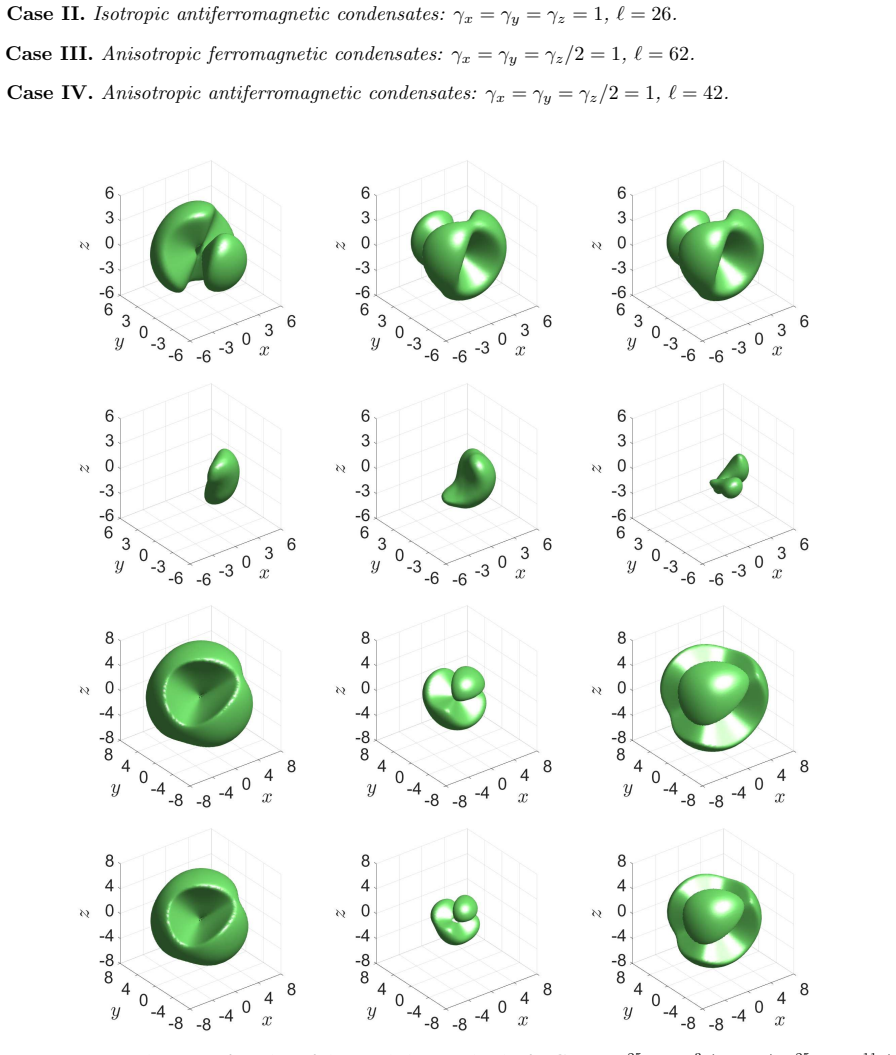
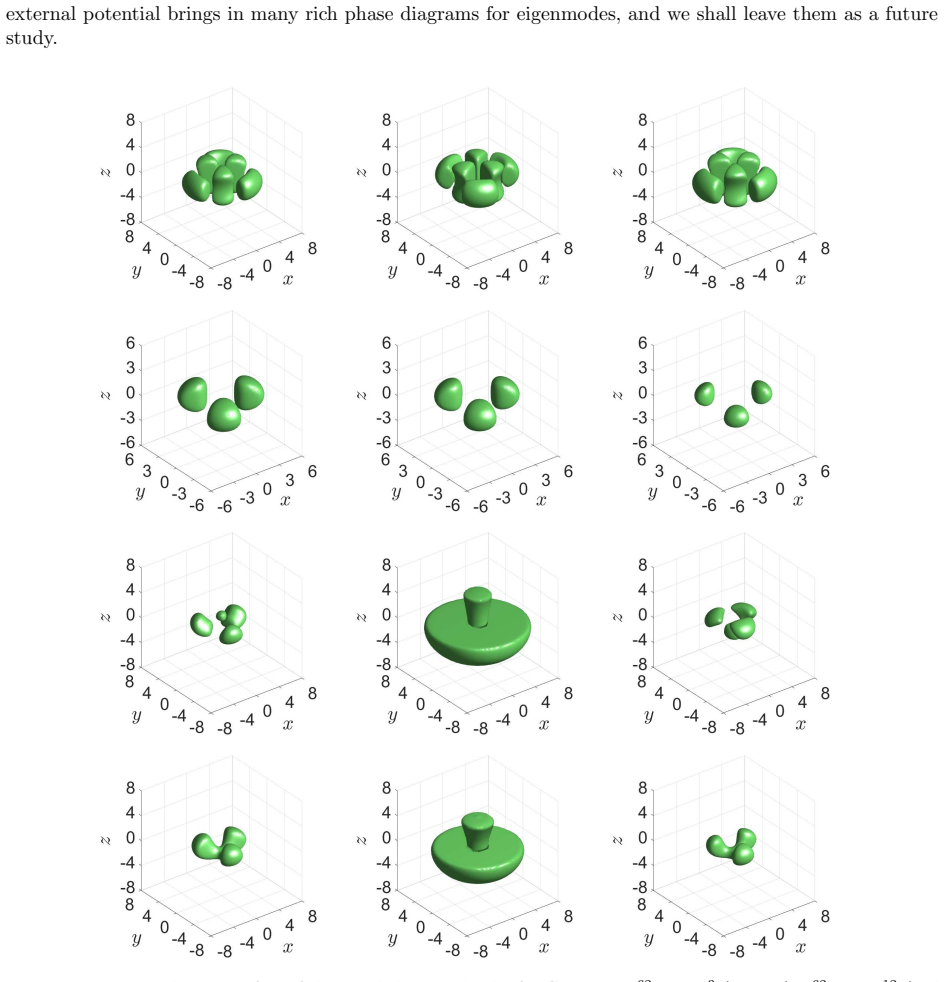
In this paper, we propose an efficient Fourier spectral algorithm for an eigenvalue problem, that is, the Bogoliubov-de Gennes (BdG) equation arsing from spin-1 Bose-Einstein condensates (BEC) to describe the elementary/collective excitations around the mean-field ground state. The BdG equation is essentially a constrained eigenvalue/eigenfunction system. Firstly, we investigate its analytical properties, including exact eigenpairs, generalized nullspace, and bi-orthogonality of eigenspaces. Secondly, by combining the standard Fourier spectral method for spatial discretization and a stable Gram-Schmidt bi-orthogonal algorithm, we develop a subspace iterative solver for such a large-scale dense eigenvalue problem, and it proves to be numerically stable, efficient, and accurate. Our solver is matrix-free and the operator-function evaluation is accelerated by discrete Fast Fourier Transform (FFT) with almost optimal efficiency. Therefore, it is memory-friendly and efficient for large-scale problems. Furthermore, we give a rigorous and detailed numerical analysis on the stability and spectral convergence. Finally, we present extensive numerical results to illustrate the spectral accuracy and efficiency, and investigate the excitation spectrum and Bogoliubov amplitudes around the ground state in 1-3 spatial dimensions.
Figures


Figures from the paper (2 more)
Reference graph
Works this paper leans on
-
[22]
Y. Li, Z. Wang and Y. Zhang , A Bi-Orthogonal Structure-Preserving eigensolver for large-scale linear response eigenvalue problem , preprint
-
[1]
X. Antoine, Q. Tang and Y. Zhang , A preconditioned conjugated gradient method for computing ground states of rotating dipolar Bose-Einstein condensates via kernel truncation method for dipole-dipole interaction evaluation , Commun. Comput. Phys., 24 (4) (2018), 966--988
work page 2018
-
[2]
I. Babu s ka, J. E. Osborn , Eigenvalue Problems , Handbook of Numerical Analysis, Vol. II, Finite Element Methods, North-Holland, Amsterdam, (1991)
work page 1991
-
[3]
Z. Bai and R.C. Li. , Minimization principles for the linear response eigenvalue problem I: Theory , SIAM J. Matrix Anal. Appl., 33 (4) (2012), 1075--1100
work page 2012
-
[4]
Z. Bai and R.C. Li , Minimization principles for linear response eigenvalue problem II: Computation , SIAM J. Matrix Anal. Appl., 34 (2) (2013), 392--416
work page 2013
-
[5]
D. Baillie, R.M. Wilson and P.B. Blakie , Collective excitations of self-bound droplets of a dipolar quantum fluid , Phys. Rev. Lett., 119 (25) (2017), article 255302
work page 2017
- [6]
- [7]
Show all 39 references
-
[8]
Bloch, J
I. Bloch, J. Dalibard and W. Zwerger , Many-body physics with ultracold gases , Rev. Mod. Phys., 80 (3) (2008), 885--964
2008
-
[9]
Canc\'es, R
E. Canc\'es, R. Chakir and Y. Maday , Numerical analysis of nonlinear eigenvalue problems , J. Sci. Comput., 45 (2010), 90--117
2010
-
[10]
L. Chen, H. Pu, Z.-Q. Yu and Y. Zhang , Collective excitation of a trapped Bose-Einstein condensate with spin-orbit coupling , Phys. Rev. A, 95 (3) (2017), article 033616
2017
-
[11]
Danaila, M.A
I. Danaila, M.A. Khamehchi, V. Gokhroo, P. Engels and P.G. Kevrekidis , Vector dark-anti dark solitary waves in multicomponent Bose-Einstein condensates , Phys. Rev. A, 94 (5) (2016), article 053617
2016
-
[12]
S.-X. Deng, T. Shi and S. Yi , Spin excitations in dipolar spin-1 condensates , Phys. Rev. A, 102 (1) (2020), article 013305
2020
-
[13]
Edwards, P.A
M. Edwards, P.A. Ruprecht, K. Burnett, R.J. Dodd and C.W. Clark , Collective excitations of atomic Bose-Einstein condensates , Phys. Rev. Lett., 77 (9) (1996), 1671--1674
1996
-
[14]
Gao and Y
Y. Gao and Y. Cai , Numerical methods for Bogoliubov-de Gennes excitations of Bose-Einstein condensates , J. Comput. Phys., 403 (2020), article 109058
2020
-
[15]
Hall, M.R
D.S. Hall, M.R. Matthews, J.R. Ensher, C.E. Wieman and E.A. Cornell , Dynamics of component separation in a binary mixture of Bose-Einstein condensates , Phys. Rev. Lett., 81 (8) (1998), 1539--1542
1998
-
[16]
Ho , Spinor Bose condensates in optical traps , Phys
T.-L. Ho , Spinor Bose condensates in optical traps , Phys. Rev. Lett., 81 (4) (1998), 742--745
1998
-
[17]
B. Hu, G. Huang and Y. Ma , Analytical solutions of the Bogoliubov--de Gennes equations for excitations of a trapped Bose-Einstein-condensed gas , Phys. Rev. A, 69 (6) (2004), article 063608
2004
-
[18]
Huhtam \"a ki and P
J.A.M. Huhtam \"a ki and P. Kuopanportti , Elementary excitations in dipolar spin-1 Bose-Einstein condensates , Phys. Rev. A, 84 (4) (2011), article 043638
2011
-
[19]
Jia, A.-B
L. Jia, A.-B. Wang and S. Yi , Low-lying excitations of vortex lattices in condensates with anisotropic dipole-dipole interaction , Phys. Rev. A, 97 (2018), article 043614
2018
-
[20]
Jin, J.R.Ensher, M.R
D.S. Jin, J.R.Ensher, M.R. Matthews, C.E. Wieman and E.A. Cornell , Collective excitations of a Bose-Einstein condensate in a dilute gas , Phys. Rev. Lett., 77 (3) (1996), 420--423
1996
-
[21]
Kawaguchi and M
Y. Kawaguchi and M. Ueda , Spinor Bose-Einstein condensates , Phys. Rep., 520 (5) (2012), 253--381
2012
-
[23]
Liu and Y
W. Liu and Y. Cai , Normalized gradient flow with Lagrange multiplier for computing ground states of Bose-Einstein condensates , SIAM J. Sci. Comput., 43 (1) (2021), B219--B242
2021
-
[24]
X. Liu, Q. Tang, S. Zhang and Y. Zhang , On optimal zero padding of kernel truncation method , SIAM J. Sci. Comput., 46 (1) (2024), A23--A49
2024
-
[25]
Matthews, D.S
M.R. Matthews, D.S. Hall, D.S. Jin, J.R. Ensher, C.E.Wieman, E.A. Cornell, F. Dalfovo, C. Minniti and S. Stringari , Dynamical response of a Bose-Einstein condensate to a discontinuous change in internal state , Phys. Rev. Lett., 81 (2) (1998), 243--247
1998
-
[26]
Ohmi and K
T. Ohmi and K. Machida , Bose-Einstein Condensation with internal degrees of freedom in alkali atom gases , J. Phys. Soc. Jpn., 67 (1998), 1822--1825
1998
-
[27]
Sadaka, V
G. Sadaka, V. Kalt, I. Danaila and Fr\'ed\'eric Hecht , A finite element toolbox for the Bogoliubov-de Gennes stability analysis of Bose-Einstein condensates , Comput. Phys. Commun., 294 (2024), article 108948
2024
-
[28]
M. Shao, F. H. da Jornada, L. Lin, C. Yang, J. Deslippe and S. G. Louie , A structure preserving Lanczos algorithm for computing the optical absorption spectrum , SIAM J. Matrix Anal. Appl., 39 (2) (2018), 683--711
2018
-
[29]
J. Shen, T. Tang and L.-L. Wang , Spectral Methods: Algorithms, Analysis and Applications , Springer, (2011)
2011
-
[30]
Stamper-Kurn, M.R
D.M. Stamper-Kurn, M.R. Andrews, A.P. Chikkatur, S.Inouye, H.-J. Miesner, J. Stenger and W. Ketterle , Optical confinement of a Bose-Einstein condensate , Phys. Rev. Lett., 80 (10) (1998), 2027--2030
1998
-
[31]
Stamper-Kurn and M
D.M. Stamper-Kurn and M. Ueda , Spinor Bose gases: Symmetries, magnetism and quantum dynamics , Rev. Modern Phys., 85 (3) (2013), 1191--1244
2013
-
[32]
Stenger, S
J. Stenger, S. Inouye, D.M. Stamper-Kurn, H.-J. Miesner, A.P. Chikkatur and W. Ketterle , Spin domains in ground-state Bose-Einstein condensates , Nature, 396 (6709) (1998), 345--348
1998
-
[33]
Stringari , Collective excitations of a trapped Bose-condensed gas , Phys
S. Stringari , Collective excitations of a trapped Bose-condensed gas , Phys. Rev. Lett., 77 (12) (1996), 2360--2363
1996
-
[34]
Q. Tang, M. Xie, Y. Zhang and Y. Zhang , A spectrally accurate numerical method for computing the Bogoliubov-de Gennes excitations of dipolar Bose-Einstein condensates , SIAM J. Sci. Comput., 44 (1) (2022), B100--B121
2022
-
[35]
https://www.caam.rice.edu/software/ARPACK/
The ARPACK homepage. https://www.caam.rice.edu/software/ARPACK/
-
[36]
T. Tian, Y. Cai, X. Wu and Z. Wen , Ground states of spin-F Bose-Einstein condensates , SIAM J. Sci. Comput., 42 (4) (2020), B983--B1013
2020
-
[37]
Wilson, S
R.M. Wilson, S. Ronen and J.L. Bohn , Stability and excitations of a dipolar Bose-Einstein condensate with a vortex , Phys. Rev. A, 79 (1) (2009), article 013621
2009
-
[38]
Zhang, S
W. Zhang, S. Yi and L. You , Mean field ground state of a spin-1 condensate in a magnetic field , New J. Phys., 5 (1) (2003), article 77
2003
-
[39]
Zhang, X
Y. Zhang, X. Liu and M. Xie , Efficient and accurate computation of the Bogoliubov-de Gennes excitations for the quasi-2D dipolar Bose-Einstein Condensates , East Asian J. Appl. Math., 11 (4) (2021), 686--707
2021
Reviewed August 7, 2026 · model on record in the stance chip above.
Discussion (0). Continue with ORCID to comment.