REVIEW 3 major objections 5 minor 38 references
trueform: Fast And Robust Mesh CSG Via Topological Aggregation
T0 review · 3 major / 5 minor · reviewed 2026-08-01 · deepseek-v4-flash
Pith's one-line read Topological majority votes let mesh booleans stay exact after rounding.
desk verdict Serious, well-engineered contribution; the exactness claim is narrower than the abstract's “we keep it exact,” and the majority-vote guarantee is statistical, but the paper deserves a careful referee. read the letter →
The pith
A machine-rendered reading of the paper's core claim, the machinery that carries it, and where it could break.
The reading
What carries the argument
Topological aggregation is the central mechanism: each topological unit (a MEL component for orientation, a relation between components for merging, a domain for classification) collects all its geometric observations and resolves disagreement by weighted-majority vote, where weights are the minimum area of incident faces. The supporting machinery is a five-type classification (VV, VE, VF, EE, EF) of pairwise intersections on a bounded integer ladder, a two-level identity scheme (topological identity plus geometric merge) that keeps the arrangement consistent across faces locally, and an implicit reduced graph that carries the same combinatorial content as a Weiler 3-map without explicit hal
What would settle it
Construct a two-sphere arrangement with a ring of near-coplanar faces at the intersection circle, deliberately round the materialised endpoints so that more than half of the edges in one relation flip their radial order, and then check whether the boolean output changes; the paper itself demonstrates the flipping mechanism, so the adversarial test would raise the corruption ratio past 50% and see whether the method still recovers the intended solid.
Extended reading notes
Core claim
The central claim is that a mesh-CSG pipeline can stay exactly correct by separating what survives materialisation from what does not. Within the build, the radial order around every intersection edge is decided by exact predicates on the original input planes alone, so no constructed coordinate enters the comparison and the result is exact without exact constructions. Where a decision spans faces and individual geometric observations disagree, the intended answer is recovered by a weighted-majority vote over the observations in that topological unit, which the paper models as a maximum-a-posteriori estimate. This makes the arrangement locally computed, globally consistent through identities
Load-bearing premise
The correctness guarantee is a majority assumption: if materialisation or inconsistent winding corrupts more than half of the observations within a single topological relation, the weighted-majority vote returns the wrong order.
Editorial extensions
If this is right
- Any boolean expression over the operands is a per-domain bit test, so a family of CSG queries cost one arrangement build plus cheap extractions.
- The radial order around non-manifold edges is exact without exact constructions, because it is computed from original input planes, which removes the need for precision escalation inside the build.
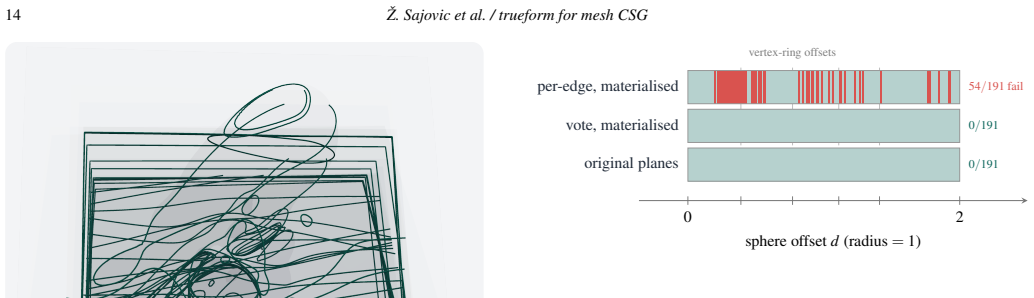
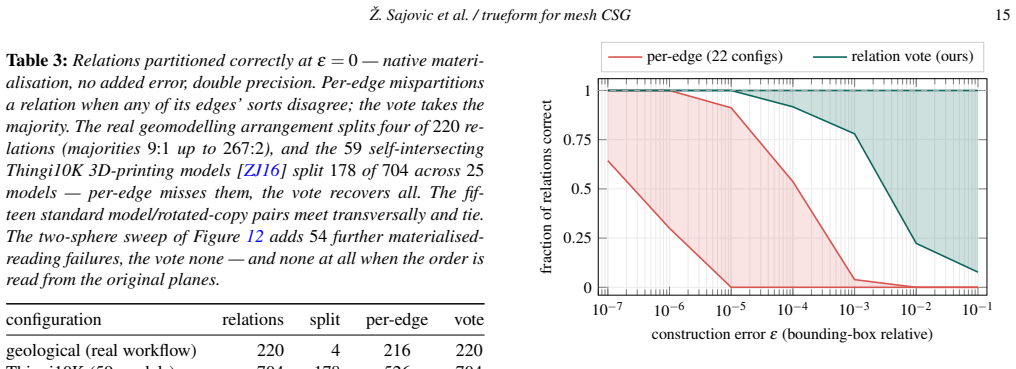
- The pipeline keeps partition correctness two to three orders of magnitude longer than per-edge extraction under added construction error, so composed, materialised pipelines can rely on the vote to recover the intended domains.
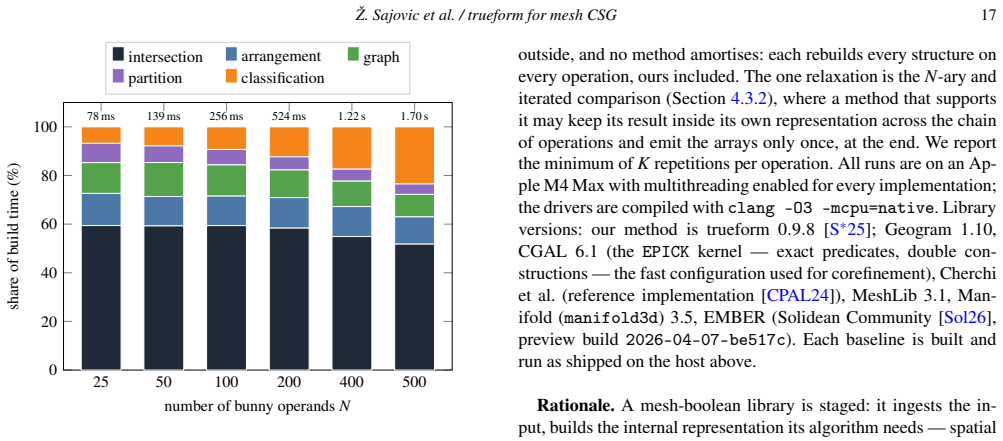
- Reported timings show the method is 5.5× to 100× faster than six prior libraries on a 1000-pair benchmark corpus, and its WebAssembly build stays interactive in the browser on the same inputs.
Reading between the lines
- The majority-vote principle could be applied to other geometric reads that a downstream stage makes from materialised coordinates, such as generalized-winding-number classification or ray parity, not just orientation, merging, and domain classification.
- If the build/extract amortisation holds, a natural next target is interactive CSG-tree editing, where each user edit is an extraction from a precomputed arrangement rather than a rebuild.
- A concrete stress test suggested by the paper's model: engineer a near-coplanar interface, round the endpoint coordinates to nudge more than half of a relation's edges to the wrong order, and observe whether the output partition flips — this would directly probe the statistical guarantee stated in Appendix A.
Editorial analysis
A structured set of objections, weighed in public.
Referee Report
Summary. The paper presents trueform, a mesh-CSG pipeline that computes arrangements with integer-exact predicates on snapped coordinates, classifies all contacts into five canonical types, arranges each cut face locally in its own plane, and uses a two-level identity scheme to keep the arrangement consistent without global exact constructions. Around non-manifold edges, radial order is decided by exact predicates on the original input planes. Where a decision spans multiple faces, the method aggregates possibly disagreeing per-edge radial-order observations by a weighted-majority vote within each topological relation, casts this as maximum-a-posteriori estimation, and classifies volumetric domains by per-domain inclusion bitvectors. One arrangement build serves arbitrary boolean expressions of any arity, including open surfaces declared as sheets. The paper reports robustness experiments (two-sphere sweeps, a geological arrangement, Thingi10K, perturbation sweeps), performance scaling experiments, and comparisons against six prior libraries plus browser baselines.
Significance. If the claims hold, the paper makes a strong practical contribution: a fast, header-only, cross-platform CSG library that builds one arrangement and answers a whole family of booleans, handles non-manifold input and open sheets, and still uses exact predicates without exact constructions for its in-build radial structure. The benchmark protocol is clearly specified, based on public data (Thingi10K) and external implementations, with no fitted constants, and the code is released. The limitations section is unusually candid, explicitly acknowledging that the majority vote is statistical and that materialised output can self-intersect. However, the exactness claim is conditional on a majority assumption whose failure modes are acknowledged but not bounded, and the validity oracle used to grade outputs is weaker than the paper's wording suggests. These issues are load-bearing for the paper's central 'exact topology' claim and need to be resolved before acceptance.
major comments (3)
- [Abstract, §1.2, §5.1, Appendix A (Eq. 4)] The abstract and Contribution 3 state that the intended answer is 'recovered' by topological aggregation and that 'we keep it exact.' But the guarantee is definitional: Appendix A Eq. (4) identifies the MAP estimate with the weighted majority, and the appendix states that 'the vote returns the intended permutation exactly when a majority of the relation's observations carry it.' Section 5.1 concedes that a configuration can be built to defeat the majority. The §4.1 experiments show that the vote tolerates more error than per-edge reading under the tested noise model, but they do not establish that real materialisation errors are unbiased, independent, or bounded below the 50% threshold in the worst cases described in Figure 2 (a single rounded vertex can flip several radial-order observations at once). The face-spanning decision is therefore a maximum-a-posteriori estimate with a conditi
- [§4.3, 'Validity' and §5.1] The validity oracle grades only closure, consistent orientation, signed volume, and surface area. Section 5.1 admits that materialising the output can introduce self-intersections that the exact arrangement did not have. Therefore the paper's claim of 'valid, watertight output' (abstract) and the validity counts in Tables 5 and 7 do not establish that the output is a valid solid in the usual CAD sense; a watertight but self-intersecting mesh is not a valid solid for downstream stages. Either extend the oracle to check self-intersection (e.g., by exact arrangement of the output or at least by reporting crossing counts on a representative subset), or explicitly define 'valid' as 'closed and consistently oriented' and state that self-intersections may remain.
- [§4.1, Figure 13] The perturbation experiment models construction error by perturbing non-manifold-edge endpoints independently in a uniform box. This does not exercise the correlated failure mode the paper itself identifies in Figure 2 and §5.1: when adjacent edges share an endpoint, a single rounded vertex can flip several radial-order observations at once, and near-coplanar geometry can make such flips systematic rather than independent. The claimed margin of 'two to three orders of magnitude more construction error' is therefore established for a particular independent-noise model, not for the worst relevant materialisation process. The paper should add a correlated-corruption experiment (e.g., coherently jittering shared vertices, or constructing a near-coplanar configuration tuned to approach the majority threshold) to show how close realistic inputs come to the failure regime, or provide a theoreti
minor comments (5)
- [§4.1, Figure 12 caption] The 'original planes 0/191' row is described as the in-build exact reading; the caption should state explicitly that this is not an additional method but the exact ordering used inside trueform before materialisation.
- [Table 3] The 'per-edge' column reports the number of correctly partitioned relations, but the column header alone could be misread as the number of failures, especially since the row label 'relations split' precedes it. Add 'correct' to the column header.
- [§2.1, Table 1] The zero-pattern decision tree abbreviates v1,v2,v3 without repeating their definitions in the table. Since the table is meant to be self-contained, consider adding the definitions or a reference to the equations above it.
- [Appendix A] The statement that adjacent-edge correlation 'is local and does not bias the majority' is an assertion, not a demonstrated property. If kept, it should be softened to a stated assumption or supported by the new correlated-corruption experiment recommended above.
- [§4.2] The build/extract timing reports 'the minimum over repeated runs.' A sentence stating the number of repeats per case would help reproducibility; currently only 'best of five' appears for the swarm and browser figures.
Circularity Check
One acknowledged definitional step in the aggregation guarantee; the in-build exactness and all external benchmarks are independent.
-
self definitional
[Appendix A, 'Epistemic status'; cf. §1.2 contribution 3, §5.1]
"the operative guarantee is definitional: the vote returns the intended permutation exactly when a majority of the relation’s observations carry it."
The paper's central claim is that topological aggregation recovers the 'intended answer' from disagreeing observations. Appendix A defines the intended category as the estimator's output: after the Dirichlet-MAP derivation, the intended category is the weighted-count argmax, i.e. the majority. Thus the stated guarantee 'vote returns the intended permutation exactly when a majority ... carry it' is true by construction, a restatement of the rule rather than an independent theorem; for materialised cross-face decisions, 'correct' and 'majority' are the same predicate. §5.1 concedes the guarantee is statistical, not worst-case, so the circularity is acknowledged and scoped, but the abstract's 'we keep it exact' still inherits this definitional character.
full rationale
This is not a case of fitted parameters called predictions or a load-bearing self-citation chain. The build's central mathematical content is self-contained: the in-build radial order is decided by exact degree-two sign tests on the original input planes (§2.3), so 'exact without exact constructions' does not reduce to an input assumption. The empirical claims are anchored outside the paper: pairwise and N-ary comparisons against Geogram, EMBER, CGAL, Cherchi et al., MeshLib, and Manifold on the Thingi10K corpus, with a fixed watertightness oracle, and the browser comparison against Manifold and three-bvh-csg. The only circular step is the aggregation guarantee in Appendix A, which the paper itself labels definitional and whose worst-case failure it concedes in §5.1; this is a genuine limitation but a scoped one. The code citation [S*25] is availability of the implementation, not an imported uniqueness theorem. Overall the derivation chain is self-contained except for one acknowledged definitional guarantee, so score 4.
Assumptions & free parameters
free parameters (3)
- integer grid resolution =
int32 (float input) or int64 (double input), with 128/256-bit predicate ladder
- tolerance band length =
user-declared length
- radial observation weight =
minimum area of faces incident to the non-manifold edge
assumptions (5)
- domain assumption Input floats can be snapped onto the integer grid without changing the intended topology.
- domain assumption Face primitives are convex or triangulated upstream; degenerate collinear chains contribute nothing.
- domain assumption The intended radial order is constant along each non-manifold polyline, so every edge is a noisy reading of one shared permutation.
- ad hoc to paper A majority of observations per relation are uncorrupted.
- domain assumption Closed, consistently oriented output (“watertight”) is the relevant validity criterion.
Cite this review
Pith. "Pith review of trueform: Fast And Robust Mesh CSG Via Topological Aggregation." pith.science (2026). https://pith.science/paper/QSOUC4WO
@misc{pith2026260715905,
  author       = {Pith},
  title        = {Pith review of: trueform: Fast And Robust Mesh CSG Via Topological Aggregation},
  year         = {2026},
  howpublished = {\url{https://pith.science/paper/QSOUC4WO}},
  note         = {Machine review of arXiv:2607.15905}
}
read the original abstract
Mesh CSG output is consumed in floating point: however exact the computation, every emitted coordinate is materialised -- rounded to a representable position -- and the next stage can observe crossings and orderings the exact result never had. Only index-based topology survives materialisation. We keep it exact: within the build, the arrangement's radial structure is ordered by exact predicates on the original input planes -- exact without exact constructions -- and where a decision spans faces, the intended answer is recovered by topological aggregation: a majority vote over the disagreeing geometric observations within their topological unit. We compute the arrangement locally with integer-exact predicates, every stage a graph problem on graphs it never explicitly constructs. Pairwise intersections are classified into five canonical types (VV, VE, VF, EE, EF), each cut face is arranged in its own plane, and a two-level identity keeps the result consistent across faces with no global structure. The arrangement and its domain partition are built once and queried arbitrarily often: a boolean of any arity is a per-domain bit test, volumetric regions read straight off the partition, and open surfaces -- declared as oriented sheets -- cut volumes through the same algebra. The method is implemented in the header-only trueform library, in C++ with Python and TypeScript bindings. Compared to prior art, it produces valid, watertight output while running up to two orders of magnitude faster, and stays interactive in the browser.
Figures


Figures from the paper (13 more)





Reference graph
Works this paper leans on
-
[1]
: Indirect predicates for geometric constructions
Attene M. : Indirect predicates for geometric constructions. Computer-Aided Design 126 (2020), Article 102856. http://dx.doi.org/10.1016/j.cad.2020.102856 doi:10.1016/j.cad.2020.102856
arXiv 2020
-
[2]
: Interval arithmetic yields efficient dynamic filters for computational geometry
Br \"o nnimann H., Burnikel C., Pion S. : Interval arithmetic yields efficient dynamic filters for computational geometry. In Proceedings of the Fourteenth Annual Symposium on Computational Geometry (SCG '98) (1998), ACM, pp. 165--174. http://dx.doi.org/10.1145/276884.276903 doi:10.1145/276884.276903
arXiv 1998
-
[3]
: Fast algorithm for extracting domains and regions from three-dimensional triangular surface meshes
Bohm S., Runge E. : Fast algorithm for extracting domains and regions from three-dimensional triangular surface meshes. Computer-Aided Design 180 (2025), Article 103824. http://dx.doi.org/10.1016/j.cad.2024.103824 doi:10.1016/j.cad.2024.103824
arXiv 2025
-
[4]
: Exact and robust (self-)intersections for polygonal meshes
Campen M., Kobbelt L. : Exact and robust (self-)intersections for polygonal meshes. Computer Graphics Forum 29, 2 (2010), 397--406. http://dx.doi.org/10.1111/j.1467-8659.2009.01609.x doi:10.1111/j.1467-8659.2009.01609.x
arXiv 2010
-
[5]
: Polygonal boundary evaluation of Minkowski sums and swept volumes
Campen M., Kobbelt L. : Polygonal boundary evaluation of Minkowski sums and swept volumes. Computer Graphics Forum 29, 5 (2010), 1613--1622. http://dx.doi.org/10.1111/j.1467-8659.2010.01770.x doi:10.1111/j.1467-8659.2010.01770.x
arXiv 2010
-
[6]
: Fast and robust mesh arrangements using floating-point arithmetic
Cherchi G., Livesu M., Scateni R., Attene M. : Fast and robust mesh arrangements using floating-point arithmetic. ACM Transactions on Graphics 39, 6 (2020), Article 250. SIGGRAPH Asia 2020. http://dx.doi.org/10.1145/3414685.3417818 doi:10.1145/3414685.3417818
arXiv 2020
-
[7]
: Interactive and robust mesh booleans
Cherchi G., Pellacini F., Attene M., Livesu M. : Interactive and robust mesh booleans. ACM Transactions on Graphics 41, 6 (2022), Article 214. SIGGRAPH Asia 2022. http://dx.doi.org/10.1145/3550454.3555460 doi:10.1145/3550454.3555460
arXiv 2022
-
[8]
: Interactive and Robust Mesh Booleans : reference implementation, 2024
Cherchi G., Pellacini F., Attene M., Livesu M. : Interactive and Robust Mesh Booleans : reference implementation, 2024. Commit 7bd6c26 . URL: https://github.com/gcherchi/InteractiveAndRobustMeshBooleans
2024
Show all 38 references
-
[9]
H., Mallet J.-L
Caumon G., Sword C. H., Mallet J.-L. : Constrained modifications of non-manifold B -reps. In Proceedings of the 8th ACM Symposium on Solid Modeling and Applications (SM '03) (2003), pp. 310--315. http://dx.doi.org/10.1145/781606.781657 doi:10.1145/781606.781657
2003
-
[10]
: QuickCSG : Arbitrary and Faster Boolean Combinations of N Solids
Douze M., Franco J.-S., Raffin B. : QuickCSG : Arbitrary and Faster Boolean Combinations of N Solids . Tech. Rep. RR-8687, INRIA, 2015. URL: https://inria.hal.science/hal-01121419
2015
-
[11]
Devillers O., Lazard S., Lenhart W. J. : 3 D snap rounding. In 34th International Symposium on Computational Geometry (SoCG 2018) (2018), vol. 99 of LIPIcs, Schloss Dagstuhl-Leibniz-Zentrum f \"u r Informatik, pp. 30:1--30:14. http://dx.doi.org/10.4230/LIPIcs.SoCG.2018.30 doi:...
2018 doi
-
[12]
Edelsbrunner H., M \"u cke E. P. : Simulation of simplicity: A technique to cope with degenerate cases in geometric algorithms. ACM Transactions on Graphics 9, 1 (1990), 66--104. http://dx.doi.org/10.1145/77635.77639 doi:10.1145/77635.77639
1990
-
[14]
: Boolean operations on 3 D selective Nef complexes: Data structure, algorithms, optimized implementation and experiments
Hachenberger P., Kettner L., Mehlhorn K. : Boolean operations on 3 D selective Nef complexes: Data structure, algorithms, optimized implementation and experiments. Computational Geometry 38, 1--2 (2007), 64--99. http://dx.doi.org/10.1016/j.comgeo.2006.11.001 doi:10.1016/j.comg...
2007 doi
-
[15]
URL: https://github.com/gkjohnson/three-bvh-csg
Johnson G., Contributors : three-bvh-csg : Performant csg for three.js built on three-mesh-bvh, 2024. URL: https://github.com/gkjohnson/three-bvh-csg
2024
-
[16]
: Robust inside-outside segmentation using generalized winding numbers
Jacobson A., Kavan L., Sorkine-Hornung O. : Robust inside-outside segmentation using generalized winding numbers. ACM Transactions on Graphics 32, 4 (2013), Article 33. http://dx.doi.org/10.1145/2461912.2461916 doi:10.1145/2461912.2461916
2013
-
[17]
: Manifold : a library dedicated to creating and operating on manifold triangle meshes, 2023
Lalish E. : Manifold : a library dedicated to creating and operating on manifold triangle meshes, 2023. URL: https://github.com/elalish/manifold
2023
-
[18]
: Geogram : a library of geometric algorithms, 2024
L \'e vy B. : Geogram : a library of geometric algorithms, 2024. URL: https://github.com/BrunoLevy/geogram
2024
-
[19]
: Exact predicates, exact constructions and combinatorics for mesh CSG
L \'e vy B. : Exact predicates, exact constructions and combinatorics for mesh CSG . arXiv preprint arXiv:2405.12949v2 (2025). URL: https://arxiv.org/abs/2405.12949, http://dx.doi.org/10.48550/arXiv.2405.12949 doi:10.48550/arXiv.2405.12949
-
[20]
: Extension of the notion of map and subdivisions of a three-dimensional space
Lienhardt P. : Extension of the notion of map and subdivisions of a three-dimensional space. In STACS 88, 5th Annual Symposium on Theoretical Aspects of Computer Science (1988), vol. 294 of Lecture Notes in Computer Science, Springer, pp. 301--311. http://dx.doi.org/10.1007/BF...
1988 doi
-
[21]
Loriot S., Rouxel-Labb \'e M., Tournois J., Yaz I. O. : Polygon Mesh Processing -- Corefinement and Boolean Operations, 5.5.2 ed., 2023. URL: https://doc.cgal.org/5.5.2/Manual/packages.html\#PkgPolygonMeshProcessing
2023
-
[22]
URL: https://meshlib.io/
MeshInspector : MeshLib : 3 D processing library, 2024. URL: https://meshlib.io/
2024
-
[23]
: FPG : A code generator for fast and certified geometric predicates
Meyer A., Pion S. : FPG : A code generator for fast and certified geometric predicates. In Real Numbers and Computers (Santiago de Compostela, Spain, 2008), pp. 47--60. URL: https://inria.hal.science/inria-00344297
2008
-
[24]
: Geometric rounding and feature separation in meshes
Milenkovi \'c V., Sacks E. : Geometric rounding and feature separation in meshes. Computer-Aided Design 108 (2019), 12--18. http://dx.doi.org/10.1016/j.cad.2018.10.001 doi:10.1016/j.cad.2018.10.001
2019 doi
-
[25]
: Merging BSP trees yields polyhedral set operations
Naylor B., Amanatides J., Thibault W. : Merging BSP trees yields polyhedral set operations. In Proceedings of SIGGRAPH '90 (1990), vol. 24 of ACM SIGGRAPH Computer Graphics, pp. 115--124. http://dx.doi.org/10.1145/97879.97894 doi:10.1145/97879.97894
1990
-
[26]
: Beitr \"a ge zur Theorie der Polyeder
Nef W. : Beitr \"a ge zur Theorie der Polyeder . Herbert Lang, Bern, 1978
1978
-
[27]
: Fast exact booleans for iterated CSG using octree-embedded BSP s
Nehring-Wirxel J., Trettner P., Kobbelt L. : Fast exact booleans for iterated CSG using octree-embedded BSP s. Computer-Aided Design 135 (2021), Article 103015. http://dx.doi.org/10.1016/j.cad.2021.103015 doi:10.1016/j.cad.2021.103015
2021
-
[28]
: RINGMesh : A programming library for developing mesh-based geomodeling applications
Pellerin J., Botella A., Bonneau F., Mazuyer A., Chauvin B., L \'e vy B., Caumon G. : RINGMesh : A programming library for developing mesh-based geomodeling applications. Computers & Geosciences 104 (2017), 93--100. http://dx.doi.org/10.1016/j.cageo.2017.03.005 doi:10.1016/j.c...
2017 doi
-
[29]
: trueform : the STL for geometry
Sajovic Z ., et al. : trueform : the STL for geometry. Polydera, 2025. URL: https://github.com/polydera/trueform
2025
-
[30]
Shewchuk J. R. : Adaptive precision floating-point arithmetic and fast robust geometric predicates. Discrete & Computational Geometry 18, 3 (1997), 305--363. http://dx.doi.org/10.1007/PL00009321 doi:10.1007/PL00009321
1997 doi
-
[31]
Community edition, arm64 preview build 2026-04-07-be517c
Solidean : Solidean : a mesh-processing toolkit for exact-arithmetic booleans, 2026. Community edition, arm64 preview build 2026-04-07-be517c . URL: https://solidean.com/
2026
-
[32]
: Interactive modeling of mechanical objects
Tymms C., Grinspun E., Zorin D. : Interactive modeling of mechanical objects. Computer Graphics Forum 35, 7 (2016), 145--155. http://dx.doi.org/10.1111/cgf.13013 doi:10.1111/cgf.13013
2016 doi
-
[33]
URL: https://doc.cgal.org/5.5.2/Manual/packages.html
The CGAL Project : CGAL User and Reference Manual , 5.5.2 ed., 2023. URL: https://doc.cgal.org/5.5.2/Manual/packages.html
2023
-
[34]
: EMBER : Exact mesh booleans via efficient and robust local arrangements
Trettner P., Nehring-Wirxel J., Kobbelt L. : EMBER : Exact mesh booleans via efficient and robust local arrangements. ACM Transactions on Graphics 41, 4 (2022), Article 39. SIGGRAPH 2022. http://dx.doi.org/10.1145/3528223.3530181 doi:10.1145/3528223.3530181
2022
-
[35]
: 3 D Snap Rounding
Valque L. : 3 D Snap Rounding . Master's thesis, Universit \'e de Lyon, 2019. URL: https://inria.hal.science/hal-02393625
2019
-
[36]
: Edge-based data structures for solid modeling in curved-surface environments
Weiler K. : Edge-based data structures for solid modeling in curved-surface environments. IEEE Computer Graphics and Applications 5, 1 (1985), 21--40. http://dx.doi.org/10.1109/MCG.1985.276271 doi:10.1109/MCG.1985.276271
1985
-
[37]
URL: https://openscad.org/
Wolf C., OpenSCAD contributors : OpenSCAD : The programmers solid 3D cad modeller, 2010. URL: https://openscad.org/
2010
-
[38]
: Mesh arrangements for solid geometry
Zhou Q., Grinspun E., Zorin D., Jacobson A. : Mesh arrangements for solid geometry. ACM Transactions on Graphics 35, 4 (2016), Article 39. SIGGRAPH 2016. http://dx.doi.org/10.1145/2897824.2925901 doi:10.1145/2897824.2925901
2016
-
[39]
: Thingi10K : A dataset of 10,000 3 D -printing models
Zhou Q., Jacobson A. : Thingi10K : A dataset of 10,000 3 D -printing models. arXiv preprint arXiv:1605.04797 (2016). URL: https://arxiv.org/abs/1605.04797
2016 arXiv
Reviewed August 1, 2026 · model on record in the stance chip above.
Discussion (0). Continue with ORCID to comment.