All-Optical Control of Birefringence in a Cold Atomic Ensemble
Pith reviewed 2026-06-30 03:36 UTC · model grok-4.3
The pith
Optically dressing the excited state of cold ytterbium atoms creates a tunable polarization-dependent refractive index.
A machine-rendered reading of the paper's core claim, the machinery that carries it, and where it could break.
Core claim
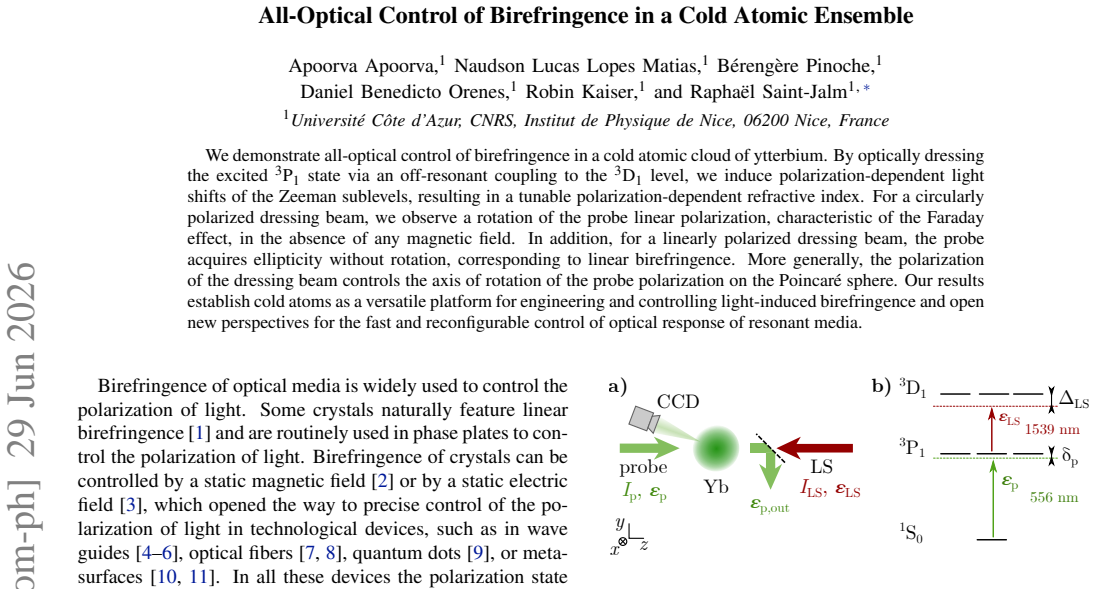
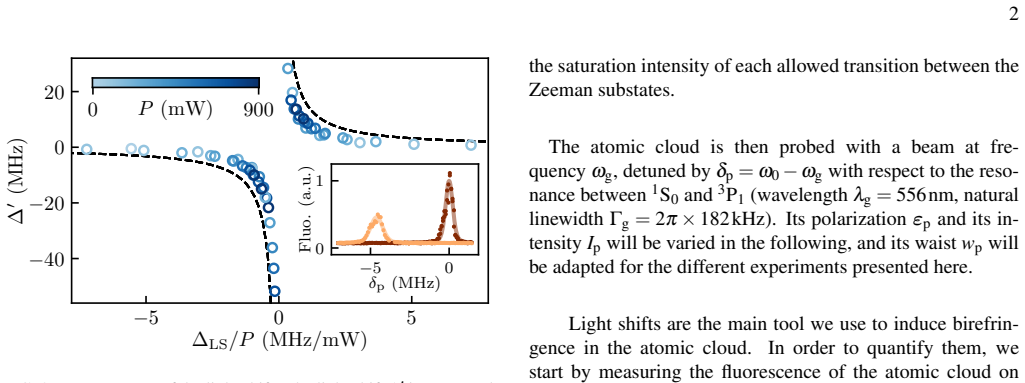
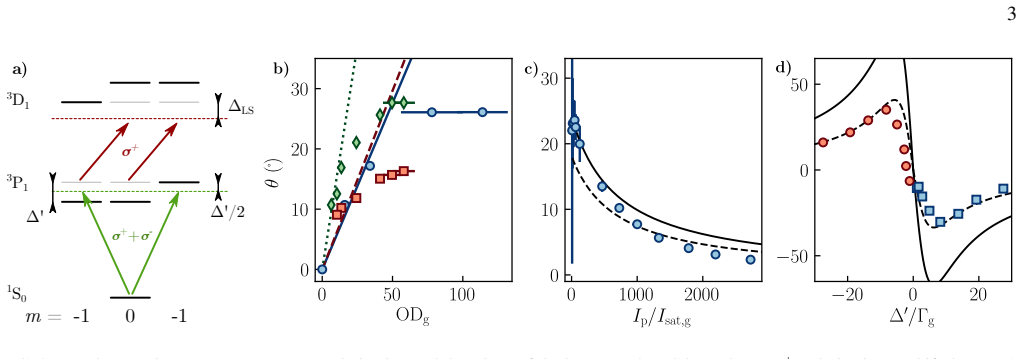
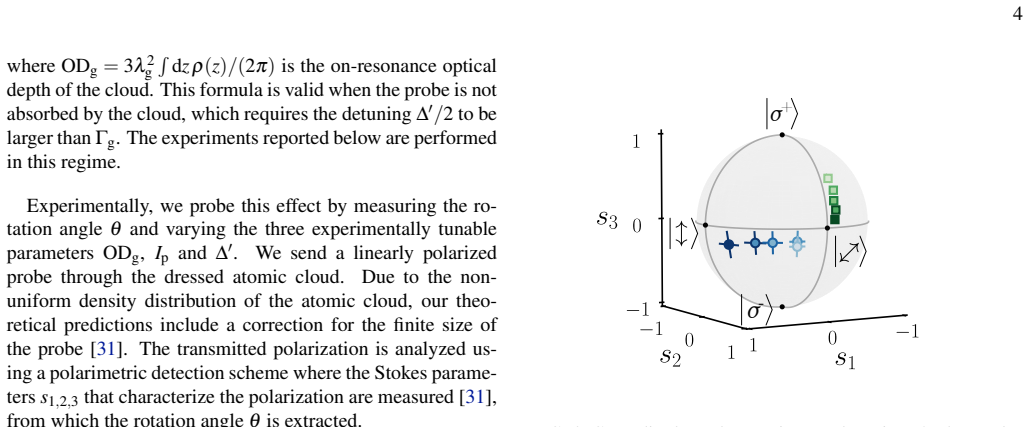
By optically dressing the excited ³P₁ state via an off-resonant coupling to the ³D₁ level, we induce polarization-dependent light shifts of the Zeeman sublevels, resulting in a tunable polarization-dependent refractive index. For a circularly polarized dressing beam, we observe a rotation of the probe linear polarization, characteristic of the Faraday effect, in the absence of any magnetic field. In addition, for a linearly polarized dressing beam, the probe acquires ellipticity without rotation, corresponding to linear birefringence. More generally, the polarization of the dressing beam controls the axis of rotation of the probe polarization on the Poincaré sphere.
What carries the argument
Polarization-dependent light shifts on Zeeman sublevels produced by off-resonant dressing of the ³P₁ state to the ³D₁ level.
If this is right
- Circular dressing polarization produces Faraday rotation of the probe without any magnetic field.
- Linear dressing polarization produces linear birefringence that changes the probe's ellipticity but not its orientation.
- The dressing beam's polarization sets the rotation axis of the probe state on the Poincaré sphere.
- Cold atomic ensembles function as a platform for all-optical engineering of birefringence.
Where Pith is reading between the lines
- The same dressing approach could be used to create dynamic, all-optical wave plates or polarization rotators inside an atomic cloud.
- Extending the method to other atomic species or transitions might allow custom engineering of optical anisotropy for specific wavelengths.
- Because the control is purely optical, the birefringence can in principle be modulated at rates limited only by the dressing laser's switching speed.
Load-bearing premise
The off-resonant dressing produces clean polarization-dependent light shifts on the Zeeman sublevels with negligible absorption, spontaneous emission, or higher-order effects that would mask the birefringence.
What would settle it
If the probe polarization rotation angle or acquired ellipticity fails to follow the predicted dependence on dressing-beam polarization, intensity, or detuning, the claimed mechanism would be ruled out.
Figures
read the original abstract
We demonstrate all-optical control of birefringence in a cold atomic cloud of ytterbium. By optically dressing the excited $^{3}\mathrm{P}_1$ state via an off-resonant coupling to the $^{3}\mathrm{D}_1$ level, we induce polarization-dependent light shifts of the Zeeman sublevels, resulting in a tunable polarization-dependent refractive index. For a circularly polarized dressing beam, we observe a rotation of the probe linear polarization, characteristic of the Faraday effect, in the absence of any magnetic field. In addition, for a linearly polarized dressing beam, the probe acquires ellipticity without rotation, corresponding to linear birefringence. More generally, the polarization of the dressing beam controls the axis of rotation of the probe polarization on the Poincar\'e sphere. Our results establish cold atoms as a versatile platform for engineering and controlling light-induced birefringence and open new perspectives for the fast and reconfigurable control of optical response of resonant media.
Editorial analysis
A structured set of objections, weighed in public.
Referee Report
Summary. The manuscript reports an experimental demonstration of all-optical control of birefringence in a cold ytterbium atomic ensemble. By optically dressing the excited 3P1 state via off-resonant coupling to the 3D1 level, the authors induce polarization-dependent light shifts on the Zeeman sublevels, producing a tunable polarization-dependent refractive index. For circularly polarized dressing they observe Faraday rotation of a linearly polarized probe in the absence of a magnetic field; for linearly polarized dressing the probe acquires ellipticity without rotation. The dressing-beam polarization is shown to control the axis of probe-polarization rotation on the Poincaré sphere.
Significance. If the observed effects are shown to arise cleanly from the intended vector/tensor light shifts, the work establishes cold atoms as a platform for engineering and reconfiguring birefringence without external magnetic fields, offering fast, all-optical control of the optical response of resonant media with potential utility in quantum optics and precision metrology.
major comments (1)
- [Experimental section] The central claim requires that the polarization-dependent refractive index arises from clean AC Stark shifts on the 3P1 Zeeman sublevels with negligible competing processes. The experimental section provides no quantitative values for the 3P1–3D1 detuning, dressing intensity, or measured optical depth on the probe transition, so it is not possible to verify that absorption, spontaneous emission from 3D1, or two-photon resonances remain below the level that would independently alter probe polarization.
Simulated Author's Rebuttal
We thank the referee for their careful reading of the manuscript and for highlighting the importance of quantitative experimental parameters to support the central claim. We address the single major comment below and will revise the manuscript to incorporate the requested details.
read point-by-point responses
-
Referee: [Experimental section] The central claim requires that the polarization-dependent refractive index arises from clean AC Stark shifts on the 3P1 Zeeman sublevels with negligible competing processes. The experimental section provides no quantitative values for the 3P1–3D1 detuning, dressing intensity, or measured optical depth on the probe transition, so it is not possible to verify that absorption, spontaneous emission from 3D1, or two-photon resonances remain below the level that would independently alter probe polarization.
Authors: We agree that explicit quantitative values are required to confirm the dominance of the intended vector and tensor light shifts. In the revised manuscript we will add the 3P1–3D1 detuning (several hundred MHz), the dressing-beam intensity, and the measured probe optical depth. These parameters place the dressing far from resonance, keeping absorption and spontaneous emission from 3D1 below 1 % and avoiding two-photon resonances with the probe, thereby ensuring that the observed Faraday rotation and linear birefringence arise cleanly from the AC Stark shifts on the 3P1 Zeeman sublevels. revision: yes
Circularity Check
No circularity: experimental demonstration with no load-bearing derivations or self-citation chains
full rationale
The paper reports an experimental observation of polarization rotation and induced ellipticity in a cold Yb ensemble under off-resonant dressing. The abstract and provided text contain no equations, no fitted parameters renamed as predictions, and no derivations that reduce to inputs by construction. The central claim rests on measured optical effects rather than a theoretical chain. No self-citations or uniqueness theorems are invoked in the given material. This is a standard experimental result with independent empirical content.
Axiom & Free-Parameter Ledger
Reference graph
Works this paper leans on
-
[1]
Ferre and G
J. Ferre and G. A. Gehring, Linear optical birefringence of mag- netic crystals, Reports on Progress in Physics47, 513 (1984)
1984
-
[2]
S. Kumari, A comprehensive study of magneto-optic materi- als and its applications, Materials Today: Proceedings Inter- national Conference on Materials, Machines and Information Technology-2022,56, 100 (2022)
2022
-
[3]
S. K. Kurtz and F. N. H. Robinson, A Physical Model of the Electro-optic Effect, Applied Physics Letters10, 62 (1967)
1967
-
[4]
An and O.-K
S. An and O.-K. Kwon, Active control of polarization state of the light in InP waveguide, Optics Express27, 37806 (2019)
2019
-
[5]
Sahib, A
H. Sahib, A. Gassenq, A. Bensalah-Ledoux, B. Baguenard, L. Guy, and S. Guy, Elliptical Birefringent Rib-Channel Chi- rowaveguides for Quasicircularly Polarized Light Applica- tions in Integrated Photonics, Advanced Photonics Research3, 2100302 (2022)
2022
-
[6]
Zafar and M
H. Zafar and M. F. Pereira, Recent Progress in Light Polariza- tion Control Schemes for Silicon Integrated Photonics, Laser & Photonics Reviews18, 2301025 (2024)
2024
-
[7]
Argyros, J
A. Argyros, J. Pla, F. Ladouceur, and L. Poladian, Circular and elliptical birefringence in spun microstructured optical fibres, Optics Express17, 15983 (2009)
2009
-
[8]
Xiong, C
W. Xiong, C. W. Hsu, Y . Bromberg, J. E. Antonio-Lopez, R. Amezcua Correa, and H. Cao, Complete polarization con- trol in multimode fibers with polarization and mode coupling, Light: Science & Applications7, 54 (2018)
2018
-
[9]
Mehdi, M
E. Mehdi, M. Gund ´ın, C. Millet, N. Somaschi, A. Lema ˆıtre, I. Sagnes, L. Le Gratiet, D. A. Fioretto, N. Belabas, O. Krebs, P. Senellart, and L. Lanco, Giant optical polarisation rotations induced by a single quantum dot spin, Nature Communications 15, 598 (2024)
2024
-
[10]
Y . Hu, X. Wang, X. Luo, X. Ou, L. Li, Y . Chen, P. Yang, S. Wang, and H. Duan, All-dielectric metasurfaces for polar- ization manipulation: principles and emerging applications, Nanophotonics9, 3755 (2020)
2020
-
[11]
F.-J. Li, S. Wang, R. Zhong, M.-X. Hu, Y . Jiang, M. Zheng, M. Wang, X. Li, R. Peng, and Z.-L. Deng, Metasurface po- larization optics: From classical to quantum, Applied Physics Reviews11, 041332 (2024)
2024
-
[12]
Z. Shi, A. Y . Zhu, Z. Li, Y .-W. Huang, W. T. Chen, C.-W. Qiu, and F. Capasso, Continuous angle-tunable birefringence with freeform metasurfaces for arbitrary polarization conver- sion, Science Advances6, eaba3367 (2020)
2020
-
[13]
Patton, E
B. Patton, E. Zhivun, D. Hovde, and D. Budker, All-Optical Vector Atomic Magnetometer, Physical Review Letters113, 013001 (2014)
2014
-
[14]
Fabricant, I
A. Fabricant, I. Novikova, and G. Bison, How to build a mag- netometer with thermal atomic vapor: a tutorial, New Journal of Physics25, 025001 (2023)
2023
-
[15]
Pandey, A
K. Pandey, A. Wasan, and V . Natarajan, Coherent control of magneto-optic rotation, Journal of Physics B: Atomic, Molecu- lar and Optical Physics41, 225503 (2008)
2008
-
[16]
Siddons, C
P. Siddons, C. S. Adams, and I. G. Hughes, Optical control of Faraday rotation in hot Rb vapor, Physical Review A81, 043838 (2010)
2010
-
[17]
T. H. Yoon, C. Y . Park, and S. J. Park, Laser-induced birefrin- gence in a wavelength-mismatched cascade system of inhomo- geneously broadened Yb atoms, Physical Review A70, 061803 (2004)
2004
-
[18]
Hu, Z.-B
X.-X. Hu, Z.-B. Wang, P. Zhang, G.-J. Chen, Y .-L. Zhang, G. Li, X.-B. Zou, T. Zhang, H. X. Tang, C.-H. Dong, G.-C. Guo, and C.-L. Zou, Noiseless photonic non-reciprocity via optically-induced magnetization, Nature Communications12, 2389 (2021)
2021
-
[19]
Labeyrie, C
G. Labeyrie, C. Miniatura, and R. Kaiser, Large Faraday rota- tion of resonant light in a cold atomic cloud, Physical Review A64, 033402 (2001)
2001
-
[20]
Pandey, C
K. Pandey, C. C. Kwong, M. S. Pramod, and D. Wilkowski, Linear and nonlinear magneto-optical rotation on the narrow strontium intercombination line, Physical Review A93, 053428 6 (2016)
2016
-
[21]
Garain, S
S. Garain, S. N. Sahoo, and A. K. Mohapatra, Measuring non- linear Faraday rotation in cold atoms in presence of persistent transverse fields using tunable differential imaging, Optics Ex- press32, 16935 (2024)
2024
-
[22]
Gajdacz, P
M. Gajdacz, P. L. Pedersen, T. Mørch, A. J. Hilliard, J. Arlt, and J. F. Sherson, Non-destructive Faraday imaging of dynamically controlled ultracold atoms, Review of Scientific Instruments84, 083105 (2013)
2013
-
[23]
Colangelo, F
G. Colangelo, F. M. Ciurana, L. C. Bianchet, R. J. Sewell, and M. W. Mitchell, Simultaneous tracking of spin angle and am- plitude beyond classical limits, Nature543, 525 (2017)
2017
-
[24]
D. Cho, J. M. Choi, J. M. Kim, and Q.-H. Park, Optically in- duced Faraday effect using three-level atoms, Physical Review A72, 023821 (2005)
2005
-
[25]
Letellier, ´A
H. Letellier, ´A. Mitchell Galv ˜ao de Melo, A. Dorne, and R. Kaiser, Loading of a large Yb MOT on the 1S0→1P1 tran- sition, Review of Scientific Instruments94, 123203 (2023)
2023
-
[26]
Letellier,Pi ´egeage magn ´eto-optique de l’ytterbium sur la transition 1S0→1P1, Theses, Universit ´e Cˆote d’Azur (2024), issue: 2024COAZ5030
H. Letellier,Pi ´egeage magn ´eto-optique de l’ytterbium sur la transition 1S0→1P1, Theses, Universit ´e Cˆote d’Azur (2024), issue: 2024COAZ5030
2024
-
[27]
´A. M. G. D. Melo,Laser cooling of Yb on the intercombination line for experiments on localization of light, Theses, Universit ´e Cˆote d’Azur (2024), issue: 2024COAZ5033
2024
-
[28]
´A. M. G. d. Melo, H. Letellier, A. Apoorva, A. Glicenstein, and R. Kaiser, Laser frequency stabilization by modulation trans- fer spectroscopy and balanced detection of molecular iodine for laser cooling of 174Yb, Optics Express32, 6204 (2024)
2024
-
[29]
For such aJ=1 toJ ′ =1 transition, all non-zero Clebsch-Gordan coefficients have an absolute value of 1/ √ 2
We defineΓ 3D1 =η|c m,m′ |2/τ3D1, whereτ 3D1 is the total life- time of the 3D1 state that has been measured in [37],η=0.36 is the branching ratio from the state 3D1 to the state 3P1, and cm,m′ is the Clebsch-Gordan coefficient between the Zeeman statemof 3P1 and the Zeeman statem ′ of 3D1. For such aJ=1 toJ ′ =1 transition, all non-zero Clebsch-Gordan co...
-
[30]
Glicenstein, A
A. Glicenstein, A. Apoorva, D. B. Orenes, H. Letellier, ´A. M. G. de Melo, R. Saint-Jalm, and R. Kaiser, In Situ Mea- surements of Light Diffusion in an Optically Dense Atomic En- semble, Physical Review Letters133, 233401 (2024)
2024
-
[31]
See Supplementary Material
-
[32]
J. Wang, F. Castellucci, and S. Franke-Arnold, Vectorial light–matter interaction: Exploring spatially structured com- plex light fields, A VS Quantum Science2, 031702 (2020)
2020
-
[33]
Y . Shen, Q. Zhan, L. G. Wright, D. N. Christodoulides, F. W. Wise, A. E. Willner, K.-h. Zou, Z. Zhao, M. A. Porras, A. Chong, C. Wan, K. Y . Bliokh, C.-T. Liao, C. Hern ´andez- Garc´ıa, M. Murnane, M. Yessenov, A. F. Abouraddy, L. J. Wong, M. Go, S. Kumar, C. Guo, S. Fan, N. Papasimakis, N. I. Zheludev, L. Chen, W. Zhu, A. Agrawal, M. Mounaix, N. K. Font...
2023
-
[34]
Jaffray, S
W. Jaffray, S. Stengel, A. Boltasseva, V . M. Shalaev, M. A. Vin- centi, D. de Ceglia, M. Scalora, C. Rizza, and M. Ferrera, All- optical polarization control in time-varying low-index films via plasma symmetry breaking, Nature Photonics , 1 (2026)
2026
-
[35]
Labeyrie, C
G. Labeyrie, C. Miniatura, C. A. M ¨uller, O. Sigwarth, D. De- lande, and R. Kaiser, Hanle Effect in Coherent Backscattering, Physical Review Letters89, 163901 (2002)
2002
-
[36]
Sigwarth, G
O. Sigwarth, G. Labeyrie, T. Jonckheere, D. Delande, R. Kaiser, and C. Miniatura, Magnetic Field Enhanced Coherence Length in Cold Atomic Gases, Physical Review Letters93, 143906 (2004)
2004
-
[37]
Beloy, J
K. Beloy, J. A. Sherman, N. D. Lemke, N. Hinkley, C. W. Oates, and A. D. Ludlow, Determination of the 5d6s 3D1 state lifetime and blackbody-radiation clock shift in Yb, Physical Review A 86, 051404 (2012). 7 Supplementary Material to: All-Optical Control of Birefringence in a Cold Atomic Ensemble Measuring the light shift The light shift of the 3P1 excite...
2012
-
[38]
linearly polarized and vertical/horizontal (oneλ/2 waveplate): we measureI ∥ andI ⊥,
-
[39]
linearly polarized and at±45 ◦ (oneλ/2 waveplate): we measureI 45◦ andI −45◦,
-
[40]
These measurements allow reconstruction of the full Stokes vector of the transmitted probe
circularly polarized, with right/left chirality (oneλ/2 and oneλ/4 waveplate): we measureI σ+ andI σ− . These measurements allow reconstruction of the full Stokes vector of the transmitted probe. Data Acquisition and Timing Window:For each value of the light shift∆ ′, the probe frequency is set midway between the shifted and unshifted resonances,δ p =∆ ′/...
-
[41]
,(S8) ∂ θ ∂s 2 = s1 2(s2 1 +s 2
-
[42]
Because the probe samples only part of the Gaussian atomic cloud, the measured rotation corresponds to an intensity- weighted average over the probe mode
(S9) Optical Depth and Mode-Overlap CorrectionThe optical depth relevant for the green probe transition is obtained by rescaling the optical depth measured on the strong blue1S0 → 3P1 transition, ODg =ηOD blue,η=1.7.(S10) This factorηcomes both from the ratio of the scattering cross- sections(λ g/λb)2 and from the Doppler effect due to the non- zero tempe...
discussion (0)
Sign in with ORCID, Apple, or X to comment. Anyone can read and Pith papers without signing in.