REVIEW 3 major objections 4 minor 78 references
AudioMiXR: Spatial Audio Object Manipulation with 6DoF for Sound Design in Augmented Reality
T0 review · 3 major / 4 minor · reviewed 2026-08-09 · deepseek-v4-flash
Pith's one-line read This paper claims that a 6DoF augmented-reality interface for spatial audio manipulation yields measurable gains in usability, workload, and creativity over a 2D desktop panner.
desk verdict Study 2 tested 3DoF AR, not 6DoF, so the abstract's 6DoF claim is unsupported; the system and Study 1's design lessons still warrant a referee. read the letter →
The pith
A machine-rendered reading of the paper's core claim, the machinery that carries it, and where it could break.
The reading
What carries the argument
The carrying mechanism is AudioMiXR itself: a Unity-built AR system on a head-mounted display that renders each sound as a spherical audio object with 3D spatialization, distance-based logarithmic attenuation, and real-time FFT-driven visual pulsation. Users interact through free-hand gestures (pinch to grab, push to move away, pull to bring closer) while the system tracks head position and orientation in 6DoF, so walking around the room changes the binaurally rendered perspective. The design lessons build on the user's body as an input-output interface and on Gestalt-like semantic clustering of audio objects in physical space.
What would settle it
Run a second controlled comparison with three conditions — a 2D panner, an AR headset restricted to 3DoF rotation, and an AR headset with unrestricted 6DoF translation and rotation — holding all audio stimuli, headset, and task identical. If the 3DoF and 6DoF conditions produce the same SUS, NASA-TLX, and creativity scores, then the gains are not caused by 6DoF translation, and the paper's central attribution would be falsified.
Extended reading notes
Core claim
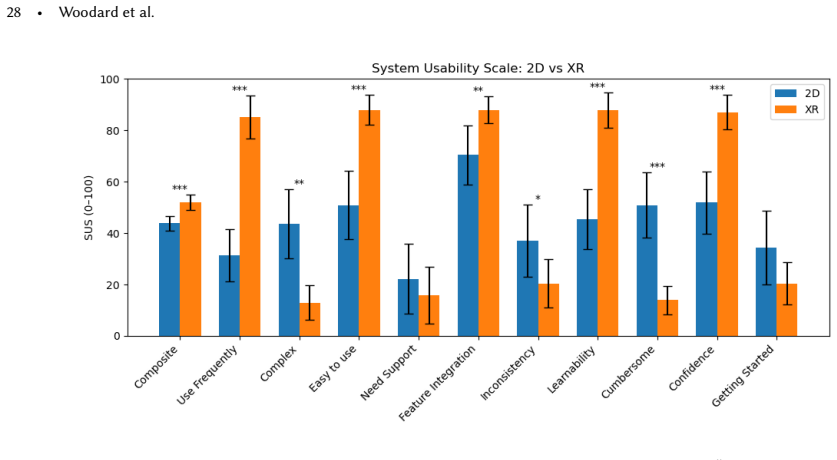
The central discovery claimed is that a 6DoF augmented-reality interface for manipulating spatial audio objects outperforms a conventional 2D desktop panner on perceived usability, workload, and creative output. Concretely, in a matched within-subjects comparison, the AR condition scored significantly higher on the System Usability Scale (with large effect sizes on overall usability, confidence, learnability, ease of use, and reduced cumbersomeness), significantly lower on NASA-TLX frustration and mental demand, and significantly higher on every creativity subscale measured, including rapid idea generation and creative insight. The authors further report that in the exploratory study, expert and non-expert users experienced similarly low workload, and that users' placement of audio objects followed semantically meaningful spatial patterns, such as placing birds high, the river on the floor, and frogs near the river. These results are used to argue that embodied, proprioceptive interaction, rather than point-and-click mapping, makes immersive mix creation more intuitive.
Load-bearing premise
The measured usability and creativity gains are attributed to 6DoF interaction, yet Study 2 deliberately restricted the AR condition to 3DoF rotation to match the 2D panner's directional capabilities, so the argument assumes that the observed advantages of the restricted AR condition still hold for full 6DoF translation.
Editorial extensions
If this is right
- A head-mounted AR mixing interface can be integrated with existing DAWs, letting producers switch between desktop editing and in-situ spatial manipulation in the execution environment.
- Users can audition a spatial mix by physically walking through it from multiple listener positions, reducing reliance on sweet-spot listening in post-production.
- The two design lessons give concrete starting points for designing XR audio-authoring tools: exploit proprioception and carefully balance visual and audio representations of sound.
- Even novice users with no DAW background can produce spatially arranged mixes with lower mental workload than with a familiar desktop panner.
Reading between the lines
- The paper's quantitative comparison omits a third condition: full 6DoF with translation. If embodied motion itself, rather than rotational head tracking plus gesture, drives the gains, future 6DoF-enabled versions might show even larger benefits, but the current data cannot distinguish these effects.
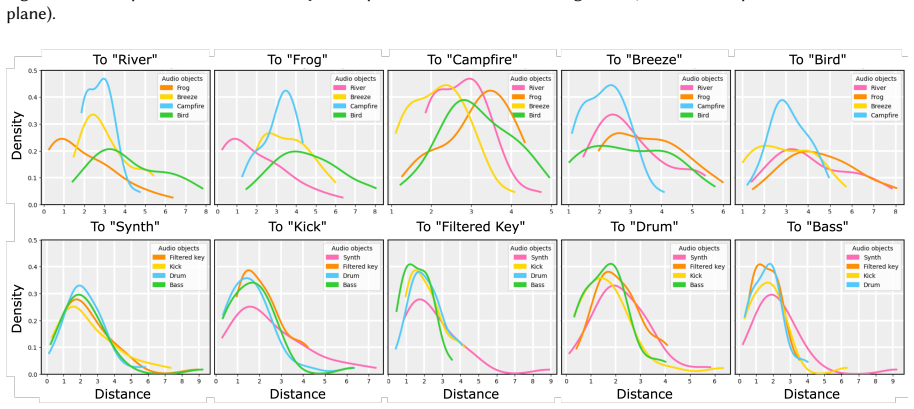
- The spatial clustering results (birds above, river on the floor, frogs near the river) suggest that 6DoF AR mixing may be especially valuable for diegetic sound-design tasks rooted in real-world spatial semantics, and a testable design guideline would be to match the mixing space to the represented scene.
- One implicit consequence is that the same interface could let users walk an auditorium and verify spatial cues from multiple seats for loudspeaker deliveries, a use case the paper only sketches.
Editorial analysis
A structured set of objections, weighed in public.
Referee Report
Summary. The paper presents AudioMiXR, an AR head-mounted display interface for manipulating virtual spatial-audio objects with free-hand gestures, and reports two user studies. Study 1 (N=27) is an exploratory 6DoF sound-design study that produces qualitative themes and two design lessons (proprioception for AR sound design; balancing audio-visual modalities). Study 2 (reported N=18) compares AudioMiXR against a 2D desktop panner and reports significant improvements in SUS, NASA-TLX, and creativity, which the abstract and conclusion attribute to '6DoF AR interaction.' The quantitative comparison is claimed to validate the design lessons from Study 1.
Significance. If the central claim were supported, the contribution would be substantial: AudioMiXR would be among the first systems to provide evidence that 6DoF embodied manipulation improves usability, workload, and creative output for spatial audio design, and the two design lessons would offer actionable guidance. The qualitative analysis of Study 1, including placement heat maps and semantic clustering of audio objects, is a useful exploratory contribution. However, the central comparative claim is not supported by the data as reported: Study 2 restricted the AR condition to 3DoF, so no 6DoF comparison exists, and the statistical reporting contains an unresolved sample-size inconsistency. These issues bear directly on the paper's headline conclusion.
major comments (3)
- [§5.3.3, Abstract, §8] The central claim that '6DoF AR interaction yields measurable gains' is not tested. Study 2's procedure explicitly states that the AR interface was 'restricted it to 3DoF (rotation + orientation only) to match with the directional placement capabilities of the 2D interface.' No condition in Study 2 provided translational 6DoF movement, yet the abstract and conclusion attribute the SUS, NASA-TLX, and creativity improvements to 6DoF interaction. The measured differences between the AR and 2D conditions are therefore differences between a 3DoF HMD gesture interface and a 2D mouse interface, confounded by interaction modality and display type. The data cannot support the paper's headline attribution.
- [§5.3.2 vs. §6.5] The reported sample size is internally inconsistent. Section 5.3.2 states N=18 participants in Study 2, but every paired t-test in Section 6.5 reports t(11), which implies N=12. The paper gives no explanation for this discrepancy, so it is impossible to determine which statistics correspond to the described study. Because all of the SUS, NASA-TLX, and creativity conclusions rest on these tests, the quantitative results are not verifiable as reported.
- [§5.3.4, §6.5.3, §7.3] The creativity measure is partly circular. Section 5.3.4 states that the creativity questions were 'informed by Study 1's results,' and Section 7.3 uses Study 2's creativity results to 'validate and expand on the design lessons from our exploratory study.' If the outcome instrument is constructed from the same qualitative findings it is later used to confirm, the confirmatory value is weakened. In addition, the creativity subscales named in Section 7.3 (originality, elaboration, expressiveness) do not appear in the measures description in Section 5.3.4, making it unclear what was actually administered and analyzed.
minor comments (4)
- [§5.3.4] The NASA-TLX description lists five dimensions and omits frustration, but Section 6.5.1 reports frustration results; please correct the list. Also, the SUS is described with a 7-point Likert scale, whereas the standard SUS uses a 5-point scale; the scoring-to-100 procedure should be specified.
- [§6.1] The normality test is referred to as the 'Shapiro-Wilkinson test'; the correct name is the Shapiro-Wilk test.
- [§7.2] The phrase 'took some trail and error' should be 'trial and error.'
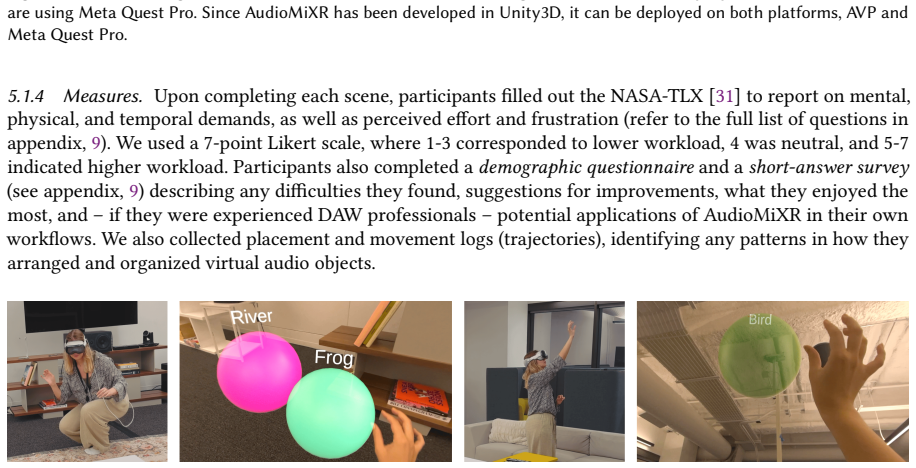
- [Figure 8 caption] The caption states that users are shown with a Meta Quest Pro, while the study text says the deployment target was the Apple Vision Pro; please clarify whether the figure shows a different hardware version or a separate demonstration.
Circularity Check
Creativity measure is partly self-confirming because it was built from Study 1's results; separately, the headline 6DoF attribution rests on a Study 2 condition that was restricted to 3DoF.
-
self definitional
[Section 5.3.4 (Measures); Section 7.3 (Creative Output)]
"Additionally, we assessed creative output by asking 7-point Likert scale questions informed by Study 1’s results, probing participants’ perceived creativity, their inclination to explore spatial arrangements, and the extent to which visual representations of sound objects supported creative insight."
The creativity outcome measure is operationalized from the same Study 1 qualitative findings (spatial exploration, visual-aural responsiveness, embodied mixing) that the paper later claims Study 2 validates. Section 7.3 states: 'These findings support our claim that spatial freedom and bodily agency facilitates divergent thinking and experimental design behavior.' Because the creativity items ask participants to rate the very constructs the first study identified, the large AR-vs-2D creativity differences are partly built into the scale's content rather than independently demonstrated. SUS and NASA-TLX are external standardized instruments, so the circularity is limited to the creativity pillar of the headline claim.
full rationale
The paper's main quantitative backbone is not circular in a statistical sense: SUS and NASA-TLX are standardized external instruments, and the Study 2 within-subjects comparison could have favored either interface. The Study 1 design lessons are standard thematic analysis rather than a derived prediction. I find one partial circularity: the 'creative output' measure was explicitly informed by Study 1's results, and its items ask about perceived creativity, spatial exploration, and visual support for creative insight—exactly the constructs that the Study 1 themes promoted. Section 7.3 then uses the Study 2 creativity advantage as evidence for those same constructs, making that pillar partly self-confirming. Separately, the paper's 6DoF attribution has a validity gap rather than a circular reduction: Section 5.3.3 restricted the AR condition to 3DoF, while the abstract and conclusion attribute the gains to '6DoF AR interaction'; no tested condition actually used translational 6DoF. The self-citations ([64], [76]) are peripheral and not load-bearing. I also note the t(11) degrees of freedom reported in Section 6.5 are inconsistent with N=18 in Section 5.3.2; this is a reporting/statistical problem, not a circular relation.
Assumptions & free parameters
assumptions (4)
- domain assumption Spatial audio rendered with generic HRTFs through Unity's built-in spatializer accurately represents the 3D audio scene for sound design tasks.
- ad hoc to paper Restricting the AR condition to 3DoF in Study 2 is a valid way to control confounds without removing the hypothesized benefit of the AR interface.
- domain assumption The Agrawal et al. definition of immersion is an appropriate and sufficient instruction for participants.
- domain assumption Self-report Likert items designed by the authors measure creativity.
Cite this review
Pith. "Pith review of AudioMiXR: Spatial Audio Object Manipulation with 6DoF for Sound Design in Augmented Reality." pith.science (2026). https://pith.science/paper/QTFGJQ53
@misc{pith2026250202929,
  author       = {Pith},
  title        = {Pith review of: AudioMiXR: Spatial Audio Object Manipulation with 6DoF for Sound Design in Augmented Reality},
  year         = {2026},
  howpublished = {\url{https://pith.science/paper/QTFGJQ53}},
  note         = {Machine review of arXiv:2502.02929}
}
read the original abstract
We present AudioMiXR, an augmented reality (AR) interface intended to assess how users manipulate virtual audio objects situated in their physical space using six degrees of freedom (6DoF) deployed on a head-mounted display (Apple Vision Pro) for 3D sound design. Existing tools for 3D sound design are typically constrained to desktop displays, which may limit spatial awareness of mixing within the execution environment. Utilizing an XR HMD to create soundscapes may provide a real-time test environment for 3D sound design, as modern HMDs can provide precise spatial localization assisted by cross-modal interactions. However, there is no research on design guidelines specific to sound design with 6DoF in XR. To provide a first step toward identifying design-related research directions in this space, we conducted an exploratory study where we recruited 27 participants, consisting of expert and non-expert sound designers. The goal was to assess design lessons that can be used to inform future research venues in 3D sound design. We ran a within-subjects study where users designed both a music and cinematic soundscapes. After thematically analyzing participant data, we constructed two design lessons: (1) Proprioception for AR Sound Design, and (2) Balancing Audio-Visual Modalities in AR GUIs. Additionally, we provide application domains that can benefit most from 6DoF sound design based on our results. To expand on these insights, we conducted a second within-subjects study comparing AudioMiXR to a 2D panner baseline. Results show that AudioMiXR significantly improved usability (SUS), reduced frustration and mental workload (NASA-TLX), and enhanced creativity across all subscales. These findings demonstrate that 6DoF AR interaction yields measurable gains in user experience and creative output, positioning AudioMiXR as a promising foundation for future AR-based sound design tools.
Figures


Figures from the paper (20 more)









Reference graph
Works this paper leans on
-
[1]
Ableton AG. 2025. Ableton Live [Computer software]. https://www.ableton.com Version 11
work page 2025
-
[2]
Sarvesh Agrawal, Adèle Simon, Søren Bech, Klaus Bærentsen, and Søren Forchhammer. 2019. Defining immersion: Literature review and implications for research on immersive audiovisual experiences.Journal of Audio Engineering Society68, 6 (2019), 404–417
work page 2019
-
[3]
2024.Logic Pro User Guide for Mac
Apple Inc. 2024.Logic Pro User Guide for Mac. Apple Inc., One Apple Park Way, Cupertino, CA 95014, USA. https://www.apple.com© 2024 Apple Inc. All rights reserved
work page 2024
- [4]
-
[5]
Avid Technology, Inc. 2024. Avid Pro Tools. https://www.avid.com/pro-tools. Version 2024.3
work page 2024
-
[6]
Anders Riddershom Bargum, Oddur Ingi Kristjánsson, Péter Babó, Rasmus Eske Waage Nielsen, Simon Rostami Mosen, and Stefania Serafin. 2023. Spatial Audio Mixing in Virtual Reality.Sonic Interactions in Virtual Environments(2023), 269
work page 2023
-
[7]
Beat Games. 2024. Beat Saber. https://www.beatsaber.com/
work page 2024
-
[8]
D.R. Begault. 1994.3-D Sound for Virtual Reality and Multimedia. AP Professional. https://books.google.com/books?id=--dQAAAAMAAJ
work page 1994
Show all 78 references
-
[9]
I. H. Bernstein and B. A. Edelstein. 1971. Effects of some variations in auditory input upon visual choice reaction time.Journal of Experimental Psychology87 (1971), 241–247. Issue 2. https://doi.org/10.1037/h0030524
1971 doi
-
[10]
Sam Bilbow. 2022. Evaluating polaris˜-An Audiovisual Augmented Reality Experience Built on Open-Source Hardware and Software. (2022)
2022
-
[11]
Stanley T Birchfield and Rajitha Gangishetty. 2005. Acoustic localization by interaural level difference. InProceedings.(ICASSP’05). IEEE International Conference on Acoustics, Speech, and Signal Processing, 2005., Vol. 4. IEEE, iv–1109
2005
-
[12]
1996.Spatial Hearing: The Psychophysics of Human Sound Localization
Jens Blauert. 1996.Spatial Hearing: The Psychophysics of Human Sound Localization. The MIT Press. https://doi.org/10.7551/mitpress/ 6391.001.0001
1996 doi
-
[13]
1996.SUS: A quick and dirty usability scale
John Brooke. 1996.SUS: A quick and dirty usability scale. Technical Report. Digital Equipment Co Ltd, Reading, UK. Technical report
1996
-
[14]
Soumyajit Chakraborty, Amanda Kane, Holly Gagnon, Timothy McNamara, and Bobby Bodenheimer. 2024. Comparative Effectiveness of an Omnidirectional Treadmill versus Natural Walking for Navigating in Virtual Environments. InACM Symposium on Applied Perception 2024(Dublin, Ireland)...
2024
-
[15]
Taizhou Chen, Yi-Shiun Wu, and Kening Zhu. 2018. Investigating different modalities of directional cues for multi-task visual-searching scenario in virtual reality. InProceedings of the 24th ACM symposium on virtual reality software and technology. 1–5
2018
-
[16]
Clemenson, Antonella Maselli, Alexander J
Gregory D. Clemenson, Antonella Maselli, Alexander J. Fiannaca, Amos Miller, and Mar Gonzalez-Franco. 2021. Rethinking GPS navigation: creating cognitive maps through auditory clues.Scientific Reports11, 1 (08 Apr 2021), 7764. https://doi.org/10.1038/s41598- 021-87148-4
2021 doi
-
[17]
Cockos Inc. 2025. REAPER [Computer software]. https://www.reaper.fm Version 7.09
2025
-
[18]
Gustavo Corrêa De Almeida, Vinicius Costa de Souza, Luiz Gonzaga Da Silveira Júnior, and Maurício Roberto Veronez. 2023. Spatial Audio in Virtual Reality: A systematic review. InProceedings of the 25th Symposium on Virtual and Augmented Reality. 264–268
2023
-
[19]
Dear Reality GmbH. 2024. dearVR Spatial Audio Solutions. https://www.dear-reality.com/
2024
-
[20]
Christopher Dewey, Austin Moore, and Hyunkook Lee. 2024. Practitioners’ Perspectives on Spatial Audio: Insights into Dolby Atmos and Binaural Mixes in Popular Music.AES: Journal of the Audio Engineering Society72, 7/8 (9 July 2024), 504–516. Publisher Copyright: ©2024 Audio En...
2024
-
[21]
Daniel Dobler, Michael Haller, and Philipp Stampfl. 2002. ASR: augmented sound reality. InACM SIGGRAPH 2002 Conference Abstracts and Applications(San Antonio, Texas)(SIGGRAPH ’02). Association for Computing Machinery, New York, NY, USA, 148. https: //doi.org/10.1145/1242073.1242161
2002
-
[22]
2018.Dolby Atmos Renderer Guide Software version 3.0
Dolby Laboratories. 2018.Dolby Atmos Renderer Guide Software version 3.0. Dolby Laboratories, Inc., 1275 Market Street, San Francisco, CA 94103-1410, USA. http://www.dolby.com©2018 Dolby Laboratories. All rights reserved
2018
-
[23]
Endsley, Kelly A
Tristan C. Endsley, Kelly A. Sprehn, Ryan M. Brill, Kimberly J. Ryan, Emily C. Vincent, and James M. Martin. 2017. Augmented Reality Design Heuristics: Designing for Dynamic Interactions.Proceedings of the Human Factors and Ergonomics Society Annual Meeting61, 1 (2017), 2100–2...
2017 doi
-
[24]
Evans and Anne Treisman
Karla K. Evans and Anne Treisman. 2010. Natural cross-modal mappings between visual and auditory features.Journal of Vision10, 1 (01 2010), 6–6. https://doi.org/10.1167/10.1.6 arXiv:https://arvojournals.org/arvo/content_public/journal/jov/932788/jov-10-1-6.pdf
2010 doi
-
[25]
A. Farnell. 2010.Designing Sound. MIT Press
2010
-
[26]
Finnegan, Eamonn O’Neill, and Michael J
Daniel J. Finnegan, Eamonn O’Neill, and Michael J. Proulx. 2016. Compensating for Distance Compression in Audiovisual Virtual Environments Using Incongruence. InProceedings of the 2016 CHI Conference on Human Factors in Computing Systems(San Jose, California, USA)(CHI ’16). As...
2016
-
[27]
Fortenbaugh, Shradha Sanghvi, Michael A
Francesca C. Fortenbaugh, Shradha Sanghvi, Michael A. Silver, and Lynn C. Robertson. 2012. Exploring the edges of visual space: The influence of visual boundaries on peripheral localization.Journal of Vision12, 2 (02 2012), 19–19. https://doi.org/10.1167/12.2.19 Proc. ACM Inte...
2012 doi
-
[28]
Tom Francart and Jan Wouters. 2007. Perception of across-frequency interaural level differences.The Journal of the Acoustical Society of America122, 5 (2007), 2826–2831
2007
-
[29]
1997.The art of mixing: a visual guide to recording, engineering, and production
David Gibson. 1997.The art of mixing: a visual guide to recording, engineering, and production. MixBooks
1997
-
[30]
Greg Guest, Arwen Bunce, and Laura Johnson. 2006. How many interviews are enough? An experiment with data saturation and variability.Field methods18, 1 (2006), 59–82
2006
-
[31]
SG Hart. 1988. Development of NASA-TLX (Task Load Index): Results of empirical and theoretical research.Human mental work- load/Elsevier(1988)
1988
-
[32]
Amal Hashky, Benjamin Rheault, Ahmed Rageeb Ahsan, Brett Benda, Tyler Audino, Samuel Lonneman, and Eric D Ragan. 2024. Multi-Modal User Modeling for Task Guidance: A Dataset for Real-Time Assistance with Stress and Interruption Dynamics. In2024 IEEE Conference on Virtual Reali...
2024
-
[33]
Marek Hatala and Ron Wakkary. 2005. Ontology-Based User Modeling in an Augmented Audio Reality System for Museums.User Modeling and User-Adapted Interaction15, 3 (01 Aug 2005), 339–380. https://doi.org/10.1007/s11257-005-2304-5
2005 doi
-
[34]
James Hereford and William Winn. 1994. Non-Speech Sound in Human-Computer Interaction: A Review and Design Guide- lines.Journal of Educational Computing Research11, 3 (1994), 211–233. https://doi.org/10.2190/MKD9-W05T-YJ9Y-81NM arXiv:https://doi.org/10.2190/MKD9-W05T-YJ9Y-81NM
1994 doi
-
[35]
Jane Hoffswell, Wilmot Li, and Zhicheng Liu. 2020. Techniques for Flexible Responsive Visualization Design. InProceedings of the 2020 CHI Conference on Human Factors in Computing Systems(Honolulu, HI, USA)(CHI ’20). Association for Computing Machinery, New York, NY, USA, 1–13....
2020
-
[36]
Together but not together
Zainab Iftikhar, Yumeng Ma, and Jeff Huang. 2023. “Together but not together”: Evaluating Typing Indicators for Interaction-Rich Communication. InProceedings of the 2023 CHI Conference on Human Factors in Computing Systems. 1–12
2023
-
[37]
Image-Line Software. 2025. FL Studio [Computer software]. https://www.image-line.com Version 20.8
2025
-
[38]
Markus Jelonek. 2023. VRtoER: When Virtual Reality leads to Accidents: A Community on Reddit as Lens to Insights about VR Safety. In Extended Abstracts of the 2023 CHI Conference on Human Factors in Computing Systems(Hamburg, Germany)(CHI EA ’23). Association for Computing Mac...
2023
-
[39]
Steven Jiang, Lawrence Lim, and Misha Sra. 2023. Spatializing Music in Virtual Reality(SUI ’23). Association for Computing Machinery, New York, NY, USA, Article 42, 3 pages. https://doi.org/10.1145/3607822.3618011
2023
-
[40]
Steven Jiang, Lawrence Lim, and Misha Sra. 2023. Spatializing Music in Virtual Reality. InProceedings of the 2023 ACM Symposium on Spatial User Interaction. 1–3
2023
-
[41]
Mohamed Kari, Reinhard Schütte, and Raj Sodhi. 2023. Scene Responsiveness for Visuotactile Illusions in Mixed Reality. InProceedings of the 36th Annual ACM Symposium on User Interface Software and Technology. 1–15
2023
-
[42]
Angelika C Kern and Wolfgang Ellermeier. 2020. Audio in VR: Effects of a soundscape and movement-triggered step sounds on presence. Front. Robot. AI7 (Feb. 2020), 20
2020
-
[43]
You-Jin Kim, Myungin Lee, Marko Peljhan, JoAnn Kuchera-Morin, and Tobias Höllerer. 2024. Spatial Orchestra: Locomotion Music Instruments through Spatial Exploration. InExtended Abstracts of the CHI Conference on Human Factors in Computing Systems. 1–5
2024
-
[44]
Tobias Langlotz, Holger Regenbrecht, Stefanie Zollmann, and Dieter Schmalstieg. 2013. Audio stickies: visually-guided spatial audio annotations on a mobile augmented reality platform. InProceedings of the 25th Australian Computer-Human Interaction Conference: Augmentation, App...
2013
-
[45]
Matthew Lombard and Theresa Ditton. 1997. At the Heart of It All: The Concept of Presence.Journal of Computer-Mediated Communication 3, 2 (09 1997), JCMC321. https://doi.org/10.1111/j.1083-6101.1997.tb00072.x
1997
-
[46]
Sandra Malpica, Ana Serrano, Marcos Allue, Manuel G Bedia, and Belén Masia. 2020. Crossmodal perception in virtual reality.Multimedia Tools and Applications79 (2020), 3311–3331
2020
-
[47]
Mark Marrington et al. 2017. Composing with the digital audio workstation.The singer-songwriter handbook(2017), 77–89
2017
-
[48]
Charles Patrick Martin, Zeruo Liu, Yichen Wang, Wennan He, and Henry Gardner. 2020. Sonic sculpture: Activating engagement with head-mounted augmented reality.arXiv preprint arXiv:2012.02311(2020)
2020 arXiv
-
[49]
Justin Mathew, Stéphane Huot, and Brian F. G. Katz. 2017. Survey and Implications for the Design of New 3D Audio Authoring Tools. Journal on Multimodal User Interfaces11, 3 (April 2017), 277–287. https://doi.org/10.1007/s12193-017-0245-z
2017 doi
-
[50]
Mauro, Rufael Mekuria, and Michele Sanna
Davide A. Mauro, Rufael Mekuria, and Michele Sanna. 2013. Binaural spatialization for 3D immersive audio communication in a virtual world. InProceedings of the 8th Audio Mostly Conference(Piteå, Sweden)(AM ’13). Association for Computing Machinery, New York, NY, USA, Article 8...
2013
-
[51]
David McGookin, Yolanda Vazquez-Alvarez, Stephen Brewster, and Joanna Bergstrom-Lehtovirta. 2012. Shaking the dead: multimodal location based experiences for un-stewarded archaeological sites. InProceedings of the 7th Nordic Conference on Human-Computer Interaction: Making Sen...
2012
-
[52]
Oussama Metatla, Nuno N Correia, Fiore Martin, Nick Bryan-Kinns, and Tony Stockman. 2016. Tap the ShapeTones: Exploring the effects of crossmodal congruence in an audio-visual interface. InProceedings of the 2016 CHI Conference on Human Factors in Computing Systems. 1055–1066
2016
-
[53]
Correia, Fiore Martin, Nick Bryan-Kinns, and Tony Stockman
Oussama Metatla, Nuno N. Correia, Fiore Martin, Nick Bryan-Kinns, and Tony Stockman. 2016. Tap the ShapeTones: Exploring the Effects of Crossmodal Congruence in an Audio-Visual Interface. InProceedings of the 2016 CHI Conference on Human Factors in Computing Systems(San Jose, ...
2016
-
[54]
Paul Milgram, Haruo Takemura, Akira Utsumi, and Fumio Kishino. 1995. Augmented reality: A class of displays on the reality-virtuality continuum. InTelemanipulator and telepresence technologies, Vol. 2351. Spie, 282–292
1995
-
[55]
George A Miller. 1956. The magical number seven, plus or minus two: Some limits on our capacity for processing information. Psychological review63, 2 (1956), 81
1956
-
[56]
Jörg Müller, Matthias Geier, Christina Dicke, and Sascha Spors. 2014. The boomRoom: mid-air direct interaction with virtual sound sources. InProceedings of the SIGCHI conference on human factors in computing systems. 247–256
2014
-
[57]
David Murphy and Flaithri Neff. 2010. Spatial Sound for Computer Games and Virtual Reality. (01 2010). https://doi.org/10.4018/978-1- 61692-828-5.ch014
2010 doi
-
[58]
Brian Odegaard, David R Wozny, and Ladan Shams. 2015. Biases in visual, auditory, and audiovisual perception of space.PLoS computational biology11, 12 (2015), e1004649
2015
-
[59]
Patrick O’Toole, Maurizio Mancini, and Ian Pitt. 2024. Sound and Colour: Evaluating Auditory-Visual Tests in Virtual Reality and Traditional Desktop Settings. InProceedings of the 2024 International Conference on Advanced Visual Interfaces. 1–5
2024
-
[60]
Alvaro Pastor and Pierre Bourdin-Kreitz. 2024. Comparing episodic memory outcomes from walking augmented reality and stationary virtual reality encoding experiences.Scientific Reports14, 1 (30 Mar 2024), 7580. https://doi.org/10.1038/s41598-024-57668-w
2024 doi
-
[61]
Jayesh Pillai, Priyanshu Thakur, and Tushar Vaid. 2024. Belonging: Exploring Audio-Visual Cues in Real-Time 6DoF VR Narrative. In Proceedings of the 14th Indian Conference on Human-Computer Interaction, Anirudha Joshi and Gavin R. Sim (Eds.). Springer Nature Singapore, Singapo...
2024
-
[62]
Ruddle, Ekaterina Volkova, and Heinrich H
Roy A. Ruddle, Ekaterina Volkova, and Heinrich H. Bülthoff. 2011. Walking improves your cognitive map in environments that are large-scale and large in extent.ACM Trans. Comput.-Hum. Interact.18, 2, Article 10 (July 2011), 20 pages. https://doi.org/10.1145/ 1970378.1970384
2011
-
[63]
Dariusz Rumiński. 2015. An experimental study of spatial sound usefulness in searching and navigating through AR environments. Virtual Reality19, 3 (01 Nov 2015), 223–233. https://doi.org/10.1007/s10055-015-0274-4
2015 doi
-
[64]
Kaili Shan, Tiger Sun, Jarrod Tart, Brandon Woodard, Irene Humer, and Christian Eckhardt. 2024. Work-in-Progress—Virtual Learning Laboratories for High School Chemistry Lab: An Immersive Learning User Study.Immersive Learning Research-Academic(2024), 61–71
2024
-
[65]
MT Shelvock. 2016. Gestalt theory and mixing audio.Innovation in Music II(2016), 1–14
2016
-
[66]
Sinclair
J.L. Sinclair. 2020.Principles of Game Audio and Sound Design: Sound Design and Audio Implementation for Interactive and Immersive Media. Taylor & Francis. https://books.google.com/books?id=EDkPEAAAQBAJ
2020
-
[67]
Sanchez-Vives, and Olaf Blanke
Mel Slater, Bernhard Spanlang, Maria V. Sanchez-Vives, and Olaf Blanke. 2010. First Person Experience of Body Transfer in Virtual Reality.PLOS ONE5, 5 (05 2010), 1–9. https://doi.org/10.1371/journal.pone.0010564
2010 doi
-
[68]
Jaka Sodnik, Saso Tomazic, Raphael Grasset, Andreas Duenser, and Mark Billinghurst. 2006. Spatial sound localization in an augmented reality environment. InProceedings of the 18th Australia Conference on Computer-Human Interaction: Design: Activities, Artefacts and Environment...
2006
-
[69]
SPARTA Team. 2025. SPARTA [Computer software]. https://www.sparta-project.org Version 1.0
2025
-
[70]
Christoph Stahl. 2007. The roaring navigator: a group guide for the zoo with shared auditory landmark display. InProceedings of the 9th International Conference on Human Computer Interaction with Mobile Devices and Services(Singapore)(MobileHCI ’07). Association for Computing ...
2007
-
[71]
Steffen, James E
Jacob H. Steffen, James E. Gaskin, Thomas O. Meservy, Jeffrey L. Jenkins, and Iopa Wolman. 2019. Framework of Affordances for Virtual Reality and Augmented Reality.Journal of Management Information Systems36, 3 (2019), 683–729. https://doi.org/10.1080/07421222. 2019.1628877 ar...
2019
-
[72]
Devin Blair Terhune, Sarah Tai, Alan Cowey, Tudor Popescu, and Roi Cohen Kadosh. 2011. Enhanced Cortical Excitability in Grapheme- Color Synesthesia and Its Modulation.Current Biology21, 23 (06 Dec 2011), 2006–2009. https://doi.org/10.1016/j.cub.2011.10.032
2011 doi
-
[73]
Wen-Jie Tseng, Petros Dimitrios Kontrazis, Eric Lecolinet, Samuel Huron, and Jan Gugenheimer. 2024. Understanding Interaction and Breakouts of Safety Boundaries in Virtual Reality Through Mixed-Method Studies . In2024 IEEE Conference Virtual Reality and 3D User Interfaces (VR)...
2024
-
[74]
Stefan Weber, David Weibel, and Fred W Mast. 2021. How to get there when you are there already? Defining presence in virtual reality and the importance of perceived realism.Frontiers in psychology12 (2021), 628298. Proc. ACM Interact. Mob. Wearable Ubiquitous Technol., Vol. 9,...
2021
-
[75]
Colton, Sarah H
Peter Willemsen, Mark B. Colton, Sarah H. Creem-Regehr, and William B. Thompson. 2009. The effects of head-mounted display mechanical properties and field of view on distance judgments in virtual environments.ACM Trans. Appl. Percept.6, 2, Article 8 (March 2009), 14 pages. htt...
2009
-
[76]
LaViola Jr
Brandon Woodard, Melvin He, Mose Sakashita, Jing Qian, Zainab Iftikhar, and Joseph J. LaViola Jr. 2025. Cam-2-Cam: Exploring the Design Space of Dual-Camera Interactions for Smartphone-based Augmented Reality. arXiv:2504.20035 [cs.HC] https://arxiv.org/abs/2504.20035
2025
-
[77]
Muzhe Wu, Yi Fei Cheng, and David Lindlbauer. 2024. New Ears: An Exploratory Study of Audio Interaction Techniques for Performing Search in a Virtual Reality Environment. In2024 IEEE International Symposium on Mixed and Augmented Reality (ISMAR). 386–395. https://doi.org/10.11...
2024
-
[78]
Jing Yang, Amit Barde, and Mark Billinghurst. 2022. Audio augmented reality: A systematic review of technologies, applications, and future research directions.journal of the audio engineering society70, 10 (2022), 788–809. Proc. ACM Interact. Mob. Wearable Ubiquitous Technol.,...
2022
Reviewed August 9, 2026 · model on record in the stance chip above.
Discussion (0). Continue with ORCID to comment.