Dynamics of a vortex column of supercritical fluid across the pseudo-boiling line
Pith reviewed 2026-06-26 22:54 UTC · model grok-4.3
The pith
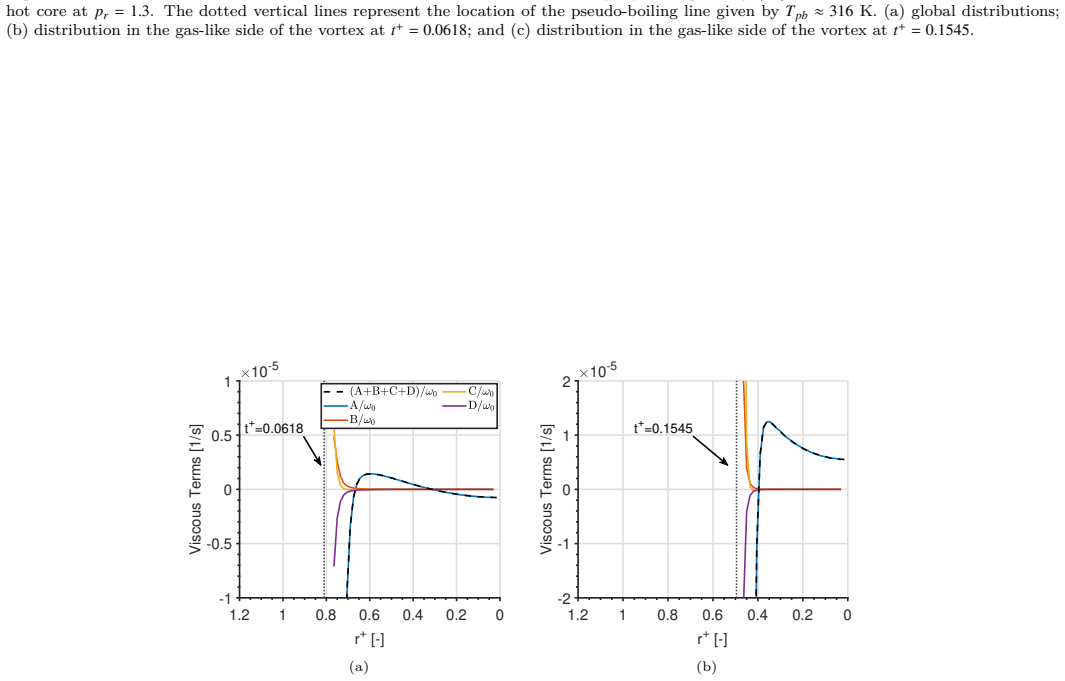
In a supercritical vortex column, three extra viscous mechanisms beyond diffusion alter vorticity when crossing the pseudo-boiling line, including one that generates reverse vorticity.
A machine-rendered reading of the paper's core claim, the machinery that carries it, and where it could break.
Core claim
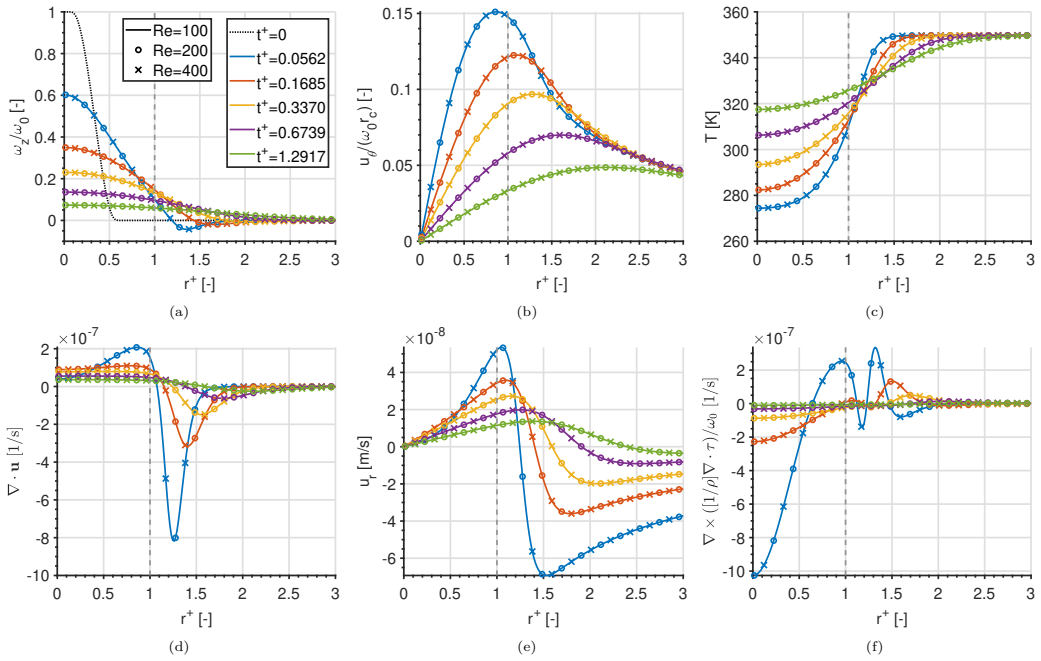
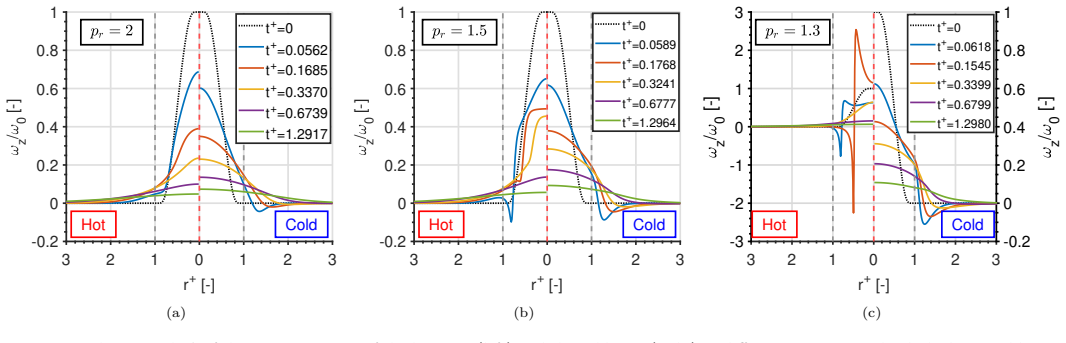
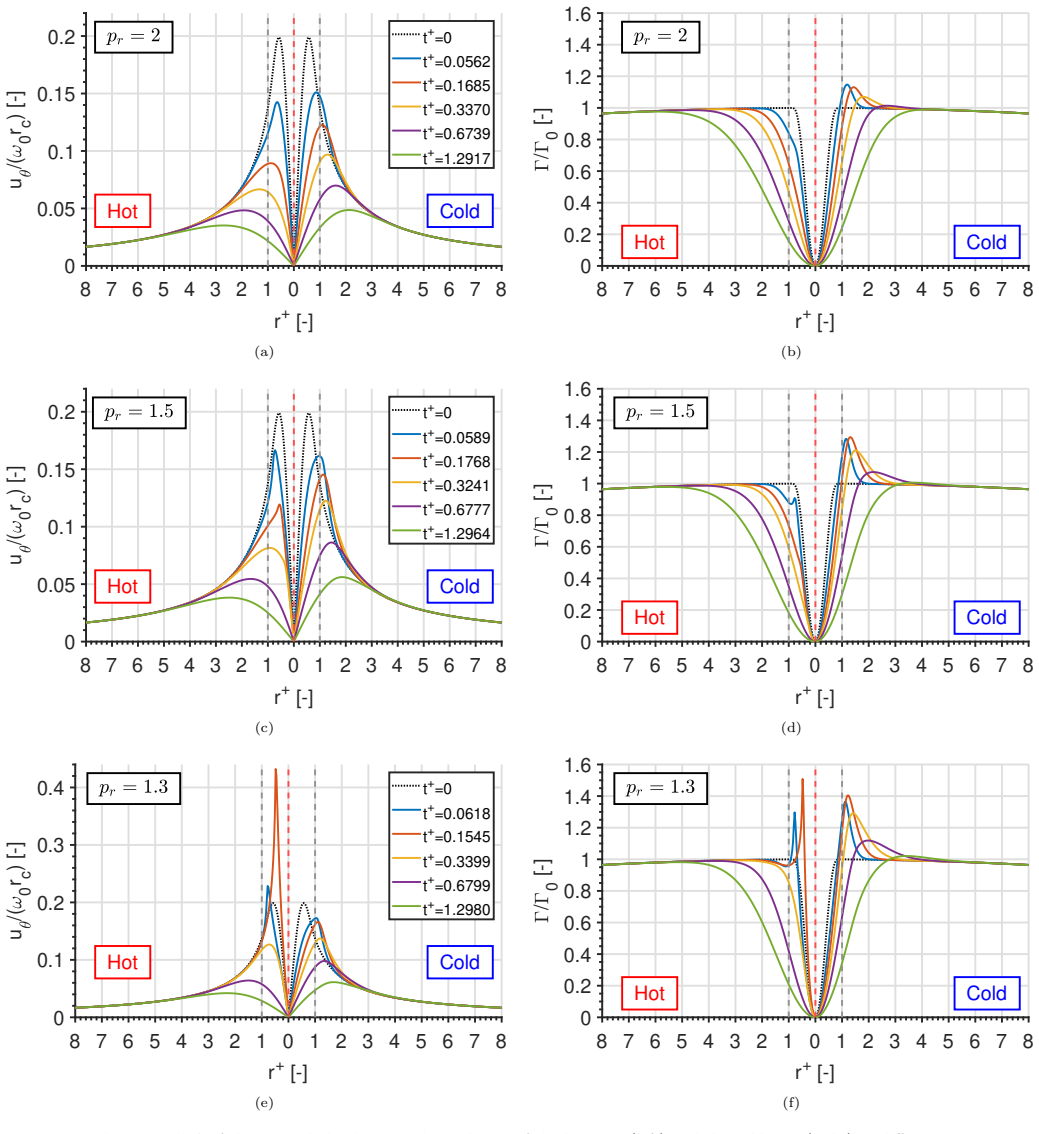
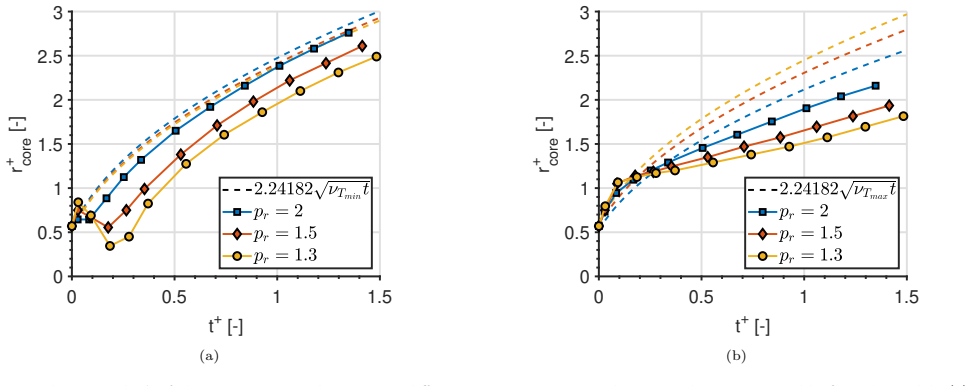
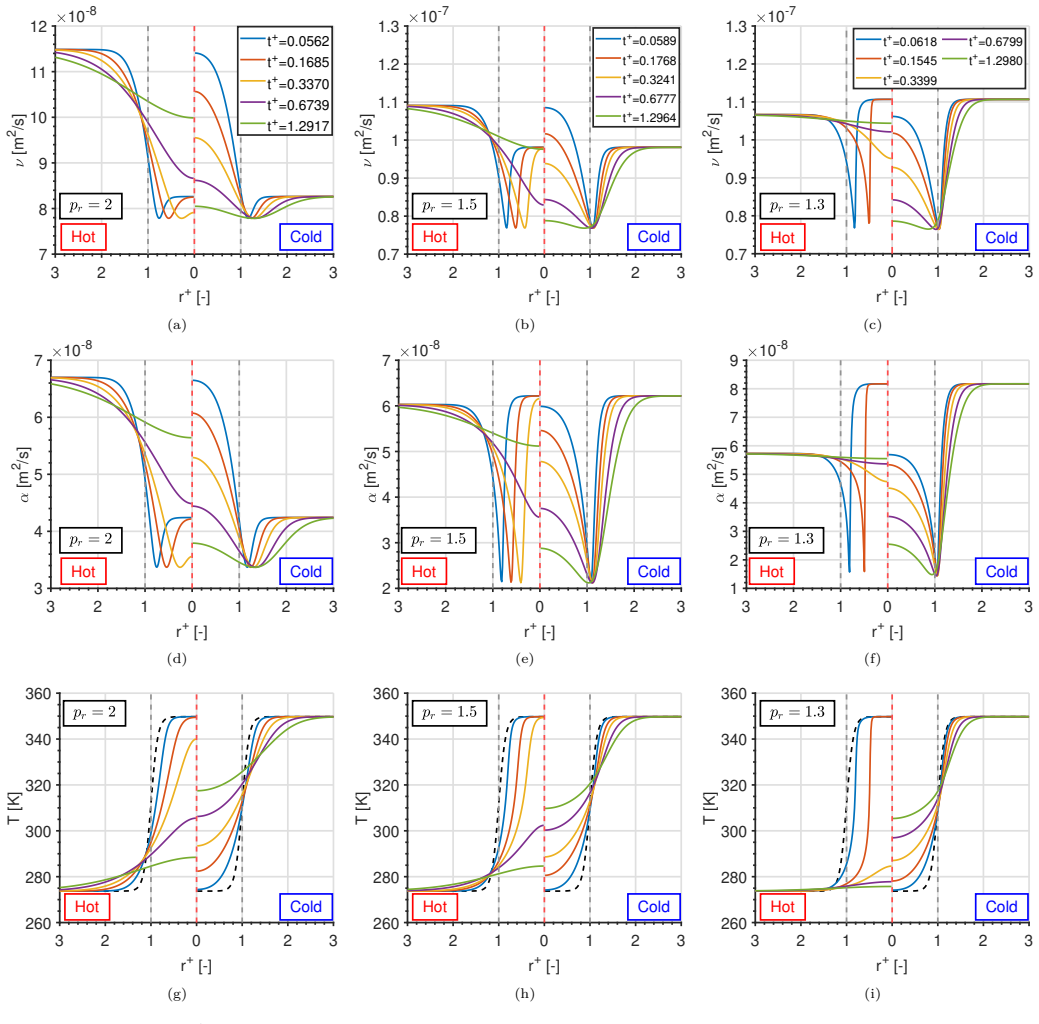
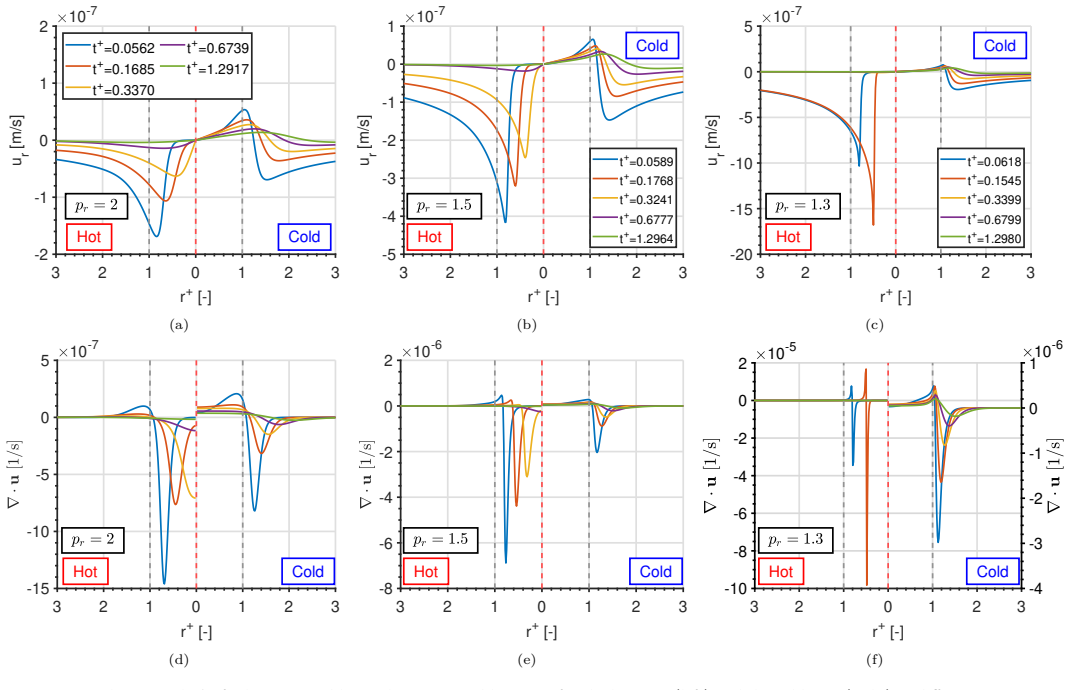
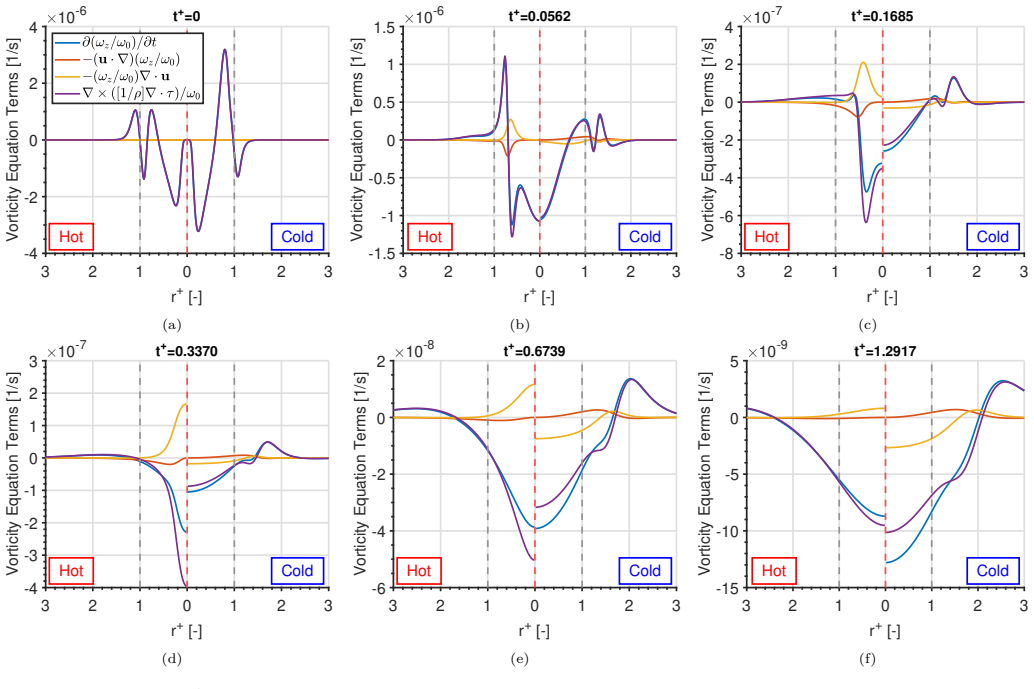
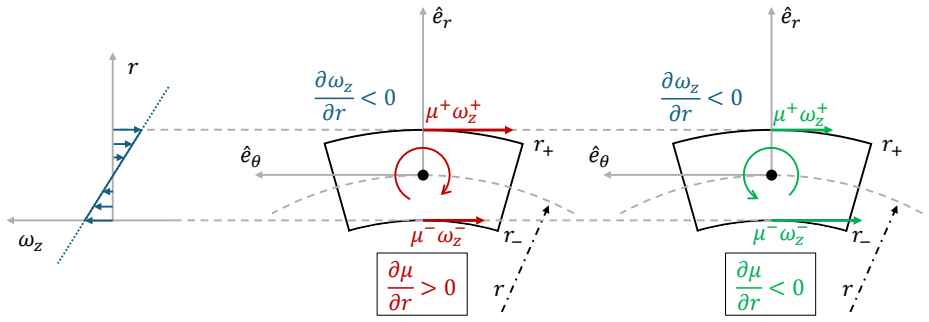
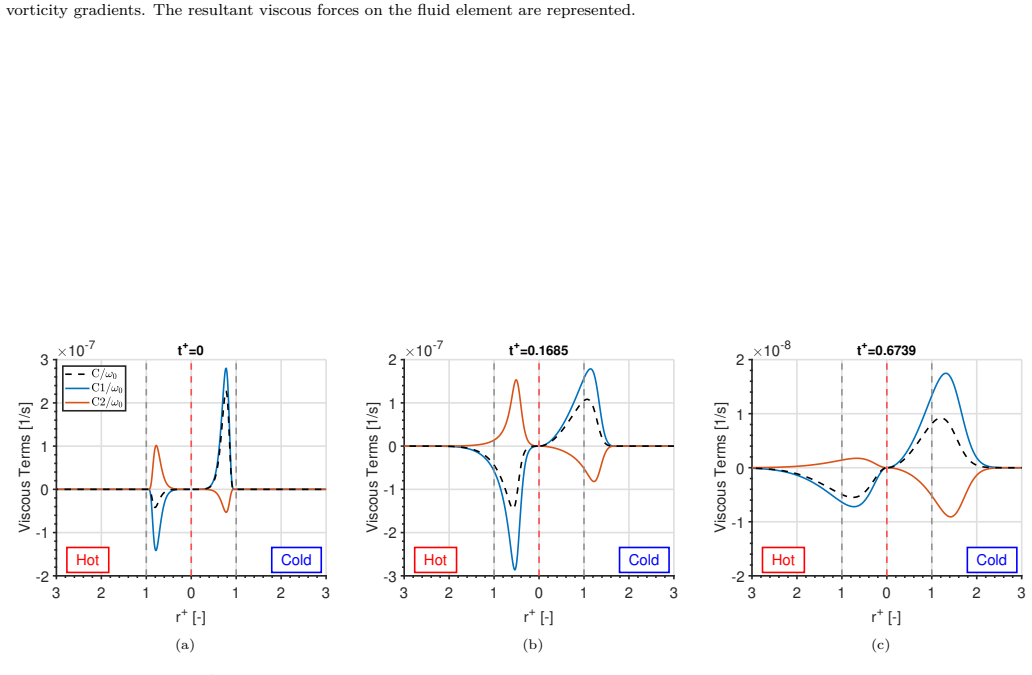
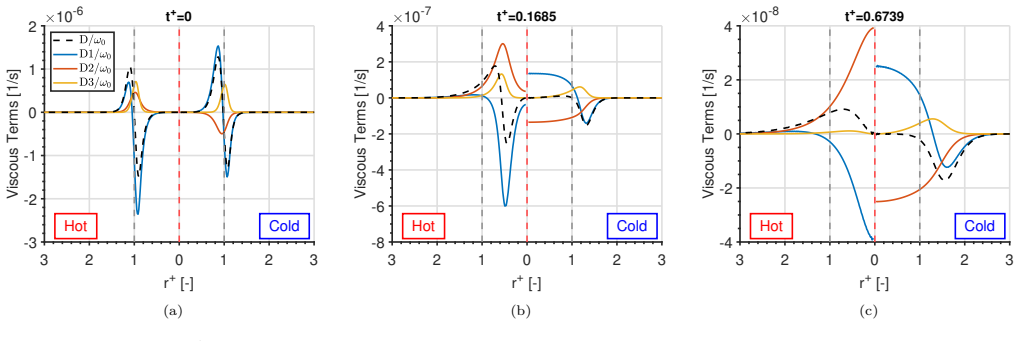
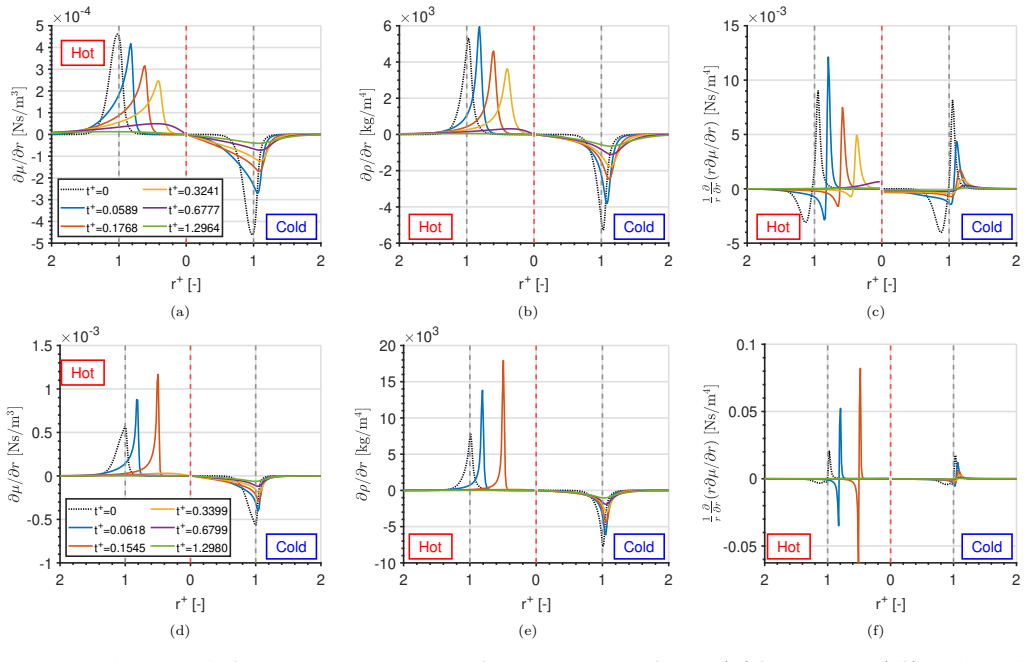
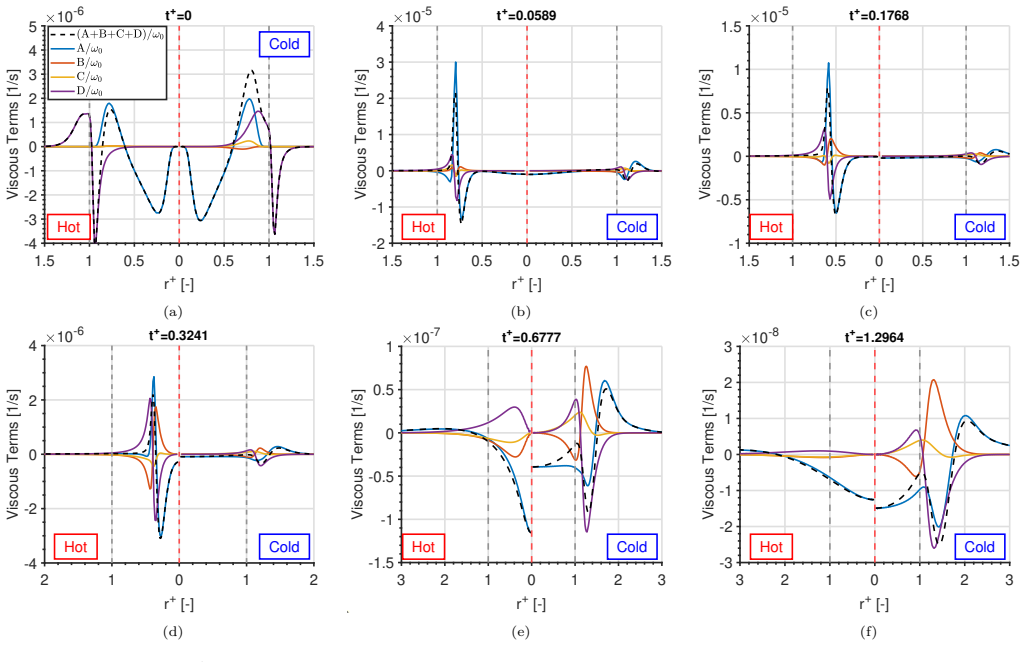
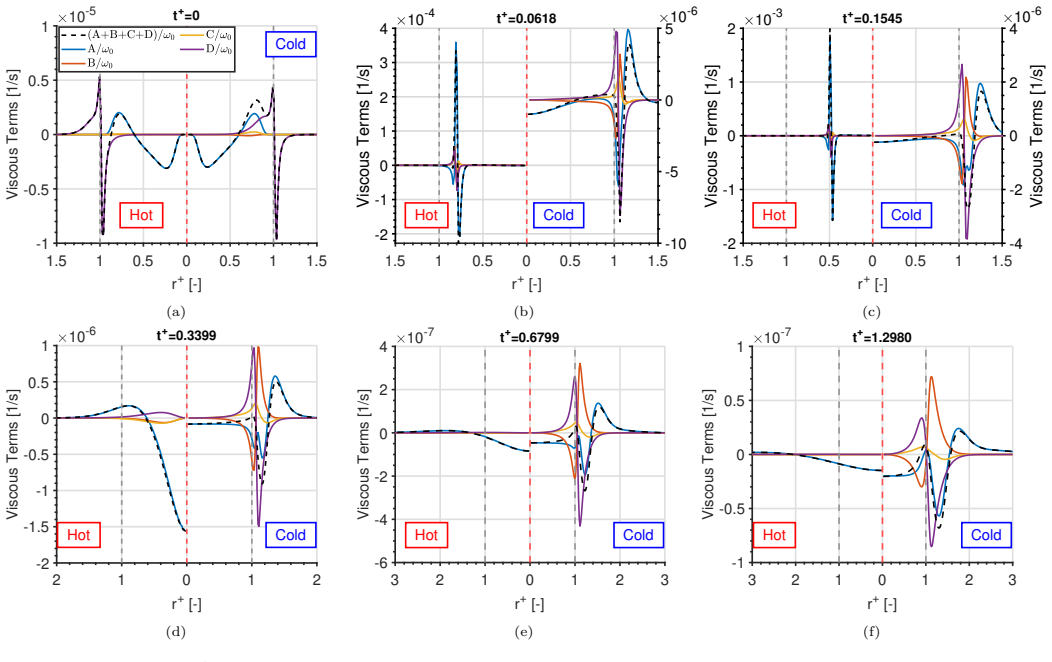
Vorticity evolution in the axisymmetric vortex depends strongly on core temperature and ambient pressure near the critical point, differing substantially from the Oseen solution during thermal mixing. Beyond diffusion, three additional viscous mechanisms become significant across the pseudo-boiling line: a vorticity stretching term, alignment of vorticity with viscosity and density gradients, and a vorticity source from the interaction of fluid swirl with those gradients. The third mechanism can generate reverse vorticity, locally increasing circulation and substantially modifying the temporal evolution of the vortex.
What carries the argument
The vorticity transport equation under the low-Mach approximation with strongly varying properties, where the three additional viscous terms (stretching, alignment, and swirl-gradient source) act across the pseudo-boiling line.
If this is right
- Reverse vorticity appears only when the core is hotter or colder than the surroundings in a way that crosses the pseudo-boiling line.
- The magnitude of the new vorticity source grows as ambient pressure approaches the critical pressure because property gradients become steeper.
- Local circulation can increase temporarily instead of monotonically decreasing as in constant-property flows.
- The temporal history of vortex radius and peak vorticity is altered during the thermal mixing phase.
Where Pith is reading between the lines
- The identified source term could be added to reduced-order vortex models used in engineering simulations of supercritical heat exchangers or turbines.
- Similar mechanisms may appear in other axisymmetric swirling flows with strong radial property stratification, such as in combustion chambers.
- If the axisymmetric assumption breaks down, the new vorticity source might seed three-dimensional instabilities that further modify mixing.
Load-bearing premise
The low-Mach approximation together with the imposed radial thermal layer and axisymmetric assumption capture the dominant physics of property variation without needing full compressibility or three-dimensional effects.
What would settle it
A direct numerical simulation or experiment at the same low Reynolds number and near-critical pressures that shows no reverse vorticity generation and no measurable deviation from the Oseen decay law when the vortex core crosses the pseudo-boiling line.
Figures
read the original abstract
The evolution of an axisymmetric vortex column in a weakly compressible supercritical fluid is analysed. A thermal layer is imposed to radially stratify the fluid and uncover effects of the large fluid property variations across the pseudo-boiling line. A multi-dimensional flow solver based on a low-Mach approximation is employed. Using supercritical carbon dioxide as the fluid, we examine axisymmetric configurations at low Reynolds number with the vortex core hotter or colder than the surrounding fluid and for different thermodynamic pressures close to the critical pressure. Vorticity evolution depends strongly on the core temperature and ambient pressure, differing substantially from the classical Oseen solution during the thermal mixing process under highly varying fluid properties. Viscous effects dominate the vorticity evolution. Beyond diffusion, three additional viscous mechanisms are identified, which become significant across the pseudo-boiling line: (1) a vorticity stretching term, (2) an alignment of vorticity and viscosity/density gradients, and (3) a vorticity source due to the interaction between the fluid swirl and the viscosity and density gradients. The first two mechanisms alter existing vorticity, while the latter injects new vorticity. In fact, the third mechanism can generate reverse vorticity, locally increasing circulation and substantially modifying the temporal evolution of the vortex.
Editorial analysis
A structured set of objections, weighed in public.
Referee Report
Summary. The manuscript analyzes the evolution of an axisymmetric vortex column in weakly compressible supercritical CO2 using a low-Mach approximation, with an imposed radial thermal layer to induce property variations across the pseudo-boiling line. At low Reynolds number, vorticity evolution deviates from the classical Oseen vortex; beyond viscous diffusion, three additional mechanisms are reported from the simulations: a vorticity stretching term, alignment of vorticity with viscosity/density gradients, and a source term arising from swirl interacting with those gradients (the last of which can generate reverse vorticity and locally increase circulation).
Significance. If the mechanisms are shown to be robust, the work isolates how strong property gradients in near-critical fluids can produce non-classical vorticity sources and sinks, offering a concrete starting point for modeling vortex mixing and circulation changes in supercritical applications. The low-Mach axisymmetric setup with controlled thermal stratification is a reasonable choice for isolating these variable-property effects.
major comments (2)
- [Results / vorticity analysis] The central claim that the three mechanisms 'become significant' and alter circulation rests on simulation outcomes, yet the manuscript supplies no quantitative support such as term-by-term budgets from the vorticity equation, relative magnitudes across the pseudo-boiling line, or circulation histories isolating each contribution. This absence is load-bearing for the reported departure from Oseen behavior.
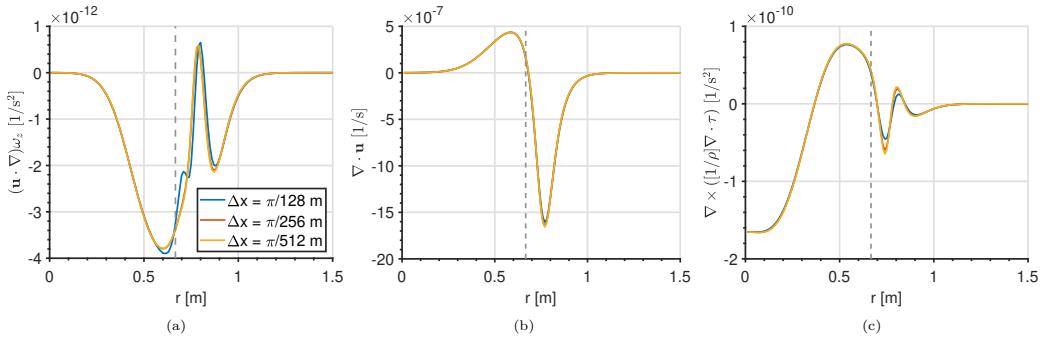
- [Numerical methods] No grid-convergence or discretization-error data are referenced for the reported mechanisms or circulation evolution, leaving open whether the identified terms are numerically converged under the low-Mach axisymmetric discretization.
minor comments (2)
- [Governing equations] Explicitly state the low-Mach vorticity equation (including all variable-property viscous terms) so that the origin of the three additional mechanisms can be traced directly to specific terms.
- [Parameter space] Clarify the thermodynamic conditions (reduced pressures and core-to-ambient temperature differences) at which each mechanism is stated to dominate.
Simulated Author's Rebuttal
We thank the referee for the detailed and constructive report. The two major comments identify areas where additional quantitative evidence and verification would strengthen the manuscript. We address each point below and will incorporate the requested material in a revised version.
read point-by-point responses
-
Referee: [Results / vorticity analysis] The central claim that the three mechanisms 'become significant' and alter circulation rests on simulation outcomes, yet the manuscript supplies no quantitative support such as term-by-term budgets from the vorticity equation, relative magnitudes across the pseudo-boiling line, or circulation histories isolating each contribution. This absence is load-bearing for the reported departure from Oseen behavior.
Authors: We agree that explicit term-by-term budgets and relative-magnitude comparisons would make the significance of the three mechanisms more transparent. The mechanisms were identified by direct inspection of the variable-property vorticity equation under the low-Mach formulation, and the simulations show clear departures from Oseen evolution when property gradients are large. Nevertheless, the manuscript does not presently contain the requested budgets or isolated circulation histories. In the revision we will add these diagnostics, including (i) instantaneous and time-integrated budgets of each term evaluated across the pseudo-boiling line and (ii) circulation histories obtained by successively enabling or disabling the three additional terms. This will provide the quantitative support needed to substantiate the claim. revision: yes
-
Referee: [Numerical methods] No grid-convergence or discretization-error data are referenced for the reported mechanisms or circulation evolution, leaving open whether the identified terms are numerically converged under the low-Mach axisymmetric discretization.
Authors: The referee is correct that no grid-convergence or discretization-error estimates are reported. The computations were performed on a sequence of successively refined meshes, but these checks were not documented. In the revised manuscript we will include a dedicated convergence subsection that reports (i) the grid resolutions employed, (ii) the observed order of accuracy for the vorticity field and circulation, and (iii) the sensitivity of the three additional viscous terms to further refinement. This will confirm that the reported mechanisms are numerically converged. revision: yes
Circularity Check
No significant circularity
full rationale
The paper derives its central claims from direct numerical simulation of the low-Mach axisymmetric Navier-Stokes equations with variable density and viscosity across the pseudo-boiling line. The three viscous mechanisms are obtained by inspecting the resulting vorticity transport equation terms under the imposed radial thermal stratification; they are not fitted parameters, not renamed inputs, and not justified solely by self-citation. The abstract and setup make clear that the mechanisms emerge as simulation outcomes rather than by construction from the model assumptions themselves. No load-bearing self-citation chain or ansatz smuggling is indicated.
Axiom & Free-Parameter Ledger
axioms (2)
- domain assumption Low-Mach approximation is valid for the weakly compressible supercritical fluid under the imposed thermal stratification.
- domain assumption Axisymmetric configuration with an imposed radial thermal layer captures the dominant vorticity mechanisms across the pseudo-boiling line.
Reference graph
Works this paper leans on
-
[1]
Effects of spatial gradients in thermophysical properties on the topology of turbulence in heated channel flow of supercritical fluids. Phys. Fluids 30, 015108. doi: 10.1063/1.5009295. Banuti, D.,
-
[2]
Crossing the widom-line – supercritical pseudo-boiling. J. Supercrit. Fluids 98, 12–16. doi: 10.1016/j. supflu.2014.12.019. Banuti, D.T., Raju, M., Ihme, M.,
work page doi:10.1016/j 2014
-
[3]
Similarity law for widom lines and coexistence lines. Phys. Rev. E 95, 052120. doi:10.1103/PhysRevE.95.052120. Barea, G., Jofre, L.,
-
[4]
Spectral characterization of thermo-fluid structures in wall-bounded high-pressure transcritical turbulence. Phys. Fluids 38, 015184. doi: 10.1063/5.0308510. Barea, G., Masclans, N., Jofre, L.,
-
[5]
Multiscale flow topologies in microconfined high-pressure transcritical fluid turbulence. Phys. Rev. Fluids 8, 054608. doi: 10.1103/PhysRevFluids.8.054608. Bernades, M., Capuano, F., Jofre, L.,
-
[6]
Microconfined high-pressure transcritical fluid turbulence. Phys. Fluids 35, 015163. doi: 10.1063/5.0135388. Bernades, M., Jofre, L.,
-
[7]
Thermophysical analysis of microconfined turbulent flow regimes at supercritical fluid conditions in heat transfer applications. J. Heat Transfer 144, 082501. doi: 10.1115/1.4054554. Buaria, D., Bodenschatz, E., Pumir, A.,
-
[8]
Vortex stretching and enstrophy production in high reynolds number turbulence. Phys. Rev. Fluids 5, 104602. doi: 10.1103/PhysRevFluids.5.104602. Bugeat, B., Boldini, P., Hasan, A., Pecnik, R.,
-
[9]
Instability in strongly stratified plane couette flow with application to supercritical fluids. J. Fluid Mech. 984, A31. doi: 10.1017/jfm.2024.193. Chehroudi, B.,
-
[10]
Recent experimental efforts on high-pressure supercritical injection for liquid rockets and their implications. Int. J. Aerosp. Eng. 2012, 121802. doi: 10.1155/2012/121802. Chung, T.H., Ajlan, M., Lee, L.L., Starling, K.E.,
-
[11]
Generalized multiparameter correlation for nonpolar and polar fluid transport properties. Ind. Eng. Chem. Res. 27, 671–679. doi: 10.1021/ie00076a024. Colonius, T., Lele, S.K., Moin, P.,
-
[12]
A FFT-based finite-difference solver for massively-parallel direct numerical simulations of turbulent flows. Comput. Math. Appl. 76, 1853–1862. doi: 10.1016/j.camwa.2018.07.034. Delplanque, J.P., Sirignano, W.A.,
-
[13]
Numerical study of the transient vaporization of an oxygen droplet at sub- and super-critical conditions. Int. J. Heat Mass Transf. 36, 303–314. doi: 10.1016/0017-9310(93)80006-G. Dodd, M.S., Ferrante, A.,
-
[14]
A fast pressure-correction method for incompressible two-fluid flows. J. Comput. Phys. 273, 416–434. doi: 10.1016/j.jcp.2014.05.024. 33 (a) (b) (c) (d) (e) (f) (g) (h) (i) Figure C.1: Contours of ωz for the cold core. The red iso-contour represents rc. (a) t+ = 0.0562 at pr = 2; (b) t+ = 0.3370 at pr = 2; (c) t+ = 1.2917 at pr = 2; (d) t+ = 0.0589 at pr =...
-
[15]
A robust and accurate outflow boundary condition for incompressible flow simulations on severely-truncated unbounded domains. J. Comput. Phys. 261, 83–105. doi: 10.1016/j.jcp.2013.12
-
[16]
The steady behavior of the supercritical carbon dioxide natural circulation loop. Energy 294, 130735. doi: 10.1016/j.energy.2024.130735. El Mansy, R., Barea, G., Mellibovsky, F., Jofre, L.,
-
[17]
Thermal effects on high-pressure transcritical wall-bounded turbulence. Phys. Fluids 37, 105119. doi: 10.1063/5.0296855. Falgout, Z., Rahm, M., Sedarsky, D., Linne, M.,
-
[18]
Gas/fuel jet interfaces under high pressures and temperatures. Fuel 168, 14–21. doi: 10.1016/j.fuel.2015.11.061. García, E., Hussain, F., Yao, J., Stout, E.,
-
[19]
Wall turbulence perturbed by a bump with organized small-scale roughness: coherent structure dynamics. J. Fluid Mech. 1006, A6. doi: 10.1017/jfm.2025.4. He, P., Ghoniem, A.F.,
-
[20]
A sharp interface method for coupling multiphase flow, heat transfer and multicomponent mass transfer with interphase diffusion. J. Comput. Phys. 332, 316–332. doi: 10.1016/j.jcp.2016.12.002. Hickling, R.,
-
[21]
Effects of thermal conduction in sonoluminescence. J. Acoust. Soc. Am. 35, 967–974. doi: 10.1121/1. 1918641. Hou, T.Y.,
-
[22]
Potentially singular behavior of the 3D Navier–Stokes equations. Found. Comput. Math. 23, 2251–2299. doi:10.1007/s10208-022-09578-4 . Hussain, F., García, E., Yao, J., Stout, E.,
-
[23]
Wall turbulence perturbed by a bump with organized small-scale roughness: flow statistics. J. Fluid Mech. 989, A13. doi: 10.1017/jfm.2024.465. Jofre, L., Urzay, J.,
-
[24]
Transcritical diffuse-interface hydrodynamics of propellants in high-pressure combustors of chemical propulsion systems. Prog. Energy Combust. Sci. 82, 100877. doi: 10.1016/j.pecs.2020.100877. Johnson, P.L.,
-
[25]
Energy transfer from large to small scales in turbulence by multiscale nonlinear strain and vorticity interactions. Phys. Rev. Lett. 124, 104501. doi: 10.1103/PhysRevLett.124.104501. Johnson, P.L.,
-
[26]
On the role of vorticity stretching and strain self-amplification in the turbulence energy cascade. J. Fluid Mech. 922, A3. doi: 10.1017/jfm.2021.490. Kawai, S.,
-
[27]
Heated transcritical and unheated non-transcritical turbulent boundary layers at supercritical pressures. J. Fluid Mech. 865, 563–601. doi: 10.1017/jfm.2019.13. Lagarza-Cortés, C., Ramírez-Cruz, J., Salinas-Vázquez, M., Vicente-Rodríguez, W., Cubos-Ramírez, J.M.,
-
[28]
Large- eddy simulation of transcritical and supercritical jets immersed in a quiescent environment. Phys. Fluids 31, 025104. doi:10.1063/1.5054797. Lapenna, P.E.,
-
[29]
Volumetric property improvement for the Soave-Redlich-Kwong equation of state. Ind. Eng. Chem. Res. 45, 1829–1839. doi: 10.1021/ie051058v. Linstrom, P.J., Mallard, W.G. (Eds.),
-
[30]
Structure of wall-bounded flows at transcritical conditions. Phys. Rev. Fluids 3, 034609. doi: 10.1103/PhysRevFluids.3.034609. Mahesh, K.,
-
[31]
A model for the onset of breakdown in an axisymmetric compressible vortex. Phys. Fluids 8, 3338–3345. doi:10.1063/1.869121. Marchionni, M., Bianchi, G., Tassou, S.A.,
-
[32]
Martín, D., Grau, J., Jofre, L.,
doi: 10.1007/s42452-020-2116-6 . Martín, D., Grau, J., Jofre, L.,
-
[33]
Turbulence statistics of homogeneous isotropic supercritical fluid flow. Phys. Rev. Fluids 11, 014609. doi: 10.1103/zkxz-5kvg. 36 Mayer, W.O.H., Schik, A.H.A., Vielle, B., Chauveau, C., Gokalp, I., Talley, D.G., Woodward, R.D.,
-
[34]
Atomization and breakup of cryogenic propellants under high-pressure subcritical and supercritical conditions. J. Propuls. Power 14, 835–842. doi: 10.2514/2.5348. Melander, M.V., Hussain, F.,
-
[35]
Moffatt, H.K., Kimura, Y.,
Proceedings of the 1988 Summer Program . Moffatt, H.K., Kimura, Y.,
1988
-
[36]
Vortex recon- nection and singularity evasion. J. Fluid Mech. 870, R1. doi: 10.1017/jfm.2019.263. Moffatt, H.K., Kimura, Y.,
-
[37]
Vortex recon- nection and singularity evasion – CORRIGENDUM. J. Fluid Mech. 887, E2. doi: 10.1017/jfm.2020.57. Nagy, P.T., Kiss, M., Paál, G.,
-
[38]
Analytic investigation of the compatibility condition and the initial evolution of a smooth velocity field for the Navier–Stokes equation in a channel configuration. Fluid Dyn. Res. 54, 055502. doi:10.1088/1873-7005/ac92a4. Oschwald, M., Smith, J.J., Branam, R., Hussong, J., Schik, A., Chehroudi, B., Talley, D.,
-
[39]
Injection of fluids into supercritical environments. Combust. Sci. Technol. 178, 49–100. doi: 10.1080/00102200500292464. Oseen, C.W.,
-
[40]
Multi-component evaporation of sustainable aviation fuel droplets, in: AIAA SCITECH 2024 Forum
Poblador-Ibanez, J., Nocivelli, L., Dasgupta, D., 2024a. Multi-component evaporation of sustainable aviation fuel droplets, in: AIAA SCITECH 2024 Forum. doi: 10.2514/6.2024-1997. Poblador-Ibanez, J., Sirignano, W.A.,
-
[41]
Transient behavior near liquid-gas interface at supercritical pressure. Int. J. Heat Mass Transf. 126, 457–473. doi: 10.1016/j.ijheatmasstransfer.2018.05.066. Poblador-Ibanez, J., Sirignano, W.A.,
-
[42]
Poblador-Ibanez, J., Sirignano, W.A., Hussain, F., 2024b
doi: 10.1063/5.0086153. Poblador-Ibanez, J., Sirignano, W.A., Hussain, F., 2024b. Vorticity dynamics in transcritical liquid jet breakup. J. Fluid Mech. 978, A6. doi: 10.1017/jfm.2023.961. Poling, B.E., Prausnitz, J.M., O’connell, J.P., et al.,
-
[43]
Effects of boundary condition in numerical simulations of vortex dynamics. J. Fluid Mech. 516, 115–124. doi: 10.1017/S002211200400076X. Ren, J., Marxen, O., Pecnik, R.,
-
[44]
Boundary-layer stability of supercritical fluids in the vicinity of the widom line. J. Fluid Mech. 871, 831–864. doi: 10.1017/jfm.2019.348. Saeed, M., Berrouk, A.S., AlShehhi, M.S., AlWahedi, Y.F.,
-
[45]
Numerical investigation of the thermohydraulic characteristics of microchannel heat sinks using supercritical CO2 as a coolant. J. Supercrit. Fluids 176, 105306. doi:10.1016/j.supflu.2021.105306. Schoppa, W., Hussain, F.,
-
[46]
Coherent structure generation in near-wall turbulence. J. Fluid Mech. 453, 57–108. doi:10.1017/S002211200100667X. Sipp, D., Fabre, D., Michelin, S., Jacquin, L.,
-
[47]
Stability of a vortex with a heavy core. J. Fluid Mech. 526, 67–76. doi:10.1017/S0022112004003143. Song, Y., Cui, C., Yin, X., Cao, F.,
-
[48]
Advanced development and application of transcritical CO2 refrigeration and heat pump technology — A review. Energy Rep. 8, 7840–7869. doi: 10.1016/j.egyr.2022.05.233. Von Ellenrieder, K.D., Cantwell, B.J.,
-
[49]
Self-similar, slightly compressible, free vortices. J. Fluid Mech. 423, 293–315. doi:10.1017/S0022112000001853. Wan, T., Wang, X.J., Jin, Y.X., Zhao, P.H., 2025a. Effects of large density variations on near-wall turbulence and heat transfer in channel flow at supercritical pressure. J. Fluid Mech. 1007, A68. doi: 10.1017/jfm.2025.193. Wan, T., Zhao, P., W...
-
[50]
Numerical solutions of time-dependent incompressible Navier-Stokes equations using an integro-differential formulation. Comput. Fluids 1, 197–215. doi: 10.1016/0045-7930(73)90018-2 . Wu, P., Ren, Y., Feng, M., Shan, J., Huang, Y., Yang, W.,
-
[51]
A review of existing supercritical water reactor concepts, safety analysis codes and safety characteristics. Prog. Nucl. Energy 153, 104409. doi: 10.1016/j.pnucene.2022.104409. Yao, J., Hussain, F., 2020a. On singularity formation via viscous vortex reconnection. J. Fluid Mech. 888, R2. doi:
-
[52]
1017/jfm.2020.58. Yao, J., Hussain, F., 2020b. A physical model of turbulence cascade via vortex reconnection sequence and avalanche. J. Fluid Mech. 883, A51. doi: 10.1017/jfm.2019.905. Yao, J., Hussain, F.,
-
[53]
Transcritical transition and self-stabilizing sharp interfaces in supercritical ammonia environment. Int. J. Therm. Sci. 225, 110813. doi: 10.1016/j.ijthermalsci.2026.110813. Zaman, K.B.M.Q., Hussain, F.,
-
[54]
General jet response. J. Fluid Mech. 101, 449–491. doi: 10.1017/S0022112080001760. Zhang, H.,
-
[55]
Evaporation of a suspended droplet in forced convective high-pressure environments. Combust. Sci. Technol. 175, 2237–2268. doi: 10.1080/714923282. Zwick, S.A., Plesset, M.S.,
discussion (0)
Sign in with ORCID, Apple, or X to comment. Anyone can read and Pith papers without signing in.