A Coordinate System for Collatz Dynamics
Pith reviewed 2026-07-03 07:16 UTC · model grok-4.3
The pith
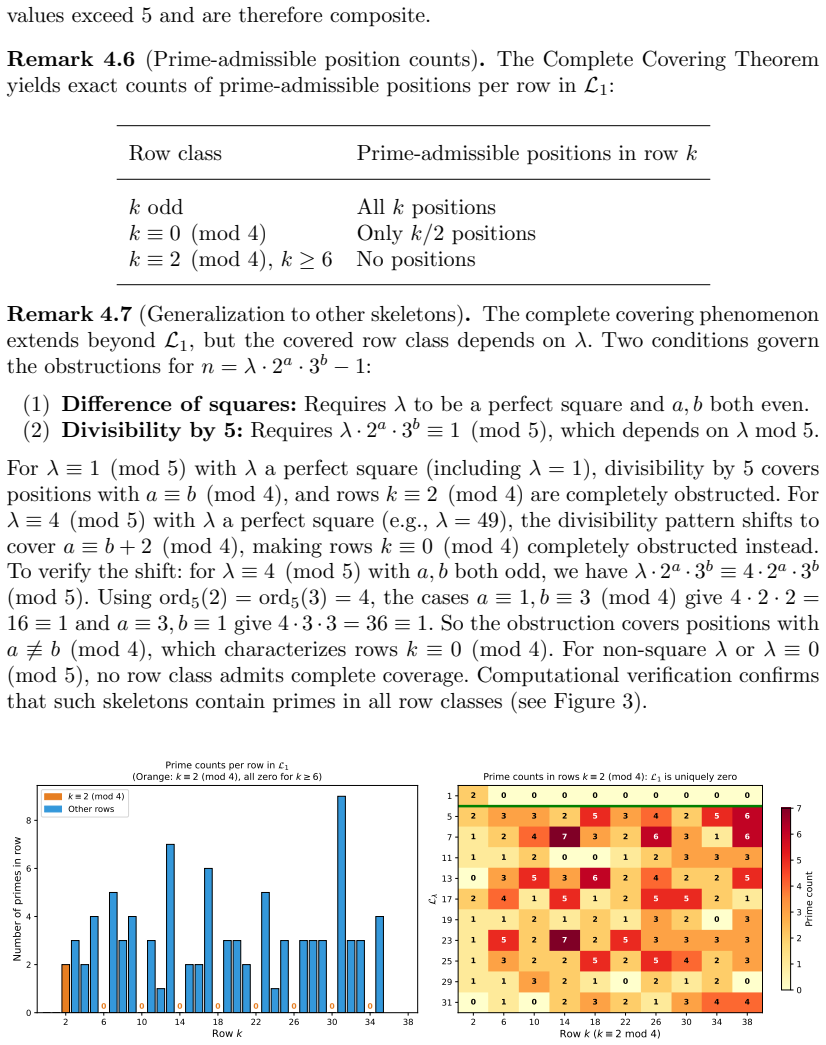
A coordinate system organizes Collatz chains into triangles and proves that rows congruent to 2 mod 4 with k at least 6 in the principal skeleton contain no primes.
A machine-rendered reading of the paper's core claim, the machinery that carries it, and where it could break.
Core claim
Building from the unique representation of every odd positive integer as n equals lambda times 2 to the a times 3 to the b minus 1 with gcd of lambda and 6 equal to 1 and a at least 1, the nonnegative integers are partitioned into countably many infinite triangles. Each row k equals a plus b forms a Collatz chain of alternating parity within the skeleton L_lambda. The coordinate system supports a deterministic flow from (a, b) to (a-1, b+1), with exit at a equals 1 to another skeleton. As an application, rows k congruent to 2 modulo 4 with k at least 6 in the principal skeleton L_1 contain no primes, and this residue class is the unique one admitting complete algebraic obstruction. All resul
What carries the argument
The skeleton L_lambda coordinate system, which assigns to each odd positive integer the pair (a, b) from its 3-smooth factorization and indexes rows by k equals a plus b, enabling deterministic diagonal flows and boundary transitions between skeletons.
If this is right
- Rows k congruent to 2 modulo 4 and at least 6 in the principal skeleton L_1 contain no prime numbers due to algebraic obstruction.
- This residue class is the only one that admits a complete algebraic obstruction to containing primes.
- The triangular partition and coordinate system apply to every nonnegative integer.
- The framework and its consequences do not depend on the truth of the Collatz conjecture.
Where Pith is reading between the lines
- The coordinate system could connect different skeletons through boundary exits, potentially forming larger structures for analyzing Collatz trajectories globally.
- Similar algebraic obstructions might be identifiable in other skeletons L_lambda for lambda not equal to 1 using the same coordinate approach.
- Checking small values of k in L_1 provides a direct way to verify the absence of primes in the obstructed rows.
Load-bearing premise
Every odd positive integer can be written uniquely in the form lambda times a power of 2 times a power of 3 minus one, where lambda is coprime to 6 and the power of 2 is at least 2 to the first.
What would settle it
Observing a prime number in any row k where k is congruent to 2 modulo 4 and k is greater than or equal to 6 in the principal skeleton L_1 would show that the algebraic obstruction does not hold for that row.
Figures
read the original abstract
It is well-established that every odd positive integer $n$ can be written uniquely as $n = \lambda \cdot 2^a \cdot 3^b - 1$ where $\gcd(\lambda, 6) = 1$ and $a \geq 1$. Building from this 3-smooth factorization, we introduce a partition of the nonnegative integers into countably many infinite triangles where each row $k$ forms a Collatz chain of alternating parity. The partition admits a coordinate system as a skeleton $\mathcal{L}_\lambda$ using the pair $(a, b)$ for odd positive integers within a geometric structure where row $k$ corresponds to $k = a + b$. Each position $(a, b)$ maps to $(a-1, b+1)$, a deterministic diagonal flow requiring no number-theoretic input. At the boundary $a = 1$, the trajectory exits to another skeleton depending on the factorization of $\lambda \cdot 3^{b+1} - 1$. The coordinate system is new. As a concrete application, we prove that rows $k \equiv 2 \pmod 4$ with $k \geq 6$ in the principal skeleton $\mathcal{L}_1$ contain no primes, and show this is the unique residue class admitting complete algebraic obstruction. Our contribution is the framework that makes visible which nonnegative integers these arguments apply to, with all results independent of the Collatz conjecture.
Editorial analysis
A structured set of objections, weighed in public.
Referee Report
Summary. The manuscript introduces a coordinate system for Collatz dynamics grounded in the unique 3-smooth factorization of every odd positive integer n = λ · 2^a · 3^b − 1 (gcd(λ,6)=1, a≥1). This induces a partition of the nonnegative integers into countably many infinite triangles whose rows k = a + b form Collatz chains of alternating parity. Skeletons L_λ are defined via the pair (a,b), with a deterministic diagonal flow (a−1,b+1) at interior points and boundary exit rules depending on the factorization of λ · 3^{b+1} − 1. The principal application is an algebraic proof that rows k ≡ 2 (mod 4) with k ≥ 6 in the principal skeleton L_1 contain no primes, together with a demonstration that this is the unique residue class admitting complete algebraic obstruction; all results are stated to be independent of the Collatz conjecture.
Significance. If the derivations hold, the coordinate system supplies a new algebraic framework that renders visible which nonnegative integers are subject to standard factorization arguments, yielding an explicit, conjecture-independent result on the absence of primes in a specific arithmetic family of rows. The use of the well-established unique 3-smooth factorization together with the algebraic factorization of 2^a 3^b − 1 constitutes a concrete, falsifiable contribution; small explicit verifications (e.g., k=6,10) are consistent with the claim while other residue classes contain known primes (e.g., 53 for k=4).
minor comments (3)
- [Abstract] Abstract, first paragraph: the mapping from position (a,b) to the Collatz step (a−1,b+1) is described as deterministic and requiring no number-theoretic input; an explicit one-line verification that this step preserves the 3-smooth form of the next odd integer would improve clarity.
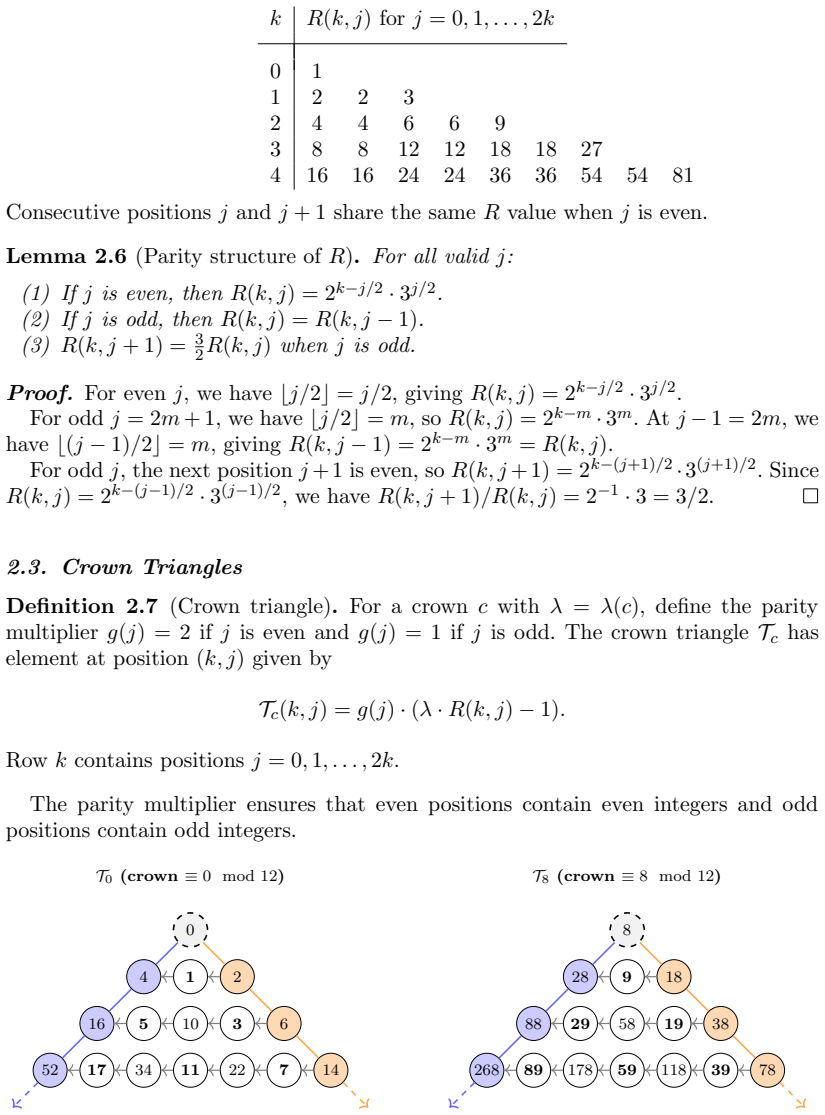
- The manuscript should include a short table or explicit list of the first few rows of L_1 for k=2,4,6,8,10 showing the explicit integers and confirming the algebraic factorization when k≡2 (mod 4).
- Notation: the boundary-exit rule at a=1 is stated to depend on the factorization of λ · 3^{b+1} − 1; a single worked example for a small λ would remove any ambiguity about how the trajectory continues across skeletons.
Simulated Author's Rebuttal
We thank the referee for the positive summary, significance assessment, and recommendation of minor revision. No specific major comments were enumerated in the report, so we have no individual points requiring point-by-point rebuttal or revision at this stage. We remain available to address any additional feedback.
Circularity Check
No significant circularity; derivation self-contained
full rationale
The paper starts from the standard, externally verifiable fact that every odd positive integer n admits a unique factorization n = λ · 2^a · 3^b − 1 with gcd(λ,6)=1 and a≥1. From this it defines a coordinate system on countably many triangles whose rows are indexed by k=a+b and whose internal flow is the deterministic map (a,b)→(a−1,b+1). The central claim—that rows k≡2 (mod 4), k≥6 in L_1 contain only composites—is obtained by an algebraic factorization of 2^a 3^b −1 that is forced precisely when a+b≡2 (mod 4) and a+b≥6; this is a direct number-theoretic identity, not a fitted parameter or self-referential definition. No self-citations, ansatzes, or renamings of known results are load-bearing. The entire argument is stated to be independent of the Collatz conjecture.
Axiom & Free-Parameter Ledger
axioms (1)
- domain assumption Every odd positive integer n can be written uniquely as n = λ · 2^a · 3^b - 1 where gcd(λ, 6) = 1 and a ≥ 1.
invented entities (2)
-
Infinite triangles partition
no independent evidence
-
Skeletons L_λ
no independent evidence
Reference graph
Works this paper leans on
-
[1]
Applegate and J
D. Applegate and J. C. Lagarias. Density bounds for the 3x+ 1 problem. I. Tree-search method.Mathematics of Computation, 64(209):411–426, 1995
1995
-
[2]
Baˇ rina
D. Baˇ rina. Convergence verification of the Collatz problem.The Journal of Supercom- puting, 77(3):2681–2688, 2021
2021
-
[3]
P. T. Bateman and R. A. Horn. A heuristic asymptotic formula concerning the distribution of prime numbers.Mathematics of Computation, 16(79):363–367, 1962
1962
-
[4]
Blecksmith, M
R. Blecksmith, M. McCallum, and J. L. Selfridge. 3-smooth representations of integers. American Mathematical Monthly, 105(6):529–543, 1998
1998
-
[5]
L. Flatto. Z-numbers andβ-transformations.Symbolic Dynamics and Its Applications (P. Walters, ed.), vol. 135 ofContemporary Mathematics, pp. 181–201, American Mathe- matical Society, 1992
1992
-
[6]
R. K. Guy.Unsolved Problems in Number Theory, 3rd ed., Problem Books in Mathematics, vol. 1. Springer, New York, 2004
2004
-
[7]
Kannan and C
T. Kannan and C. Ganesa Moorthy. Collatz Conjecture for Modulo an Integer.Interna- tional Journal of Mathematics and its Applications, 4(3-A):41–61, 2016
2016
-
[8]
K. Knight. Collatz high cycles do not exist.Discrete Mathematics, 349:114812, 2026
2026
-
[9]
J. C. Lagarias. The 3x+ 1 problem and its generalizations.The American Mathematical Monthly, 92(1):3–23, 1985
1985
-
[10]
J. C. Lagarias.The Ultimate Challenge: The3x+ 1Problem. American Mathematical Society, 2010
2010
-
[11]
J. C. Lagarias and A. Weiss. The 3x+ 1 problem: Two stochastic models.Annals of Applied Probability, 2(1):229–261, 1992
1992
-
[12]
K. Mahler. An unsolved problem on the powers of 3/2.Journal of the Australian Mathe- matical Society, 8(2):313–321, 1968
1968
-
[13]
The On-Line Encyclopedia of Integer Sequences,
OEIS Foundation Inc., “The On-Line Encyclopedia of Integer Sequences,”https://oeis. org, 2024
2024
-
[14]
W. Ren. Collatz dynamics is partitioned by residue class regularly.Research in Mathe- matics, 10(1):2269657, 2023. 20
2023
-
[15]
Sorenson and J
J. Sorenson and J. Webster. Strong pseudoprimes to twelve prime bases.Mathematics of Computation, 86(304):985–1003, 2017
2017
-
[16]
T. Tao. Almost all orbits of the Collatz map attain almost bounded values.Forum of Mathematics, Pi, 10:e12, 2022
2022
-
[17]
R. Terras. A stopping time problem on the positive integers.Acta Arithmetica, 30:241– 252, 1976
1976
-
[18]
Wirsching.The Dynamical System Generated by the3n+ 1Function, Lecture Notes in Mathematics, No
G. Wirsching.The Dynamical System Generated by the3n+ 1Function, Lecture Notes in Mathematics, No. 1681. Springer-Verlag: Berlin, 1998. 21
1998
discussion (0)
Sign in with ORCID, Apple, or X to comment. Anyone can read and Pith papers without signing in.