REVIEW 3 major objections 5 minor 66 references
Rhythm Controllable and Efficient Zero-Shot Voice Conversion via Shortcut Flow Matching
T0 review · 3 major / 5 minor · reviewed 2026-08-07 · deepseek-v4-flash
Pith's one-line read R-VC claims that zero-shot voice conversion can transfer both timbre and rhythm to an unseen target speaker while generating speech in as few as two sampling steps, matching or beating larger baselines in naturalness, intelligibility, and…
desk verdict Solid rhythm-controllable VC system, but the printed self-consistency equation is wrong as written; a referee must verify it before accepting the few-step claim. read the letter →
The pith
A machine-rendered reading of the paper's core claim, the machinery that carries it, and where it could break.
The reading
What carries the argument
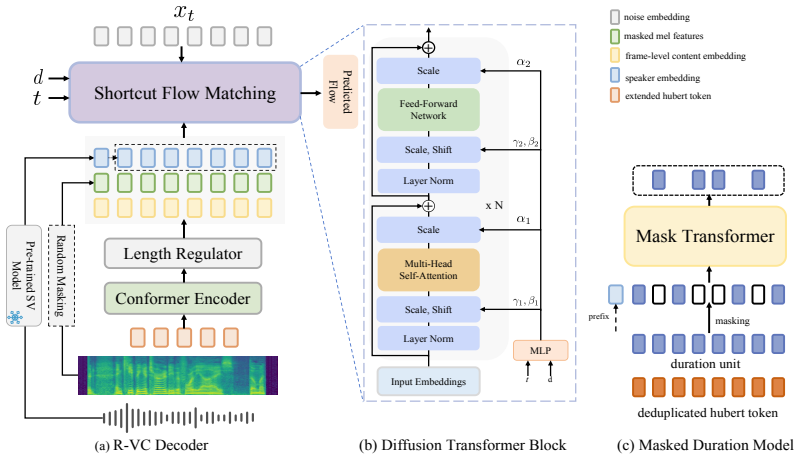
Shortcut flow matching is the efficiency engine: the decoder regresses a normalized shortcut $s(x_t, t, d)$ that points from the current noisy spectrogram to the next point after a step of size $d$, trained with an optimal-transport conditional flow matching loss at $d=0$ plus a self-consistency target $s(x_t,t,2d)=\frac12\bigl(s(x_t,t,d)+s(x'_{t+d},t,d)\bigr)$ so predictions stay consistent across step sizes. The other load-bearing piece is the masked generative transformer for duration, which uses mask-predict iterative decoding conditioned on deduplicated HuBERT tokens, unmasked context durations, and a speaker embedding to predict the unit durations that transfer the target's rhythm.
What would settle it
Inspect the released training loop for the self-consistency loss and verify that the second term of Eq. (7) uses time index $t+d$, i.e. $s(x'_{t+d}, t+d, d)$, and not $t$ as printed; if the code matches the printed form, retraining with that literal objective and measuring two-step word error rate, speaker similarity, and perceptual quality on the paper's test set would directly settle the claim.
Extended reading notes
Core claim
The paper's central claim is that three design choices together yield a zero-shot voice converter that is both rhythm-controllable and efficient. First, perturbing the input waveform and discretizing HuBERT features with K-means, then deduplicating the tokens, removes timbre and prosody leakage from the content stream. Second, a non-autoregressive masked transformer predicts unit-level durations so the linguistic content is stretched or compressed to match the target speaker's rhythm; the paper reports 90.2% speaking-rate category accuracy and higher emotion transfer scores as evidence. Third, a Diffusion Transformer trained with shortcut flow matching conditions on the desired step size and a self-consistency loss, letting the model take large denoising jumps; the authors report two-step generation with a word error rate of 3.51 and speaker similarity essentially matching their ten-step decoder while running about 2.83 times faster.
Load-bearing premise
The two-step generation claim rests on the self-consistency identity in Eq. (7) being a valid training target; if its second term is evaluated at time $t$ instead of $t+d$ as printed, the shortcut target is mis-specified and the few-step results would not hold.
Editorial extensions
If this is right
- Two-step R-VC reaches a real-time factor of 0.12 on a V100, making zero-shot voice conversion viable in latency-sensitive applications.
- Because the duration model is trained on deduplicated content tokens, the same linguistic content can be re-timed to different target styles without retraining, demonstrated for slow, normal, and fast speaking rates.
- Removing source prosody before content extraction reduces timbre leakage, so converted speech follows the target speaker's characteristics rather than the source's emotional style.
- Shortcut flow matching keeps two-step WER within 0.04 points and speaker similarity within 0.001 of the ten-step variant, indicating few-step generation does not trade away intelligibility or similarity.
- The 2.83x speedup over the ten-step CFM decoder closes the latency gap with non-diffusion voice converters while keeping quality near the vocoder upper bound.
Reading between the lines
- If the self-consistency target is corrected and reproduced, the same step-size conditioning could speed up other flow-matching speech systems, such as text-to-speech and speech editing, without architectural change.
- The deduplication-plus-duration-remodeling recipe suggests a general strategy for prosody transfer: any prosodic feature that survives token deduplication could in principle be re-targeted by a learned re-timing model.
- The paper's rhythm-control evaluation measures only speaking rate; a natural extension would test finer prosodic contours such as pauses and stress, which would likely expose where unit-level duration prediction still errs.
- Because the decoder separates a global speaker verification embedding from a masked target prompt, the model could be probed to see whether time-invariant timbre and time-varying style are truly independent in the generated audio.
Editorial analysis
A structured set of objections, weighed in public.
Referee Report
Summary. The paper proposes R-VC, a zero-shot voice conversion system that combines discrete HuBERT content tokens with data perturbation, a masked generative transformer for duration/rhythm modeling, and a diffusion-transformer decoder trained with shortcut flow matching. The central claim is that R-VC achieves state-of-the-art naturalness, intelligibility, and style transfer with comparable speaker similarity to larger models, while generating speech in as few as two sampling steps (a 2.83x speedup over 10-step CFM). The paper reports objective and subjective evaluations on LibriSpeech test-clean and the ESD dataset, plus ablations on the duration model, speaker conditioning, data perturbation, architecture, and the self-consistency mixing fraction.
Significance. If the method is correct, R-VC makes two useful contributions to zero-shot VC: explicit rhythm control via non-autoregressive duration modeling, and improved sampling efficiency via shortcut flow matching. The paper is generally well organized, includes informative ablations (Tables 4, 5, 8), reports both objective and subjective metrics, and provides a demo page with audio samples. The main technical risk is the self-consistency equation in Section 3.4 and Appendix B.2: as printed, it is mathematically inconsistent with the shortcut definition, which directly affects the load-bearing few-step generation claim. Because no code is released, the reader cannot determine whether the text is a typo or the implemented objective. With the identity corrected and the evaluation strengthened with error bars, the contributions would be credible and relevant to the speech synthesis community.
major comments (3)
- [Section 3.4, Eq. (7); Appendix B.2, Eq. (13)] The self-consistency identity has a wrong time index. From the shortcut definition x'_{t+d}=x_t+d*s(x_t,t,d), applying a second shortcut of size d gives x_t + d*s(x_t,t,d) + d*s(x'_{t+d}, t+d, d). Equating this to the 2d shortcut x_t + 2d*s(x_t,t,2d) yields s(x_t,t,2d)=1/2[s(x_t,t,d)+s(x'_{t+d},t+d,d)]. The printed equation and the starget formula in Appendix B.2 evaluate the second term at time t instead of t+d. If training uses the printed objective literally, the self-consistency target does not correspond to two consistent half-steps and the claimed NFE=2 performance is not a consequence of the stated loss; if it is a typo, the corrected identity must be stated explicitly for the method to be reproducible.
- [Section 4.2, Table 1; Section 4.3, Table 2] Objective metrics (WER, CER, SECS, UTMOS, EMO) are reported as point estimates without confidence intervals, bootstrap resampling, or significance tests. Several key comparisons rest on very small margins, e.g., R-VC NFE=2 has SECS 0.930 vs CosyVoice-VC 0.933 and UTMOS 4.10 vs 4.09; R-VC CFM WER 3.47 vs R-VC NFE=2 WER 3.51. Without variance estimates, the claim of 'surpassing' these baselines is not statistically supported. Please provide per-utterance error bars or bootstrap confidence intervals for all objective metrics.
- [Section 4.4, Table 3] The rhythm control evaluation lacks a baseline for comparison. The test set is imbalanced (2071 of 2620 samples are in the 'normal' class), so an always-normal predictor would already achieve 79.0% 'accuracy.' The per-class accuracies (86.0%, 92.3%, 80.7%) are more informative, but no error bars or significance tests are given, and no comparison is made to a source-rhythm baseline or to the duration model without speaker conditioning. Given that rhythm control is a central contribution, this analysis needs a stronger baseline and uncertainty quantification.
minor comments (5)
- [Section 3.5] There is a typo in 'shourtcut flow matching loss'; it should read 'shortcut.'
- [Section 4.2, text after Table 1] The text says the model surpasses baselines 'except inference latency,' but Table 1 shows R-VC NFE=2 has RTF 0.12 versus FACodec-VC 0.10; please clarify that R-VC is slightly slower than the fastest non-diffusion baseline while much faster than 10-step CFM.
- [Figure 3] The x-axis of Figure 3 should be labeled explicitly as the number of sampling steps (NFE), and the two curves should be distinguished in the legend with the same naming convention used in Table 1.
- [Abstract and Section 4.2] The abstract states the model 'surpasses [baselines] in terms of speech naturalness, intelligibility and style transfer performance,' but style transfer results appear only in Table 2 (ESD emotion transfer), not in Table 1; please cross-reference the correct table when making this claim.
- [Section 3.3] The iteration index t in the duration model equations (Eq. 3-5) conflicts with the continuous time t used in the shortcut flow matching section; consider renaming the iteration index to j or n to avoid confusion.
Circularity Check
No significant circularity: R-VC's claims are grounded in external benchmarks and the shortcut objective is anchored by the d=0 flow-matching loss; self-citations are contextual rather than load-bearing.
full rationale
R-VC's central claims are not circular. The zero-shot quality claims are measured against external references: WavLM-based SECS, Whisper WER/CER, UTMOS, human QMOS/SMOS, Emotion2Vec emotion scores, and computed speaking-rate alignment; none of these metrics is a function of the model's own fitted parameters. The few-step generation claim rests on the shortcut self-consistency objective, which is a standard bootstrapping loss: the d=0 term is pinned to the OT-CFM vector field (x1-x0), so the self-consistency equation is not the sole target and the two-step output is not equivalent to a fitted input by construction. Self-citations (e.g., Zuo et al. 2025, Ji et al. 2024a, Ji et al. 2024b) appear in contextual descriptions of prompting, parallel decoding, and PPS metrics, but none is load-bearing for the main claims. The paper also includes an explicit limitation in Section 7 on duration-prediction instability, and Appendix B.2 Eq. (13) contains a likely time-index typo (the second shortcut should be evaluated at t+d, not t); that is a correctness and reproducibility risk, not a circularity. No code release is indicated, so the typo cannot be disambiguated from the manuscript alone, but this does not change the circularity verdict.
Assumptions & free parameters
free parameters (5)
- Number of ODE time steps N =
128
- Self-consistency batch fraction k =
0.3
- Classifier-free guidance scale alpha =
0.7
- Masking schedule in duration model =
p = sin(u), u~U[0, pi/2]
- Duration decoding iterations T =
not specified
assumptions (3)
- domain assumption HuBERT K-means discrete tokens are a speaker-neutral representation of linguistic content
- domain assumption Data perturbation (formant shifting, pitch randomization, equalizer) removes timbre and style information from the waveform
- ad hoc to paper Self-consistency property of shortcut models
Cite this review
Pith. "Pith review of Rhythm Controllable and Efficient Zero-Shot Voice Conversion via Shortcut Flow Matching." pith.science (2026). https://pith.science/paper/QVUVDA5H
@misc{pith2026250601014,
  author       = {Pith},
  title        = {Pith review of: Rhythm Controllable and Efficient Zero-Shot Voice Conversion via Shortcut Flow Matching},
  year         = {2026},
  howpublished = {\url{https://pith.science/paper/QVUVDA5H}},
  note         = {Machine review of arXiv:2506.01014}
}
read the original abstract
Zero-Shot Voice Conversion (VC) aims to transform the source speaker's timbre into an arbitrary unseen one while retaining speech content. Most prior work focuses on preserving the source's prosody, while fine-grained timbre information may leak through prosody, and transferring target prosody to synthesized speech is rarely studied. In light of this, we propose R-VC, a rhythm-controllable and efficient zero-shot voice conversion model. R-VC employs data perturbation techniques and discretize source speech into Hubert content tokens, eliminating much content-irrelevant information. By leveraging a Mask Generative Transformer for in-context duration modeling, our model adapts the linguistic content duration to the desired target speaking style, facilitating the transfer of the target speaker's rhythm. Furthermore, R-VC introduces a powerful Diffusion Transformer (DiT) with shortcut flow matching during training, conditioning the network not only on the current noise level but also on the desired step size, enabling high timbre similarity and quality speech generation in fewer sampling steps, even in just two, thus minimizing latency. Experimental results show that R-VC achieves comparable speaker similarity to state-of-the-art VC methods with a smaller dataset, and surpasses them in terms of speech naturalness, intelligibility and style transfer performance.
Figures


Figures from the paper (2 more)


Reference graph
Works this paper leans on
-
[1]
Arun Babu, Changhan Wang, Andros Tjandra, Kushal Lakhotia, Qiantong Xu, Naman Goyal, Kritika Singh, Patrick Von Platen, Yatharth Saraf, Juan Pino, et al. 2021. Xls-r: Self-supervised cross-lingual speech representation learning at scale. arXiv preprint arXiv:2111.09296
arXiv 2021
-
[2]
Alexei Baevski, Yuhao Zhou, Abdelrahman Mohamed, and Michael Auli. 2020. wav2vec 2.0: A framework for self-supervised learning of speech representations. Advances in neural information processing systems, 33:12449--12460
2020
-
[3]
Zal \'a n Borsos, Rapha \"e l Marinier, Damien Vincent, Eugene Kharitonov, Olivier Pietquin, Matt Sharifi, Dominik Roblek, Olivier Teboul, David Grangier, Marco Tagliasacchi, et al. 2023 a . Audiolm: a language modeling approach to audio generation. IEEE/ACM transactions on audio, speech, and language processing, 31:2523--2533
work page 2023
-
[4]
Zal \'a n Borsos, Matt Sharifi, Damien Vincent, Eugene Kharitonov, Neil Zeghidour, and Marco Tagliasacchi. 2023 b . Soundstorm: Efficient parallel audio generation. arXiv preprint arXiv:2305.09636
arXiv 2023
-
[5]
Edresson Casanova, Julian Weber, Christopher D Shulby, Arnaldo Candido Junior, Eren G \"o lge, and Moacir A Ponti. 2022. Yourtts: Towards zero-shot multi-speaker tts and zero-shot voice conversion for everyone. In International Conference on Machine Learning, pages 2709--2720. PMLR
2022
-
[6]
Huiwen Chang, Han Zhang, Lu Jiang, Ce Liu, and William T Freeman. 2022. Maskgit: Masked generative image transformer. In Proceedings of the IEEE/CVF Conference on Computer Vision and Pattern Recognition, pages 11315--11325
work page 2022
-
[7]
Ricky TQ Chen, Yulia Rubanova, Jesse Bettencourt, and David K Duvenaud. 2018. Neural ordinary differential equations. Advances in neural information processing systems, 31
2018
-
[8]
Sanyuan Chen, Chengyi Wang, Zhengyang Chen, Yu Wu, Shujie Liu, Zhuo Chen, Jinyu Li, Naoyuki Kanda, Takuya Yoshioka, Xiong Xiao, et al. 2022. Wavlm: Large-scale self-supervised pre-training for full stack speech processing. IEEE Journal of Selected Topics in Signal Processing, 16(6):1505--1518
2022
Show all 66 references
-
[9]
Yushen Chen, Zhikang Niu, Ziyang Ma, Keqi Deng, Chunhui Wang, Jian Zhao, Kai Yu, and Xie Chen. 2024 a . F5-tts: A fairytaler that fakes fluent and faithful speech with flow matching. arXiv preprint arXiv:2410.06885
2024 arXiv
-
[10]
Zhengyang Chen, Shuai Wang, Mingyang Zhang, Xuechen Liu, Junichi Yamagishi, and Yanmin Qian. 2024 b . Disentangling the prosody and semantic information with pre-trained model for in-context learning based zero-shot voice conversion. arXiv preprint arXiv:2409.05004
2024 arXiv
-
[11]
Ha-Yeong Choi, Sang-Hoon Lee, and Seong-Whan Lee. 2023. Diff-hiervc: Diffusion-based hierarchical voice conversion with robust pitch generation and masked prior for zero-shot speaker adaptation. International Speech Communication Association, pages 2283--2287
2023
-
[12]
Ha-Yeong Choi, Sang-Hoon Lee, and Seong-Whan Lee. 2024. Dddm-vc: Decoupled denoising diffusion models with disentangled representation and prior mixup for verified robust voice conversion. In Proceedings of the AAAI Conference on Artificial Intelligence, volume 38, pages 17862--17870
2024
-
[13]
Hyeong-Seok Choi, Juheon Lee, Wansoo Kim, Jie Lee, Hoon Heo, and Kyogu Lee. 2021. Neural analysis and synthesis: Reconstructing speech from self-supervised representations. Advances in Neural Information Processing Systems, 34:16251--16265
2021
-
[14]
Erica Cooper, Cheng-I Lai, Yusuke Yasuda, Fuming Fang, Xin Wang, Nanxin Chen, and Junichi Yamagishi. 2020. Zero-shot multi-speaker text-to-speech with state-of-the-art neural speaker embeddings. In ICASSP 2020-2020 IEEE International Conference on Acoustics, Speech and Signal ...
2020
-
[15]
Zhihao Du, Qian Chen, Shiliang Zhang, Kai Hu, Heng Lu, Yexin Yang, Hangrui Hu, Siqi Zheng, Yue Gu, Ziyang Ma, et al. 2024. Cosyvoice: A scalable multilingual zero-shot text-to-speech synthesizer based on supervised semantic tokens. arXiv preprint arXiv:2407.05407
2024 arXiv
-
[16]
Abhimanyu Dubey, Abhinav Jauhri, Abhinav Pandey, Abhishek Kadian, Ahmad Al-Dahle, Aiesha Letman, Akhil Mathur, Alan Schelten, Amy Yang, Angela Fan, et al. 2024. The llama 3 herd of models. arXiv preprint arXiv:2407.21783
2024 arXiv
-
[17]
Patrick Esser, Sumith Kulal, Andreas Blattmann, Rahim Entezari, Jonas M \"u ller, Harry Saini, Yam Levi, Dominik Lorenz, Axel Sauer, Frederic Boesel, et al. 2024. Scaling rectified flow transformers for high-resolution image synthesis. In Forty-first International Conference o...
2024
-
[18]
Kevin Frans, Danijar Hafner, Sergey Levine, and Pieter Abbeel. 2024. One step diffusion via shortcut models. arXiv preprint arXiv:2410.12557
2024 arXiv
-
[19]
Marjan Ghazvininejad, Omer Levy, Yinhan Liu, and Luke Zettlemoyer. 2019. Mask-predict: Parallel decoding of conditional masked language models. arXiv preprint arXiv:1904.09324
2019 arXiv
-
[20]
Yewei Gu, Zhenyu Zhang, Xiaowei Yi, and Xianfeng Zhao. 2021. Mediumvc: Any-to-any voice conversion using synthetic specific-speaker speeches as intermedium features. arXiv preprint arXiv:2110.02500
2021 arXiv
-
[21]
Jonathan Ho, Ajay Jain, and Pieter Abbeel. 2020. Denoising diffusion probabilistic models. Advances in neural information processing systems, 33:6840--6851
2020
-
[22]
Chin-Cheng Hsu, Hsin-Te Hwang, Yi-Chiao Wu, Yu Tsao, and Hsin-Min Wang. 2016. Voice conversion from non-parallel corpora using variational auto-encoder. In 2016 Asia-Pacific Signal and Information Processing Association Annual Summit and Conference (APSIPA), pages 1--6. IEEE
2016
-
[23]
Wei-Ning Hsu, Benjamin Bolte, Yao-Hung Hubert Tsai, Kushal Lakhotia, Ruslan Salakhutdinov, and Abdelrahman Mohamed. 2021. Hubert: Self-supervised speech representation learning by masked prediction of hidden units. IEEE/ACM transactions on audio, speech, and language processin...
2021
-
[24]
Shengpeng Ji, Ziyue Jiang, Hanting Wang, Jialong Zuo, and Zhou Zhao. 2024 a . Mobilespeech: A fast and high-fidelity framework for mobile zero-shot text-to-speech. arXiv preprint arXiv:2402.09378
2024 arXiv
-
[25]
Shengpeng Ji, Jialong Zuo, Minghui Fang, Ziyue Jiang, Feiyang Chen, Xinyu Duan, Baoxing Huai, and Zhou Zhao. 2024 b . Textrolspeech: A text style control speech corpus with codec language text-to-speech models. In ICASSP 2024-2024 IEEE International Conference on Acoustics, Sp...
2024
-
[26]
Ziyue Jiang, Jinglin Liu, Yi Ren, Jinzheng He, Zhenhui Ye, Shengpeng Ji, Qian Yang, Chen Zhang, Pengfei Wei, Chunfeng Wang, et al. 2024. Mega-tts 2: Boosting prompting mechanisms for zero-shot speech synthesis. In The Twelfth International Conference on Learning Representations
2024
-
[27]
Ziyue Jiang, Yi Ren, Ruiqi Li, Shengpeng Ji, Boyang Zhang, Zhenhui Ye, Chen Zhang, Bai Jionghao, Xiaoda Yang, Jialong Zuo, et al. 2025. Megatts 3: Sparse alignment enhanced latent diffusion transformer for zero-shot speech synthesis. arXiv preprint arXiv:2502.18924
2025 arXiv
-
[28]
Ziyue Jiang, Qian Yang, Jialong Zuo, Zhenhui Ye, Rongjie Huang, Yi Ren, and Zhou Zhao. 2023. Fluentspeech: Stutter-oriented automatic speech editing with context-aware diffusion models. arXiv preprint arXiv:2305.13612
2023 arXiv
-
[29]
Zeqian Ju, Yuancheng Wang, Kai Shen, Xu Tan, Detai Xin, Dongchao Yang, Yanqing Liu, Yichong Leng, Kaitao Song, Siliang Tang, et al. 2024. Naturalspeech 3: Zero-shot speech synthesis with factorized codec and diffusion models. arXiv preprint arXiv:2403.03100
2024 arXiv
-
[30]
Heeseung Kim, Sungwon Kim, Jiheum Yeom, and Sungroh Yoon. 2023. Unitspeech: Speaker-adaptive speech synthesis with untranscribed data. arXiv preprint arXiv:2306.16083
2023 arXiv
-
[31]
Jungil Kong, Jaehyeon Kim, and Jaekyoung Bae. 2020. Hifi-gan: Generative adversarial networks for efficient and high fidelity speech synthesis. Advances in neural information processing systems, 33:17022--17033
2020
-
[32]
Matthew Le, Apoorv Vyas, Bowen Shi, Brian Karrer, Leda Sari, Rashel Moritz, Mary Williamson, Vimal Manohar, Yossi Adi, Jay Mahadeokar, et al. 2024. Voicebox: Text-guided multilingual universal speech generation at scale. Advances in neural information processing systems, 36
2024
-
[33]
Ann Lee, Hongyu Gong, Paul-Ambroise Duquenne, Holger Schwenk, Peng-Jen Chen, Changhan Wang, Sravya Popuri, Yossi Adi, Juan Pino, Jiatao Gu, et al. 2021. Textless speech-to-speech translation on real data. arXiv preprint arXiv:2112.08352
2021 arXiv
-
[34]
Sang-Hoon Lee, Ha-Yeong Choi, Seung-Bin Kim, and Seong-Whan Lee. 2023. Hierspeech++: Bridging the gap between semantic and acoustic representation of speech by hierarchical variational inference for zero-shot speech synthesis. arXiv preprint arXiv:2311.12454
2023 arXiv
-
[35]
Junjie Li, Yiwei Guo, Xie Chen, and Kai Yu. 2024. Sef-vc: Speaker embedding free zero-shot voice conversion with cross attention. In ICASSP 2024-2024 IEEE International Conference on Acoustics, Speech and Signal Processing (ICASSP), pages 12296--12300. IEEE
2024
-
[36]
Yaron Lipman, Ricky TQ Chen, Heli Ben-Hamu, Maximilian Nickel, and Matt Le. 2022. Flow matching for generative modeling. arXiv preprint arXiv:2210.02747
2022 arXiv
-
[37]
Eric Luhman and Troy Luhman. 2021. Knowledge distillation in iterative generative models for improved sampling speed. arXiv preprint arXiv:2101.02388
2021 arXiv
-
[38]
Ziyang Ma, Zhisheng Zheng, Jiaxin Ye, Jinchao Li, Zhifu Gao, Shiliang Zhang, and Xie Chen. 2023. emotion2vec: Self-supervised pre-training for speech emotion representation. arXiv preprint arXiv:2312.15185
2023 arXiv
-
[39]
Shivam Mehta, Ruibo Tu, Jonas Beskow, \'E va Sz \'e kely, and Gustav Eje Henter. 2024. Matcha-tts: A fast tts architecture with conditional flow matching. In ICASSP 2024-2024 IEEE International Conference on Acoustics, Speech and Signal Processing (ICASSP), pages 11341--11345. IEEE
2024
-
[40]
Ziqian Ning, Qicong Xie, Pengcheng Zhu, Zhichao Wang, Liumeng Xue, Jixun Yao, Lei Xie, and Mengxiao Bi. 2023. Expressive-vc: Highly expressive voice conversion with attention fusion of bottleneck and perturbation features. In ICASSP 2023-2023 IEEE International Conference on A...
2023
-
[41]
Vassil Panayotov, Guoguo Chen, Daniel Povey, and Sanjeev Khudanpur. 2015. Librispeech: an asr corpus based on public domain audio books. In 2015 IEEE international conference on acoustics, speech and signal processing (ICASSP), pages 5206--5210. IEEE
2015
-
[42]
William Peebles and Saining Xie. 2023. Scalable diffusion models with transformers. In Proceedings of the IEEE/CVF International Conference on Computer Vision, pages 4195--4205
2023
-
[43]
Vadim Popov, Ivan Vovk, Vladimir Gogoryan, Tasnima Sadekova, Mikhail Kudinov, and Jiansheng Wei. 2021. Diffusion-based voice conversion with fast maximum likelihood sampling scheme. arXiv preprint arXiv:2109.13821
2021 arXiv
-
[44]
Vineel Pratap, Qiantong Xu, Anuroop Sriram, Gabriel Synnaeve, and Ronan Collobert. 2020. Mls: A large-scale multilingual dataset for speech research. arXiv preprint arXiv:2012.03411
2020 arXiv
-
[45]
Kaizhi Qian, Yang Zhang, Shiyu Chang, Mark Hasegawa-Johnson, and David Cox. 2020. Unsupervised speech decomposition via triple information bottleneck. In International Conference on Machine Learning, pages 7836--7846. PMLR
2020
-
[46]
Kaizhi Qian, Yang Zhang, Shiyu Chang, Xuesong Yang, and Mark Hasegawa-Johnson. 2019. Autovc: Zero-shot voice style transfer with only autoencoder loss. In International Conference on Machine Learning, pages 5210--5219. PMLR
2019
-
[47]
Kaizhi Qian, Yang Zhang, Heting Gao, Junrui Ni, Cheng-I Lai, David Cox, Mark Hasegawa-Johnson, and Shiyu Chang. 2022. Contentvec: An improved self-supervised speech representation by disentangling speakers. In International Conference on Machine Learning, pages 18003--18017. PMLR
2022
-
[48]
Takaaki Saeki, Detai Xin, Wataru Nakata, Tomoki Koriyama, Shinnosuke Takamichi, and Hiroshi Saruwatari. 2022. Utmos: Utokyo-sarulab system for voicemos challenge 2022. arXiv preprint arXiv:2204.02152
2022 arXiv
-
[49]
David Snyder, Daniel Garcia-Romero, Gregory Sell, Daniel Povey, and Sanjeev Khudanpur. 2018. X-vectors: Robust dnn embeddings for speaker recognition. In 2018 IEEE international conference on acoustics, speech and signal processing (ICASSP), pages 5329--5333. IEEE
2018
-
[50]
Jianlin Su, Murtadha Ahmed, Yu Lu, Shengfeng Pan, Wen Bo, and Yunfeng Liu. 2024. Roformer: Enhanced transformer with rotary position embedding. Neurocomputing, 568:127063
2024
-
[51]
Zhiyuan Tan, Jianguo Wei, Junhai Xu, Yuqing He, and Wenhuan Lu. 2021. Zero-shot voice conversion with adjusted speaker embeddings and simple acoustic features. In ICASSP 2021-2021 IEEE International Conference on Acoustics, Speech and Signal Processing (ICASSP), pages 5964--5968. IEEE
2021
-
[53]
Alexander Tong, Nikolay Malkin, Guillaume Huguet, Yanlei Zhang, Jarrid Rector-Brooks, Kilian Fatras, Guy Wolf, and Yoshua Bengio. 2023 b . Conditional flow matching: Simulation-free dynamic optimal transport. arXiv preprint arXiv:2302.00482, 2(3)
2023 arXiv
-
[54]
Aaron Van Den Oord, Oriol Vinyals, et al. 2017. Neural discrete representation learning. Advances in neural information processing systems, 30
2017
-
[55]
Benjamin Van Niekerk, Marc-Andr \'e Carbonneau, Julian Za \" di, Matthew Baas, Hugo Seut \'e , and Herman Kamper. 2022 a . A comparison of discrete and soft speech units for improved voice conversion. In ICASSP 2022-2022 IEEE International Conference on Acoustics, Speech and S...
2022
-
[56]
Benjamin Van Niekerk, Marc-Andr \'e Carbonneau, Julian Za \" di, Matthew Baas, Hugo Seut \'e , and Herman Kamper. 2022 b . A comparison of discrete and soft speech units for improved voice conversion. In ICASSP 2022-2022 IEEE International Conference on Acoustics, Speech and S...
2022
-
[57]
Chengyi Wang, Sanyuan Chen, Yu Wu, Ziqiang Zhang, Long Zhou, Shujie Liu, Zhuo Chen, Yanqing Liu, Huaming Wang, Jinyu Li, et al. 2023 a . Neural codec language models are zero-shot text to speech synthesizers. arXiv preprint arXiv:2301.02111
2023 arXiv
-
[58]
Zhichao Wang, Yuanzhe Chen, Lei Xie, Qiao Tian, and Yuping Wang. 2023 b . Lm-vc: Zero-shot voice conversion via speech generation based on language models. IEEE Signal Processing Letters
2023
-
[59]
Da-Yi Wu, Yen-Hao Chen, and Hung-Yi Lee. 2020. Vqvc+: One-shot voice conversion by vector quantization and u-net architecture. arXiv preprint arXiv:2006.04154
2020 arXiv
-
[60]
Dongchao Yang, Jinchuan Tian, Xu Tan, Rongjie Huang, Songxiang Liu, Xuankai Chang, Jiatong Shi, Sheng Zhao, Jiang Bian, Xixin Wu, et al. 2023. Uniaudio: An audio foundation model toward universal audio generation. arXiv preprint arXiv:2310.00704
2023 arXiv
-
[61]
Qian Yang, Jialong Zuo, Zhe Su, Ziyue Jiang, Mingze Li, Zhou Zhao, Feiyang Chen, Zhefeng Wang, and Baoxing Huai. 2024. Mscenespeech: A multi-scene speech dataset for expressive speech synthesis. arXiv preprint arXiv:2407.14006
2024 arXiv
-
[62]
Jixun Yao, Yuguang Yang, Yi Lei, Ziqian Ning, Yanni Hu, Yu Pan, Jingjing Yin, Hongbin Zhou, Heng Lu, and Lei Xie. 2024. Promptvc: Flexible stylistic voice conversion in latent space driven by natural language prompts. In ICASSP 2024-2024 IEEE International Conference on Acoust...
2024
-
[63]
Mingyang Zhang, Yi Zhou, Yi Ren, Chen Zhang, Xiang Yin, and Haizhou Li. 2024. Refxvc: Cross-lingual voice conversion with enhanced reference leveraging. IEEE/ACM Transactions on Audio, Speech, and Language Processing
2024
-
[64]
Kun Zhou, Berrak Sisman, Rui Liu, and Haizhou Li. 2021. Seen and unseen emotional style transfer for voice conversion with a new emotional speech dataset. In ICASSP 2021-2021 IEEE International Conference on Acoustics, Speech and Signal Processing (ICASSP), pages 920--924. IEEE
2021
-
[65]
Jialong Zuo, Shengpeng Ji, Minghui Fang, Ziyue Jiang, Xize Cheng, Qian Yang, Wenrui Liu, Guangyan Zhang, Zehai Tu, Yiwen Guo, et al. 2025. Enhancing expressive voice conversion with discrete pitch-conditioned flow matching model. arXiv preprint arXiv:2502.05471
2025 arXiv
-
[66]
online" 'onlinestring :=
ENTRY address archivePrefix author booktitle chapter edition editor eid eprint eprinttype howpublished institution journal key month note number organization pages publisher school series title type volume year doi pubmed url lastchecked label extra.label sort.label short.list...
-
[67]
write newline
" write newline "" before.all 'output.state := FUNCTION n.dashify 't := "" t empty not t #1 #1 substring "-" = t #1 #2 substring "--" = not "--" * t #2 global.max substring 't := t #1 #1 substring "-" = "-" * t #2 global.max substring 't := while if t #1 #1 substring * t #2 gl...
Reviewed August 7, 2026 · model on record in the stance chip above.
Discussion (0). Sign in to comment.