REVIEW 2 major objections 1 minor
P-ARC: Exploiting Subproblem Independence for Parallel Multi-Robot Motion Planning
T0 review · 2 major / 1 minor · reviewed 2026-06-29 · grok-4.3
Pith's one-line read P-ARC parallelizes the three stages of ARC to achieve speedups approaching 4X for large multi-robot teams on 16 cores.
desk verdict P-ARC parallelizes ARC's three stages but the 4X Panda speedup is reported only for the OR-P-ARC hybrid, leaving the contribution of the stage parallelization unclear. read the letter →
The pith
A machine-rendered reading of the paper's core claim, the machinery that carries it, and where it could break.
The reading
What carries the argument
ARC's decomposition of the MRMP problem into subproblems that remain sufficiently independent to support parallel execution of the three planning stages with limited synchronization.
What would settle it
Running the parallel version on scenarios with high numbers of inter-robot conflicts and observing little or no speedup or a clear drop in solution quality due to synchronization costs.
Extended reading notes
Core claim
P-ARC proposes parallel variants for each of the three main stages in ARC—initial individual solutions, conflict detection, and conflict resolution—by exploiting the independence created by ARC's decomposition of the MRMP problem. It additionally employs an OR-parallel multi-start strategy to create the hybrid OR-P-ARC. The approach is evaluated on scaling scenarios with up to 128 robots and on large Panda manipulator teams, where it delivers planning time speedups approaching 4X over the sequential version when using 16 CPU cores.
Load-bearing premise
ARC's decomposition creates enough independence between subproblems for parallelization of the stages to succeed with limited synchronization overhead and without significant loss in solution quality.
Editorial extensions
If this is right
- Parallel execution of initial solution generation, conflict detection, and resolution can each be applied independently while preserving the overall ARC workflow.
- The hybrid OR-P-ARC strategy combines multi-start diversity with stage-level parallelism for further time reduction.
- Speedups hold across both 2D mobile robot teams and planar manipulator teams up to 128 robots when conflicts and work distribution are controlled.
- The method applies directly to real-world inspired multi-manipulator teams such as multiple Panda arms.
Reading between the lines
- The same subproblem independence could be used to parallelize other decomposed multi-agent planning methods beyond ARC.
- The observed CPU scaling suggests that further hardware such as GPUs might produce larger speedups for even bigger robot teams.
- Faster planning times could support repeated replanning loops in dynamic or uncertain environments where robots must react to moving obstacles.
Editorial analysis
A structured set of objections, weighed in public.
Referee Report
Summary. The paper introduces P-ARC as a parallel extension of the Adaptive Robot Coordination (ARC) framework for multi-robot motion planning (MRMP). It parallelizes ARC's three stages (initial individual solutions, conflict detection, and conflict resolution) by exploiting subproblem independence from ARC's decomposition. An OR-parallel multi-start strategy is additionally applied to both ARC and P-ARC to form the hybrid OR-P-ARC. Scaling experiments with up to 128 robots in 2D mobile and planar manipulator scenarios are used to evaluate the parallel strategies, and nearly 4X planning-time speedups over sequential ARC are reported for large Panda multi-manipulator teams on 16 CPU cores in real-world-inspired scenarios.
Significance. If the speedups are shown to arise specifically from parallelizing the independent subproblems with limited synchronization overhead, the approach could improve scalability of MRMP for large teams. The use of both controlled scaling tests and real manipulator scenarios provides a reasonable evaluation structure, though the attribution of gains requires clarification to assess the core contribution.
major comments (2)
- [Abstract] Abstract: the reported speedups approaching 4X for Panda teams are stated for the hybrid OR-P-ARC, yet no ablation isolates the contribution of P-ARC stage parallelization from the OR-parallel multi-start; this leaves open whether the claimed exploitation of subproblem independence (the central assumption) produces the gains or whether multi-start dominates.
- [scaling experiments] Scaling experiments description: the manuscript states that experiments with up to 128 robots control for conflicts and work distribution across ARC stages, but provides no details on baselines, run-to-run variability, or controls, preventing verification that the parallelization delivers effective speedups with limited overhead or quality loss.
minor comments (1)
- [Abstract] The abstract introduces OR-P-ARC after describing P-ARC but does not clearly separate their respective contributions in the evaluation summary.
Simulated Author's Rebuttal
We thank the referee for the constructive feedback. We address the two major comments point by point below. We agree that additional clarity is warranted on both points and will revise the manuscript accordingly.
read point-by-point responses
-
Referee: [Abstract] Abstract: the reported speedups approaching 4X for Panda teams are stated for the hybrid OR-P-ARC, yet no ablation isolates the contribution of P-ARC stage parallelization from the OR-parallel multi-start; this leaves open whether the claimed exploitation of subproblem independence (the central assumption) produces the gains or whether multi-start dominates.
Authors: The abstract correctly attributes the reported 4X speedups in the Panda scenarios to the hybrid OR-P-ARC. The scaling experiments separately evaluate the stage-parallelization strategies in P-ARC (without OR) versus the hybrid. To better isolate and highlight the contribution of subproblem independence, we will revise the abstract to explicitly report speedups from P-ARC alone in the scaling experiments and add a clarifying sentence on the relative roles of the two parallelization approaches. revision: yes
-
Referee: [scaling experiments] Scaling experiments description: the manuscript states that experiments with up to 128 robots control for conflicts and work distribution across ARC stages, but provides no details on baselines, run-to-run variability, or controls, preventing verification that the parallelization delivers effective speedups with limited overhead or quality loss.
Authors: The scaling experiments use controlled scenarios that vary robot count while fixing conflict patterns and work distribution per ARC stage. We will expand the experimental section in the revision to include explicit baselines (sequential ARC), description of run-to-run variability (multiple independent runs with reported means and standard deviations), and controls for synchronization overhead and solution quality preservation. revision: yes
Circularity Check
No circularity; empirical extension of prior ARC framework
full rationale
The paper describes algorithmic parallelization of three ARC stages by exploiting subproblem independence already present in the base ARC decomposition, plus an added OR-parallel multi-start variant. No derivation chain exists that reduces a claimed result to its inputs by construction, no fitted parameters renamed as predictions, and no load-bearing self-citation to an unverified uniqueness theorem. Experimental speedups are measured directly on scaling scenarios and Panda teams; the base independence assumption is imported from prior ARC work but treated as given rather than redefined within this paper. The reporting of OR-P-ARC results does not create a definitional loop.
Assumptions & free parameters
assumptions (1)
- domain assumption ARC's decomposition of the multi-robot motion planning problem creates independent subproblems suitable for parallel execution across the three stages.
Cite this review
Pith. "Pith review of P-ARC: Exploiting Subproblem Independence for Parallel Multi-Robot Motion Planning." pith.science (2026). https://pith.science/paper/QWKMHWTQ
@misc{pith2026260627625,
  author       = {Pith},
  title        = {Pith review of: P-ARC: Exploiting Subproblem Independence for Parallel Multi-Robot Motion Planning},
  year         = {2026},
  howpublished = {\url{https://pith.science/paper/QWKMHWTQ}},
  note         = {Machine review of arXiv:2606.27625}
}
read the original abstract
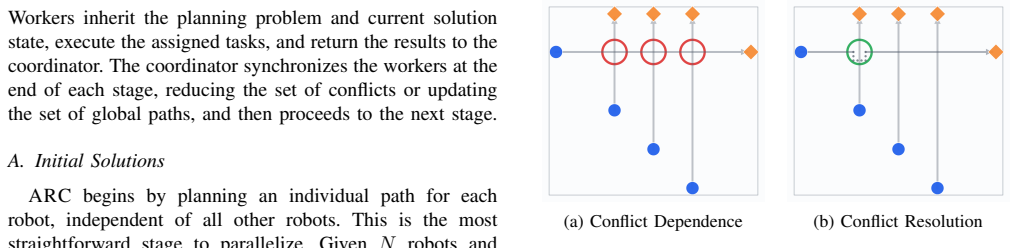
This paper presents Parallel ARC (P-ARC), a parallel formulation of the Adaptive Robot Coordination (ARC) approach to multi-robot motion planning (MRMP) which exploits subproblem independence. ARC's adaptive (de)composition of the multi-robot planning space exposes parallelism: single-robot paths are solved independently and iterative conflict detection and resolution create locally coupled subproblems. While distributing single-robot queries is trivial, not all conflicts are independent, so P-ARC proposes robot-disjoint conflict batches which enable efficient distributed detection and concurrent repair. Additionally, OR-multi-start strategies are employed at the global and subproblem resolution levels, creating a hybrid parallel strategy OR-P-ARC. We evaluate the methods against sequential ARC, multi-start OR-ARC, and coupled and prioritized parallel baselines on controlled 2D mobile robot and planar-manipulator problems with up to 256 robots and 3D Panda manipulator problems with up to 16 robots. On 16-robot Panda tasks, with 16 workers, P-ARC and OR-P-ARC achieve 3.48X and 6.67X speedups, respectively.
Figures


Figures from the paper (2 more)


Reviewed June 29, 2026 · model on record in the stance chip above.
Discussion (0). Continue with ORCID to comment.