REVIEW 3 major objections 7 minor 74 references
Magnetic flux transport via reconnection diffusion in different sonic regimes of interstellar MHD turbulence
T0 review · 3 major / 7 minor · reviewed 2026-08-06 · deepseek-v4-flash
Pith's one-line read This paper reports that magnetic flux diffusion in sub-Alfvénic turbulence matches the Reconnection Diffusion scaling $D \propto M_A^3$ in the incompressible limit, and that the exponent softens to roughly $3/(1+M_S)$ as the sonic Mach…
desk verdict The incompressible D ∝ M_A³ confirmation is robust and citable, but the new α(M_S) ≈ 3/(1+M_S) formula rests on an unverified tracer-field correspondence in the supersonic regime—a weakness the authors openly acknowledge. read the letter →
The pith
A machine-rendered reading of the paper's core claim, the machinery that carries it, and where it could break.
The reading
What carries the argument
The load-bearing object is the Reconnection Diffusion coefficient $\eta_{\rm rd} \sim L U \min(1, M_A^3)$, derived from weak Alfvénic turbulence, which the simulations target by using sub-Alfvénic forcing in an elongated periodic domain. The measurements are carried by ensembles of $10^4$ Lagrangian tracer particles restricted to the plane perpendicular to the mean magnetic field, analyzed with two estimators: the time integral of the perpendicular velocity autocorrelation and the growth of the mean square perpendicular displacement. A third, independent measurement via the Test-Field method on passive vector fields anchors the particle-based estimators in the weakly compressible runs. The compressibility dependence is captured by the empirical fit $\alpha(M_S) = \alpha_0/(1 + b M_S)$, with values near $\alpha_0 \approx 3.1$, $b \approx 1.2$ in the lower-resolution runs.
What would settle it
Run a transonic or supersonic simulation ($M_S \approx 1$–$3$) at $M_A \approx 0.25$ and measure the magnetic field diffusion coefficient with the Test-Field method; if it disagrees with the tracer-particle $D$ from the same run, the reported supersonic values are particle diffusion, not field diffusion. A second check is to replace the delta-correlated forcing with a time-correlated forcing: if $\alpha(M_S)$ changes, the empirical law is a property of the forcing scheme rather than of the turbulence regime.
Extended reading notes
Core claim
The paper's central claim is that the magnetic flux transport coefficient in sub-Alfvénic MHD turbulence is set by $D \propto M_A^3$ in the incompressible limit, and that increasing the sonic Mach number raises the effective transport at fixed $M_A$. Concretely, the simulations are consistent with $D \propto \ell v_{\rm rms} M_A^{\alpha}$, where the exponent depends on the sonic Mach number as $\alpha(M_S) \approx 3/(1+M_S)$. The authors treat the low-$M_A$ runs in which diffusion is dominated by two-dimensional ($k_\parallel = 0$) velocity modes as contaminated by the periodic numerical domain and exclude them from the fit. The work also establishes, in the weakly compressible regime, that the magnetic field diffusion coefficient extracted with the Test-Field method agrees with two new tracer-particle measurements, which is the paper's evidence for the RD assumption linking field-line and fluid-particle diffusion.
Load-bearing premise
The paper's reported diffusion coefficients are magnetic flux transport rates only if tracer particles and magnetic field lines diffuse at the same rate in supersonic turbulence; that correspondence is verified directly only at low compressibility, then assumed to carry over to the transonic and supersonic runs.
Editorial extensions
If this is right
- In molecular clouds with $M_S \sim 1$–$3$, turbulent magnetic flux transport is several times faster than the incompressible Reconnection Diffusion estimate, easing the magnetic flux problem in star and disk formation.
- The two tracer-particle estimators can be used in any MHD code to measure magnetic flux diffusion, without implementing the Test-Field method.
- The confirmed particle–field correspondence implies that the same diffusion coefficient applies to temperature, chemical composition, and similar scalar fields advected by the turbulence.
- In the supersonic limit the exponent $\alpha(M_S)$ approaches zero, so the transport tends toward the unsuppressed hydrodynamic mixing rate at fixed large-scale velocity.
Reading between the lines
- If the empirical law $\alpha(M_S) \approx 3/(1+M_S)$ extrapolates to $M_S \gg 1$, flux freezing effectively fails for large-scale fields in highly supersonic star-forming gas, leaving turbulence as the dominant flux transport channel; this extrapolation is an editorial inference, not tested in the paper.
- The paper attributes the 2D-mode diffusion to periodic boundaries; testing with a non-periodic or shearing-sheet boundary would determine whether such modes actually survive in molecular clouds, where field lines connect to the surrounding medium.
- Because the forcing is delta-correlated in time, the measured decorrelation time $\tau_{\rm dec} \propto \ell/V_A$ may reflect the forcing rather than the cascade; replacing the forcing with a sustained one is a direct test of how universal the fitted $D(M_A, M_S)$ actually is.
Editorial analysis
A structured set of objections, weighed in public.
Referee Report
Summary. The paper reports numerical measurements of the effective perpendicular diffusion coefficient of large-scale magnetic fields (reconnection diffusion, RD) in sub-Alfvénic MHD turbulence across different sonic regimes. Using tracer particles that move only perpendicular to the mean magnetic field, the authors extract diffusion coefficients with two new methods (velocity autocorrelation, D_corr, and mean squared displacement, D_yz), and validate these against the Test-Field method in weakly compressible Pencil Code runs. The incompressible and weakly compressible simulations yield D ∝ M_A^3, consistent with the RD prediction. For compressible Pluto runs at M_S = 0.1, 1, and 3, the suppression with decreasing M_A weakens, and the authors propose an empirical scaling α(M_S) ≈ 3/(1 + M_S) for D ∝ M_A^α. The paper also tests several RD assumptions, finding that the velocity decorrelation is better described by a Gaussian than an exponential function in the subsonic/transonic regimes, and that the measured decorrelation time does not match the inferred energy-transfer time.
Significance. If the results hold, the proposed α(M_S) scaling is a new quantitative characterization of reconnection diffusion in compressible turbulence, with direct implications for magnetic flux transport in molecular clouds and star formation. The work is commendable for combining three independent estimators (D_corr, D_yz, Test-Field), for cross-code consistency checks at M_S = 0.1, and for explicitly flagging its own limitations in Section 5.2. The incompressible M_A^3 result is well supported by the Test-Field validation and by agreement between two codes. However, the headline new result—the sonic-Mach dependence—currently rests on transferring the tracer/field-line correspondence from the weakly compressible regime to the supersonic regime, and on a small number of simulation points. The central claim is therefore plausible but should be regarded as conditional until the supersonic correspondence is verified.
major comments (3)
- [§4.1, §4.3, §5.2] The correspondence between tracer-particle perpendicular diffusion and magnetic-field diffusion is demonstrated only for the M_S = 0.1 Pencil runs (Figure 3). The same tracer diagnostics are then applied to the M_S = 1 and M_S = 3 Pluto runs (Figure 6) and form the basis of the α(M_S) fit in Figures 9 and 10. The authors explicitly acknowledge in Section 5.2 that this correspondence is not verified in the supersonic regime. This is a load-bearing gap: if the identification fails at high M_S, the reported D values are particle diffusivities, not magnetic-field diffusivities, and the supersonic reduction of α is unsupported. The revision should provide a direct check for at least one supersonic case—for example, a Test-Field implementation in the Pluto code or an independent measurement of magnetic field-line spreading—and quantify how the resulting uncertainty propagates into the M_S = 3 points.
- [§4.4, Figure 10] The empirical relation α(M_S) = α0/(1 + b M_S) is constrained by only four sonic Mach numbers (M_S = 0, 0.1, 1, 3), with the M_S = 0 point coming from a different code (Snoopy) and with low-M_A runs excluded on the basis of a threshold inferred from the 2D-mode contribution (Section 4.2). The two resolutions give α0 = 3.11 ± 0.04 and 2.73 ± 0.47; the very small quoted uncertainty on the low-resolution fit is not credible given the systematic influence of threshold choice and resolution. The paper should show the sensitivity of α0 and b to the exclusion criterion and to the removal of any single M_S point, and preferably add one or two intermediate sonic Mach numbers (e.g., M_S ≈ 0.3 and 2) to stabilize the fit.
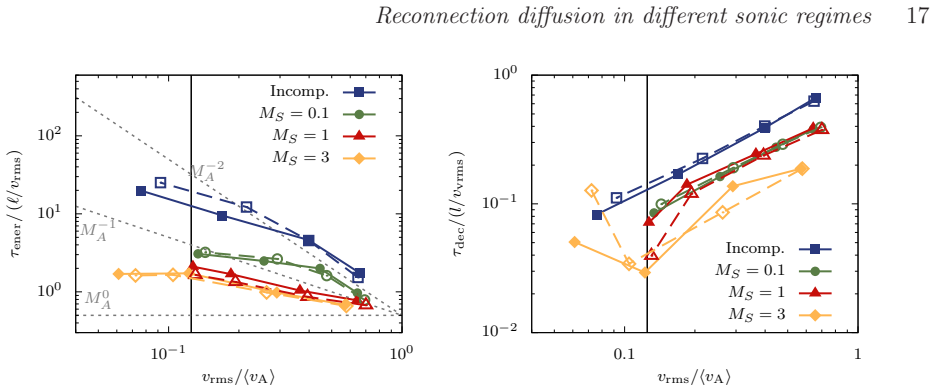
- [§4.5, §2 (Eqs. 5 and 6)] The RD derivation used in the paper relies on the assumption that the velocity decorrelation time equals the energy-transfer time at the injection scale (Section 2), but Figure 11 shows τ_dec roughly following the linear wave-crossing time ℓ/V_A, whereas τ_ener follows a different M_A dependence. The paper records this as a failed assumption yet still obtains D ∝ M_A^3. The logical connection is missing: if Eq. (5) is evaluated with the measured τ_dec(M_A), does it reproduce the measured D? A quantitative reconciliation—or an explicit statement that the M_A^3 result is not attributable to the assumed τ_dec—would remove an internal tension and strengthen the claim of confirming RD theory.
minor comments (7)
- [Abstract] The abstract states that the results confirm the RD assumption of correspondence between magnetic-field diffusion and Lagrangian-particle diffusion, but this correspondence is validated only in the weakly compressible regime (M_S = 0.1) through the Test-Field method; please add this qualification.
- [Table 1 and §3.4] The resolutions written as "1024 × 642" and "2048 × 1282" should read "1024 × 64^2" and "2048 × 128^2"; the current notation is ambiguous.
- [§3.4] The phrase "10 4 tracer particles" should read "10^4 tracer particles".
- [§5.1] The sentence "our results for the compressible simulations show an that the suppression ins mitigated" contains typos; it should read "show that the suppression is mitigated".
- [Figure 9 caption] The caption says "fits to the each curve"; this should be "fits to each curve".
- [Figures 3, 4, 6, 9] The vertical line marking the "theoretical limit of M_A below which finite domain size effects can affect the turbulence regime" is not defined in the captions; please add a cross-reference to the text where this limit is derived.
- [§4.2, Appendix A] The claim that the Gaussian decorrelation is a better description than the exponential one is said to be "visually evident"; please add a quantitative goodness-of-fit measure (e.g., reduced χ²) for the fits shown in Figures A1 and A2.
Circularity Check
No circularity: the RD scaling is an external theory tested against independent simulations, and the compressible α(M_S) fit is explicitly empirical.
full rationale
The derivation chain is not circular. Section 2 states the RD prediction η_rd ∼ L U M_A^3 (Eq. 1) as a pre-existing theoretical result from Lazarian (2006) and lists the assumptions (Lagrangian-particle correspondence, exponential decorrelation, weak-turbulence cascade time). The numerical test in Section 4.1 compares the Test-Field magnetic-field diffusion coefficient η_tf with the tracer-based coefficients D_corr and D_yz for the weakly compressible Pencil runs; this is an external benchmark, and the agreement validates the particle-based diagnostics in that regime. The incompressible runs (Section 4.2, Figure 4) then measure D_yz and D_corr directly from particle statistics and compare their M_A scaling against the theoretical M_A^3 curve; the exponent α is fitted from the simulation points, not imported from the theory, so the agreement is not forced. The compressible result is explicitly treated as an empirical extension: Eq. (32), α(M_S)=α0/(1+bM_S), is introduced as 'We propose an empirical dependence,' and α0 and b are fitted to the measured α values in Figure 10, with no claim that this formula derives from RD theory. The only load-bearing extrapolation is the use of tracer diffusion as a proxy for magnetic-field diffusion in the transonic and supersonic Pluto runs, where the Test-Field check was not performed; the authors flag this in Section 5.2 ('Another point of caution is the validity of the correspondence between particle perpendicular diffusion and magnetic field diffusion in the supersonic regime.') and call for verification in future studies. That is an acknowledged limitation, not a circular reduction: the supersonic D values are labeled as particle diffusivities unless one accepts the correspondence, and the paper does not redefine the measured quantity to match the theory. The same-group citations (Lazarian 2005, Santos-Lima et al. 2021, Lazarian et al. 2025) supply the theory being tested and a physical argument for excluding 2D-mode transport; they are not used to assert that the measured numbers must equal the prediction, so they do not make the derivation circular.
Assumptions & free parameters
free parameters (4)
- α0 (amplitude of α(M_S) fit) =
3.11±0.04 (lo res), 2.73±0.47 (hi res)
- b (denominator slope in α(M_S)) =
1.17±0.04 (lo), 0.95±0.29 (hi)
- 2D-mode exclusion threshold in M_A =
approximately 0.2-0.3
- Autocorrelation fit parameters A0, ω, γ =
per simulation
assumptions (4)
- domain assumption Magnetic flux diffusion occurs at the same rate as perpendicular Lagrangian particle diffusion (RD assumption 1)
- ad hoc to paper 2D velocity modes (k∥=0) that grow in elongated periodic domains are numerical artifacts and would not transport magnetic flux in real astrophysical systems
- domain assumption Isothermal MHD equations with periodic boundary conditions and delta-correlated random forcing adequately represent interstellar turbulence regimes
- domain assumption The weak Alfvénic turbulence regime applies for sub-Alfvénic injection at the scales studied
Cite this review
Pith. "Pith review of Magnetic flux transport via reconnection diffusion in different sonic regimes of interstellar MHD turbulence." pith.science (2026). https://pith.science/paper/QXYDRCF4
@misc{pith2026250721832,
  author       = {Pith},
  title        = {Pith review of: Magnetic flux transport via reconnection diffusion in different sonic regimes of interstellar MHD turbulence},
  year         = {2026},
  howpublished = {\url{https://pith.science/paper/QXYDRCF4}},
  note         = {Machine review of arXiv:2507.21832}
}
abstract
Turbulence and magnetic fields are components of the interstellar medium and are interconnected through plasma processes. In particular, the magnetic flux transport in the presence of magneto-hydrodynamic (MHD) turbulence is an essential factor for understanding star formation. The theory of Reconnection Diffusion (RD), based on statistics of Alfv\'enic turbulence, predicts a dependence of the diffusion coefficient of the magnetic field on the Alfv\'enic Mach number $M_A$. However, this theory does not consider the effects of compressibility which are important in the regime of supersonic MHD turbulence. In this work, we measure the diffusion coefficient of magnetic fields in sub-Alfv\'enic MHD turbulence, with different sonic Mach numbers $M_S$. We perform numerical simulations of forced turbulence in periodic domains from the incompressible limit to the supersonic regime. We introduce two methods to extract the diffusion coefficient, based on the analysis of tracer particles. Our results confirm the RD assumption regarding the correspondence between the diffusion of magnetic field and that of fluid Lagrangian particles. The measured diffusion rate provided by incompressible turbulence agrees with the suppression predicted by the RD theory in the presence of strong magnetic fields: $D \propto M_A^3$. Our simulations also indicate an increase in RD efficiency when the turbulence is compressible. The dependency on $M_A$ and $M_S$ from the simulations can be described by the relation $D \propto M_A^\alpha$, where $\alpha(M_S) \approx 3/(1 + M_S)$. This quantitative characterization of $D$ is critical for modeling star formation in turbulent molecular clouds and evaluating the efficiency of this transport compared to other mechanisms.
Figures


Figures from the paper (8 more)


Reference graph
Works this paper leans on
-
[1]
Alexakis A., 2011, @doi [ ] 10.1103/PhysRevE.84.056330 , https://ui.adsabs.harvard.edu/abs/2011PhRvE..84e6330A 84, 056330
-
[2]
Alexakis A., 2013, @doi [ ] 10.1103/PhysRevLett.110.084502 , https://ui.adsabs.harvard.edu/abs/2013PhRvL.110h4502A 110, 084502
-
[3]
H., 2003, @doi [ ] 10.1086/379243 , https://ui.adsabs.harvard.edu/abs/2003ApJ...599..363A 599, 363
Allen A., Li Z.-Y., Shu F. H., 2003, @doi [ ] 10.1086/379243 , https://ui.adsabs.harvard.edu/abs/2003ApJ...599..363A 599, 363
doi:10.1086/379243 2003
-
[4]
G., Lazarian A., Vaillancourt J
Andersson B. G., Lazarian A., Vaillancourt J. E., 2015, @doi [ ] 10.1146/annurev-astro-082214-122414 , https://ui.adsabs.harvard.edu/abs/2015ARA&A..53..501A 53, 501
-
[5]
Angarita Y., Versteeg M. J. F., Haverkorn M., Rodrigues C. V., Magalh \ a es A. M., Santos-Lima R., Kawabata K. S., 2023, @doi [ ] 10.3847/1538-3881/acdc1e , https://ui.adsabs.harvard.edu/abs/2023AJ....166...34A 166, 34
-
[6]
Angarita Y., Versteeg M. J. F., Haverkorn M., Marchal A., Rodrigues C. V., Magalh \ a es A. M., Santos-Lima R., Kawabata K. S., 2024, @doi [arXiv e-prints] 10.48550/arXiv.2405.07347 , https://ui.adsabs.harvard.edu/abs/2024arXiv240507347A p. arXiv:2405.07347
-
[7]
Armstrong J., Rickett B., Spangler S., 1995, The Astrophysical Journal, 443, 209
work page 1995
-
[8]
Balsara D. S., Kim J., 2004, @doi [ ] 10.1086/381051 , https://ui.adsabs.harvard.edu/abs/2004ApJ...602.1079B 602, 1079
doi:10.1086/381051 2004
Show all 74 references
-
[9]
Bigot B., Galtier S., 2011, @doi [ ] 10.1103/PhysRevE.83.026405 , https://ui.adsabs.harvard.edu/abs/2011PhRvE..83b6405B 83, 026405
2011 doi
-
[10]
Brandenburg A., Dobler W., 2002, @doi [Computer Physics Communications] 10.1016/S0010-4655(02)00334-X , https://ui.adsabs.harvard.edu/abs/2002CoPhC.147..471B 147, 471
2002 doi
-
[11]
Brandenburg A., Subramanian K., 2005, @doi [ ] 10.1016/j.physrep.2005.06.005 , https://ui.adsabs.harvard.edu/abs/2005PhR...417....1B 417, 1
2005 doi
-
[12]
Brandenburg A., R \"a dler K.-H., Rheinhardt M., Subramanian K., 2008, @doi [ ] 10.1086/593146 , https://ui.adsabs.harvard.edu/abs/2008ApJ...687L..49B 687, L49
2008 doi
-
[13]
J., Rheinhardt M., 2010, @doi [Physica Scripta Volume T] 10.1088/0031-8949/2010/T142/014028 , https://ui.adsabs.harvard.edu/abs/2010PhST..142a4028B 142, 014028
Brandenburg A., Chatterjee P., Del Sordo F., Hubbard A., K \"a pyl \"a P. J., Rheinhardt M., 2010, @doi [Physica Scripta Volume T] 10.1088/0031-8949/2010/T142/014028 , https://ui.adsabs.harvard.edu/abs/2010PhST..142a4028B 142, 014028
2010 doi
-
[14]
Brandenburg A., Schober J., Rogachevskii I., 2017, @doi [Astronomische Nachrichten] 10.1002/asna.201713384 , https://ui.adsabs.harvard.edu/abs/2017AN....338..790B 338, 790
2017 doi
-
[15]
Brandenburg A., Elstner D., Masada Y., Pipin V., 2023, @doi [ ] 10.1007/s11214-023-00999-3 , https://ui.adsabs.harvard.edu/abs/2023SSRv..219...55B 219, 55
2023 doi
-
[16]
Chepurnov A., 1999, Astronomical and Astrophysical Transactions, 17, 281
1999
-
[17]
Chepurnov A., Lazarian A., 2010, @doi [ ] 10.1088/0004-637X/710/1/853 , https://ui.adsabs.harvard.edu/abs/2010ApJ...710..853C 710, 853
2010 doi
-
[18]
M., 2005, in Cesaroni R., Felli M., Churchwell E., Walmsley M., eds, IAU Symposium Vol
Crutcher R. M., 2005, in Cesaroni R., Felli M., Churchwell E., Walmsley M., eds, IAU Symposium Vol. 227, Massive Star Birth: A Crossroads of Astrophysics. pp 98--107, @doi 10.1017/S1743921305004412
2005 doi
-
[19]
M., Hakobian N., Troland T
Crutcher R. M., Hakobian N., Troland T. H., 2009, @doi [ ] 10.1088/0004-637X/692/1/844 , https://ui.adsabs.harvard.edu/abs/2009ApJ...692..844C 692, 844
2009 doi
-
[20]
Doi Y., et al., 2024, @doi [ ] 10.3847/1538-4357/ad0fe2 , https://ui.adsabs.harvard.edu/abs/2024ApJ...961...13D 961, 13
2024 doi
-
[21]
G., Scalo J., 2004, Annu
Elmegreen B. G., Scalo J., 2004, Annu. Rev. Astron. Astrophys., 42, 211
2004
-
[22]
L., Lazarian A., Vishniac E
Eyink G. L., Lazarian A., Vishniac E. T., 2011, The Astrophysical Journal, 743, 51
2011
-
[23]
Eyink G., et al., 2013, Nature, 497, 466
2013
-
[24]
H., Allen A., 2006, @doi [ ] 10.1086/505257 , https://ui.adsabs.harvard.edu/abs/2006ApJ...647..374G 647, 374
Galli D., Lizano S., Shu F. H., Allen A., 2006, @doi [ ] 10.1086/505257 , https://ui.adsabs.harvard.edu/abs/2006ApJ...647..374G 647, 374
2006 doi
-
[25]
C., Pouquet A., 2000, Journal of plasma physics, 63, 447
Galtier S., Nazarenko S., Newell A. C., Pouquet A., 2000, Journal of plasma physics, 63, 447
2000
-
[26]
Goldreich P., Sridhar S., 1995, Astrophysical Journal, Part 1 (ISSN 0004-637X), vol. 438, no. 2, p. 763-775, 438, 763
1995
-
[27]
F., Lazarian A., Santos-Lima R., 2016, The Astrophysical Journal, 819, 96
Gonz \'a lez-Casanova D. F., Lazarian A., Santos-Lima R., 2016, The Astrophysical Journal, 819, 96
2016
-
[28]
Haverkorn M., Brown J., Gaensler B., McClure-Griffiths N., 2008, The Astrophysical Journal, 680, 362
2008
-
[29]
Hennebelle P., Fromang S., 2008, @doi [ ] 10.1051/0004-6361:20078309 , https://ui.adsabs.harvard.edu/abs/2008A&A...477....9H 477, 9
2008 doi
-
[30]
Hennebelle P., Inutsuka S.-i., 2019, Frontiers in Astronomy and Space Sciences, 6, 5
2019
-
[31]
L., et al., 2017, The Astrophysical Journal Letters, 842, L9
Hull C. L., et al., 2017, The Astrophysical Journal Letters, 842, L9
2017
-
[32]
Joos M., Hennebelle P., Ciardi A., 2012, Astronomy & Astrophysics, 543, A128
2012
-
[33]
Joos M., Hennebelle P., Ciardi A., Fromang S., 2013, Astronomy & Astrophysics, 554, A17
2013
-
[34]
a pyl \"a P. J., K \
Karak B. B., Rheinhardt M., Brandenburg A., K \"a pyl \"a P. J., K \"a pyl \"a M. J., 2014, @doi [ ] 10.1088/0004-637X/795/1/16 , https://ui.adsabs.harvard.edu/abs/2014ApJ...795...16K 795, 16
2014 doi
-
[35]
Krasnopolsky R., Li Z.-Y., Shang H., 2010, @doi [ ] 10.1088/0004-637X/716/2/1541 , https://ui.adsabs.harvard.edu/abs/2010ApJ...716.1541K 716, 1541
2010 doi
-
[36]
Krasnopolsky R., Li Z.-Y., Shang H., 2011, @doi [ ] 10.1088/0004-637X/733/1/54 , https://ui.adsabs.harvard.edu/abs/2011ApJ...733...54K 733, 54
2011 doi
-
[37]
H., Li Z.-Y., Chen C.-Y., Tomida K., Zhao B., 2019, @doi [ ] 10.1093/mnras/stz2436 , https://ui.adsabs.harvard.edu/abs/2019MNRAS.489.5326L 489, 5326
Lam K. H., Li Z.-Y., Chen C.-Y., Tomida K., Zhao B., 2019, @doi [ ] 10.1093/mnras/stz2436 , https://ui.adsabs.harvard.edu/abs/2019MNRAS.489.5326L 489, 5326
2019 doi
-
[38]
Larson R., 1981, Monthly Notices, 194, 809
1981
-
[39]
M., Lugones G., Lazarian A., eds, American Institute of Physics Conference Series Vol
Lazarian A., 2005, in de Gouveia dal Pino E. M., Lugones G., Lazarian A., eds, American Institute of Physics Conference Series Vol. 784, Magnetic Fields in the Universe: From Laboratory and Stars to Primordial Structures.. AIP, pp 42--53 ( @eprint arXiv astro-ph/0505574 ), @do...
2005 arXiv
-
[40]
Lazarian A., 2006, @doi [ ] 10.1086/505796 , https://ui.adsabs.harvard.edu/abs/2006ApJ...645L..25L 645, L25
2006 doi
-
[41]
Lazarian A., Pogosyan D., 2000, The Astrophysical Journal, 537, 720
2000
-
[42]
T., 1999, The Astrophysical Journal, 517, 700
Lazarian A., Vishniac E. T., 1999, The Astrophysical Journal, 517, 700
1999
-
[43]
Lazarian A., Vlahos L., Kowal G., Yan H., Beresnyak A., de Gouveia Dal Pino E., 2012a, Space science reviews, 173, 557
-
[44]
Lazarian A., Esquivel A., Crutcher R., 2012b, The Astrophysical Journal, 757, 154
-
[45]
W., Yuen K
Lazarian A., Ho K. W., Yuen K. H., Vishniac E., 2025, @doi [ ] 10.3847/1538-4357/ad8d49 , https://ui.adsabs.harvard.edu/abs/2025ApJ...978...88L 978, 88
2025 doi
-
[46]
Le \ a o M., Dal Pino E. d. G., Santos-Lima R., Lazarian A., 2013, The Astrophysical Journal, 777, 46
2013
-
[47]
Y., 2005, @doi [ ] 10.1051/0004-6361:20053683 , https://ui.adsabs.harvard.edu/abs/2005A&A...444...25L 444, 25
Lesur G., Longaretti P. Y., 2005, @doi [ ] 10.1051/0004-6361:20053683 , https://ui.adsabs.harvard.edu/abs/2005A&A...444...25L 444, 25
2005 doi
-
[49]
Li Z.-Y., Krasnopolsky R., Shang H., 2011, @doi [ ] 10.1088/0004-637X/738/2/180 , https://ui.adsabs.harvard.edu/abs/2011ApJ...738..180L 738, 180
2011 doi
-
[50]
S., 2004, Reviews of modern physics, 76, 125
Mac Low M.-M., Klessen R. S., 2004, Reviews of modern physics, 76, 125
2004
-
[51]
N., Inutsuka S.-i., Matsumoto T., 2007, @doi [ ] 10.1086/521779 , https://ui.adsabs.harvard.edu/abs/2007ApJ...670.1198M 670, 1198
Machida M. N., Inutsuka S.-i., Matsumoto T., 2007, @doi [ ] 10.1086/521779 , https://ui.adsabs.harvard.edu/abs/2007ApJ...670.1198M 670, 1198
2007 doi
-
[52]
N., Inutsuka S.-i., Matsumoto T., 2009, @doi [ ] 10.1088/0004-637X/704/1/L10 , https://ui.adsabs.harvard.edu/abs/2009ApJ...704L..10M 704, L10
Machida M. N., Inutsuka S.-i., Matsumoto T., 2009, @doi [ ] 10.1088/0004-637X/704/1/L10 , https://ui.adsabs.harvard.edu/abs/2009ApJ...704L..10M 704, L10
2009 doi
-
[53]
M., 2022, @doi [Frontiers in Astronomy and Space Sciences] 10.3389/fspas.2022.949223 , https://ui.adsabs.harvard.edu/abs/2022FrASS...9.9223M 9, 949223
Maury A., Hennebelle P., Girart J. M., 2022, @doi [Frontiers in Astronomy and Space Sciences] 10.3389/fspas.2022.949223 , https://ui.adsabs.harvard.edu/abs/2022FrASS...9.9223M 9, 949223
2022
-
[54]
F., Ostriker E
McKee C. F., Ostriker E. C., 2007, Annu. Rev. Astron. Astrophys., 45, 565
2007
-
[55]
R., Li Z.-Y., 2008, @doi [ ] 10.1086/587542 , https://ui.adsabs.harvard.edu/abs/2008ApJ...681.1356M 681, 1356
Mellon R. R., Li Z.-Y., 2008, @doi [ ] 10.1086/587542 , https://ui.adsabs.harvard.edu/abs/2008ApJ...681.1356M 681, 1356
2008 doi
-
[56]
H., Galtier S., 2015, @doi [Journal of Fluid Mechanics] 10.1017/jfm.2015.141 , https://ui.adsabs.harvard.edu/abs/2015JFM...770R...1M 770, R1
Meyrand R., Kiyani K. H., Galtier S., 2015, @doi [Journal of Fluid Mechanics] 10.1017/jfm.2015.141 , https://ui.adsabs.harvard.edu/abs/2015JFM...770R...1M 770, R1
2015 doi
-
[57]
Mignone A., Bodo G., Massaglia S., Matsakos T., Tesileanu O., Zanni C., Ferrari A., 2007, @doi [ ] 10.1086/513316 , https://ui.adsabs.harvard.edu/abs/2007ApJS..170..228M 170, 228
2007 doi
-
[58]
Mocz P., Pakmor R., Springel V., Vogelsberger M., Marinacci F., Hernquist L., 2016, @doi [ ] 10.1093/mnras/stw2004 , https://ui.adsabs.harvard.edu/abs/2016MNRAS.463..477M 463, 477
2016 doi
-
[59]
Nazarenko S., 2007, New Journal of Physics, 9, 307
2007
-
[60]
L., 2009, The Astrophysical Journal, 707, L153
Padoan P., Juvela M., Kritsuk A., Norman M. L., 2009, The Astrophysical Journal, 707, L153
2009
-
[61]
Pencil Code Collaboration et al., 2021, @doi [The Journal of Open Source Software] 10.21105/joss.02807 , https://ui.adsabs.harvard.edu/abs/2021JOSS....6.2807P 6, 2807
2021 doi
-
[62]
C., Boldyrev S., 2008, @doi [ ] 10.1086/526342 , https://ui.adsabs.harvard.edu/abs/2008ApJ...672L..61P 672, L61
Perez J. C., Boldyrev S., 2008, @doi [ ] 10.1086/526342 , https://ui.adsabs.harvard.edu/abs/2008ApJ...672L..61P 672, L61
2008 doi
-
[63]
J., Bate M
Price D. J., Bate M. R., 2007, @doi [ ] 10.1111/j.1365-2966.2007.11621.x , https://ui.adsabs.harvard.edu/abs/2007MNRAS.377...77P 377, 77
2007
-
[64]
Santos-Lima R., Lazarian A., Dal Pino E. d. G., Cho J., 2010, The Astrophysical Journal, 714, 442
2010
-
[65]
Santos-Lima R., Dal Pino E. d. G., Lazarian A., 2012, The Astrophysical Journal, 747, 21
2012
-
[66]
Santos-Lima R., de Gouveia Dal Pino E., Lazarian A., 2013, Monthly Notices of the Royal Astronomical Society, 429, 3371
2013
-
[67]
Santos-Lima R., Guerrero G., de Gouveia Dal Pino E., Lazarian A., 2021, Monthly Notices of the Royal Astronomical Society, 503, 1290
2021
-
[68]
R., 2007, @doi [Geophysical and Astrophysical Fluid Dynamics] 10.1080/03091920701345707 , https://ui.adsabs.harvard.edu/abs/2007GApFD.101...81S 101, 81
Schrinner M., R \"a dler K.-H., Schmitt D., Rheinhardt M., Christensen U. R., 2007, @doi [Geophysical and Astrophysical Fluid Dynamics] 10.1080/03091920701345707 , https://ui.adsabs.harvard.edu/abs/2007GApFD.101...81S 101, 81
2007 doi
-
[69]
H., Galli D., Lizano S., Cai M., 2006, @doi [ ] 10.1086/505258 , https://ui.adsabs.harvard.edu/abs/2006ApJ...647..382S 647, 382
Shu F. H., Galli D., Lizano S., Cai M., 2006, @doi [ ] 10.1086/505258 , https://ui.adsabs.harvard.edu/abs/2006ApJ...647..382S 647, 382
2006 doi
-
[70]
Sur S., Brandenburg A., Subramanian K., 2008, @doi [ ] 10.1111/j.1745-3933.2008.00423.x , https://ui.adsabs.harvard.edu/abs/2008MNRAS.385L..15S 385, L15
2008
-
[71]
H., Crutcher R
Troland T. H., Crutcher R. M., 2008, @doi [ ] 10.1086/587546 , https://ui.adsabs.harvard.edu/abs/2008ApJ...680..457T 680, 457
2008 doi
-
[72]
Versteeg M. J. F., Magalh \ a es A. M., Haverkorn M., Angarita Y., Rodrigues C. V., Santos-Lima R., Kawabata K. S., 2023, @doi [ ] 10.3847/1538-3881/aca8fd , https://ui.adsabs.harvard.edu/abs/2023AJ....165...87V 165, 87
2023 doi
-
[73]
Versteeg M. J. F., Angarita Y., Magalh \ a es A. M., Haverkorn M., Rodrigues C. V., Santos-Lima R., Kawabata K. S., 2024, @doi [ ] 10.3847/1538-3881/ad2e08 , https://ui.adsabs.harvard.edu/abs/2024AJ....167..177V 167, 177
2024 doi
-
[74]
H., Hu Y., Lazarian A., Pogosyan D., 2019, arXiv preprint arXiv:1904.03173
Yuen K. H., Hu Y., Lazarian A., Pogosyan D., 2019, arXiv preprint arXiv:1904.03173
2019 arXiv
-
[75]
write newline
" write newline "" before.all 'output.state := FUNCTION fin.entry write newline FUNCTION new.block output.state before.all = 'skip after.block 'output.state := if FUNCTION new.sentence output.state after.block = 'skip output.state before.all = 'skip after.sentence 'output.stat...
Reviewed August 6, 2026 · model on record in the stance chip above.
Discussion (0). Sign in to comment.