REVIEW 4 major objections 5 minor 97 references
Interplay of asymmetry and fragmentation in the many-body tunneling dynamics of two-dimensional bosonic Josephson junctions
T0 review · 4 major / 5 minor · reviewed 2026-08-16 · deepseek-v4-flash
Pith's one-line read A two-dimensional bosonic Josephson junction's tilt direction determines whether the point of maximal fragmentation interference is delayed or accelerated, a purely many-body effect with no mean-field analog.
desk verdict A numerically honest but diagnostic-heavy follow-up to Ref. [59]: the direction-dependent POM shifts are real observations, but the 'interference of fragmentations' measure needs a direct validation before the central claim is taken as established. read the letter →
The pith
A machine-rendered reading of the paper's core claim, the machinery that carries it, and where it could break.
The reading
What carries the argument
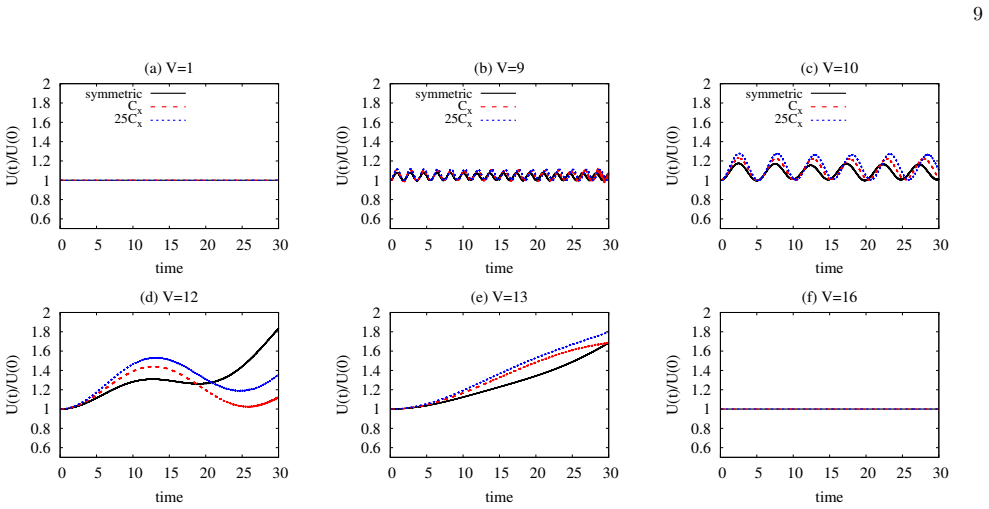
The machinery is the time evolution of natural-orbital occupations, especially $n_2(t)/N$, computed with a multiconfigurational time-dependent variational treatment ($N=10$ bosons, $M=8$ time-adaptive orbitals, on a $128\times128$ grid). When the initial state is fragmented, the first excited orbital is the odd transverse (ungerade) orbital; its occupation first falls as transverse fragmentation is reduced and then rises as longitudinal fragmentation develops. The central diagnostic is the ratio $\Delta = \mathrm{TF}/\mathrm{LF}$ of these two changes, and the location of the point of minimum (POM) is the event whose timing is compared across symmetric, longitudinally asymmetric, and transversely asymmetric junctions. The transverse uncertainty product $U(t)=\frac{1}{N^2}\Delta^2\hat{Y}\,\Delta^2\hat{P}_Y$ serves as a second probe: it oscillates when the two fragmentations compete and stays almost frozen when one dominates.
What would settle it
Re-run the same quench dynamics with a single-orbital mean-field equation: because that description cannot fragment, it should show no direction-dependent shift of the point of minimum in $n_2(t)/N$; if the envelope of the survival probability or the density variance reproduces the delay/acceleration pattern anyway, the central 'purely many-body' claim fails. Alternatively, compute the overlap of the two lowest natural orbitals through the dip: if they exchange character at the point of minimum, the two 'fragmentation processes' are one avoided crossing.
Extended reading notes
Core claim
The paper's central claim is that, for a fixed barrier height, initial transverse fragmentation is essentially insensitive to asymmetry along the tunneling direction but is reduced by asymmetry orthogonal to it, and that the subsequent tunneling dynamics show a direction-dependent competition between longitudinal fragmentation, built up during tunneling, and transverse fragmentation, present from the start. The diagnostic is the occupation of the first excited natural orbital, $n_2(t)/N$: it falls from its initial value to a point of minimum (POM) and then rises again. The paper reads the falling part as reduction of transverse fragmentation (TF) and the rising part as development of longitudinal fragmentation (LF), with the ratio $\Delta = \mathrm{TF}/\mathrm{LF}$ quantifying their interference. Longitudinal tilt delays the POM, transverse tilt brings it earlier, self-trapping suppresses the interference, and the resonant-tunneling asymmetry enhances it. Because a single-orbital mean-field state remains fully condensed, these direction-dependent timing shifts have no mean-field counterpart and are presented as a purely many-body effect of correlated tunneling.
Load-bearing premise
The whole timing comparison stands on treating the dip-and-rise of the second-orbital occupation as two separate fragmentation processes, and on the single fixed interaction strength being representative; if the dip is one dynamical feature or the interaction strength changes the picture, the delay-versus-acceleration conclusion would not isolate two competing mechanisms.
Editorial extensions
If this is right
- A longitudinal tilt postpones the moment at which the first-excited-orbital occupation bottoms out, until the system crosses into self-trapping, after which the collapse of the survival-probability oscillations accelerates again toward the resonant condition.
- A transverse tilt advances that same moment and also reduces the initial transverse fragmentation itself, so the two directions of asymmetry have opposite effects on the fragmentation competition.
- The rate of density collapse in the survival probability tracks the interference: it slows with self-trapping, speeds up as the barrier height grows through the intermediate range, and under resonant tunneling it stays faster than at small asymmetry but slower than in the symmetric case.
- The normalized uncertainty product along the transverse direction becomes a diagnostic of the fragmentation competition: oscillating when the two fragmentations compete and nearly constant when either one dominates.
- Since none of these effects appears in a single-orbital mean-field description, an accurate description of fragmented-state tunneling in asymmetric two-dimensional junctions must retain multiple orbitals.
- The same direction-dependent fragmentation competition is expected to shape other correlation-sensitive observables beyond the survival probability and uncertainty product.
- If the two-process interpretation holds, the timing of maximal fragmentation interference could serve as a probe of how correlations redistribute among natural orbitals during tunneling.
Reading between the lines
- The 'two processes' reading of the dip in $n_2(t)/N$ could be tested against an alternative: if the dip is an avoided crossing between natural orbitals, the same timing shifts might be describable as a spectral Landau-Zener problem, and computing the orbital overlaps at the POM would distinguish the two descriptions.
- The direction-dependent POM shift suggests a practical metrological or atomtronic use: the time of maximal fragmentation interference is a correlation-based readout of tilt direction and magnitude that a mean-field model cannot mimic.
- Because the paper fixes one unstated interaction strength, a natural robustness test is to vary $\lambda_0$ and $N$ while keeping $\Lambda = \lambda_0(N-1)$ fixed and to check whether the longitudinal-delay / transverse-acceleration pattern survives.
- The same diagnostic could be carried into dipolar or supersolid setups, where the competition between the two fragmentations might appear at different barrier heights or acquire additional long-range interaction effects.
Signed reviews
Editorial analysis
A structured set of objections, weighed in public.
Referee Report
Summary. The manuscript studies the many-body tunneling dynamics of N=10 bosons in a two-dimensional bosonic Josephson junction with either longitudinal (Cx) or transverse (Cy) asymmetry, using the MCTDHB method with M=8 time-adaptive orbitals. The initial ground state is prepared with a barrier orthogonal to the tunneling direction, so that for sufficiently high barrier heights the system is transversely fragmented. The authors analyze the survival probability on the left side, the occupation of the first excited natural orbital n2(t)/N, and the transverse uncertainty product. They introduce the ratio Delta = TF/LF, where TF and LF are respectively the initial drop and the later growth of n2/N separated by its point of minimum (POM), and they interpret Delta approximately equal to one as 'maximal interference of fragmentations'. The central reported result is that longitudinal asymmetry delays, while transverse asymmetry accelerates, the time at which this POM is reached, and the paper claims that this behavior is a pure many-body effect with no mean-field counterpart.
Significance. If established, the paper would provide a concrete, experimentally accessible observable—the occupation of the first excited natural orbital—through which the direction of the trap asymmetry controls the competition between transverse and longitudinal fragmentation in a 2D bosonic Josephson junction. The study is systematic in barrier height and asymmetry, and the numerical convergence checks in the Supplemental Material (orbital number and grid density) strengthen the reliability of the presented MCTDHB results. The direction-dependent delay/acceleration of the POM is an interesting and potentially useful prediction for atomtronic and fragmented-BEC studies. However, the central measure Delta is currently a post hoc decomposition of a single time series, the interaction strength lambda0 is never specified, and the mean-field comparison needed to support the 'no counterpart' claim is absent; these issues must be addressed before the main claims can be considered established.
major comments (4)
- [Section IV.A.2.b, Fig. 4(c)] The central quantity Delta = TF/LF is a post hoc two-process decomposition of a single curve n2(t)/N. TF is defined as n2(0) - n2(POM) and LF as n2(t) - n2(POM), both using the same point of minimum (POM) of the same curve, so Delta approximately equal to one at the POM is true by construction. The informative content is therefore only the time- and parameter-dependence of the POM location, not an independent measure of 'interference' between two separate fragmentation processes. Nothing in the manuscript independently verifies that the pre-POM drop is specifically a reduction of transversal fragmentation rather than, for example, an avoided-crossing transient of the natural orbitals or a mean-field-like pulse of the excited mode. The authors should either reframe the central claim in terms of the POM location and depth, or provide a direct test of the two-process interpretation, e.g., by analyzing the overlaps between time-dependent natural orbitals and the initial g/u orbitals, or by showing that the POM behavior is absent in a Gross-Pitaevskii simulation of the same observable.
- [Section II, Eq. (2.1)] The interaction strength lambda0 is never specified numerically. The Hamiltonian in Eq. (2.1) contains lambda0, and later Lambda = lambda0(N-1) is introduced, but no value is given in the main text or in the Supplemental Material. The statement in Section II that 'the choices of shape and strength of interaction between bosons do not qualitatively affect the physical phenomena described here' is an assertion without supporting data. Since the initial fragmentation threshold, the POM location, and the values of Delta all depend on the interaction, the manuscript must state lambda0 (or Lambda) and ideally show that the direction-dependent delay/acceleration of the POM persists over a range of interaction strengths.
- [Abstract and Section V] The claim that the observed asymmetry dependence 'arises purely from the many-body effects and has no counterpart in the mean-field theory' is not supported by the data shown. The only mean-field results are the initial-state fragmentation and the uncertainty product (Fig. 1); no mean-field dynamics of the survival probability, orbital occupations, or any n2-like quantity are presented. To support this central claim, the authors should compute the time-dependent mean-field (M=1) analogues of the same observables and show that the POM and its asymmetry dependence are absent at the mean-field level. Without such a comparison, the 'no mean-field counterpart' statement remains an unsupported extrapolation.
- [Section IV.A.1, Fig. 1(a)] The assertion that the initial transversal fragmentation is essentially independent of the longitudinal asymmetry Cx is never demonstrated. The text states 'therefore not shown' for the Cx dependence in Fig. 1(a), and the caption claims the results are 'practically insensitive' to Cx without providing the corresponding curves or a quantitative measure. This point is load-bearing because the comparison of dynamics across different Cx values assumes identical initial conditions; if the initial fragmentation actually varies with Cx, the reported dynamical differences could be trivially attributed to different initial states. The authors should show the initial-state data for all Cx values, at least in the Supplemental Material, or explicitly quantify the variation.
minor comments (5)
- [Introduction] There are several typos, for example 'tunneling pheomena' in the first paragraph should be 'tunneling phenomena', and the caption of Fig. S.3 uses 'symetric' instead of 'symmetric'.
- [Section IV.A.2.b, Fig. 5 and Fig. 11] The text repeatedly refers to 'Delta = 0', 'Delta approximately equal to 1', and 'Delta much greater than 1', but the color bars in Figs. 5 and 11 are not annotated with these thresholds; please add explicit labels or a scale so the reader can connect the text to the figures.
- [Sections IV.A.2.a and IV.B.2.a, Figs. 3 and 9] The 'rate of density collapse' is described only qualitatively (e.g., 'the collapse slows', 'accelerates', 'is fastest'), with no extracted decay rate or fitting procedure. If this quantity is intended as a quantitative result, the authors should define an estimator (for example, an exponential decay constant of the survival-probability envelope) and report it for the relevant parameter sets.
- [Section IV.A.2.b, text near Fig. 4(c)] The sentence 'A value of Delta corresponds to maximal interference of the transversal and longitudinal fragmentations' is missing the condition 'approximately equal to 1'; as written, it implies any value of Delta corresponds to maximal interference.
- [Section II] The manuscript would benefit from a brief statement of the numerical value of lambda0 in the main text (not only in the Supplemental Material), together with the corresponding Lambda, so that the dimensionless units and the interaction regime are transparent from the outset.
Circularity Check
Delta=TF/LF is defined from one n2(t)/N curve, so 'maximal interference' reports that same curve's minimum/return time; the underlying simulations are independent.
-
self definitional
[Section IV.A.2.b (definition of TF, LF, and Delta following Fig. 4(c); used in Figs. 5 and 11)]
"TF is quantified by the difference between the initial occupation of the u-orbital at t = 0 and the occupation at the POM. Conversely, the longitudinal fragmentation (LF) is determined by the difference between the occupation of the u-orbital at time t (after the POM) and the occupation at the POM. We define the ratio of TF to LF, ∆ = TF LF , as a measure of the interference between the transversal and longitudinal fragmentations. ... A value of ∆ corresponds to maximal interference of the transversal and longitudinal fragmentations, implying an approximately equal contribution from TF and LF."
Substituting TF = n2(0)/N - n2(POM)/N and LF(t) = n2(t)/N - n2(POM)/N gives Delta = 1 iff n2(t)/N = n2(0)/N. Hence the 'point of maximal interference' is, by construction, the time at which the very same n2(t)/N curve returns to its initial value after its minimum. The paper's central conclusion that longitudinal asymmetry delays and transverse asymmetry accelerates 'maximal interference' is therefore a contour of the n2(t)/N curve from which TF and LF are read, not an independent measurement of a competition between two mechanisms.
full rationale
The many-body calculations are self-contained: MCTDHB with M=8 (checked against M=10) and grid-convergence checks produce the raw observables P(t), U(t), and n2(t)/N directly from the Hamiltonian, with no fitted parameter later renamed as a prediction. There is also no load-bearing uniqueness theorem or ansatz smuggled in via self-citation; the reliance on prior work [59] for the concept of interference of fragmentations is not itself circular because the asymmetric-junction dynamics are recomputed here. The genuine circularity is confined to the interpretive quantity Delta. Since TF and LF are both read from the same single n2(t)/N curve, and Delta=1 is algebraically equivalent to n2(t)=n2(0), the reported asymmetry-driven delay/acceleration of 'maximal interference' reduces by construction to the location of the point of minimum and the first-return time of that curve. The two-process decomposition (transversal reduction followed by longitudinal development) is therefore not independently evidenced. This is a partial, definitional circularity in the interpretation, while the underlying numerical content remains independent; additionally, the interaction strength lambda0 is never stated numerically, which is a reproducibility gap rather than a circularity.
Assumptions & free parameters
free parameters (3)
- Interaction strength lambda0 (equivalently Lambda = lambda0(N-1)) =
Not stated in main text or supplemental material
- Fragmentation threshold of 1% occupation =
1%
- Time horizon and point-of-minimum location =
t up to 30 Rabi cycles; POM read by inspection
assumptions (4)
- standard math MCTDHB with M=8 orbitals converges to the exact many-body wavefunction for the observables considered
- domain assumption The inter-boson interaction can be modeled as a repulsive Gaussian with sigma = 0.25*sqrt(pi), and the shape and strength of the interaction do not qualitatively affect the phenomena
- domain assumption The initial state is the ground state of the preparation potential, and the quench to the junction potential is instantaneous
- ad hoc to paper The point-of-minimum decomposition of n2(t)/N into TF and LF separates two distinct fragmentation processes, so Delta=TF/LF measures their interference
Cite this review
Pith. "Pith review of Interplay of asymmetry and fragmentation in the many-body tunneling dynamics of two-dimensional bosonic Josephson junctions." pith.science (2026). https://pith.science/paper/QYB3AMLT
@misc{pith2026250501069,
  author       = {Pith},
  title        = {Pith review of: Interplay of asymmetry and fragmentation in the many-body tunneling dynamics of two-dimensional bosonic Josephson junctions},
  year         = {2026},
  howpublished = {\url{https://pith.science/paper/QYB3AMLT}},
  note         = {Machine review of arXiv:2505.01069}
}
read the original abstract
It is well known that the many-body tunneling of a bosonic condensate leads to (longitudinal) fragmentation along the tunneling direction. In this work, we prepare the initial ground state as a (transversely) fragmented system by introducing a barrier oriented orthogonally to the tunneling direction and allow it to tunnel through a two-dimensional longitudinally and transversely-asymmetric bosonic Josephson junctions. For a fixed barrier height, we find that the initial transversal fragmentation is essentially independent of the asymmetry along the tunneling direction but reduces when the asymmetry is oriented orthogonally to the junction. We investigate the interplay between the interference of fragmentations and asymmetry in the junction by analyzing the rate of density collapse in the survival probability, the uncertainty product, and the nontrivial dynamics of the occupation of the first excited orbital. The interference of fragmentations is quantified by the ratio between the reduction of transverse fragmentation and the development of longitudinal fragmentation. We show that asymmetry along the junction (orthogonal to the junction) delays (accelerates), compared to the symmetric potential, in obtaining the maximal interference of fragmentations. Notably, self-trapping opposes the interference, whereas a resonant tunneling condition enhances it. Overall, we demonstrate that the influence of asymmetry on the competition between longitudinal and transversal fragmentations, which together govern the macroscopic tunneling dynamics of interacting bosons, arises purely from the many-body effects and has no counterpart in the mean-field theory.
Figures


Figures from the paper (8 more)




Reference graph
Works this paper leans on
-
[59]
R. W. Spekkens and J. E. Sipe, Spatial fragmentation of a Bose-Einstein condensate in a double-well potential, Phys. Rev. A 59, 3868 (1999)
work page 1999
-
[1]
Here, fL(y) = 1 2y2 +Ve−y2/8 with V is the barrier height along the y-direction
Preparation of the ground state in the longitudinally-asymmetric potential We prepare the ground state of the bosons in the left part of space of the longitudinally-asymmetric potential 4 using the trap VL(x,y ) where VL(x,y ) = 1 2(x + 2)2−Cxx +fL(y), (4.1) andCx is the asymmetry parameter along the longitudi- nal (x)-direction. Here, fL(y) = 1 2y2 +Ve−y...
-
[2]
The form of V′ L(x,y ), see Fig
Tunneling of bosons in the longitudinally-asymmetric BJJ To investigate the tunneling dynamics of initially pre- pared states, we solve the time-dependent Schr¨ odinger equation, ˆH(r1.r2,..., rN)Ψ(r1.r2,..., rN,t ) = i∂Ψ(r1.r2,..., rN,t ) ∂t , for the scenario where the system evolves following a quench of the trap potential from VL(x,y ) to the longitud...
-
[3]
The transversely-asymmetric potential is then expressed as VT (x,y ) = 1 2(x + 2)2 +fT (y), (4.3) where fT (y) = 1 2y2−Cyy +Ve−y2/8
Preparation of the ground state in the transversely-asymmetric potential To prepare the ground state in a transversely- asymmetric potential, we introduce a linear slope along the y-direction. The transversely-asymmetric potential is then expressed as VT (x,y ) = 1 2(x + 2)2 +fT (y), (4.3) where fT (y) = 1 2y2−Cyy +Ve−y2/8. Here Cy is the asymmetry parame...
-
[4]
The transversely-asymmetric 2D BJJ is given by 11 FIG
Tunneling of bosons in the transversely-asymmetric BJJ In order to investigate the tunneling dynamics, we quench the potential from VT (x,y ) to V′ T (x,y ). The transversely-asymmetric 2D BJJ is given by 11 FIG. 8. External potential for tunneling dynamics in the transversely-asymmetric 2D BJJ, described in Eq. 4.4. The transversal asymmetric parameter i...
-
[5]
Javanainen, Oscillatory exchange of atoms between traps containing Bose condensates, Phys
J. Javanainen, Oscillatory exchange of atoms between traps containing Bose condensates, Phys. Rev. Lett. 57, 3164 (1986)
1986
-
[6]
Bloch, J
I. Bloch, J. Dalibard, and W. Zwerger, Many-body physics with ultracold gases, Rev. Mod. Phys. 80, 885 (2008)
2008
-
[7]
S. Levy, E. Lahoud, I. Shomroni, and J. Steinhauer, The a.c. and d.c. Josephson effects in a Bose-Einstein conden- sate, Nature 449, 579 (2007)
2007
Show all 97 references
-
[8]
Bhowmik, S
A. Bhowmik, S. K. Haldar, and O. E. Alon, Impact of the transverse direction on the many-body tunneling dy- namics in a two-dimensional bosonic Josephson junction, Sci. Rep. 10, 21476 (2020)
2020
-
[9]
Smerzi, S
A. Smerzi, S. Fantoni, S. Giovanazzi, and S. R. Shenoy, Quantum Coherent Atomic Tunneling between Two Trapped Bose-Einstein Condensates, Phys. Rev. Lett. 79, 4950 (1997)
1997
-
[10]
Albiez, R
M. Albiez, R. Gati, J. F¨ olling, S. Hunsmann, M. Cris- tiani, and M. K. Oberthaler, Direct Observation of Tun- neling and Nonlinear Self-Trapping in a Single Bosonic Josephson Junction, Phys. Rev. Lett. 95, 010402 (2005)
2005
-
[11]
G. J. Milburn, J. Corney, E. M. Wright, and D. F. Walls, Quantum dynamics of an atomic Bose-Einstein conden- sate in a double-well potential, Phys. Rev. A 55, 4318 (1997)
1997
-
[12]
Valtolina, A
G. Valtolina, A. Burchianti, A. Amico, E. Neri, K. Xhani, J. A. Seman, A. Trombettoni, A. Smerzi, M. Zaccanti, M. Inguscio, and G. Roati, Josephson effect in fermionic superfluids across the BEC-BCS crossover, Science 350, 1505 (2015)
2015
-
[13]
Pascucci and L
F. Pascucci and L. Salasnich, Josephson effect with superfluid fermions in the two-dimensional BCS-BEC crossover, Phys. Rev. A 102, 013325 (2020)
2020
-
[14]
Su, S.-C
S.-W. Su, S.-C. Gou, Q. Sun, L. Wen, W.-M. Liu, A.-C. Ji, J. Ruseckas, and G. Juzeli¯ unas, Rashba-type spin-orbit coupling in bilayer Bose-Einstein condensates, Phys. Rev. A 93, 053630 (2016)
2016
-
[15]
Hou, X.-W
J. Hou, X.-W. Luo, K. Sun, T. Bersano, V. Gokhroo, S. Mossman, P. Engels, and C. Zhang, Momentum-Space Josephson Effects, Phys. Rev. Lett. 120, 120401 (2018)
2018
-
[16]
Abbarchi, A
M. Abbarchi, A. Amo, V. G. Sala, D. D. Solnyshkov, H. Flayac, L. Ferrier, I. Sagnes, E. Galopin, A. Lemaˆ ıtre, G. Malpuech, and J. Bloch, Macroscopic quantum self- trapping and Josephson oscillations of exciton polaritons, Nat. Phys. 9, 275 (2013)
2013
-
[17]
Chestnov, A
I. Chestnov, A. Yulin, I. A. Shelykh, and A. Kavokin, Dissipative Josephson vortices in annular polariton fluids, Phys. Rev. B 104, 165305 (2021)
2021
-
[18]
Zibold, E
T. Zibold, E. Nicklas, C. Gross, and M. K. Oberthaler, Classical Bifurcation at the Transition from Rabi to Josephson Dynamics, Phys. Rev. Lett. 105, 204101 (2010)
2010
-
[19]
S. I. Mistakidis, K. Mukherjee, S. M. Reimann, and H. R. Sadeghpour, Tunneling dynamics of 164Dy supersolids and droplets, Phys. Rev. A 110, 013323 (2024)
2024
-
[20]
Grynberg and C
G. Grynberg and C. Robilliard, Cold atoms in dissipative optical lattices, Physics Reports 355, 335 (2001)
2001
-
[21]
A. N. Salgueiro, A. F. R. de Toledo Piza, G. B. Lemos, R. Drumond, M. C. Nemes, and M. Weidem¨ uller, Quan- tum dynamics of bosons in a double-well potential: Josephson oscillations, self-trapping and ultralong tun- neling times, Eur. Phys. J. D 44, 537 (2007)
2007
-
[22]
Liu and Y
Y. Liu and Y. Zhang, Two atoms in a double well: Exact solution with a Bethe ansatz, Phys. Rev. A 91, 053610 (2015)
2015
-
[23]
Sakmann, A
K. Sakmann, A. I. Streltsov, O. E. Alon, and L. S. Ceder- baum, Exact Quantum Dynamics of a Bosonic Josephson Junction, Phys. Rev. Lett. 103, 220601 (2009)
2009
-
[24]
H. M. Cataldo and D. M. Jezek, Dynamics in asymmetric double-well condensates, Phys. Rev. A90, 043610 (2014)
2014
-
[25]
J. G. Cosme, M. F. Andersen, and J. Brand, Interaction blockade for bosons in an asymmetric double well, Phys. Rev. A 96, 013616 (2017)
2017
-
[26]
S. Hunn, K. Zimmermann, M. Hiller, and A. Buchleitner, Tunneling decay of two interacting bosons in an asym- metric double-well potential: A spectral approach, Phys. Rev. A 87, 043626 (2013)
2013
-
[27]
M. c. v. Gavrilov and J. Bechhoefer, Erasure without Work in an Asymmetric Double-Well Potential, Phys. Rev. Lett. 117, 200601 (2016)
2016
-
[28]
S. J. Kim, H. Yu, S. T. Gang, D. Z. Anderson, and J. B. Kim, Controllable asymmetric double well and ring po- tential on an atom chip, Phys. Rev. A 93, 033612 (2016)
2016
-
[29]
S. K. Haldar and O. E. Alon, Impact of the range of the interaction on the quantum dynamics of a bosonic Josephson junction, Chemical Physics 509, 72 (2018)
2018
-
[30]
Bhowmik and O
A. Bhowmik and O. E. Alon, Longitudinal and transver- sal resonant tunneling of interacting bosons in a two- dimensional Josephson junction, Sci. Rep.12, 627 (2022)
2022
-
[31]
A. R. Kolovsky, Topological phase transitions in tilted optical lattices, Phys. Rev. A 98, 013603 (2018)
2018
-
[32]
A. R. Kolovsky and D. N. Maksimov, Mott-insulator state of cold atoms in tilted optical lattices: Doublon dynamics and multilevel Landau-Zener tunneling, Phys. Rev. A 94, 043630 (2016)
2016
-
[33]
A. R. Kolovsky, Bright solitons and self-trapping with a Bose-Einstein condensate of atoms in driven tilted optical lattices, Phys. Rev. A 82, 011601 (2010)
2010
-
[34]
Zenesini, H
A. Zenesini, H. Lignier, G. Tayebirad, J. Radogostowicz, D. Ciampini, R. Mannella, S. Wimberger, O. Morsch, and E. Arimondo, Time-Resolved Measurement of Landau- Zener Tunneling in Periodic Potentials, Phys. Rev. Lett. 103, 090403 (2009)
2009
-
[35]
Sharma and E
V. Sharma and E. J. Mueller, Driven-dissipative control of cold atoms in tilted optical lattices, Phys. Rev. A 103, 043322 (2021)
2021
-
[36]
J. C. Garreau and V. Zehnl´ e, Synthesizing dispersion re- lations in a modulated tilted optical lattice, Phys. Rev. A 105, 013318 (2022)
2022
-
[37]
S. K. Haldar and O. E. Alon, Many-body quantum dy- namics of an asymmetric bosonic Josephson junction, New Journal of Physics 21, 103037 (2019)
2019
-
[38]
Zenesini, C
A. Zenesini, C. Sias, H. Lignier, Y. Singh, D. Ciampini, O. Morsch, R. Mannella, E. Arimondo, A. Tomadin, and S. Wimberger, Resonant tunneling of Bose–Einstein con- densates in optical lattices, New Journal of Physics 10, 053038 (2008)
2008
-
[39]
C. Sias, A. Zenesini, H. Lignier, S. Wimberger, D. Ciampini, O. Morsch, and E. Arimondo, Resonantly Enhanced Tunneling of Bose-Einstein Condensates in Pe- riodic Potentials, Phys. Rev. Lett. 98, 120403 (2007). 16
2007
-
[40]
B. K. Teo, J. R. Guest, and G. Raithel, Tunneling Reso- nances and Coherence in an Optical Lattice, Phys. Rev. Lett. 88, 173001 (2002)
2002
-
[41]
D. Q. To, T. H. Dang, L. Vila, J. P. Attan´ e, M. Bibes, and H. Jaffr` es, Spin to charge conversion at Rashba-split SrTiO3 interfaces from resonant tunneling, Phys. Rev. Res. 3, 043170 (2021)
2021
-
[42]
Mamaev, T
M. Mamaev, T. Bilitewski, B. Sundar, and A. M. Rey, Resonant Dynamics of Strongly Interacting SU( n) Fermionic Atoms in a Synthetic Flux Ladder, PRX Quantum 3, 030328 (2022)
2022
-
[43]
Girardeau, Simple and Generalized Condensation in Many-Boson Systems, The Physics of Fluids 5, 1468 (1962)
M. Girardeau, Simple and Generalized Condensation in Many-Boson Systems, The Physics of Fluids 5, 1468 (1962)
1962
-
[44]
and Saint James, D., Particle vs
Nozi` eres, P. and Saint James, D., Particle vs. pair con- densation in attractive Bose liquids, J. Phys. France 43, 1133 (1982)
1982
-
[45]
E. J. Mueller, T.-L. Ho, M. Ueda, and G. Baym, Frag- mentation of Bose-Einstein condensates, Phys. Rev. A 74, 033612 (2006)
2006
-
[46]
Bader and U
P. Bader and U. R. Fischer, Fragmented Many-Body Ground States for Scalar Bosons in a Single Trap, Phys. Rev. Lett. 103, 060402 (2009)
2009
-
[47]
Zhou and X
Q. Zhou and X. Cui, Fate of a Bose-Einstein Condensate in the Presence of Spin-Orbit Coupling, Phys. Rev. Lett. 110, 140407 (2013)
2013
-
[48]
Kang and U
M.-K. Kang and U. R. Fischer, Revealing Single- Trap Condensate Fragmentation by Measuring Density- Density Correlations after Time of Flight, Phys. Rev. Lett. 113, 140404 (2014)
2014
-
[49]
A. U. J. Lode and C. Bruder, Fragmented Superradi- ance of a Bose-Einstein Condensate in an Optical Cavity, Phys. Rev. Lett. 118, 013603 (2017)
2017
-
[50]
Lee and A
J. Lee and A. Michelangeli, On the characterisation of fragmented Bose–Einstein condensation and its emergent effective evolution, Nonlinearity 36, 6364 (2023)
2023
-
[51]
Dutta, A
S. Dutta, A. U. J. Lode, and O. E. Alon, Fragmentation and correlations in a rotating Bose-Einstein condensate undergoing breakup, Sci. Rep. 13, 3343 (2023)
2023
-
[52]
S. K. Haldar and A. Bhowmik, Many-Body effects in a composite bosonic josephson junction, Atoms 12 (2024)
2024
-
[53]
Hofferberth, I
S. Hofferberth, I. Lesanovsky, B. Fischer, J. Verdu, and J. Schmiedmayer, Radiofrequency-dressed-state poten- tials for neutral atoms, Nature Physics 2, 710 (2006)
2006
-
[54]
J. H. V. Nguyen, M. C. Tsatsos, D. Luo, A. U. J. Lode, G. D. Telles, V. S. Bagnato, and R. G. Hulet, Parametric Excitation of a Bose-Einstein Condensate: From Faraday Waves to Granulation, Phys. Rev. X 9, 011052 (2019)
2019
-
[55]
Evrard, A
B. Evrard, A. Qu, J. Dalibard, and F. Gerbier, Observa- tion of fragmentation of a spinor Bose-Einstein conden- sate, Science 373, 1340 (2021)
2021
-
[56]
Sakmann, A
K. Sakmann, A. I. Streltsov, O. E. Alon, and L. S. Ceder- baum, Quantum dynamics of attractive versus repulsive bosonic Josephson junctions: Bose-Hubbard and full- Hamiltonian results, Phys. Rev. A 82, 013620 (2010)
2010
-
[57]
Grond, A
J. Grond, A. I. Streltsov, L. S. Cederbaum, and O. E. Alon, Excitation spectra of fragmented condensates by linear response: General theory and application to a condensate in a double-well potential, Phys. Rev. A 86, 063607 (2012)
2012
-
[58]
Sakmann, A
K. Sakmann, A. I. Streltsov, O. E. Alon, and L. S. Ceder- baum, Universality of fragmentation in the Schr¨ odinger dynamics of bosonic Josephson junctions, Phys. Rev. A 89, 023602 (2014)
2014
-
[60]
G. M. Koutentakis, S. I. Mistakidis, and P. Schmelcher, Interplay of phase separation and itinerant magnetism for correlated few fermions in a double-well, New Journal of Physics 22, 063058 (2020)
2020
-
[61]
Erdmann, S
J. Erdmann, S. I. Mistakidis, and P. Schmelcher, Cor- related tunneling dynamics of an ultracold Fermi-Fermi mixture confined in a double well, Phys. Rev. A 98, 053614 (2018)
2018
-
[62]
Roy and O
R. Roy and O. E. Alon, Assessing small accelerations using a bosonic Josephson junction, Phys. Rev. A 111, 043307 (2025)
2025
-
[63]
Bhowmik and O
A. Bhowmik and O. E. Alon, Interference of longitudinal and transversal fragmentations in the Josephson tunnel- ing dynamics of Bose–Einstein condensates, New Journal of Physics 26, 123035 (2024)
2024
-
[64]
B. T. Seaman, M. Kr¨ amer, D. Z. Anderson, and M. J. Holland, Atomtronics: Ultracold-atom analogs of elec- tronic devices, Phys. Rev. A 75, 023615 (2007)
2007
-
[65]
M. K. Olsen and A. S. Bradley, Quantum ultracold atom- tronics, Phys. Rev. A 91, 043635 (2015)
2015
-
[66]
Dumke, Z
R. Dumke, Z. Lu, J. Close, N. Robins, A. Weis, M. Mukherjee, G. Birkl, C. Hufnagel, L. Amico, M. G. Boshier, K. Dieckmann, W. Li, and T. C. Killian, Roadmap on quantum optical systems, Journal of Op- tics 18, 093001 (2016)
2016
-
[67]
K. W. Wilsmann, L. H. Ymai, A. P. Tonel, J. Links, and A. Foerster, Control of tunneling in an atomtronic switching device, Communications Physics 1, 91 (2018)
2018
-
[68]
Amico, M
L. Amico, M. Boshier, G. Birkl, A. Minguzzi, C. Miniatura, L.-C. Kwek, D. Aghamalyan, V. Ahufinger, D. Anderson, N. Andrei, A. S. Arnold, M. Baker, T. A. Bell, T. Bland, J. P. Brantut, D. Cassettari, W. J. Chet- cuti, F. Chevy, R. Citro, S. De Palo, R. Dumke, M. Ed- wards, R. ...
2021
-
[69]
Amico, D
L. Amico, D. Anderson, M. Boshier, J.-P. Brantut, L.-C. Kwek, A. Minguzzi, and W. von Klitzing, Colloquium: Atomtronic circuits: From many-body physics to quan- tum technologies, Rev. Mod. Phys. 94, 041001 (2022)
2022
-
[70]
R. A. Doganov, S. Klaiman, O. E. Alon, A. I. Streltsov, and L. S. Cederbaum, Two trapped particles interact- ing by a finite-range two-body potential in two spatial dimensions, Phys. Rev. A 87, 033631 (2013)
2013
-
[71]
A. I. Streltsov, O. E. Alon, and L. S. Cederbaum, Role of Excited States in the Splitting of a Trapped Interacting Bose-Einstein Condensate by a Time-Dependent Barrier, Phys. Rev. Lett. 99, 030402 (2007)
2007
-
[72]
O. E. Alon, A. I. Streltsov, and L. S. Cederbaum, Multiconfigurational time-dependent Hartree method for bosons: Many-body dynamics of bosonic systems, Phys. Rev. A 77, 033613 (2008). 17
2008
-
[73]
Grond, J
J. Grond, J. Schmiedmayer, and U. Hohenester, Optimiz- ing number squeezing when splitting a mesoscopic con- densate, Phys. Rev. A 79, 021603 (2009)
2009
-
[74]
Klaiman, A
S. Klaiman, A. U. J. Lode, A. I. Streltsov, L. S. Ceder- baum, and O. E. Alon, Breaking the resilience of a two- dimensional Bose-Einstein condensate to fragmentation, Phys. Rev. A 90, 043620 (2014)
2014
-
[75]
U. R. Fischer, A. U. J. Lode, and B. Chatterjee, Conden- sate fragmentation as a sensitive measure of the quantum many-body behavior of bosons with long-range interac- tions, Phys. Rev. A 91, 063621 (2015)
2015
-
[76]
Beinke, S
R. Beinke, S. Klaiman, L. S. Cederbaum, A. I. Streltsov, and O. E. Alon, Many-body tunneling dynamics of Bose- Einstein condensates and vortex states in two spatial di- mensions, Phys. Rev. A 92, 043627 (2015)
2015
-
[77]
J. M. Schurer, A. Negretti, and P. Schmelcher, Capture dynamics of ultracold atoms in the presence of an impu- rity ion, New Journal of Physics 17, 083024 (2015)
2015
-
[78]
A. U. J. Lode, F. S. Diorico, R. Wu, P. Molignini, L. Pa- pariello, R. Lin, C. L´ evˆ eque, L. Exl, M. C. Tsatsos, R. Chitra, and N. J. Mauser, Many-body physics in two- component Bose–Einstein condensates in a cavity: frag- mented superradiance and polarization, New Journal o...
2018
-
[79]
Chatterjee, M
B. Chatterjee, M. C. Tsatsos, and A. U. J. Lode, Corre- lations of strongly interacting one-dimensional ultracold dipolar few-boson systems in optical lattices, New Jour- nal of Physics 21, 033030 (2019)
2019
-
[80]
R. Roy, B. Chakrabarti, and A. Gammal, Out of equilib- rium many-body expansion dynamics of strongly inter- acting bosons, SciPost Phys. Core 6, 073 (2023)
2023
-
[81]
R. Roy, B. Chakrabarti, N. D. Chavda, and M. L. Lekala, Information theoretic measures for interacting bosons in optical lattice, Phys. Rev. E 107, 024119 (2023)
2023
-
[82]
Chakrabarti, A
B. Chakrabarti, A. Gammal, and L. Salasnich, Strongly interacting bosons in a one-dimensional disordered lat- tice: Phase coherence of distorted Mott phases, Phys. Rev. B 110, 184202 (2024)
2024
-
[83]
Molignini and B
P. Molignini and B. Chakrabarti, Interaction quench of dipolar bosons in a one-dimensional optical lattice, Phys. Rev. Res. 7, 013257 (2025)
2025
-
[84]
A. U. J. Lode and C. Bruder, Dynamics of Hub- bard Hamiltonians with the multiconfigurational time- dependent Hartree method for indistinguishable parti- cles, Phys. Rev. A 94, 013616 (2016)
2016
-
[85]
Fasshauer and A
E. Fasshauer and A. U. J. Lode, Multiconfigurational time-dependent Hartree method for fermions: Imple- mentation, exactness, and few-fermion tunneling to open space, Phys. Rev. A 93, 033635 (2016)
2016
-
[86]
R. Lin, P. Molignini, L. Papariello, M. C. Tsatsos, C. L´ evˆ eque, S. E. Weiner, E. Fasshauer, R. Chitra, and A. U. J. Lode, MCTDH-X: The multiconfigura- tional time-dependent Hartree method for indistinguish- able particles software, Quantum Science and Technology 5, 024004 (2020)
2020
-
[87]
Dalfovo, S
F. Dalfovo, S. Giorgini, L. P. Pitaevskii, and S. Stringari, Theory of Bose-Einstein condensation in trapped gases, Rev. Mod. Phys. 71, 463 (1999)
1999
-
[88]
See Supplemental Material for details on the dynamic occupation of the ground orbital for the longitudinal- and transversal-asymmetric 2D BJJ, time evolution of the normalized uncertainty product in the transversal- asymmetric 2D BJJ, and the convergences of the results with t...
-
[89]
O. E. Alon, Condensates in annuli: dimensionality of the variance, Molecular Physics 117, 2108 (2019)
2019
-
[90]
A. U. J. Lode, C. L´ evˆ eque, L. B. Madsen, A. I. Streltsov, and O. E. Alon, Colloquium: Multiconfigurational time- dependent Hartree approaches for indistinguishable par- ticles, Rev. Mod. Phys. 92, 011001 (2020)
2020
-
[91]
Klaiman and O
S. Klaiman and O. E. Alon, Variance as a sensitive probe of correlations, Phys. Rev. A 91, 063613 (2015)
2015
-
[92]
Biagioni, N
G. Biagioni, N. Antolini, B. Donelli, L. Pezz` e, A. Smerzi, M. Fattori, A. Fioretti, C. Gabbanini, M. Inguscio, L. Tanzi, and G. Modugno, Measurement of the super- fluid fraction of a supersolid by Josephson effect, Nature 629, 773 (2024)
2024
-
[93]
J. Qin, S. Li, Y. Tu, M. Gu, L. Guan, W. Xu, and L. Zhou, Bi-Josephson effect in a driven-dissipative su- persolid, New Journal of Physics 27, 013015 (2025)
2025
-
[94]
Capello, F
M. Capello, F. Becca, M. Fabrizio, and S. Sorella, Su- perfluid to Mott-Insulator Transition in Bose-Hubbard Models, Phys. Rev. Lett. 99, 056402 (2007)
2007
-
[95]
del Campo, F
A. del Campo, F. Delgado, G. Garc´ ıa-Calder´ on, J. G. Muga, and M. G. Raizen, Decay by tunneling of bosonic and fermionic Tonks-Girardeau gases, Phys. Rev. A 74, 013605 (2006)
2006
-
[96]
Ko´ scik, Decay properties of unstable Tonks-Girardeau gases from a split trap, Phys
P. Ko´ scik, Decay properties of unstable Tonks-Girardeau gases from a split trap, Phys. Rev. A 102, 033308 (2020)
2020
-
[97]
Baak and U
J.-G. Baak and U. R. Fischer, Self-Consistent Many- Body Metrology, Phys. Rev. Lett. 132, 240803 (2024). SUPPLEMENT AL MA TERIAL In this supplemental material, we provide addi- tional details to complement the main text. Specif- ically, we present the dynamical occupation of t...
2024
Reviewed August 16, 2026 · model on record in the stance chip above.
Discussion (0). Continue with ORCID to comment.