REVIEW 2 major objections 6 minor 66 references
MUSE library of stellar spectra
T0 review · 2 major / 6 minor · reviewed 2026-08-14 · deepseek-v4-flash
Pith's one-line read This paper supplies 35 high-signal-to-noise MUSE stellar spectra with continuum shapes it argues are more reliable than those of the X-shooter Spectral Library, because the integral field unit avoids slit losses and order stitching.
desk verdict A genuinely useful IFU-built stellar library, but the continuum-shape fidelity claim goes beyond what the external checks can support. read the letter →
The pith
A machine-rendered reading of the paper's core claim, the machinery that carries it, and where it could break.
The reading
What carries the argument
The central object is the integral-field unit itself: MUSE records a two-dimensional field at every wavelength, so all of the star's light that falls in the field is captured and each wavelength is measured contiguously rather than reassembled from separate orders. The paper uses this property to argue that aperture and slit losses change the spectrum's overall slope by less than 1% from blue to red, and it tests the resulting shapes with synthetic SDSS colors, aperture-radius experiments, telluric correction, and Lick indices.
What would settle it
Compare the continuum of any one library star with a space-based spectrum that has no atmospheric extinction and an independent flux calibration; a smooth blue-to-red slope difference of 1% or more would refute the claimed fidelity.
Extended reading notes
Core claim
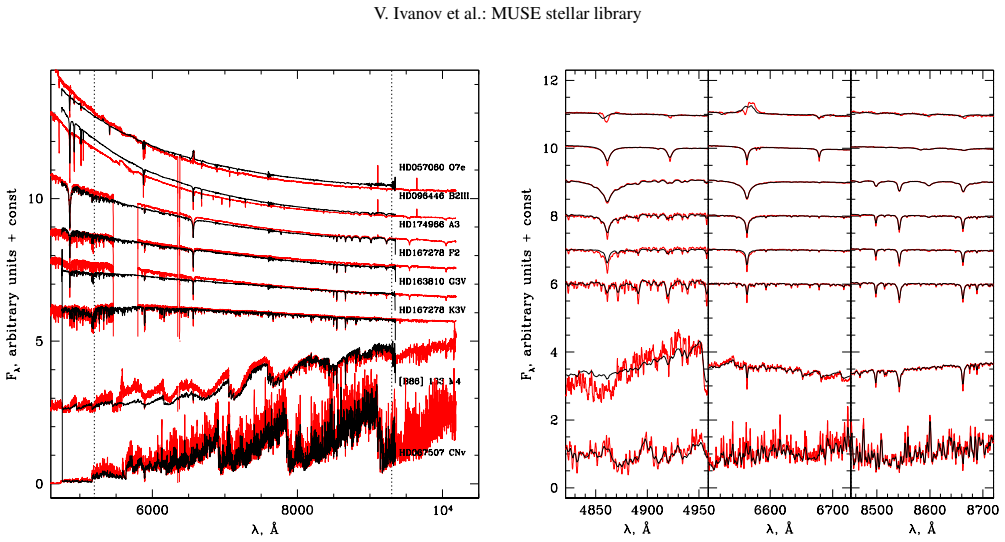
The central claim is that the MUSE spectra have more reliable continuum shapes than the X-shooter Spectral Library, because the integral-field unit eliminates slit losses and produces continuous wavelength coverage without order stitching. The paper supports this with direct XSL-to-MUSE ratios that show gradual 10–15% slope differences within the MUSE range, and with synthetic SDSS colors that are "slightly tighter" for MUSE than for XSL, confirming the shape claim. It also reports Lick indices measured from the new spectra and lists second-order polynomial coefficients in Table B.1 that quantify and correct the XSL/MUSE ratio for individual stars. The intended result is a high-fidelity empirical library that can anchor continuum shapes across roughly 4800–9300 Å.
Load-bearing premise
The load-bearing premise is that, on the non-photometric nights, the Earth's atmosphere and the instrument's response changed the spectrum by the same gray factor at every wavelength, so after dividing by the same-spaxel standard star the measured shape is the true stellar shape.
Editorial extensions
If this is right
- Users of the X-shooter Spectral Library can apply the second-order polynomial coefficients in Table B.1 to correct the continuum slope of each overlapping star.
- Galaxy stellar-population models can use the 35 MUSE spectra as shape-accurate templates across 4800–9300 Å.
- Synthetic colors derived from MUSE spectra should reproduce observed broad-band colors more closely than XSL spectra do for the same stars.
- The measured Lick indices place these 35 stars on the standard index system, allowing direct index-based stellar and galaxy analysis.
Reading between the lines
- Inference: the paper's internal consistency checks, such as repeat exposures, aperture experiments, and XSL ratios, would not detect a smooth wavelength-dependent response error, so an independent space-based comparison is the cleanest test of the less-than-1% slope claim.
- Inference: if the same IFU approach were applied blueward of 4800 Å, the gray-response assumption would need to be re-proved; the current library cannot certify continuum shapes at shorter wavelengths.
- Inference: after applying Table B.1 corrections, XSL and MUSE should agree in narrow features and disagree mainly in broad-band slope, so parameters derived from index-based versus color-based methods would flag which library to trust.
Signed reviews
Editorial analysis
A structured set of objections, weighed in public.
Referee Report
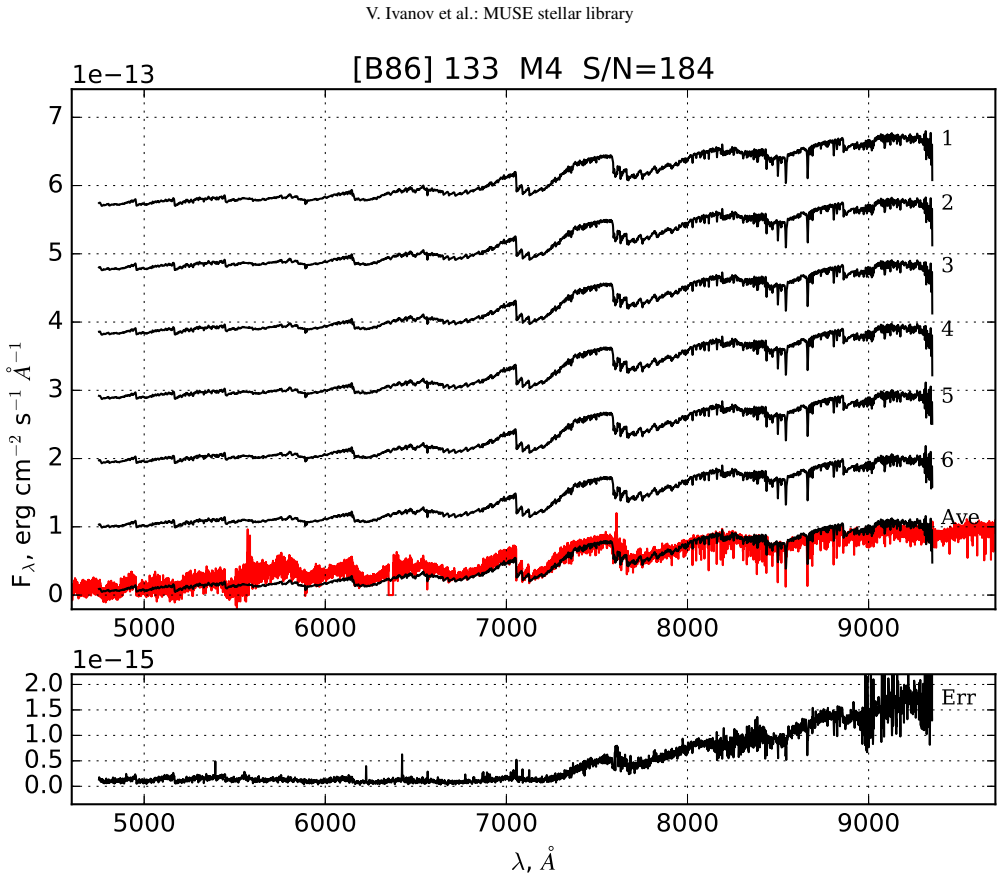
Summary. The paper presents a library of 35 high signal-to-noise MUSE stellar spectra covering 4800-9300 Å, selected from the X-shooter Spectral Library sample to span the Hertzsprung-Russell diagram. The central claim is that these spectra have reliable continuum shapes because integral-field observations avoid slit losses and the order-stitching required by cross-dispersed echelle spectrographs. The authors support this claim with the internal repeatability of six (or twelve) individual exposures, aperture-extraction experiments that bound aperture-induced slope changes below 1%, a comparison with XSL spectra that reveals smooth 10-15% continuum discrepancies (attributed to XSL) with polynomial corrections listed in Table B.1, synthetic SDSS color-color diagrams, and Lick indices. The paper acknowledges in §5 that external photometry is available for only about a quarter of the sample.
Significance. If the continuum-shape fidelity is confirmed, this small library would be a valuable reference for the absolute shape of stellar continua and a useful cross-calibrator for XSL and similar multi-order libraries, and it would demonstrate the IFU approach as a promising route for building empirical spectral libraries. The paper has genuine strengths: the same-spaxel placement of science targets and spectrophotometric standards, the careful aperture-loss tests, the public machine-readable spectra (Table A.2), the XSL/MUSE correction coefficients (Table B.1), and the Lick-index table (Table C.1). The internal consistency is good and the data themselves are useful. However, the external verification is weaker than the central claim requires: the synthetic color comparison in Fig. 5 is internal to the two spectral libraries, not a check against observed photometry, and a coherent smooth slope error would evade it.
major comments (2)
- [§4, Fig. 5] The claim that the MUSE spectra 'have more reliable shapes' than the XSL spectra rests on the synthetic SDSS color-color comparison in Fig. 5, but both sequences are computed from the spectra themselves, so the test is not external to the two libraries. A smooth, monotonic wavelength-dependent error in the MUSE flux calibration (non-gray cloud extinction, a standard-star SED error, or residual response curvature) shifts all stars coherently in color-color space and leaves the sequence tight; the comparison against XSL cannot break this degeneracy because the 10-15% sloped XSL/MUSE ratios in Fig. 4 could in part reflect MUSE's own systematic error. The r.m.s. of the individual exposures (Fig. A.1) tests repeatability only, since all exposures share the same response and the same sky. The paper's own §5 admits that external photometry exists for only about a quarter of the sample, and no synthetic-versus-observed comparison is shown anywhere. I request a direct, quantitative test for the stars that do have Gaia/SDSS photometry (for example, residuals of synthetic minus observed colors with stated uncertainties), or alternatively a rephrasing that restricts the claim to internal consistency and order-scale agreement with XSL.
- [§3, Table A.1] The argument in §3 that non-photometric observations preserve the 'true' intrinsic shape implicitly assumes that the atmospheric extinction and the response transfer are effectively gray across 4800-9300 Å and that the standard-star calibration introduces no smooth slope error. This assumption is not quantitatively tested. Table A.1 shows differential airmasses between targets and their spectrophotometric standards of up to about 1.3 (for example, HD 100733 at sec z 2.39-2.52 with GD 108 at 1.06), so a small non-gray component of the atmospheric extinction or an error in the standard-star SED would produce exactly the smooth slope error that the r.m.s. of the individual exposures and the aperture-radius experiments cannot reveal. A feasible check would be to extract the observed standard-star spectra and compare them with their tabulated SEDs, or to redo the flux calibration with an alternate standard SED and report the resulting slope change across the MUSE band.
minor comments (6)
- [Abstract, §1] The text contains several typos: 'build with the MUSE' should be 'built with the MUSE', 'homogenious' should be 'homogeneous', and 'observaitons' should be 'observations'.
- [§4] 'A example of the data products is plotted in Fig. 2' should read 'An example', and the sentence 'the error is the r.m.s. of that averaging' would be clearer as 'the uncertainty is the r.m.s. scatter of the individual exposures about the mean'.
- [Fig. 5 caption] The caption contains garbled text ('Larg er open circles', 'datab ase', 'and although many statrs are variable') and does not state which SDSS filters and color axes are plotted; both the axes and the filters should be identified explicitly.
- [Table C.1 caption] The phrase 'and the rest and the rest are equivalent widths' is garbled and should be corrected.
- [§5] The phrase 'the high blue wavelength limit of MUSE' is ambiguous; it should state that MUSE does not cover wavelengths shortward of about 4800 Å.
- [§4, Fig. 5] The statement that the MUSE sequences are 'slightly tighter' is not quantified; reporting the RMS dispersion of each sequence about the Lenz et al. (1998) reference lines, and the number of stars used in each case, would make the comparison reproducible.
Circularity Check
No significant circularity: the MUSE library is verified by new, independent observations and comparisons.
full rationale
This paper is an observational data-release/library paper, not a derivation of predictions from fitted parameters. The central claim—that the 35 MUSE spectra have reliable continuum shapes because an IFU avoids slit losses and order stitching—rests on the new MUSE observations themselves, on the internal repeatability of six (or twelve) exposures, on comparison with the independent XSL library, on Lick indices measured on the standard Worthey system, and on synthetic SDSS colors. None of these checks is defined in terms of the conclusion. The polynomial coefficients in Table B.1 are descriptive fits to XSL/MUSE flux ratios offered as corrections to XSL spectra; they are not presented as predictions and no claimed result is forced by them. The synthetic-color comparison in Figure 5 compares the tightness of two independently reduced spectral libraries; the MUSE colors are not fitted to the XSL colors or to any photometry used to define the conclusion. The paper itself notes in Section 5 that external broad-band photometry exists for only about a quarter of the sample, which is a validation limitation rather than a circular step: a smooth, coherent slope error could escape the tightness test, but that is a correctness risk, not a reduction of the claim to its own inputs. Self-citations in the paper (e.g., Ivanov et al. 2004 for a stellar parameter, Cesetti et al. 2013, and Johnston et al. 2018) are contextual or bibliographic and are not load-bearing for the central continuum-shape claim. Accordingly, the honest finding is no significant circularity, with a score of 0.
Assumptions & free parameters
free parameters (2)
- Extraction aperture radius (6 arcsec) =
6 arcsec
- Per-star second-order polynomial correction coefficients a0, a1, a2 for XSL/MUSE ratios =
Listed in Table B.1 for each star
assumptions (3)
- domain assumption MUSE data pipeline (ver. 2.6) and molecfit correctly reduce and telluric-correct the spectra
- domain assumption Spectrophotometric standard stars provide an accurate relative flux calibration across 4800-9300 Å under non-photometric conditions
- domain assumption Literature stellar parameters (Teff, log g, [Fe/H]) compiled in Table 1 are accurate enough for sample description
Cite this review
Pith. "Pith review of MUSE library of stellar spectra." pith.science (2026). https://pith.science/paper/QYEQ4LO4
@misc{pith2026190802717,
  author       = {Pith},
  title        = {Pith review of: MUSE library of stellar spectra},
  year         = {2026},
  howpublished = {\url{https://pith.science/paper/QYEQ4LO4}},
  note         = {Machine review of arXiv:1908.02717}
}
read the original abstract
Empirical stellar spectral libraries have applications in both extragalactic and stellar studies, and they have an advantage over theoretical libraries because they naturally include all relevant chemical species and physical processes. During recent years we see a stream of new high quality sets of spectra, but increasing the spectral resolution and widening the wavelength coverage means resorting to multi-order echelle spectrographs. Assembling the spectra from many pieces results in lower fidelity of their shapes. We aim to offer the community a library of high signal-to-noise spectra with reliable continuum shapes. Furthermore, the using an integral field unit (IFU) alleviates the issue of slit losses. Our library was build with the MUSE (Multi-Unit Spectroscopic Explorer) IFU instrument. We obtained spectra over nearly the entire visual band (lambda~4800-9300 Ang). We assembled a library of 35 high-quality MUSE spectra for a subset of the stars from the X-shooter Spectral Library. We verified the continuum shape of these spectra with synthetic broad band colors derived from the spectra. We also report some spectral indices from the Lick system, derived from the new observations. We offer a high-fidelity set of stellar spectra that covers the Hertzsprung-Russell diagram. It can be useful for both extragalactic and stellar work and demonstrates that the IFUs are excellent tools for building reliable spectral libraries.
Figures

Figures from the paper (3 more)


Reference graph
Works this paper leans on
-
[1]
2012, Philosophical Transactions of the Royal Society of London Series A, 370, 2765
Allard , F., Homeier , D., & Freytag , B. 2012, Philosophical Transactions of the Royal Society of London Series A, 370, 2765
2012
-
[2]
Ammons , S. M., Robinson , S. E., Strader , J., et al. 2006, , 638, 1004
work page 2006
-
[3]
Arentsen , A., Prugniel , P., Gonneau , A., et al. 2019, , 627, A138
work page 2019
-
[4]
Bacon , R., Accardo , M., Adjali , L., et al. 2010, in , Vol. 7735, Ground-based and Airborne Instrumentation for Astronomy III, 773508
work page 2010
-
[5]
Beam \' n , J. C., Ivanov , V. D., Minniti , D., et al. 2015, , 454, 4054
work page 2015
- [6]
-
[7]
R., Bershady , M
Blanton , M. R., Bershady , M. A., Abolfathi , B., et al. 2017, , 154, 28
2017
-
[8]
G., & Kurucz , R
Castelli , F., Gratton , R. G., & Kurucz , R. L. 1997, , 318, 841
1997
Show all 66 references
-
[9]
J., Cardiel , N., Gorgas , J., et al
Cenarro , A. J., Cardiel , N., Gorgas , J., et al. 2001, , 326, 959
2001
-
[10]
J., Peletier , R
Cenarro , A. J., Peletier , R. F., S \'a nchez-Bl \'a zquez , P., et al. 2007, , 374, 664
2007
-
[11]
D., et al
Cesetti , M., Pizzella , A., Ivanov , V. D., et al. 2013, , 549, A129
2013
-
[12]
C., Peletier , R
Chen , Y.-P., Trager , S. C., Peletier , R. F., et al. 2014, , 565, A117
2014
-
[13]
W., Rieke , M
Engelbracht , C. W., Rieke , M. J., Rieke , G. H., Kelly , D. M., & Achtermann , J. M. 1998, , 505, 639
1998
-
[14]
& Bunzel , F
Engels , D. & Bunzel , F. 2015, , 582, A68
2015
-
[15]
2009, , 498, 627
Famaey , B., Pourbaix , D., Frankowski , A., et al. 2009, , 498, 627
2009
-
[16]
M., et al
Freudling , W., Romaniello , M., Bramich , D. M., et al. 2013, , 559, A96
2013
-
[17]
2018, VizieR Online Data Catalog, 1345
Gaia Collaboration . 2018, VizieR Online Data Catalog, 1345
2018
-
[18]
Gaia Collaboration , Brown , A. G. A., Vallenari , A., et al. 2018, , 616, A1
2018
-
[19]
Gontcharov , G. A. 2006, Astronomy Letters, 32, 759
2006
-
[20]
H., Allard , F., Ferguson , J., Baron , E., & Alexander , D
Hauschildt , P. H., Allard , F., Ferguson , J., Baron , E., & Alexander , D. R. 1999, , 525, 871
1999
-
[21]
O., Wende-von Berg , S., Dreizler , S., et al
Husser , T. O., Wende-von Berg , S., Dreizler , S., et al. 2013, , 553, A6
2013
-
[22]
D., Rieke , M
Ivanov , V. D., Rieke , M. J., Engelbracht , C. W., et al. 2004, , 151, 387
2004
-
[23]
J., Hau , G
Johnston , E. J., Hau , G. K. T., Coccato , L., & Herrera , C. 2018, , 480, 3215
2018
-
[24]
2015, , 576, A78
Kausch , W., Noll , S., Smette , A., et al. 2015, , 576, A78
2015
-
[25]
& Vazdekis , A
Koleva , M. & Vazdekis , A. 2012, , 538, A143
2012
-
[26]
M., Urrutia , T., et al
Krajnovi \'c , D., Weilbacher , P. M., Urrutia , T., et al. 2015, , 452, 2
2015
-
[27]
2017, , 153, 75
Kunder , A., Kordopatis , G., Steinmetz , M., et al. 2017, , 153, 75
2017
-
[28]
Kurucz , R. L. 1992, in IAU Symposium, Vol. 149, The Stellar Populations of Galaxies, ed. B. Barbuy & A. Renzini , 225
1992
-
[29]
W., Stefanik , R
Latham , D. W., Stefanik , R. P., Torres , G., et al. 2002, , 124, 1144
2002
-
[30]
2004, , 425, 881
Le Borgne , D., Rocca-Volmerange , B., Prugniel , P., et al. 2004, , 425, 881
2004
-
[31]
2003, , 402, 433
Le Borgne , J.-F., Bruzual , G., Pell \'o , R., et al. 2003, , 402, 433
2003
-
[32]
1997, , 125, 229
Lejeune , T., Cuisinier , F., & Buser , R. 1997, , 125, 229
1997
-
[33]
1998, , 130, 65
Lejeune , T., Cuisinier , F., & Buser , R. 1998, , 130, 65
1998
-
[34]
D., Newberg , J., Rosner , R., Richards , G
Lenz , D. D., Newberg , J., Rosner , R., Richards , G. T., & Stoughton , C. 1998, , 119, 121
1998
-
[35]
2005, , 362, 799
Maraston , C. 2005, , 362, 799
2005
-
[36]
& Str \"o mb \"a ck , G
Maraston , C. & Str \"o mb \"a ck , G. 2011, , 418, 2785
2011
-
[37]
Martinsson , T. P. K., Sarzi , M., Knapen , J. H., et al. 2018, , 612, A66
2018
-
[38]
W., Stefanik , R
Massarotti , A., Latham , D. W., Stefanik , R. P., & Fogel , J. 2008, , 135, 209
2008
-
[39]
C., Mayor , M., & Udry , S
Mermilliod , J. C., Mayor , M., & Udry , S. 2008, , 485, 303
2008
-
[40]
M., et al
Nedelchev , B., Coccato , L., Corsini , E. M., et al. 2019, , 623, A87
2019
-
[41]
Pickles , A. J. 1998, , 110, 863
1998
-
[42]
A., Batten , A
Pourbaix , D., Tokovinin , A. A., Batten , A. H., et al. 2004, , 424, 727
2004
-
[43]
& Soubiran , C
Prugniel , P. & Soubiran , C. 2001, , 369, 1048
2001
-
[44]
2011, , 531, A165
Prugniel , P., Vauglin , I., & Koleva , M. 2011, , 531, A165
2011
-
[45]
2016, , 589, A73
R \"o ck , B., Vazdekis , A., Ricciardelli , E., et al. 2016, , 589, A73
2016
-
[46]
F., Jim \'e nez-Vicente , J., et al
S \'a nchez-Bl \'a zquez , P., Peletier , R. F., Jim \'e nez-Vicente , J., et al. 2006, , 371, 703
2006
-
[47]
E., Milone , A
Sansom , A. E., Milone , A. d. C., Vazdekis , A., & S \'a nchez-Bl \'a zquez , P. 2013, , 435, 952
2013
-
[48]
C., Mayor , M., Bonfils , X., et al
Santos , N. C., Mayor , M., Bonfils , X., et al. 2011, , 526, A112
2011
-
[49]
Sargent , W. L. W., Schechter , P. L., Boksenberg , A., & Shortridge , K. 1977, , 212, 326
1977
-
[50]
2012, PyRAF: Python alternative for IRAF , Astrophysics Source Code Library
Science Software Branch at STScI . 2012, PyRAF: Python alternative for IRAF , Astrophysics Source Code Library
2012
-
[51]
Sharma , K., Prugniel , P., & Singh , H. P. 2016, , 585, A64
2016
-
[52]
2015, , 576, A77
Smette , A., Sana , H., Noll , S., et al. 2015, , 576, A77
2015
-
[53]
V., & Kovtyukh , V
Soubiran , C., Bienaym \'e , O., Mishenina , T. V., & Kovtyukh , V. V. 2008, , 480, 91
2008
-
[54]
2013, , 552, A64
Soubiran , C., Jasniewicz , G., Chemin , L., et al. 2013, , 552, A64
2013
-
[55]
1998, , 133, 221
Soubiran , C., Katz , D., & Cayrel , R. 1998, , 133, 221
1998
-
[56]
2016, , 591, A118
Soubiran , C., Le Campion , J.-F., Brouillet , N., & Chemin , L. 2016, , 591, A118
2016
-
[57]
A., Tolstoy , E., & Irwin , M
Swan , J., Cole , A. A., Tolstoy , E., & Irwin , M. J. 2016, , 456, 4315
2016
-
[58]
C., Mahadevan , S., Bender , C
Terrien , R. C., Mahadevan , S., Bender , C. F., Deshpande , R., & Robertson , P. 2015, , 802, L10
2015
-
[59]
1986, in , Vol
Tody , D. 1986, in , Vol. 627, Instrumentation in astronomy VI, ed. D. L. Crawford , 733
1986
-
[60]
1993, in Astronomical Society of the Pacific Conference Series, Vol
Tody , D. 1993, in Astronomical Society of the Pacific Conference Series, Vol. 52, Astronomical Data Analysis Software and Systems II, ed. R. J. Hanisch , R. J. V. Brissenden , & J. Barnes , 173
1993
-
[61]
A., Singh , H
Valdes , F., Gupta , R., Rose , J. A., Singh , H. P., & Bell , D. J. 2004, , 152, 251
2004
-
[62]
2002, , 381, 524
Westera , P., Lejeune , T., Buser , R., Cuisinier , F., & Bruzual , G. 2002, , 381, 524
2002
-
[63]
Wilson , R. E. 1953, Carnegie Institute Washington D.C. Publication
1953
-
[64]
M., Gonzalez , J
Worthey , G., Faber , S. M., Gonzalez , J. J., & Burstein , D. 1994, , 94, 687
1994
-
[65]
O., Egan , M
Wright , C. O., Egan , M. P., Kraemer , K. E., & Price , S. D. 2003, , 125, 359
2003
-
[66]
2018, arXiv e-prints
Yan , R., Chen , Y., Lazarz , D., et al. 2018, arXiv e-prints
2018
Reviewed August 14, 2026 · model on record in the stance chip above.
Discussion (0). Continue with ORCID to comment.