REVIEW 3 major objections 5 minor 1 cited by
Agent-based Liquidity Risk Modelling for Financial Markets
T0 review · 3 major / 5 minor · reviewed 2026-08-07 · deepseek-v4-flash
Pith's one-line read This paper claims that transient and permanent market impact, including the square-root law, emerge from simple trader behaviours in an agent-based market simulator rather than being explicitly coded.
desk verdict Useful industrial ABM for liquidity risk, but the 'emergent' permanent impact is really injected through a calibrated single-trade impact function in the reflexive fundamental value; the paper needs an ablation and out-of-sample checks. read the letter →
The pith
A machine-rendered reading of the paper's core claim, the machinery that carries it, and where it could break.
The reading
What carries the argument
The load-bearing mechanism is the reflexive fundamental value $\tilde{V}_t = V_t + X_t$, where $V_t$ is an exogenous fair-value random walk and $X_t$ accumulates the fitted single-trade impact $f_{\rm mi}(Q_t)$ after each trade. It is the channel through which traders treat orderflow as informed, so every executed trade changes perceived fair value and shifts subsequent quotes. Around it sit the exchange's continuous double auction (price-time priority matching on a limit order book) and the three trader behaviours the simulator uses: fundamental traders acting on $\tilde{V}_t$, momentum traders following mid-price trends, and noise traders. The reflexive update is what converts the fitted one-trade impact function into aggregate transient and permanent impact, which is why the paper can claim the impact is emergent.
What would settle it
Run the simulator twice with identical orderflow and trader behaviour, once with the reflexive update active and once with $X_t \equiv 0$: if the square-root-shaped permanent impact survives the frozen case, the emergence claim is refuted, and if it disappears, the impact is an artifact of the fitted $f_{\rm mi}$ rather than an independent outcome. A complementary check is to compare the simulated impact curve with measured meta-order impact on a different day than the calibration day.
Extended reading notes
Core claim
The central claim is that price impact is an emergent outcome of the agent rules, not a parameterised component of the simulator. The model contains no meta-order impact formula; it contains only a single-trade impact function $f_{\rm mi}(Q)=0.561\sqrt{Q}$ calibrated from historical orderflow imbalance and mid-price changes on 2022-12-23, and feeds it into a reflexive fundamental value $\tilde{V}_t = V_t + X_t$, with $X_t = X_{t-1} + f_{\rm mi}(Q_t)$. Fundamental traders act on $\tilde{V}_t$, so each executed trade shifts perceived fair value and the next round of quoting and trading. The paper's demonstration is that simulated liquidation of a meta-order produces a concave, square-root-shaped transient impact that decays to a permanent impact, and that the resulting cost surface for the Hang-Seng Index Futures has the expected shape: higher cost for larger size, lower cost for longer horizon.
Load-bearing premise
The whole construction rests on the assumption that the fitted one-trade impact function, used to update traders' fair-value belief after every trade, faithfully and stably represents how information enters the price, and that the historical price path used to calibrate it contains no other systematic drivers.
Editorial extensions
If this is right
- Any execution strategy can be priced by paired baseline/counterfactual simulations, so a trader can compare schedules, horizons, and order types without a closed-form impact model.
- Transaction cost decomposes into market impact and market risk, giving both expected cost and the uncertainty around a forced liquidation.
- For the Hang-Seng Index Futures contract, the simulated liquidity risk surface rises concavely with size and falls with horizon, consistent with the square-root law.
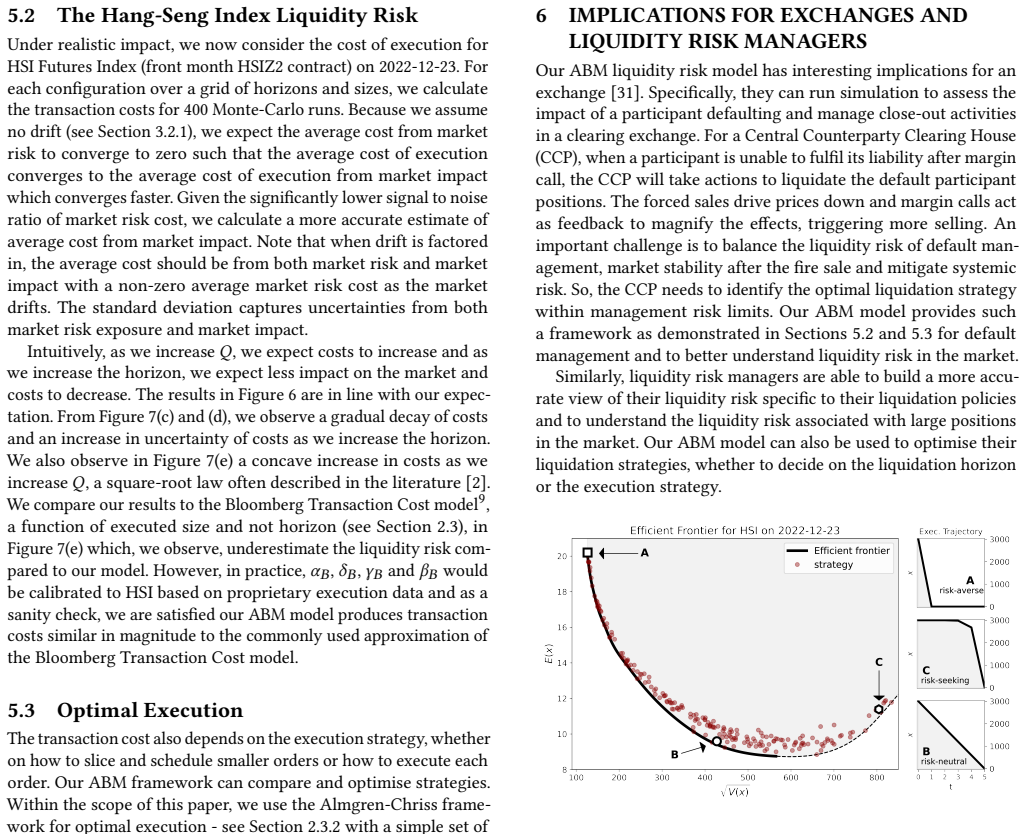
- The calibrated simulator reproduces the efficient frontier for execution schedules predicted by the optimal-execution framework: front-loaded strategies cost more but have lower variance, and balanced strategies are near-optimal.
Reading between the lines
- A stricter test of the emergence claim would freeze the reflexive update ($X_t \equiv 0$) or fit $f_{\rm mi}$ on a different day; the paper's calibration uses the same day's orderflow and price data for both the impact function and the exogenous value, so part of the permanent impact is inherited from the fitted curve.
- The baseline/counterfactual cost decomposition could be applied to adaptive execution algorithms and to other instruments, turning the method into a general transaction-cost analytics pipeline.
- Because the calibration uses a single trading day, an out-of-sample liquidity surface across several days would show whether the parameters and impact function are stable enough for production use.
Signed reviews
Editorial analysis
A structured set of objections, weighed in public.
Referee Report
Summary. The paper proposes an agent-based model (ABM) of a continuous double auction limit order book, calibrated to one day of Hang Seng Index Futures tick data, and uses it to estimate the cost of executing large meta-orders over different horizons and sizes. The model combines zero-intelligence order arrival calibrated to historical rates, Chiarella-style fundamental/momentum/noise trader demands, and a novel 'reflexive fundamental value' in which traders update their fair value by a fitted single-trade impact function. The authors claim that transient and permanent market impact 'emerge' from these behaviours, reproduce a square-root impact law, and produce a liquidity risk surface for practical use by exchanges and risk managers.
Significance. If the central claims were fully supported, the framework would be a practically useful tool for estimating liquidation costs and for optimizing execution strategies under liquidity risk, with a computationally explicit limit order book and a clean decomposition of transaction cost into market risk and market impact. The paper is clearly written and provides a detailed calibration procedure, and the Monte-Carlo liquidity risk surfaces are a useful industrial artifact. However, the load-bearing claim that permanent impact 'emerges' rather than being explicitly coded is severely weakened by the construction of the reflexive fundamental value, which directly accumulates the fitted single-trade impact function. The manuscript needs either an ablation or a substantial reframing of its central claim before its conclusions can be accepted.
major comments (3)
- [§3.2.1, Eq. (8); §7] The headline claim that permanent impact emerges is contradicted by the model construction. In Eq. (8), the signal X_t is updated as X_t = X_{t-1} + f_mi(Q_t), and f_mi(Q) = 0.561 sqrt(Q) is fitted to the same day's orderflow imbalance and mid-price changes in §3.3.3. The permanent impact of a meta-order is therefore, to first order, the accumulated fitted single-trade impact of its own trades; the square-root law is injected at the single-trade level rather than emerging from collective agent behaviour. The paper should run an ablation that disables or replaces Eq. (8) and show whether permanent impact survives, or explicitly revise the 'emergence' claim in §7, which currently states that the authors do not explicitly model permanent impact.
- [§3.3.2, §3.3.3] The calibration of the exogenous fundamental value V_t raises a circularity concern. In §3.3.2, V_t is constructed by subtracting the cumulative fitted impact sum_i f_mi(Q_i) from historical trade prices, and then the same f_mi is used in Eq. (8) to drive the reflexive fundamental value. The counterfactual-minus-baseline permanent impact measured in §5.1 may therefore largely reproduce the input calibration rather than independently validate it. To support the liquidity-risk surface, the authors should demonstrate calibration stability across multiple days or validate the model on a held-out day.
- [§5.1, Fig. 5] The empirical claim that impact decays with horizon is stated qualitatively, and no statistical quantification is provided (e.g., standard errors over the Monte-Carlo runs, or a fitted relation between impact and horizon). Given that X_t accumulates f_mi over successive slices, it is not self-evident that spreading the same total size over a longer horizon reduces the accumulated impact; the paper should report the simulated impact-vs-horizon curve with error bars and compare it directly with the fitted f_mi, rather than only with the external Bloomberg-style model.
minor comments (5)
- [§3.3.2] Typos: 'marker orders' should be 'market orders', and 'cummulative' should be 'cumulative'.
- [Eqs. (1), (4)] The symbol delta_p is used for the exponentially distributed offset in the ZI model in Eq. (1) and for the sampled depth in Eq. (4); these are conceptually distinct and the notation should be disambiguated.
- [References] References [23] and [24] appear to be the same paper (McGroarty et al., 2019) with only the volume/page formatting differing; please merge the duplicate entry.
- [§5.2, Fig. 7] The text refers to 'Figure 7(e)', 'Figure 7(c) and (d)', and 'Figure 7(a) and (b)', but the figure caption lists panels in a single line; please ensure the panel labels are clearly visible and cited consistently.
- [§5.3, Fig. 8] The text says 'Strategy C executes at the end and is always sub-optimal under the no-drift assumption,' but the figure shows the efficient frontier; clarifying how 'sub-optimal' is defined (higher cost for the same risk?) would improve readability.
Circularity Check
Permanent impact is inherited from the calibrated single-trade impact function, not emergent: Eq. (8) accumulates f_mi(Q)=0.561√Q fitted to the same day, and §3.3.2 reconstructs the exogenous fundamental by subtracting that same f_mi.
-
fitted input called prediction
[Section 3.2.1, Eq. (8); Section 3.3.3; Section 5.1]
"X_t = X_{t−1} + f_mi(Q_t) ... we calibrate the market impact of an individual trade as an aggregate impact function: f_mi(Q) = λQ^γ ... we fit f_mi to the observed excess demand and impact data using least-square regression. We note that for HSIZ2 trade data on 2022-12-23, the calibrated model f_mi(Q) = 0.561√Q shows similar concavity to the results reported by Bouchaud et. al."
Because X_t accumulates f_mi of every trade, and f_mi(Q)=0.561√Q is fitted to the same day's order-flow imbalance versus mid-price change, the permanent impact measured as the baseline-vs-counterfactual mid-price difference is largely the accumulated fitted single-trade impact of the meta-order's own trades. The square-root law is therefore injected at the single-trade level through Eq. (8). The paper's claim that permanent impact 'emerges' and 'follows the square-root law' is not a free prediction of the ABM; it is a propagation of a calibrated input.
-
self definitional
[Section 3.3.2, 'Calibrating to observed data']
"Given that we introduce a reflexive fundamental value that will add in the impact from individual trade at each step, we remove the cummulative market impact from historical trade prices \(\hat V_t − \sum_{i=0}^t f_mi(Q_i)\) to get a reasonable a proxy of the exogeneous fundamental value V_t."
The exogenous fundamental V_t is defined by subtracting exactly the same fitted f_mi from historical prices, and in simulation the same f_mi is re-added via Eq. (8). Thus the model's 'fundamental' signal and its impact channel are two uses of one fitted function. Any square-root permanent impact observed in the counterfactual is baked into both the calibration target (historical impact) and the constructed exogenous price path, making the claimed emergence circular by construction.
full rationale
The transient impact may genuinely emerge from the limit-order-book mechanics, and the comparison with the Bloomberg transaction-cost model is an external sanity check rather than a circular step. However, the paper's central emergence claim explicitly bundles transient and permanent impact, and the permanent component is not emergent: Eq. (8) accumulates a single-trade impact function f_mi(Q)=0.561√Q that was fitted to the same instrument and day, while §3.3.2 reconstructs the exogenous fundamental by subtracting that same fitted function from historical prices. The permanent square-root law is therefore forced by the model's own construction. No load-bearing self-citation chain was found; the circularity is in the equations themselves.
Assumptions & free parameters
free parameters (4)
- Single-trade impact function coefficients =
lambda=0.561, gamma=0.5
- Chiarella demand parameters =
kappa=0.011, beta_L=1.976, gamma_L=5.26, beta_H=0.530, gamma_H=290000, sigma=0.249, eta_H=0.98, eta_L=1.7e-4
- Order arrival rates alpha(t), mu(t) =
Per-minute rates estimated from 2022-12-23 data
- Conditional order distributions F_l and F_m =
Empirical histograms over depth, volume, duration, spread, time
assumptions (5)
- domain assumption Exogenous fundamental value V_t follows a random walk with no drift in forward simulation (g_V=0).
- ad hoc to paper Traders assume orderflow is informed and update their fair value on every trade via f_mi(Q_t).
- domain assumption Removing the cumulative fitted impact from historical prices yields a proxy for the exogenous fundamental value.
- domain assumption Baseline and counterfactual simulations with the same random seed and same V_t isolate market impact from market risk.
- domain assumption The aggregate impact function f_mi(Q)=lambda Q^gamma is the correct model for single-trade impact in this market.
invented entities (1)
-
Reflexive fundamental value V~_t (with accumulated signal X_t)
Cite this review
Pith. "Pith review of Agent-based Liquidity Risk Modelling for Financial Markets." pith.science (2026). https://pith.science/paper/R225O2DH
@misc{pith2026250515296,
  author       = {Pith},
  title        = {Pith review of: Agent-based Liquidity Risk Modelling for Financial Markets},
  year         = {2026},
  howpublished = {\url{https://pith.science/paper/R225O2DH}},
  note         = {Machine review of arXiv:2505.15296}
}
read the original abstract
In this paper, we describe a novel agent-based approach for modelling the transaction cost of buying or selling an asset in financial markets, e.g., to liquidate a large position as a result of a margin call to meet financial obligations. The simple act of buying or selling in the market causes a price impact and there is a cost described as liquidity risk. For example, when selling a large order, there is market slippage -- each successive trade will execute at the same or worse price. When the market adjusts to the new information revealed by the execution of such a large order, we observe in the data a permanent price impact that can be attributed to the change in the fundamental value as market participants reassess the value of the asset. In our ABM model, we introduce a novel mechanism where traders assume orderflow is informed and each trade reveals some information about the value of the asset, and traders update their belief of the fundamental value for every trade. The result is emergent, realistic price impact without oversimplifying the problem as most stylised models do, but within a realistic framework that models the exchange with its protocols, its limit orderbook and its auction mechanism and that can calculate the transaction cost of any execution strategy without limitation. Our stochastic ABM model calculates the costs and uncertainties of buying and selling in a market by running Monte-Carlo simulations, for a better understanding of liquidity risk and can be used to optimise for optimal execution under liquidity risk. We demonstrate its practical application in the real world by calculating the liquidity risk for the Hang-Seng Futures Index.
Figures


Figures from the paper (5 more)


Forward citations
Cited by 1 Pith paper
-
Herding and Liquidity in Order-Book Markets. II. Fundamental Anchoring and the Resilience of Liquidity
In a two-market order-book agent-based model, fundamental anchoring is the stabilizer whose removal lets a leverage spiral self-sustain, while none of six coupling channels transmits liquidity stress between markets.
Reference graph
Works this paper leans on
-
[1]
Robert Almgren and Neil Chriss. 2001. Optimal execution of portfolio transactions. Journal of Risk 3 (2001), 5–40
work page 2001
-
[2]
Emmanuel Bacry, Adrian Iuga, Matthieu Lasnier, and Charles-Albert Lehalle
-
[3]
Tucker Hybinette Balch, Mahmoud Mahfouz, Joshua Lockhart, Maria Hybinette, and David Byrd. 2019. How to evaluate trading strategies: Single agent market replay or multiple agent interactive simulation? arXiv preprint arXiv:1906.12010 (2019)
work page Pith review arXiv 2019
-
[4]
Peter Belcak, Jan-Peter Calliess, Stefan Zohren, et al . 2020. Fast agent-based simulation framework of limit order books with applications to pro-rata markets and the study of latency effects. arXiv preprint arXiv:2008.07871 (2020)
work page Pith review arXiv 2020
-
[5]
Richard Bookstaber, Mark Paddrik, and Brian Tivnan. 2018. An agent-based model for financial vulnerability. Journal of Economic Interaction and Coordination 13, 2 (2018), 433–466
work page 2018
-
[6]
JP Bouchaud, J Bonart, J Donier, and M Gould. [n. d.]. Trades, quotes and prices: financial markets under the microscope, 2018
work page 2018
-
[7]
Jean-Philippe Bouchaud. 2022. The inelastic market hypothesis: a microstructural interpretation. Quantitative Finance 22, 10 (2022), 1785–1795
work page 2022
-
[8]
Jean-Philippe Bouchaud, J Doyne Farmer, and Fabrizio Lillo. 2009. How markets slowly digest changes in supply and demand. In Handbook of financial markets: dynamics and evolution. Elsevier, 57–160
work page 2009
Show all 33 references
-
[9]
Jean-Philippe Bouchaud, Marc Mézard, and Marc Potters. 2002. Statistical prop- erties of stock order books: empirical results and models. Quantitative finance 2, 4 (2002), 251
2002
-
[10]
David Byrd, Maria Hybinette, and Tucker Hybinette Balch. 2020. ABIDES: To- wards high-fidelity multi-agent market simulation. In Proceedings of the 2020 ACM SIGSIM Conference on Principles of Advanced Discrete Simulation . 11–22
2020
-
[11]
Carl Chiarella and Giulia Iori. 2002. A simulation analysis of the microstructure of double auction markets. Quantitative finance 2, 5 (2002), 346
2002
-
[12]
Dave Cliff and Janet Bruten. 1997. Zero is Not Enough: On The Lower Limit of Agent Intelligence For Continuous Double Auction Markets. Technical Report HPL-97-141, Hewlett-Packard Laboratories, Bristol, UK (1997)
1997
-
[13]
Andrea Coletta, Aymeric Moulin, Svitlana Vyetrenko, and Tucker Balch. 2022. Learning to simulate realistic limit order book markets from data as a World Agent. In Proceedings of the Third ACM International Conference on AI in Finance . 428–436
2022
-
[14]
Rama Cont and Marvin S. Mueller. 2019. A stochastic partial differential equation model for limit order book dynamics. (4 2019). http://arxiv.org/abs/1904.03058
2019 arXiv
-
[15]
J Doyne Farmer, Paolo Patelli, and Ilija I Zovko. 2005. The predictive power of zero intelligence in financial markets. Proceedings of the National Academy of Sciences 102, 6 (2005), 2254–2259
2005
-
[16]
Kang Gao, Perukrishnen Vytelingum, Stephen Weston, Wayne Luk, and Ce Guo
-
[17]
Jim Gatheral. 2010. No-dynamic-arbitrage and market impact. Quantitative finance 10, 7 (2010), 749–759
2010
-
[18]
Dhananjay K Gode and Shyam Sunder. 1993. Allocative efficiency of markets with zero-intelligence traders: Market as a partial substitute for individual rationality. Journal of political economy 101, 1 (1993), 119–137
1993
-
[19]
Albert S. Kyle. 1985. Continuous Auctions and Insider Trading. Econometrica 53 (11 1985), 1315. Issue 6. https://doi.org/10.2307/1913210
1985 doi
-
[20]
Francesco Lamperti, Andrea Roventini, and Amir Sani. 2018. Agent-based model calibration using machine learning surrogates. Journal of Economic Dynamics and Control 90 (2018), 366–389
2018
-
[21]
Ananth Madhavan. 2000. Market microstructure: A survey. Journal of financial markets 3, 3 (2000), 205–258
2000
-
[22]
Adam A Majewski, Stefano Ciliberti, and Jean-Philippe Bouchaud. 2020. Co- existence of trend and value in financial markets: Estimating an extended Chiarella model. Journal of Economic Dynamics and Control 112 (2020), 103791
2020
-
[23]
Frank McGroarty, Ash Booth, Enrico Gerding, and V. L. Raju Chinthalapati. 2019. High frequency trading strategies, market fragility and price spikes: an agent based model perspective. Annals of Operations Research 282, 1 (2019), 217–244
2019
-
[24]
Frank McGroarty, Ash Booth, Enrico Gerding, and VL Raju Chinthalapati. 2019. High frequency trading strategies, market fragility and price spikes: an agent based model perspective. Annals of Operations Research 282, 1-2 (2019), 217–244
2019
-
[25]
Marc Potters and Jean-Philippe Bouchaud. 2003. More statistical properties of order books and price impact. Physica A: Statistical Mechanics and its Applications 324, 1 (2003), 133–140
2003
-
[26]
Tobias Preis, Sebastian Golke, Wolfgang Paul, and Johannes J Schneider. 2006. Multi-agent-based order book model of financial markets. Europhysics Letters 75, 3 (2006), 510
2006
-
[27]
Raja Velu. 2020. Algorithmic trading and quantitative strategies . CRC Press
2020
-
[28]
Svitlana Vyetrenko, David Byrd, Nick Petosa, Mahmoud Mahfouz, Danial Der- vovic, Manuela Veloso, and Tucker Balch. 2020. Get real: Realism metrics for robust limit order book market simulations. In Proceedings of the First ACM International Conference on AI in Finance . 1–8
2020
-
[29]
Perukrishnen Vytelingum, Dave Cliff, and Nicholas R Jennings. 2008. Strategic bidding in continuous double auctions. Artificial Intelligence 172, 14 (2008), 1700–1729
2008
-
[30]
Xintong Wang and Michael Paul Wellman. 2017. Spoofing the limit order book: An agent-based model. In Workshops at the Thirty-First AAAI Conference on Artificial Intelligence
2017
-
[31]
Dingqiu Zhu, Richard Wise, and Tao Chen. 2023. An innovative approach for optimizing CCP default management through Agent Based Modelling. Journal of Risk Management (Oct 2023)
2023
-
[2014]
Market impacts and the life cycle of investors orders. (2014)
2014
-
[2022]
Understanding intra-day price formation process by agent-based financial market simulation: calibrating the extended chiarella model. (Aug. 2022)
2022
Reviewed August 7, 2026 · model on record in the stance chip above.
Discussion (0). Continue with ORCID to comment.