Ca-bearing cyanopolyynes in IRC+10216
Pith reviewed 2026-06-28 18:34 UTC · model grok-4.3
The pith
Observed CaNC abundance in IRC+10216 requires formation from larger Ca-terminated cyanopolyyne ions via dissociative recombination with rearrangement.
A machine-rendered reading of the paper's core claim, the machinery that carries it, and where it could break.
Core claim
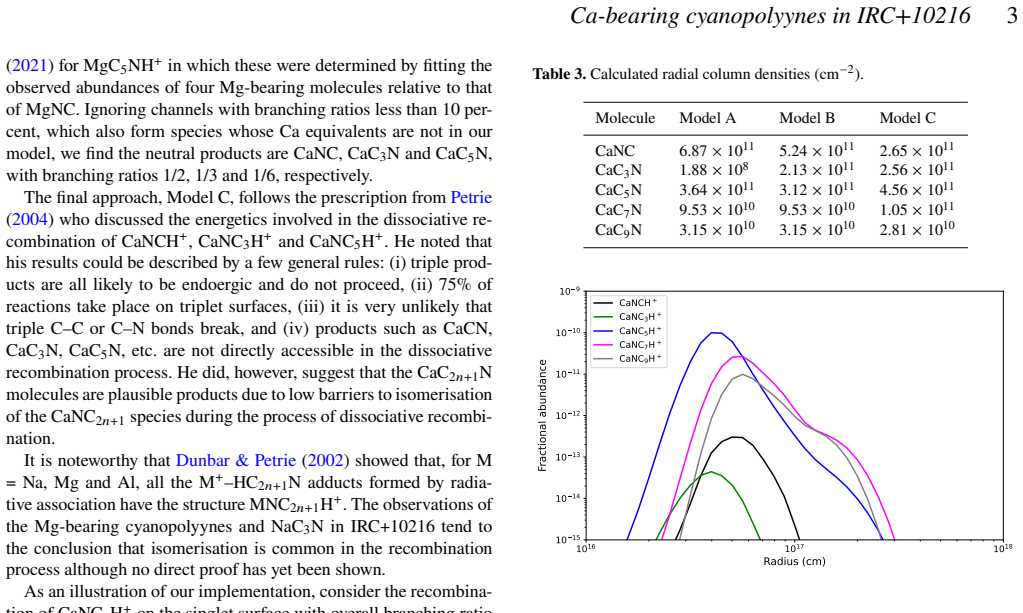
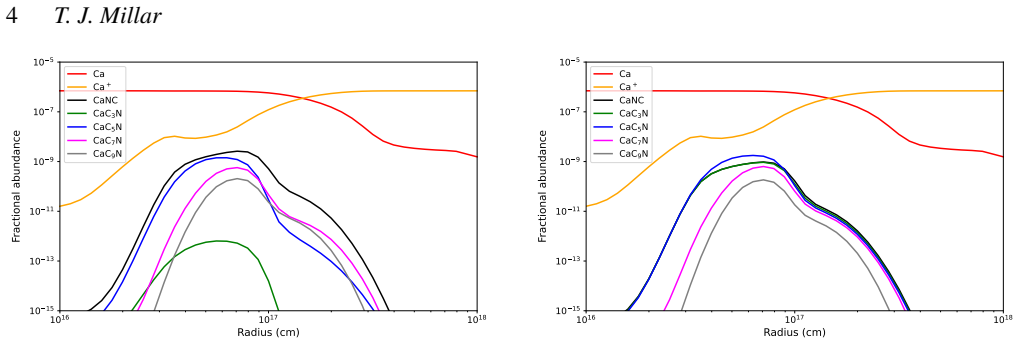
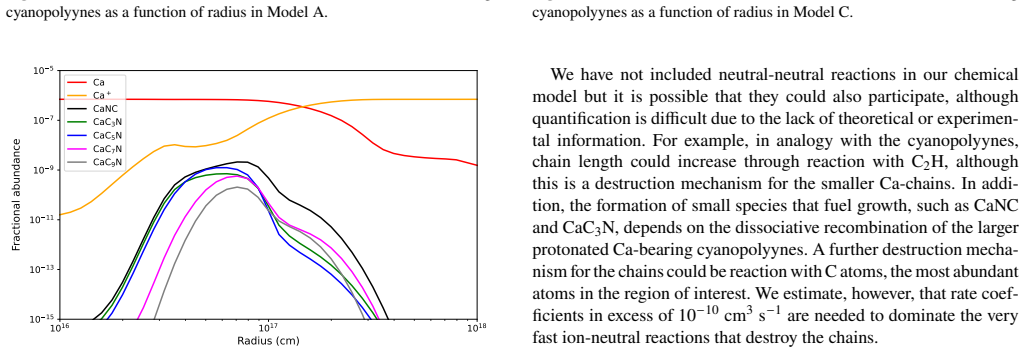
The central claim is that the observed abundance of CaNC must be made from much larger Ca-terminated cyanopolyyne ions, which requires considerable rearrangement in their dissociative recombination. Abundances are computed for the neutral and ionic species CaC3N, CaC5N, CaC7N and CaC9N, and the work highlights the recent laboratory measurement of the CaC3N rotational spectrum as a route to observational tests.
What carries the argument
The chemical network that tracks formation and destruction of CaC_{2n+1}N species and their ions, with dissociative recombination of the larger ions as the step that must produce CaNC through rearrangement.
If this is right
- Predicted column densities for CaC5N and CaC7N become direct observational targets.
- The same rearrangement step must be included when modeling abundances of other metal cyanides.
- CaC3N becomes a priority for new radio searches once its spectrum is known.
- Product branching ratios in the dissociative recombination of CaC_{2n+1}N^+ ions control the final CaNC yield.
Where Pith is reading between the lines
- If rearrangement is required, laboratory measurements of recombination branching ratios for CaC5N^+ would directly test the proposed route.
- The result implies that metal insertion or termination occurs after chain growth rather than early in the sequence.
- Similar ion-recombination pathways may operate for Mg-bearing chains already detected in the same source.
Load-bearing premise
The chemical network and reaction rates capture all relevant formation and destruction pathways for these calcium species and contain no direct routes that can produce CaNC at the observed levels.
What would settle it
A sensitive search for CaC3N rotational lines in IRC+10216 that either detects the molecule at the predicted column density or places a firm upper limit well below it.
Figures
read the original abstract
In recent years, a number of metal-containing, carbon-chain species have been detected in the external circumstellar envelope of the carbon-rich AGB star IRC+10216. The most common metal detected in such species is Mg, for which molecules as large as MgC$_5$N, MgC$_5$N$^+$, MgC$_6$H and MgC$_6$H$^+$ have been observed. In this paper, we calculate the likely abundances of the Ca-bearing cyanopolyynes, CaC$_{2n+1}$N for n = 1-4, drawing the conclusion that the observed abundance of CaNC must be made from much larger Ca-terminated cyanopolyyne ions, which requires considerable rearrangement in their dissociative recombination. We pay particular attention to the detectability of CaC$_3$N whose rotational spectrum has recently been measured.
Editorial analysis
A structured set of objections, weighed in public.
Referee Report
Summary. The manuscript calculates the likely abundances of Ca-bearing cyanopolyynes CaC_{2n+1}N (n=1-4) in the circumstellar envelope of IRC+10216. It concludes that the observed abundance of CaNC must arise from dissociative recombination of much larger Ca-terminated cyanopolyyne ions, requiring considerable molecular rearrangement, and discusses the detectability of CaC3N based on its recently measured rotational spectrum.
Significance. If the chemical model holds, the result would advance understanding of metal chemistry in carbon-rich AGB envelopes by extending Mg-species studies to Ca and emphasizing ion-recombination pathways with rearrangement. No machine-checked proofs or parameter-free derivations are present.
major comments (2)
- [Abstract] Abstract: the central claim that observed CaNC abundance 'must' come from larger CaC_{2n+1}N ions via rearrangement rests on model abundances being too low for direct routes, yet no equations, rate coefficients, model outputs, or error analysis are supplied, making it impossible to judge support for the claim.
- [Methods/Results (implied)] Chemical network description (throughout): the conclusion depends on the assumption that the adopted network captures all relevant formation/destruction pathways for CaC_{2n+1}N and CaNC without direct CaNC routes at observed levels, but no reaction list, rate sources, or sensitivity tests are provided to substantiate this.
Simulated Author's Rebuttal
We thank the referee for their thoughtful review and valuable comments on our manuscript. We address each major comment below and will revise the paper accordingly to improve clarity and completeness.
read point-by-point responses
-
Referee: [Abstract] Abstract: the central claim that observed CaNC abundance 'must' come from larger CaC_{2n+1}N ions via rearrangement rests on model abundances being too low for direct routes, yet no equations, rate coefficients, model outputs, or error analysis are supplied, making it impossible to judge support for the claim.
Authors: We agree that the abstract's claim would benefit from more supporting information. In the revised manuscript, we will expand the abstract slightly if space allows or ensure the main text provides the necessary details. Specifically, we will include the key rate equations used in the abundance calculations, the adopted rate coefficients for the relevant reactions, representative model output abundances for CaC_{2n+1}N species, and a discussion of uncertainties to better support the conclusion regarding the origin of CaNC. revision: yes
-
Referee: [Methods/Results (implied)] Chemical network description (throughout): the conclusion depends on the assumption that the adopted network captures all relevant formation/destruction pathways for CaC_{2n+1}N and CaNC without direct CaNC routes at observed levels, but no reaction list, rate sources, or sensitivity tests are provided to substantiate this.
Authors: The referee is correct that the current manuscript lacks a detailed description of the chemical network. The network is based on extensions from our previous work on Mg-bearing cyanopolyynes, with Ca-specific reactions drawn from analogous systems and literature rate coefficients. To address this, the revised version will include: (1) a table or list of the primary reactions involving CaC_{2n+1}N and CaNC, (2) sources for the rate coefficients, and (3) results from sensitivity tests varying key rates to demonstrate that direct formation pathways do not reach the observed CaNC levels. This will substantiate the assumption that the network is comprehensive for this purpose. revision: yes
Circularity Check
No circularity detected; derivation relies on external chemical network
full rationale
The paper computes abundances of CaC_{2n+1}N species via a chemical network and infers that observed CaNC requires production from larger ions with rearrangement in dissociative recombination. No equations, fitted parameters, or self-citations are quoted that reduce the central claim to its own inputs by construction. The network and rates are treated as external inputs (standard in the field), and the result is a comparison of model output to observation rather than a self-definitional or fitted-input prediction. This is the most common honest finding for such modeling papers.
Axiom & Free-Parameter Ledger
Reference graph
Works this paper leans on
-
[1]
New molecules in IRC +10216: confirmation of C _ 5 S and tentative identification of MgCCH, NCCP, and SiH _ 3 CN. , keywords =. doi:10.1051/0004-6361/201424542 , archivePrefix =. 1408.6306 , primaryClass =
work page internal anchor Pith review Pith/arXiv arXiv doi:10.1051/0004-6361/201424542
-
[2]
Laboratory and Astronomical Discovery of HydroMagnesium Isocyanide
Laboratory and Astronomical Discovery of HydroMagnesium Isocyanide. , keywords =. doi:10.1088/0004-637X/775/2/133 , archivePrefix =. 1309.0371 , primaryClass =
work page internal anchor Pith review Pith/arXiv arXiv doi:10.1088/0004-637x/775/2/133
-
[3]
Discovery of two metallic cyanoacetylides in IRC+10216: HMgCCCN and NaCCCN. , keywords =. doi:10.1051/0004-6361/202346462 , archivePrefix =. 2304.01066 , primaryClass =
-
[4]
Discovery of two new magnesium-bearing species in IRC+10216: MgC _ 3 N and MgC _ 4 H. , keywords =. doi:10.1051/0004-6361/201936372 , adsurl =
-
[5]
Discovery of the first Ca-bearing molecule in space: CaNC
Discovery of the first Ca-bearing molecule in space: CaNC. , keywords =. doi:10.1051/0004-6361/201936040 , archivePrefix =. 1906.09352 , primaryClass =
work page internal anchor Pith review Pith/arXiv arXiv doi:10.1051/0004-6361/201936040 1906
-
[6]
The magnesium paradigm in IRC +10216: Discovery of MgC _ 4 H ^ + , MgC _ 3 N ^ + , MgC _ 6 H ^ + , and MgC _ 5 N ^ +. , keywords =. doi:10.1051/0004-6361/202346467 , archivePrefix =. 2304.05117 , primaryClass =
-
[7]
Detection of the linear SiC _ 3 and SiC _ 5 radicals in IRC+10216. , keywords =. doi:10.1051/0004-6361/202556370 , archivePrefix =. 2508.04509 , primaryClass =
-
[8]
Laboratory and Astronomical Discovery of Magnesium Dicarbide, MgC _ 2. , keywords =. doi:10.3847/2041-8213/aca144 , archivePrefix =. 2210.17348 , primaryClass =
-
[9]
Interstellar and Circumstellar Reaction Kinetics of Na ^ + , Mg ^ + , and Al ^ + with Cyanopolyynes and Polyynes. , keywords =. doi:10.1086/324196 , adsurl =
-
[10]
Calcium Chemistry in Carbon-rich Circumstellar Environments: The Laboratory and Astronomical Discovery of Calcium Dicarbide, CaC _ 2. , keywords =. doi:10.3847/2041-8213/ad3336 , adsurl =
-
[11]
Journal of Physical Chemistry A , year = 2025, month = dec, volume =
Laboratory Rotational Spectroscopy of CaC3N and CaC4H. Journal of Physical Chemistry A , year = 2025, month = dec, volume =. doi:10.1021/acs.jpca.5c06201 , adsurl =
-
[12]
Model for the circumstellar gas around alpha Orionis. , keywords =. doi:10.1086/159452 , adsurl =
-
[13]
Quantum-State Controlled Formation of Cosmically Relevant Metallic Molecular Ions. , keywords =. doi:10.1103/PhysRevLett.134.203401 , adsurl =
-
[14]
Gas phase atomic metals in the circumstellar envelope of IRC+10216
Gas phase atomic metals in the circumstellar envelope of IRC+10216. , keywords =. doi:10.1051/0004-6361/200913970 , archivePrefix =. 1002.3554 , primaryClass =
work page internal anchor Pith review Pith/arXiv arXiv doi:10.1051/0004-6361/200913970
-
[15]
, keywords =
A new chemical model of the circumstellar envelope surrounding IRC+10216. , keywords =
-
[16]
Large molecules in the envelope surrounding IRC+10216. , keywords =. doi:10.1046/j.1365-8711.2000.03560.x , adsurl =
-
[17]
The UMIST Database for Astrochemistry 2022. , keywords =. doi:10.1051/0004-6361/202346908 , archivePrefix =. 2311.03936 , primaryClass =
-
[18]
doi:10.1016/j.molstruc.2005.01.027 , Journal =
The Cologne Database for Molecular Spectroscopy, CDMS: a useful tool for astronomers and spectroscopists. Journal of Molecular Structure , year = 2005, month = may, volume =. doi:10.1016/j.molstruc.2005.01.027 , adsurl =
-
[19]
Magnesium radicals MgC _ 5 N and MgC _ 6 H in IRC +10216. , keywords =. doi:10.1051/0004-6361/202141671 , archivePrefix =. 2108.01480 , primaryClass =
-
[20]
Detection of SiC _ 6 in IRC +10216 through Q-band lines. , keywords =. doi:10.1051/0004-6361/202555902 , adsurl =
-
[21]
On the formation of metal cyanides and related compounds in the circumstellar envelope of IRC+10216. , keywords =. doi:10.1093/mnras/282.3.807 , adsurl =
-
[22]
Association Reactions of Fe ^ + with Hydrocarbons: Implications for Dense Interstellar Cloud Chemistry. , keywords =. doi:10.1086/303596 , adsurl =
-
[23]
Variational Transition State Theory Calculations
Radiative Association Reactions of Na+, Mg+, and Al+with Abundant Interstellar Molecules. Variational Transition State Theory Calculations. J. Phys. Chem. A , year = 2000, month = may, volume =. doi:10.1021/jp993485q , adsurl =
-
[24]
Australian Journal of Chemistry , volume =
Petrie, Simon , title =. Australian Journal of Chemistry , volume =. 2004 , month =. doi:10.1071/CH03173 , url =
-
[25]
PARAMETRIZATION OF THE ION-POLAR MOLECULE COLLISION RATE-CONSTANT BY TRAJECTORY CALCULATIONS , Journal =. 1982 , Volume =. doi:10.1063/1.442828 , ISSN =
discussion (0)
Sign in with ORCID, Apple, or X to comment. Anyone can read and Pith papers without signing in.