REVIEW 2 major objections 5 minor 44 references
Type I outbursts in low eccentricity Be/X-ray binaries
T0 review · 2 major / 5 minor · reviewed 2026-08-14 · deepseek-v4-flash
Pith's one-line read A circular-orbit Be/X-ray binary can still produce type I outbursts: the 3:1 Lindblad resonance inside the Be star's decretion disk drives eccentricity growth, letting the neutron star capture material at disk apastron on a timescale up…
desk verdict A plausible new mechanism for type I outbursts in low-eccentricity Be/X-ray binaries, but the key premise that disks reach the 3:1 resonance is untested. read the letter →
The pith
A machine-rendered reading of the paper's core claim, the machinery that carries it, and where it could break.
The reading
What carries the argument
The load-bearing object is the 3:1 Lindblad resonance: the radius in the Be star disk where a disk particle's Keplerian orbital frequency is commensurable with the binary's tidal forcing in a 3:1 ratio, giving the radius formula $R_{\mathrm{res}} = 3^{-2/3}(1+q)^{-1/3}a$. At this resonance, tidal forcing drives eccentricity growth at the rate $\lambda \simeq 2.1 q^2 \Omega_b R_{\mathrm{res}}^{-1} W$ (for disk radial extent $W$), and this growth is what turns the initially circular disk into an eccentric one that overflows the Be star's Roche lobe. The precessing eccentric disk then sets the outburst period through the apsidal-superhump relation $P_{\mathrm{burst}}\simeq P_b(1+P_b/P_p)$. The mechanism requires $q\lesssim0.33$ and a disk aspect ratio at the resonance small enough for the resonance to be strong.
What would settle it
Measure the outer radius of the Be star's disk in a low-eccentricity Be/X-ray binary that shows type I outbursts, using line-profile fitting or interferometry: if the disk edge stays inside the 3:1 resonance radius $R_{\mathrm{res}}$ while outbursts continue, the proposed mechanism is ruled out. Alternatively, time the outbursts precisely: if the recurrence period equals the orbital period to better than 0.1% instead of exceeding it by a few percent, the apastron-capture picture is falsified.
Extended reading notes
Core claim
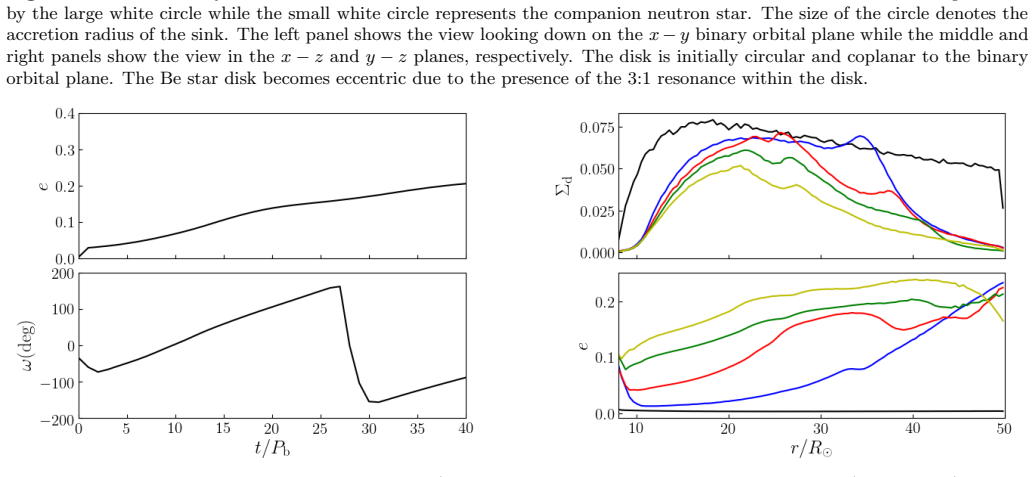
The paper's central claim is that the 3:1 Lindblad resonance, located at $R_{\mathrm{res}} = 3^{-2/3}(1+q)^{-1/3}a$, sits inside the decretion disk of a low-mass-ratio ($q=M_{\mathrm{NS}}/M_\star=0.078$) Be/X-ray binary and drives the disk eccentric. An SPH simulation starting with a coplanar, circular disk extending to $50\,R_\odot$ shows the outer disk developing an eccentricity of about 0.2 within 40 binary orbits, with growth beginning at the outside and spreading inward. The neutron star's accretion rate then shows repeated outbursts with period about $1.02P_b$, and the estimated X-ray luminosity is $L_X\approx0.09L_{\mathrm{Edd}}$, typical of type I outbursts. The eccentric disk precesses prograde with a period $P_p\approx34.8P_b$, so the apastron overtakes the neutron star on a superhump-like period $P_{\mathrm{burst}}\approx P_b(1+P_b/P_p)$ slightly longer than the orbital period.
Load-bearing premise
The mechanism only works if the Be star's disk is large enough to reach the 3:1 resonance radius ($44.5\,R_\odot$ for the simulated parameters); if real decretion disks are tidally truncated inside that radius, the eccentricity growth never starts and no such outbursts occur.
Editorial extensions
If this is right
- Observed type I outbursts in nearly circular Be/X-ray binaries, including the 107-day recurrences of GS 0834-430 versus its 105.8-day orbit, can be explained without invoking unobserved orbital eccentricity.
- Outburst recurrence in these systems should exceed the orbital period by a few percent, and precise timing of that offset can constrain the disk's aspect ratio $H/R$.
- The mechanism is favoured in shorter-period binaries ($P_b\lesssim150$ days) with flared disks; longer-period or thicker disks at the resonance weaken the 3:1 resonance and are unlikely to show this type of outburst.
- If the Be disk is misaligned by more than about $20^\circ$ from the binary plane, the eccentricity growth is insufficient to produce outbursts, so the appearance of type I outbursts implies the disk is nearly coplanar.
Reading between the lines
- A timing campaign on low-eccentricity type I sources could turn the recurrence-time excess into a direct measurement of disk precession, effectively allowing apsidal precession to be observed without resolving the disk.
- The same 3:1 resonance mechanism should operate in other extreme-mass-ratio decretion-disk binaries, such as Be stars with white-dwarf or black-hole companions, predicting similar low-eccentricity outburst behaviour.
- Long-baseline spectroscopy of H-alpha or other Be lines should show periodic variations in line shape or peak separation with the precession period (~34 orbits in the simulation), a testable signature that the disk is eccentric and precessing.
- Interferometric or line-profile mapping that shows real Be disks in these systems are tidally truncated inside $R_{\mathrm{res}}$ would directly undercut the mechanism, since the paper's simulation starts with a disk that already extends past the resonance.
Signed reviews
Editorial analysis
A structured set of objections, weighed in public.
Referee Report
Summary. The manuscript proposes that the 3:1 Lindblad resonance lying inside the Be star's decretion disk drives eccentricity growth even when the binary orbit is circular. The neutron star then captures material near the disk's apastron, producing type I outbursts on a timescale slightly longer than the orbital period. The paper reports an SPH simulation with phantom for a binary with mass ratio q = 0.078, separation a = 95 R_sun, and initial disk outer radius Rout = 50 R_sun, showing disk eccentricity growth, prograde precession, and periodic accretion onto the neutron star. Analytic estimates are given for the resonance radius, the eccentricity growth rate, the precession period, and the resulting superhump/outburst period, with the nominal prediction Pburst = 1.028 Pb. The mechanism is offered as an explanation for type I outbursts in low-eccentricity Be/X-ray binaries such as GS 0834-430.
Significance. If the mechanism operates, it fills a genuine observational gap: type I outbursts in nearly circular Be/X-ray binaries cannot be explained by periastron passage in an eccentric orbit. The numerical setup is clearly described, the use of a standard SPH code is appropriate, and the analytic estimates are based on established resonance theory rather than tuned to the observations. The prediction that the outburst period should exceed the orbital period by a few percent is falsifiable with timing data. The main weakness is that the reported simulation initializes the disk already outside the resonance and therefore does not test the crucial premise that a real disk can extend past the 3:1 resonance; the paper's own conclusions identify this as a required system property.
major comments (2)
- [§2, §3 (Eq. 1), §4] The simulation initializes the Be-star disk with Rout = 50 R_sun (Section 2), which is already beyond the 3:1 resonance radius R_res = 44.5 R_sun from Eq. (1). The resonance is therefore populated from t = 0, and the run cannot test whether a disk that starts inside R_res can viscously spread past the resonance. The Introduction's statement that 'we show that the disc is able to extend farther out than the 3:1 resonance' is not demonstrated by this simulation, and the Conclusions' first required property, 'the disk must be large enough,' remains an assumption. Because the cited Okazaki & Negueruela (2001) work argues that such disks are truncated at the resonance, I regard this as the main load-bearing gap; a run initialized with Rout < R_res, or a run with mass injection and viscous spreading from small radii, is needed to validate the mechanism.
- [§2, §3 (Eq. 2), Fig. 2] The measured eccentricity growth rate, λ ≈ 0.005 P_b^-1 (Fig. 2), is 2.5 times the analytic value λ ≈ 0.002 P_b^-1 quoted from Eq. (2). The suggested explanation involving viscosity and sound speed is plausible but unquantified. Under the linear interpretation used in the text, the analytic rate would postpone the onset of Roche-lobe overflow (e_min = 0.14) from the roughly 10 P_b seen in Fig. 4 to around 70 P_b. This quantitative discrepancy should be addressed, for example with a lower-viscosity run or a resolution study, so that the numerical and analytic growth rates can be compared on a firm basis.
minor comments (5)
- [§3 (Eq. 2)] The symbol W in Eq. (2) is described as 'the disk radial extent,' but the numerical evaluation giving λ ≈ 0.002 P_b^-1 is not shown; please define W precisely (resonance width versus outer disk radius) and state the value used.
- [§2, Fig. 2] The lower panel of Fig. 2 plots the argument of periapsis but gives no vertical scale or units; a reader cannot check the precession period of about 40 P_b from the figure.
- [§2.1] The claim that inclination angles above about 20° suppress the eccentricity growth is reported without supporting figures or a table of the runs performed; at least a brief description of the initial inclinations and resulting eccentricities is needed for reproducibility.
- [§1, §4] There are typographical errors such as 'occurrance' and 'obital eccentricity' (Section 1), and the paper alternates between 'disc' and 'disk'; these should be harmonized in a final version.
- [§2, Fig. 4] The axis label in Fig. 4 ('Md = 10 −8 M⊙') is malformed; it should read 'M_d = 10^-8 M_sun' with proper spacing.
Circularity Check
No circularity: the resonance growth and precession rates are taken from independent prior theory, and the simulated outburst period is compared rather than fitted.
full rationale
The paper's central derivation is self-contained against external benchmarks. The 3:1 Lindblad resonance radius (Eq. 1), the eccentricity growth rate (Eq. 2), and the apsidal precession period formulas (Eqs. 3-5) are all taken from independent prior work (Lubow 1992; Goodchild & Ogilvie 2006; Murray 1998, 2000) and are not fitted to the target outburst observations. The predicted outburst period P_burst = 1.028 P_b is an upper limit derived from standard precession theory, and the simulated value of about 1.02 P_b is compared to it, with the paper explaining that pressure effects should lower the estimate; neither quantity is tuned to match observed periods. The application to GS 0834-430 is presented as a consistency check, not as a fitted input. Self-citations (e.g., Franchini et al. 2019; Martin et al. 2014) are used for code validation, circumbinary material, and luminosity estimates, but none of these carries the load-bearing claim that the 3:1 resonance drives eccentricity growth. The main caveat is physical rather than circular: the simulation initializes the disk with Rout = 50 R_sun, already outside the resonance radius R_res = 44.5 R_sun (Eq. 1), and the Conclusions list 'the disk must be large enough to reach the location of the 3:1 Lindblad resonance' as a required system property. This is an explicit limitation on the applicability of the mechanism, not a definitional reduction of the prediction to its input. No parameter that determines the burst period is fitted from observed outburst timescales, so the derivation chain is not circular.
Assumptions & free parameters
free parameters (3)
- initial disk outer radius Rout =
50 R_sun
- Shakura-Sunyaev viscosity parameter alpha =
0.3
- disk aspect ratio H/R at inner edge =
0.01
assumptions (5)
- domain assumption The Be star disk is a geometrically thin, Keplerian decretion disk in vertical hydrostatic equilibrium.
- domain assumption The disk is nearly coplanar with the binary orbital plane; eccentricity growth is insufficient for inclination above about 20 degrees.
- domain assumption The disk can extend beyond the 3:1 Lindblad resonance radius given by Eq. (1).
- domain assumption A global isothermal equation of state with H/R = 0.01 at the inner edge and flared profile is appropriate.
- standard math The 3:1 Lindblad resonance eccentricity-growth rate formula (Eq. 2) from Lubow (1992) applies to a decretion disk with this viscosity and aspect ratio.
Cite this review
Pith. "Pith review of Type I outbursts in low eccentricity Be/X-ray binaries." pith.science (2026). https://pith.science/paper/R2UE5B4H
@misc{pith2026190802776,
  author       = {Pith},
  title        = {Pith review of: Type I outbursts in low eccentricity Be/X-ray binaries},
  year         = {2026},
  howpublished = {\url{https://pith.science/paper/R2UE5B4H}},
  note         = {Machine review of arXiv:1908.02776}
}
read the original abstract
Type I outbursts in Be/X-ray binaries are usually associated with the eccentricity of the binary orbit. The neutron star accretes gas from the outer parts of the decretion disk around the Be star at each periastron passage. However, this mechanism cannot explain type I outbursts that have been observed in nearly circular orbit Be/X-ray binaries. With hydrodynamical simulations and analytic estimates we find that in a circular orbit binary, a nearly coplanar disk around the Be star can become eccentric. The extreme mass ratio of the binary leads to the presence of the 3:1 Lindblad resonance inside the Be star disk and this drives eccentricity growth. Therefore the neutron star can capture material each time it approaches the disk apastron, on a timescale up to a few percent longer than the orbital period. We have found a new application of this mechanism that is able to explain the observed type I outbursts in low eccentricity Be/X-ray binaries.
Figures


Reference graph
Works this paper leans on
-
[1]
Artymowicz, P., & Lubow, S. H. 1994, ApJ, 421, 651
1994
- [2]
-
[3]
P., Brown, J
Cassinelli, J. P., Brown, J. C., Maheswaran, M., Miller, N. A., & Telfer, D. C. 2002, ApJ, 578, 951
2002
- [4]
-
[5]
Eggleton, P. P. 1983, ApJ, 268, 368
1983
- [6]
-
[7]
Frank, J., King, A., & Raine, D. J. 2002, Accretion Power in Astrophysics: Third Edition
2002
- [8]
Show all 44 references
-
[9]
Hayasaki, K., & Okazaki, A. T. 2004, MNRAS, 350, 971
2004
-
[10]
1990, PASJ, 42, 135
Hirose, M., & Osaki, Y. 1990, PASJ, 42, 135
1990
-
[11]
R., Pringle, J
King, A. R., Pringle, J. E., & Livio, M. 2007, MNRAS, 376, 1740
2007
-
[12]
Kley, W., Papaloizou, J. C. B., & Ogilvie, G. I. 2008, A&A, 487, 671
2008
-
[13]
1991, MNRAS, 250, 432
Lee, U., Osaki, Y., & Saio, H. 1991, MNRAS, 250, 432
1991
-
[14]
Lodato, G., & Price, D. J. 2010, MNRAS, 405, 1212
2010
-
[15]
Lubow, S. H. 1991a, ApJ, 381, 259 —. 1991b, ApJ, 381, 268 —. 1992, ApJ, 401, 317
1992
-
[16]
Price, D. J. 2014, ApJ, 790, L34
2014
-
[17]
G., Nixon, C
Martin, R. G., Nixon, C. J., Pringle, J. E., & Livio, M. 2019, NewA, 70, 7
2019
-
[18]
G., Pringle, J
Martin, R. G., Pringle, J. E., Tout, C. A., & Lubow, S. H. 2011, MNRAS, 416, 2827
2011
-
[19]
G., Tout, C
Martin, R. G., Tout, C. A., & Pringle, J. E. 2009, MNRAS, 397, 1563
2009
-
[20]
Murray, J. R. 1998, MNRAS, 297, 323 —. 2000, MNRAS, 314, L1
1998
-
[21]
1998, A&A, 338, 505
Negueruela, I. 1998, A&A, 338, 505
1998
-
[22]
Negueruela, I., & Okazaki, A. T. 2001, A&A, 369, 108
2001
-
[23]
Nixon, C., & Lubow, S. H. 2015, MNRAS, 448, 3472
2015
-
[24]
Nixon, C. J. 2012, MNRAS, 423, 2597
2012
-
[25]
T., Bate, M
Okazaki, A. T., Bate, M. R., Ogilvie, G. I., & Pringle, J. E. 2002, MNRAS, 337, 967
2002
-
[26]
T., & Negueruela, I
Okazaki, A. T., & Negueruela, I. 2001, A&A, 377, 161
2001
-
[27]
1977, ApJ, 216, 822
Paczynski, B. 1977, ApJ, 216, 822
1977
-
[28]
2002, ApJ, 574, 364
Pfahl, E., Rappaport, S., Podsiadlowski, P., & Spruit, H. 2002, ApJ, 574, 364
2002
-
[29]
Podsiadlowski, P., Langer, N., Poelarends, A. J. T., et al. 2004, ApJ, 612, 1044
2004
-
[30]
Porter, J. M. 1996, MNRAS, 280, L31
1996
-
[31]
M., & Rivinius, T
Porter, J. M., & Rivinius, T. 2003, PASP, 115, 1153
2003
-
[32]
J., & Monaghan, J
Price, D. J., & Monaghan, J. J. 2007, MNRAS, 374, 1347
2007
-
[33]
J., Wurster, J., Nixon, C., et al
Price, D. J., Wurster, J., Nixon, C., et al. 2017, PHANTOM: Smoothed particle hydrodynamics and magnetohydrodynamics code, Astrophysics Source Code Library, , , ascl:1709.002
2017
-
[34]
Pringle, J. E. 1991, MNRAS, 248, 754
1991
-
[35]
V., & Popov, S
Raguzova, N. V., & Popov, S. B. 2005, Astronomical and Astrophysical Transactions, 24, 151
2005
-
[36]
2007, MNRAS, 377, 867
Reig, P. 2007, MNRAS, 377, 867
2007
-
[37]
2013, A&A, 551, A1 R´ ımulo, L
Reig, P., & Nespoli, E. 2013, A&A, 551, A1 R´ ımulo, L. R., Carciofi, A. C., Vieira, R. G., et al. 2018, MNRAS, 476, 3555
2013
-
[38]
I., & Sunyaev, R
Shakura, N. I., & Sunyaev, R. A. 1973, A&A, 24, 337 6 A. Franchini & R. G. Martin
1973
-
[39]
1986, in Plasma Penetration into Magnetospheres, ed
Stella, L. 1986, in Plasma Penetration into Magnetospheres, ed. N. Kylafis, J. Papamastorakis, & J. Ventura, 199
1986
-
[40]
1978, Ap&SS, 54, 479
Sutantyo, W. 1978, Ap&SS, 54, 479
1978
-
[41]
J., Coe, M
Townsend, L. J., Coe, M. J., Corbet, R. H. D., & Hill, A. B. 2011, MNRAS, 416, 1556
2011
-
[42]
1988, MNRAS, 232, 35
Whitehurst, R. 1988, MNRAS, 232, 35
1988
-
[43]
1991, MNRAS, 249, 25
Whitehurst, R., & King, A. 1991, MNRAS, 249, 25
1991
-
[44]
A., Finger, M
Wilson, C. A., Finger, M. H., Harmon, B. A., et al. 1997, ApJ, 479, 388
1997
Reviewed August 14, 2026 · model on record in the stance chip above.
Discussion (0). Continue with ORCID to comment.