REVIEW 4 major objections 4 minor 54 references
Liquid Marble Photosensor
T0 review · 4 major / 4 minor · reviewed 2026-08-14 · deepseek-v4-flash
Pith's one-line read A Belousov-Zhabotinsky liquid marble with two inserted electrodes acts as a reusable photosensor: light halts its oscillation, darkness restarts it.
desk verdict A clearly reported BZ liquid marble photosensor prototype whose photochemical mechanism is asserted rather than tested; the light response itself is credible, but the paper needs a heating/evaporation control before the title claim holds. read the letter →
The pith
A machine-rendered reading of the paper's core claim, the machinery that carries it, and where it could break.
The reading
What carries the argument
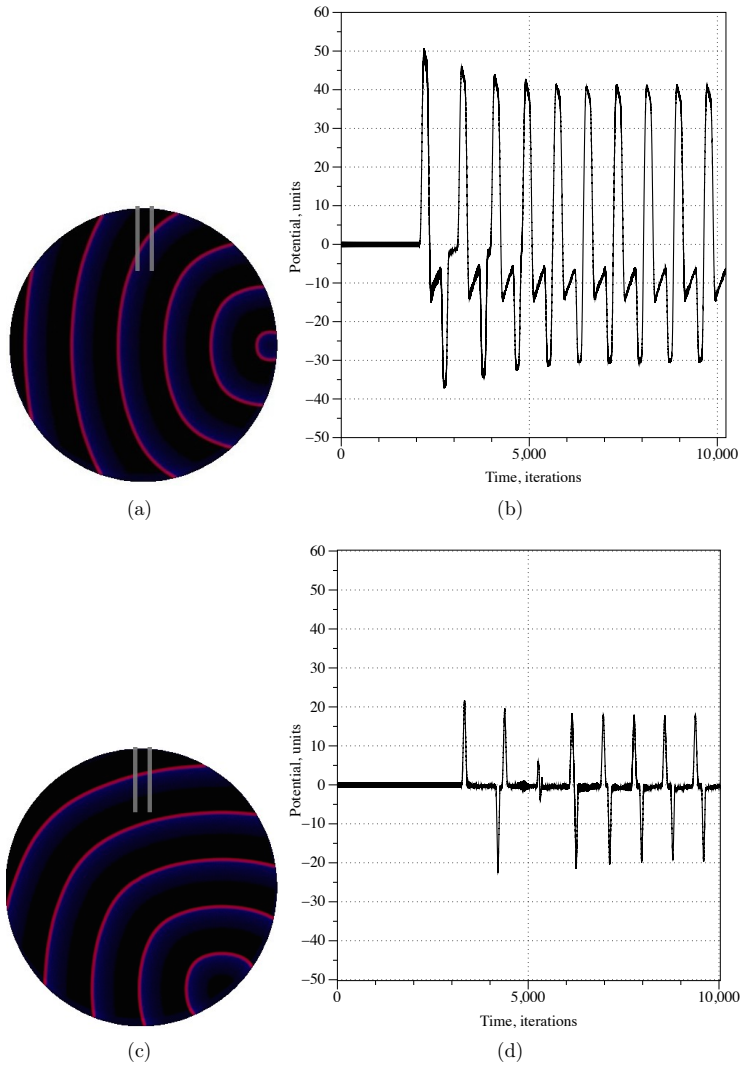
The load-bearing object is the liquid marble photosensor itself: a roughly 62 µL droplet of ferroin-catalysed BZ reagent coated with ultra-high-density polyethylene powder, through which two iridium-coated steel needle electrodes are inserted. The electrodes act as the readout: the potential difference they record oscillates when oxidation wave-fronts pass between them, and the waveform's shape depends on the direction and angle at which the fronts cross. The light source (a 3250 K, 18 MLux cold lamp) is the stimulus. The explanatory mechanism invoked is the photochemical sensitivity of the BZ catalyst—light increases the effective rate of inhibitor production—modelled by raising the parameter φ in the Oregonator equations, which in simulation drives wave-fronts to vanish and the computed electrode potential to stop oscillating.
What would settle it
Measure the temperature inside a BZ liquid marble with a fine thermocouple under the 18 MLux lamp, and run the same illumination through a heat-absorbing filter (e.g., a water cell) that removes infrared but keeps visible light. If the marble halts only when it heats up, or if a dark control heated to the same temperature halts as well, the photochemical photosensor interpretation would be falsified.
Extended reading notes
Core claim
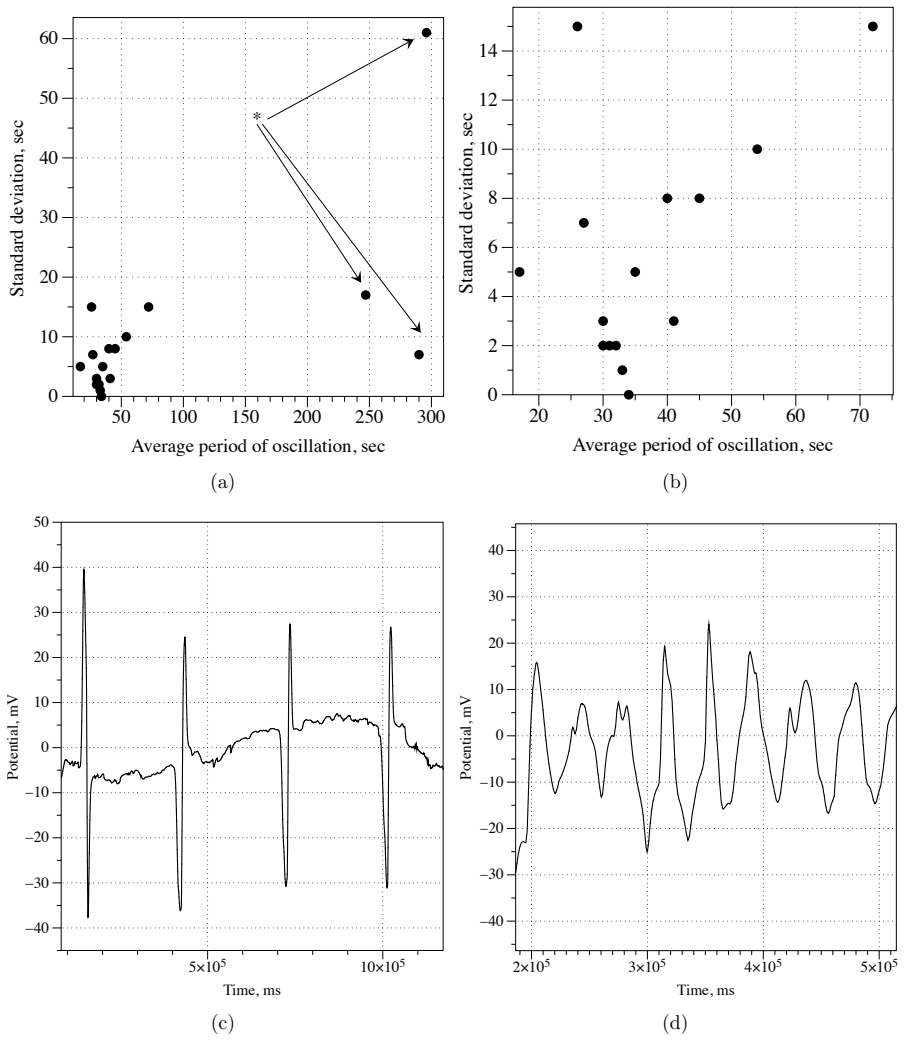
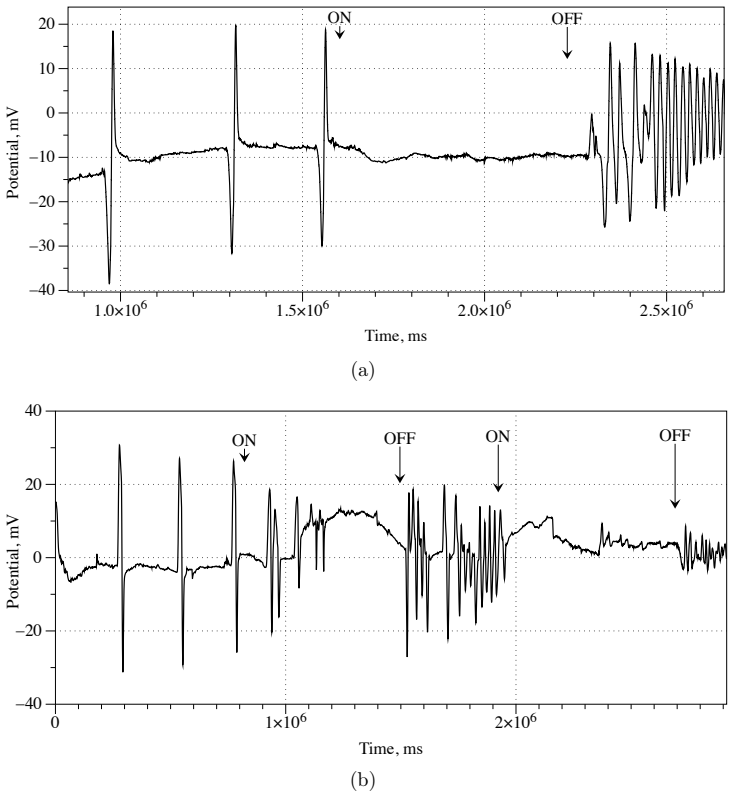
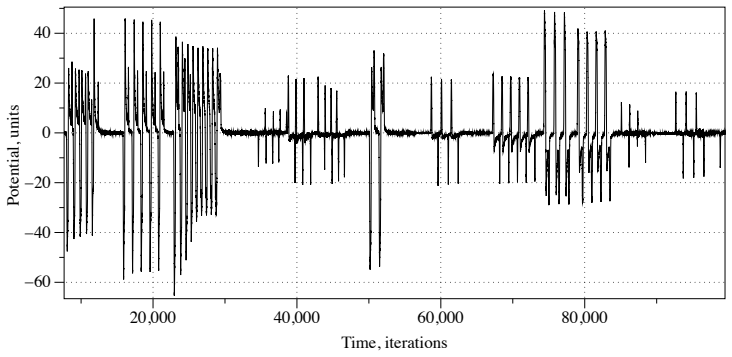
The central claim is that illumination suppresses the oscillatory electrical signature of a BZ liquid marble, and that the suppression is repeatable: across nineteen marbles, stimulation with an 18 MLux cold light source nearly instantaneously halted oscillations in the typical-frequency group (sixteen marbles), with recovery after the light was removed taking about forty seconds. The paper also reports that after stimulation, marbles split into two groups: those that oscillate at roughly half their original frequency (Group A) and those that roughly double it (Group B). Low-frequency marbles behaved differently—two halted instantly, one kept oscillating at a reduced period before halting. A two-variable Oregonator model with the light parameter φ increased is used to reproduce the recorded waveforms, including the direction-dependent spike shapes that arise from wave-fronts crossing the two electrodes.
Load-bearing premise
The claim rests on the assumption that the cessation of oscillations under the lamp is caused by the light's photochemical effect on the BZ reaction, not by heating or evaporation from that same lamp; the paper reports no temperature measurements and includes no control marble exposed to the same lamp with the light's heat filtered out.
Editorial extensions
If this is right
- A BZ liquid marble can serve as an optical input element in unconventional computing circuits, converting light patterns into measurable electrical signals.
- Because the polyethylene coating prevents wetting, marbles can be packed into dense clusters to act as an array of photosensors for optical inputs.
- The sensor is reusable for its lifetime (up to about one hour under the reported conditions) and responds to repeated light pulses, allowing sequences of on/off stimulation to be detected.
- Light control offers a scalable, non-contact alternative to the earlier Peltier-based thermal switching of BZ marble oscillations.
- The recorded electrical potential provides a direct interface between chemical wave activity and conventional electronics, since the electrode signal is the output.
Reading between the lines
- If the photochemical mechanism is confirmed with heat-filtered controls, the same design could be tuned into a wavelength-selective light detector by choosing BZ catalysts with different absorption spectra, something the paper does not explore.
- The on/off response to light suggests a simple write/erase scheme—illumination stores a 'halt' state, darkness erases it—though the paper does not test whether the halt state is retained after the light is removed for long periods.
- The Oregonator explanation implies that a spatially patterned light field could shape wave-front motion inside a single marble, effectively giving a one-marble image-processing element; this is a testable extension of the reported simulation framework.
- A straightforward extension would be to measure the dose-response curve: the paper uses one light intensity, but the model's φ parameter predicts that weaker light should slow rather than halt oscillations, which can be tested experimentally.
Signed reviews
Editorial analysis
A structured set of objections, weighed in public.
Referee Report
Summary. The paper reports a photo-sensor made from a Belousov-Zhabotinsky (BZ) liquid marble. Two electrodes inserted into the marble record a potential difference that oscillates as oxidation wave-fronts pass. The authors report that strong illumination (18 MLux from a cold light source for about 300 s) halts these oscillations nearly instantly in all tested marbles, that oscillations resume roughly 40 s after the light is switched off, and that the response is reusable over a lifetime of about one hour. Data from 19 marbles are presented, split into low-frequency and typical-frequency groups, and the post-stimulus behavior is divided into two groups based on whether the oscillation period increases or decreases. Oregonator-based simulations are used to illustrate how wave-front direction and source location shape the recorded potential traces. The central claim is that this system is a working, reusable optical-to-electrical sensor based on photochemical inhibition of BZ wave-fronts.
Significance. If the mechanism is truly photochemical, this is a simple and reusable optical-to-electrical transducer that combines the fields of liquid marbles and unconventional computing, extending earlier work on BZ liquid marble thermal sensors. The strengths are the direct experimental evidence that illumination suppresses electrical oscillations in multiple exemplar traces, the demonstration of reusability, and the straightforward electrode readout that does not require transparent coatings. The significance is limited by the absence of controls that would rule out thermal or evaporative causes of the observed cessation, and by the lack of any quantitative sensor characterization; as written, the claim that this is a photosensor rather than a thermo/hygro-sensor is not fully supported.
major comments (4)
- [§2 Methods, stimulus; §3 Results] The central claim that illumination hinders oxidation wave-fronts is not supported by the experiments because no control for heating or evaporation is provided. The light source is a PL2000 lamp at 18 MLux for ~300 s; at this intensity, radiative heating could increase the marble temperature, accelerate evaporation, change reagent concentrations and ionic strength, and shift electrode potentials, any of which could suppress BZ oscillations. The paper reports no temperature measurement, no sham marble under the same lamp, no wavelength filter, and no dark thermal control. Without such a control, the observed cessation and recovery could be thermal rather than photochemical, and the title/abstract assertion of a photo-sensor is not established.
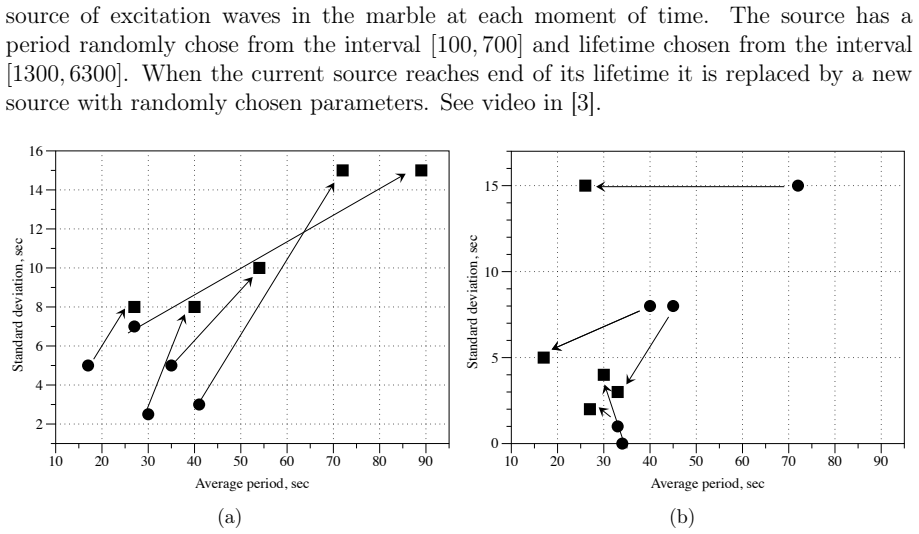
- [§3.2, Fig. 6] The bursting model in Fig. 6 is not a test of any mechanism. The source period and lifetime are chosen randomly from intervals [100, 700] and [1300, 6300] with no constraint from the experimental data, and the resulting burst-like signal is then cited as an explanation of experimentally observed bursts. This is a post-hoc construction, not validation. The authors should either state explicitly that the simulation is purely illustrative, or fit the model to a specific experimental trace and quantify the agreement.
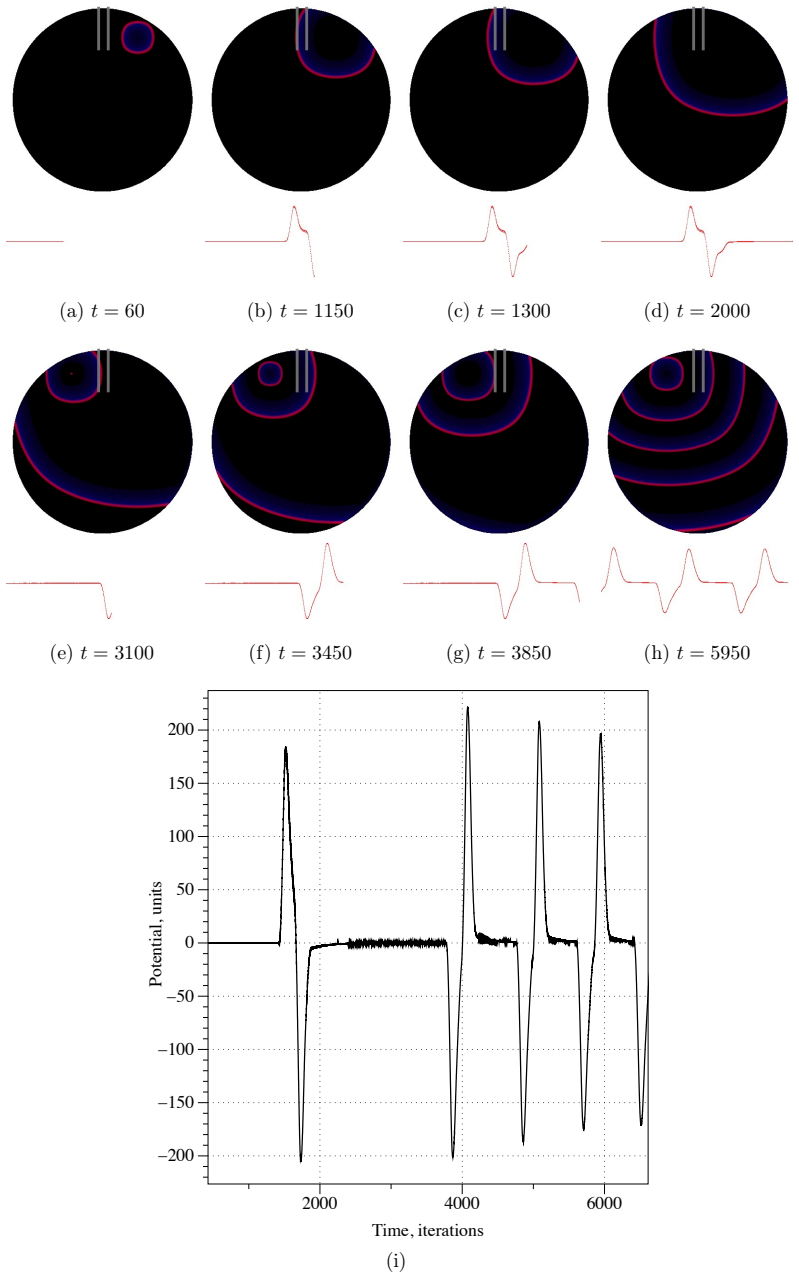
- [§2 Methods, Eq. (1); §3 Results] The Oregonator simulations vary the parameter φ in [0.05, 0.08] (called the rate of inhibitor production), but the Methods do not state that φ represents illumination intensity or how the chosen range maps to the experimental light source. Consequently, the simulations do not demonstrate that light-induced photochemistry can explain the observed cessation in the marble experiments; they only show that some parameter perturbation in a model can suppress oscillations. The link between φ and illumination must be made explicit and quantitative, or the simulations should not be used as evidence for the photochemical mechanism.
- [§3.1, §3.2, §4 Summary] The claimed sensor functionality is only qualitative. There is no intensity-response curve, no detection threshold, no statistical test for the distribution of response and recovery times (reported as means without confidence intervals or effect sizes), and no test of repeatability across multiple on/off cycles for a single marble. The labels 'nearly instant' and the grouping into Groups A and B are based on post-hoc observations. For a paper titled and framed around a 'photosensor', at least one quantitative calibration and a measure of inter-marble variability are needed to support the functional claim.
minor comments (4)
- [Abstract] The abstract says 'coated by a hydrophobic power'; this should be 'hydrophobic powder'.
- [Fig. 2 and Fig. 4] The time axes are labeled 'Time, ms' but are scaled by 10^5 and 10^6; please check whether the unit should be seconds or whether the axis labels and scaling are consistent with the reported oscillation periods.
- [§3.1] The text refers to the 'eastern site' and 'western part' of the marble; consider using consistent compass or clock-face notation for the source locations.
- [§2 Methods] The sentence describing the preparation of the BZ medium says 'resulting in a transiently orange solution caused by the emission of bromine gas'; the causal link to bromine emission is likely a simplification and should be worded more carefully.
Circularity Check
Experimental photosensor claim is independent, but the Oregonator 'verifications' of observed spike and burst patterns are demonstrations by construction rather than predictions.
-
fitted input called prediction
[Section 3.1, Fig. 3 (Oregonator verification of low-frequency oscillations)]
"The experimental lab findings (Fig. 2(c)) were verified in the Oregonator model, as illustrated in Fig. 3. We excited the medium once on the eastern site of the marble (Fig. 3a). ... After that we initiated a source of repeating oscillations on the 'western' part of the marble (Fig. 3e). The excitation wave-fronts cross the electrodes three times (Figs. 3f, 3g and 3h), which results in the three latter spikes shown in the plot Fig. 3i."
The model 'verification' is constructed from the experimental trace: the east-side single excitation is inserted to produce the first ascending spike, and a west-side repeating source is inserted to produce the three later spikes. The simulated waveform therefore mirrors the input source schedule by construction; it is not a parameter-free prediction that could fail. Calling this a verification is circular because the explanatory model's output is stipulated to match the data rather than independently derived. This circularity is limited to the interpretive modeling and does not affect the direct experimental photosensor claim.
-
fitted input called prediction
[Section 3.2, Fig. 6 (modelling of bursting spiking of non-stimulated marble)]
"We can model this phenomenon by choosing the location of a source at random, allowing the source to oscillate with an arbitrary period, and allocating a short life time. When one source of excitation waves dies it is replaced by another source with randomly chosen parameters and location. The simulated signal bursts are shown in Fig. 6."
The bursty output is generated by imposing randomly chosen source periods (interval [100, 700]) and lifetimes (interval [1300, 6300]) plus random locations. Bursting is thus an input assumption, not a derived outcome; any sufficiently variable source schedule will produce burst-like signal trains. The visual match with experimentally recorded bursts is therefore demonstration by construction rather than a test of the proposed mechanism. This is the 'explanations of recorded activity' promised in the abstract, but it does not make the central sensor claim circular.
full rationale
The central sensor claim is experimental and self-contained: electrodes inserted into BZ liquid marbles record potential oscillations that cease under illumination and resume after removal, so the main result does not reduce to a fitted parameter or a self-citation. The mechanistic attribution to photochemical inhibition of wavefronts is not fully controlled (no temperature measurement, no sham marble under the same lamp), but that is a correctness and confound concern, not circularity. Self-citations such as the prior thermal sensor and the BZ marble pattern study are motivational and not load-bearing, and no uniqueness theorem is imported. However, the paper's Oregonator 'verifications' in Fig. 3 and Fig. 6 are post-hoc constructions: source positions, periods, and lifetimes are chosen so that the simulated traces match the experimentally recorded spikes and bursts. Because those outputs are stipulated by the inputs, the explanatory modeling is circular in a limited, non-load-bearing sense. The empirical photosensor demonstration itself remains independent, so the overall circularity is partial rather than complete.
Assumptions & free parameters
free parameters (7)
- Oregonator time-scale ratio epsilon =
0.02
- Oregonator stoichiometric coefficient f =
1.4
- Oregonator scaling parameter q =
0.002
- Light-sensitive parameter phi =
varied over [0.05, 0.08]
- Excitation source period interval =
[100, 700] iterations
- Excitation source lifetime interval =
[1300, 6300] iterations
- Oregonator diffusion coefficient D_u =
not stated
assumptions (5)
- domain assumption Two-variable Oregonator model in Eq. 1 captures the relevant wave dynamics of the experimental BZ marble.
- domain assumption The recorded electrical potential difference corresponds to the difference in activator concentration summed over the two electrode domains.
- domain assumption Illumination affects only the photochemical BZ reaction and does not significantly heat or evaporate the marble.
- domain assumption Electrode insertion does not alter the BZ dynamics in a way that dominates the measured signal.
- domain assumption The ferroin-catalyzed BZ reaction is light-sensitive through photochemical inhibition of the catalyst.
Cite this review
Pith. "Pith review of Liquid Marble Photosensor." pith.science (2026). https://pith.science/paper/R3AAGNLZ
@misc{pith2026190800632,
  author       = {Pith},
  title        = {Pith review of: Liquid Marble Photosensor},
  year         = {2026},
  howpublished = {\url{https://pith.science/paper/R3AAGNLZ}},
  note         = {Machine review of arXiv:1908.00632}
}
read the original abstract
A liquid marble is a liquid droplet coated by a hydrophobic power. The liquid marble does not wet adjacent surfaces and therefore can be manipulated as a dry soft body. A Belousov-Zhabotinsky (BZ) reaction is an oscillatory chemical reaction exhibiting waves of oxidation. We demonstrate how to make a photo-sensor from BZ medium liquid marbles. We insert electrodes into a liquid marble, prepared from BZ solution and coated with polyethylene powder. The electrodes record a potential difference which oscillates due to oxidation wave-fronts crossing the electrodes. When the BZ marble is illuminated by a light source, the oxidation wave-fronts are hindered and, thus, the electrical potential recorded ceases to oscillate. We characterise several types of responses of BZ marble photosensors to various stimuli, and provide explanations of the recorded activity. BZ liquid marble photosensors may find applications in the fields of liquid electronics, soft robotics and unconventional computing.
Figures

Figures from the paper (5 more)

Reference graph
Works this paper leans on
-
[53]
Y Wang, Y Xie, C Yuan, H Wang, and D Fu. Intelligent image sensor based on probing the evolution of redox potentials distributed in reaction–diffusion medium. Sensors and Actuators B: Chemical, 145(1):285–292, 2010
work page 2010
-
[1]
Experimental implementation of mobile robot taxis with onboard Belousov– Zhabotinsky chemical medium
Andrew Adamatzky, Benjamin de Lacy Costello, Chris Melhuish, and Norman Rat- cliffe. Experimental implementation of mobile robot taxis with onboard Belousov– Zhabotinsky chemical medium. Materials Science and Engineering: C, 24(4):541– 548, 2004
work page 2004
-
[2]
Thermal switch of oscillation frequency in Belousov–Zhabotinsky liquid marbles
Andrew Adamatzky, Claire Fullarton, Neil Phillips, Ben De Lacy Costello, and Thomas C Draper. Thermal switch of oscillation frequency in Belousov–Zhabotinsky liquid marbles. Royal Society Open Science, 6(4):190078, 2019
work page 2019
-
[3]
Andrew Adamatzky, Antisthenis Tsompanas, Thomas Draper, and Richard Mayne. Supplementary materials. liquid marble photosensor. http://doi.org/10.5281/zenodo.3352607, 2019. 11
-
[4]
Pascale Aussillous and David Quéré. Liquid marbles. Nature, 411(6840):924–927, 2001
work page 2001
-
[5]
Liquid marbles: From industrial to medical ap- plications
Roxana-Elena Avrămescu, Mihaela-Violeta Ghica, Cristina Dinu-Pîrvu, Denisa Udeanu, and Lăcrămioara Popa. Liquid marbles: From industrial to medical ap- plications. Molecules, 23(5):1120, 2018
work page 2018
-
[6]
Valentina Beato and Harald Engel. Pulse propagation in a model for the photosensi- tive Belousov-Zhabotinsky reaction with external noise. InSPIE’s First International Symposium on Fluctuations and Noise, pages 353–362. International Society for Op- tics and Photonics, 2003
work page 2003
-
[7]
Boris P Belousov. A periodic reaction and its mechanism.Compilation of Abstracts on Radiation Medicine, 147(145):1, 1959
work page 1959
Show all 54 references
-
[8]
Liquid marbles: properties and applications.Current Opinion in Colloid & Interface Science, 16(4):266–271, 2011
Edward Bormashenko. Liquid marbles: properties and applications.Current Opinion in Colloid & Interface Science, 16(4):266–271, 2011
2011
-
[9]
On the mechanism of floating and sliding of liquid marbles.ChemPhysChem, 10(4):654– 656, 2009
Edward Bormashenko, Yelena Bormashenko, Albina Musin, and Zahava Barkay. On the mechanism of floating and sliding of liquid marbles.ChemPhysChem, 10(4):654– 656, 2009
2009
-
[10]
Fully-digital oscillatory associative memories en- abled by non-volatile logic
Vehbi Calayir and Larry Pileggi. Fully-digital oscillatory associative memories en- abled by non-volatile logic. In Neural Networks (IJCNN), The 2013 International Joint Conference on, pages 1–6. IEEE, 2013
2013
-
[11]
Propulsion of liquid marbles: A tool to measure their effective surface tension and viscosity.Journal of colloid and interface science, 532:32–36, 2018
F Celestini and Ed Bormashenko. Propulsion of liquid marbles: A tool to measure their effective surface tension and viscosity.Journal of colloid and interface science, 532:32–36, 2018
2018
-
[12]
Liquid metals: fundamentals and applications in chemistry.Chemical Society Reviews, 47(11):4073–4111, 2018
T Daeneke, K Khoshmanesh, N Mahmood, IA de Castro, D Esrafilzadeh, SJ Barrow, MD Dickey, and K Kalantar-Zadeh. Liquid metals: fundamentals and applications in chemistry.Chemical Society Reviews, 47(11):4073–4111, 2018
2018
-
[13]
Draper, Claire Fullarton, Neil Phillips, Ben P
Thomas C. Draper, Claire Fullarton, Neil Phillips, Ben P. J. de Lacy Costello, and Andrew Adamatzky. Liquid Marble Actuator for Microfluidic Logic Systems.Sci. Rep., 8(1):14153, 2018
2018
-
[14]
Draper, Claire Fullarton, Neil Phillips, Ben P
Thomas C. Draper, Claire Fullarton, Neil Phillips, Ben P. J. de Lacy Costello, and Andrew Adamatzky. Mechanical Sequential Counting with Liquid Marbles. In Su- san Stepney and Sergey Verlan, editors,UCNC 2018, LNCS 10867, pages 59–71. Springer, 2018
2018
-
[15]
Draper, Claire Fullarton, Neil Phillips, Ben P.J
Thomas C. Draper, Claire Fullarton, Neil Phillips, Ben P.J. de Lacy Costello, and Andrew Adamatzky. Liquid marble interaction gate for collision-based computing. Mater. Today, 20(10):561–568, dec 2017
2017
-
[16]
Oscillations in chemical systems
Richard J Field and Richard M Noyes. Oscillations in chemical systems. iv. limit cycle behavior in a model of a real chemical reaction.The Journal of Chemical Physics, 60(5):1877–1884, 1974. 12
1974
-
[17]
Richard J Field and Arthur T. Winfree. Travelling waves of chemical activity in the Zaikin-Zhabotinskii-Winfree reagent. Journal of Chemical Education, 56(11):754, 1979
1979
-
[18]
Draper, Neil Phillips, Ben P J de Lacy Costello, and Andrew Adamatzky
Claire Fullarton, Thomas C. Draper, Neil Phillips, Ben P J de Lacy Costello, and Andrew Adamatzky. Belousov-Zhabotinsky reaction in liquid marbles. J. Phys. Mater., 2(1):015005, jan 2019
2019
-
[19]
The influence of visible light on the beloasoy-zhabotinskii oscillating reactions applying different catalysts
V Gáşpár, Gy Bazsa, and MT Beck. The influence of visible light on the beloasoy-zhabotinskii oscillating reactions applying different catalysts. Zeitschrift für Physikalische Chemie, 264(1):43–48, 1983
1983
-
[20]
chemical neuron
Pier Luigi Gentili, Viktor Horvath, Vladimir K Vanag, and Irving R Epstein. Belousov-Zhabotinsky “chemical neuron” as a binary and fuzzy logic processor.IJUC, 8(2):177–192, 2012
2012
-
[21]
Chemical memory with states coded in light controlled oscillations of interacting Belousov–Zhabotinsky droplets.Physical Chem- istry Chemical Physics, 19(9):6519–6531, 2017
Konrad Gizynski and Jerzy Gorecki. Chemical memory with states coded in light controlled oscillations of interacting Belousov–Zhabotinsky droplets.Physical Chem- istry Chemical Physics, 19(9):6519–6531, 2017
2017
-
[22]
T-shaped coincidence detector as a band filter of chemical signal frequency.Physical Review E, 67(6):067203, 2003
J Gorecka and J Gorecki. T-shaped coincidence detector as a band filter of chemical signal frequency.Physical Review E, 67(6):067203, 2003
2003
-
[23]
Chemical computing with reaction–diffusion processes.Philosophical Transactions of the Royal Society A: Mathematical, Physical and Engineering Sci- ences, 373(2046):20140219, 2015
J Gorecki, K Gizynski, J Guzowski, JN Gorecka, P Garstecki, G Gruenert, and P Dittrich. Chemical computing with reaction–diffusion processes.Philosophical Transactions of the Royal Society A: Mathematical, Physical and Engineering Sci- ences, 373(2046):20140219, 2015
2015
-
[24]
Information coding with fre- quency of oscillations in Belousov-Zhabotinsky encapsulated disks.Physical Review E, 89(4):042910, 2014
J Gorecki, JN Gorecka, and Andrew Adamatzky. Information coding with fre- quency of oscillations in Belousov-Zhabotinsky encapsulated disks.Physical Review E, 89(4):042910, 2014
2014
-
[25]
On chemical reactors that can count.The Journal of Physical Chemistry A, 107(10):1664–1669, 2003
J Gorecki, K Yoshikawa, and Y Igarashi. On chemical reactors that can count.The Journal of Physical Chemistry A, 107(10):1664–1669, 2003
2003
-
[26]
Information processing with chemical excitations–from instant machines to an artificial chemical brain.International Jour- nal of Unconventional Computing, 2(4), 2006
Jerzy Gorecki and Joanna Natalia Gorecka. Information processing with chemical excitations–from instant machines to an artificial chemical brain.International Jour- nal of Unconventional Computing, 2(4), 2006
2006
-
[27]
Understanding networks of computing chemical droplet neurons based on information flow.International journal of neural systems, 25(07):1450032, 2015
Gerd Gruenert, Konrad Gizynski, Gabi Escuela, Bashar Ibrahim, Jerzy Gorecki, and Peter Dittrich. Understanding networks of computing chemical droplet neurons based on information flow.International journal of neural systems, 25(07):1450032, 2015
2015
-
[28]
Multi-scale mod- elling of computers made from excitable chemical droplets.IJUC, 9(3-4):237–266, 2013
GerdGruenert, JanSzymanski, JulianHolley, GabiEscuela, AlexandraDiem, Bashar Ibrahim, Andrew Adamatzky, Jerzy Gorecki, and Peter Dittrich. Multi-scale mod- elling of computers made from excitable chemical droplets.IJUC, 9(3-4):237–266, 2013
2013
-
[29]
Photo-response of chemical oscilla- tors
I Hanazaki, Y Mori, T Sekiguchi, and Gy Rábai. Photo-response of chemical oscilla- tors. Physica D: Nonlinear Phenomena, 84(1-2):228–237, 1995. 13
1995
-
[30]
Towards heterotic computing with droplets in a fully automated droplet-maker platform
Alon Henson, Juan Manuel Parrilla Gutierrez, Trevor Hinkley, Soichiro Tsuda, and Leroy Cronin. Towards heterotic computing with droplets in a fully automated droplet-maker platform. Philosophical Transactions of the Royal Society A: Mathe- matical, Physical and Engineering Sci...
2015
-
[31]
Chemical diodes built with controlled excitable media
Yasuhiro Igarashi and Jerzy Gorecki. Chemical diodes built with controlled excitable media. IJUC, 7(3):141–158, 2011
2011
-
[32]
A reaction–diffusion memory device.Angewandte Chemie International Edition, 45(19):3087–3089, 2006
Akiko Kaminaga, Vladimir K Vanag, and Irving R Epstein. A reaction–diffusion memory device.Angewandte Chemie International Edition, 45(19):3087–3089, 2006
2006
-
[33]
A new optical photochemical memory device in a light-sensitive chemical active medium
L Kuhnert. A new optical photochemical memory device in a light-sensitive chemical active medium. Nature, 319(6052):393, 1986
1986
-
[34]
Kuhnert, K
L. Kuhnert, K. I. Agladze, and V. I. Krinsky. Image processing using light-sensitive chemical waves.Nature, 337(6204):244–247, jan 1989
1989
-
[35]
Liquid marbles: principles and applications
Glen McHale and Michael I Newton. Liquid marbles: principles and applications. Soft Matter, 7(12):5473–5481, 2011
2011
-
[36]
Manipulation of liquid marbles.Microflu- idics and Nanofluidics, 19(3):483–495, 2015
Chin Hong Ooi and Nam-Trung Nguyen. Manipulation of liquid marbles.Microflu- idics and Nanofluidics, 19(3):483–495, 2015
2015
-
[37]
Computing with membranes: An introduction
Gheorghe Păun. Computing with membranes: An introduction. Bulletin of the EATCS, 67:139–152, 1999
1999
-
[38]
Computing with membranes (P systems): A variant.Int
Gheorghe Păun. Computing with membranes (P systems): A variant.Int. J. Found. Comput. Sci., 11(1):167–181, 2000
2000
-
[39]
Membrane computing
Gheorghe Păun. Membrane computing. InEncyclopedia of Complexity and Systems Science, pages 5523–5535. Springer, 2009
2009
-
[40]
A guide to membrane computing.Theo- retical Computer Science, 287(1):73–100, 2002
Gheorghe Păun and Grzegorz Rozenberg. A guide to membrane computing.Theo- retical Computer Science, 287(1):73–100, 2002
2002
-
[41]
Information-processing capabilities of chemical reaction–diffusion systems
NG Rambidi, TO-O Kuular, and EE Makhaeva. Information-processing capabilities of chemical reaction–diffusion systems. 1. Belousov–Zhabotinsky media in hydro- gel matrices and on solid supports.Advanced Materials for Optics and Electronics, 8(4):163–171, 1998
1998
-
[42]
chemical signal
Jakub Sielewiesiuk and Jerzy Górecki. Passive barrier as a transformer of “chemical signal” frequency.The Journal of Physical Chemistry A, 106(16):4068–4076, 2002
2002
-
[43]
Chemical wave logic gates
Oliver Steinbock, Petteri Kettunen, and Kenneth Showalter. Chemical wave logic gates. The Journal of Physical Chemistry, 100(49):18970–18975, 1996
1996
-
[44]
Time-dependent wave selection for information processing in excitable media.Phys- ical Review E, 85(6):066129, 2012
William M Stevens, Andrew Adamatzky, Ishrat Jahan, and Ben de Lacy Costello. Time-dependent wave selection for information processing in excitable media.Phys- ical Review E, 85(6):066129, 2012
2012
-
[45]
Associative memory in reaction-diffusion chem- istry
James Stovold and Simon O’Keefe. Associative memory in reaction-diffusion chem- istry. InAdvances in Unconventional Computing, pages 141–166. Springer, 2017. 14
2017
-
[46]
Crossover structures for logical computations in excitable chemical medium
Ming-Zhu Sun and Xin Zhao. Crossover structures for logical computations in excitable chemical medium. International Journal Unconventional Computing , 11(2):165–184, 2015
2015
-
[47]
Chemo-mechanical coupling in reactive droplets
Jan Szymanski, Jerzy Gorecki, and Marcus JB Hauser. Chemo-mechanical coupling in reactive droplets. The Journal of Physical Chemistry C, 117(25):13080–13086, 2013
2013
-
[48]
Wave initiation in the ferroin-catalysed belousov–zhabotinsky reaction with visible light.Physical Chemistry Chemical Physics, 2(3):413–416, 2000
Rita Tóth, Vilmos Gáspár, Andrew Belmonte, Megan C O’Connell, Annette Taylor, and Stephen K Scott. Wave initiation in the ferroin-catalysed belousov–zhabotinsky reaction with visible light.Physical Chemistry Chemical Physics, 2(3):413–416, 2000
2000
-
[49]
Belousov- zhabotinsky liquid marbles in robot control
Michail-AntisthenisTsompanas, ClaireFullarton, andAndrewAdamatzky. Belousov- zhabotinsky liquid marbles in robot control. Sensors and Actuators B: Chemical, 295:194–203, 2019
2019
-
[50]
Waves and patterns in reaction–diffusion systems
Vladimir K Vanag. Waves and patterns in reaction–diffusion systems. Belousov– Zhabotinsky reaction in water-in-oil microemulsions. Physics-Uspekhi, 47(9):923, 2004
2004
-
[51]
Pattern formation in a tunable medium: The belousov-zhabotinsky reaction in an aerosol ot microemulsion.Physical review letters, 87(22):228301, 2001
Vladimir K Vanag and Irving R Epstein. Pattern formation in a tunable medium: The belousov-zhabotinsky reaction in an aerosol ot microemulsion.Physical review letters, 87(22):228301, 2001
2001
-
[52]
Con- figurable nor gate arrays from belousov-zhabotinsky micro-droplets.The European Physical Journal Special Topics, 225(1):211–227, 2016
AL Wang, JM Gold, N Tompkins, M Heymann, KI Harrington, and S Fraden. Con- figurable nor gate arrays from belousov-zhabotinsky micro-droplets.The European Physical Journal Special Topics, 225(1):211–227, 2016
2016
-
[54]
Periodic processes of malonic acid oxidation in a liquid phase
AM Zhabotinsky. Periodic processes of malonic acid oxidation in a liquid phase. Biofizika, 9(306-311):11, 1964. 15
1964
Reviewed August 14, 2026 · model on record in the stance chip above.
Discussion (0). Continue with ORCID to comment.