Entity -- Hardware-agnostic Particle-in-Cell Code for Plasma Astrophysics. III: Higher-order shape functions & generalized field stencils
Pith reviewed 2026-05-19 16:21 UTC · model grok-4.3
The pith
Entity PIC code adds up to 11th-order shape functions and tunable stencils to cut numerical artifacts in plasma simulations.
A machine-rendered reading of the paper's core claim, the machinery that carries it, and where it could break.
Core claim
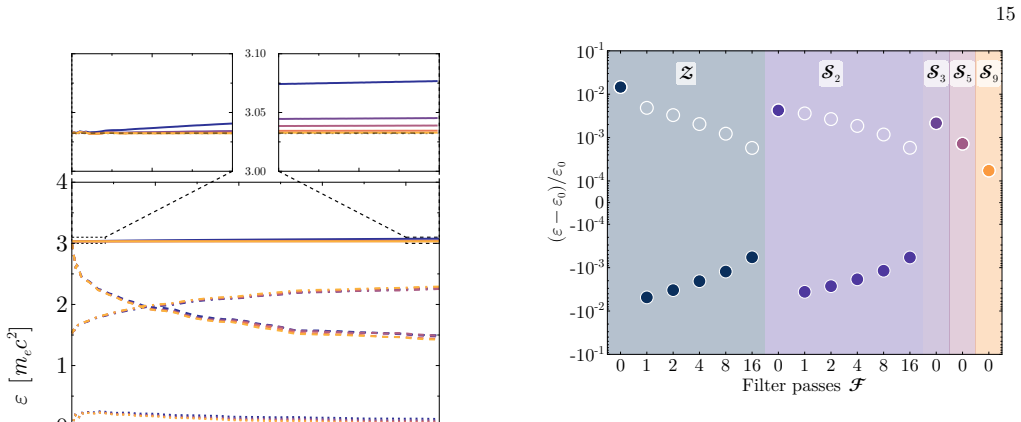
By implementing higher-order shape functions for current deposit and field interpolation along with generalized stencils for the field solver, the code reaches up to 11th-order accurate interpolation while allowing stencil tuning to suppress dispersion; extensive tests confirm the schemes maintain charge conservation, stabilize against numerical heating, improve energy conservation, and reduce numerical Cherenkov effects, with performance scaling discussed relative to resolution and filtering.
What carries the argument
Higher-order shape functions for current deposition and generalized field stencils that can be tuned for dispersion control.
If this is right
- Charge is conserved to higher accuracy across particle updates and field solves.
- Numerical heating is suppressed, allowing longer stable runs before artificial temperature growth appears.
- Energy conservation improves over many time steps compared with lower-order baselines.
- Stencil tuning can be chosen to minimize numerical Cherenkov radiation in relativistic flows.
- Performance cost grows with order but can be traded against coarser grids or added filtering.
Where Pith is reading between the lines
- The same higher-order deposit and stencil approach could be ported to other PIC frameworks that currently rely on lower-order splines.
- Tunable dispersion control might help separate physical wave propagation from grid effects in studies of collisionless shocks.
- If the performance balance holds, these methods could enable larger-domain astrophysical runs without proportional increases in core count.
Load-bearing premise
The extra computational cost of higher-order operations can be offset by adjusting resolution and adding current filtering so that simulations of realistic multi-scale plasmas remain practical and stable.
What would settle it
A direct comparison run at fixed resolution showing that the new 11th-order deposit and tuned stencils produce the same or worse energy drift and Cherenkov radiation as the prior second-order scheme would falsify the accuracy claims.
Figures




read the original abstract
Modern particle-in-cell (PIC) codes have become an integral tool in plasma astrophysics. As most plasma phenomena grow from initially small instabilities, it is important to ensure PIC codes can suppress noise and ensure that any growing instability is indeed physical. Therefore, we introduce our efforts to implement higher-order methods for the current deposit and field interpolation as well as generalized field stencils for the field solver in the PIC code \texttt{Entity}. Our updated current deposit scheme allows for up to $11^\mathrm{th}$-order accurate interpolation, while the generalized stencils for the field solver can be tuned to suppress numerical dispersion. We perform extensive tests to ensure high accuracy of the implemented schemes for charge conservation, stabilization against numerical heating, improved energy conservation, and suppression of numerical Cherenkov effects. To supply a benchmark on performance impact, we demonstrate the scaling of the higher-order current deposit and discuss the possible performance balance between higher-order interpolation, numerical resolution, and the inclusion of additional current filtering.
Editorial analysis
A structured set of objections, weighed in public.
Referee Report
Summary. The manuscript presents the implementation of higher-order (up to 11th-order) shape functions for current deposition and generalized stencils for the field solver within the Entity PIC code. It reports tests demonstrating improved charge conservation, reduced numerical heating, better energy conservation, and suppression of numerical Cherenkov radiation, together with scaling measurements for the deposit routine and a discussion of performance trade-offs against resolution and filtering.
Significance. If the accuracy improvements hold under realistic conditions, the methods could reduce numerical artifacts in plasma astrophysics simulations and support more efficient modeling of multi-scale instabilities by permitting coarser grids or lighter filtering.
major comments (1)
- [Performance section] Performance section (as referenced in the abstract): the scaling of the higher-order deposit is shown and isolated tests for conservation and Cherenkov suppression are reported, but no end-to-end demonstration exists in a long-running, multi-scale astrophysical plasma configuration showing that the 11th-order scheme plus tuned stencils actually permits reduced resolution or less filtering while preserving the same physical fidelity as a conventional second-order run.
minor comments (1)
- [Abstract] Abstract: the claim of 'extensive tests' is not accompanied by quantitative error metrics, baseline comparisons, or specific test-problem details, which weakens the reader's ability to assess the accuracy claims from the summary alone.
Simulated Author's Rebuttal
We thank the referee for their thorough review and valuable comments on our manuscript. We provide a point-by-point response to the major comment below.
read point-by-point responses
-
Referee: [Performance section] Performance section (as referenced in the abstract): the scaling of the higher-order deposit is shown and isolated tests for conservation and Cherenkov suppression are reported, but no end-to-end demonstration exists in a long-running, multi-scale astrophysical plasma configuration showing that the 11th-order scheme plus tuned stencils actually permits reduced resolution or less filtering while preserving the same physical fidelity as a conventional second-order run.
Authors: The referee correctly identifies that the manuscript does not contain an end-to-end demonstration within a long-running, multi-scale astrophysical plasma configuration. This paper (Part III) is devoted to the implementation of higher-order shape functions up to 11th order and generalized field stencils, together with targeted validation tests that isolate improvements in charge conservation, numerical heating, energy conservation, and Cherenkov suppression. These tests are performed in standard configurations relevant to plasma astrophysics. Scaling data for the deposit routine and an explicit discussion of performance trade-offs with resolution and filtering are also included. We have revised the discussion section to more clearly articulate how the demonstrated improvements can support coarser grids or reduced filtering in future applications. A full end-to-end demonstration in a specific long-running multi-scale setup lies outside the scope of the present methods paper but is planned for subsequent work. revision: partial
Circularity Check
No significant circularity; implementation and tests are self-contained
full rationale
The paper describes the implementation of higher-order current deposition (up to 11th order) and tunable field stencils in the Entity PIC code, followed by standard benchmark tests for charge conservation, energy conservation, numerical heating, and Cherenkov suppression, plus scaling measurements. These steps rely on established numerical techniques rather than deriving new results from fitted parameters or self-referential definitions. No equations reduce to their own inputs by construction, no load-bearing claims rest solely on unverified self-citations, and the performance discussion is presented as an empirical trade-off analysis rather than a tautological prediction. The work is therefore self-contained against external benchmarks and standard diagnostics.
Axiom & Free-Parameter Ledger
free parameters (2)
- Interpolation order
- Generalized stencil coefficients
axioms (1)
- domain assumption Higher-order current deposit and generalized stencils preserve charge conservation and improve energy conservation without introducing new instabilities in the tested regimes
Reference graph
Works this paper leans on
-
[1]
Adams, L. C., Werner, G. R., & Cary, J. R. 2025, Physics of Plasmas, 32, 093905, doi: 10.1063/5.0271598
-
[2]
Arber, T. D., Bennett, K., Brady, C. S., et al. 2015, Plasma Physics and Controlled Fusion, 57, 113001, doi: 10.1088/0741-3335/57/11/113001
-
[3]
2022, The Astrophysical Journal, 938, 86, doi: 10.3847/1538-4357/ac8a94
Bacchini, F., Arzamasskiy, L., Zhdankin, V., et al. 2022, The Astrophysical Journal, 938, 86, doi: 10.3847/1538-4357/ac8a94
-
[4]
Bacchini, F., Zhdankin, V., Gorbunov, E. A., et al. 2024, Phys. Rev. Lett., 133, 045202, doi: 10.1103/PhysRevLett.133.045202
-
[5]
Bell, A. R. 2004, MNRAS, 353, 550, doi: 10.1111/j.1365-2966.2004.08097.x
-
[6]
Birdsall, C. K., & Maron, N. 1980, Journal of Computational Physics, 36, 1, doi: 10.1016/0021-9991(80)90171-0
-
[7]
2018, Computer Physics Communications, 224, 273, doi: 10.1016/j.cpc.2017.10.010
Blinne, A., Schinkel, D., Kuschel, S., et al. 2018, Computer Physics Communications, 224, 273, doi: 10.1016/j.cpc.2017.10.010
-
[8]
2017, ApJ, 847, 71, doi: 10.3847/1538-4357/aa872a
Bohdan, A., Niemiec, J., Kobzar, O., & Pohl, M. 2017, ApJ, 847, 71, doi: 10.3847/1538-4357/aa872a
-
[9]
Boris, J. P., & Lee, R. 1973, Journal of Computational Physics, 12, 131, doi: 10.1016/0021-9991(73)90174-5
-
[10]
Bransgrove, A., Beloborodov, A. M., & Levin, Y. 2023, ApJL, 958, L9, doi: 10.3847/2041-8213/ad0556 Bruce Langdon, A. 1992, Computer Physics Communications, 70, 447, doi: 10.1016/0010-4655(92)90105-8
-
[11]
1993 in Computer Space Plasma Physics: Simulation Techniques and Software, ed
Buneman, O. 1993 in Computer Space Plasma Physics: Simulation Techniques and Software, ed. H. Matsumoto & Y. Omura (Terra Scientific Publishing Company), 67
work page 1993
-
[12]
2023, A&A, 676, A23, doi: 10.1051/0004-6361/202346481
Cerutti, B., & Giacinti, G. 2023, A&A, 676, A23, doi: 10.1051/0004-6361/202346481
-
[13]
Cerutti, B., Philippov, A. A., & Dubus, G. 2020, A&A, 642, A204, doi: 10.1051/0004-6361/202038618
-
[14]
Cerutti, B., Werner, G. R., Uzdensky, D. A., & Begelman, M. C. 2013, ApJ, 770, 147, doi: 10.1088/0004-637X/770/2/147
-
[15]
Chen, A. Y., & Beloborodov, A. M. 2014, ApJL, 795, L22, doi: 10.1088/2041-8205/795/1/L22
-
[16]
Cole, J. B. 1997, IEEE Transactions on Microwave Theory and Techniques, 45, 991, doi: 10.1109/22.588615
-
[17]
Cole, J. B. 2002, IEEE Transactions on Antennas and Propagation, 50, 1185, doi: 10.1109/TAP.2002.801268
-
[18]
Comisso, L., & Sironi, L. 2018, Phys. Rev. Lett., 121, 255101, doi: 10.1103/PhysRevLett.121.255101
-
[19]
Comisso, L., & Sironi, L. 2019, The Astrophysical Journal, 886, 122, doi: 10.3847/1538-4357/ab4c33
-
[20]
2022, The Astrophysical Journal Letters, 936, L27, doi: 10.3847/2041-8213/ac8422
Comisso, L., & Sironi, L. 2022, The Astrophysical Journal Letters, 936, L27, doi: 10.3847/2041-8213/ac8422
-
[21]
Cormier-Michel, E., Shadwick, B. A., Geddes, C. G. R., et al. 2008, Phys. Rev. E, 78, 016404, doi: 10.1103/PhysRevE.78.016404
-
[22]
Cormier-Michel, E., & Geddes, C. G. R. 2013, Physical Review Accelerators and Beams, 16, 041303, doi: 10.1103/PhysRevSTAB.16.041303
-
[23]
2018, Computer Physics Communications, 222, 351, doi: 10.1016/j.cpc.2017.09.024
Derouillat, J., Beck, A., P´ erez, F., et al. 2018, Computer Physics Communications, 222, 351, doi: 10.1016/j.cpc.2017.09.024
-
[24]
Esirkepov, T. Z. 2001, Computer Physics Communications, 135, 144, doi: 10.1016/S0010-4655(00)00228-9
-
[25]
Filipovic, M., Baumann, C., & Pukhov, A. 2022, Physical Review Accelerators and Beams, 25, 054405, doi: 10.1103/PhysRevAccelBeams.25.054405 26
-
[26]
2018, in APS Meeting Abstracts, Vol
Fonseca, R., Dalichaouch, T., Davidson, A., et al. 2018, in APS Meeting Abstracts, Vol. 2018, APS Division of Plasma Physics Meeting Abstracts, PP11.023
work page 2018
-
[27]
Fonseca, R. A., Silva, L. O., Tsung, F. S., et al. 2002, in Computational Science — ICCS 2002, ed. P. M. A. Sloot, A. G. Hoekstra, C. J. K. Tan, & J. J. Dongarra (Berlin, Heidelberg: Springer Berlin Heidelberg), 342–351
work page 2002
-
[28]
Crinquand, B. 2025, arXiv e-prints, arXiv:2511.17701, doi: 10.48550/arXiv.2511.17701
-
[29]
2023, PhRvL, 130, 115201, doi: 10.1103/PhysRevLett.130.115201 Gargat´ e, L., Fonseca, R
Galishnikova, A., Philippov, A., Quataert, E., et al. 2023, PhRvL, 130, 115201, doi: 10.1103/PhysRevLett.130.115201 Gargat´ e, L., Fonseca, R. A., Niemiec, J., et al. 2010, ApJL, 711, L127, doi: 10.1088/2041-8205/711/2/L127
-
[30]
Godfrey, B. B. 1974, Journal of Computational Physics, 15, 504, doi: 10.1016/0021-9991(74)90076-X
-
[31]
A., Bacchini, F., Zhdankin, V., et al
Gorbunov, E. A., Bacchini, F., Zhdankin, V., et al. 2025, ApJL, 982, L28, doi: 10.3847/2041-8213/adbca4
-
[32]
A., Groˇ selj, D., & Bacchini, F
Gorbunov, E. A., Groˇ selj, D., & Bacchini, F. 2025, Phys. Rev. Lett., 135, 065201, doi: 10.1103/3777-z37m
-
[33]
Baca, E. A. 2004, Journal of Computational Physics, 201, 665, doi: https://doi.org/10.1016/j.jcp.2004.06.021 Groˇ selj, D., Hakobyan, H., Beloborodov, A. M., Sironi, L., & Philippov, A. 2024, Phys. Rev. Lett., 132, 085202, doi: 10.1103/PhysRevLett.132.085202 Groˇ selj, D., Sironi, L., & Beloborodov, A. M. 2022, ApJ, 933, 74, doi: 10.3847/1538-4357/ac713e ...
-
[34]
2026, The Astrophysical Journal, 1001, 64, doi: 10.3847/1538-4357/ae50fc
Mushotzky, R. 2026, The Astrophysical Journal, 1001, 64, doi: 10.3847/1538-4357/ae50fc
-
[35]
2014, ApJ, 794, 153, doi: 10.1088/0004-637X/794/2/153
Guo, X., Sironi, L., & Narayan, R. 2014, ApJ, 794, 153, doi: 10.1088/0004-637X/794/2/153
-
[36]
Gupta, S., Caprioli, D., & Spitkovsky, A. 2024, ApJ, 976, 10, doi: 10.3847/1538-4357/ad7c4c
-
[37]
2021, ApJ, 915, 18, doi: 10.3847/1538-4357/abfb68
Ha, J.-H., Kim, S., Ryu, D., & Kang, H. 2021, ApJ, 915, 18, doi: 10.3847/1538-4357/abfb68
-
[38]
Ha, J.-H., Ryu, D., Kang, H., & van Marle, A. J. 2018, ApJ, 864, 105, doi: 10.3847/1538-4357/aad634
-
[39]
2023, ApJ, 943, 105, doi: 10.3847/1538-4357/acab05
Hakobyan, H., Philippov, A., & Spitkovsky, A. 2023, ApJ, 943, 105, doi: 10.3847/1538-4357/acab05
-
[40]
Hakobyan, H., Spitkovsky, A., Chernoglazov, A., et al. 2024, in Zenodo, Vol. 75 (Zenodo), 7566725, doi: 10.5281/zenodo.7566725
-
[41]
Hakobyan, H., B¨ oss, L. M., Cai, Y., et al. 2025, arXiv e-prints, arXiv:2511.17710, doi: 10.48550/arXiv.2511.17710
-
[42]
2019, ApJ, 882, 3, doi: 10.3847/1538-4357/ab328a
Holcomb, C., & Spitkovsky, A. 2019, ApJ, 882, 3, doi: 10.3847/1538-4357/ab328a
-
[43]
Hoshino, M. 2015, Phys. Rev. Lett., 114, 061101, doi: 10.1103/PhysRevLett.114.061101
-
[44]
2025, PhRvE, 111, 035308, doi: 10.1103/PhysRevE.111.035308
Dromey, B., & Yeung, M. 2025, PhRvE, 111, 035308, doi: 10.1103/PhysRevE.111.035308
-
[45]
Kamiido, K., & Ohira, Y. 2025, ApJ, 985, 134, doi: 10.3847/1538-4357/adced6 K¨ arkk¨ ainen, M., Gjonaj, E., Lau, T., & Weiland, T. 2006, in Proceedings of ICAP 2006: International Computational Accelerator Physics Conference (Chamonix, France: JACoW), 35–40
-
[46]
Kato, T. N. 2013, arXiv e-prints, arXiv:1312.5507, doi: 10.48550/arXiv.1312.5507
work page internal anchor Pith review Pith/arXiv arXiv doi:10.48550/arxiv.1312.5507 2013
-
[47]
Kim, S., Choe, G. S., Ryu, D., & Yi, S. 2026, Computer Physics Communications, 321, 110021, doi: 10.1016/j.cpc.2026.110021
-
[48]
2021, ApJ, 919, 97, doi: 10.3847/1538-4357/ac1107
Kobzar, O., Niemiec, J., Amano, T., et al. 2021, ApJ, 919, 97, doi: 10.3847/1538-4357/ac1107
-
[49]
2018, Journal of Plasma Physics, 84, 905840305, doi: 10.1017/S0022377818000399
Spitkovsky, A. 2018, Journal of Plasma Physics, 84, 905840305, doi: 10.1017/S0022377818000399
-
[50]
2013, Physical Review Accelerators and Beams, 16, 021301, doi: 10.1103/PhysRevSTAB.16.021301
Lehe, R., Lifschitz, A., Thaury, C., Malka, V., & Davoine, X. 2013, Physical Review Accelerators and Beams, 16, 021301, doi: 10.1103/PhysRevSTAB.16.021301
-
[51]
2025, ApJ, 979, 34, doi: 10.3847/1538-4357/ad8eb3
Lemmerz, R., Shalaby, M., Pfrommer, C., & Thomas, T. 2025, ApJ, 979, 34, doi: 10.3847/1538-4357/ad8eb3
-
[52]
2019, PhRvL, 123, 035101, doi: 10.1103/PhysRevLett.123.035101
Lemoine, M., Gremillet, L., Pelletier, G., & Vanthieghem, A. 2019, PhRvL, 123, 035101, doi: 10.1103/PhysRevLett.123.035101
-
[53]
2017, Computer Physics Communications, 214, 6, doi: 10.1016/j.cpc.2017.01.001
Li, F., Yu, P., Xu, X., et al. 2017, Computer Physics Communications, 214, 6, doi: 10.1016/j.cpc.2017.01.001
-
[54]
2020, Journal of Computational Physics, 413, 109388, doi: 10.1016/j.jcp.2020.109388
Lu, Y., Kilian, P., Guo, F., Li, H., & Liang, E. 2020, Journal of Computational Physics, 413, 109388, doi: 10.1016/j.jcp.2020.109388
-
[55]
2020, Living Reviews in Computational Astrophysics, 6, 1, doi: 10.1007/s41115-020-0007-6
Marcowith, A., Ferrand, G., Grech, M., et al. 2020, Living Reviews in Computational Astrophysics, 6, 1, doi: 10.1007/s41115-020-0007-6
-
[56]
A Method for Incorporating Gauss' Law into Electromagnetic PIC Codes
Marder, B. 1987, Journal of Computational Physics, 68, 48, doi: 10.1016/0021-9991(87)90043-X
-
[57]
2000, Journal of Computational Physics, 161, 484, doi: 10.1006/jcph.2000.6507 N¨ attil¨ a, J
Munz, C.-D., Omnes, P., Schneider, R., Sonnendr¨ ucker, E., & Voß, U. 2000, Journal of Computational Physics, 161, 484, doi: 10.1006/jcph.2000.6507 N¨ attil¨ a, J. 2024, Nature Communications, 15, 7026, doi: 10.1038/s41467-024-51257-1
-
[58]
2008, ApJ, 684, 1174, doi: 10.1086/590054 27
Niemiec, J., Pohl, M., Stroman, T., & Nishikawa, K.-I. 2008, ApJ, 684, 1174, doi: 10.1086/590054 27
-
[59]
2021, Living Reviews in Computational Astrophysics, 7, 1, doi: 10.1007/s41115-021-00012-0
Nishikawa, K., Dut ¸an, I., K¨ ohn, C., & Mizuno, Y. 2021, Living Reviews in Computational Astrophysics, 7, 1, doi: 10.1007/s41115-021-00012-0
-
[60]
Ohira, Y., Reville, B., Kirk, J. G., & Takahara, F. 2009, ApJ, 698, 445, doi: 10.1088/0004-637X/698/1/445
-
[61]
Parfrey, K., Philippov, A., & Cerutti, B. 2019, Phys. Rev. Lett., 122, 035101, doi: 10.1103/PhysRevLett.122.035101
-
[62]
2015, PhRvL, 114, 085003, doi: 10.1103/PhysRevLett.114.085003
Park, J., Caprioli, D., & Spitkovsky, A. 2015, PhRvL, 114, 085003, doi: 10.1103/PhysRevLett.114.085003
-
[63]
2015, Journal of Computational Physics, 294, 547, doi: 10.1016/j.jcp.2015.04.001
Pfeiffer, M., Munz, C.-D., & Fasoulas, S. 2015, Journal of Computational Physics, 294, 547, doi: 10.1016/j.jcp.2015.04.001
-
[64]
2022, ARA&A, 60, 495, doi: 10.1146/annurev-astro-052920-112338
Philippov, A., & Kramer, M. 2022, ARA&A, 60, 495, doi: 10.1146/annurev-astro-052920-112338
-
[65]
Philippov, A. A., & Spitkovsky, A. 2014, ApJL, 785, L33, doi: 10.1088/2041-8205/785/2/L33
-
[66]
2018, MNRAS, 477, 5238, doi: 10.1093/mnras/sty979
Plotnikov, I., Grassi, A., & Grech, M. 2018, MNRAS, 477, 5238, doi: 10.1093/mnras/sty979
-
[67]
2020, Progress in Particle and Nuclear Physics, 111, 103751, doi: 10.1016/j.ppnp.2019.103751
Pohl, M., Hoshino, M., & Niemiec, J. 2020, Progress in Particle and Nuclear Physics, 111, 103751, doi: 10.1016/j.ppnp.2019.103751
-
[68]
1999, Journal of Plasma Physics, 61, 425, doi: 10.1017/S0022377899007515
Pukhov, A. 1999, Journal of Plasma Physics, 61, 425, doi: 10.1017/S0022377899007515
-
[69]
A., Quataert, E., Sharma, P., & Spitkovsky, A
Riquelme, M. A., Quataert, E., Sharma, P., & Spitkovsky, A. 2012, The Astrophysical Journal, 755, 50, doi: 10.1088/0004-637X/755/1/50
-
[70]
Riquelme, M. A., & Spitkovsky, A. 2009, ApJ, 694, 626, doi: 10.1088/0004-637X/694/1/626
-
[71]
2018, PhRvL, 120, 035101, doi: 10.1103/PhysRevLett.120.035101
Swisdak, M. 2018, PhRvL, 120, 035101, doi: 10.1103/PhysRevLett.120.035101
-
[72]
2024, Monthly Notices of the Royal Astronomical Society, 530, 1866, doi: 10.1093/mnras/stae959
Sandoval, A., Riquelme, M., Spitkovsky, A., & Bacchini, F. 2024, Monthly Notices of the Royal Astronomical Society, 530, 1866, doi: 10.1093/mnras/stae959
-
[73]
Shalaby, M., Broderick, A. E., Chang, P., et al. 2017, ApJ, 841, 52, doi: 10.3847/1538-4357/aa6d13
-
[74]
2021, ApJ, 908, 206, doi: 10.3847/1538-4357/abd02d
Shalaby, M., Thomas, T., & Pfrommer, C. 2021, ApJ, 908, 206, doi: 10.3847/1538-4357/abd02d
-
[75]
2011, ApJ, 726, 75, doi: 10.1088/0004-637X/726/2/75
Sironi, L., & Spitkovsky, A. 2011, ApJ, 726, 75, doi: 10.1088/0004-637X/726/2/75
-
[76]
2013, ApJ, 771, 54, doi: 10.1088/0004-637X/771/1/54
Sironi, L., Spitkovsky, A., & Arons, J. 2013, ApJ, 771, 54, doi: 10.1088/0004-637X/771/1/54
-
[77]
Sironi, L., Uzdensky, D. A., & Giannios, D. 2025, ARA&A, 63, 127, doi: 10.1146/annurev-astro-020325-115713
-
[78]
2005, in American Institute of Physics Conference Series, Vol
Spitkovsky, A. 2005, in American Institute of Physics Conference Series, Vol. 801, Astrophysical Sources of High Energy Particles and Radiation, ed. T. Bulik, B. Rudak, & G. Madejski (AIP), 345–350, doi: 10.1063/1.2141897
-
[79]
2008a, ApJL, 682, L5, doi: 10.1086/590248
Spitkovsky, A. 2008a, ApJL, 682, L5, doi: 10.1086/590248
-
[80]
2008b, ApJL, 673, L39, doi: 10.1086/527374
Spitkovsky, A. 2008b, ApJL, 673, L39, doi: 10.1086/527374
discussion (0)
Sign in with ORCID, Apple, or X to comment. Anyone can read and Pith papers without signing in.